HR Advisor's Role: Skills, Development, and Organizational Performance
VerifiedAdded on 2020/10/22
|15
|4323
|345
Report
AI Summary
This report delves into the multifaceted role of an HR advisor, examining the essential knowledge, skills, and behaviors required for success. It begins with an analysis of the specific competencies needed, including legal knowledge, communication skills, and adaptive behaviors. A personal SWOT analysis and development plan are presented, highlighting strengths, weaknesses, opportunities, and threats, and outlining strategies for continuous professional growth. The report then compares organizational and individual learning, training, and development, emphasizing the need for continuous learning to adapt to changing environments and technological advancements. Furthermore, it explores the impact of high-performance work systems on employee engagement and competitive advantage. Finally, it discusses different approaches to support high performance and commitment within an organization. The report emphasizes the importance of continuous learning, adaptability, and employee engagement for organizational success. This report is contributed by a student to be published on the website Desklib, a platform which provides all the necessary AI based study tools for students.
DEVELOPING INIDVIDUAL, TEAM
AND ORGANISATION
AND ORGANISATION

Paraphrase This Document
Need a fresh take? Get an instant paraphrase of this document with our AI Paraphraser
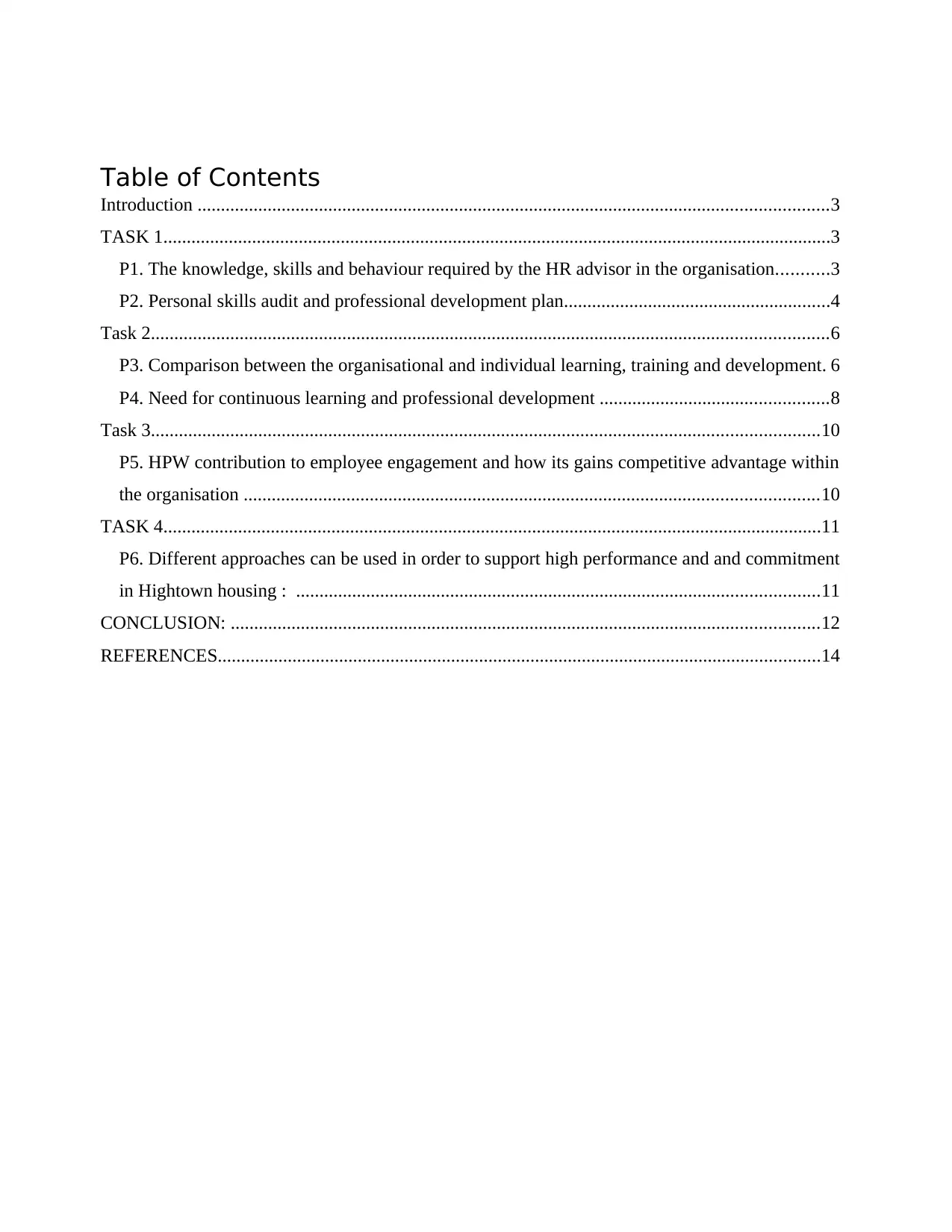
Table of Contents
Introduction .......................................................................................................................................3
TASK 1...............................................................................................................................................3
P1. The knowledge, skills and behaviour required by the HR advisor in the organisation...........3
P2. Personal skills audit and professional development plan.........................................................4
Task 2.................................................................................................................................................6
P3. Comparison between the organisational and individual learning, training and development. 6
P4. Need for continuous learning and professional development .................................................8
Task 3...............................................................................................................................................10
P5. HPW contribution to employee engagement and how its gains competitive advantage within
the organisation ...........................................................................................................................10
TASK 4.............................................................................................................................................11
P6. Different approaches can be used in order to support high performance and and commitment
in Hightown housing : ................................................................................................................11
CONCLUSION: ..............................................................................................................................12
REFERENCES.................................................................................................................................14
Introduction .......................................................................................................................................3
TASK 1...............................................................................................................................................3
P1. The knowledge, skills and behaviour required by the HR advisor in the organisation...........3
P2. Personal skills audit and professional development plan.........................................................4
Task 2.................................................................................................................................................6
P3. Comparison between the organisational and individual learning, training and development. 6
P4. Need for continuous learning and professional development .................................................8
Task 3...............................................................................................................................................10
P5. HPW contribution to employee engagement and how its gains competitive advantage within
the organisation ...........................................................................................................................10
TASK 4.............................................................................................................................................11
P6. Different approaches can be used in order to support high performance and and commitment
in Hightown housing : ................................................................................................................11
CONCLUSION: ..............................................................................................................................12
REFERENCES.................................................................................................................................14
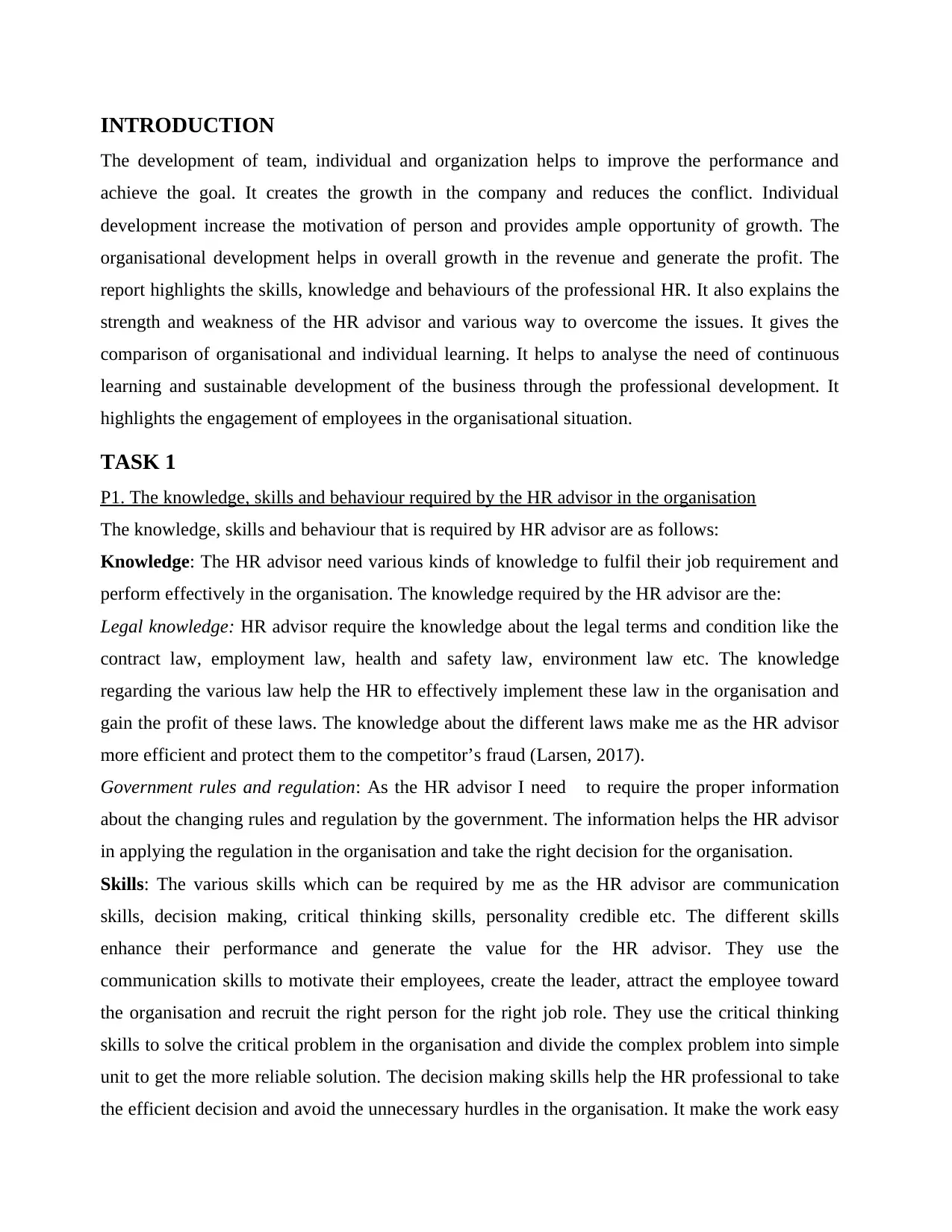
INTRODUCTION
The development of team, individual and organization helps to improve the performance and
achieve the goal. It creates the growth in the company and reduces the conflict. Individual
development increase the motivation of person and provides ample opportunity of growth. The
organisational development helps in overall growth in the revenue and generate the profit. The
report highlights the skills, knowledge and behaviours of the professional HR. It also explains the
strength and weakness of the HR advisor and various way to overcome the issues. It gives the
comparison of organisational and individual learning. It helps to analyse the need of continuous
learning and sustainable development of the business through the professional development. It
highlights the engagement of employees in the organisational situation.
TASK 1
P1. The knowledge, skills and behaviour required by the HR advisor in the organisation
The knowledge, skills and behaviour that is required by HR advisor are as follows:
Knowledge: The HR advisor need various kinds of knowledge to fulfil their job requirement and
perform effectively in the organisation. The knowledge required by the HR advisor are the:
Legal knowledge: HR advisor require the knowledge about the legal terms and condition like the
contract law, employment law, health and safety law, environment law etc. The knowledge
regarding the various law help the HR to effectively implement these law in the organisation and
gain the profit of these laws. The knowledge about the different laws make me as the HR advisor
more efficient and protect them to the competitor’s fraud (Larsen, 2017).
Government rules and regulation: As the HR advisor I need to require the proper information
about the changing rules and regulation by the government. The information helps the HR advisor
in applying the regulation in the organisation and take the right decision for the organisation.
Skills: The various skills which can be required by me as the HR advisor are communication
skills, decision making, critical thinking skills, personality credible etc. The different skills
enhance their performance and generate the value for the HR advisor. They use the
communication skills to motivate their employees, create the leader, attract the employee toward
the organisation and recruit the right person for the right job role. They use the critical thinking
skills to solve the critical problem in the organisation and divide the complex problem into simple
unit to get the more reliable solution. The decision making skills help the HR professional to take
the efficient decision and avoid the unnecessary hurdles in the organisation. It make the work easy
The development of team, individual and organization helps to improve the performance and
achieve the goal. It creates the growth in the company and reduces the conflict. Individual
development increase the motivation of person and provides ample opportunity of growth. The
organisational development helps in overall growth in the revenue and generate the profit. The
report highlights the skills, knowledge and behaviours of the professional HR. It also explains the
strength and weakness of the HR advisor and various way to overcome the issues. It gives the
comparison of organisational and individual learning. It helps to analyse the need of continuous
learning and sustainable development of the business through the professional development. It
highlights the engagement of employees in the organisational situation.
TASK 1
P1. The knowledge, skills and behaviour required by the HR advisor in the organisation
The knowledge, skills and behaviour that is required by HR advisor are as follows:
Knowledge: The HR advisor need various kinds of knowledge to fulfil their job requirement and
perform effectively in the organisation. The knowledge required by the HR advisor are the:
Legal knowledge: HR advisor require the knowledge about the legal terms and condition like the
contract law, employment law, health and safety law, environment law etc. The knowledge
regarding the various law help the HR to effectively implement these law in the organisation and
gain the profit of these laws. The knowledge about the different laws make me as the HR advisor
more efficient and protect them to the competitor’s fraud (Larsen, 2017).
Government rules and regulation: As the HR advisor I need to require the proper information
about the changing rules and regulation by the government. The information helps the HR advisor
in applying the regulation in the organisation and take the right decision for the organisation.
Skills: The various skills which can be required by me as the HR advisor are communication
skills, decision making, critical thinking skills, personality credible etc. The different skills
enhance their performance and generate the value for the HR advisor. They use the
communication skills to motivate their employees, create the leader, attract the employee toward
the organisation and recruit the right person for the right job role. They use the critical thinking
skills to solve the critical problem in the organisation and divide the complex problem into simple
unit to get the more reliable solution. The decision making skills help the HR professional to take
the efficient decision and avoid the unnecessary hurdles in the organisation. It make the work easy
⊘ This is a preview!⊘
Do you want full access?
Subscribe today to unlock all pages.

Trusted by 1+ million students worldwide
and complete them on time without any delay and take valuable and correct steps in critical
situations.
Behaviour: As a HR advisor I need to require the polite behaviour in the company to involve the
employees in the organisational activities and freely share their problems with HR advisor. It
creates the link between the management and the employee. They need adaptive behaviour so they
can easily adopt the changing environment and can learn from the new culture. It helps them to
respond effectively with the multiple demands of the customer (De Mauro and et.al., 2018). The
accountable nature of the HR advisor creates a positive environment on work place and increase
the productivity of the organisation. HR advisor requires a coordinative nature to coordinate the
organisation departments like finance, marketing, administration etc. They must be influencer who
influence the employees to participate in decision making, organisational goal and the different
activities of the organisation. They influence them to develop the new skills to improve
themselves and get the opportunity of promotion and growth in the company.
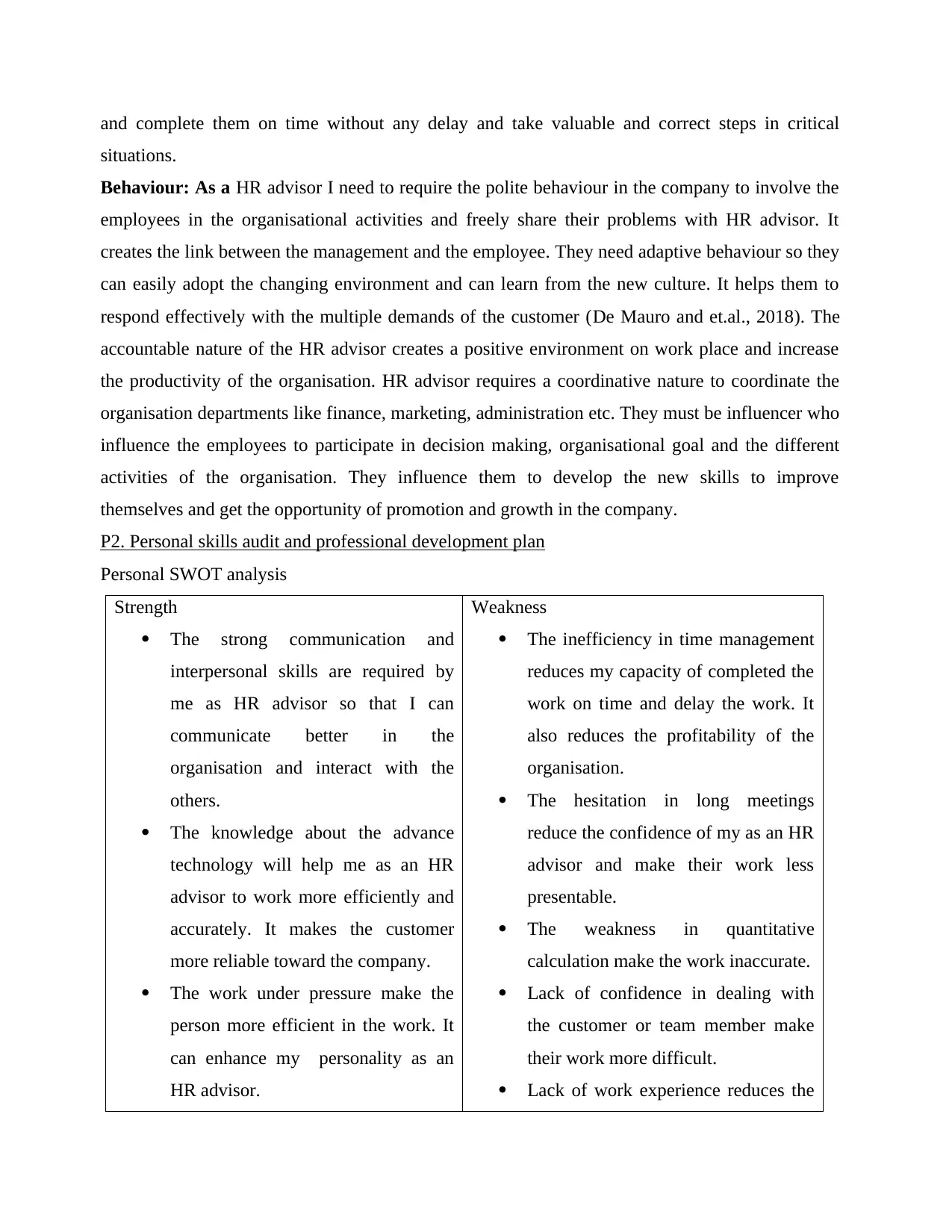
P2. Personal skills audit and professional development plan
Personal SWOT analysis
Strength
The strong communication and
interpersonal skills are required by
me as HR advisor so that I can
communicate better in the
organisation and interact with the
others.
The knowledge about the advance
technology will help me as an HR
advisor to work more efficiently and
accurately. It makes the customer
more reliable toward the company.
The work under pressure make the
person more efficient in the work. It
can enhance my personality as an
HR advisor.
Weakness
The inefficiency in time management
reduces my capacity of completed the
work on time and delay the work. It
also reduces the profitability of the
organisation.
The hesitation in long meetings
reduce the confidence of my as an HR
advisor and make their work less
presentable.
The weakness in quantitative
calculation make the work inaccurate.
Lack of confidence in dealing with
the customer or team member make
their work more difficult.
Lack of work experience reduces the
situations.
Behaviour: As a HR advisor I need to require the polite behaviour in the company to involve the
employees in the organisational activities and freely share their problems with HR advisor. It
creates the link between the management and the employee. They need adaptive behaviour so they
can easily adopt the changing environment and can learn from the new culture. It helps them to
respond effectively with the multiple demands of the customer (De Mauro and et.al., 2018). The
accountable nature of the HR advisor creates a positive environment on work place and increase
the productivity of the organisation. HR advisor requires a coordinative nature to coordinate the
organisation departments like finance, marketing, administration etc. They must be influencer who
influence the employees to participate in decision making, organisational goal and the different
activities of the organisation. They influence them to develop the new skills to improve
themselves and get the opportunity of promotion and growth in the company.
P2. Personal skills audit and professional development plan
Personal SWOT analysis
Strength
The strong communication and
interpersonal skills are required by
me as HR advisor so that I can
communicate better in the
organisation and interact with the
others.
The knowledge about the advance
technology will help me as an HR
advisor to work more efficiently and
accurately. It makes the customer
more reliable toward the company.
The work under pressure make the
person more efficient in the work. It
can enhance my personality as an
HR advisor.
Weakness
The inefficiency in time management
reduces my capacity of completed the
work on time and delay the work. It
also reduces the profitability of the
organisation.
The hesitation in long meetings
reduce the confidence of my as an HR
advisor and make their work less
presentable.
The weakness in quantitative
calculation make the work inaccurate.
Lack of confidence in dealing with
the customer or team member make
their work more difficult.
Lack of work experience reduces the
Paraphrase This Document
Need a fresh take? Get an instant paraphrase of this document with our AI Paraphraser
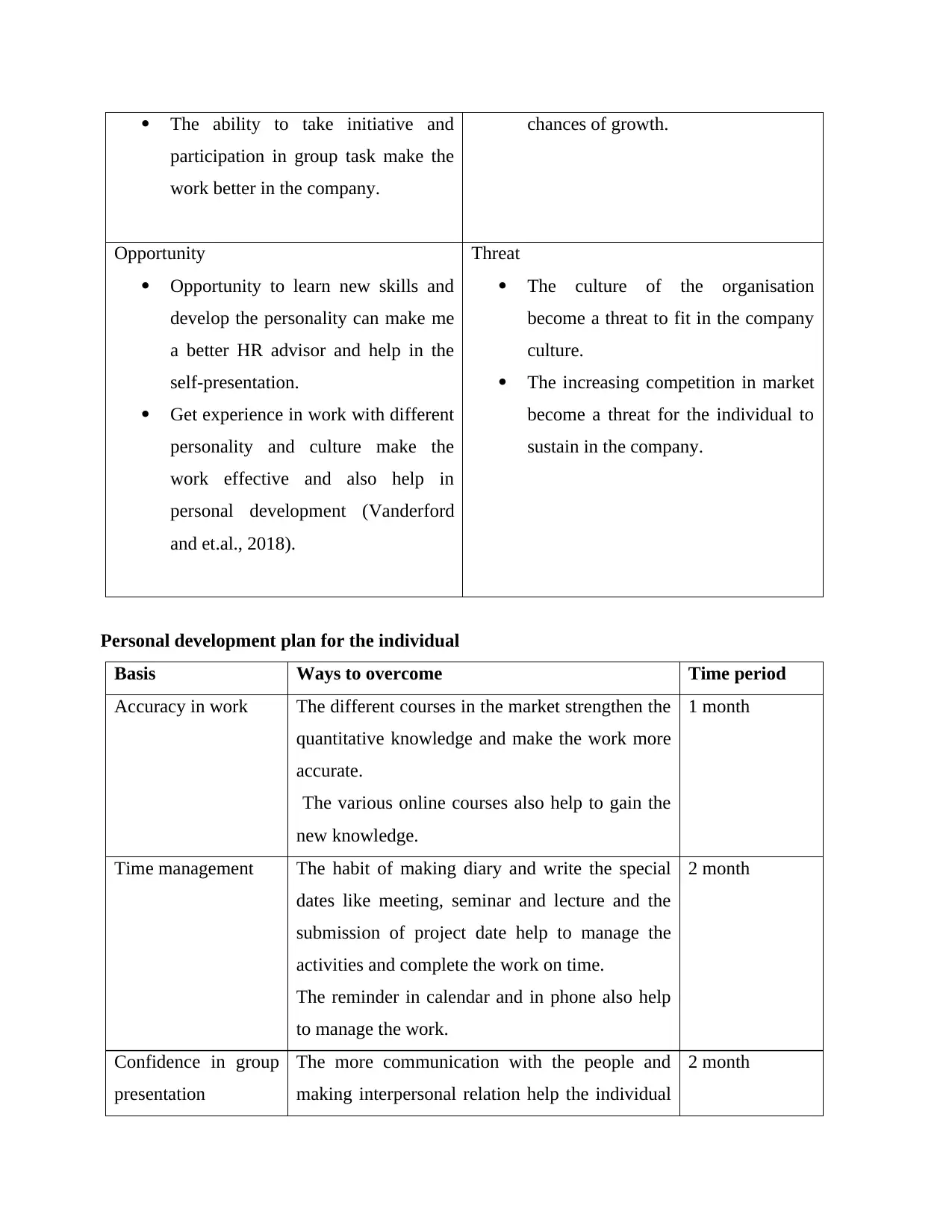
The ability to take initiative and
participation in group task make the
work better in the company.
chances of growth.
Opportunity
Opportunity to learn new skills and
develop the personality can make me
a better HR advisor and help in the
self-presentation.
Get experience in work with different
personality and culture make the
work effective and also help in
personal development (Vanderford
and et.al., 2018).
Threat
The culture of the organisation
become a threat to fit in the company
culture.
The increasing competition in market
become a threat for the individual to
sustain in the company.
Personal development plan for the individual
Basis Ways to overcome Time period
Accuracy in work The different courses in the market strengthen the
quantitative knowledge and make the work more
accurate.
The various online courses also help to gain the
new knowledge.
1 month
Time management The habit of making diary and write the special
dates like meeting, seminar and lecture and the
submission of project date help to manage the
activities and complete the work on time.
The reminder in calendar and in phone also help
to manage the work.
2 month
Confidence in group
presentation
The more communication with the people and
making interpersonal relation help the individual
2 month
participation in group task make the
work better in the company.
chances of growth.
Opportunity
Opportunity to learn new skills and
develop the personality can make me
a better HR advisor and help in the
self-presentation.
Get experience in work with different
personality and culture make the
work effective and also help in
personal development (Vanderford
and et.al., 2018).
Threat
The culture of the organisation
become a threat to fit in the company
culture.
The increasing competition in market
become a threat for the individual to
sustain in the company.
Personal development plan for the individual
Basis Ways to overcome Time period
Accuracy in work The different courses in the market strengthen the
quantitative knowledge and make the work more
accurate.
The various online courses also help to gain the
new knowledge.
1 month
Time management The habit of making diary and write the special
dates like meeting, seminar and lecture and the
submission of project date help to manage the
activities and complete the work on time.
The reminder in calendar and in phone also help
to manage the work.
2 month
Confidence in group
presentation
The more communication with the people and
making interpersonal relation help the individual
2 month
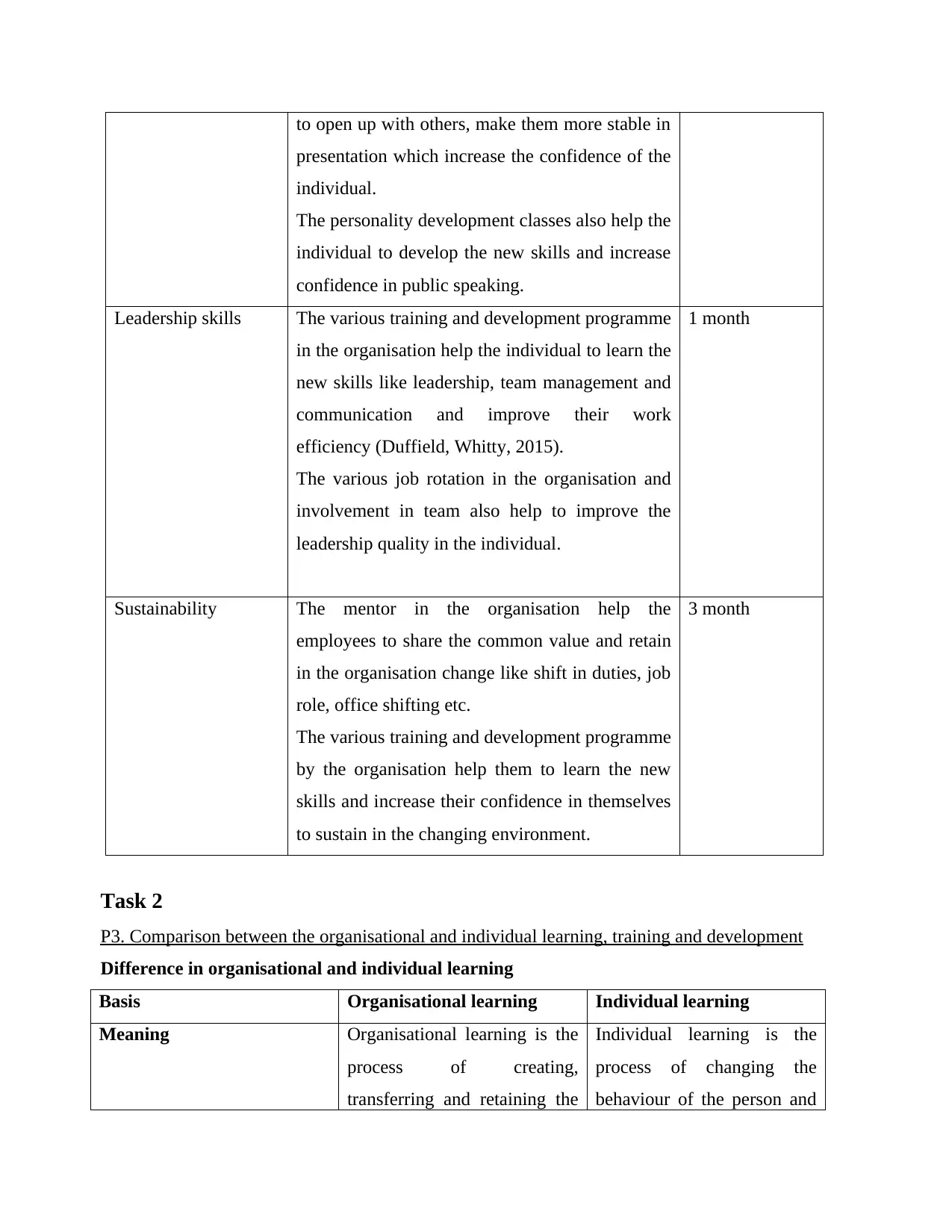
to open up with others, make them more stable in
presentation which increase the confidence of the
individual.
The personality development classes also help the
individual to develop the new skills and increase
confidence in public speaking.
Leadership skills The various training and development programme
in the organisation help the individual to learn the
new skills like leadership, team management and
communication and improve their work
efficiency (Duffield, Whitty, 2015).
The various job rotation in the organisation and
involvement in team also help to improve the
leadership quality in the individual.
1 month
Sustainability The mentor in the organisation help the
employees to share the common value and retain
in the organisation change like shift in duties, job
role, office shifting etc.
The various training and development programme
by the organisation help them to learn the new
skills and increase their confidence in themselves
to sustain in the changing environment.
3 month
Task 2
P3. Comparison between the organisational and individual learning, training and development
Difference in organisational and individual learning
Basis Organisational learning Individual learning
Meaning Organisational learning is the
process of creating,
transferring and retaining the
Individual learning is the
process of changing the
behaviour of the person and
presentation which increase the confidence of the
individual.
The personality development classes also help the
individual to develop the new skills and increase
confidence in public speaking.
Leadership skills The various training and development programme
in the organisation help the individual to learn the
new skills like leadership, team management and
communication and improve their work
efficiency (Duffield, Whitty, 2015).
The various job rotation in the organisation and
involvement in team also help to improve the
leadership quality in the individual.
1 month
Sustainability The mentor in the organisation help the
employees to share the common value and retain
in the organisation change like shift in duties, job
role, office shifting etc.
The various training and development programme
by the organisation help them to learn the new
skills and increase their confidence in themselves
to sustain in the changing environment.
3 month
Task 2
P3. Comparison between the organisational and individual learning, training and development
Difference in organisational and individual learning
Basis Organisational learning Individual learning
Meaning Organisational learning is the
process of creating,
transferring and retaining the
Individual learning is the
process of changing the
behaviour of the person and
⊘ This is a preview!⊘
Do you want full access?
Subscribe today to unlock all pages.
Trusted by 1+ million students worldwide
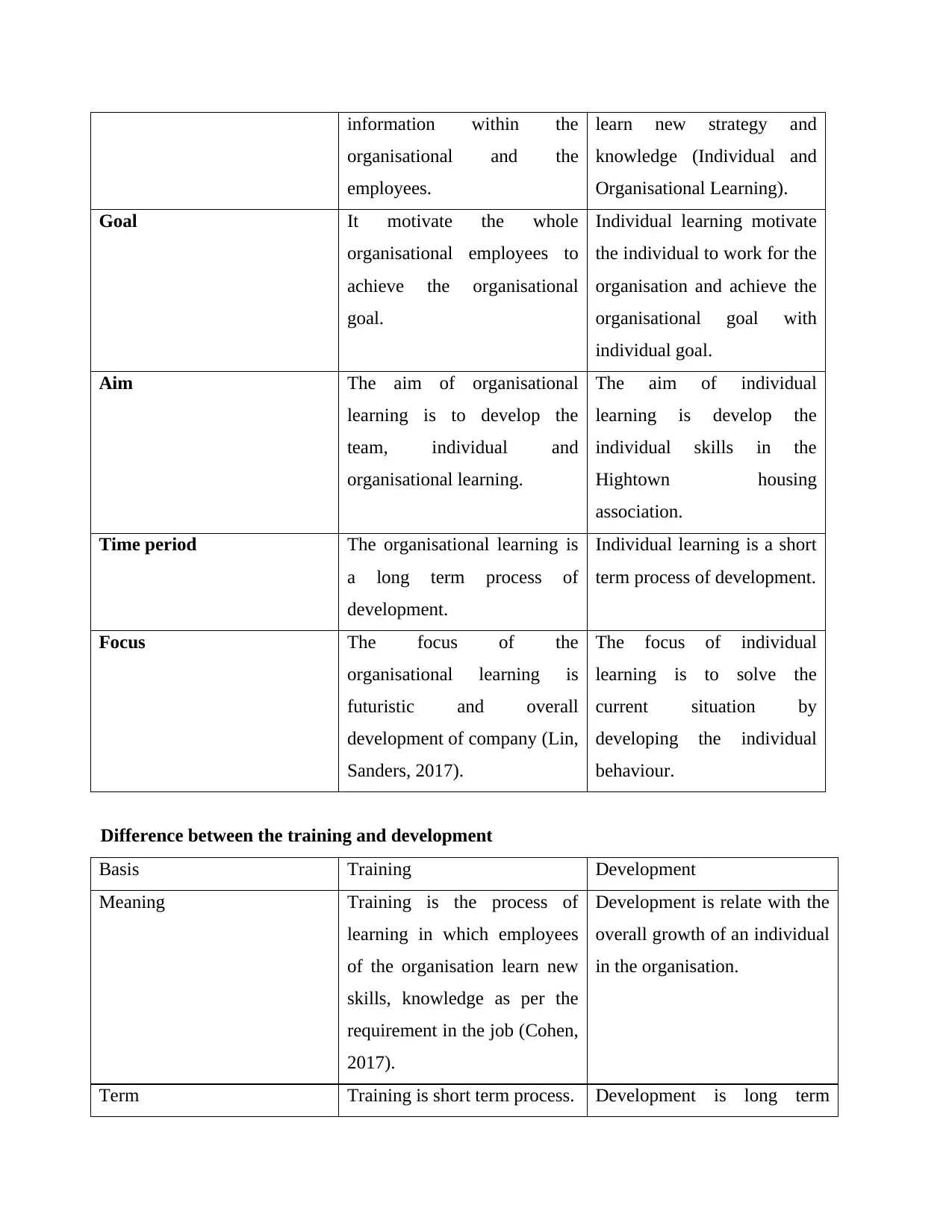
information within the
organisational and the
employees.
learn new strategy and
knowledge (Individual and
Organisational Learning).
Goal It motivate the whole
organisational employees to
achieve the organisational
goal.
Individual learning motivate
the individual to work for the
organisation and achieve the
organisational goal with
individual goal.
Aim The aim of organisational
learning is to develop the
team, individual and
organisational learning.
The aim of individual
learning is develop the
individual skills in the
Hightown housing
association.
Time period The organisational learning is
a long term process of
development.
Individual learning is a short
term process of development.
Focus The focus of the
organisational learning is
futuristic and overall
development of company (Lin,
Sanders, 2017).
The focus of individual
learning is to solve the
current situation by
developing the individual
behaviour.
Difference between the training and development
Basis Training Development
Meaning Training is the process of
learning in which employees
of the organisation learn new
skills, knowledge as per the
requirement in the job (Cohen,
2017).
Development is relate with the
overall growth of an individual
in the organisation.
Term Training is short term process. Development is long term
organisational and the
employees.
learn new strategy and
knowledge (Individual and
Organisational Learning).
Goal It motivate the whole
organisational employees to
achieve the organisational
goal.
Individual learning motivate
the individual to work for the
organisation and achieve the
organisational goal with
individual goal.
Aim The aim of organisational
learning is to develop the
team, individual and
organisational learning.
The aim of individual
learning is develop the
individual skills in the
Hightown housing
association.
Time period The organisational learning is
a long term process of
development.
Individual learning is a short
term process of development.
Focus The focus of the
organisational learning is
futuristic and overall
development of company (Lin,
Sanders, 2017).
The focus of individual
learning is to solve the
current situation by
developing the individual
behaviour.
Difference between the training and development
Basis Training Development
Meaning Training is the process of
learning in which employees
of the organisation learn new
skills, knowledge as per the
requirement in the job (Cohen,
2017).
Development is relate with the
overall growth of an individual
in the organisation.
Term Training is short term process. Development is long term
Paraphrase This Document
Need a fresh take? Get an instant paraphrase of this document with our AI Paraphraser
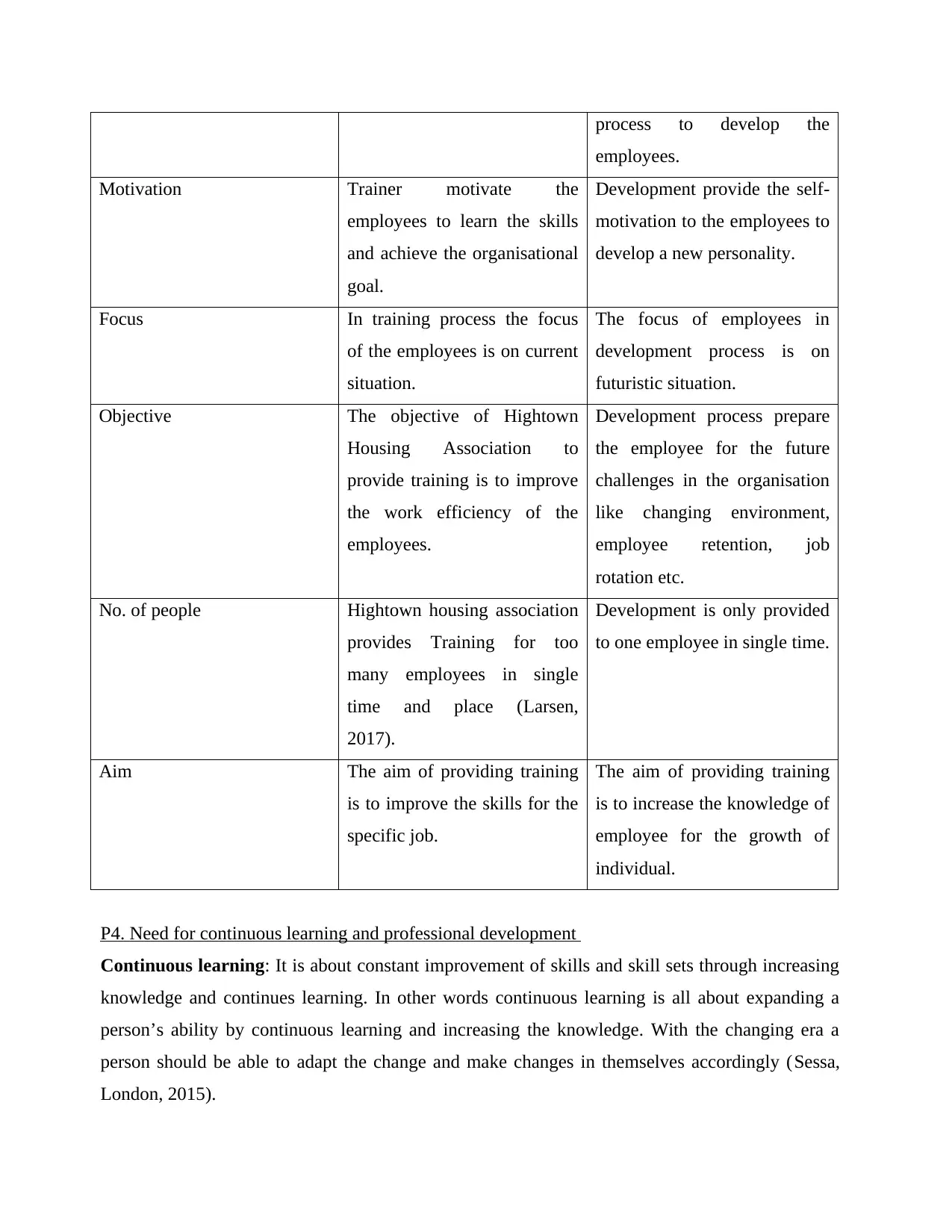
process to develop the
employees.
Motivation Trainer motivate the
employees to learn the skills
and achieve the organisational
goal.
Development provide the self-
motivation to the employees to
develop a new personality.
Focus In training process the focus
of the employees is on current
situation.
The focus of employees in
development process is on
futuristic situation.
Objective The objective of Hightown
Housing Association to
provide training is to improve
the work efficiency of the
employees.
Development process prepare
the employee for the future
challenges in the organisation
like changing environment,
employee retention, job
rotation etc.
No. of people Hightown housing association
provides Training for too
many employees in single
time and place (Larsen,
2017).
Development is only provided
to one employee in single time.
Aim The aim of providing training
is to improve the skills for the
specific job.
The aim of providing training
is to increase the knowledge of
employee for the growth of
individual.
P4. Need for continuous learning and professional development
Continuous learning: It is about constant improvement of skills and skill sets through increasing
knowledge and continues learning. In other words continuous learning is all about expanding a
person’s ability by continuous learning and increasing the knowledge. With the changing era a
person should be able to adapt the change and make changes in themselves accordingly (Sessa,
London, 2015).
employees.
Motivation Trainer motivate the
employees to learn the skills
and achieve the organisational
goal.
Development provide the self-
motivation to the employees to
develop a new personality.
Focus In training process the focus
of the employees is on current
situation.
The focus of employees in
development process is on
futuristic situation.
Objective The objective of Hightown
Housing Association to
provide training is to improve
the work efficiency of the
employees.
Development process prepare
the employee for the future
challenges in the organisation
like changing environment,
employee retention, job
rotation etc.
No. of people Hightown housing association
provides Training for too
many employees in single
time and place (Larsen,
2017).
Development is only provided
to one employee in single time.
Aim The aim of providing training
is to improve the skills for the
specific job.
The aim of providing training
is to increase the knowledge of
employee for the growth of
individual.
P4. Need for continuous learning and professional development
Continuous learning: It is about constant improvement of skills and skill sets through increasing
knowledge and continues learning. In other words continuous learning is all about expanding a
person’s ability by continuous learning and increasing the knowledge. With the changing era a
person should be able to adapt the change and make changes in themselves accordingly (Sessa,
London, 2015).
Need of continuous learning:
Continuous learning is required as to help a person adapt the unexpected changes for example
advent of any new technology can result in loss of job or it need an high skill to operate in such
case a person should be ready to deal with such situations in order to do so a person need a
continuous learning which will help an individual to step out of the comfort zone an search for the
new job opportunities or learn the new technological skill to maintain the position in the
organisation. Learning new things creates the feeling of accomplishment in a person which in turn
creates the confidence. Also with the continuous learning a person feels more comfortable in
taking challenges and facing the changes. Continuous learning also changes the persons attitude
for the thing an individual already know. Continuous learning also helps an individual to develop
leadership skills among themselves.
Professional Development
Professional development can be defined as a learning to earn money or to maintain professional
credentials such as degree of formal coursework, informal learning opportunities, attending
conferences etc (Lillicrap and et.al., 2015). Or it can be defined as improving and increasing of
capabilities of an individual training opportunities in the workplace or access to education, training
opportunities outside the workplace or by seeing others and making improvement in ourselves.
Need of professional development :
The organisation should conduct the training programme for its employees as to retain their
employees. It will help in building confidence among the workers it will also help the employee to
build trust due to continuous learning of new skills and certificates (Desimone, Pak, 2017). It will
also help the organisation in creating leaders for the organisation rather than hiring from outside. It
will also help the employee in showing their creativity. The professional development programme
by the organisation will also help the employee to learn new skills. The staff loyalty is one of the
most important factor for an organisation success by providing proper training to the employee in
a way that the employee move forward in the organisation which will result in organisation
success.
KOLB'S EXPERIENTIAL LEARNING CYCLE
Concrete Experience: - They can either be everyday experiences or a completely novel
experience i.e. it is either an entirely new experience which one encounters or it can be
reinterpretation of existing one. Since one regularly learns from experiences and also experiences
Continuous learning is required as to help a person adapt the unexpected changes for example
advent of any new technology can result in loss of job or it need an high skill to operate in such
case a person should be ready to deal with such situations in order to do so a person need a
continuous learning which will help an individual to step out of the comfort zone an search for the
new job opportunities or learn the new technological skill to maintain the position in the
organisation. Learning new things creates the feeling of accomplishment in a person which in turn
creates the confidence. Also with the continuous learning a person feels more comfortable in
taking challenges and facing the changes. Continuous learning also changes the persons attitude
for the thing an individual already know. Continuous learning also helps an individual to develop
leadership skills among themselves.
Professional Development
Professional development can be defined as a learning to earn money or to maintain professional
credentials such as degree of formal coursework, informal learning opportunities, attending
conferences etc (Lillicrap and et.al., 2015). Or it can be defined as improving and increasing of
capabilities of an individual training opportunities in the workplace or access to education, training
opportunities outside the workplace or by seeing others and making improvement in ourselves.
Need of professional development :
The organisation should conduct the training programme for its employees as to retain their
employees. It will help in building confidence among the workers it will also help the employee to
build trust due to continuous learning of new skills and certificates (Desimone, Pak, 2017). It will
also help the organisation in creating leaders for the organisation rather than hiring from outside. It
will also help the employee in showing their creativity. The professional development programme
by the organisation will also help the employee to learn new skills. The staff loyalty is one of the
most important factor for an organisation success by providing proper training to the employee in
a way that the employee move forward in the organisation which will result in organisation
success.
KOLB'S EXPERIENTIAL LEARNING CYCLE
Concrete Experience: - They can either be everyday experiences or a completely novel
experience i.e. it is either an entirely new experience which one encounters or it can be
reinterpretation of existing one. Since one regularly learns from experiences and also experiences
⊘ This is a preview!⊘
Do you want full access?
Subscribe today to unlock all pages.
Trusted by 1+ million students worldwide
new things every day; it encourages continuous development of an individual.
Reflective Observation: - Here one reflects over their experiences which occurs naturally when
one experiences new things. One also observes inconsistencies that arises between one's
experience and understanding. When a person reflects on his experience, he always learns
something whether good or bad. This learning guides us on how to act or what to do when one
gets stuck in the same situation again. Thus, it helps in the development of a person.
Abstract Conceptualization: - This is the third component. Here, after a person reflects on their
experiences, they form new ideas or an abstract concept or a modification of a concept which
already exists. This concept formation helps in building new ideas and ideologies thus developing
a person's character and personality.
Active Experimentation: - Here after one forms new ideologies, the learner applies them in real
life situations around them and analyses the results. After application, they also judge whether the
concepts formed hold true or they need modification. Hence, this develops person as an individual
and helps them in forming correct and tested ideologies through cause and effect method.
Task 3
P5. HPW contribution to employee engagement and how its gains competitive advantage within
the organisation
HPW (High performance working): High-performance work practices (HPWPs) can be
defined as practices that have been shown to improve an organization's capacity to effectively
attract, select, hire, develop, and retain high-performing personnel. The HPW aims at stimulating
effective employees in the organisation and their involvement and commitment to the organisation
in order to achieve high level performance of the organisation in order to achieve competitive
advantage.
Self-directed team- Organization who have self-directed team can lay good impact on company.
Employee engagement means that employees in the organisation feel more engaged or involved in
their work. Engaged employees give their full efforts and contribution in the success of
organisation.
The environment is constantly changing now every sector has to face challenges due to rapid
changes in the working method and technologies. Thus as an HR manager they would suggest to
make our organisation a high performance working system. And it can be done with the
Reflective Observation: - Here one reflects over their experiences which occurs naturally when
one experiences new things. One also observes inconsistencies that arises between one's
experience and understanding. When a person reflects on his experience, he always learns
something whether good or bad. This learning guides us on how to act or what to do when one
gets stuck in the same situation again. Thus, it helps in the development of a person.
Abstract Conceptualization: - This is the third component. Here, after a person reflects on their
experiences, they form new ideas or an abstract concept or a modification of a concept which
already exists. This concept formation helps in building new ideas and ideologies thus developing
a person's character and personality.
Active Experimentation: - Here after one forms new ideologies, the learner applies them in real
life situations around them and analyses the results. After application, they also judge whether the
concepts formed hold true or they need modification. Hence, this develops person as an individual
and helps them in forming correct and tested ideologies through cause and effect method.
Task 3
P5. HPW contribution to employee engagement and how its gains competitive advantage within
the organisation
HPW (High performance working): High-performance work practices (HPWPs) can be
defined as practices that have been shown to improve an organization's capacity to effectively
attract, select, hire, develop, and retain high-performing personnel. The HPW aims at stimulating
effective employees in the organisation and their involvement and commitment to the organisation
in order to achieve high level performance of the organisation in order to achieve competitive
advantage.
Self-directed team- Organization who have self-directed team can lay good impact on company.
Employee engagement means that employees in the organisation feel more engaged or involved in
their work. Engaged employees give their full efforts and contribution in the success of
organisation.
The environment is constantly changing now every sector has to face challenges due to rapid
changes in the working method and technologies. Thus as an HR manager they would suggest to
make our organisation a high performance working system. And it can be done with the
Paraphrase This Document
Need a fresh take? Get an instant paraphrase of this document with our AI Paraphraser
combination of right people, process, organisational structure and new technologies. The HPW
within the organisation will help the organisation to achieve competitive advantage.
Job- rotation- The organisation having HPW environment and the employee working under such
environment are regarded as highly skilled and highly valued employees who are constantly
learning new skills and behaviour in the organisation. Therefore it can be said that HPW works as
an important factor which binds the employee and the employer and builds the strong relationship
between them. The competitive advantage not just achieved from the shaping of organisation and
workforce but by the flexibility in the organisation and commitment to business goals and plans.
HPW focuses on promoting decentralization in the organisation. The technology, people,
organisation and process, has to work together to achieve competitive advantage over its
competitors in the market. For example in 1980’s when there was a tough competition between
Canon and Xerox in the copier market the Xerox adapts the high performance working system to
beat the counterparties(Katzenbach, Smith, 2015). The technology is changing rapidly and with
the change in technology the various functional area of the organisation such as transportation,
manufacturing and communication are also been changed so as an HR I would suggest that the
organisation should ensure to recruit right and talented people for the organisation who are able to
face challenges.
The organisation in order to built high performance working system should conduct an effective
training programme, recruit people with specific skills and encourage learning and teamwork
within the organisation. It will also helps in motivating the employees as HPW system provides
ample opportunities to employee to make use of their knowledge, skills and experiences. The
creation of HPW system in the Hightown Housing Association will help the company to gain
competitive advantage over the others in the market. It will result in high productivity, lower costs,
better responsive to customers and increase in profitability of the company.
TASK 4
P6. Different approaches can be used in order to support high performance and and commitment in
Hightown housing :
Collaborative working: Collaborative working means working together in order to achieve
organisation goal (Kiani and et.al., 2018). Collaborative working in Hightown Housing
Association will enhance all the team members to work together in order to achieve the goal of the
within the organisation will help the organisation to achieve competitive advantage.
Job- rotation- The organisation having HPW environment and the employee working under such
environment are regarded as highly skilled and highly valued employees who are constantly
learning new skills and behaviour in the organisation. Therefore it can be said that HPW works as
an important factor which binds the employee and the employer and builds the strong relationship
between them. The competitive advantage not just achieved from the shaping of organisation and
workforce but by the flexibility in the organisation and commitment to business goals and plans.
HPW focuses on promoting decentralization in the organisation. The technology, people,
organisation and process, has to work together to achieve competitive advantage over its
competitors in the market. For example in 1980’s when there was a tough competition between
Canon and Xerox in the copier market the Xerox adapts the high performance working system to
beat the counterparties(Katzenbach, Smith, 2015). The technology is changing rapidly and with
the change in technology the various functional area of the organisation such as transportation,
manufacturing and communication are also been changed so as an HR I would suggest that the
organisation should ensure to recruit right and talented people for the organisation who are able to
face challenges.
The organisation in order to built high performance working system should conduct an effective
training programme, recruit people with specific skills and encourage learning and teamwork
within the organisation. It will also helps in motivating the employees as HPW system provides
ample opportunities to employee to make use of their knowledge, skills and experiences. The
creation of HPW system in the Hightown Housing Association will help the company to gain
competitive advantage over the others in the market. It will result in high productivity, lower costs,
better responsive to customers and increase in profitability of the company.
TASK 4
P6. Different approaches can be used in order to support high performance and and commitment in
Hightown housing :
Collaborative working: Collaborative working means working together in order to achieve
organisation goal (Kiani and et.al., 2018). Collaborative working in Hightown Housing
Association will enhance all the team members to work together in order to achieve the goal of the
organisation. The aim of the collaborative working is to create a open communication among the
team members to increase organisation success.
Collaborative working support high performance culture and commitment
The collaborative working in the Hightown Housing Association can be enhanced by
Group brainstorming: Group brainstorming is a practice which provide all team members an
opportunity to present their ideas in order to reach to the decision. Group brainstorming will help
in creating high performance culture in the organisation as the increase in communication within
the team help in building trust within the team which in result contribute to organisational success.
Mixed skill teams: The mixed skill team consist of individual with different skills which
strengthen the team performance. This is done intentionally to get the fresh ideas which will result
in new innovative ways of doing work.
Open discussion: Open discussion help in breaking hierarchical boundaries and can result in more
productive meeting.
Effective communication: A communication is said to be effective when all the parties in the
communication has similar meanings to a message. Means the sender of the message and the
receiver of the message get the same meaning of the message that has been exchanged between
them(Effective communication. 2019). Effective communication within the Hightown Housing
Association will enable the employee to strengthen their relation and will improve the teamwork
within the organisation, decision making and problem solving capacity of the employees.
Effective communication support high performance culture and commitment
Effective communication within the Hightown Housing Association will help the organisation to
overcome all type of internal misunderstanding. The organisation should ensure that there is an
open communication in the workplace within the employees. The information should flow freely
within the hierarchy. There should be regular conversation between the managers and subordinates
in the organisation as well as with the stakeholders which will result in high performance in the
organisation and will help the employee to be committed to the organisation.
As the open communication provide a sense of belongingness to the employees and employee feel
more valued when the information is shared with them and their views are asked to reach to the
solution. An effective communication will help in improving workers creativity. It will also help
the organisation to survive in difficult situation as by presenting the current situation of the
team members to increase organisation success.
Collaborative working support high performance culture and commitment
The collaborative working in the Hightown Housing Association can be enhanced by
Group brainstorming: Group brainstorming is a practice which provide all team members an
opportunity to present their ideas in order to reach to the decision. Group brainstorming will help
in creating high performance culture in the organisation as the increase in communication within
the team help in building trust within the team which in result contribute to organisational success.
Mixed skill teams: The mixed skill team consist of individual with different skills which
strengthen the team performance. This is done intentionally to get the fresh ideas which will result
in new innovative ways of doing work.
Open discussion: Open discussion help in breaking hierarchical boundaries and can result in more
productive meeting.
Effective communication: A communication is said to be effective when all the parties in the
communication has similar meanings to a message. Means the sender of the message and the
receiver of the message get the same meaning of the message that has been exchanged between
them(Effective communication. 2019). Effective communication within the Hightown Housing
Association will enable the employee to strengthen their relation and will improve the teamwork
within the organisation, decision making and problem solving capacity of the employees.
Effective communication support high performance culture and commitment
Effective communication within the Hightown Housing Association will help the organisation to
overcome all type of internal misunderstanding. The organisation should ensure that there is an
open communication in the workplace within the employees. The information should flow freely
within the hierarchy. There should be regular conversation between the managers and subordinates
in the organisation as well as with the stakeholders which will result in high performance in the
organisation and will help the employee to be committed to the organisation.
As the open communication provide a sense of belongingness to the employees and employee feel
more valued when the information is shared with them and their views are asked to reach to the
solution. An effective communication will help in improving workers creativity. It will also help
the organisation to survive in difficult situation as by presenting the current situation of the
⊘ This is a preview!⊘
Do you want full access?
Subscribe today to unlock all pages.
Trusted by 1+ million students worldwide

1 out of 15


Related Documents


Your All-in-One AI-Powered Toolkit for Academic Success.
+13062052269
info@desklib.com
Available 24*7 on WhatsApp / Email
![[object Object]](/_next/static/media/star-bottom.7253800d.svg)
Unlock your academic potential
Copyright © 2020–2026 A2Z Services. All Rights Reserved. Developed and managed by ZUCOL.