American University of Dubai: Employee Performance and Culture Study
VerifiedAdded on 2022/01/05
|17
|2695
|33
Report
AI Summary
This report investigates the relationship between individualism/collectivism and employee performance, focusing on the context of the American University of Dubai. The research aims to assess how these cultural dimensions, based on Hofstede's model, influence employee performance, job satisfaction, and the intention to leave. The study employs both qualitative and quantitative research methods, including literature reviews and surveys. The findings suggest that collectivism positively influences customer focus, while job satisfaction is inversely related to the intention of leaving. The report also discusses managerial implications and areas for further research, highlighting the importance of understanding cultural dimensions in fostering a productive work environment within a diverse setting. The report also addresses the impact of cross-cultural teams and the significance of employee satisfaction in providing effective services to students. The research uses statistical analysis to assess gathered information and MS-excel to demonstrate data.
Running head: HOFSTEDE'S CULTURAL DIMENSIONS AND EMPLOYEE
PERFORMANCE
Relation between Collectivism/Individualism and Employee Performance: In A Diverse
Environment
PERFORMANCE
Relation between Collectivism/Individualism and Employee Performance: In A Diverse
Environment

Paraphrase This Document
Need a fresh take? Get an instant paraphrase of this document with our AI Paraphraser
HOFSTEDE'S CULTURAL DIMENSIONS AND EMPLOYEE PERFORMANCE 2
Abstract
The aim of this research is to assess the relation between Collectivism/Individualism and the
employee’s performance in American University of Dubai. There are high effects influenced by
high amount of team members that imposes their ordinary situation on group dissenter at the
time of decision making of group. Due to internationalisation, the implementation of cross-
culture teams in group tasks is fitting gradually more common. The goal of this investigation is
to assess how Collectivism/Individualism may influence the employee’s performance in context
of American University of Dubai.
As employees give their contribution in performing their responsibility in concerning issue
hence, there is a need to assess the performance of employees from different perceptions. The
contribution and significance of this existing investigation are to assess whether the dimension of
company culture will influence the performance of employees in American University of Dubai.
There are 10 groups who have contributed in empirical research at large-scale. The result
indicates that Collectivism/Individualism of group has created significant contribution in the
performance of employees. Further, the application of Geert Hofstede cross-cultural model can
decline that effect. The findings have both qualitative and quantitative implications in order to
enhance the result as well as usefulness of decision making of team in an environment of cross-
culture. The outcome indicates that customer focus is inadequately predicted by the
individualism. However, it is effectively predicted by collectivism. Along with this, customer
focus is favourably associated with job satisfaction and is negatively linked with the intention of
leaving. It is addressed that job satisfaction is adversely and directly related to the intention of
leaving within American University of Dubai. In addition to this, managerial implication
together with further research is discussed in this report.
Abstract
The aim of this research is to assess the relation between Collectivism/Individualism and the
employee’s performance in American University of Dubai. There are high effects influenced by
high amount of team members that imposes their ordinary situation on group dissenter at the
time of decision making of group. Due to internationalisation, the implementation of cross-
culture teams in group tasks is fitting gradually more common. The goal of this investigation is
to assess how Collectivism/Individualism may influence the employee’s performance in context
of American University of Dubai.
As employees give their contribution in performing their responsibility in concerning issue
hence, there is a need to assess the performance of employees from different perceptions. The
contribution and significance of this existing investigation are to assess whether the dimension of
company culture will influence the performance of employees in American University of Dubai.
There are 10 groups who have contributed in empirical research at large-scale. The result
indicates that Collectivism/Individualism of group has created significant contribution in the
performance of employees. Further, the application of Geert Hofstede cross-cultural model can
decline that effect. The findings have both qualitative and quantitative implications in order to
enhance the result as well as usefulness of decision making of team in an environment of cross-
culture. The outcome indicates that customer focus is inadequately predicted by the
individualism. However, it is effectively predicted by collectivism. Along with this, customer
focus is favourably associated with job satisfaction and is negatively linked with the intention of
leaving. It is addressed that job satisfaction is adversely and directly related to the intention of
leaving within American University of Dubai. In addition to this, managerial implication
together with further research is discussed in this report.

HOFSTEDE'S CULTURAL DIMENSIONS AND EMPLOYEE PERFORMANCE 3
Keywords: Individualism, collectivism, Customer Focus, Intention of Leaving, Job Satisfaction,
Keywords: Individualism, collectivism, Customer Focus, Intention of Leaving, Job Satisfaction,
⊘ This is a preview!⊘
Do you want full access?
Subscribe today to unlock all pages.

Trusted by 1+ million students worldwide
HOFSTEDE'S CULTURAL DIMENSIONS AND EMPLOYEE PERFORMANCE 4
Table of Contents
Abstract............................................................................................................................................2
Introduction......................................................................................................................................5
Literature review..............................................................................................................................6
References......................................................................................................................................10
Appendix: Questionnaire design....................................................................................................12
Table of Contents
Abstract............................................................................................................................................2
Introduction......................................................................................................................................5
Literature review..............................................................................................................................6
References......................................................................................................................................10
Appendix: Questionnaire design....................................................................................................12
Paraphrase This Document
Need a fresh take? Get an instant paraphrase of this document with our AI Paraphraser
HOFSTEDE'S CULTURAL DIMENSIONS AND EMPLOYEE PERFORMANCE 5
Introduction
It is a key concern for educational organization to generate and develops a long-term liaison with
employees in an international competitive atmosphere. Employees play a significant association
between students and American University of Dubai. A satisfied employee will provide effective
services to students so that the effectiveness of American University of Dubai could be
accomplished. Under American University of Dubai, there are different empirical studies that
assess the effects of cross-culture environment on the performance of employees. By contrast,
the less empirical focus has been considered on the impact of individualism and collectivism on
the performance of employees. It is a significan tissue to assess factor that impacts on the
performance of employees (Trompenaars & Greene, 2016).
The cause is a lack of cooperation and a high extent of employee’s turnover may affect the
quality of offering services and the evaluation of students towards American University of Dubai
(Yusof, Zakaria & Muton, 2017). This study creates and tests a research model that assesses the
effects of chosen cultural dimension like individualism/ collectivism on employee’s performance
in the context of American University of Dubai. This paper is classified as a different way. In
section two, the theoretical background is discussed by using secondary sources. In the third
chapter, research methodology and empirical results are evaluated. Finally, this investigation
concludes suggestion and implication for further investigation.
Hypothesis
H0: There is no significant relationship between individualism/ collectivism and employee’s
performance of American University of Dubai
H1: There is a significant relationship between individualism/ collectivism and employee’s
performance of American University of Dubai
Introduction
It is a key concern for educational organization to generate and develops a long-term liaison with
employees in an international competitive atmosphere. Employees play a significant association
between students and American University of Dubai. A satisfied employee will provide effective
services to students so that the effectiveness of American University of Dubai could be
accomplished. Under American University of Dubai, there are different empirical studies that
assess the effects of cross-culture environment on the performance of employees. By contrast,
the less empirical focus has been considered on the impact of individualism and collectivism on
the performance of employees. It is a significan tissue to assess factor that impacts on the
performance of employees (Trompenaars & Greene, 2016).
The cause is a lack of cooperation and a high extent of employee’s turnover may affect the
quality of offering services and the evaluation of students towards American University of Dubai
(Yusof, Zakaria & Muton, 2017). This study creates and tests a research model that assesses the
effects of chosen cultural dimension like individualism/ collectivism on employee’s performance
in the context of American University of Dubai. This paper is classified as a different way. In
section two, the theoretical background is discussed by using secondary sources. In the third
chapter, research methodology and empirical results are evaluated. Finally, this investigation
concludes suggestion and implication for further investigation.
Hypothesis
H0: There is no significant relationship between individualism/ collectivism and employee’s
performance of American University of Dubai
H1: There is a significant relationship between individualism/ collectivism and employee’s
performance of American University of Dubai
HOFSTEDE'S CULTURAL DIMENSIONS AND EMPLOYEE PERFORMANCE 6
Objectives
Following are the objectives of this research:
RO1: To explore the meaning and concept of individualism and collectivism, and employee’s
performance
RO2: To assess the relationship between individualism/collectivism on the performance of
employees in the context of American University of Dubai
RO3: To recommend the strategy to improve the performance of employees via individualism
and collectivism with respect to American University of Dubai
Literature review
According to Yousef (2018), individualism is the extent to which an individual has an
independent definition of self. Apart from this, collectivism is the extent to which an individual
illustrates the self as mutually dependent and as a member of the specific group as compared to
independent of others. One of the key culture dimensions that are discussed by Geert Hofstede is
individualism/ collectivism. It is defined as the extent to which a person in a specific nation
prefers acting as individuals as compared to members of groups. This dimension emphasizes on
the association between a person and larger social groups.
In contrast to this, Nusari Al Falasi Alrajawy Khalifa & Isaac (2018) argued that culture differs
on the extent of emphasis they offer on motivating individuality/ uniqueness and on conformity
and intervention. Along with this, individualistic societies tend to emphasize more on themselves
and the immediate family. On the other side, collective societies put more focus on integration
into cohesive in-groups where they safe and offer unquestionable loyalty. Moreover, collectivism
focuses on well-being and effective performance of the whole team at American University of
Dubai.
Objectives
Following are the objectives of this research:
RO1: To explore the meaning and concept of individualism and collectivism, and employee’s
performance
RO2: To assess the relationship between individualism/collectivism on the performance of
employees in the context of American University of Dubai
RO3: To recommend the strategy to improve the performance of employees via individualism
and collectivism with respect to American University of Dubai
Literature review
According to Yousef (2018), individualism is the extent to which an individual has an
independent definition of self. Apart from this, collectivism is the extent to which an individual
illustrates the self as mutually dependent and as a member of the specific group as compared to
independent of others. One of the key culture dimensions that are discussed by Geert Hofstede is
individualism/ collectivism. It is defined as the extent to which a person in a specific nation
prefers acting as individuals as compared to members of groups. This dimension emphasizes on
the association between a person and larger social groups.
In contrast to this, Nusari Al Falasi Alrajawy Khalifa & Isaac (2018) argued that culture differs
on the extent of emphasis they offer on motivating individuality/ uniqueness and on conformity
and intervention. Along with this, individualistic societies tend to emphasize more on themselves
and the immediate family. On the other side, collective societies put more focus on integration
into cohesive in-groups where they safe and offer unquestionable loyalty. Moreover, collectivism
focuses on well-being and effective performance of the whole team at American University of
Dubai.
⊘ This is a preview!⊘
Do you want full access?
Subscribe today to unlock all pages.
Trusted by 1+ million students worldwide
HOFSTEDE'S CULTURAL DIMENSIONS AND EMPLOYEE PERFORMANCE 7
In the view of Behery (2016), individualism focuses on the interest and value of a specific
person. Individualism can be advantageous for American University of Dubai because those
people who have individualist perspective tend to become more competitive for completing the
objectives. In addition, individualists are independent, focused and do not rely on others to
succeed. They do not want to be micro managed and could often be trusted to take on more
accountability as compared to required.
On the other side, Karim & Rampersad (2017) opined that individualism could be challenging
while an individual refuses or is unwilling to working with other team members or sees
colleague as threats. While an individual values individualism then, they may demonstrate their
selfish attitude and consequently may create an unpleasant work atmosphere. On the other side,
collectivism endorses the loyalty of a person with respect to the workgroup to which they belong.
But, at the same time, the objectives of the group are always positioned higher as compared to
any person.
According to Majid & Maarof (2017), the chase of individual success and happiness is a strong
motivation. The whole capitalist culture relies on the assumption that individual will focus on
own wellbeing. When a business can align the wellbeing of the employees with the business
interest then this may lead to gain productivity and moral. On the other side, Goby & Nickerson
(2015) stated that the individualism has been linked to innovation with creativity. Companies
that endorse an individualistic attitude are better to create innovative and creative ideas as
compared to firms that have team-based culture.
In contrast to this, Tipu & Ryan (2016) stated that effective teamwork permits employees for
attaining the projects that are too large for an individual to perform alone that involves all but the
smallest of projects. For example, American University of Dubai plans to develop spa services in
In the view of Behery (2016), individualism focuses on the interest and value of a specific
person. Individualism can be advantageous for American University of Dubai because those
people who have individualist perspective tend to become more competitive for completing the
objectives. In addition, individualists are independent, focused and do not rely on others to
succeed. They do not want to be micro managed and could often be trusted to take on more
accountability as compared to required.
On the other side, Karim & Rampersad (2017) opined that individualism could be challenging
while an individual refuses or is unwilling to working with other team members or sees
colleague as threats. While an individual values individualism then, they may demonstrate their
selfish attitude and consequently may create an unpleasant work atmosphere. On the other side,
collectivism endorses the loyalty of a person with respect to the workgroup to which they belong.
But, at the same time, the objectives of the group are always positioned higher as compared to
any person.
According to Majid & Maarof (2017), the chase of individual success and happiness is a strong
motivation. The whole capitalist culture relies on the assumption that individual will focus on
own wellbeing. When a business can align the wellbeing of the employees with the business
interest then this may lead to gain productivity and moral. On the other side, Goby & Nickerson
(2015) stated that the individualism has been linked to innovation with creativity. Companies
that endorse an individualistic attitude are better to create innovative and creative ideas as
compared to firms that have team-based culture.
In contrast to this, Tipu & Ryan (2016) stated that effective teamwork permits employees for
attaining the projects that are too large for an individual to perform alone that involves all but the
smallest of projects. For example, American University of Dubai plans to develop spa services in
Paraphrase This Document
Need a fresh take? Get an instant paraphrase of this document with our AI Paraphraser
HOFSTEDE'S CULTURAL DIMENSIONS AND EMPLOYEE PERFORMANCE 8
their hotels hence it would need to collaborate through teamwork. It is assessed that teamwork
permits a group for addressing the issues from different perspective via brainstorming. It allows
a team in order to incorporate different ideas and perspectives. A group strategy increases the
possibility to detect errors from a solution that an individual might overlook.
Methods and sampling
In this research, both qualitative and quantitative research methodology is used to complete the
main aim of this research. Qualitative research is an effective methodology to obtain theoretical
information regarding the impact of individualism/collectivism on employee’s performance in
context of American University of Dubai. Along with this, quantitative research is effective to
capture the numeric information regarding research issue (Kemp and Zhao, 2016). Qualitative
data is gathered through literature review and quantitative data is collected via conducting the
survey through a questionnaire.
Data collection
In this research, both data collection is used to gather information regarding research issue.
Primary data is gathered via survey through questionnaire. This data gathering technique helps to
gather fresh information but, it takes maximum time. Along with this, secondary data is collected
through different sources such as journal articles, academic publication, online websites, and
textbooks (Chipulu, et. al., 2016). This data collection technique takes minimum time but
provides authentic information.
Sampling
In this research, a probability sampling technique is used to equally choose the sample from a
large number of populations. Under this technique, the simple random sampling method is used
to select the sample from the high amount of the population on a random basis. This technique is
their hotels hence it would need to collaborate through teamwork. It is assessed that teamwork
permits a group for addressing the issues from different perspective via brainstorming. It allows
a team in order to incorporate different ideas and perspectives. A group strategy increases the
possibility to detect errors from a solution that an individual might overlook.
Methods and sampling
In this research, both qualitative and quantitative research methodology is used to complete the
main aim of this research. Qualitative research is an effective methodology to obtain theoretical
information regarding the impact of individualism/collectivism on employee’s performance in
context of American University of Dubai. Along with this, quantitative research is effective to
capture the numeric information regarding research issue (Kemp and Zhao, 2016). Qualitative
data is gathered through literature review and quantitative data is collected via conducting the
survey through a questionnaire.
Data collection
In this research, both data collection is used to gather information regarding research issue.
Primary data is gathered via survey through questionnaire. This data gathering technique helps to
gather fresh information but, it takes maximum time. Along with this, secondary data is collected
through different sources such as journal articles, academic publication, online websites, and
textbooks (Chipulu, et. al., 2016). This data collection technique takes minimum time but
provides authentic information.
Sampling
In this research, a probability sampling technique is used to equally choose the sample from a
large number of populations. Under this technique, the simple random sampling method is used
to select the sample from the high amount of the population on a random basis. This technique is
HOFSTEDE'S CULTURAL DIMENSIONS AND EMPLOYEE PERFORMANCE 9
used to decline the chances of biases from the investigation (Kamali, Jayashree & Lindsay,
2014). For conducting the survey, 100 employees are selected from American University of
Dubai as a sample size. It is beneficial for gaining the understanding of the impact of
individualism/collectivism on employee’s performance in the context of American University of
Dubai.
Data analysis
In this investigation, statistical data analysis method is used to assess the gathered information
regarding research issues. This technique is beneficial for measuring the mean, mode, median
and regression analysis. It would be effective to understand the information in a comprehensive
way. Along with this, Ms-excel software is used to demonstrate the bar graph, pie charts and
column diagram (Chipulu, et. al., 2016). It would be effective to comprehend the information
about research issues.
used to decline the chances of biases from the investigation (Kamali, Jayashree & Lindsay,
2014). For conducting the survey, 100 employees are selected from American University of
Dubai as a sample size. It is beneficial for gaining the understanding of the impact of
individualism/collectivism on employee’s performance in the context of American University of
Dubai.
Data analysis
In this investigation, statistical data analysis method is used to assess the gathered information
regarding research issues. This technique is beneficial for measuring the mean, mode, median
and regression analysis. It would be effective to understand the information in a comprehensive
way. Along with this, Ms-excel software is used to demonstrate the bar graph, pie charts and
column diagram (Chipulu, et. al., 2016). It would be effective to comprehend the information
about research issues.
⊘ This is a preview!⊘
Do you want full access?
Subscribe today to unlock all pages.
Trusted by 1+ million students worldwide
HOFSTEDE'S CULTURAL DIMENSIONS AND EMPLOYEE PERFORMANCE 10
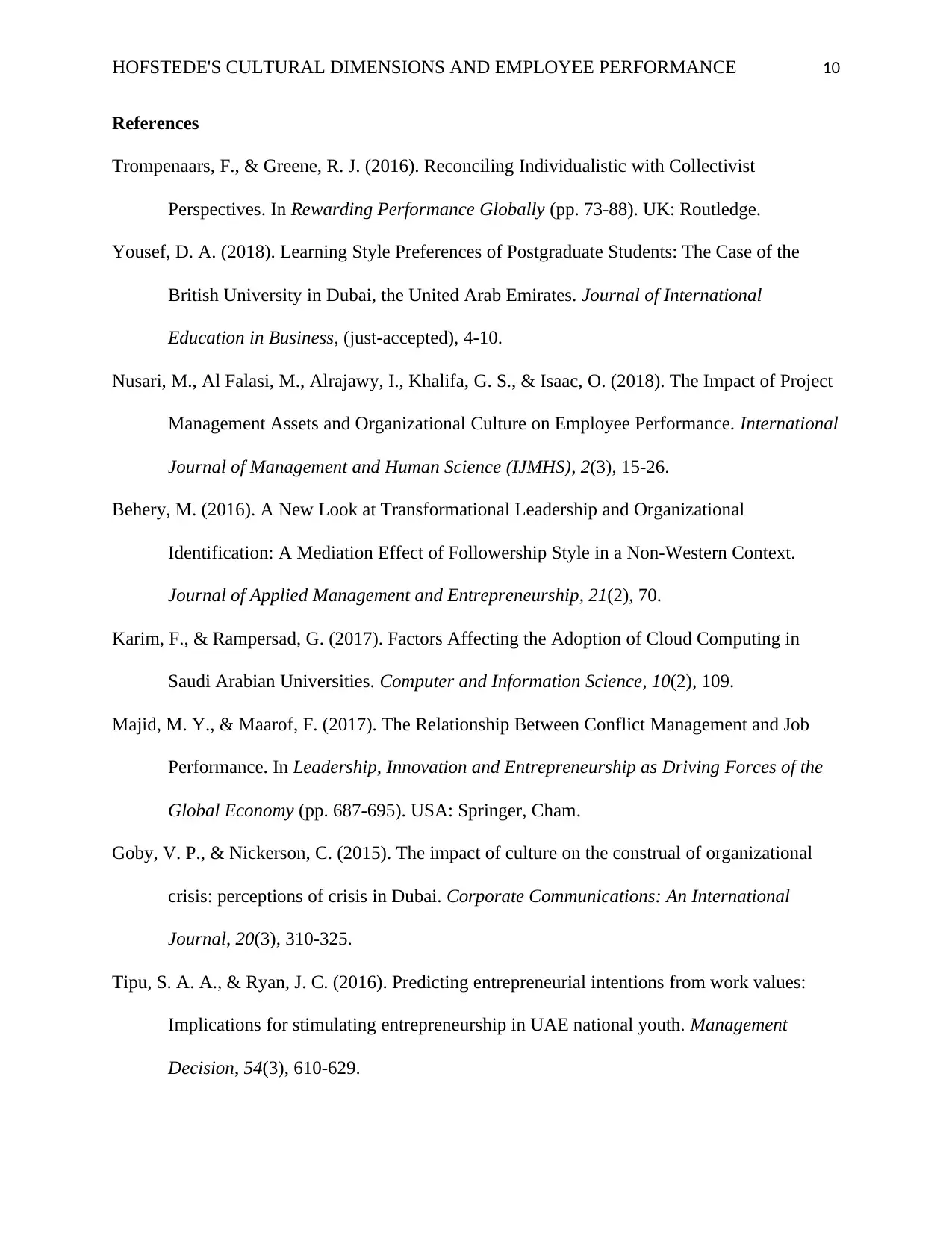
References
Trompenaars, F., & Greene, R. J. (2016). Reconciling Individualistic with Collectivist
Perspectives. In Rewarding Performance Globally (pp. 73-88). UK: Routledge.
Yousef, D. A. (2018). Learning Style Preferences of Postgraduate Students: The Case of the
British University in Dubai, the United Arab Emirates. Journal of International
Education in Business, (just-accepted), 4-10.
Nusari, M., Al Falasi, M., Alrajawy, I., Khalifa, G. S., & Isaac, O. (2018). The Impact of Project
Management Assets and Organizational Culture on Employee Performance. International
Journal of Management and Human Science (IJMHS), 2(3), 15-26.
Behery, M. (2016). A New Look at Transformational Leadership and Organizational
Identification: A Mediation Effect of Followership Style in a Non-Western Context.
Journal of Applied Management and Entrepreneurship, 21(2), 70.
Karim, F., & Rampersad, G. (2017). Factors Affecting the Adoption of Cloud Computing in
Saudi Arabian Universities. Computer and Information Science, 10(2), 109.
Majid, M. Y., & Maarof, F. (2017). The Relationship Between Conflict Management and Job
Performance. In Leadership, Innovation and Entrepreneurship as Driving Forces of the
Global Economy (pp. 687-695). USA: Springer, Cham.
Goby, V. P., & Nickerson, C. (2015). The impact of culture on the construal of organizational
crisis: perceptions of crisis in Dubai. Corporate Communications: An International
Journal, 20(3), 310-325.
Tipu, S. A. A., & Ryan, J. C. (2016). Predicting entrepreneurial intentions from work values:
Implications for stimulating entrepreneurship in UAE national youth. Management
Decision, 54(3), 610-629.
References
Trompenaars, F., & Greene, R. J. (2016). Reconciling Individualistic with Collectivist
Perspectives. In Rewarding Performance Globally (pp. 73-88). UK: Routledge.
Yousef, D. A. (2018). Learning Style Preferences of Postgraduate Students: The Case of the
British University in Dubai, the United Arab Emirates. Journal of International
Education in Business, (just-accepted), 4-10.
Nusari, M., Al Falasi, M., Alrajawy, I., Khalifa, G. S., & Isaac, O. (2018). The Impact of Project
Management Assets and Organizational Culture on Employee Performance. International
Journal of Management and Human Science (IJMHS), 2(3), 15-26.
Behery, M. (2016). A New Look at Transformational Leadership and Organizational
Identification: A Mediation Effect of Followership Style in a Non-Western Context.
Journal of Applied Management and Entrepreneurship, 21(2), 70.
Karim, F., & Rampersad, G. (2017). Factors Affecting the Adoption of Cloud Computing in
Saudi Arabian Universities. Computer and Information Science, 10(2), 109.
Majid, M. Y., & Maarof, F. (2017). The Relationship Between Conflict Management and Job
Performance. In Leadership, Innovation and Entrepreneurship as Driving Forces of the
Global Economy (pp. 687-695). USA: Springer, Cham.
Goby, V. P., & Nickerson, C. (2015). The impact of culture on the construal of organizational
crisis: perceptions of crisis in Dubai. Corporate Communications: An International
Journal, 20(3), 310-325.
Tipu, S. A. A., & Ryan, J. C. (2016). Predicting entrepreneurial intentions from work values:
Implications for stimulating entrepreneurship in UAE national youth. Management
Decision, 54(3), 610-629.
Paraphrase This Document
Need a fresh take? Get an instant paraphrase of this document with our AI Paraphraser
HOFSTEDE'S CULTURAL DIMENSIONS AND EMPLOYEE PERFORMANCE 11
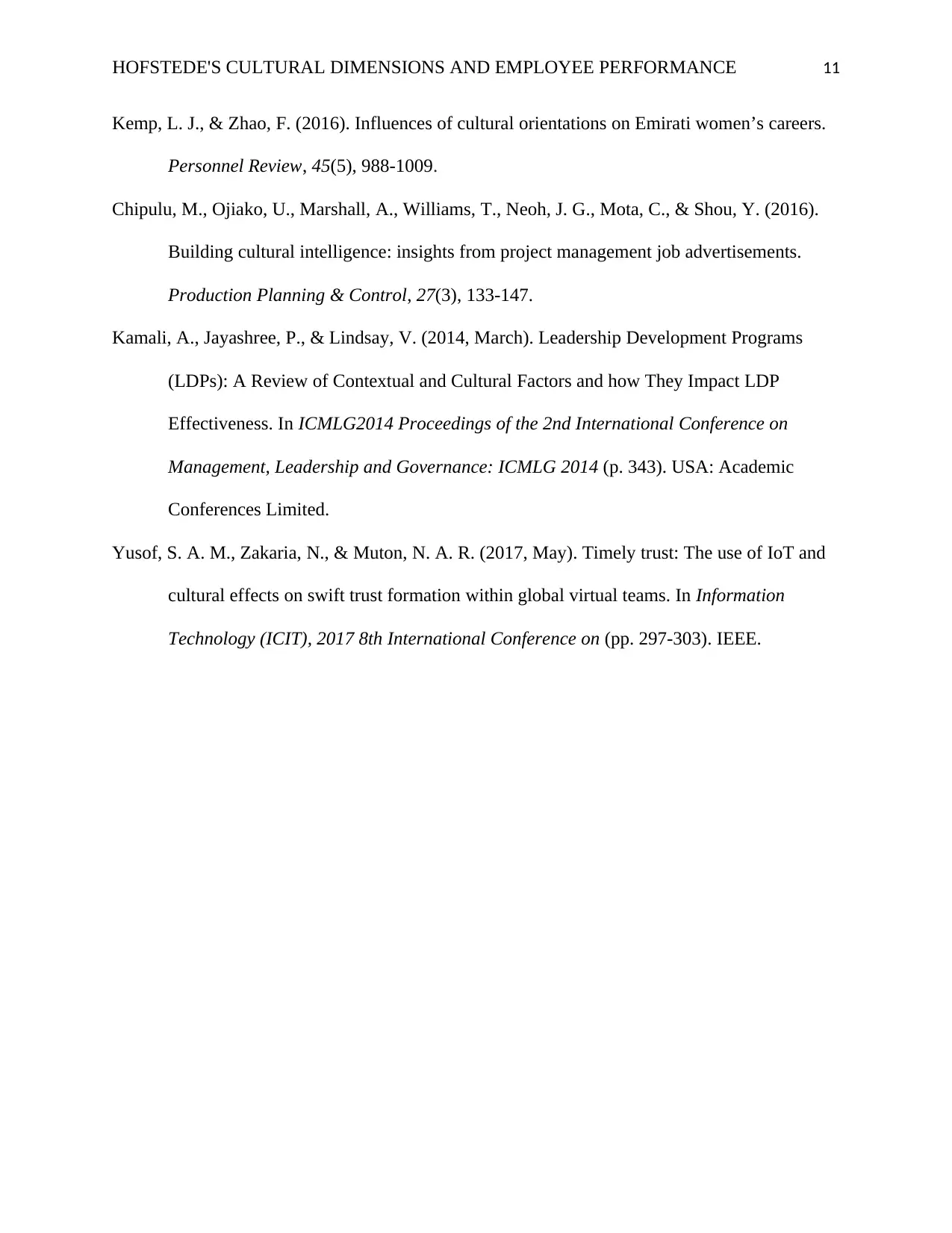
Kemp, L. J., & Zhao, F. (2016). Influences of cultural orientations on Emirati women’s careers.
Personnel Review, 45(5), 988-1009.
Chipulu, M., Ojiako, U., Marshall, A., Williams, T., Neoh, J. G., Mota, C., & Shou, Y. (2016).
Building cultural intelligence: insights from project management job advertisements.
Production Planning & Control, 27(3), 133-147.
Kamali, A., Jayashree, P., & Lindsay, V. (2014, March). Leadership Development Programs
(LDPs): A Review of Contextual and Cultural Factors and how They Impact LDP
Effectiveness. In ICMLG2014 Proceedings of the 2nd International Conference on
Management, Leadership and Governance: ICMLG 2014 (p. 343). USA: Academic
Conferences Limited.
Yusof, S. A. M., Zakaria, N., & Muton, N. A. R. (2017, May). Timely trust: The use of IoT and
cultural effects on swift trust formation within global virtual teams. In Information
Technology (ICIT), 2017 8th International Conference on (pp. 297-303). IEEE.
Kemp, L. J., & Zhao, F. (2016). Influences of cultural orientations on Emirati women’s careers.
Personnel Review, 45(5), 988-1009.
Chipulu, M., Ojiako, U., Marshall, A., Williams, T., Neoh, J. G., Mota, C., & Shou, Y. (2016).
Building cultural intelligence: insights from project management job advertisements.
Production Planning & Control, 27(3), 133-147.
Kamali, A., Jayashree, P., & Lindsay, V. (2014, March). Leadership Development Programs
(LDPs): A Review of Contextual and Cultural Factors and how They Impact LDP
Effectiveness. In ICMLG2014 Proceedings of the 2nd International Conference on
Management, Leadership and Governance: ICMLG 2014 (p. 343). USA: Academic
Conferences Limited.
Yusof, S. A. M., Zakaria, N., & Muton, N. A. R. (2017, May). Timely trust: The use of IoT and
cultural effects on swift trust formation within global virtual teams. In Information
Technology (ICIT), 2017 8th International Conference on (pp. 297-303). IEEE.
HOFSTEDE'S CULTURAL DIMENSIONS AND EMPLOYEE PERFORMANCE 12
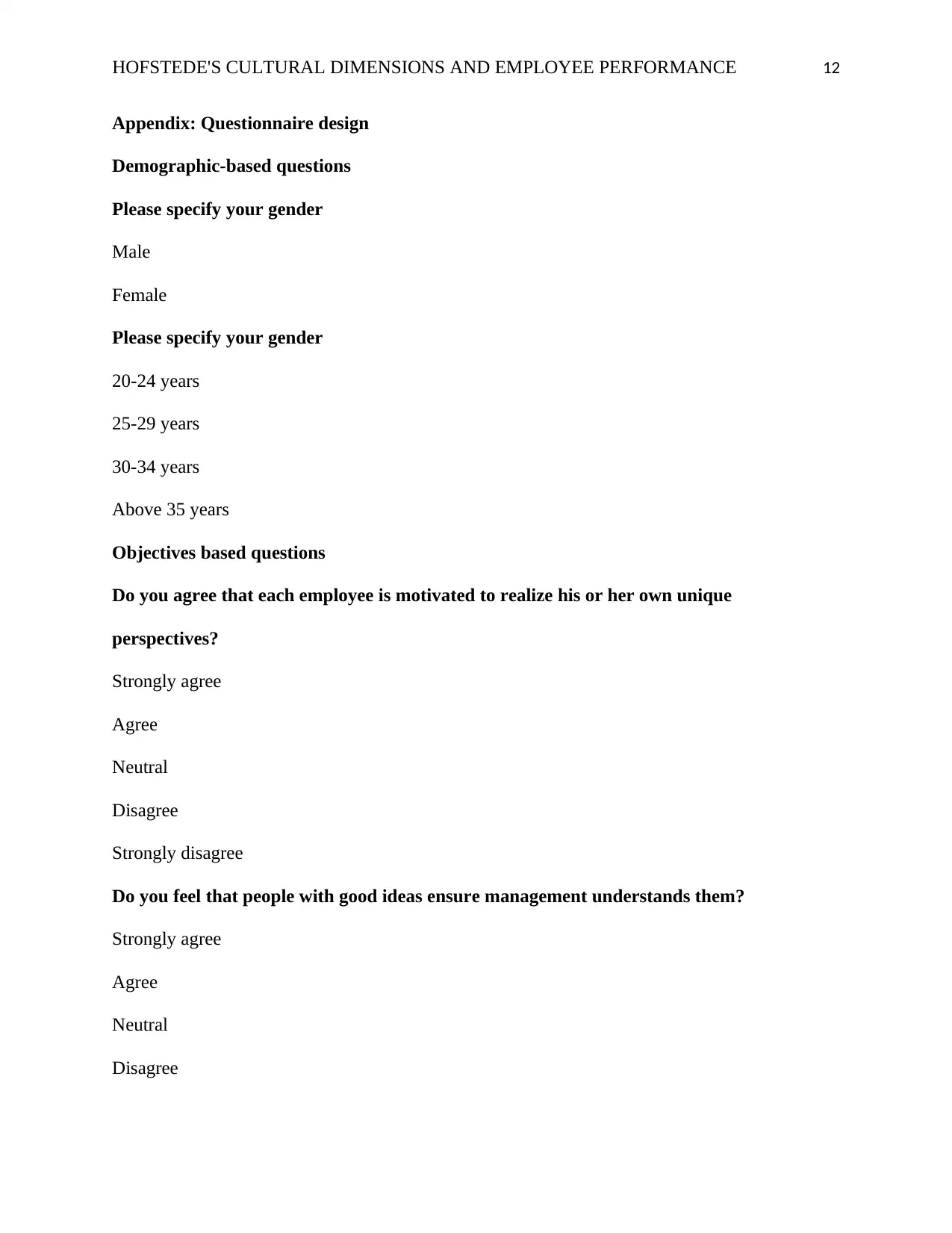
Appendix: Questionnaire design
Demographic-based questions
Please specify your gender
Male
Female
Please specify your gender
20-24 years
25-29 years
30-34 years
Above 35 years
Objectives based questions
Do you agree that each employee is motivated to realize his or her own unique
perspectives?
Strongly agree
Agree
Neutral
Disagree
Strongly disagree
Do you feel that people with good ideas ensure management understands them?
Strongly agree
Agree
Neutral
Disagree
Appendix: Questionnaire design
Demographic-based questions
Please specify your gender
Male
Female
Please specify your gender
20-24 years
25-29 years
30-34 years
Above 35 years
Objectives based questions
Do you agree that each employee is motivated to realize his or her own unique
perspectives?
Strongly agree
Agree
Neutral
Disagree
Strongly disagree
Do you feel that people with good ideas ensure management understands them?
Strongly agree
Agree
Neutral
Disagree
⊘ This is a preview!⊘
Do you want full access?
Subscribe today to unlock all pages.
Trusted by 1+ million students worldwide

1 out of 17


Related Documents


Your All-in-One AI-Powered Toolkit for Academic Success.
+13062052269
info@desklib.com
Available 24*7 on WhatsApp / Email
![[object Object]](/_next/static/media/star-bottom.7253800d.svg)
Unlock your academic potential
Copyright © 2020–2026 A2Z Services. All Rights Reserved. Developed and managed by ZUCOL.