Analyzing Industrial Automation's Effect on Ford's Revenue and Output
VerifiedAdded on 2021/06/15
|16
|4224
|129
Report
AI Summary
This report examines the impact of industrial automation on Ford's revenue generation. The study explores how Ford, an automobile manufacturing industry, has implemented industrial automation to increase output, reduce production costs, and ultimately boost revenue. The report investigates the effects of automation on output levels, cost efficiency, and the company's overall market share, using secondary data sources such as articles, journals, and books. The findings highlight that automation enhances output, improves product quality, and allows Ford to enjoy economies of scale, leading to increased revenue. The report also acknowledges the challenges associated with automation, such as initial investment costs and global competition, while emphasizing the significant positive impact on Ford's financial performance. Data from 2006 to 2017 demonstrates the growth in automobile production and revenue, highlighting a clear link between automation and financial success, making Ford a competitive player in the global market.
INDUSTRIAL AUTOMATION 1
Industrial Automation and its role in generating revenues
Students Name
Institutional Affiliation
Industrial Automation and its role in generating revenues
Students Name
Institutional Affiliation

Paraphrase This Document
Need a fresh take? Get an instant paraphrase of this document with our AI Paraphraser
INDUSTRIAL AUTOMATION 2
Introduction
Due to technological advancement, many industries have shifted from relying fully on
human labour to industrial automation where human labour is not required. There are various
industries that have implemented this technology. One of them is the automobile manufacturing
industry such as Ford. Apart from Ford automobile manufacturing industry, there are also other
automobile manufacturing industries like General Motors, Toyota and Honda which have also
implemented industrial automation in their production. Implementation of this technology has
resulted in an increase in revenue generated by these industries (Noble, 2017). Increase in
revenue is as a result of an increase in the production level which eventually has led to the
increased sales level of these products.
Since industrial automation has helped in generating revenues in various automobile
manufacturing industries like Ford, it is very essential to establish how industrial automation has
helped these industries in generating revenue. The study will focus on how Ford which is an
automobile industry has generated revenue due to the implementation of industrial automation in
their manufacturing process. Therefore the study aims at establishing how Ford automobile
industry has been able to generate revenues as a result of the implementation of industrial
automation.
The objective of the study
To establish how the implementation of industrial automation by Ford automobile
manufacturing Industry has helped them in generating revenue.
To determine how the implementation of industrial automation by Ford automobile
industry has enhanced the increase in the output level of the company.
Introduction
Due to technological advancement, many industries have shifted from relying fully on
human labour to industrial automation where human labour is not required. There are various
industries that have implemented this technology. One of them is the automobile manufacturing
industry such as Ford. Apart from Ford automobile manufacturing industry, there are also other
automobile manufacturing industries like General Motors, Toyota and Honda which have also
implemented industrial automation in their production. Implementation of this technology has
resulted in an increase in revenue generated by these industries (Noble, 2017). Increase in
revenue is as a result of an increase in the production level which eventually has led to the
increased sales level of these products.
Since industrial automation has helped in generating revenues in various automobile
manufacturing industries like Ford, it is very essential to establish how industrial automation has
helped these industries in generating revenue. The study will focus on how Ford which is an
automobile industry has generated revenue due to the implementation of industrial automation in
their manufacturing process. Therefore the study aims at establishing how Ford automobile
industry has been able to generate revenues as a result of the implementation of industrial
automation.
The objective of the study
To establish how the implementation of industrial automation by Ford automobile
manufacturing Industry has helped them in generating revenue.
To determine how the implementation of industrial automation by Ford automobile
industry has enhanced the increase in the output level of the company.
INDUSTRIAL AUTOMATION 3
To establish how the implementation of industrial automation by Ford automobile
industry resulted in a reduction of cost of production.
Research Questions
What is the effect of implementation of industrial automation on Ford’s revenue
generation?
What is the effect of implementation of industrial automation on Ford’s output
level?
What is the effect of implementation of industrial automation by Ford automobile
on the cost of output?
Literature review
Overview of industrial automation
As a result of technological advancement, various industries especially automobile
manufacturing industry like Ford have implemented the industrial automation in their
manufacturing process which has greatly impacted their revenue generation. The idea of
automation begun during the second world war in 1961 (Jammes, & Smit, 2005). It was first
adopted by General Motors facilities. The robots were used to replace human and they did not
perform every task. They used to perform spot welding successfully leading to an increase in
output to cater for the high demand thus resulting to increase in revenue, which attracted various
automobile industries including Ford to adopt this technology in their production.
Globally, almost all the automobile industries have implemented Industrial Automation.
In the United States of America (USA) for example, Ford Motors Company which came into
existence in 1928 has implemented industrial automation which has resulted to increase in
To establish how the implementation of industrial automation by Ford automobile
industry resulted in a reduction of cost of production.
Research Questions
What is the effect of implementation of industrial automation on Ford’s revenue
generation?
What is the effect of implementation of industrial automation on Ford’s output
level?
What is the effect of implementation of industrial automation by Ford automobile
on the cost of output?
Literature review
Overview of industrial automation
As a result of technological advancement, various industries especially automobile
manufacturing industry like Ford have implemented the industrial automation in their
manufacturing process which has greatly impacted their revenue generation. The idea of
automation begun during the second world war in 1961 (Jammes, & Smit, 2005). It was first
adopted by General Motors facilities. The robots were used to replace human and they did not
perform every task. They used to perform spot welding successfully leading to an increase in
output to cater for the high demand thus resulting to increase in revenue, which attracted various
automobile industries including Ford to adopt this technology in their production.
Globally, almost all the automobile industries have implemented Industrial Automation.
In the United States of America (USA) for example, Ford Motors Company which came into
existence in 1928 has implemented industrial automation which has resulted to increase in
⊘ This is a preview!⊘
Do you want full access?
Subscribe today to unlock all pages.

Trusted by 1+ million students worldwide
INDUSTRIAL AUTOMATION 4
automobile output that caters for the high demand of this product and eventually enabling the
company to generate more revenue. As a result of Industrial automation, Ford Manufacturing
Company has been able to manufacture quality vehicles for several years. The output has also
increased significantly and as a result, the revenue has also increased. The revenues from the
sales of vehicles in the year 2017 raised from $152 billion in 2016 to $156.8billion in 2017 in the
USA. There are also other companies in the USA that manufactured an automobile. Some of
them include Toyota, Honda, and General Motors which has posted a very great challenge to
Ford globally by reducing its market share (Groover, Weiss, Nagel, & Odrey, 1986).
In Asia Continent, there is also a Ford automobile company. It has also experienced a
significant increase in revenue as a result of the increase in demand for the automobile. The
increase in demand has been facilitated by the improved quality of the product. Both India and
China have experienced the increase in revenue (Klepper, 2002). This is due to the increase in
output since the robots used in car manufacturing can do a very huge amount of job in a minute
which can be done by humans in an entire month or so. There are also Ford automobile
companies in Africa in various countries such as Kenya and South Africa. They also experience
an increase in revenue due to industrial automation.
In Australia, Ford automobile manufacturing company deals in manufacturing and
distributing automobiles as well as automotive parts. The use of robots in the manufacturing
process has also been implemented in Australia. The use of robots has a result to decrease in cost
of production and increase in output since robots are capable of working very fast (Hounshell,
1985).
Research Methods
automobile output that caters for the high demand of this product and eventually enabling the
company to generate more revenue. As a result of Industrial automation, Ford Manufacturing
Company has been able to manufacture quality vehicles for several years. The output has also
increased significantly and as a result, the revenue has also increased. The revenues from the
sales of vehicles in the year 2017 raised from $152 billion in 2016 to $156.8billion in 2017 in the
USA. There are also other companies in the USA that manufactured an automobile. Some of
them include Toyota, Honda, and General Motors which has posted a very great challenge to
Ford globally by reducing its market share (Groover, Weiss, Nagel, & Odrey, 1986).
In Asia Continent, there is also a Ford automobile company. It has also experienced a
significant increase in revenue as a result of the increase in demand for the automobile. The
increase in demand has been facilitated by the improved quality of the product. Both India and
China have experienced the increase in revenue (Klepper, 2002). This is due to the increase in
output since the robots used in car manufacturing can do a very huge amount of job in a minute
which can be done by humans in an entire month or so. There are also Ford automobile
companies in Africa in various countries such as Kenya and South Africa. They also experience
an increase in revenue due to industrial automation.
In Australia, Ford automobile manufacturing company deals in manufacturing and
distributing automobiles as well as automotive parts. The use of robots in the manufacturing
process has also been implemented in Australia. The use of robots has a result to decrease in cost
of production and increase in output since robots are capable of working very fast (Hounshell,
1985).
Research Methods
Paraphrase This Document
Need a fresh take? Get an instant paraphrase of this document with our AI Paraphraser
INDUSTRIAL AUTOMATION 5
In order to establish the effect of industrial automation by manufacturing company on the
generation of revenue, a secondary method of collecting data was used; that is, articles, journals
and books. In the USA, Ford automobiles introduced new robots with the capacity to do more
jobs as years went by (Gereffi, 2001). This led to the reduction in a number of workers needed in
the company. The less the number of workers needed in the company the less the cost of
production since salary and training expenses would be cut because robots do not require salary
or training like humans. The few humans that are left to monitor the robots are left with little to
do which leads to job satisfaction. Satisfied employees lead to quality work (Helper, 1991).
Since the robots have replaced human labour in automobile manufacturing, the cost of
production has been reduced. This is because salary and training expenses have been reduced
since robots only require maintenance which is not done on regular basis. As the cost of
production has reduced, the possibility of reducing the cost of the automobile can be achieved
without the risk of operating at a loss (Drucker, 2014). With the reduced cost of the vehicles,
there has been an increase in demand which has led to increase in sales and eventually increase
revenue. The reduction in the number of vehicles has enabled Ford automobile company to be
competitively advantaged when compared to its competitors like General motor, Toyota and
Honda (Chandler, 1990).
The output level has increased. This is due to operational efficiency since machines once
set to work, are not subject to getting tired, being environmentally distracted like humans or
being bored from the work given. With increased output level, Ford automobile has been able to
meet the needs of its clients globally, considering that this company is a multinational
organization with automobiles companies in various continents globally. Increase in the level of
output has helped the company to enjoy economies of scale. This is because the cost of
In order to establish the effect of industrial automation by manufacturing company on the
generation of revenue, a secondary method of collecting data was used; that is, articles, journals
and books. In the USA, Ford automobiles introduced new robots with the capacity to do more
jobs as years went by (Gereffi, 2001). This led to the reduction in a number of workers needed in
the company. The less the number of workers needed in the company the less the cost of
production since salary and training expenses would be cut because robots do not require salary
or training like humans. The few humans that are left to monitor the robots are left with little to
do which leads to job satisfaction. Satisfied employees lead to quality work (Helper, 1991).
Since the robots have replaced human labour in automobile manufacturing, the cost of
production has been reduced. This is because salary and training expenses have been reduced
since robots only require maintenance which is not done on regular basis. As the cost of
production has reduced, the possibility of reducing the cost of the automobile can be achieved
without the risk of operating at a loss (Drucker, 2014). With the reduced cost of the vehicles,
there has been an increase in demand which has led to increase in sales and eventually increase
revenue. The reduction in the number of vehicles has enabled Ford automobile company to be
competitively advantaged when compared to its competitors like General motor, Toyota and
Honda (Chandler, 1990).
The output level has increased. This is due to operational efficiency since machines once
set to work, are not subject to getting tired, being environmentally distracted like humans or
being bored from the work given. With increased output level, Ford automobile has been able to
meet the needs of its clients globally, considering that this company is a multinational
organization with automobiles companies in various continents globally. Increase in the level of
output has helped the company to enjoy economies of scale. This is because the cost of
INDUSTRIAL AUTOMATION 6
producing the huge amount of products is lower than the cost of producing the very little level of
any given product (Drucker, 2014).
Due to increased output and reduced cost of production, there has been an increase in the
amount of revenue generated by Ford automobile company globally. For example, in 2017,
there was an increase in revenue from $152 billion in 2016 to $156billion in 2017 in the USA
(Mowery, & Rosenberg, 1999). This is a clear indication that as a result of industrial automation,
there has been a significant increase in revenue.
However, despite the fact that there are various advantages associated with Industrial automation
enjoyed by Ford automobiles, there are various challenges that have been faced so far. They
include the costs incurred in importing the robots to replace human labour. This is the case in all
Ford companies globally. For example, in the USA, Ford is the leading importers of robots. By
importing these robots, the company incurs an expense, both transportation and purchasing
expenses. This results to increase the cost of production and eventually decrease in the revenues.
Also, Ford faces stiff competition globally form other automobile industries like Toyota and
Honda among others. The stiff competition has resulted in a continuous decrease in market share
for this Company (Vesey, 1992).
Quality of the product is also enhanced by humans since robots cannot fully perform on
their own. This makes it a challenge since the company relies on human labour to some extent,
thus, incur the salary expense to pay employees and an additional expense that is incurred in
importing the robots.
producing the huge amount of products is lower than the cost of producing the very little level of
any given product (Drucker, 2014).
Due to increased output and reduced cost of production, there has been an increase in the
amount of revenue generated by Ford automobile company globally. For example, in 2017,
there was an increase in revenue from $152 billion in 2016 to $156billion in 2017 in the USA
(Mowery, & Rosenberg, 1999). This is a clear indication that as a result of industrial automation,
there has been a significant increase in revenue.
However, despite the fact that there are various advantages associated with Industrial automation
enjoyed by Ford automobiles, there are various challenges that have been faced so far. They
include the costs incurred in importing the robots to replace human labour. This is the case in all
Ford companies globally. For example, in the USA, Ford is the leading importers of robots. By
importing these robots, the company incurs an expense, both transportation and purchasing
expenses. This results to increase the cost of production and eventually decrease in the revenues.
Also, Ford faces stiff competition globally form other automobile industries like Toyota and
Honda among others. The stiff competition has resulted in a continuous decrease in market share
for this Company (Vesey, 1992).
Quality of the product is also enhanced by humans since robots cannot fully perform on
their own. This makes it a challenge since the company relies on human labour to some extent,
thus, incur the salary expense to pay employees and an additional expense that is incurred in
importing the robots.
⊘ This is a preview!⊘
Do you want full access?
Subscribe today to unlock all pages.
Trusted by 1+ million students worldwide
INDUSTRIAL AUTOMATION 7
Findings
It was established that as a result of industrial automation by Ford automobile company, the
output level is enhanced through the automation and inventions. This is because the robots
usually performed a very significant amount of task when compared to human labour. As a
result, the company enjoyed economies of scale since the huge production of commodities meant
that the cost of producing such commodity was reduced. With increased output level, revenue
generated from the sales was enhanced. This is because there were enough vehicles to meet the
need of clients globally. The quality of the product was also enhanced. This is because the robots
were able to complete the assigned task quickly thus allowing electrical engineers to focus on
improving the quality of the finished product since these engineers are the ones responsible to
monitor the robots as they perform the assigned task (Barrett, 1992). Output level was also
increased as a result of the ability of the robots to be configured and be able to perform various
tasks. This is not the case with humans since one can only perform the task that he or she is
specialized in. In vehicle manufacturing, robots are capable of assembling all the dirty and hard
parts of the vehicle, do welding and even painting of these vehicles.
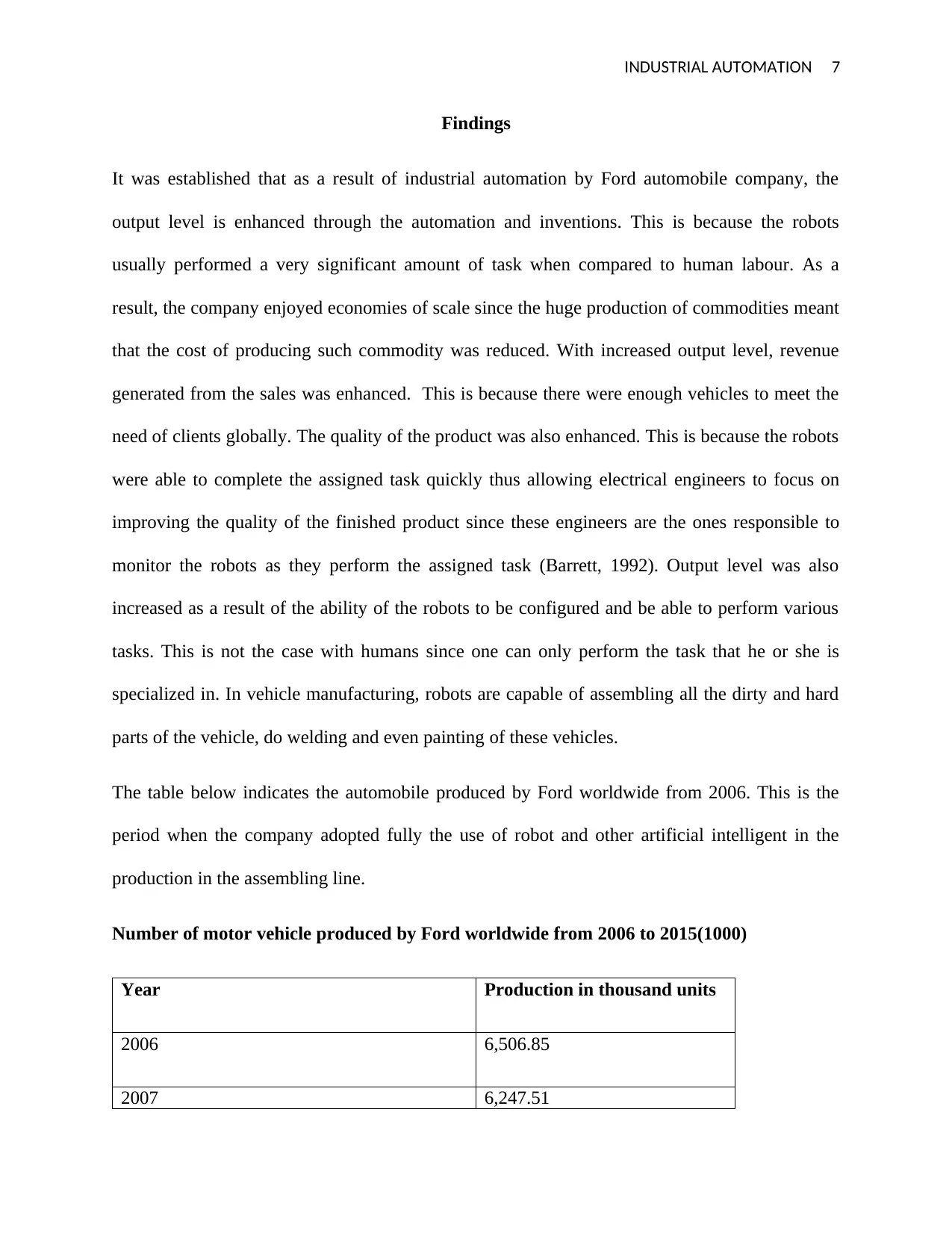
The table below indicates the automobile produced by Ford worldwide from 2006. This is the
period when the company adopted fully the use of robot and other artificial intelligent in the
production in the assembling line.
Number of motor vehicle produced by Ford worldwide from 2006 to 2015(1000)
Year Production in thousand units
2006 6,506.85
2007 6,247.51
Findings
It was established that as a result of industrial automation by Ford automobile company, the
output level is enhanced through the automation and inventions. This is because the robots
usually performed a very significant amount of task when compared to human labour. As a
result, the company enjoyed economies of scale since the huge production of commodities meant
that the cost of producing such commodity was reduced. With increased output level, revenue
generated from the sales was enhanced. This is because there were enough vehicles to meet the
need of clients globally. The quality of the product was also enhanced. This is because the robots
were able to complete the assigned task quickly thus allowing electrical engineers to focus on
improving the quality of the finished product since these engineers are the ones responsible to
monitor the robots as they perform the assigned task (Barrett, 1992). Output level was also
increased as a result of the ability of the robots to be configured and be able to perform various
tasks. This is not the case with humans since one can only perform the task that he or she is
specialized in. In vehicle manufacturing, robots are capable of assembling all the dirty and hard
parts of the vehicle, do welding and even painting of these vehicles.
The table below indicates the automobile produced by Ford worldwide from 2006. This is the
period when the company adopted fully the use of robot and other artificial intelligent in the
production in the assembling line.
Number of motor vehicle produced by Ford worldwide from 2006 to 2015(1000)
Year Production in thousand units
2006 6,506.85
2007 6,247.51
Paraphrase This Document
Need a fresh take? Get an instant paraphrase of this document with our AI Paraphraser
INDUSTRIAL AUTOMATION 8
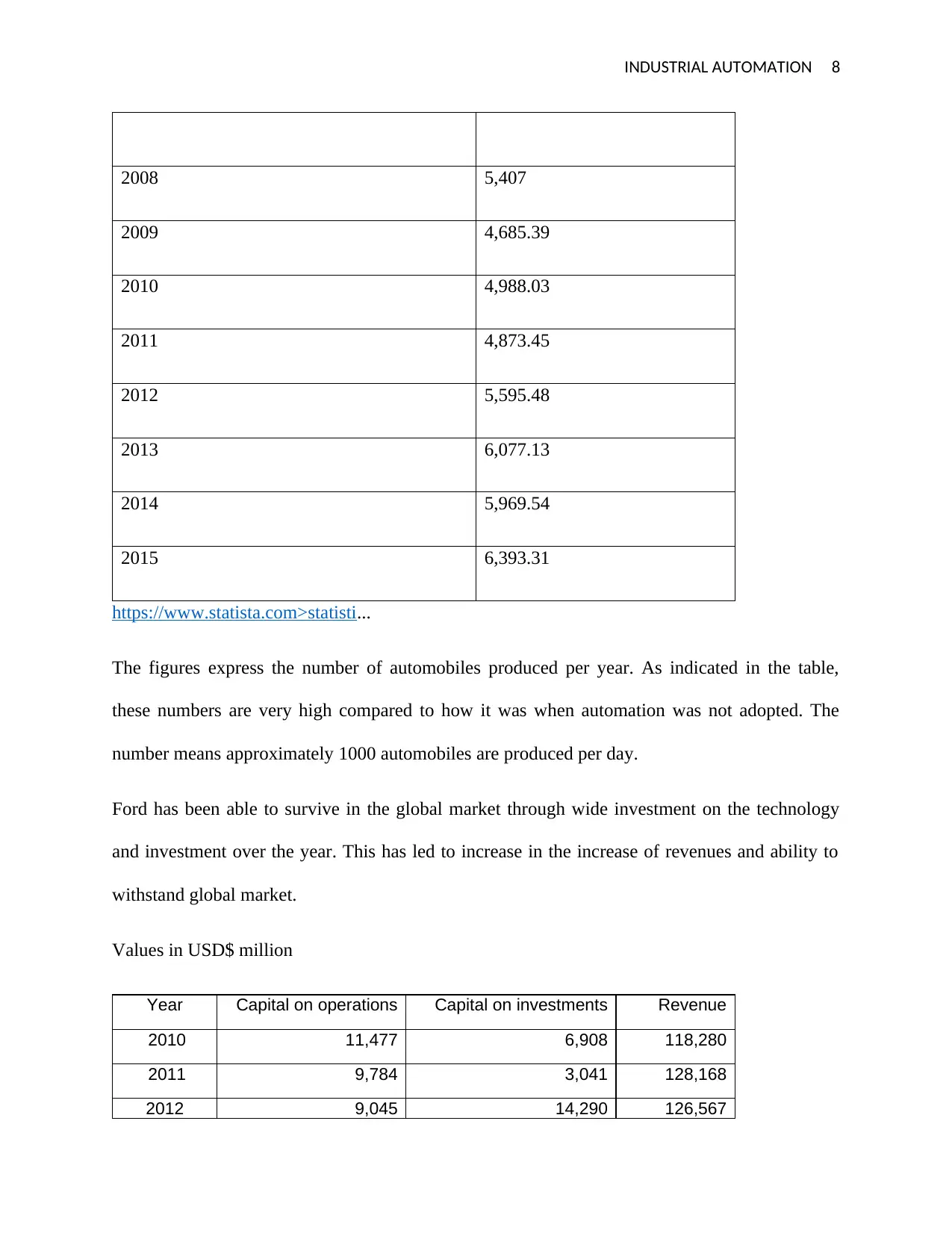
2008 5,407
2009 4,685.39
2010 4,988.03
2011 4,873.45
2012 5,595.48
2013 6,077.13
2014 5,969.54
2015 6,393.31
https://www.statista.com>statisti...
The figures express the number of automobiles produced per year. As indicated in the table,
these numbers are very high compared to how it was when automation was not adopted. The
number means approximately 1000 automobiles are produced per day.
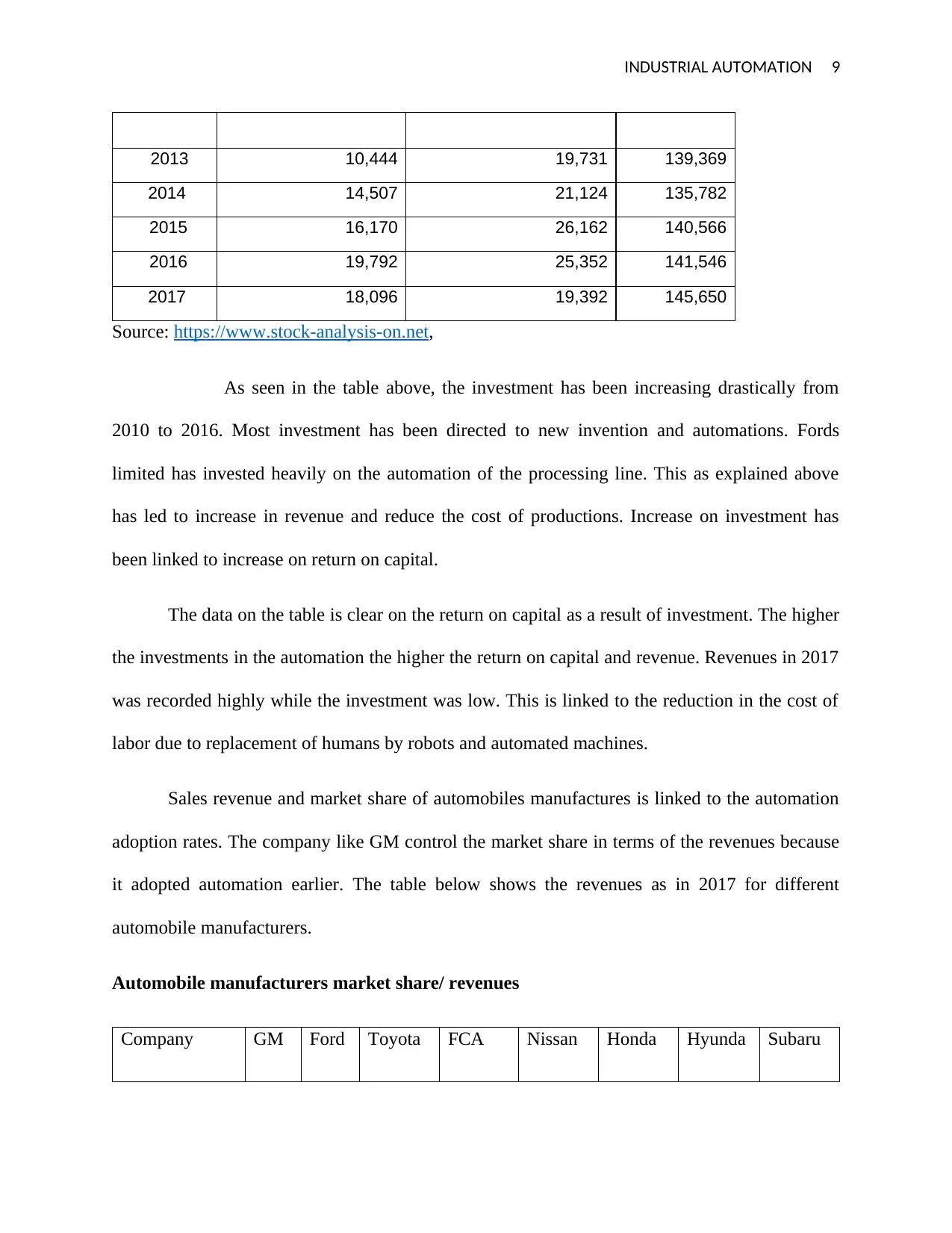
Ford has been able to survive in the global market through wide investment on the technology
and investment over the year. This has led to increase in the increase of revenues and ability to
withstand global market.
Values in USD$ million
Year Capital on operations Capital on investments Revenue
2010 11,477 6,908 118,280
2011 9,784 3,041 128,168
2012 9,045 14,290 126,567
2008 5,407
2009 4,685.39
2010 4,988.03
2011 4,873.45
2012 5,595.48
2013 6,077.13
2014 5,969.54
2015 6,393.31
https://www.statista.com>statisti...
The figures express the number of automobiles produced per year. As indicated in the table,
these numbers are very high compared to how it was when automation was not adopted. The
number means approximately 1000 automobiles are produced per day.
Ford has been able to survive in the global market through wide investment on the technology
and investment over the year. This has led to increase in the increase of revenues and ability to
withstand global market.
Values in USD$ million
Year Capital on operations Capital on investments Revenue
2010 11,477 6,908 118,280
2011 9,784 3,041 128,168
2012 9,045 14,290 126,567
INDUSTRIAL AUTOMATION 9
2013 10,444 19,731 139,369
2014 14,507 21,124 135,782
2015 16,170 26,162 140,566
2016 19,792 25,352 141,546
2017 18,096 19,392 145,650
Source: https://www.stock-analysis-on.net,
As seen in the table above, the investment has been increasing drastically from
2010 to 2016. Most investment has been directed to new invention and automations. Fords
limited has invested heavily on the automation of the processing line. This as explained above
has led to increase in revenue and reduce the cost of productions. Increase on investment has
been linked to increase on return on capital.
The data on the table is clear on the return on capital as a result of investment. The higher
the investments in the automation the higher the return on capital and revenue. Revenues in 2017
was recorded highly while the investment was low. This is linked to the reduction in the cost of
labor due to replacement of humans by robots and automated machines.
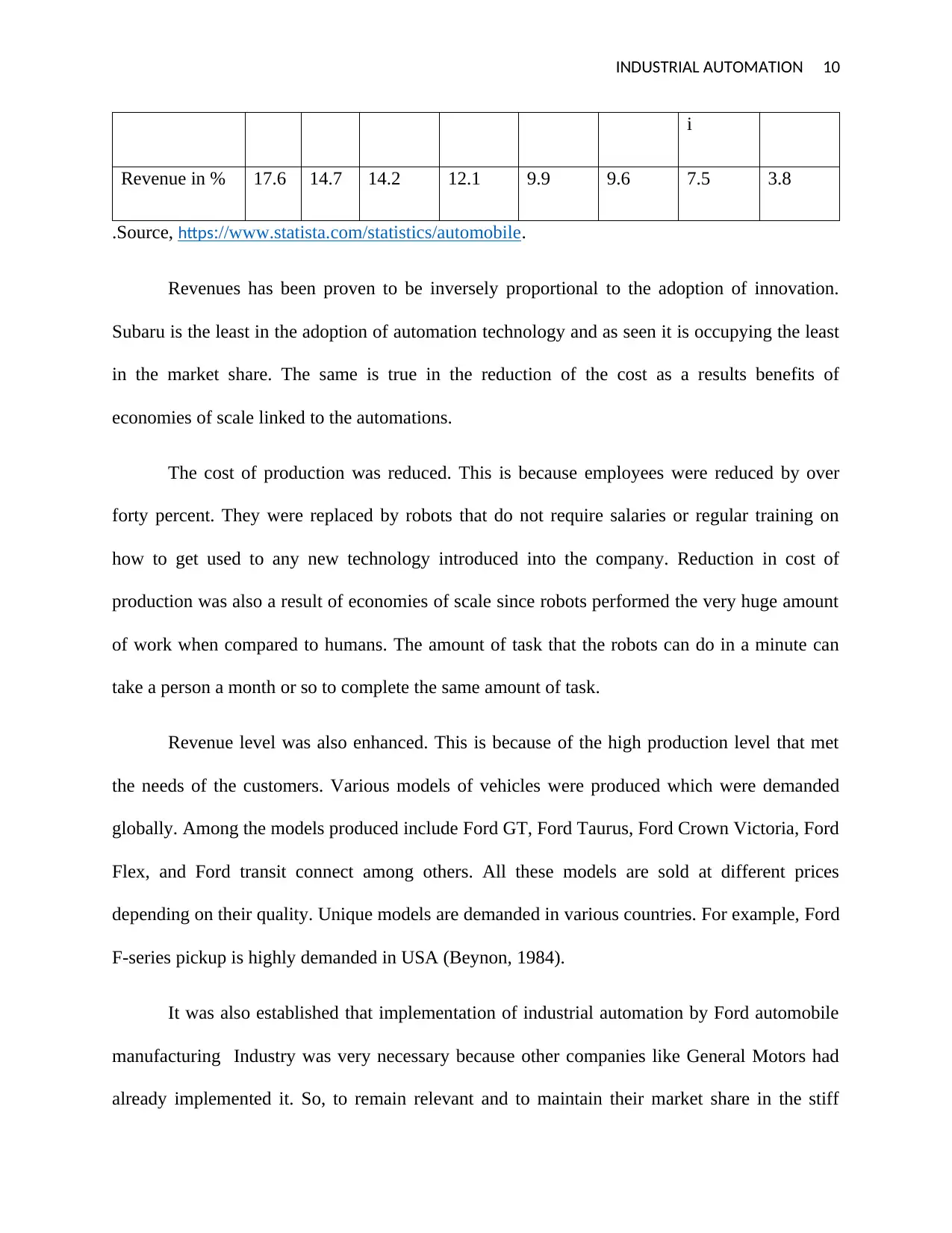
Sales revenue and market share of automobiles manufactures is linked to the automation
adoption rates. The company like GM control the market share in terms of the revenues because
it adopted automation earlier. The table below shows the revenues as in 2017 for different
automobile manufacturers.
Automobile manufacturers market share/ revenues
Company GM Ford Toyota FCA Nissan Honda Hyunda Subaru
2013 10,444 19,731 139,369
2014 14,507 21,124 135,782
2015 16,170 26,162 140,566
2016 19,792 25,352 141,546
2017 18,096 19,392 145,650
Source: https://www.stock-analysis-on.net,
As seen in the table above, the investment has been increasing drastically from
2010 to 2016. Most investment has been directed to new invention and automations. Fords
limited has invested heavily on the automation of the processing line. This as explained above
has led to increase in revenue and reduce the cost of productions. Increase on investment has
been linked to increase on return on capital.
The data on the table is clear on the return on capital as a result of investment. The higher
the investments in the automation the higher the return on capital and revenue. Revenues in 2017
was recorded highly while the investment was low. This is linked to the reduction in the cost of
labor due to replacement of humans by robots and automated machines.
Sales revenue and market share of automobiles manufactures is linked to the automation
adoption rates. The company like GM control the market share in terms of the revenues because
it adopted automation earlier. The table below shows the revenues as in 2017 for different
automobile manufacturers.
Automobile manufacturers market share/ revenues
Company GM Ford Toyota FCA Nissan Honda Hyunda Subaru
⊘ This is a preview!⊘
Do you want full access?
Subscribe today to unlock all pages.
Trusted by 1+ million students worldwide
INDUSTRIAL AUTOMATION 10
i
Revenue in % 17.6 14.7 14.2 12.1 9.9 9.6 7.5 3.8
.Source, https://www.statista.com/statistics/automobile.
Revenues has been proven to be inversely proportional to the adoption of innovation.
Subaru is the least in the adoption of automation technology and as seen it is occupying the least
in the market share. The same is true in the reduction of the cost as a results benefits of
economies of scale linked to the automations.
The cost of production was reduced. This is because employees were reduced by over
forty percent. They were replaced by robots that do not require salaries or regular training on
how to get used to any new technology introduced into the company. Reduction in cost of
production was also a result of economies of scale since robots performed the very huge amount
of work when compared to humans. The amount of task that the robots can do in a minute can
take a person a month or so to complete the same amount of task.
Revenue level was also enhanced. This is because of the high production level that met
the needs of the customers. Various models of vehicles were produced which were demanded
globally. Among the models produced include Ford GT, Ford Taurus, Ford Crown Victoria, Ford
Flex, and Ford transit connect among others. All these models are sold at different prices
depending on their quality. Unique models are demanded in various countries. For example, Ford
F-series pickup is highly demanded in USA (Beynon, 1984).
It was also established that implementation of industrial automation by Ford automobile
manufacturing Industry was very necessary because other companies like General Motors had
already implemented it. So, to remain relevant and to maintain their market share in the stiff
i
Revenue in % 17.6 14.7 14.2 12.1 9.9 9.6 7.5 3.8
.Source, https://www.statista.com/statistics/automobile.
Revenues has been proven to be inversely proportional to the adoption of innovation.
Subaru is the least in the adoption of automation technology and as seen it is occupying the least
in the market share. The same is true in the reduction of the cost as a results benefits of
economies of scale linked to the automations.
The cost of production was reduced. This is because employees were reduced by over
forty percent. They were replaced by robots that do not require salaries or regular training on
how to get used to any new technology introduced into the company. Reduction in cost of
production was also a result of economies of scale since robots performed the very huge amount
of work when compared to humans. The amount of task that the robots can do in a minute can
take a person a month or so to complete the same amount of task.
Revenue level was also enhanced. This is because of the high production level that met
the needs of the customers. Various models of vehicles were produced which were demanded
globally. Among the models produced include Ford GT, Ford Taurus, Ford Crown Victoria, Ford
Flex, and Ford transit connect among others. All these models are sold at different prices
depending on their quality. Unique models are demanded in various countries. For example, Ford
F-series pickup is highly demanded in USA (Beynon, 1984).
It was also established that implementation of industrial automation by Ford automobile
manufacturing Industry was very necessary because other companies like General Motors had
already implemented it. So, to remain relevant and to maintain their market share in the stiff
Paraphrase This Document
Need a fresh take? Get an instant paraphrase of this document with our AI Paraphraser
INDUSTRIAL AUTOMATION 11
competition, Ford automobile had to implement industrial automation as well. They also
implemented because they realized it was a success in other automobile industries like General
Motors from as early as the 1960s during the Second World War (Welch, & Nayak, 1992).
Despite the fact that industrial automation had so many benefits that were realized by Ford
automobile as an increase in revenue generation and enhanced productivity, there are so many
challenges associated with the implementation of industrial automation. These include the cost
incurred in purchasing the robots and the transportation cost incurred since they were mostly
imported. Also, these robots require maintenance on regular basis, thus the need to set aside
some cash to cater for such expenses. The fact that these robots cannot work on their own is a
challenge because there must be workers present always to monitor these robots. These workers
require salaries which is an expense to the company.
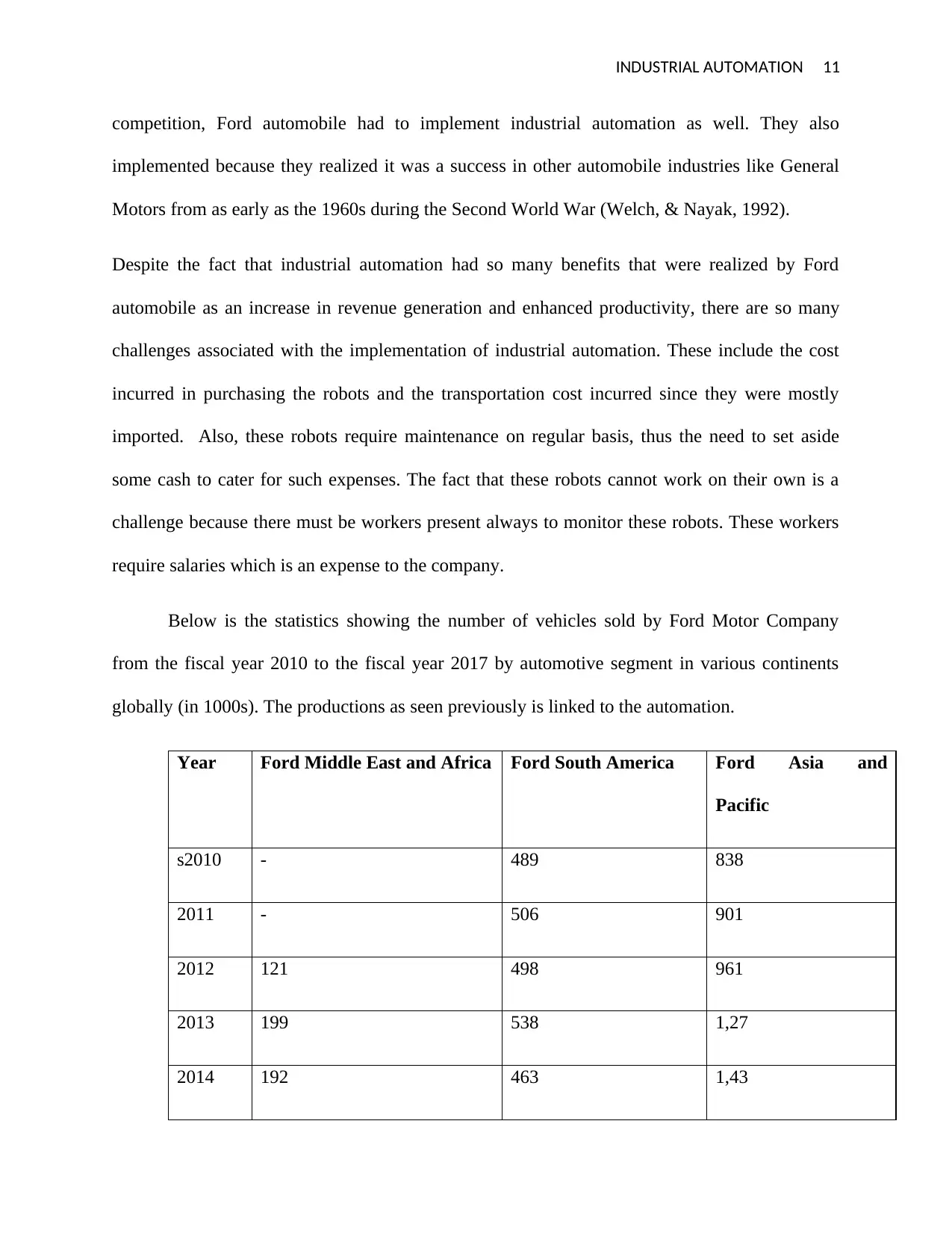
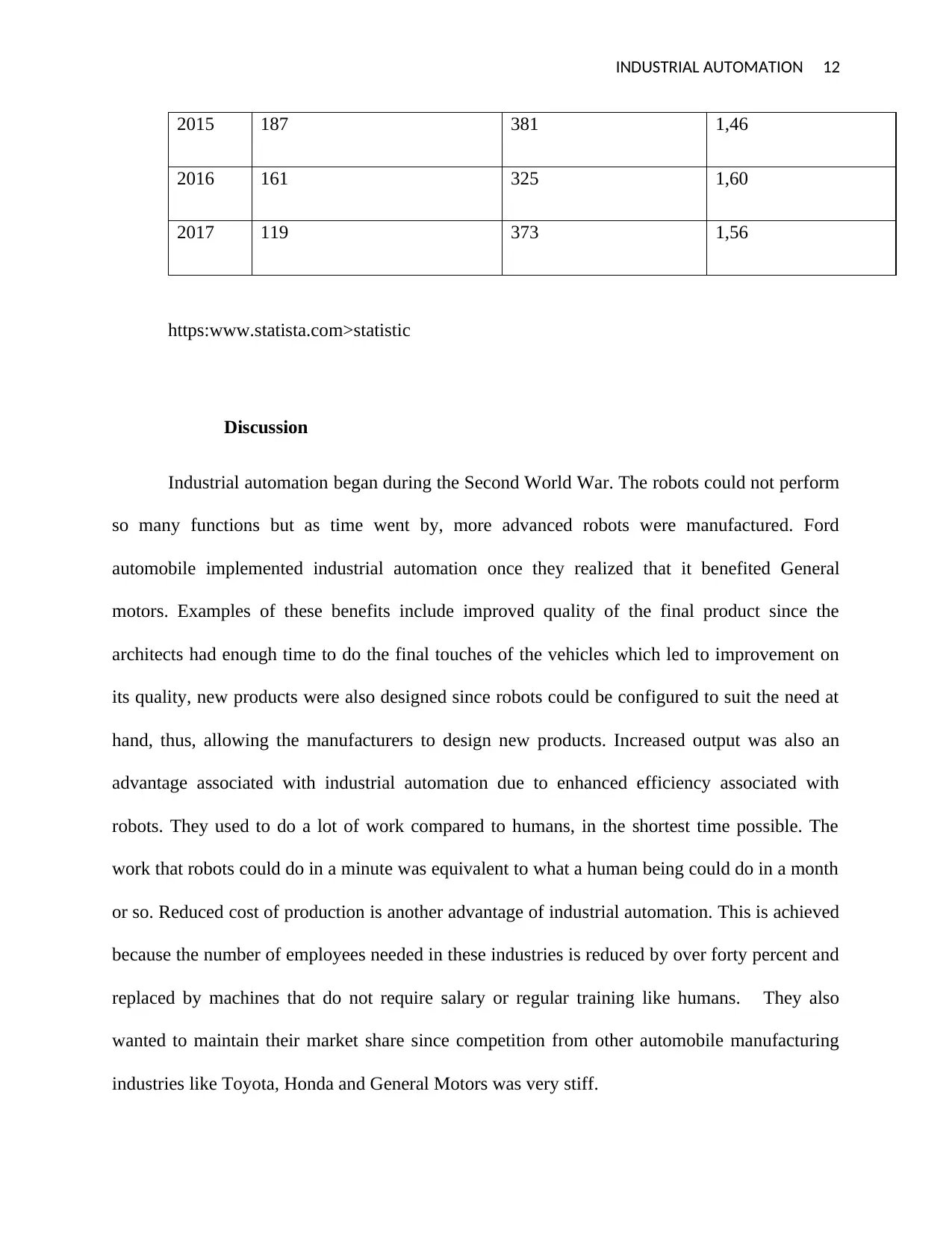
Below is the statistics showing the number of vehicles sold by Ford Motor Company
from the fiscal year 2010 to the fiscal year 2017 by automotive segment in various continents
globally (in 1000s). The productions as seen previously is linked to the automation.
Year Ford Middle East and Africa Ford South America Ford Asia and
Pacific
s2010 - 489 838
2011 - 506 901
2012 121 498 961
2013 199 538 1,27
2014 192 463 1,43
competition, Ford automobile had to implement industrial automation as well. They also
implemented because they realized it was a success in other automobile industries like General
Motors from as early as the 1960s during the Second World War (Welch, & Nayak, 1992).
Despite the fact that industrial automation had so many benefits that were realized by Ford
automobile as an increase in revenue generation and enhanced productivity, there are so many
challenges associated with the implementation of industrial automation. These include the cost
incurred in purchasing the robots and the transportation cost incurred since they were mostly
imported. Also, these robots require maintenance on regular basis, thus the need to set aside
some cash to cater for such expenses. The fact that these robots cannot work on their own is a
challenge because there must be workers present always to monitor these robots. These workers
require salaries which is an expense to the company.
Below is the statistics showing the number of vehicles sold by Ford Motor Company
from the fiscal year 2010 to the fiscal year 2017 by automotive segment in various continents
globally (in 1000s). The productions as seen previously is linked to the automation.
Year Ford Middle East and Africa Ford South America Ford Asia and
Pacific
s2010 - 489 838
2011 - 506 901
2012 121 498 961
2013 199 538 1,27
2014 192 463 1,43
INDUSTRIAL AUTOMATION 12
2015 187 381 1,46
2016 161 325 1,60
2017 119 373 1,56
https:www.statista.com>statistic
Discussion
Industrial automation began during the Second World War. The robots could not perform
so many functions but as time went by, more advanced robots were manufactured. Ford
automobile implemented industrial automation once they realized that it benefited General
motors. Examples of these benefits include improved quality of the final product since the
architects had enough time to do the final touches of the vehicles which led to improvement on
its quality, new products were also designed since robots could be configured to suit the need at
hand, thus, allowing the manufacturers to design new products. Increased output was also an
advantage associated with industrial automation due to enhanced efficiency associated with
robots. They used to do a lot of work compared to humans, in the shortest time possible. The
work that robots could do in a minute was equivalent to what a human being could do in a month
or so. Reduced cost of production is another advantage of industrial automation. This is achieved
because the number of employees needed in these industries is reduced by over forty percent and
replaced by machines that do not require salary or regular training like humans. They also
wanted to maintain their market share since competition from other automobile manufacturing
industries like Toyota, Honda and General Motors was very stiff.
2015 187 381 1,46
2016 161 325 1,60
2017 119 373 1,56
https:www.statista.com>statistic
Discussion
Industrial automation began during the Second World War. The robots could not perform
so many functions but as time went by, more advanced robots were manufactured. Ford
automobile implemented industrial automation once they realized that it benefited General
motors. Examples of these benefits include improved quality of the final product since the
architects had enough time to do the final touches of the vehicles which led to improvement on
its quality, new products were also designed since robots could be configured to suit the need at
hand, thus, allowing the manufacturers to design new products. Increased output was also an
advantage associated with industrial automation due to enhanced efficiency associated with
robots. They used to do a lot of work compared to humans, in the shortest time possible. The
work that robots could do in a minute was equivalent to what a human being could do in a month
or so. Reduced cost of production is another advantage of industrial automation. This is achieved
because the number of employees needed in these industries is reduced by over forty percent and
replaced by machines that do not require salary or regular training like humans. They also
wanted to maintain their market share since competition from other automobile manufacturing
industries like Toyota, Honda and General Motors was very stiff.
⊘ This is a preview!⊘
Do you want full access?
Subscribe today to unlock all pages.
Trusted by 1+ million students worldwide

1 out of 16


Related Documents


Your All-in-One AI-Powered Toolkit for Academic Success.
+13062052269
info@desklib.com
Available 24*7 on WhatsApp / Email
![[object Object]](/_next/static/media/star-bottom.7253800d.svg)
Unlock your academic potential
Copyright © 2020–2026 A2Z Services. All Rights Reserved. Developed and managed by ZUCOL.