University Economics Assignment: Competition and Industry Analysis
VerifiedAdded on 2021/06/17
|11
|1914
|65
Homework Assignment
AI Summary
This economics assignment delves into the concepts of competition and industry analysis, focusing on offshoring activities and their economic implications. The assignment begins by evaluating the factors influencing offshoring decisions, such as infrastructure, business size, cultural alignment, local talent pools, and industry standards, highlighting the advantages of countries like China and India. It then examines the profitability of offshoring, considering factors like administrative frameworks, quality standards, and transportation costs. The assignment further explores the concept of increasing returns to scale and its impact on production decisions. Using a production function, it calculates the optimal production location (home or foreign country) based on cost analysis and analyzes the impact of trade policies, specifically those implemented by President Trump, including rules of origin, environmental and labor standards, and VAT adjustments. The student concludes by discussing the competitive advantages of producing in the home country and the addition of unique product features.
Running head: COMPETITION AND INDUSTRY- ECONOMIC ASSIGNMENT
Competition and Industry- Economic Assignment
Name of the Student:
Name of the University:
Author’s Note:
Competition and Industry- Economic Assignment
Name of the Student:
Name of the University:
Author’s Note:
Paraphrase This Document
Need a fresh take? Get an instant paraphrase of this document with our AI Paraphraser

COMPETITION AND INDUSTRY- ECONOMIC ASSIGNMENT 1
Table of Contents
Answer to Question 1......................................................................................................................2
Answer to Question 2......................................................................................................................4
Part a:...............................................................................................................................................4
Part b:...............................................................................................................................................5
Part c:...............................................................................................................................................6
Part d:...............................................................................................................................................7
Answer to Question 3:.....................................................................................................................7
Reference List..................................................................................................................................9
Table of Contents
Answer to Question 1......................................................................................................................2
Answer to Question 2......................................................................................................................4
Part a:...............................................................................................................................................4
Part b:...............................................................................................................................................5
Part c:...............................................................................................................................................6
Part d:...............................................................................................................................................7
Answer to Question 3:.....................................................................................................................7
Reference List..................................................................................................................................9

COMPETITION AND INDUSTRY- ECONOMIC ASSIGNMENT 2
Answer to Question 1
Through practicing the offshoring activities an organization can transfer some its
business activities overseas. This can either be in the form of an operational process such as
manufacturing or a supporting process for instance accounting or both. The offshoring activities
can be divided into two types which are namely the production operation related offshoring or
service related offshoring (Bandick, 2016). In relation to this a few processes that helps in
evaluating the business can be taken into account. Those factors ranges from business size,
cultural environment, infrastructural framework. Availability of skilled workers an standard of
the industry. Evaluating these factors and observing them closely will in turn help to determine
why the Asian countries are evolving as the most efficient offshoring partner in comparison to
the countries of South America or Africa (Kvedaraviciene and Boguslauskas, 2015).
Since the past few years the infrastructural framework of China and India have depicted
significant growth and development. These two countries taken together have acquired the lion’s
share of the total market share of the world which as a result contributed effectively in the
economic development of these two countries (Clampit et al., 2015). The governments of both
the countries have invested enormously in developing the communication and transportation
systems. Moreover, the businesses within the countries have also marked significant growth
during this period. There are mainly five key determinants which should be considered by an
organization while selecting the offshoring countries. These five key factors can be stated as
follows,
Infrastructure
Answer to Question 1
Through practicing the offshoring activities an organization can transfer some its
business activities overseas. This can either be in the form of an operational process such as
manufacturing or a supporting process for instance accounting or both. The offshoring activities
can be divided into two types which are namely the production operation related offshoring or
service related offshoring (Bandick, 2016). In relation to this a few processes that helps in
evaluating the business can be taken into account. Those factors ranges from business size,
cultural environment, infrastructural framework. Availability of skilled workers an standard of
the industry. Evaluating these factors and observing them closely will in turn help to determine
why the Asian countries are evolving as the most efficient offshoring partner in comparison to
the countries of South America or Africa (Kvedaraviciene and Boguslauskas, 2015).
Since the past few years the infrastructural framework of China and India have depicted
significant growth and development. These two countries taken together have acquired the lion’s
share of the total market share of the world which as a result contributed effectively in the
economic development of these two countries (Clampit et al., 2015). The governments of both
the countries have invested enormously in developing the communication and transportation
systems. Moreover, the businesses within the countries have also marked significant growth
during this period. There are mainly five key determinants which should be considered by an
organization while selecting the offshoring countries. These five key factors can be stated as
follows,
Infrastructure
⊘ This is a preview!⊘
Do you want full access?
Subscribe today to unlock all pages.

Trusted by 1+ million students worldwide

COMPETITION AND INDUSTRY- ECONOMIC ASSIGNMENT 3
It is needless to mention that the geographical location should be considered first while
selecting the country of outsourcing, however, the most critical factor in this case is the
infrastructure of the service provider which can be considered as the main determining factor of
offshoring choice. Now in relation to India it can certainly be stated that the country has
projected significant growth in terms of infrastructural facilities since the past few years
(Rodríguez and Nieto, 2016). Various countries have already selected India as their offshoring
partner. However, it has been projected that by the end of 2040 the Indian economy will be
needing $4.5 trillion of investment for developing its infrastructure furthermore. As a result the
country is thrusting on development and betterment of its existing infrastructure so that the
foreign investors become willing to invest in the country (Gylling et al., 2015). The Chinese
infrastructure on the other hand, has also projected significant development. Specifically the
transport infrastructure of China is being developed at a rapid pace.
Business Size
The businesses which is offshoring should certainly consider whether the service
provider have experience of working with organizations of their size or not. In India and China
there are numerous service providers and hence this factor is in favor of any foreign business
willing to offshore in these countries (Musteen, 2016).
Cultural Alignment
The theorists suggest that businesses should focus on offshoring to only those locations
with which they will found certain similarities in culture. Language barriers and cultural gap may
affect the productivity. In this context it can be stated that India and China are two huge
It is needless to mention that the geographical location should be considered first while
selecting the country of outsourcing, however, the most critical factor in this case is the
infrastructure of the service provider which can be considered as the main determining factor of
offshoring choice. Now in relation to India it can certainly be stated that the country has
projected significant growth in terms of infrastructural facilities since the past few years
(Rodríguez and Nieto, 2016). Various countries have already selected India as their offshoring
partner. However, it has been projected that by the end of 2040 the Indian economy will be
needing $4.5 trillion of investment for developing its infrastructure furthermore. As a result the
country is thrusting on development and betterment of its existing infrastructure so that the
foreign investors become willing to invest in the country (Gylling et al., 2015). The Chinese
infrastructure on the other hand, has also projected significant development. Specifically the
transport infrastructure of China is being developed at a rapid pace.
Business Size
The businesses which is offshoring should certainly consider whether the service
provider have experience of working with organizations of their size or not. In India and China
there are numerous service providers and hence this factor is in favor of any foreign business
willing to offshore in these countries (Musteen, 2016).
Cultural Alignment
The theorists suggest that businesses should focus on offshoring to only those locations
with which they will found certain similarities in culture. Language barriers and cultural gap may
affect the productivity. In this context it can be stated that India and China are two huge
Paraphrase This Document
Need a fresh take? Get an instant paraphrase of this document with our AI Paraphraser

COMPETITION AND INDUSTRY- ECONOMIC ASSIGNMENT 4
countries which possess multicultural environment and cultural amalgamation is quite normal in
these countries (Oshri et al., 2015).
Local Talent Pool
Due to the higher number of educated population no organizations will ever face
difficulties in finding educated and skilled workforce at lower cost at least in these two countries.
Industry Standards
The industry standard is also quite high in India and China. As both of the countries are
already hosting several foreign business, these countries are experienced in maintaining higher
industry standards.
These are the underlying reasons for which the businesses are choosing India and China
as their offshoring partner compared to Africa and South America.
Answer to Question 2
Part a:
In an economic perspective, often the offshoring activities are considered as non-viable
activities from the part of the business. Mainly the companies offshore the different segments of
their entire production process in different countries in order to save cost. However, this concept
is not always correct, as in order to conduct business in the foreign countries the business entities
are required to follow certain administrative legal framework which can in turn offset the
reduction in cost (Moe et al., 2014). On the other hand, the outputs of the production abroad may
not mitigate the quality standards set by the company. Furthermore, the transportation cost, tariff
may also make the entire production process unprofitable. On the other hand, properly trained
countries which possess multicultural environment and cultural amalgamation is quite normal in
these countries (Oshri et al., 2015).
Local Talent Pool
Due to the higher number of educated population no organizations will ever face
difficulties in finding educated and skilled workforce at lower cost at least in these two countries.
Industry Standards
The industry standard is also quite high in India and China. As both of the countries are
already hosting several foreign business, these countries are experienced in maintaining higher
industry standards.
These are the underlying reasons for which the businesses are choosing India and China
as their offshoring partner compared to Africa and South America.
Answer to Question 2
Part a:
In an economic perspective, often the offshoring activities are considered as non-viable
activities from the part of the business. Mainly the companies offshore the different segments of
their entire production process in different countries in order to save cost. However, this concept
is not always correct, as in order to conduct business in the foreign countries the business entities
are required to follow certain administrative legal framework which can in turn offset the
reduction in cost (Moe et al., 2014). On the other hand, the outputs of the production abroad may
not mitigate the quality standards set by the company. Furthermore, the transportation cost, tariff
may also make the entire production process unprofitable. On the other hand, properly trained

COMPETITION AND INDUSTRY- ECONOMIC ASSIGNMENT 5
labor force is required in the foreign country which is essential for effective production.
Therefore, it can be stated that offshoring abroad is not always a profitable activity it may pose
certain shortcomings as well.
Part b:
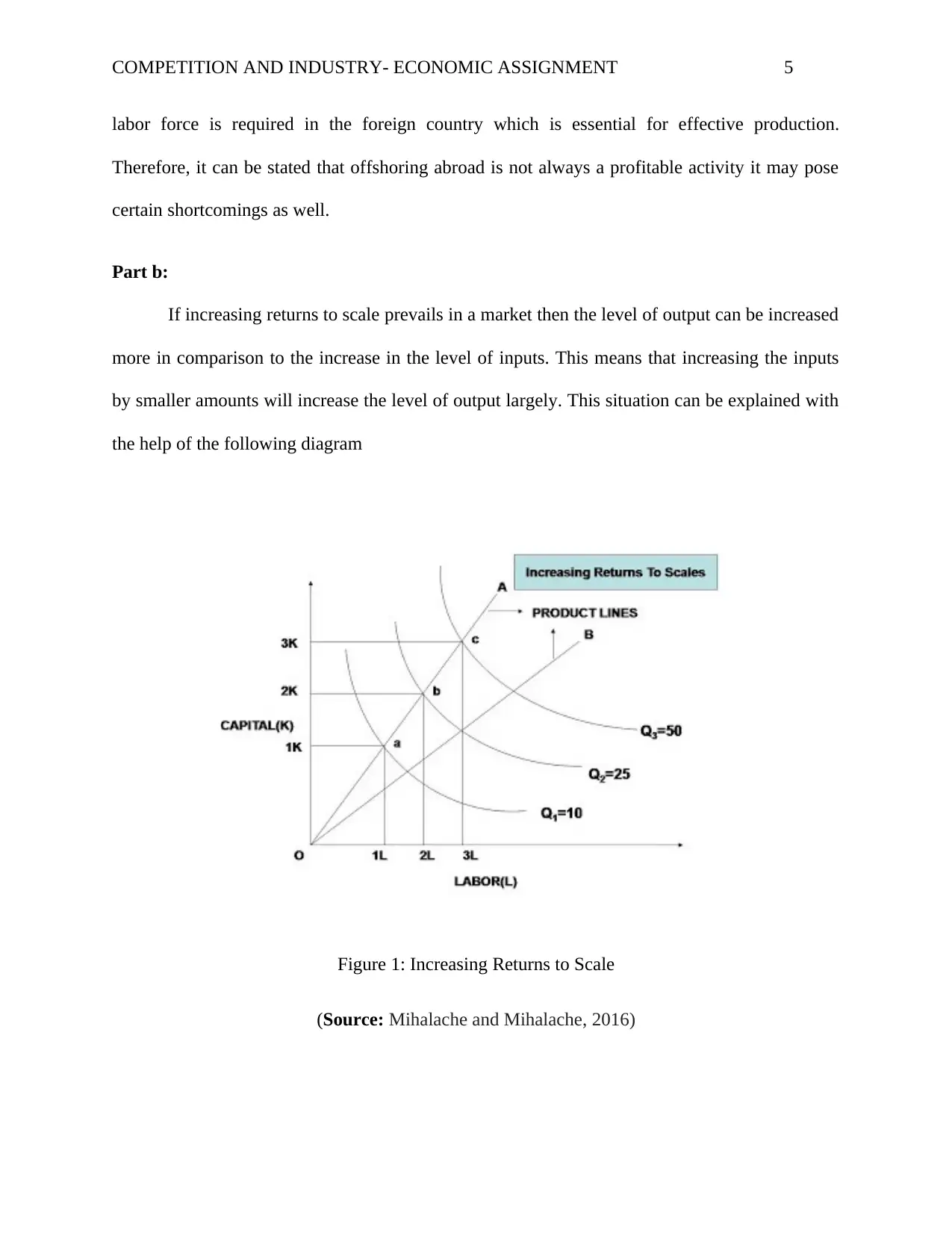
If increasing returns to scale prevails in a market then the level of output can be increased
more in comparison to the increase in the level of inputs. This means that increasing the inputs
by smaller amounts will increase the level of output largely. This situation can be explained with
the help of the following diagram
Figure 1: Increasing Returns to Scale
(Source: Mihalache and Mihalache, 2016)
labor force is required in the foreign country which is essential for effective production.
Therefore, it can be stated that offshoring abroad is not always a profitable activity it may pose
certain shortcomings as well.
Part b:
If increasing returns to scale prevails in a market then the level of output can be increased
more in comparison to the increase in the level of inputs. This means that increasing the inputs
by smaller amounts will increase the level of output largely. This situation can be explained with
the help of the following diagram
Figure 1: Increasing Returns to Scale
(Source: Mihalache and Mihalache, 2016)
⊘ This is a preview!⊘
Do you want full access?
Subscribe today to unlock all pages.

Trusted by 1+ million students worldwide

COMPETITION AND INDUSTRY- ECONOMIC ASSIGNMENT 6
For the sake of simplicity it is assumed that price of capital is same in both the foreign
and domestic country while labor is cheaper in the foreign country. If the business is
experiencing increasing returns to scale it should certainly produce a part of its business in the
foreign country as with cheaper labor it will be able to continue the production process more
profitably (Mihalache and Mihalache, 2016).
Part c:
The production function of the firm is given by,
Q=K2L2
The MPL=2K2L and MPK=2L2K
The efficient production point is where MRTSLK= MPL/ MPK = K/L
K/L= 20/40=1/2
L=2K
Substituting this value of L in the production function, K= 2.23 as L=2K=4.46
Hence the total cost of producing 100 units at home will be 20*2.23+40*4.46= 223
The total cost of producing the entire output in the home country is $223
Similarly, the cost of labor that is the wage is $10 in the foreign country and hence the cost of
production could be determined following the same process,
K/L=10/40=1/4
L=4K
Substituting this value of L in the production function yield K=1.5, L= 6
For the sake of simplicity it is assumed that price of capital is same in both the foreign
and domestic country while labor is cheaper in the foreign country. If the business is
experiencing increasing returns to scale it should certainly produce a part of its business in the
foreign country as with cheaper labor it will be able to continue the production process more
profitably (Mihalache and Mihalache, 2016).
Part c:
The production function of the firm is given by,
Q=K2L2
The MPL=2K2L and MPK=2L2K
The efficient production point is where MRTSLK= MPL/ MPK = K/L
K/L= 20/40=1/2
L=2K
Substituting this value of L in the production function, K= 2.23 as L=2K=4.46
Hence the total cost of producing 100 units at home will be 20*2.23+40*4.46= 223
The total cost of producing the entire output in the home country is $223
Similarly, the cost of labor that is the wage is $10 in the foreign country and hence the cost of
production could be determined following the same process,
K/L=10/40=1/4
L=4K
Substituting this value of L in the production function yield K=1.5, L= 6
Paraphrase This Document
Need a fresh take? Get an instant paraphrase of this document with our AI Paraphraser

COMPETITION AND INDUSTRY- ECONOMIC ASSIGNMENT 7
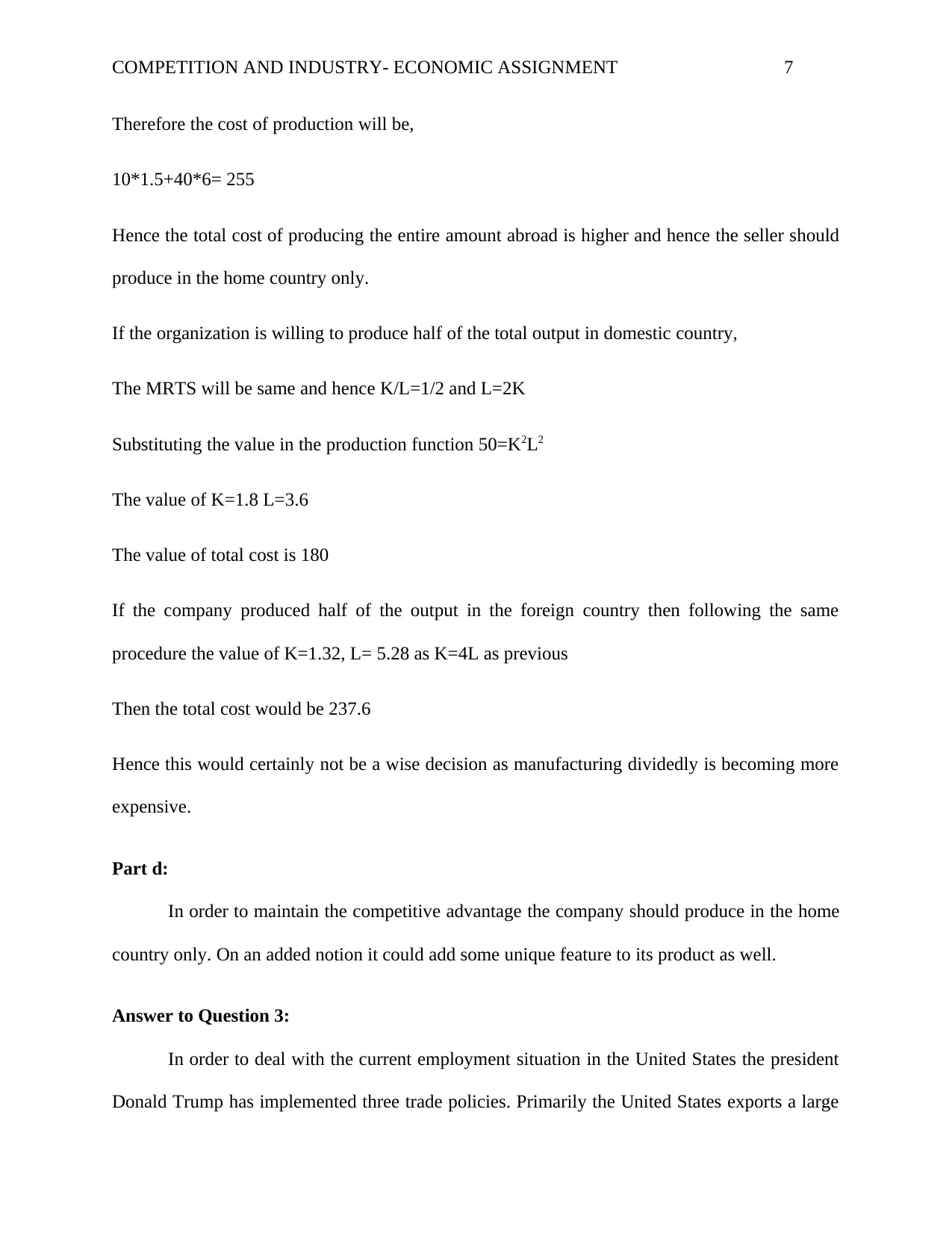
Therefore the cost of production will be,
10*1.5+40*6= 255
Hence the total cost of producing the entire amount abroad is higher and hence the seller should
produce in the home country only.
If the organization is willing to produce half of the total output in domestic country,
The MRTS will be same and hence K/L=1/2 and L=2K
Substituting the value in the production function 50=K2L2
The value of K=1.8 L=3.6
The value of total cost is 180
If the company produced half of the output in the foreign country then following the same
procedure the value of K=1.32, L= 5.28 as K=4L as previous
Then the total cost would be 237.6
Hence this would certainly not be a wise decision as manufacturing dividedly is becoming more
expensive.
Part d:
In order to maintain the competitive advantage the company should produce in the home
country only. On an added notion it could add some unique feature to its product as well.
Answer to Question 3:
In order to deal with the current employment situation in the United States the president
Donald Trump has implemented three trade policies. Primarily the United States exports a large
Therefore the cost of production will be,
10*1.5+40*6= 255
Hence the total cost of producing the entire amount abroad is higher and hence the seller should
produce in the home country only.
If the organization is willing to produce half of the total output in domestic country,
The MRTS will be same and hence K/L=1/2 and L=2K
Substituting the value in the production function 50=K2L2
The value of K=1.8 L=3.6
The value of total cost is 180
If the company produced half of the output in the foreign country then following the same
procedure the value of K=1.32, L= 5.28 as K=4L as previous
Then the total cost would be 237.6
Hence this would certainly not be a wise decision as manufacturing dividedly is becoming more
expensive.
Part d:
In order to maintain the competitive advantage the company should produce in the home
country only. On an added notion it could add some unique feature to its product as well.
Answer to Question 3:
In order to deal with the current employment situation in the United States the president
Donald Trump has implemented three trade policies. Primarily the United States exports a large

COMPETITION AND INDUSTRY- ECONOMIC ASSIGNMENT 8
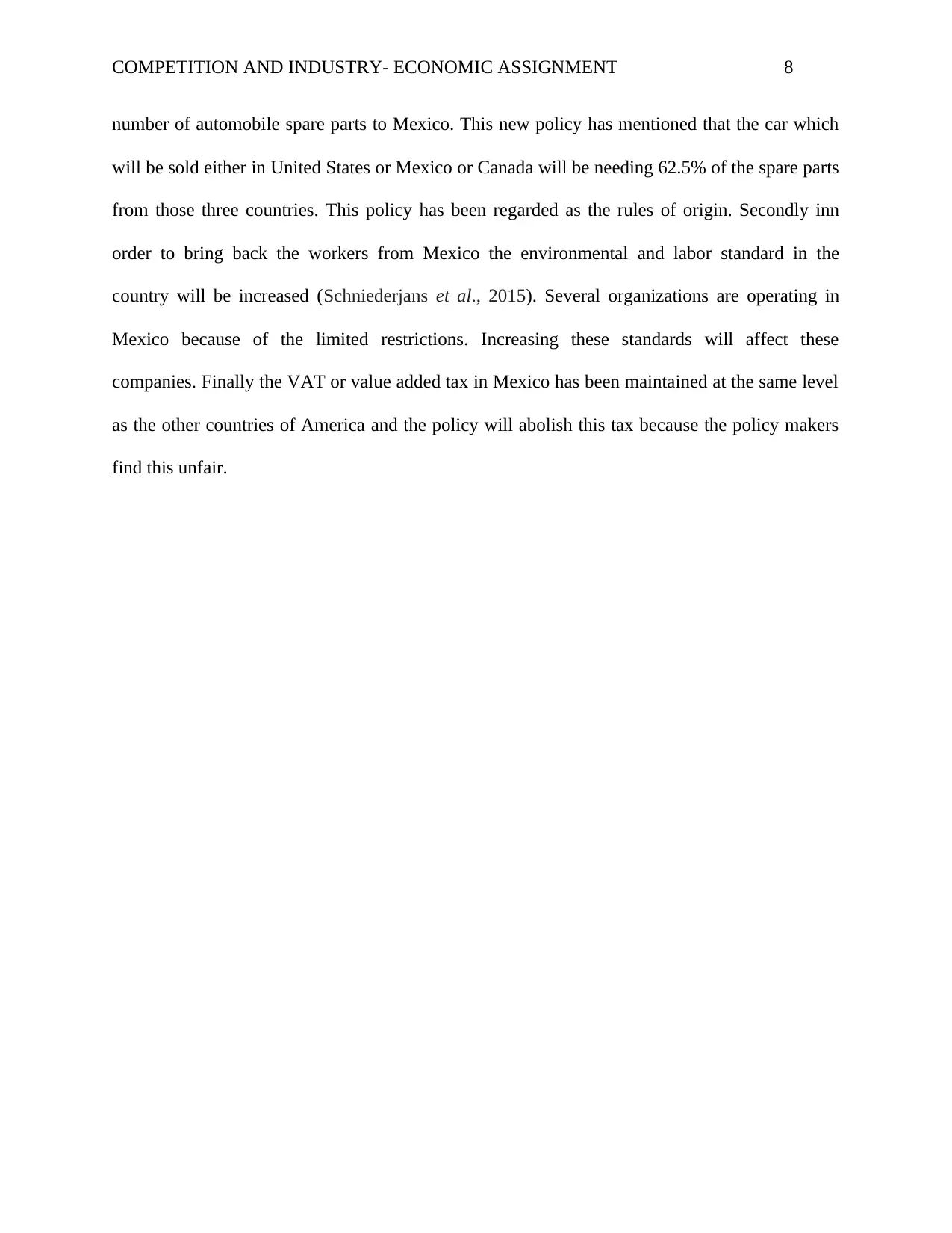
number of automobile spare parts to Mexico. This new policy has mentioned that the car which
will be sold either in United States or Mexico or Canada will be needing 62.5% of the spare parts
from those three countries. This policy has been regarded as the rules of origin. Secondly inn
order to bring back the workers from Mexico the environmental and labor standard in the
country will be increased (Schniederjans et al., 2015). Several organizations are operating in
Mexico because of the limited restrictions. Increasing these standards will affect these
companies. Finally the VAT or value added tax in Mexico has been maintained at the same level
as the other countries of America and the policy will abolish this tax because the policy makers
find this unfair.
number of automobile spare parts to Mexico. This new policy has mentioned that the car which
will be sold either in United States or Mexico or Canada will be needing 62.5% of the spare parts
from those three countries. This policy has been regarded as the rules of origin. Secondly inn
order to bring back the workers from Mexico the environmental and labor standard in the
country will be increased (Schniederjans et al., 2015). Several organizations are operating in
Mexico because of the limited restrictions. Increasing these standards will affect these
companies. Finally the VAT or value added tax in Mexico has been maintained at the same level
as the other countries of America and the policy will abolish this tax because the policy makers
find this unfair.
⊘ This is a preview!⊘
Do you want full access?
Subscribe today to unlock all pages.

Trusted by 1+ million students worldwide

COMPETITION AND INDUSTRY- ECONOMIC ASSIGNMENT 9
Reference List
Bandick, R., 2016. Offshoring, plant survival and employment growth. The World
Economy, 39(5), pp.597-620.
Clampit, J., Kedia, B., Fabian, F. and Gaffney, N., 2015. Offshoring satisfaction: The role of
partnership credibility and cultural complementarity. Journal of World Business, 50(1), pp.79-
93.
Gylling, M., Heikkilä, J., Jussila, K. and Saarinen, M., 2015. Making decisions on offshore
outsourcing and backshoring: A case study in the bicycle industry. International Journal of
Production Economics, 162, pp.92-100.
Kvedaraviciene, G. and Boguslauskas, V., 2015. Underestimated importance of cultural
differences in outsourcing arrangements. Engineering Economics, 21(2).
Mihalache, M. and Mihalache, O.R., 2016. A decisional framework of offshoring: integrating
insights from 25 years of research to provide direction for future. Decision Sciences, 47(6),
pp.1103-1149.
Moe, N.B., Šmite, D., Hanssen, G.K. and Barney, H., 2014. From offshore outsourcing to
insourcing and partnerships: four failed outsourcing attempts. Empirical Software
Engineering, 19(5), pp.1225-1258.
Musteen, M., 2016. Behavioral factors in offshoring decisions: A qualitative analysis. Journal of
Business Research, 69(9), pp.3439-3446.
Reference List
Bandick, R., 2016. Offshoring, plant survival and employment growth. The World
Economy, 39(5), pp.597-620.
Clampit, J., Kedia, B., Fabian, F. and Gaffney, N., 2015. Offshoring satisfaction: The role of
partnership credibility and cultural complementarity. Journal of World Business, 50(1), pp.79-
93.
Gylling, M., Heikkilä, J., Jussila, K. and Saarinen, M., 2015. Making decisions on offshore
outsourcing and backshoring: A case study in the bicycle industry. International Journal of
Production Economics, 162, pp.92-100.
Kvedaraviciene, G. and Boguslauskas, V., 2015. Underestimated importance of cultural
differences in outsourcing arrangements. Engineering Economics, 21(2).
Mihalache, M. and Mihalache, O.R., 2016. A decisional framework of offshoring: integrating
insights from 25 years of research to provide direction for future. Decision Sciences, 47(6),
pp.1103-1149.
Moe, N.B., Šmite, D., Hanssen, G.K. and Barney, H., 2014. From offshore outsourcing to
insourcing and partnerships: four failed outsourcing attempts. Empirical Software
Engineering, 19(5), pp.1225-1258.
Musteen, M., 2016. Behavioral factors in offshoring decisions: A qualitative analysis. Journal of
Business Research, 69(9), pp.3439-3446.
Paraphrase This Document
Need a fresh take? Get an instant paraphrase of this document with our AI Paraphraser

COMPETITION AND INDUSTRY- ECONOMIC ASSIGNMENT 10
Oshri, I., Kotlarsky, J. and Willcocks, L.P., 2015. Sourcing Models: What and When to
Outsource or Offshore. In The Handbook of Global Outsourcing and Offshoring (pp. 31-75).
Palgrave Macmillan, London.
Rodríguez, A. and Nieto, M.J., 2016. Does R&D offshoring lead to SME growth? Different
governance modes and the mediating role of innovation. Strategic Management Journal, 37(8),
pp.1734-1753.
Schniederjans, M.J., Schniederjans, A.M. and Schniederjans, D.G., 2015. Outsourcing and
insourcing in an international context. Routledge.
Oshri, I., Kotlarsky, J. and Willcocks, L.P., 2015. Sourcing Models: What and When to
Outsource or Offshore. In The Handbook of Global Outsourcing and Offshoring (pp. 31-75).
Palgrave Macmillan, London.
Rodríguez, A. and Nieto, M.J., 2016. Does R&D offshoring lead to SME growth? Different
governance modes and the mediating role of innovation. Strategic Management Journal, 37(8),
pp.1734-1753.
Schniederjans, M.J., Schniederjans, A.M. and Schniederjans, D.G., 2015. Outsourcing and
insourcing in an international context. Routledge.
1 out of 11
Related Documents
Your All-in-One AI-Powered Toolkit for Academic Success.
+13062052269
info@desklib.com
Available 24*7 on WhatsApp / Email
Unlock your academic potential
Copyright © 2020–2025 A2Z Services. All Rights Reserved. Developed and managed by ZUCOL.