Ineffective Breathing Nursing Care Plan: Post-operative Case Study

Verified

Added on  2023/03/29

|1
|314
|59
Case Study
AI Summary
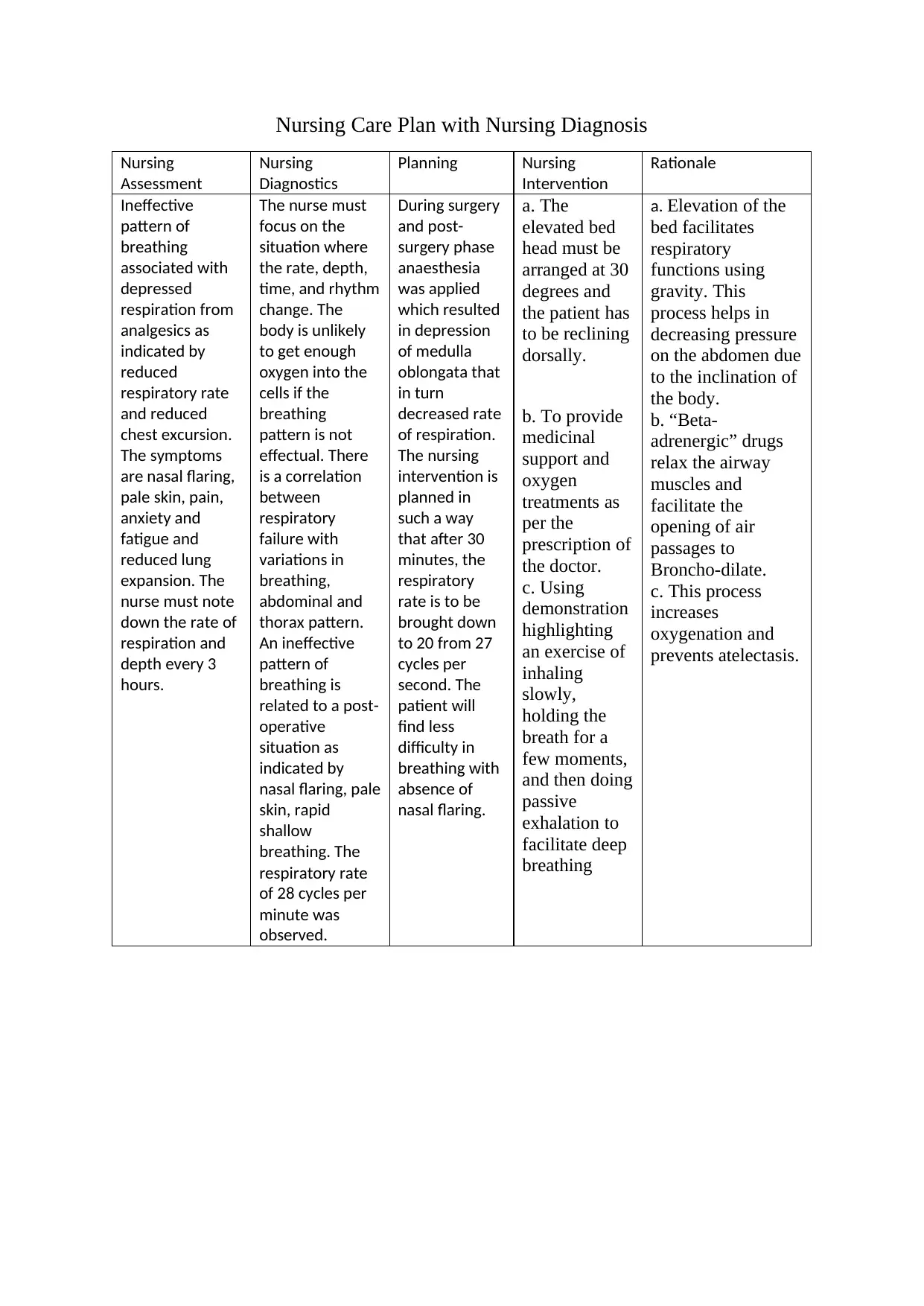
This case study presents a nursing care plan addressing an ineffective breathing pattern related to depressed respiration from analgesics following a surgical procedure. The nursing assessment identifies symptoms such as nasal flaring, pale skin, pain, anxiety, fatigue, reduced lung expansion, and a respiratory rate of 28 cycles per minute. The nursing diagnosis focuses on the mismatch between oxygen supply and demand due to the altered breathing pattern. The planned intervention aims to reduce the respiratory rate to 20 cycles per minute within 30 minutes, alleviating breathing difficulty and eliminating nasal flaring. Interventions include elevating the bed head to 30 degrees, administering prescribed medications and oxygen treatments, and demonstrating deep breathing exercises to improve oxygenation and prevent atelectasis. The rationale behind these interventions is to leverage gravity to ease respiratory effort, dilate airways with beta-adrenergic drugs, and promote alveolar expansion through controlled breathing techniques.
Document Page
Nursing Care Plan with Nursing Diagnosis
Nursing
Assessment
Nursing
Diagnostics
Planning Nursing
Intervention
Rationale
Ineffective
pattern of
breathing
associated with
depressed
respiration from
analgesics as
indicated by
reduced
respiratory rate
and reduced
chest excursion.
The symptoms
are nasal flaring,
pale skin, pain,
anxiety and
fatigue and
reduced lung
expansion. The
nurse must note
down the rate of
respiration and
depth every 3
hours.
The nurse must
focus on the
situation where
the rate, depth,
time, and rhythm
change. The
body is unlikely
to get enough
oxygen into the
cells if the
breathing
pattern is not
effectual. There
is a correlation
between
respiratory
failure with
variations in
breathing,
abdominal and
thorax pattern.
An ineffective
pattern of
breathing is
related to a post-
operative
situation as
indicated by
nasal flaring, pale
skin, rapid
shallow
breathing. The
respiratory rate
of 28 cycles per
minute was
observed.
During surgery
and post-
surgery phase
anaesthesia
was applied
which resulted
in depression
of medulla
oblongata that
in turn
decreased rate
of respiration.
The nursing
intervention is
planned in
such a way
that after 30
minutes, the
respiratory
rate is to be
brought down
to 20 from 27
cycles per
second. The
patient will
find less
difficulty in
breathing with
absence of
nasal flaring.
a. The
elevated bed
head must be
arranged at 30
degrees and
the patient has
to be reclining
dorsally.
b. To provide
medicinal
support and
oxygen
treatments as
per the
prescription of
the doctor.
c. Using
demonstration
highlighting
an exercise of
inhaling
slowly,
holding the
breath for a
few moments,
and then doing
passive
exhalation to
facilitate deep
breathing
a. Elevation of the
bed facilitates
respiratory
functions using
gravity. This
process helps in
decreasing pressure
on the abdomen due
to the inclination of
the body.
b. “Beta-
adrenergic” drugs
relax the airway
muscles and
facilitate the
opening of air
passages to
Broncho-dilate.
c. This process
increases
oxygenation and
prevents atelectasis.
tabler-icon-diamond-filled.svg

Paraphrase This Document

Need a fresh take? Get an instant paraphrase of this document with our AI Paraphraser
[object Object]