The Impact of Ineffective Discharge Planning on Patient Outcomes

Verified

Added on  2020/05/28

|3
|419
|32
Report
AI Summary
This report explores the effects of ineffective discharge planning on hospital readmissions and patient outcomes. It highlights that poor discharge planning can lead to increased readmission rates, as well as negatively impacting patient care and the families. The report identifies the key factors contributing to ineffective discharge planning, such as inadequate staff training and communication breakdowns. The report discusses the impact of these issues on healthcare professionals, patients, and their families. It emphasizes the importance of research in this area to develop effective discharge planning policies and procedures. The report aims to provide insights into the causes of ineffective discharge planning and suggest solutions, such as improved staff training and better communication strategies, to enhance the quality of care and ensure a smoother discharge process. By addressing these issues, hospitals can improve patient outcomes and reduce the burden on healthcare systems.
Document Page
Running head: EFFECTS OF INEFFECTIVE DISCHARGE PLANNING 1
Effects of Ineffective Discharge Planning in Hospitals
Name:
Institutional Affiliation:
tabler-icon-diamond-filled.svg

Paraphrase This Document

Need a fresh take? Get an instant paraphrase of this document with our AI Paraphraser
Document Page
EFFECTS OF INEFFECTIVE DISCHARGE PLANNING 2
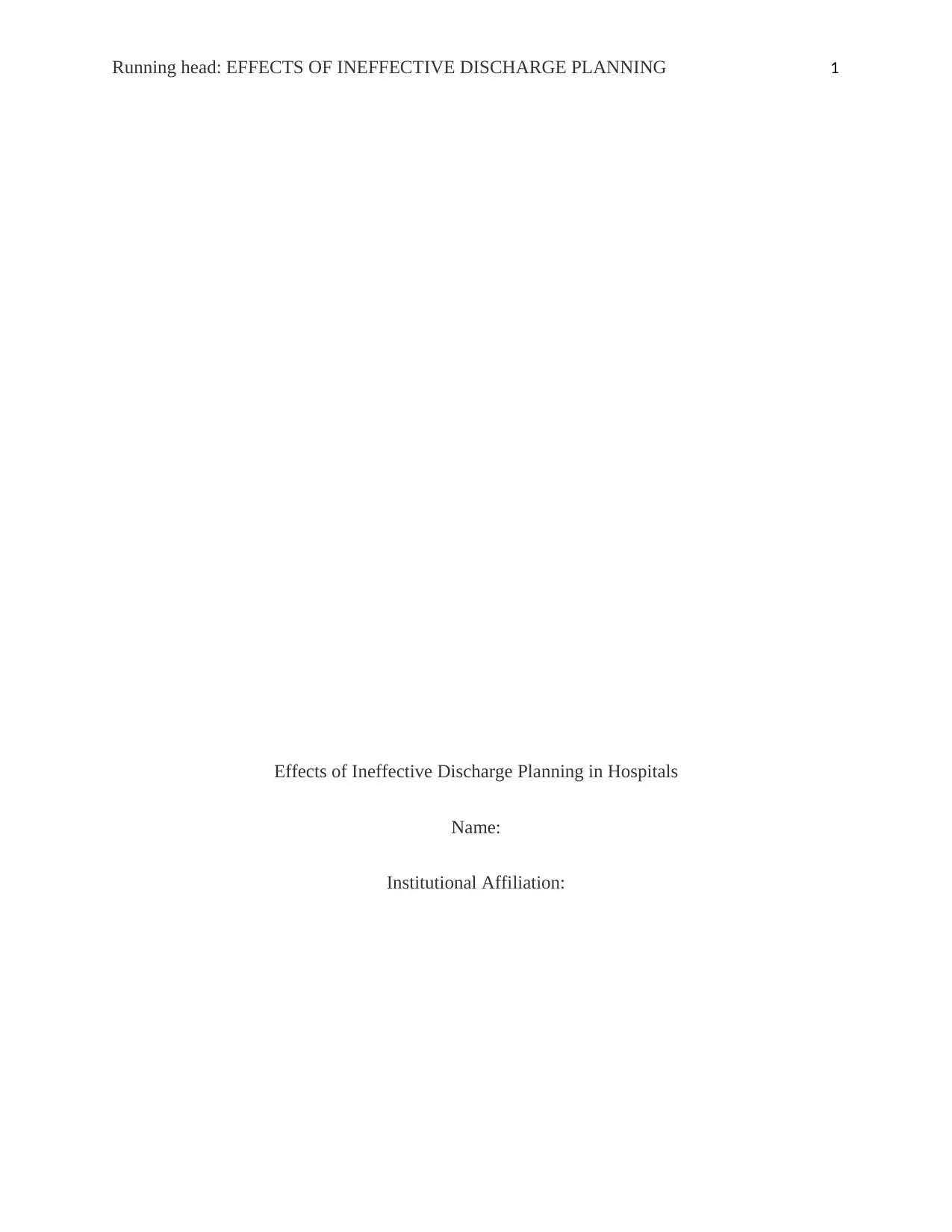
Effects of Ineffective Discharge Planning in Hospitals
Description of Barrier
Discharge planning is a very crucial step in hospitals. Lacking policies or procedures for
discharging patients can be a barrier to effective hospital administration. This is because it leads
to low quality care for admitted patients and this eventually results in re-admission. Some of the
challenges faced by hospitals are that health professionals lack the proper understanding of
discharge procedures (Coleman & Roman, 2015). This will also be a revelation to the myriad of
issues that occur due to ineffective discharge planning in hospitals.
Stakeholders Affected
Discharge planning in hospitals affects healthcare professionals, caregivers, patients
and their families. Patient caregivers will constantly be faced with challenges as they have to
keep taking their patient back to the hospital due to relapses. It also leads to longer recovery
times, which puts a strain on the patient. Families are affected as they will be stressed and the
amount of finances used will increase drastically (Hessenlik et al., 2014). All these factors can
lead to communication breakdowns between all the parties.
Relevance of Problem as Relates to Research
It is important to carry out a research on discharge planning, as it will provide an insight
into causes of ineffective discharge planning. It will also suggest solutions to the problem by
giving recommendations on how hospitals can put up effective discharge planning policies and
procedures (Hessenlik et al., 2014). Hospitals will also focus on improving the communication
skills and knowledge of their staff concerning providing quality care that will eventually lead to
a smooth discharge process.
Document Page
EFFECTS OF INEFFECTIVE DISCHARGE PLANNING 3
References
Coleman, E. A., & Roman, S. P. (2015). Family caregivers' experiences during transitions out of
hospital. Journal for Healthcare Quality, 37(1), 12-21.
Hesselink, G., Zegers, M., Vernooij-Dassen, M., Barach, P., Kalkman, C., Flink, M. & Suñol, R.
(2014). Improving patient discharge and reducing hospital readmissions by using
Intervention Mapping. BMC health services research, 14(1), 389.
chevron_up_icon
1 out of 3
circle_padding
hide_on_mobile
zoom_out_icon
[object Object]