Swinburne INF30029: Reflective Paper on Team Project Management
VerifiedAdded on 2023/06/12
|13
|3693
|81
Report
AI Summary
This research paper reflects on the experiences of a researcher within a project team, focusing on project management and team cooperation. It analyzes project management concepts, team member dynamics, team composition, and the social processes that impact team performance. The paper highlights the importance of effective communication, leadership, and diverse team composition in achieving project success. It also explores the challenges encountered due to a lack of initial social processes and proposes solutions based on academic theories. The researcher emphasizes the significance of team cognition and the need for tools that facilitate social interaction within diverse teams to leverage their potential for creativity and innovation. This document is available on Desklib, a platform offering a wide range of study resources for students.
Research & Reflective Paper
on Team Project
Name:
Register Number:
Guide:
on Team Project
Name:
Register Number:
Guide:

Paraphrase This Document
Need a fresh take? Get an instant paraphrase of this document with our AI Paraphraser
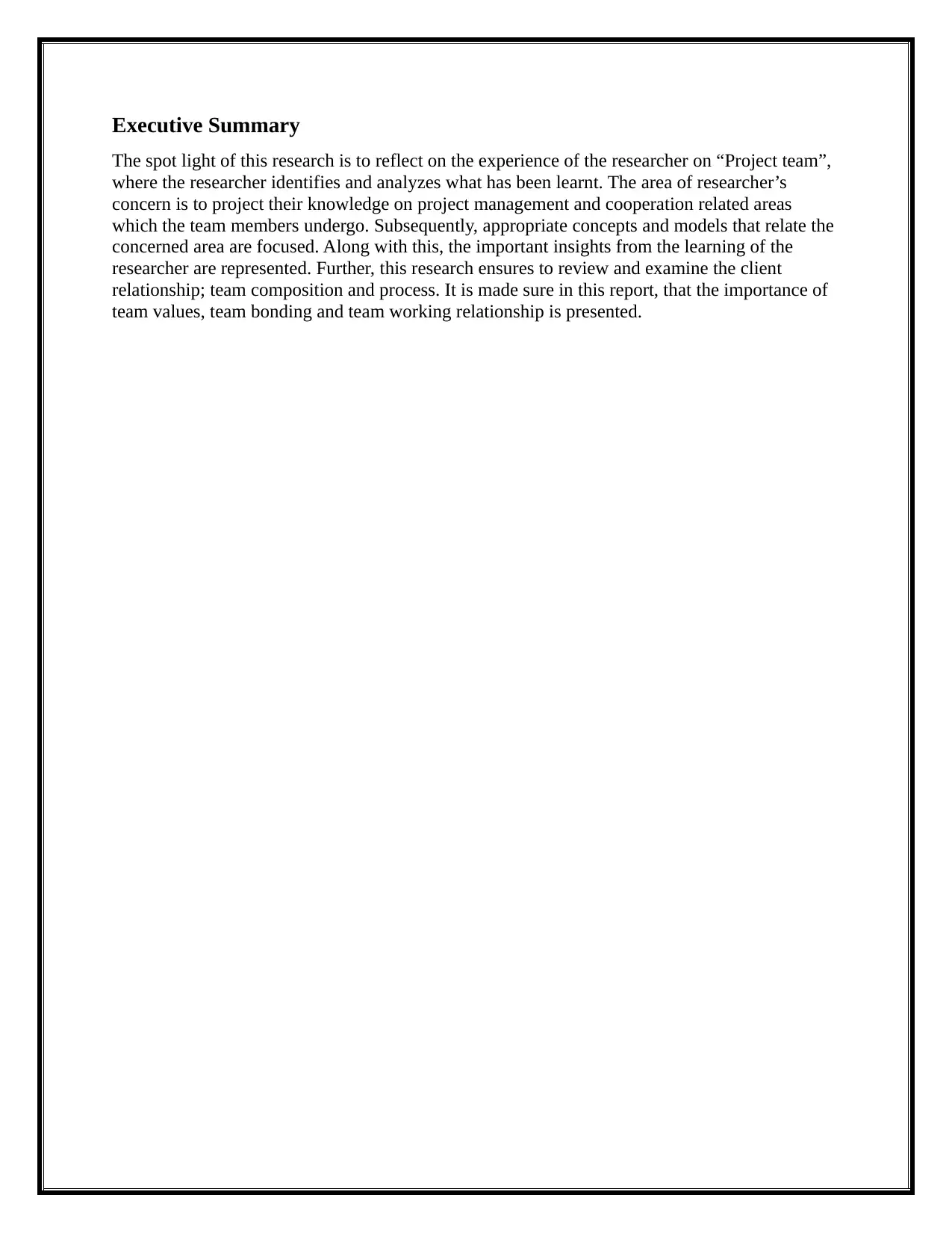
Executive Summary
The spot light of this research is to reflect on the experience of the researcher on “Project team”,
where the researcher identifies and analyzes what has been learnt. The area of researcher’s
concern is to project their knowledge on project management and cooperation related areas
which the team members undergo. Subsequently, appropriate concepts and models that relate the
concerned area are focused. Along with this, the important insights from the learning of the
researcher are represented. Further, this research ensures to review and examine the client
relationship; team composition and process. It is made sure in this report, that the importance of
team values, team bonding and team working relationship is presented.
The spot light of this research is to reflect on the experience of the researcher on “Project team”,
where the researcher identifies and analyzes what has been learnt. The area of researcher’s
concern is to project their knowledge on project management and cooperation related areas
which the team members undergo. Subsequently, appropriate concepts and models that relate the
concerned area are focused. Along with this, the important insights from the learning of the
researcher are represented. Further, this research ensures to review and examine the client
relationship; team composition and process. It is made sure in this report, that the importance of
team values, team bonding and team working relationship is presented.
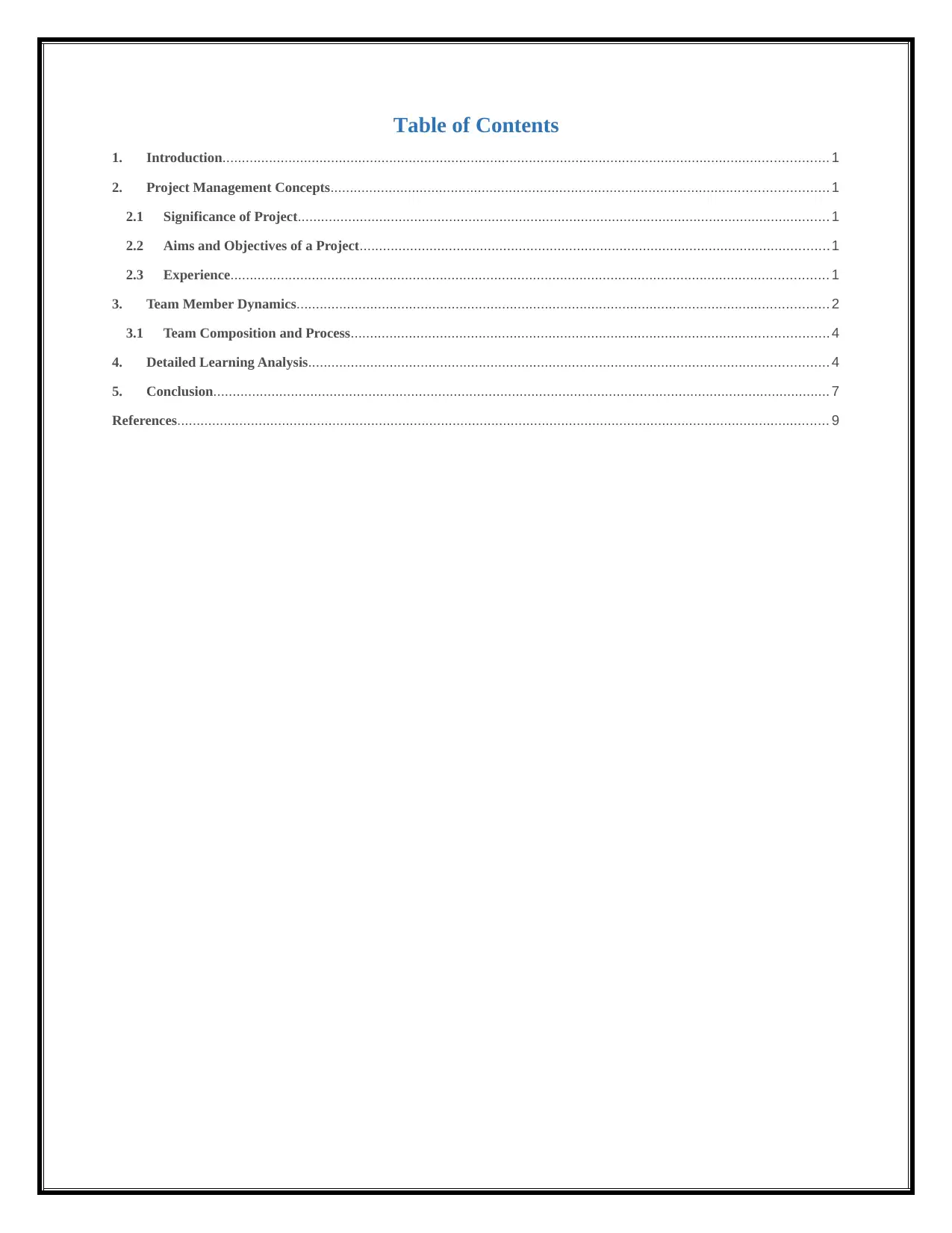
Table of Contents
1. Introduction............................................................................................................................................................ 1
2. Project Management Concepts................................................................................................................................ 1
2.1 Significance of Project......................................................................................................................................... 1
2.2 Aims and Objectives of a Project.........................................................................................................................1
2.3 Experience.......................................................................................................................................................... 1
3. Team Member Dynamics......................................................................................................................................... 2
3.1 Team Composition and Process...........................................................................................................................4
4. Detailed Learning Analysis...................................................................................................................................... 4
5. Conclusion............................................................................................................................................................... 7
References........................................................................................................................................................................ 9
1. Introduction............................................................................................................................................................ 1
2. Project Management Concepts................................................................................................................................ 1
2.1 Significance of Project......................................................................................................................................... 1
2.2 Aims and Objectives of a Project.........................................................................................................................1
2.3 Experience.......................................................................................................................................................... 1
3. Team Member Dynamics......................................................................................................................................... 2
3.1 Team Composition and Process...........................................................................................................................4
4. Detailed Learning Analysis...................................................................................................................................... 4
5. Conclusion............................................................................................................................................................... 7
References........................................................................................................................................................................ 9
⊘ This is a preview!⊘
Do you want full access?
Subscribe today to unlock all pages.

Trusted by 1+ million students worldwide
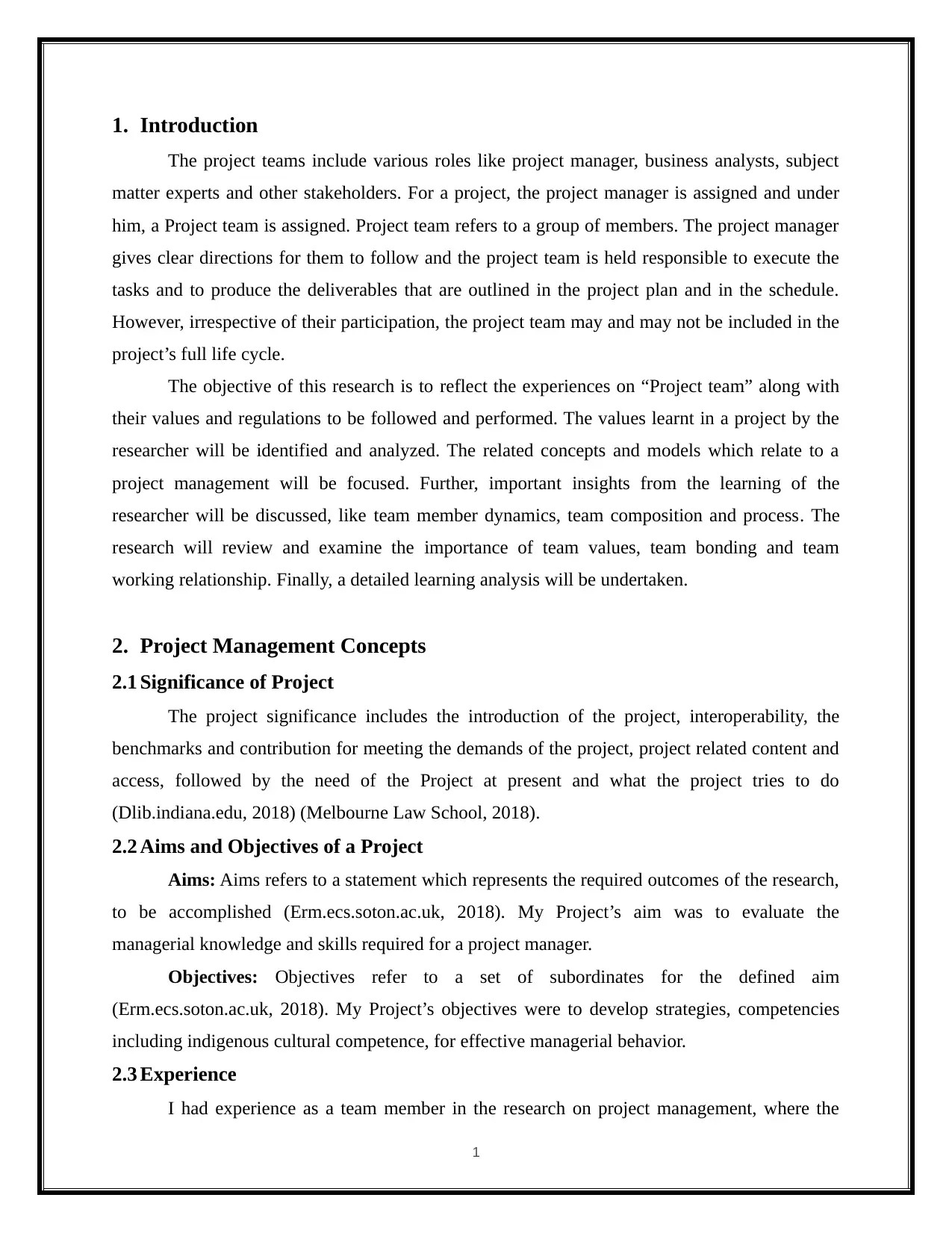
1. Introduction
The project teams include various roles like project manager, business analysts, subject
matter experts and other stakeholders. For a project, the project manager is assigned and under
him, a Project team is assigned. Project team refers to a group of members. The project manager
gives clear directions for them to follow and the project team is held responsible to execute the
tasks and to produce the deliverables that are outlined in the project plan and in the schedule.
However, irrespective of their participation, the project team may and may not be included in the
project’s full life cycle.
The objective of this research is to reflect the experiences on “Project team” along with
their values and regulations to be followed and performed. The values learnt in a project by the
researcher will be identified and analyzed. The related concepts and models which relate to a
project management will be focused. Further, important insights from the learning of the
researcher will be discussed, like team member dynamics, team composition and process. The
research will review and examine the importance of team values, team bonding and team
working relationship. Finally, a detailed learning analysis will be undertaken.
2. Project Management Concepts
2.1 Significance of Project
The project significance includes the introduction of the project, interoperability, the
benchmarks and contribution for meeting the demands of the project, project related content and
access, followed by the need of the Project at present and what the project tries to do
(Dlib.indiana.edu, 2018) (Melbourne Law School, 2018).
2.2 Aims and Objectives of a Project
Aims: Aims refers to a statement which represents the required outcomes of the research,
to be accomplished (Erm.ecs.soton.ac.uk, 2018). My Project’s aim was to evaluate the
managerial knowledge and skills required for a project manager.
Objectives: Objectives refer to a set of subordinates for the defined aim
(Erm.ecs.soton.ac.uk, 2018). My Project’s objectives were to develop strategies, competencies
including indigenous cultural competence, for effective managerial behavior.
2.3 Experience
I had experience as a team member in the research on project management, where the
1
The project teams include various roles like project manager, business analysts, subject
matter experts and other stakeholders. For a project, the project manager is assigned and under
him, a Project team is assigned. Project team refers to a group of members. The project manager
gives clear directions for them to follow and the project team is held responsible to execute the
tasks and to produce the deliverables that are outlined in the project plan and in the schedule.
However, irrespective of their participation, the project team may and may not be included in the
project’s full life cycle.
The objective of this research is to reflect the experiences on “Project team” along with
their values and regulations to be followed and performed. The values learnt in a project by the
researcher will be identified and analyzed. The related concepts and models which relate to a
project management will be focused. Further, important insights from the learning of the
researcher will be discussed, like team member dynamics, team composition and process. The
research will review and examine the importance of team values, team bonding and team
working relationship. Finally, a detailed learning analysis will be undertaken.
2. Project Management Concepts
2.1 Significance of Project
The project significance includes the introduction of the project, interoperability, the
benchmarks and contribution for meeting the demands of the project, project related content and
access, followed by the need of the Project at present and what the project tries to do
(Dlib.indiana.edu, 2018) (Melbourne Law School, 2018).
2.2 Aims and Objectives of a Project
Aims: Aims refers to a statement which represents the required outcomes of the research,
to be accomplished (Erm.ecs.soton.ac.uk, 2018). My Project’s aim was to evaluate the
managerial knowledge and skills required for a project manager.
Objectives: Objectives refer to a set of subordinates for the defined aim
(Erm.ecs.soton.ac.uk, 2018). My Project’s objectives were to develop strategies, competencies
including indigenous cultural competence, for effective managerial behavior.
2.3 Experience
I had experience as a team member in the research on project management, where the
1
Paraphrase This Document
Need a fresh take? Get an instant paraphrase of this document with our AI Paraphraser
tasks were divided among the team members. The aim acts as the purpose of the study, which is
defined clearly in a short form, whereas, the objectives comprises of the steps that must be
answered to the question of the research. First, the aim is defined and then the objectives. Aims
can be two to three, but the objectives must be comparatively more in number. The project’s aims
and objectives are significant areas which help the readers to know the purpose of the project and
for the researcher to stay on the track.
Risks/Problems Encountered:
The main problem was where to start the research and what are the necessary
requirements for evaluating the managerial knowledge and skills of an individual.
Description:
I decided to work with my team members on this problem and our research lead us to
Thomas-Kilmann Conflict Mode Instrument which effectively assesses an individual’s
behaviour, in conflict struck circumstances. Because, a project manager must effectively handle
conflicts.
3. Team Member Dynamics
Team Dynamics which Worked and Why?
The Team dynamics is essential in a team as it help to build motivation and increases the
driving forces which pushes the team members toward their target (Tolstoy and Karenina, 2018).
The team dynamics which worked for us in our project includes:
1) Identifying an apt leader
2) Establishing roles and responsibilities
3) Discussing each other’s results or work, on a fixed date, time and place.
4) Establish a set of goals and objectives.
5) Deadlines for completion the defined tasks.
Insights to be carried into the Future Projects
I wish to carry all the above mentioned team dynamics, as they are the basic elements and
are highly essential aspects to be followed by the team members. These team dynamics will
benefit to discipline the team members.
Key Team Dynamics which Impacted Team’s Performance
2
defined clearly in a short form, whereas, the objectives comprises of the steps that must be
answered to the question of the research. First, the aim is defined and then the objectives. Aims
can be two to three, but the objectives must be comparatively more in number. The project’s aims
and objectives are significant areas which help the readers to know the purpose of the project and
for the researcher to stay on the track.
Risks/Problems Encountered:
The main problem was where to start the research and what are the necessary
requirements for evaluating the managerial knowledge and skills of an individual.
Description:
I decided to work with my team members on this problem and our research lead us to
Thomas-Kilmann Conflict Mode Instrument which effectively assesses an individual’s
behaviour, in conflict struck circumstances. Because, a project manager must effectively handle
conflicts.
3. Team Member Dynamics
Team Dynamics which Worked and Why?
The Team dynamics is essential in a team as it help to build motivation and increases the
driving forces which pushes the team members toward their target (Tolstoy and Karenina, 2018).
The team dynamics which worked for us in our project includes:
1) Identifying an apt leader
2) Establishing roles and responsibilities
3) Discussing each other’s results or work, on a fixed date, time and place.
4) Establish a set of goals and objectives.
5) Deadlines for completion the defined tasks.
Insights to be carried into the Future Projects
I wish to carry all the above mentioned team dynamics, as they are the basic elements and
are highly essential aspects to be followed by the team members. These team dynamics will
benefit to discipline the team members.
Key Team Dynamics which Impacted Team’s Performance
2
Positive Key Team Dynamics:
The key team dynamic which helped our team includes (Hale, 2012):
Direct communication, where no one is dominating and allows all the team members to both talk
and listen. This created high interaction and energy for the team.
Negative Key Team Dynamics:
The negative team dynamics is individual contribution, because in a team all must work
as a team with their available skills and knowledge. The individual contribution was not effective
when compared to a successful communication patterns in a team.
Explanation on how it was managed:
Team dynamics worked well for us due to our leader’s leadership qualities like integrity,
cooperation, letting the team speak and focusing on the target (Briantracy.com, 2018). Moreover,
decision-Making Capabilities, accountability of all the team member and empathy has helped to
manage the above mentioned key team dynamics (Hasan, 2017).
Key Learning Outcomes
The key learning outcomes includes:
1) The leader must be selected wisely based on his or her leadership qualities.
2) The knowledge of each team member is important and beneficial for the team,
which must be heard and discussed with the other team members.
3) Both team and individual performance go hand-in-hand, in a team dynamics
(Myers, 2013).
4) Team dynamics refer to certain forces which takes place unconsciously and
psychological influences to direct the team’s behaviour and performance (Myers,
2013).
5) Energetic participation of the team plays a vital role (Williams, 2017).
6) Roles of the team must be defined clearly (Villanovau.com, 2018).
7) The team must be made aware on the aim and deadline of the project, to work
effectively.
8) The team members are required to put their individual responsibilities, to increase
the performance of the project (IT Portfolio Management, 2018).
9) It is necessary to have cooperation between the team members for working
effectively on the project and it discards conflicts too (Inloox.com, 2018).
3
The key team dynamic which helped our team includes (Hale, 2012):
Direct communication, where no one is dominating and allows all the team members to both talk
and listen. This created high interaction and energy for the team.
Negative Key Team Dynamics:
The negative team dynamics is individual contribution, because in a team all must work
as a team with their available skills and knowledge. The individual contribution was not effective
when compared to a successful communication patterns in a team.
Explanation on how it was managed:
Team dynamics worked well for us due to our leader’s leadership qualities like integrity,
cooperation, letting the team speak and focusing on the target (Briantracy.com, 2018). Moreover,
decision-Making Capabilities, accountability of all the team member and empathy has helped to
manage the above mentioned key team dynamics (Hasan, 2017).
Key Learning Outcomes
The key learning outcomes includes:
1) The leader must be selected wisely based on his or her leadership qualities.
2) The knowledge of each team member is important and beneficial for the team,
which must be heard and discussed with the other team members.
3) Both team and individual performance go hand-in-hand, in a team dynamics
(Myers, 2013).
4) Team dynamics refer to certain forces which takes place unconsciously and
psychological influences to direct the team’s behaviour and performance (Myers,
2013).
5) Energetic participation of the team plays a vital role (Williams, 2017).
6) Roles of the team must be defined clearly (Villanovau.com, 2018).
7) The team must be made aware on the aim and deadline of the project, to work
effectively.
8) The team members are required to put their individual responsibilities, to increase
the performance of the project (IT Portfolio Management, 2018).
9) It is necessary to have cooperation between the team members for working
effectively on the project and it discards conflicts too (Inloox.com, 2018).
3
⊘ This is a preview!⊘
Do you want full access?
Subscribe today to unlock all pages.
Trusted by 1+ million students worldwide
10) However, the pre-existing friendship could create strong impact on all the team
member, either in a positive or a negative way (Sqa.org.uk, 2018).
3.1 Team Composition and Process
Aspects which Worked Well:
The one aspect which mainly worked for our team is diverse team members. As, diversity
helped to get new ideas for the project.
It is observed from various researches that a team which is more diverse tends to perform
better when compared to a team whose team members are more homogenous (Mumford, 2012)
(Coursera, 2018).
Aspects which Didn’t Work so Well:
However, the other aspect of the diversity is social process which impacted on our
performance. The social processes can disrupt the team, if the team is not established well. This
aspect lead to loss of productivity in the beginning. Because, it takes time for people to know
each other, resolve their conflicts and have proper communication. Initially, this factors impacted
by dividing our team into sub groups.
According to my weekly progress reports I am good at interacting with people, this
quality of mine will help to gel well with the diverse team members. Finally, it will result in
development of effective social processes in less time.
4. Detailed Learning Analysis
The team composition is necessary factor which has to be focused. In our team, we
experienced team composition diversity which helped us to get ideas only after developing social
processes among the team members. Prior to social process like open communication, it was
difficult to know what is happening and where the project is directed. Moreover, our team was
sub divided among ourselves based on understandings. This was a threat for the team and its
productivity.
Why this Event/Situation Occurred?
From the analysis, it is understood that the team composition diversity must interact with
4
member, either in a positive or a negative way (Sqa.org.uk, 2018).
3.1 Team Composition and Process
Aspects which Worked Well:
The one aspect which mainly worked for our team is diverse team members. As, diversity
helped to get new ideas for the project.
It is observed from various researches that a team which is more diverse tends to perform
better when compared to a team whose team members are more homogenous (Mumford, 2012)
(Coursera, 2018).
Aspects which Didn’t Work so Well:
However, the other aspect of the diversity is social process which impacted on our
performance. The social processes can disrupt the team, if the team is not established well. This
aspect lead to loss of productivity in the beginning. Because, it takes time for people to know
each other, resolve their conflicts and have proper communication. Initially, this factors impacted
by dividing our team into sub groups.
According to my weekly progress reports I am good at interacting with people, this
quality of mine will help to gel well with the diverse team members. Finally, it will result in
development of effective social processes in less time.
4. Detailed Learning Analysis
The team composition is necessary factor which has to be focused. In our team, we
experienced team composition diversity which helped us to get ideas only after developing social
processes among the team members. Prior to social process like open communication, it was
difficult to know what is happening and where the project is directed. Moreover, our team was
sub divided among ourselves based on understandings. This was a threat for the team and its
productivity.
Why this Event/Situation Occurred?
From the analysis, it is understood that the team composition diversity must interact with
4
Paraphrase This Document
Need a fresh take? Get an instant paraphrase of this document with our AI Paraphraser
various types of social processes in a way that the teams could capitalize on the benefits of
diversity, only if they engage in effective social processes like, “Open communication”, which
was not carried out in the initial stage of our project.
Appropriate Academic Theory
According to Reiter-Palmon, Wiger and de Vreede, any team must provide tools which
facilitates the social processes like effective leadership and training. This will allow to realize the
team composition diversity’s positive effects (Mumford, 2012).
The empirical work is conducted and its impact of team cognition on the creativity and
innovation of the team is projected. When the individual cognitive processes are researched, the
research has observed that creativity and innovation dominates more. The authors consider team
cognition as new interest which is been related with team composition. Various important points
emerge from the research such as- Team cognitive processes are concentrated on the social
cognition; then, there exists interrelation between the team cognitive processes’ various
dimensions; Time could play a vital role on these cognitive processes; The team cognitive
processes could influence, it can get influenced and can interact with the team social processes;
and the team cognitive processes could mediate or moderate the association among the team
composition, team creativity and team innovation.
Generally, the cognitive processes are linked with the skills like creative problem solving,
For example, the natural progressions like idea generation, problem construction and evaluation
and selection of idea.
The results of various researches show that the team which is more diverse tends to
perform better, when compared to the team whose team members are more homogenous.
Even according to (Zarzu, Scarlat and Falcıoğlu, 2013), team composition is identified as
an important factor which has influence on the performance of the team. The same view is shared
by Senior, (1997) and Belbin, (2002). Further, the team composition is said that it not just
questions what the individuals of the team bring to the group. For instance, skill, experience,
ability, role and so on. Instead, it also questions whether the capabilities of these individuals
when combined could increase the performance of the team, as a whole or not. Here the authors
have concentrated on reviews of various research papers, which concentrates on size of the team,
combined characteristics of the members and member heterogeneity.
5
diversity, only if they engage in effective social processes like, “Open communication”, which
was not carried out in the initial stage of our project.
Appropriate Academic Theory
According to Reiter-Palmon, Wiger and de Vreede, any team must provide tools which
facilitates the social processes like effective leadership and training. This will allow to realize the
team composition diversity’s positive effects (Mumford, 2012).
The empirical work is conducted and its impact of team cognition on the creativity and
innovation of the team is projected. When the individual cognitive processes are researched, the
research has observed that creativity and innovation dominates more. The authors consider team
cognition as new interest which is been related with team composition. Various important points
emerge from the research such as- Team cognitive processes are concentrated on the social
cognition; then, there exists interrelation between the team cognitive processes’ various
dimensions; Time could play a vital role on these cognitive processes; The team cognitive
processes could influence, it can get influenced and can interact with the team social processes;
and the team cognitive processes could mediate or moderate the association among the team
composition, team creativity and team innovation.
Generally, the cognitive processes are linked with the skills like creative problem solving,
For example, the natural progressions like idea generation, problem construction and evaluation
and selection of idea.
The results of various researches show that the team which is more diverse tends to
perform better, when compared to the team whose team members are more homogenous.
Even according to (Zarzu, Scarlat and Falcıoğlu, 2013), team composition is identified as
an important factor which has influence on the performance of the team. The same view is shared
by Senior, (1997) and Belbin, (2002). Further, the team composition is said that it not just
questions what the individuals of the team bring to the group. For instance, skill, experience,
ability, role and so on. Instead, it also questions whether the capabilities of these individuals
when combined could increase the performance of the team, as a whole or not. Here the authors
have concentrated on reviews of various research papers, which concentrates on size of the team,
combined characteristics of the members and member heterogeneity.
5
It is possible to operationalize the team diversity in various methods like, average of the
construct across team members and highest scoring team members. These operationalizations
might direct towards diverse results related to the impact of diversity. For instance, the team
which comprises of members who have high creativity could perform better. However, the
cognitive style, diversity in styles was correlated with creativity
Therefore, the “team composition” contains a complex combination of member attributes.
Deeper Insights
The selected concept is team composition diverse. For our team members, the team
composition diversity supported in the later stage of the project, to gain new ideas for the project.
This is because, the diverse team members had no close interaction before the formation
of team. Each one of them were unique and it took a while to understand each other and their
perspectives towards their recommended ideas. The results of various researches on team refers
that more diverse members tends to perform better when compared to a team whose team
members are more homogenous. This is a concept which must be looked carefully, as the point is
true but it might take some time to see the actual results. Thus time plays a role here. The other
aspect of the diversity is social process, which impacted on our performance. The social
processes surely disrupted our team and thus if the team is not established well it is difficult to
get productive results.
Moreover, it was mentioned that this very aspect lead our team to productivity loss, in the
beginning. Time plays the following role- time is needed to understand and gel with the team
members for coordination. Coordination will help to cooperate with each other which is very
important for any productive team. This can also discard any conflicts or misunderstanding of an
individual’s characteristics. The team leader can know the skills and capabilities of the
individuals during the social processes and utilize this event to define the roles and
responsibilities of each team members.
Our team initially was impacted with division of the team into sub groups. If the social
processes like open communication takes place this division can be eliminated. As a whole
communication, cooperation, accountability, individual’s skills and other attributes play a major
role in a team. The responsibility of the team leader is high here, as “team composition” is
complicated, which comprises of complex combination of member attributes.
6
construct across team members and highest scoring team members. These operationalizations
might direct towards diverse results related to the impact of diversity. For instance, the team
which comprises of members who have high creativity could perform better. However, the
cognitive style, diversity in styles was correlated with creativity
Therefore, the “team composition” contains a complex combination of member attributes.
Deeper Insights
The selected concept is team composition diverse. For our team members, the team
composition diversity supported in the later stage of the project, to gain new ideas for the project.
This is because, the diverse team members had no close interaction before the formation
of team. Each one of them were unique and it took a while to understand each other and their
perspectives towards their recommended ideas. The results of various researches on team refers
that more diverse members tends to perform better when compared to a team whose team
members are more homogenous. This is a concept which must be looked carefully, as the point is
true but it might take some time to see the actual results. Thus time plays a role here. The other
aspect of the diversity is social process, which impacted on our performance. The social
processes surely disrupted our team and thus if the team is not established well it is difficult to
get productive results.
Moreover, it was mentioned that this very aspect lead our team to productivity loss, in the
beginning. Time plays the following role- time is needed to understand and gel with the team
members for coordination. Coordination will help to cooperate with each other which is very
important for any productive team. This can also discard any conflicts or misunderstanding of an
individual’s characteristics. The team leader can know the skills and capabilities of the
individuals during the social processes and utilize this event to define the roles and
responsibilities of each team members.
Our team initially was impacted with division of the team into sub groups. If the social
processes like open communication takes place this division can be eliminated. As a whole
communication, cooperation, accountability, individual’s skills and other attributes play a major
role in a team. The responsibility of the team leader is high here, as “team composition” is
complicated, which comprises of complex combination of member attributes.
6
⊘ This is a preview!⊘
Do you want full access?
Subscribe today to unlock all pages.
Trusted by 1+ million students worldwide
The levels of conceptualization, measurement, and analysis are ignored for team
composition, in many research papers. This is important as the considerable usage of averaging
the additive models for guiding aggregation of individual characteristics, for the team level could
suggests a very limited conceptualization of the compositional construct at the higher level
(Orgcom14.hciresearch.org, 2018).
What combination of team member’s attribute can work well is highly critical to
understand and hence it must be articulated carefully. At the team level, a well-defined models of
emergence must guide the representation of individual-level characteristics. Certain theoretical
research have developed models for skills, knowledge and abilities that are necessary for the
individuals in the team. However, the results of the association is still unknown. The reason for
such complexity is problem to find the samples which has adequate number of teams, and the
next reason is that the concentration is mainly on the team and not on the team members.
New Learning
The new learning which will influences the researcher in future includes:
1) Team composition is essential but a complicated and the results vary.
2) For a project, provide and gather information by getting feedbacks for project
planning.
3) Based on the effective planed designed work on the project.
4) Define the roles and responsibilities according to the skills and capabilities of the
individuals present in the team.
5) Make sure to analyze the processes and carry out documentation as and when
required. This will help the project in a long run and also benefit in the future
projects.
6) Provide the required social processes for the team.
7) Share the status of the Project with the team.
8) Increase collaboration of work with the other team members, for meeting the
project’s goals and objectives.
7
composition, in many research papers. This is important as the considerable usage of averaging
the additive models for guiding aggregation of individual characteristics, for the team level could
suggests a very limited conceptualization of the compositional construct at the higher level
(Orgcom14.hciresearch.org, 2018).
What combination of team member’s attribute can work well is highly critical to
understand and hence it must be articulated carefully. At the team level, a well-defined models of
emergence must guide the representation of individual-level characteristics. Certain theoretical
research have developed models for skills, knowledge and abilities that are necessary for the
individuals in the team. However, the results of the association is still unknown. The reason for
such complexity is problem to find the samples which has adequate number of teams, and the
next reason is that the concentration is mainly on the team and not on the team members.
New Learning
The new learning which will influences the researcher in future includes:
1) Team composition is essential but a complicated and the results vary.
2) For a project, provide and gather information by getting feedbacks for project
planning.
3) Based on the effective planed designed work on the project.
4) Define the roles and responsibilities according to the skills and capabilities of the
individuals present in the team.
5) Make sure to analyze the processes and carry out documentation as and when
required. This will help the project in a long run and also benefit in the future
projects.
6) Provide the required social processes for the team.
7) Share the status of the Project with the team.
8) Increase collaboration of work with the other team members, for meeting the
project’s goals and objectives.
7
Paraphrase This Document
Need a fresh take? Get an instant paraphrase of this document with our AI Paraphraser
5. Conclusion
The experiences of the research on “Project team” along with their values and regulations
to be followed and performed are studied. The related concepts and models which relate to a
project management are concentrated. Then, the important insights from the learning of the
researcher are discussed.
It is observed that the aim acts as the purpose of the study, which is defined clearly in a
short form and the objectives comprises of steps which must be answered to the research
questions.
The research examines the importance of team values, team bonding and team working
relationship. It is determined that team composition is a complicated combination of member
attributes. Thus, the concepts of project management, team member dynamics, team composition
and process are reported. Finally, a detailed learning analysis is undertaken.
Team composition is a concern of many due to its diverse results. Complicated insights
are discussed, where the reason for complexity in team composition is regarded as, the problem
to find the samples which has adequate number of teams, and the next reason is that the
concentration is mainly on the team and not on the team members.
An appropriate academic theory is discussed and insights are extracted from it. At last,
the new learning are listed.
8
The experiences of the research on “Project team” along with their values and regulations
to be followed and performed are studied. The related concepts and models which relate to a
project management are concentrated. Then, the important insights from the learning of the
researcher are discussed.
It is observed that the aim acts as the purpose of the study, which is defined clearly in a
short form and the objectives comprises of steps which must be answered to the research
questions.
The research examines the importance of team values, team bonding and team working
relationship. It is determined that team composition is a complicated combination of member
attributes. Thus, the concepts of project management, team member dynamics, team composition
and process are reported. Finally, a detailed learning analysis is undertaken.
Team composition is a concern of many due to its diverse results. Complicated insights
are discussed, where the reason for complexity in team composition is regarded as, the problem
to find the samples which has adequate number of teams, and the next reason is that the
concentration is mainly on the team and not on the team members.
An appropriate academic theory is discussed and insights are extracted from it. At last,
the new learning are listed.
8
References
Briantracy.com. (2018). The 7 Best Leadership Qualities. [online] Available at:
https://www.briantracy.com/blog/leadership-success/the-seven-leadership-qualities-of-great-
leaders-strategic-planning/ [Accessed 24 May 2018].
Coursera. (2018). 4.- Team Composition, Part 1. [online] Available at:
https://www.coursera.org/learn/managing-people-iese/lecture/1vhst/4-team-composition-part-1
[Accessed 24 May 2018].
Dlib.indiana.edu. (2018). I. Significance of the Project. [online] Available at:
http://www.dlib.indiana.edu/projects/sounddirections/projectDoc/admin/
NEHNarrativeWebsite.pdf [Accessed 24 May 2018].
Erm.ecs.soton.ac.uk. (2018). Aims and Objectives. [online] Available at:
http://www.erm.ecs.soton.ac.uk/theme4/aims_and_objectives.html [Accessed 24 May 2018].
Hale, E. (2012). The 6 Group Dynamics Of High-Performing Teams. [online] Fast Company.
Available at: https://www.fastcompany.com/1842891/6-group-dynamics-high-performing-teams
[Accessed 24 May 2018].
Hasan, S. (2017). Top 10 Leadership Qualities That Make Good Leaders. [online] TaskQue.
Available at: https://blog.taskque.com/characteristics-good-leaders/ [Accessed 24 May 2018].
Inloox.com. (2018). What is a project team?. [online] Available at:
https://www.inloox.com/project-management-glossary/project-team/ [Accessed 24 May 2018].
IT Portfolio Management. (2018). Project team. [online] Available at: https://uwaterloo.ca/it-
portfolio-management/methodologies/roles-and-responsibilities/project-team [Accessed 24 May
2018].
9
Briantracy.com. (2018). The 7 Best Leadership Qualities. [online] Available at:
https://www.briantracy.com/blog/leadership-success/the-seven-leadership-qualities-of-great-
leaders-strategic-planning/ [Accessed 24 May 2018].
Coursera. (2018). 4.- Team Composition, Part 1. [online] Available at:
https://www.coursera.org/learn/managing-people-iese/lecture/1vhst/4-team-composition-part-1
[Accessed 24 May 2018].
Dlib.indiana.edu. (2018). I. Significance of the Project. [online] Available at:
http://www.dlib.indiana.edu/projects/sounddirections/projectDoc/admin/
NEHNarrativeWebsite.pdf [Accessed 24 May 2018].
Erm.ecs.soton.ac.uk. (2018). Aims and Objectives. [online] Available at:
http://www.erm.ecs.soton.ac.uk/theme4/aims_and_objectives.html [Accessed 24 May 2018].
Hale, E. (2012). The 6 Group Dynamics Of High-Performing Teams. [online] Fast Company.
Available at: https://www.fastcompany.com/1842891/6-group-dynamics-high-performing-teams
[Accessed 24 May 2018].
Hasan, S. (2017). Top 10 Leadership Qualities That Make Good Leaders. [online] TaskQue.
Available at: https://blog.taskque.com/characteristics-good-leaders/ [Accessed 24 May 2018].
Inloox.com. (2018). What is a project team?. [online] Available at:
https://www.inloox.com/project-management-glossary/project-team/ [Accessed 24 May 2018].
IT Portfolio Management. (2018). Project team. [online] Available at: https://uwaterloo.ca/it-
portfolio-management/methodologies/roles-and-responsibilities/project-team [Accessed 24 May
2018].
9
⊘ This is a preview!⊘
Do you want full access?
Subscribe today to unlock all pages.
Trusted by 1+ million students worldwide

1 out of 13


Related Documents


Your All-in-One AI-Powered Toolkit for Academic Success.
+13062052269
info@desklib.com
Available 24*7 on WhatsApp / Email
![[object Object]](/_next/static/media/star-bottom.7253800d.svg)
Unlock your academic potential
Copyright © 2020–2026 A2Z Services. All Rights Reserved. Developed and managed by ZUCOL.