Aged Care Facility Case Study: Infectious Conjunctivitis Analysis
VerifiedAdded on 2022/10/06
|5
|2034
|25
Case Study
AI Summary
This case study examines a patient, John, in a high-dependency aged care facility diagnosed with infectious conjunctivitis. The assignment requires identifying the causative agent, with Staphylococcus aureus being the most probable cause due to the presence of purulent discharge, and the administration of gentamicin eye drops. The study explores the mechanism of action of gentamicin, including its effect on bacterial protein synthesis and two of its adverse reactions: nephrotoxicity and neuropathy. It then analyzes the physiological basis of the signs observed, such as red, swollen eyes, pus-filled discharge, and painful eyelids. The case study also addresses infection control issues within the aged care facility, emphasizing the importance of avoiding contact with infected individuals and maintaining personal hygiene. Finally, it describes the transmission of infection from John to another resident, Mary, and identifies procedures to break the chain of infection, including cleaning, disinfection, sterilization, and appropriate treatment with antibiotics.
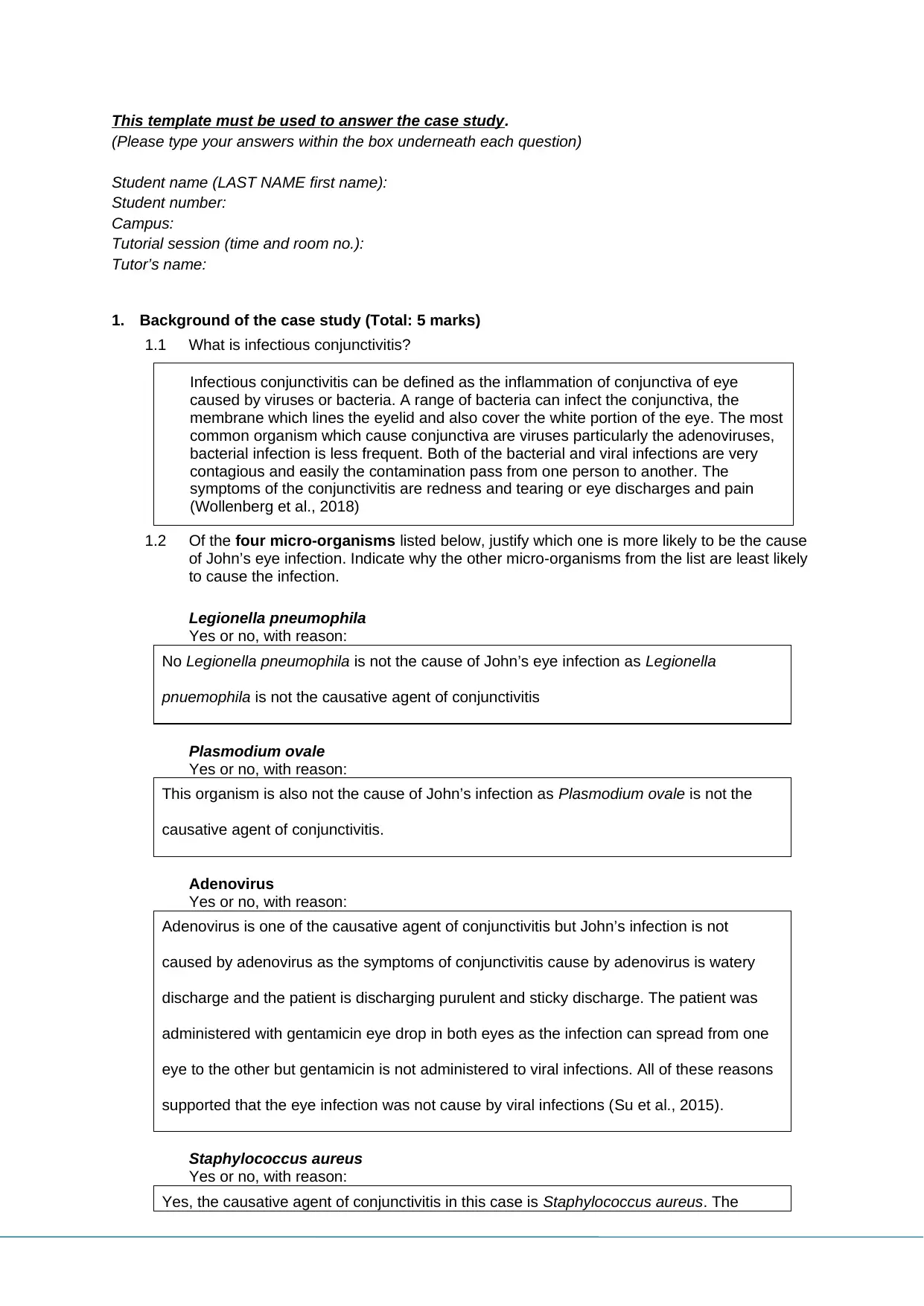
This template must be used to answer the case study.
(Please type your answers within the box underneath each question)
Student name (LAST NAME first name):
Student number:
Campus:
Tutorial session (time and room no.):
Tutor’s name:
1. Background of the case study (Total: 5 marks)
1.1 What is infectious conjunctivitis?
Infectious conjunctivitis can be defined as the inflammation of conjunctiva of eye
caused by viruses or bacteria. A range of bacteria can infect the conjunctiva, the
membrane which lines the eyelid and also cover the white portion of the eye. The most
common organism which cause conjunctiva are viruses particularly the adenoviruses,
bacterial infection is less frequent. Both of the bacterial and viral infections are very
contagious and easily the contamination pass from one person to another. The
symptoms of the conjunctivitis are redness and tearing or eye discharges and pain
(Wollenberg et al., 2018)
1.2 Of the four micro-organisms listed below, justify which one is more likely to be the cause
of John’s eye infection. Indicate why the other micro-organisms from the list are least likely
to cause the infection.
Legionella pneumophila
Yes or no, with reason:
No Legionella pneumophila is not the cause of John’s eye infection as Legionella
pnuemophila is not the causative agent of conjunctivitis
Plasmodium ovale
Yes or no, with reason:
This organism is also not the cause of John’s infection as Plasmodium ovale is not the
causative agent of conjunctivitis.
Adenovirus
Yes or no, with reason:
Adenovirus is one of the causative agent of conjunctivitis but John’s infection is not
caused by adenovirus as the symptoms of conjunctivitis cause by adenovirus is watery
discharge and the patient is discharging purulent and sticky discharge. The patient was
administered with gentamicin eye drop in both eyes as the infection can spread from one
eye to the other but gentamicin is not administered to viral infections. All of these reasons
supported that the eye infection was not cause by viral infections (Su et al., 2015).
Staphylococcus aureus
Yes or no, with reason:
Yes, the causative agent of conjunctivitis in this case is Staphylococcus aureus. The
(Please type your answers within the box underneath each question)
Student name (LAST NAME first name):
Student number:
Campus:
Tutorial session (time and room no.):
Tutor’s name:
1. Background of the case study (Total: 5 marks)
1.1 What is infectious conjunctivitis?
Infectious conjunctivitis can be defined as the inflammation of conjunctiva of eye
caused by viruses or bacteria. A range of bacteria can infect the conjunctiva, the
membrane which lines the eyelid and also cover the white portion of the eye. The most
common organism which cause conjunctiva are viruses particularly the adenoviruses,
bacterial infection is less frequent. Both of the bacterial and viral infections are very
contagious and easily the contamination pass from one person to another. The
symptoms of the conjunctivitis are redness and tearing or eye discharges and pain
(Wollenberg et al., 2018)
1.2 Of the four micro-organisms listed below, justify which one is more likely to be the cause
of John’s eye infection. Indicate why the other micro-organisms from the list are least likely
to cause the infection.
Legionella pneumophila
Yes or no, with reason:
No Legionella pneumophila is not the cause of John’s eye infection as Legionella
pnuemophila is not the causative agent of conjunctivitis
Plasmodium ovale
Yes or no, with reason:
This organism is also not the cause of John’s infection as Plasmodium ovale is not the
causative agent of conjunctivitis.
Adenovirus
Yes or no, with reason:
Adenovirus is one of the causative agent of conjunctivitis but John’s infection is not
caused by adenovirus as the symptoms of conjunctivitis cause by adenovirus is watery
discharge and the patient is discharging purulent and sticky discharge. The patient was
administered with gentamicin eye drop in both eyes as the infection can spread from one
eye to the other but gentamicin is not administered to viral infections. All of these reasons
supported that the eye infection was not cause by viral infections (Su et al., 2015).
Staphylococcus aureus
Yes or no, with reason:
Yes, the causative agent of conjunctivitis in this case is Staphylococcus aureus. The
Paraphrase This Document
Need a fresh take? Get an instant paraphrase of this document with our AI Paraphraser

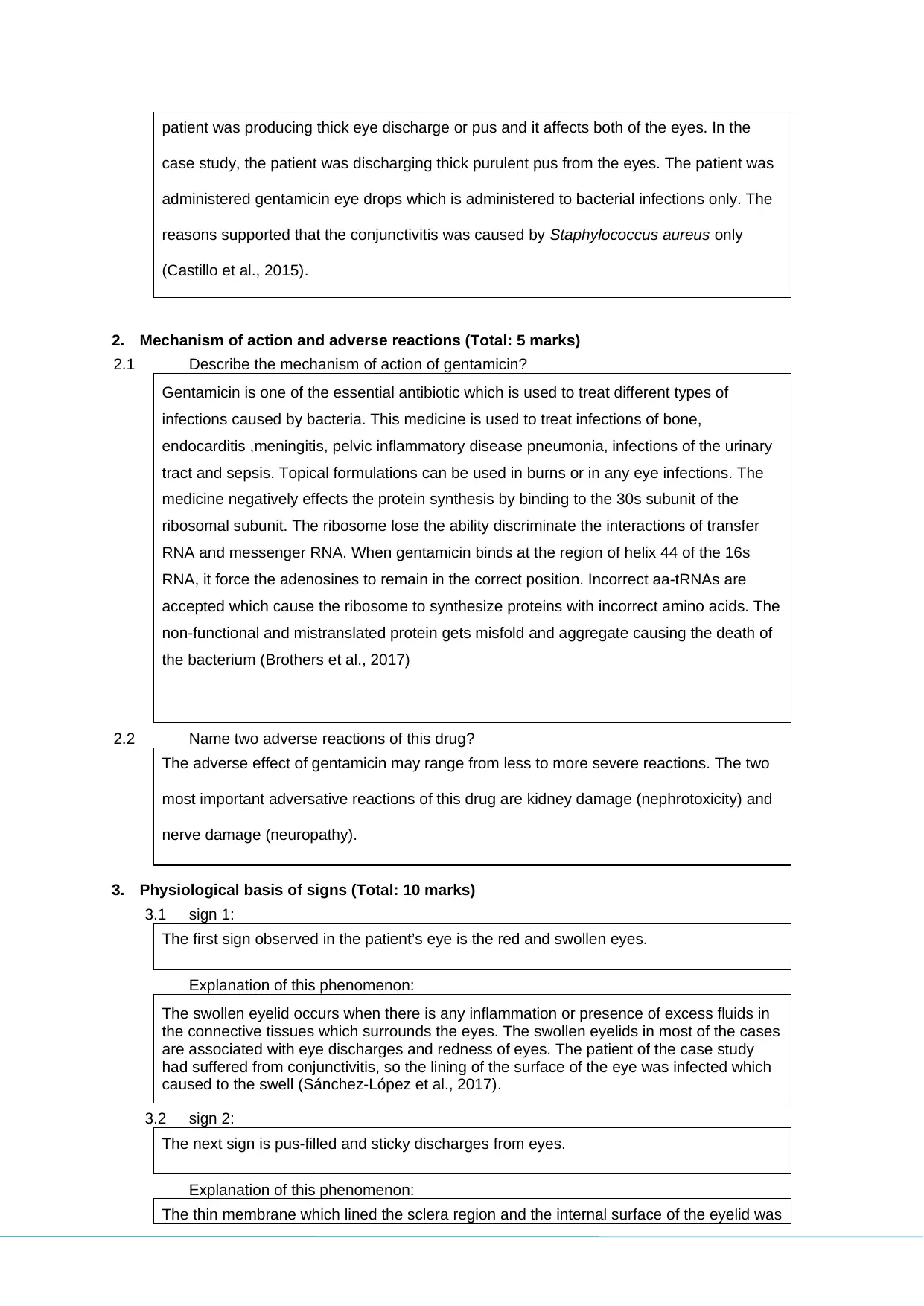
patient was producing thick eye discharge or pus and it affects both of the eyes. In the
case study, the patient was discharging thick purulent pus from the eyes. The patient was
administered gentamicin eye drops which is administered to bacterial infections only. The
reasons supported that the conjunctivitis was caused by Staphylococcus aureus only
(Castillo et al., 2015).
2. Mechanism of action and adverse reactions (Total: 5 marks)
2.1 Describe the mechanism of action of gentamicin?
Gentamicin is one of the essential antibiotic which is used to treat different types of
infections caused by bacteria. This medicine is used to treat infections of bone,
endocarditis ,meningitis, pelvic inflammatory disease pneumonia, infections of the urinary
tract and sepsis. Topical formulations can be used in burns or in any eye infections. The
medicine negatively effects the protein synthesis by binding to the 30s subunit of the
ribosomal subunit. The ribosome lose the ability discriminate the interactions of transfer
RNA and messenger RNA. When gentamicin binds at the region of helix 44 of the 16s
RNA, it force the adenosines to remain in the correct position. Incorrect aa-tRNAs are
accepted which cause the ribosome to synthesize proteins with incorrect amino acids. The
non-functional and mistranslated protein gets misfold and aggregate causing the death of
the bacterium (Brothers et al., 2017)
2.2 Name two adverse reactions of this drug?
The adverse effect of gentamicin may range from less to more severe reactions. The two
most important adversative reactions of this drug are kidney damage (nephrotoxicity) and
nerve damage (neuropathy).
3. Physiological basis of signs (Total: 10 marks)
3.1 sign 1:
The first sign observed in the patient’s eye is the red and swollen eyes.
Explanation of this phenomenon:
The swollen eyelid occurs when there is any inflammation or presence of excess fluids in
the connective tissues which surrounds the eyes. The swollen eyelids in most of the cases
are associated with eye discharges and redness of eyes. The patient of the case study
had suffered from conjunctivitis, so the lining of the surface of the eye was infected which
caused to the swell (Sánchez-López et al., 2017).
3.2 sign 2:
The next sign is pus-filled and sticky discharges from eyes.
Explanation of this phenomenon:
The thin membrane which lined the sclera region and the internal surface of the eyelid was
case study, the patient was discharging thick purulent pus from the eyes. The patient was
administered gentamicin eye drops which is administered to bacterial infections only. The
reasons supported that the conjunctivitis was caused by Staphylococcus aureus only
(Castillo et al., 2015).
2. Mechanism of action and adverse reactions (Total: 5 marks)
2.1 Describe the mechanism of action of gentamicin?
Gentamicin is one of the essential antibiotic which is used to treat different types of
infections caused by bacteria. This medicine is used to treat infections of bone,
endocarditis ,meningitis, pelvic inflammatory disease pneumonia, infections of the urinary
tract and sepsis. Topical formulations can be used in burns or in any eye infections. The
medicine negatively effects the protein synthesis by binding to the 30s subunit of the
ribosomal subunit. The ribosome lose the ability discriminate the interactions of transfer
RNA and messenger RNA. When gentamicin binds at the region of helix 44 of the 16s
RNA, it force the adenosines to remain in the correct position. Incorrect aa-tRNAs are
accepted which cause the ribosome to synthesize proteins with incorrect amino acids. The
non-functional and mistranslated protein gets misfold and aggregate causing the death of
the bacterium (Brothers et al., 2017)
2.2 Name two adverse reactions of this drug?
The adverse effect of gentamicin may range from less to more severe reactions. The two
most important adversative reactions of this drug are kidney damage (nephrotoxicity) and
nerve damage (neuropathy).
3. Physiological basis of signs (Total: 10 marks)
3.1 sign 1:
The first sign observed in the patient’s eye is the red and swollen eyes.
Explanation of this phenomenon:
The swollen eyelid occurs when there is any inflammation or presence of excess fluids in
the connective tissues which surrounds the eyes. The swollen eyelids in most of the cases
are associated with eye discharges and redness of eyes. The patient of the case study
had suffered from conjunctivitis, so the lining of the surface of the eye was infected which
caused to the swell (Sánchez-López et al., 2017).
3.2 sign 2:
The next sign is pus-filled and sticky discharges from eyes.
Explanation of this phenomenon:
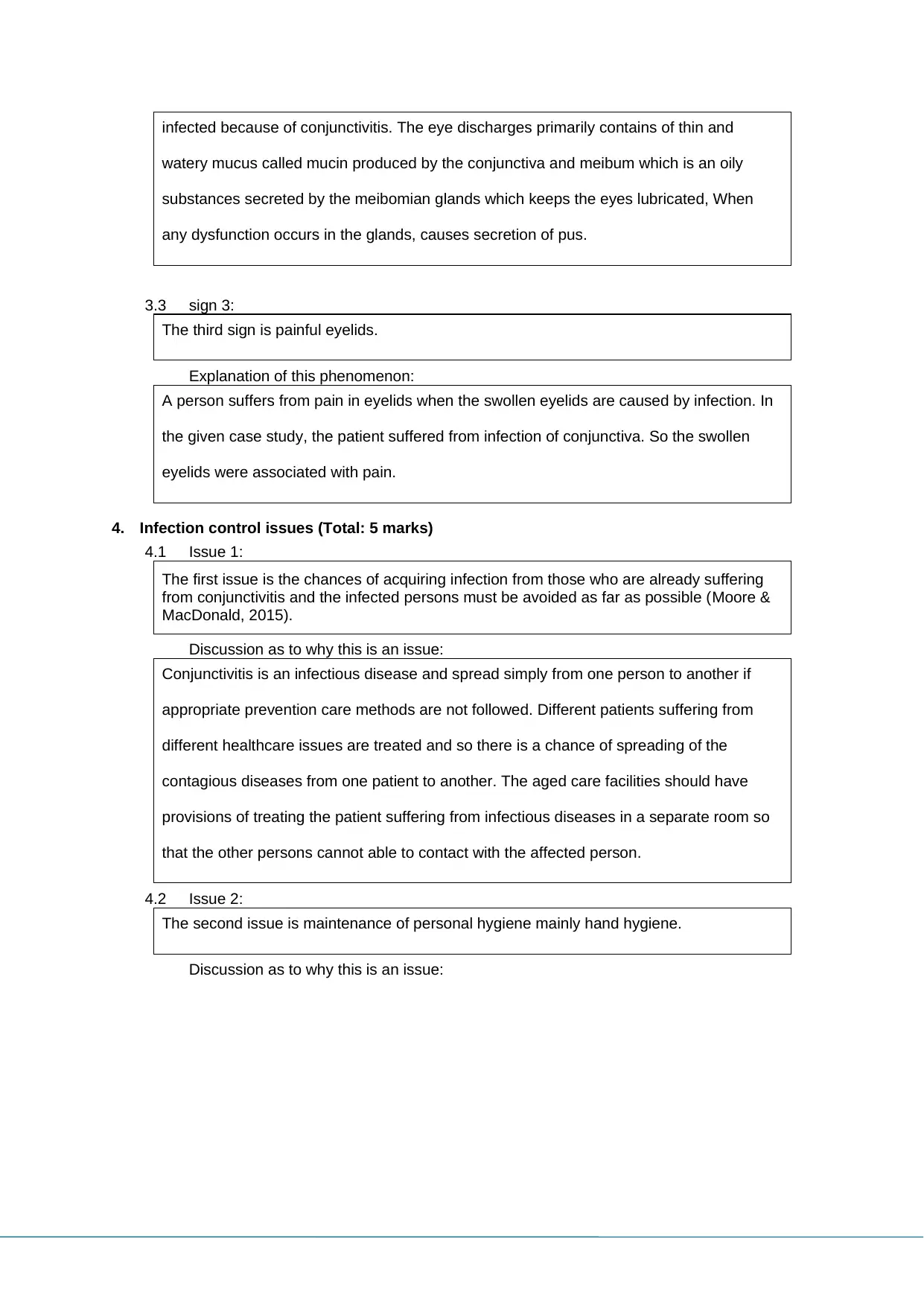
The thin membrane which lined the sclera region and the internal surface of the eyelid was

infected because of conjunctivitis. The eye discharges primarily contains of thin and
watery mucus called mucin produced by the conjunctiva and meibum which is an oily
substances secreted by the meibomian glands which keeps the eyes lubricated, When
any dysfunction occurs in the glands, causes secretion of pus.
3.3 sign 3:
The third sign is painful eyelids.
Explanation of this phenomenon:
A person suffers from pain in eyelids when the swollen eyelids are caused by infection. In
the given case study, the patient suffered from infection of conjunctiva. So the swollen
eyelids were associated with pain.
4. Infection control issues (Total: 5 marks)
4.1 Issue 1:
The first issue is the chances of acquiring infection from those who are already suffering
from conjunctivitis and the infected persons must be avoided as far as possible (Moore &
MacDonald, 2015).
Discussion as to why this is an issue:
Conjunctivitis is an infectious disease and spread simply from one person to another if
appropriate prevention care methods are not followed. Different patients suffering from
different healthcare issues are treated and so there is a chance of spreading of the
contagious diseases from one patient to another. The aged care facilities should have
provisions of treating the patient suffering from infectious diseases in a separate room so
that the other persons cannot able to contact with the affected person.
4.2 Issue 2:
The second issue is maintenance of personal hygiene mainly hand hygiene.
Discussion as to why this is an issue:
watery mucus called mucin produced by the conjunctiva and meibum which is an oily
substances secreted by the meibomian glands which keeps the eyes lubricated, When
any dysfunction occurs in the glands, causes secretion of pus.
3.3 sign 3:
The third sign is painful eyelids.
Explanation of this phenomenon:
A person suffers from pain in eyelids when the swollen eyelids are caused by infection. In
the given case study, the patient suffered from infection of conjunctiva. So the swollen
eyelids were associated with pain.
4. Infection control issues (Total: 5 marks)
4.1 Issue 1:
The first issue is the chances of acquiring infection from those who are already suffering
from conjunctivitis and the infected persons must be avoided as far as possible (Moore &
MacDonald, 2015).
Discussion as to why this is an issue:
Conjunctivitis is an infectious disease and spread simply from one person to another if
appropriate prevention care methods are not followed. Different patients suffering from
different healthcare issues are treated and so there is a chance of spreading of the
contagious diseases from one patient to another. The aged care facilities should have
provisions of treating the patient suffering from infectious diseases in a separate room so
that the other persons cannot able to contact with the affected person.
4.2 Issue 2:
The second issue is maintenance of personal hygiene mainly hand hygiene.
Discussion as to why this is an issue:
⊘ This is a preview!⊘
Do you want full access?
Subscribe today to unlock all pages.

Trusted by 1+ million students worldwide

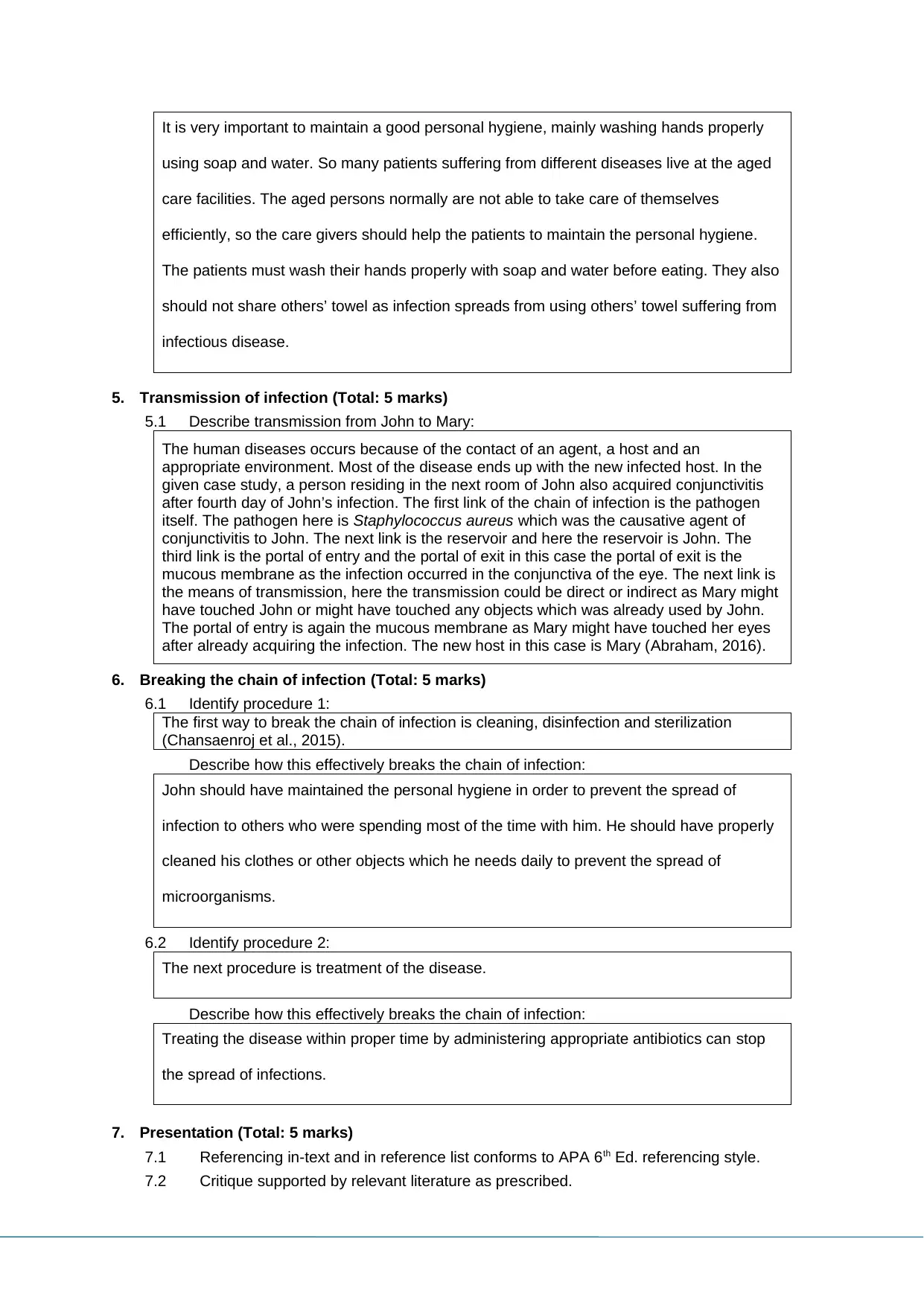
It is very important to maintain a good personal hygiene, mainly washing hands properly
using soap and water. So many patients suffering from different diseases live at the aged
care facilities. The aged persons normally are not able to take care of themselves
efficiently, so the care givers should help the patients to maintain the personal hygiene.
The patients must wash their hands properly with soap and water before eating. They also
should not share others’ towel as infection spreads from using others’ towel suffering from
infectious disease.
5. Transmission of infection (Total: 5 marks)
5.1 Describe transmission from John to Mary:
The human diseases occurs because of the contact of an agent, a host and an
appropriate environment. Most of the disease ends up with the new infected host. In the
given case study, a person residing in the next room of John also acquired conjunctivitis
after fourth day of John’s infection. The first link of the chain of infection is the pathogen
itself. The pathogen here is Staphylococcus aureus which was the causative agent of
conjunctivitis to John. The next link is the reservoir and here the reservoir is John. The
third link is the portal of entry and the portal of exit in this case the portal of exit is the
mucous membrane as the infection occurred in the conjunctiva of the eye. The next link is
the means of transmission, here the transmission could be direct or indirect as Mary might
have touched John or might have touched any objects which was already used by John.
The portal of entry is again the mucous membrane as Mary might have touched her eyes
after already acquiring the infection. The new host in this case is Mary (Abraham, 2016).
6. Breaking the chain of infection (Total: 5 marks)
6.1 Identify procedure 1:
The first way to break the chain of infection is cleaning, disinfection and sterilization
(Chansaenroj et al., 2015).
Describe how this effectively breaks the chain of infection:
John should have maintained the personal hygiene in order to prevent the spread of
infection to others who were spending most of the time with him. He should have properly
cleaned his clothes or other objects which he needs daily to prevent the spread of
microorganisms.
6.2 Identify procedure 2:
The next procedure is treatment of the disease.
Describe how this effectively breaks the chain of infection:
Treating the disease within proper time by administering appropriate antibiotics can stop
the spread of infections.
7. Presentation (Total: 5 marks)
7.1 Referencing in-text and in reference list conforms to APA 6th Ed. referencing style.
7.2 Critique supported by relevant literature as prescribed.
using soap and water. So many patients suffering from different diseases live at the aged
care facilities. The aged persons normally are not able to take care of themselves
efficiently, so the care givers should help the patients to maintain the personal hygiene.
The patients must wash their hands properly with soap and water before eating. They also
should not share others’ towel as infection spreads from using others’ towel suffering from
infectious disease.
5. Transmission of infection (Total: 5 marks)
5.1 Describe transmission from John to Mary:
The human diseases occurs because of the contact of an agent, a host and an
appropriate environment. Most of the disease ends up with the new infected host. In the
given case study, a person residing in the next room of John also acquired conjunctivitis
after fourth day of John’s infection. The first link of the chain of infection is the pathogen
itself. The pathogen here is Staphylococcus aureus which was the causative agent of
conjunctivitis to John. The next link is the reservoir and here the reservoir is John. The
third link is the portal of entry and the portal of exit in this case the portal of exit is the
mucous membrane as the infection occurred in the conjunctiva of the eye. The next link is
the means of transmission, here the transmission could be direct or indirect as Mary might
have touched John or might have touched any objects which was already used by John.
The portal of entry is again the mucous membrane as Mary might have touched her eyes
after already acquiring the infection. The new host in this case is Mary (Abraham, 2016).
6. Breaking the chain of infection (Total: 5 marks)
6.1 Identify procedure 1:
The first way to break the chain of infection is cleaning, disinfection and sterilization
(Chansaenroj et al., 2015).
Describe how this effectively breaks the chain of infection:
John should have maintained the personal hygiene in order to prevent the spread of
infection to others who were spending most of the time with him. He should have properly
cleaned his clothes or other objects which he needs daily to prevent the spread of
microorganisms.
6.2 Identify procedure 2:
The next procedure is treatment of the disease.
Describe how this effectively breaks the chain of infection:
Treating the disease within proper time by administering appropriate antibiotics can stop
the spread of infections.
7. Presentation (Total: 5 marks)
7.1 Referencing in-text and in reference list conforms to APA 6th Ed. referencing style.
7.2 Critique supported by relevant literature as prescribed.
Paraphrase This Document
Need a fresh take? Get an instant paraphrase of this document with our AI Paraphraser

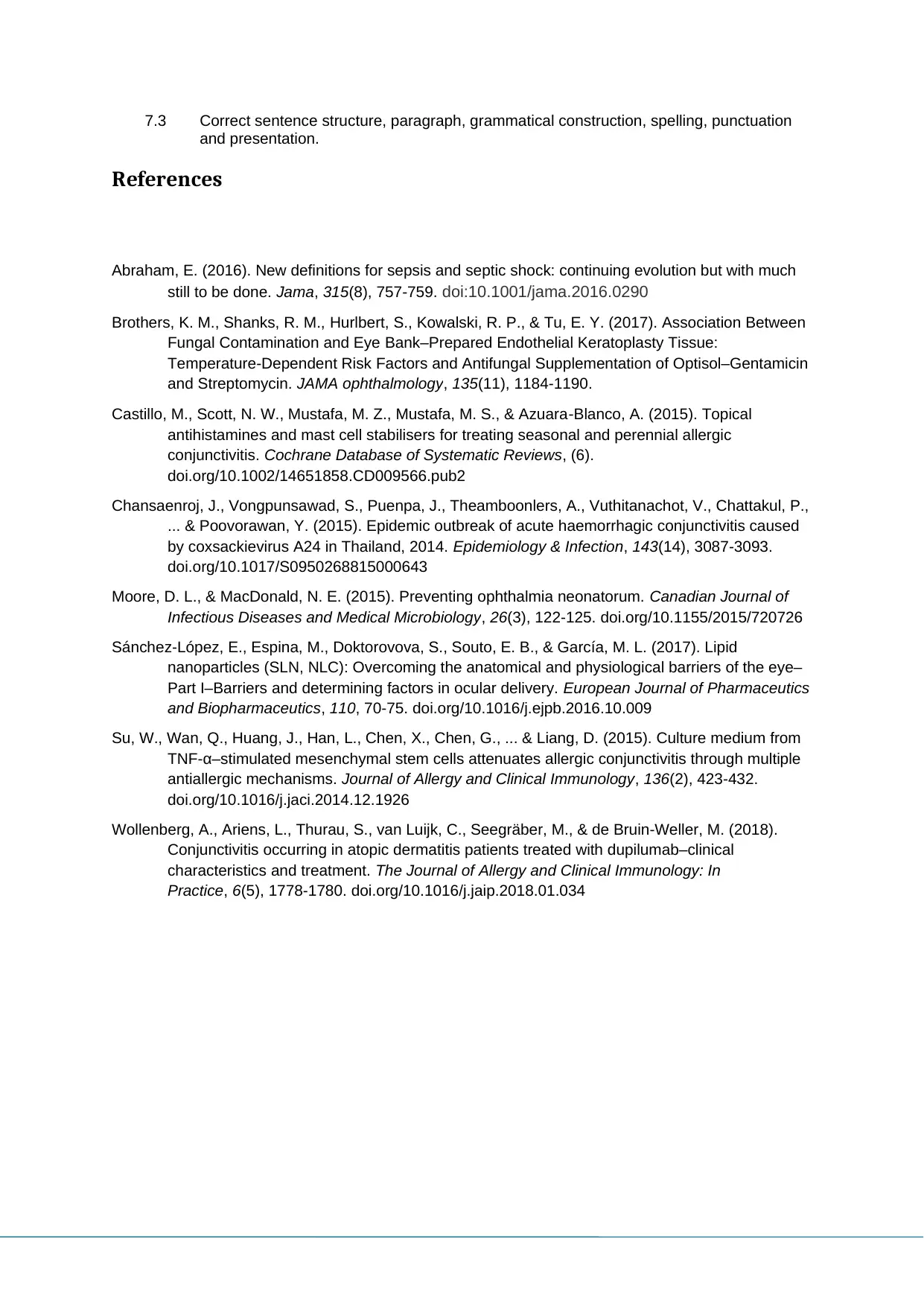
7.3 Correct sentence structure, paragraph, grammatical construction, spelling, punctuation
and presentation.
References
Abraham, E. (2016). New definitions for sepsis and septic shock: continuing evolution but with much
still to be done. Jama, 315(8), 757-759. doi:10.1001/jama.2016.0290
Brothers, K. M., Shanks, R. M., Hurlbert, S., Kowalski, R. P., & Tu, E. Y. (2017). Association Between
Fungal Contamination and Eye Bank–Prepared Endothelial Keratoplasty Tissue:
Temperature-Dependent Risk Factors and Antifungal Supplementation of Optisol–Gentamicin
and Streptomycin. JAMA ophthalmology, 135(11), 1184-1190.
Castillo, M., Scott, N. W., Mustafa, M. Z., Mustafa, M. S., & Azuara‐Blanco, A. (2015). Topical
antihistamines and mast cell stabilisers for treating seasonal and perennial allergic
conjunctivitis. Cochrane Database of Systematic Reviews, (6).
doi.org/10.1002/14651858.CD009566.pub2
Chansaenroj, J., Vongpunsawad, S., Puenpa, J., Theamboonlers, A., Vuthitanachot, V., Chattakul, P.,
... & Poovorawan, Y. (2015). Epidemic outbreak of acute haemorrhagic conjunctivitis caused
by coxsackievirus A24 in Thailand, 2014. Epidemiology & Infection, 143(14), 3087-3093.
doi.org/10.1017/S0950268815000643
Moore, D. L., & MacDonald, N. E. (2015). Preventing ophthalmia neonatorum. Canadian Journal of
Infectious Diseases and Medical Microbiology, 26(3), 122-125. doi.org/10.1155/2015/720726
Sánchez-López, E., Espina, M., Doktorovova, S., Souto, E. B., & García, M. L. (2017). Lipid
nanoparticles (SLN, NLC): Overcoming the anatomical and physiological barriers of the eye–
Part I–Barriers and determining factors in ocular delivery. European Journal of Pharmaceutics
and Biopharmaceutics, 110, 70-75. doi.org/10.1016/j.ejpb.2016.10.009
Su, W., Wan, Q., Huang, J., Han, L., Chen, X., Chen, G., ... & Liang, D. (2015). Culture medium from
TNF-α–stimulated mesenchymal stem cells attenuates allergic conjunctivitis through multiple
antiallergic mechanisms. Journal of Allergy and Clinical Immunology, 136(2), 423-432.
doi.org/10.1016/j.jaci.2014.12.1926
Wollenberg, A., Ariens, L., Thurau, S., van Luijk, C., Seegräber, M., & de Bruin-Weller, M. (2018).
Conjunctivitis occurring in atopic dermatitis patients treated with dupilumab–clinical
characteristics and treatment. The Journal of Allergy and Clinical Immunology: In
Practice, 6(5), 1778-1780. doi.org/10.1016/j.jaip.2018.01.034
and presentation.
References
Abraham, E. (2016). New definitions for sepsis and septic shock: continuing evolution but with much
still to be done. Jama, 315(8), 757-759. doi:10.1001/jama.2016.0290
Brothers, K. M., Shanks, R. M., Hurlbert, S., Kowalski, R. P., & Tu, E. Y. (2017). Association Between
Fungal Contamination and Eye Bank–Prepared Endothelial Keratoplasty Tissue:
Temperature-Dependent Risk Factors and Antifungal Supplementation of Optisol–Gentamicin
and Streptomycin. JAMA ophthalmology, 135(11), 1184-1190.
Castillo, M., Scott, N. W., Mustafa, M. Z., Mustafa, M. S., & Azuara‐Blanco, A. (2015). Topical
antihistamines and mast cell stabilisers for treating seasonal and perennial allergic
conjunctivitis. Cochrane Database of Systematic Reviews, (6).
doi.org/10.1002/14651858.CD009566.pub2
Chansaenroj, J., Vongpunsawad, S., Puenpa, J., Theamboonlers, A., Vuthitanachot, V., Chattakul, P.,
... & Poovorawan, Y. (2015). Epidemic outbreak of acute haemorrhagic conjunctivitis caused
by coxsackievirus A24 in Thailand, 2014. Epidemiology & Infection, 143(14), 3087-3093.
doi.org/10.1017/S0950268815000643
Moore, D. L., & MacDonald, N. E. (2015). Preventing ophthalmia neonatorum. Canadian Journal of
Infectious Diseases and Medical Microbiology, 26(3), 122-125. doi.org/10.1155/2015/720726
Sánchez-López, E., Espina, M., Doktorovova, S., Souto, E. B., & García, M. L. (2017). Lipid
nanoparticles (SLN, NLC): Overcoming the anatomical and physiological barriers of the eye–
Part I–Barriers and determining factors in ocular delivery. European Journal of Pharmaceutics
and Biopharmaceutics, 110, 70-75. doi.org/10.1016/j.ejpb.2016.10.009
Su, W., Wan, Q., Huang, J., Han, L., Chen, X., Chen, G., ... & Liang, D. (2015). Culture medium from
TNF-α–stimulated mesenchymal stem cells attenuates allergic conjunctivitis through multiple
antiallergic mechanisms. Journal of Allergy and Clinical Immunology, 136(2), 423-432.
doi.org/10.1016/j.jaci.2014.12.1926
Wollenberg, A., Ariens, L., Thurau, S., van Luijk, C., Seegräber, M., & de Bruin-Weller, M. (2018).
Conjunctivitis occurring in atopic dermatitis patients treated with dupilumab–clinical
characteristics and treatment. The Journal of Allergy and Clinical Immunology: In
Practice, 6(5), 1778-1780. doi.org/10.1016/j.jaip.2018.01.034
1 out of 5
Related Documents
Your All-in-One AI-Powered Toolkit for Academic Success.
+13062052269
info@desklib.com
Available 24*7 on WhatsApp / Email
Unlock your academic potential
Copyright © 2020–2025 A2Z Services. All Rights Reserved. Developed and managed by ZUCOL.