Solutions for STAT 2006 Assignment 2: Inferential Statistics Problems

Verified

Added on  2022/08/23

|31
|1132
|18
Homework Assignment
AI Summary
This document presents a comprehensive solution set for an inferential statistics assignment (STAT 2006). It covers a range of problems, including finding the moment-generating function (MGF) for jointly normal random variables, analyzing ordered random variables from an exponential distribution, and determining their independence. The solution also delves into maximum likelihood estimation (MLE), moment estimators, and the application of Chebyshev's inequality. Furthermore, it addresses the properties of bivariate normal distributions, the calculation of sample size, and the analysis of shifted exponential distributions. The document provides detailed step-by-step solutions to each problem, offering valuable insights into the concepts and techniques of inferential statistics. The assignment covers topics such as calculating the MGF, working with exponential distributions, finding joint and marginal probability density functions, and estimating parameters using various methods.
Document Page
Running Head: PROBLEMS ON INFERENTIAL STATISTICS
PROBLEMS ON INFERENTIAL STATISTICS
Name of the Student:
Name of the University:
Author Note:
tabler-icon-diamond-filled.svg

Paraphrase This Document

Need a fresh take? Get an instant paraphrase of this document with our AI Paraphraser
Document Page
1PROBLEMS ON INFERENTIAL STATISTICS
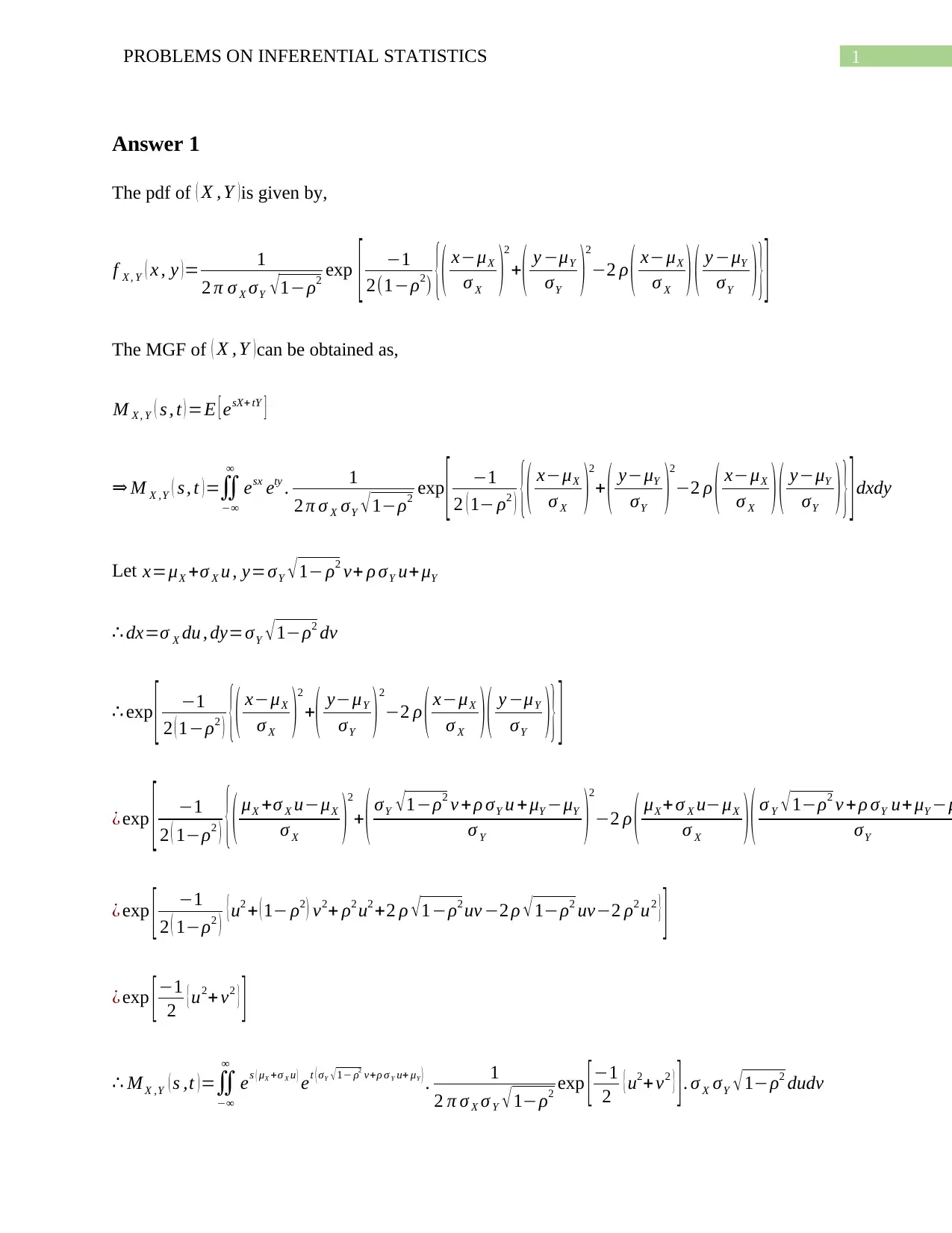
Answer 1
The pdf of ( X , Y )is given by,
f X , Y ( x , y )= 1
2 π σ X σY 1ρ2 exp [ 1
2(1ρ2) {( xμX
σ X )2
+
( y μY
σY )2
2 ρ ( xμX
σ X )( y μY
σY ) }]
The MGF of ( X , Y )can be obtained as,
M X , Y ( s , t ) =E [ esX+ tY ]
M X ,Y ( s , t )=


esx ety . 1
2 π σ X σY 1ρ2 exp [ 1
2 ( 1 ρ2 ) {( xμX
σ X )2
+ ( yμY
σY )2
2 ρ ( xμX
σ X )( yμY
σY ) }]dxdy
Let x=μX +σ X u , y=σY 1 ρ2 v+ ρ σY u+ μY
dx=σ X du , dy=σY 1ρ2 dv
exp [ 1
2 ( 1ρ2 ) {( xμX
σ X )
2
+( yμY
σY ) 2
2 ρ ( xμX
σ X )( y μY
σY )}]
¿ exp [ 1
2 ( 1ρ2 ) {( μX +σ X uμX
σ X )2
+ ( σY 1ρ2 v + ρ σY u + μY μY
σ Y )2
2 ρ ( μX + σ X uμX
σ X ) ( σ Y 1ρ2 v + ρ σY u+ μY μ
σY
¿ exp [ 1
2 ( 1ρ2 ) { u2 + ( 1 ρ2 ) v2+ ρ2 u2 +2 ρ 1ρ2 uv 2 ρ 1ρ2 uv2 ρ2 u2 } ]
¿ exp [ 1
2 { u2+ v2 } ]
M X ,Y ( s ,t ) =


es ( μX +σ X u ) et ( σY 1 ρ2 v+ρ σ Y u+ μY ) . 1
2 π σ X σ Y 1ρ2 exp [ 1
2 { u2+ v2 } ] . σ X σY 1ρ2 dudv
Document Page
2PROBLEMS ON INFERENTIAL STATISTICS
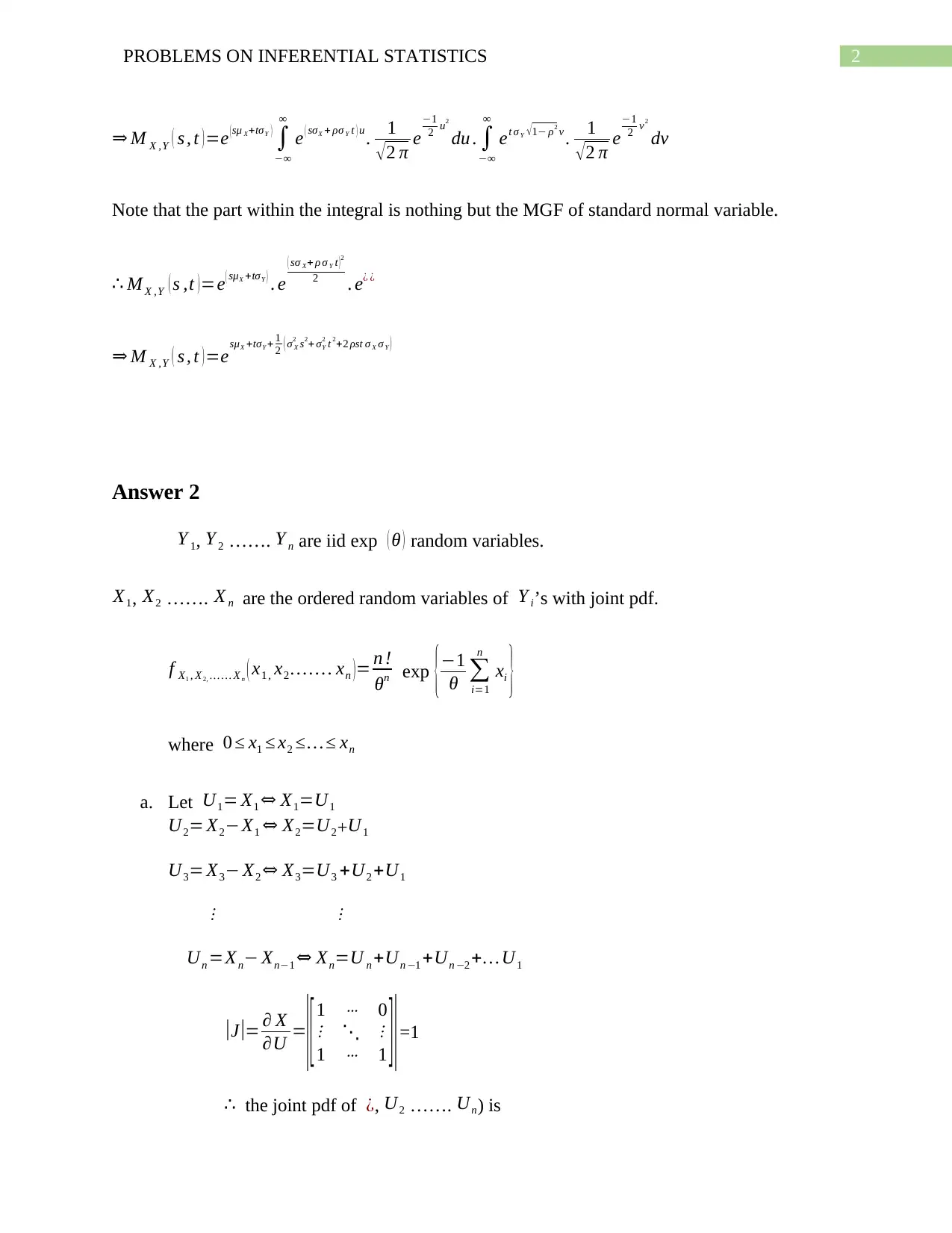
M X ,Y ( s , t ) =e ( X+Y )


e ( X + ρσ Y t ) u . 1
2 π e
1
2 u2
du .


et σ Y 1 ρ2 v . 1
2 π e
1
2 v2
dv
Note that the part within the integral is nothing but the MGF of standard normal variable.
M X ,Y ( s ,t ) =e( X +Y ) . e
( X+ ρ σ Y t ) 2
2 . e¿ ¿
M X ,Y ( s , t ) =eX +Y + 1
2 ( σ X
2 s2+ σY
2 t 2+2 ρst σ X σ Y )
Answer 2
Y 1, Y 2 ……. Y n are iid exp ( θ ) random variables.
X1, X2 ……. X n are the ordered random variables of Y i’s with joint pdf.
f X1 , X 2, X n ( x1 , x2 . xn )= n !
θn exp {1
θ
i=1
n
xi }
where 0 x1 x2 xn
a. Let U1= X1 X1=U1
U2= X2X1 X2=U2+U1
U3= X3 X2 X3=U3 +U2 +U1

Un =Xn Xn1 Xn=U n +Un 1 +Un 2 + U1
|J |= X
U =
|[ 1 0

1 1 ]|=1
the joint pdf of ¿, U2 ……. Un) is
Document Page
3PROBLEMS ON INFERENTIAL STATISTICS
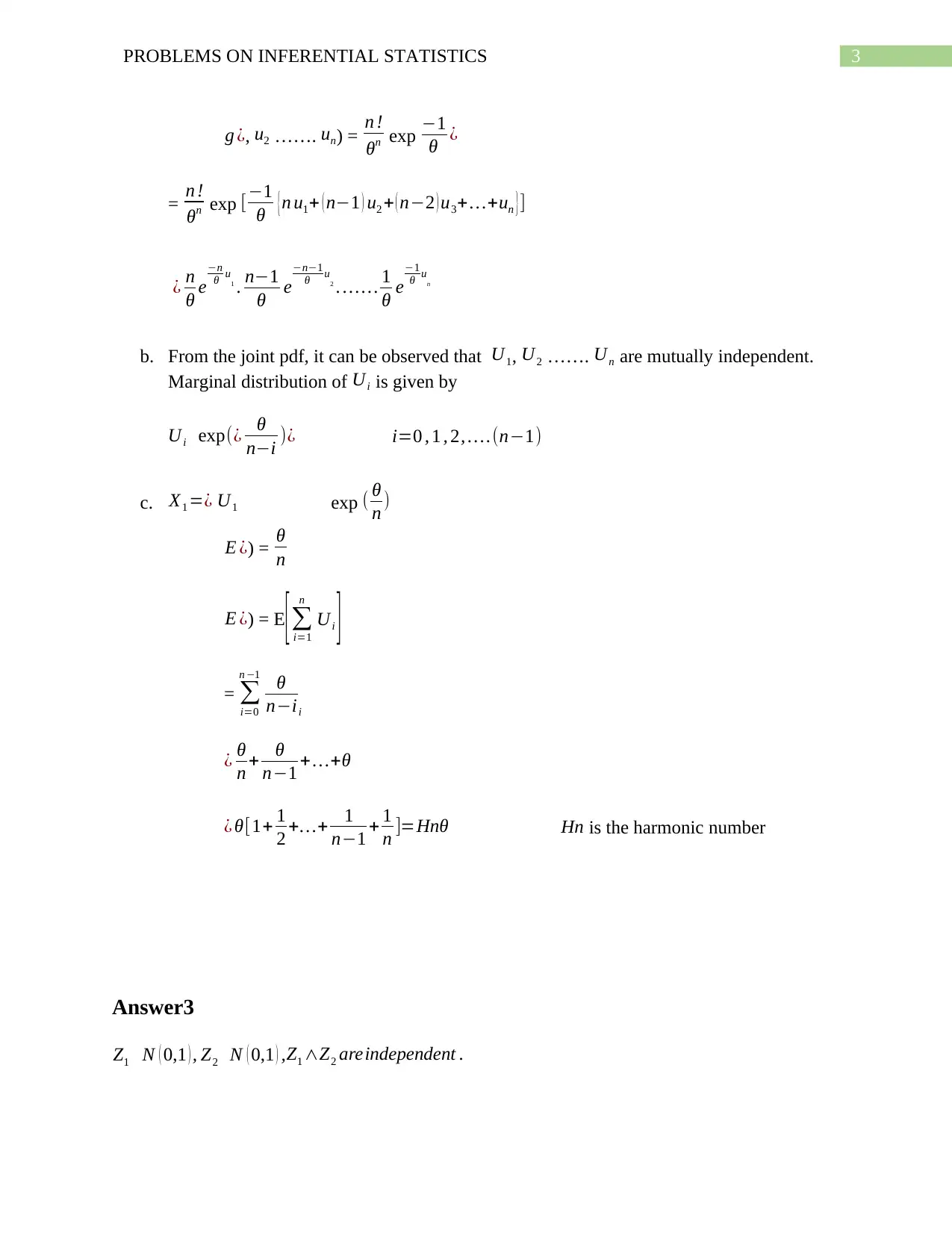
g ¿, u2 ……. un) = n !
θn exp 1
θ ¿
= n !
θn exp [1
θ {n u1+ ( n1 ) u2 + ( n2 ) u3++un }]
¿ n
θ e
n
θ u1
. n1
θ e
n1
θ u2
. 1
θ e
1
θ un
b. From the joint pdf, it can be observed that U1, U2 ……. Un are mutually independent.
Marginal distribution of Ui is given by
Ui exp(¿ θ
ni )¿ i=0 , 1 , 2, .(n1)
c. X1 =¿ U1 exp ( θ
n )
E ¿) = θ
n
E ¿) = E[
i=1
n
Ui ]
=
i=0
n 1 θ
nii
¿ θ
n + θ
n1 ++θ
¿ θ[1+ 1
2 ++ 1
n1 + 1
n ]=Hnθ Hn is the harmonic number
Answer3
Z1 N ( 0,1 ) , Z2 N ( 0,1 ) , Z1 Z2 areindependent .
tabler-icon-diamond-filled.svg

Paraphrase This Document

Need a fresh take? Get an instant paraphrase of this document with our AI Paraphraser
Document Page
4PROBLEMS ON INFERENTIAL STATISTICS
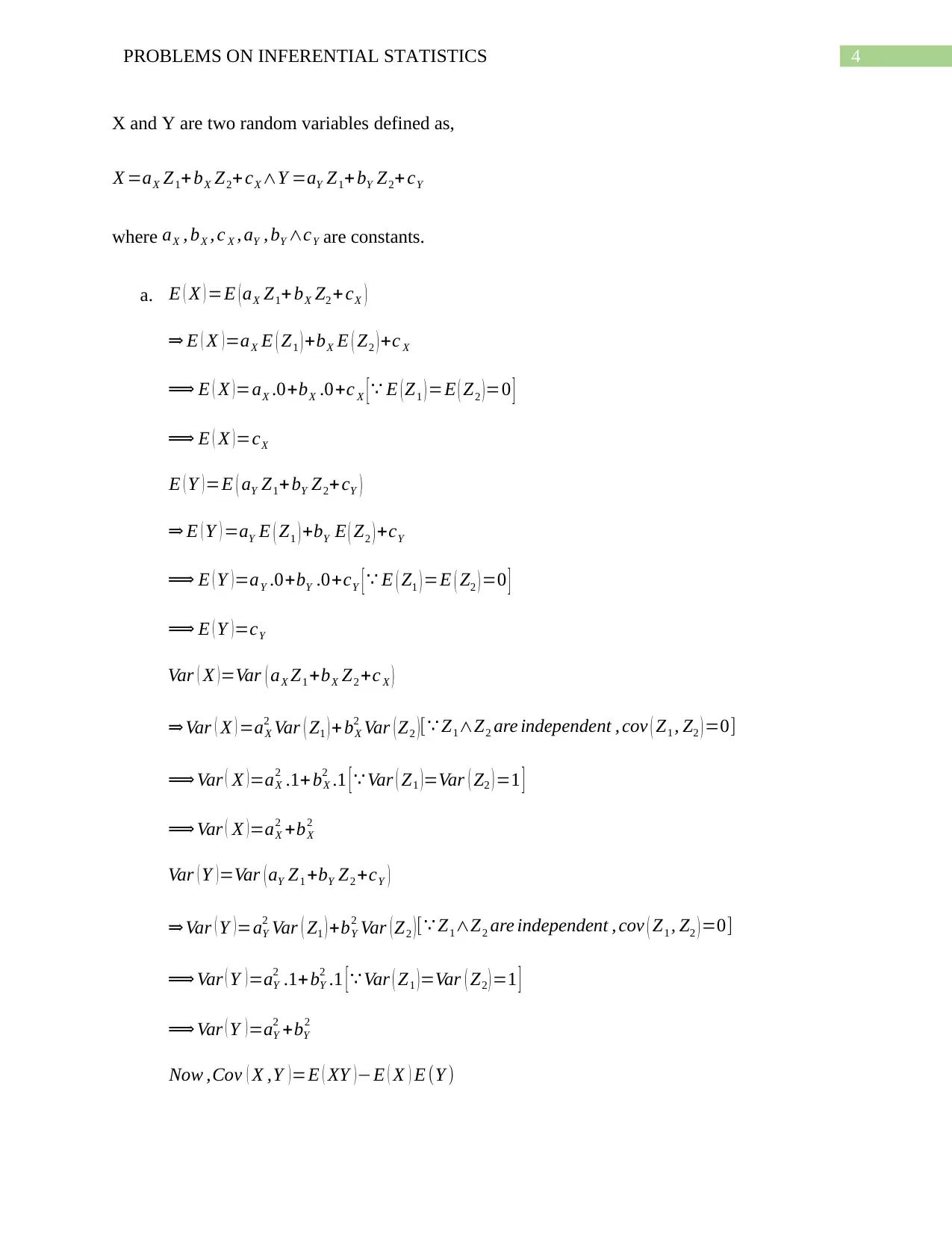
X and Y are two random variables defined as,
X =aX Z1+ bX Z2+ cX Y =aY Z1+ bY Z2+ cY
where aX , bX , c X , aY , bY cY are constants.
a. E ( X ) =E ( aX Z1+ bX Z2 + cX )
E ( X ) =aX E ( Z1 ) +bX E ( Z2 ) +c X
E ( X ) =aX .0+bX .0+c X [ E ( Z1 ) =E ( Z2 ) =0 ]
E ( X ) =cX
E ( Y )=E ( aY Z1+ bY Z2+ cY )
E ( Y ) =aY E ( Z1 ) +bY E ( Z2 ) +cY
E ( Y ) =aY .0+bY .0+cY [ E ( Z1 ) =E ( Z2 ) =0 ]
E ( Y ) =cY
Var ( X ) =Var ( aX Z1 +bX Z2 +c X )
Var ( X ) =aX
2 Var ( Z1 ) + bX
2 Var ( Z2 ) [ Z1Z2 are independent , cov ( Z1 , Z2 ) =0]
Var ( X )=aX
2 .1+bX
2 .1 [ Var ( Z1 )=Var ( Z2 ) =1 ]
Var ( X ) =aX
2 +bX
2
Var ( Y )=Var ( aY Z1 +bY Z2 +cY )
Var ( Y ) =aY
2 Var ( Z1 ) +bY
2 Var ( Z2 ) [ Z1Z2 are independent , cov ( Z1 , Z2 ) =0]
Var ( Y ) =aY
2 .1+bY
2 .1 [ Var ( Z1 ) =Var ( Z2 ) =1 ]
Var ( Y ) =aY
2 +bY
2
Now ,Cov ( X ,Y ) =E ( XY ) E ( X ) E (Y )
Document Page
5PROBLEMS ON INFERENTIAL STATISTICS
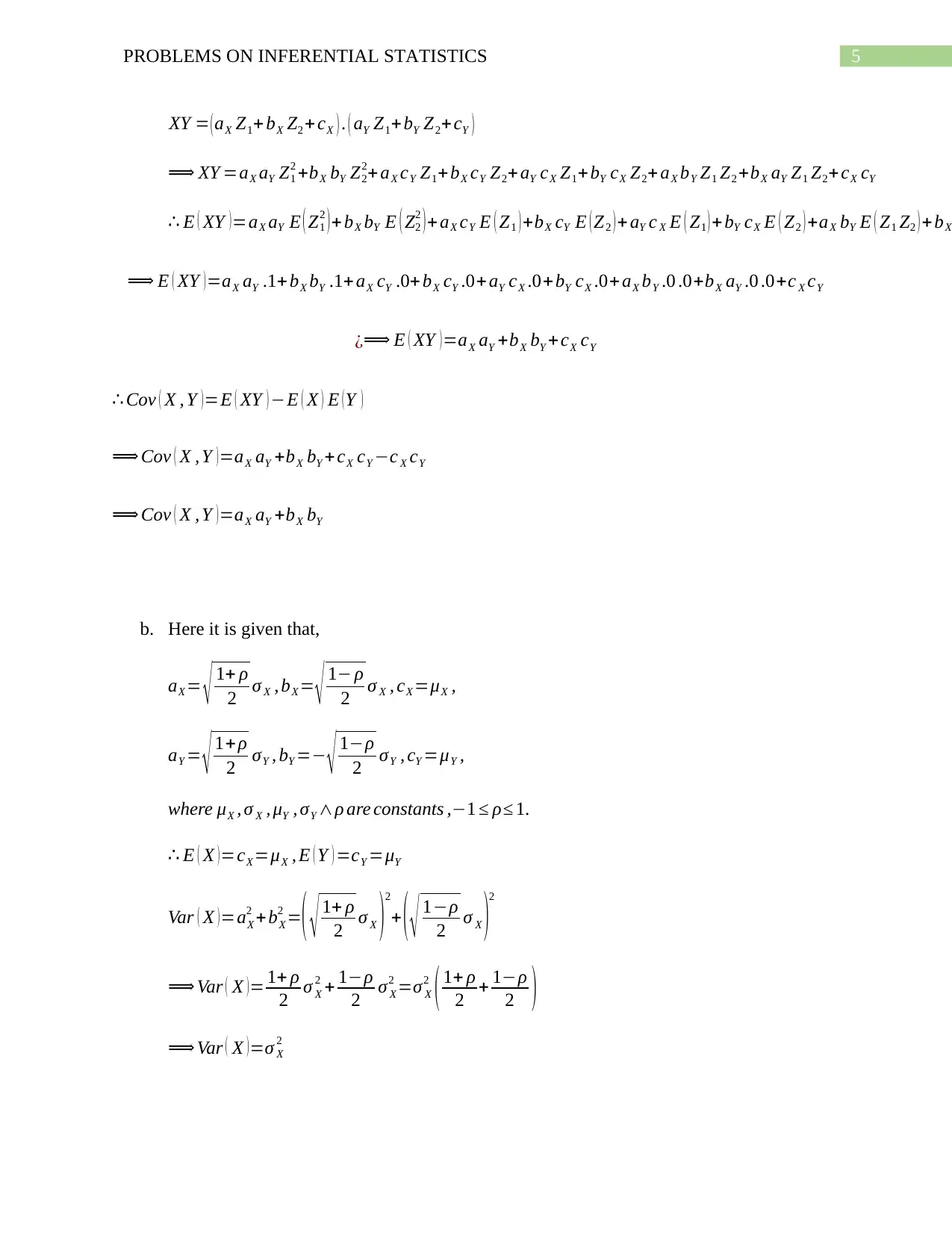
XY = ( aX Z1+ bX Z2 + cX ) . ( aY Z1+ bY Z2+ cY )
XY =aX aY Z1
2 +bX bY Z2
2+ aX cY Z1+bX cY Z2+ aY cX Z1+bY cX Z2+ aX bY Z1 Z2 +bX aY Z1 Z2+ cX cY
E ( XY )=aX aY E ( Z1
2 )+bX bY E ( Z2
2 )+ aX cY E ( Z1 ) +bX cY E ( Z2 )+ aY c X E ( Z1 ) + bY cX E ( Z2 ) +aX bY E ( Z1 Z2 ) +bX
E ( XY ) =aX aY .1+ bX bY .1+ aX cY .0+bX cY .0+ aY cX .0+ bY cX .0+ aX bY .0 .0+bX aY .0 .0+c X cY
¿ E ( XY )=aX aY +bX bY +cX cY
Cov ( X , Y )=E ( XY ) E ( X ) E (Y )
Cov ( X , Y ) =aX aY +bX bY + cX cY c X cY
Cov ( X , Y )=aX aY +bX bY
b. Here it is given that,
aX = 1+ ρ
2 σ X , bX = 1 ρ
2 σ X , cX =μX ,
aY = 1+ρ
2 σY , bY = 1ρ
2 σY , cY =μY ,
where μX , σ X , μY , σY ρ are constants ,1 ρ 1.
E ( X ) =cX =μX , E ( Y ) =cY =μY
Var ( X ) =aX
2 + bX
2 =( 1+ ρ
2 σ X )
2
+ ( 1ρ
2 σ X )
2
Var ( X )= 1+ ρ
2 σ X
2 + 1ρ
2 σ X
2 =σ X
2
( 1+ ρ
2 + 1ρ
2 )
Var ( X )=σ X
2
Document Page
6PROBLEMS ON INFERENTIAL STATISTICS
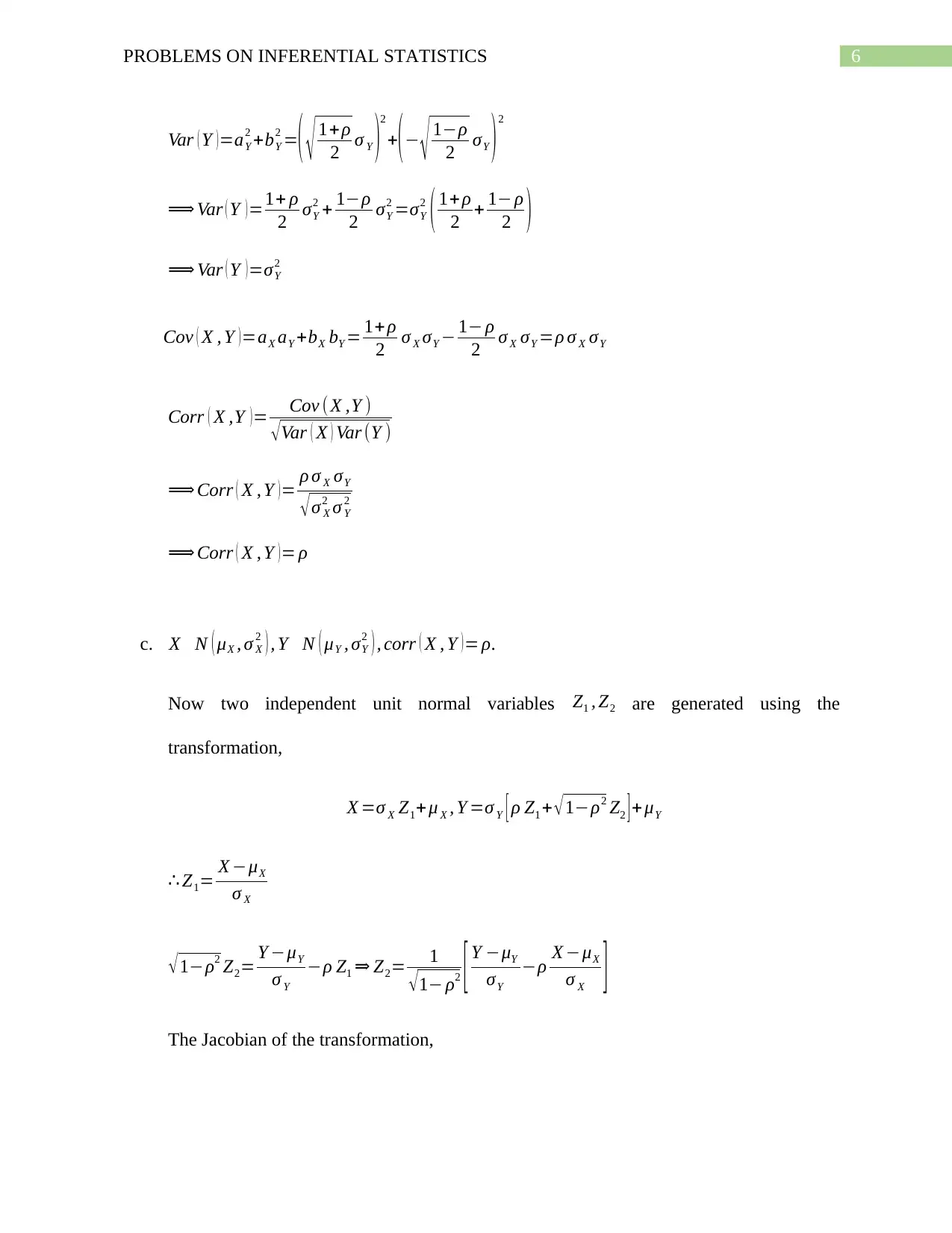
Var ( Y ) =aY
2 +bY
2 =( 1+ ρ
2 σ Y )
2
+( 1ρ
2 σY ) 2
Var ( Y ) =1+ ρ
2 σY
2 + 1ρ
2 σY
2 =σY
2
( 1+ ρ
2 + 1 ρ
2 )
Var ( Y ) =σY
2
Cov ( X , Y )=aX aY +bX bY = 1+ ρ
2 σ X σY 1 ρ
2 σ X σY =ρ σ X σY
Corr ( X ,Y )= Cov (X ,Y )
Var ( X ) Var (Y )
Corr ( X , Y )= ρ σ X σY
σ X
2 σ Y
2
Corr ( X , Y )= ρ
c. X N ( μX , σ X
2 ) , Y N ( μY , σY
2 ) , corr ( X , Y )= ρ.
Now two independent unit normal variables Z1 , Z2 are generated using the
transformation,
X =σ X Z1+ μ X , Y =σ Y [ ρ Z1 + 1ρ2 Z2 ]+ μY
Z1= X μX
σ X
1ρ2 Z2= Y μY
σ Y
ρ Z1 Z2= 1
1 ρ2 [ Y μY
σY
ρ X μX
σ X ]
The Jacobian of the transformation,
tabler-icon-diamond-filled.svg

Paraphrase This Document

Need a fresh take? Get an instant paraphrase of this document with our AI Paraphraser
Document Page
7PROBLEMS ON INFERENTIAL STATISTICS
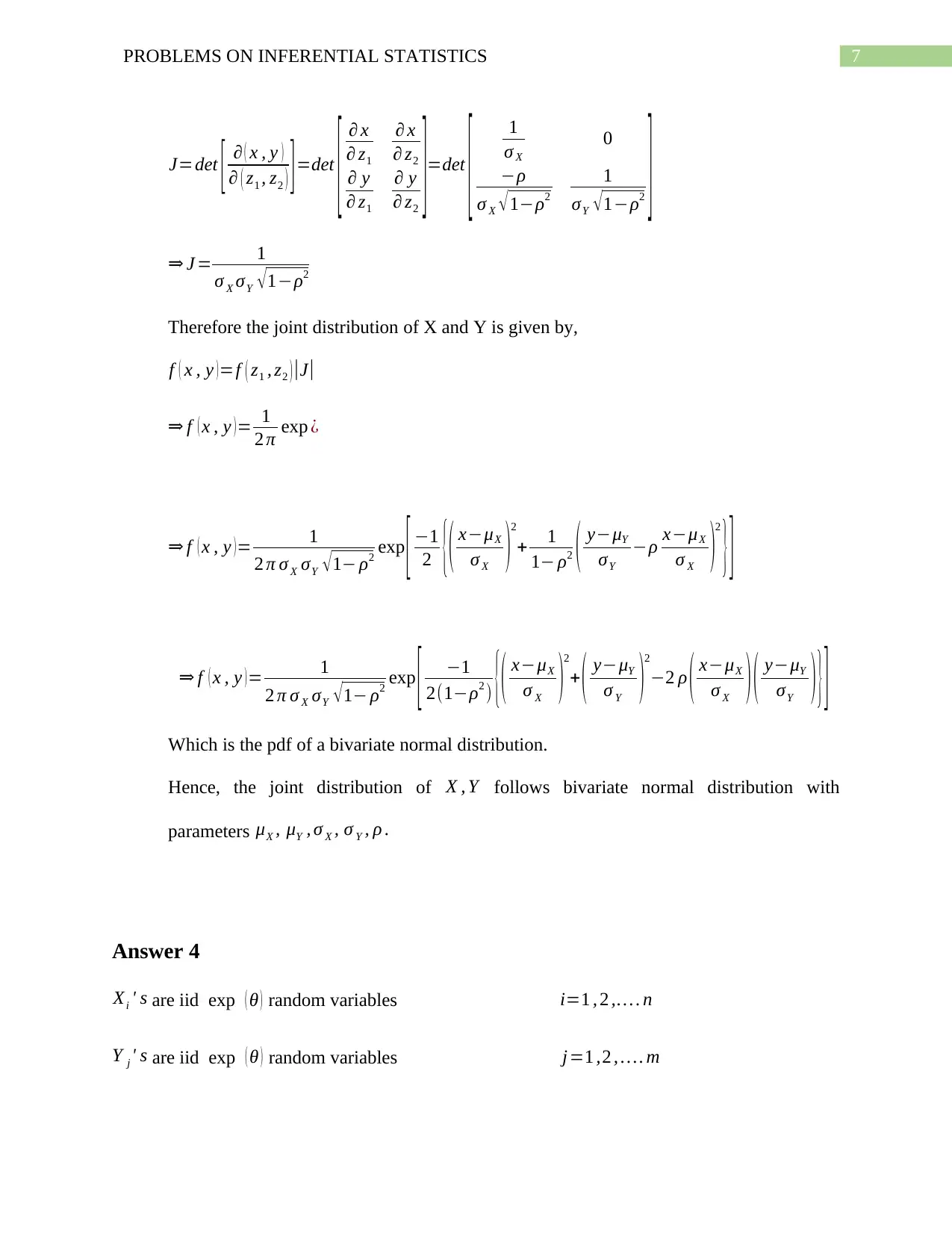
J=det [ ( x , y )
( z1 , z2 ) ]=det
[ x
z1
x
z2
y
z1
y
z2
]=det
[ 1
σ X
0
ρ
σ X 1ρ2
1
σY 1ρ2 ]
J = 1
σ X σY 1ρ2
Therefore the joint distribution of X and Y is given by,
f ( x , y ) =f ( z1 , z2 )|J|
f ( x , y ) = 1
2 π exp ¿
f ( x , y )= 1
2 π σ X σY 1 ρ2 exp [ 1
2 {( xμX
σ X )2
+ 1
1 ρ2 ( yμY
σY
ρ xμX
σ X )2
}]
f ( x , y )= 1
2 π σ X σY 1 ρ2 exp [ 1
2(1ρ2 ) {( xμX
σ X )2
+ ( yμY
σ Y )2
2 ρ ( xμX
σ X )( yμY
σY ) }]
Which is the pdf of a bivariate normal distribution.
Hence, the joint distribution of X , Y follows bivariate normal distribution with
parameters μX , μY , σ X , σ Y , ρ .
Answer 4
Xi ' s are iid exp ( θ ) random variables i=1 , 2 , . n
Y j ' s are iid exp ( θ ) random variables j=1 ,2 , . m
Document Page
8PROBLEMS ON INFERENTIAL STATISTICS
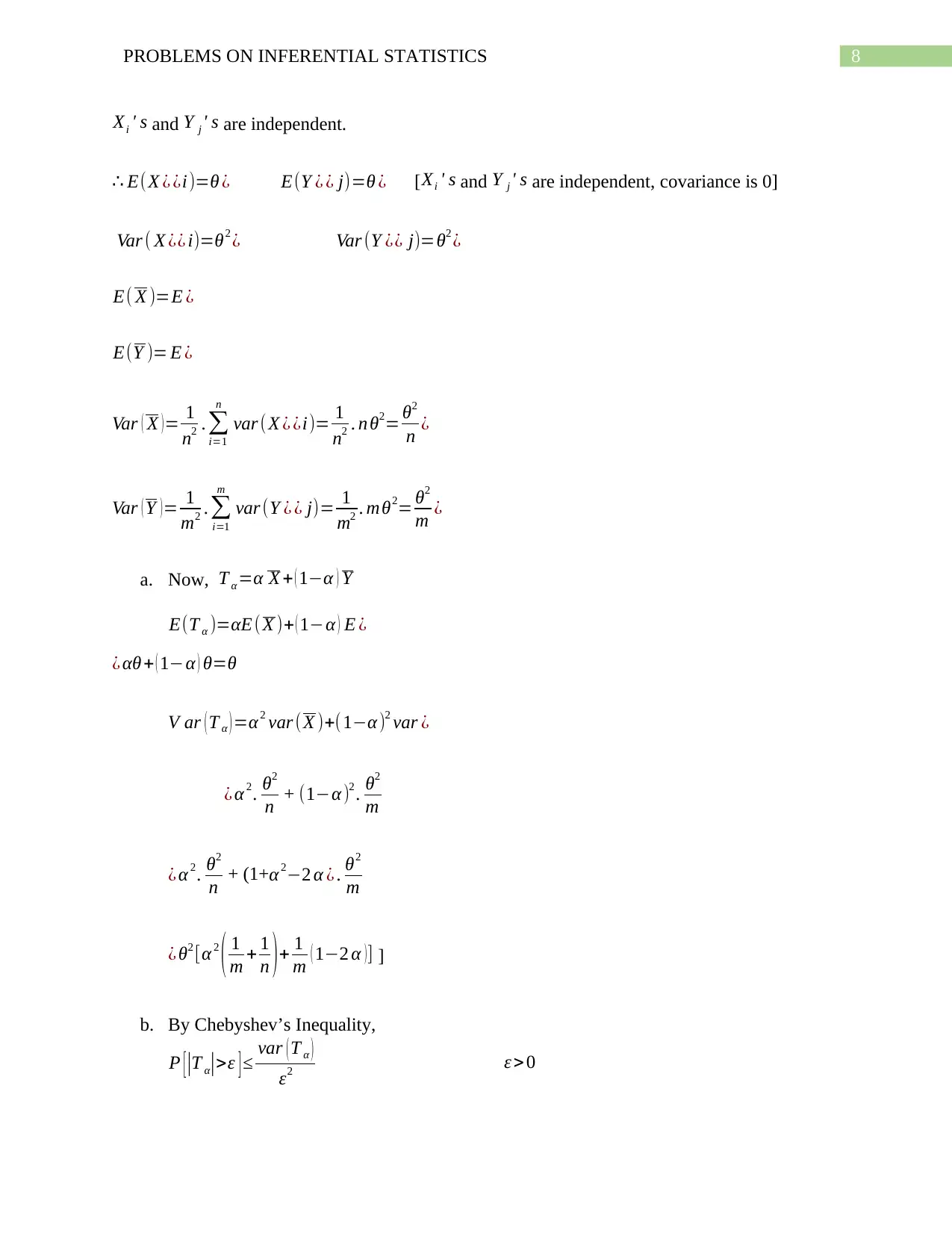
Xi ' s and Y j ' s are independent.
E(X ¿ ¿i)=θ ¿ E(Y ¿ ¿ j)=θ ¿ [ Xi ' s and Y j ' s are independent, covariance is 0]
Var ( X ¿¿ i)=θ2 ¿ Var (Y ¿¿ j)=θ2 ¿
E( X )=E ¿
E(Y )= E ¿
Var ( X )= 1
n2 .
i=1
n
var ( X ¿ ¿i)= 1
n2 . n θ2= θ2
n ¿
Var ( Y )= 1
m2 .
i=1
m
var (Y ¿ ¿ j)= 1
m2 . mθ2= θ2
m ¿
a. Now, T α =α X + ( 1α ) Y
E(T α )=αE ( X )+ ( 1α ) E ¿
¿ αθ + ( 1α ) θ=θ
V ar ( T α ) =α2 var (X )+(1α )2 var ¿
¿ α 2 . θ2
n + (1α )2 . θ2
m
¿ α 2 . θ2
n + (1+α 22 α ¿ . θ2
m
¿ θ2 [α 2
( 1
m + 1
n )+ 1
m ( 12 α )] ]
b. By Chebyshev’s Inequality,
P [|T α|>ε ] var ( T α )
ε2 ε > 0
Document Page
9PROBLEMS ON INFERENTIAL STATISTICS
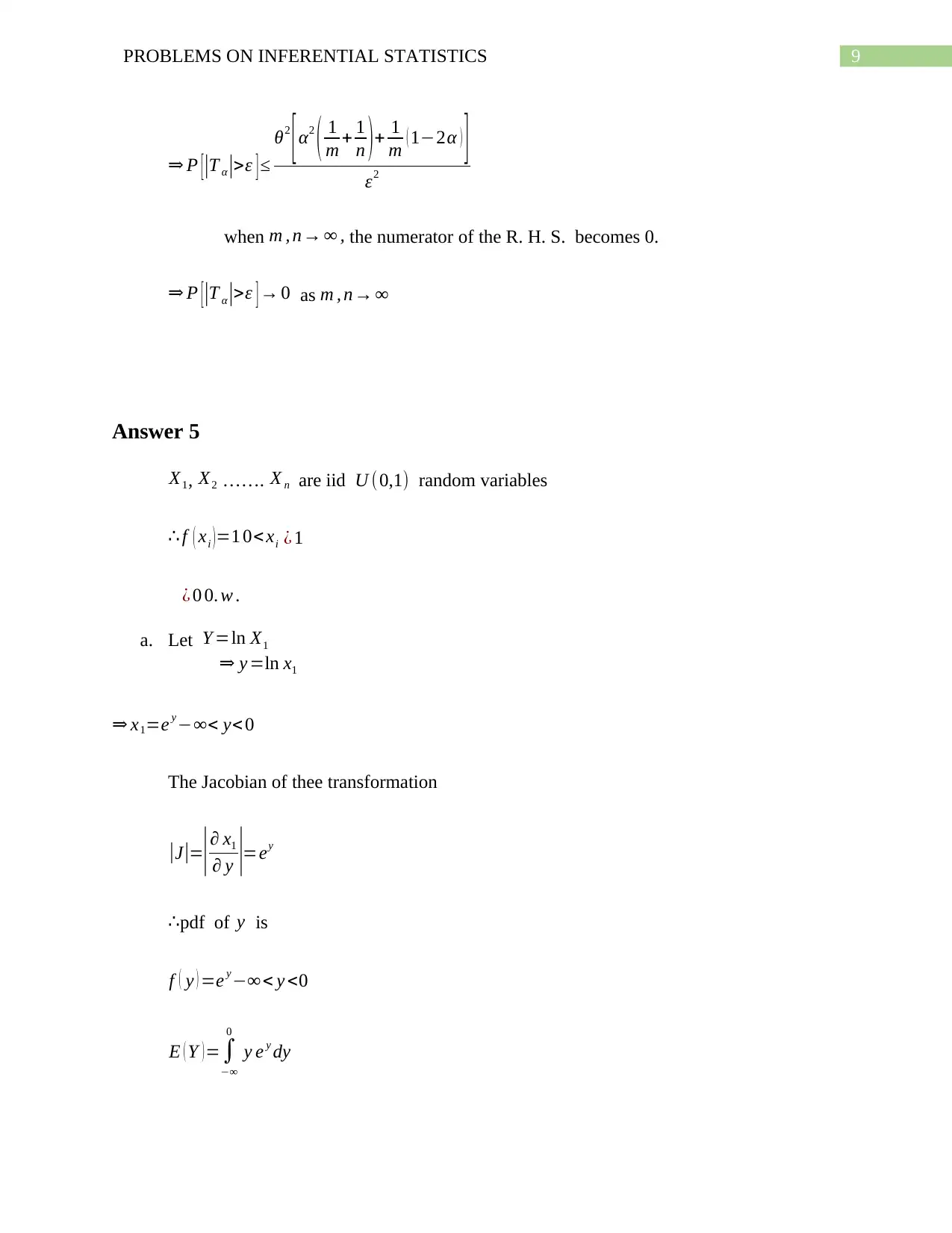
P [|T α|>ε ]
θ2
[α2
( 1
m + 1
n )+ 1
m ( 12α ) ]
ε2
when m , n , the numerator of the R. H. S. becomes 0.
P [|T α|>ε ] 0 as m , n
Answer 5
X1, X2 ……. X n are iid U (0,1) random variables
f ( xi ) =1 0< xi ¿ 1
¿ 0 0. w .
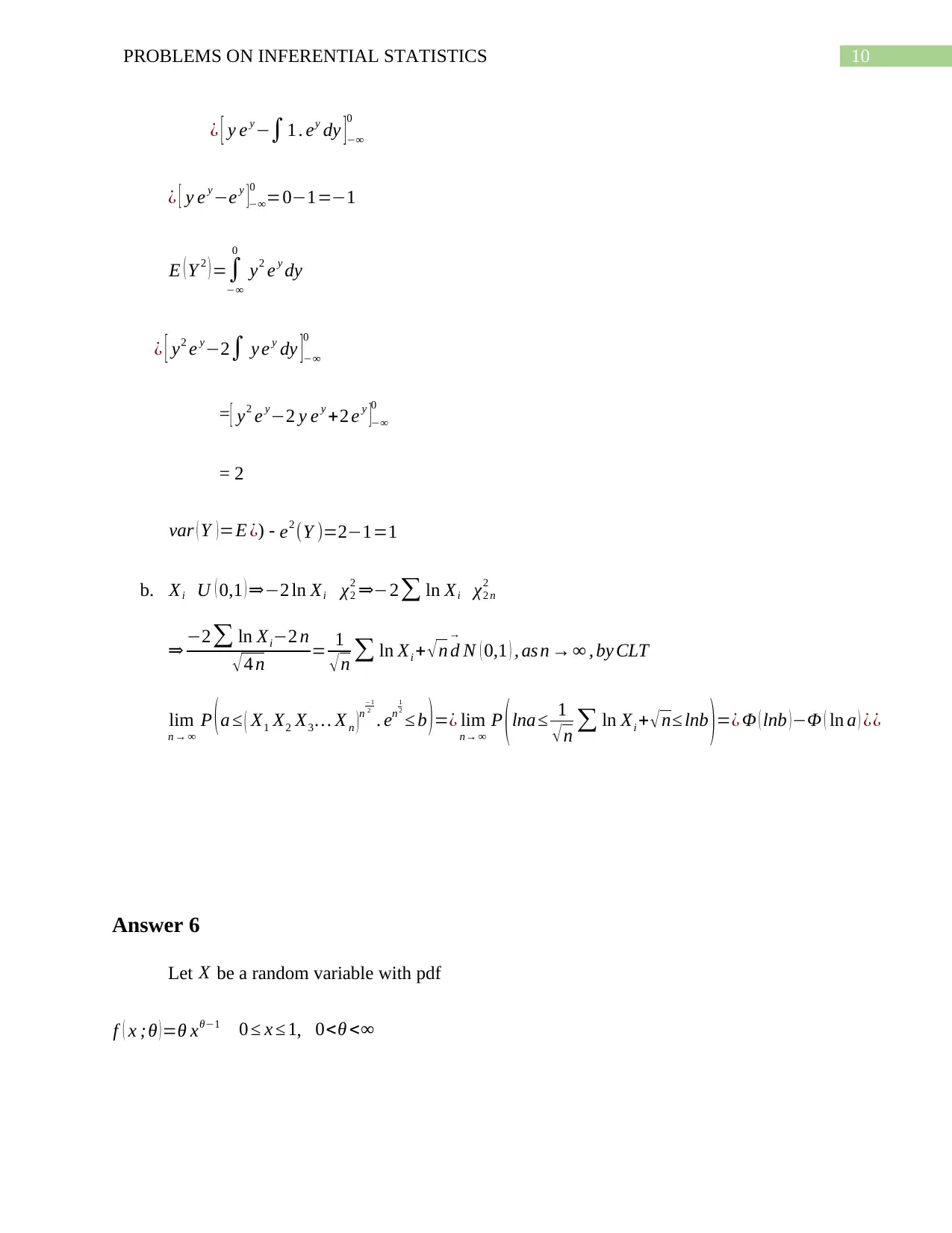
a. Let Y =ln X1
y =ln x1
x1=e y< y< 0
The Jacobian of thee transformation
|J |=| x1
y |=ey
pdf of y is
f ( y ) =e y< y <0
E ( Y )=

0
y e y dy
tabler-icon-diamond-filled.svg

Paraphrase This Document

Need a fresh take? Get an instant paraphrase of this document with our AI Paraphraser
Document Page
10PROBLEMS ON INFERENTIAL STATISTICS
¿ [ y e y1 . ey dy ]
0
¿ [ y e ye y ]
0
=01=1
E ( Y 2 ) =

0
y2 e y dy
¿ [ y2 e y2 y e y dy ]
0
=[ y2 e y2 y e y +2 e y ]
0
= 2
var ( Y )=E ¿) - e2 (Y )=21=1
b. Xi U ( 0,1 ) 2 ln Xi χ2
2 2 ln Xi χ2 n
2
2 ln Xi2 n
4 n = 1
n ln Xi + n d

N ( 0,1 ) , as n , by CLT
lim
n
P (a ( X1 X2 X3 X n )n
1
2
. en
1
2
b )=¿ lim
n
P (lna 1
n ln Xi + n lnb )=¿ Φ ( lnb )Φ ( ln a ) ¿¿
Answer 6
Let X be a random variable with pdf
f ( x ;θ )=θ xθ1 0 x 1, 0<θ <
Document Page
11PROBLEMS ON INFERENTIAL STATISTICS
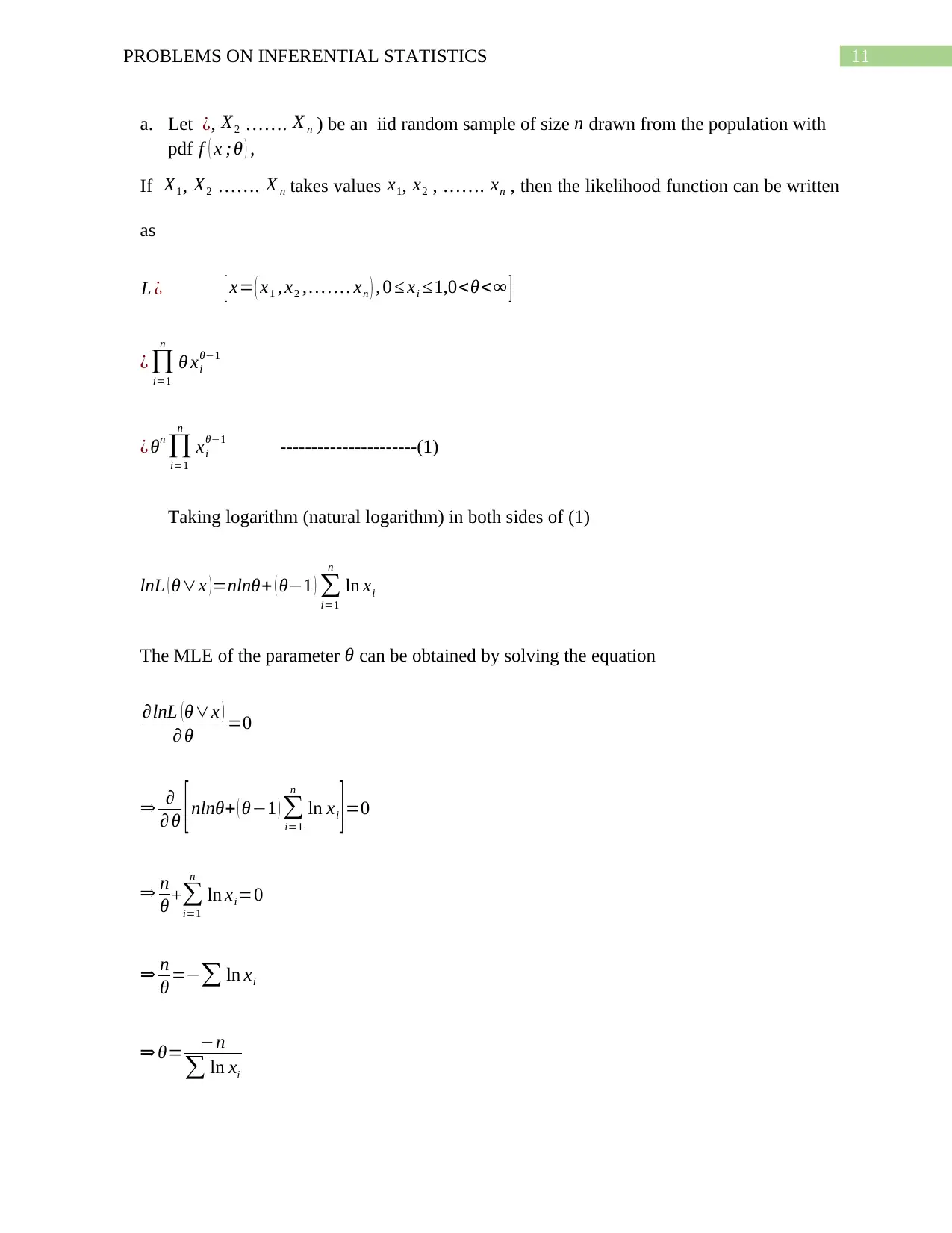
a. Let ¿, X2 ……. X n ) be an iid random sample of size n drawn from the population with
pdf f ( x ;θ ) ,
If X1, X2 ……. X n takes values x1, x2 , ……. xn , then the likelihood function can be written
as
L ¿ [ x= ( x1 , x2 , . xn ) , 0 xi 1,0<θ< ]
¿
i=1
n
θ xi
θ1
¿ θn

i=1
n
xi
θ1 ----------------------(1)
Taking logarithm (natural logarithm) in both sides of (1)
lnL ( θx )=nlnθ+ ( θ1 )
i=1
n
ln xi
The MLE of the parameter θ can be obtained by solving the equation
lnL (θx )
θ =0

θ [ nlnθ+ ( θ1 )
i=1
n
ln xi ] =0
n
θ +
i=1
n
ln xi=0
n
θ = ln xi
θ= n
ln xi
chevron_up_icon
1 out of 31
circle_padding
hide_on_mobile
zoom_out_icon
[object Object]