Determinants of Inflation: The Role of Rule of Law Across Nations

Verified

Added on  2022/08/30

|14
|1096
|21
Presentation
AI Summary
This presentation examines the relationship between the rule of law and inflation across various countries from 2000 to 2019. The study utilizes data from the World Bank to analyze inflation rates and inflation risk, measured by standard deviation, in ten countries including the USA, UK, Germany, India, Hong Kong, Singapore, China, Australia, South Africa, and Saudi Arabia. The findings indicate that developing countries like India and South Africa experience higher average inflation rates, while Saudi Arabia demonstrates the highest inflation risk. The presentation further explores the global inflation scenario, discussing government interventions, monetary policy, and the impact of inflation on consumers and the banking sector. It also highlights the connection between money supply, inflation, and open market operations. The conclusion emphasizes the detrimental effects of unchecked inflation on macroeconomic indicators such as unemployment, aggregate demand, and supply, affecting both developed and developing nations.
Document Page
Topic : Rule of law and inflation across countries
tabler-icon-diamond-filled.svg

Paraphrase This Document

Need a fresh take? Get an instant paraphrase of this document with our AI Paraphraser
Document Page
Table of contents
Introduction
Data Collection
Methodology
Main Findings
Global scenario on inflation
Rule of laws on inflation control
Government intervention across the countries
Conclusion
Document Page
Introduction
Inflation is an emerging concern for the economists. This macroeconomic
indicator is deeply associated with the consumer expenditure. Monetary
policy is the key tool to control the inflation . An overall global scenario
on the inflation with respect to the last two decades is the key objective
of the current study.
Document Page
Data collection
Referring to the research topic, Inflation is the only considerate variable for
the current study. Inflation data is collected from World Bank Data. over
2000 – 2019 (Data.worldbank.org 2020).
Inflation rate is represented as a percentage of the Consumer Price.
Over this concerned time period, there is no missing observation for every
country.
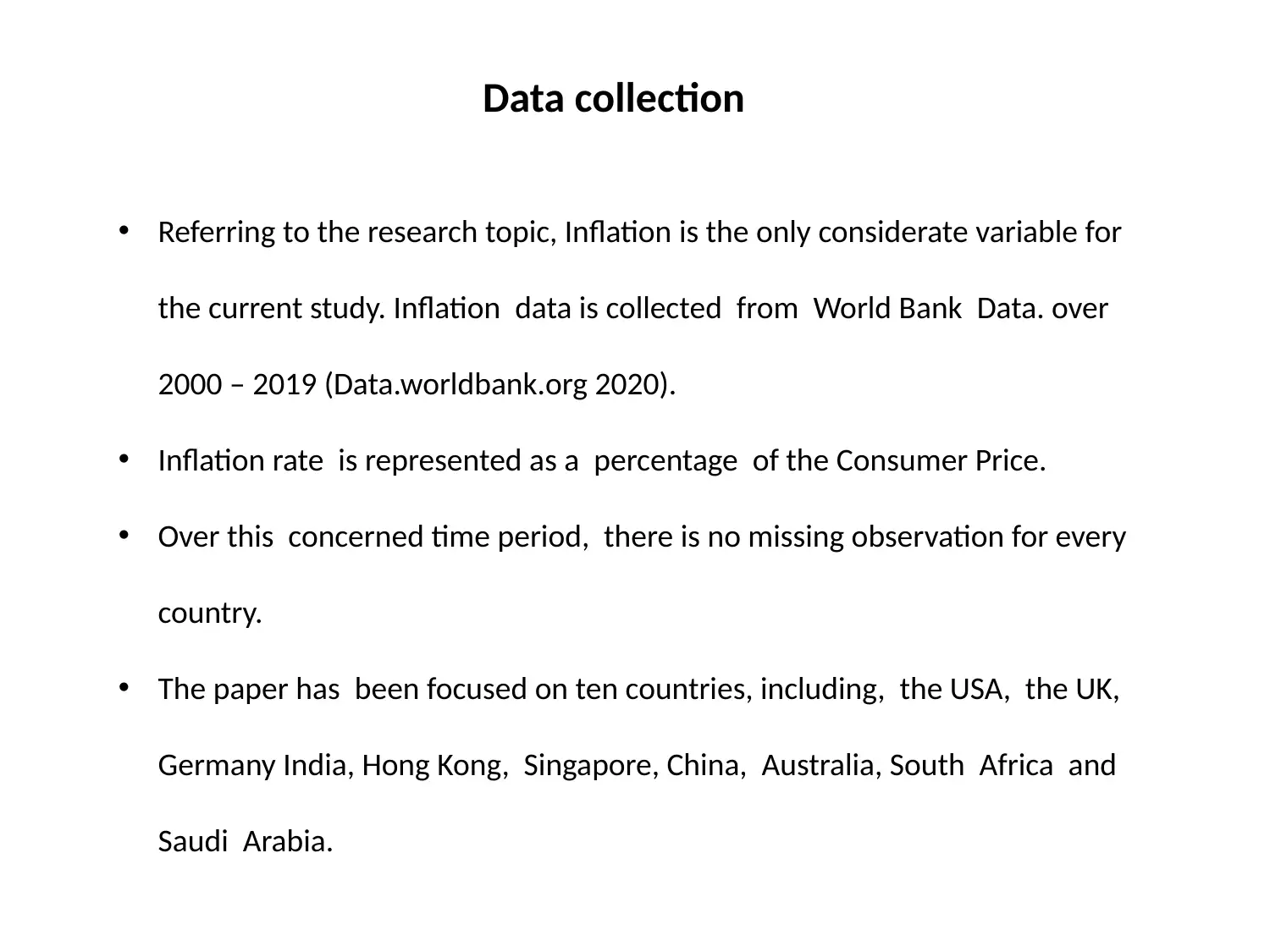
The paper has been focused on ten countries, including, the USA, the UK,
Germany India, Hong Kong, Singapore, China, Australia, South Africa and
Saudi Arabia.
tabler-icon-diamond-filled.svg

Paraphrase This Document

Need a fresh take? Get an instant paraphrase of this document with our AI Paraphraser
Document Page
Methodology
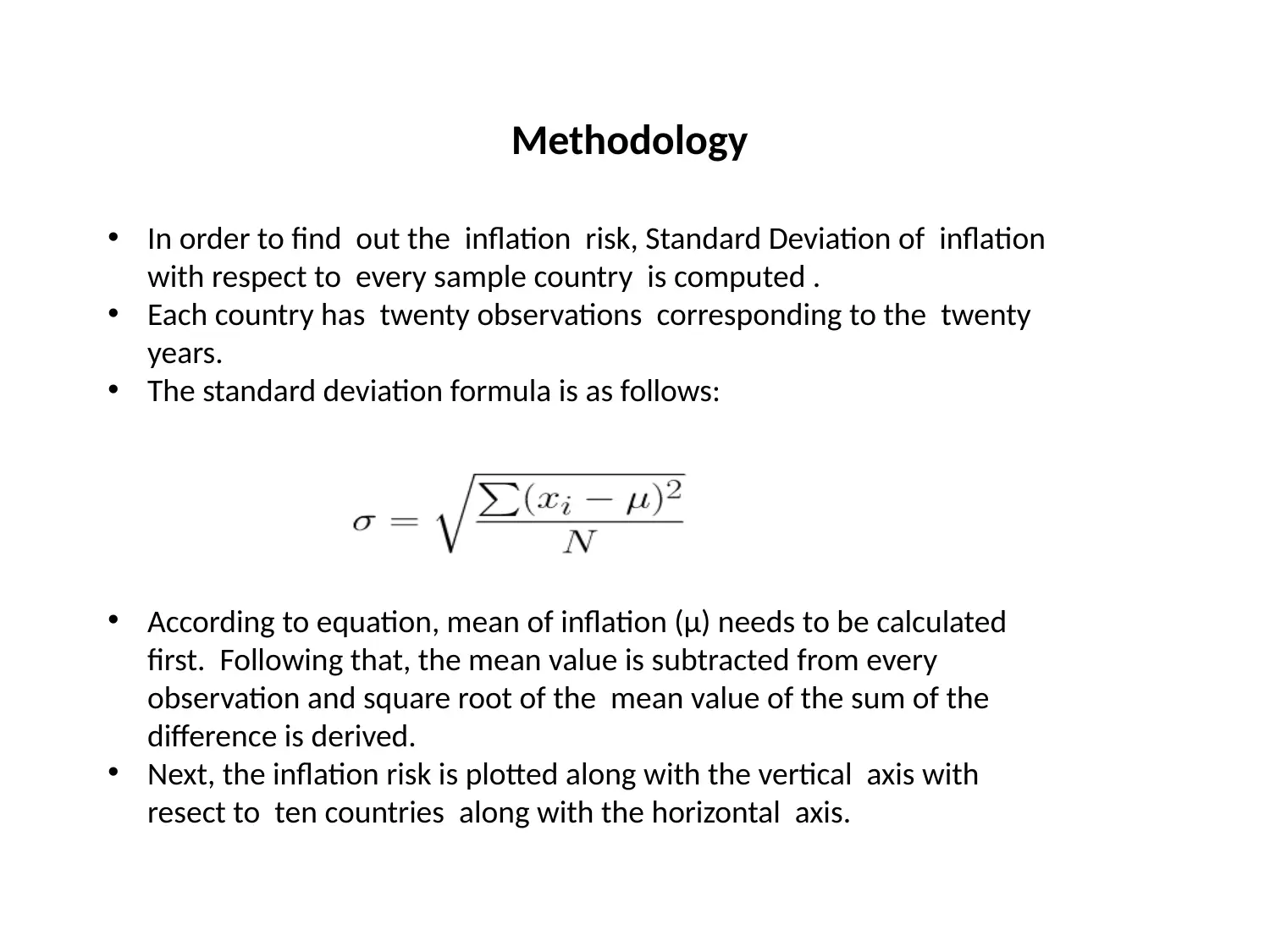
In order to find out the inflation risk, Standard Deviation of inflation
with respect to every sample country is computed .
Each country has twenty observations corresponding to the twenty
years.
The standard deviation formula is as follows:
According to equation, mean of inflation (μ) needs to be calculated
first. Following that, the mean value is subtracted from every
observation and square root of the mean value of the sum of the
difference is derived.
Next, the inflation risk is plotted along with the vertical axis with
resect to ten countries along with the horizontal axis.
Document Page
Findings
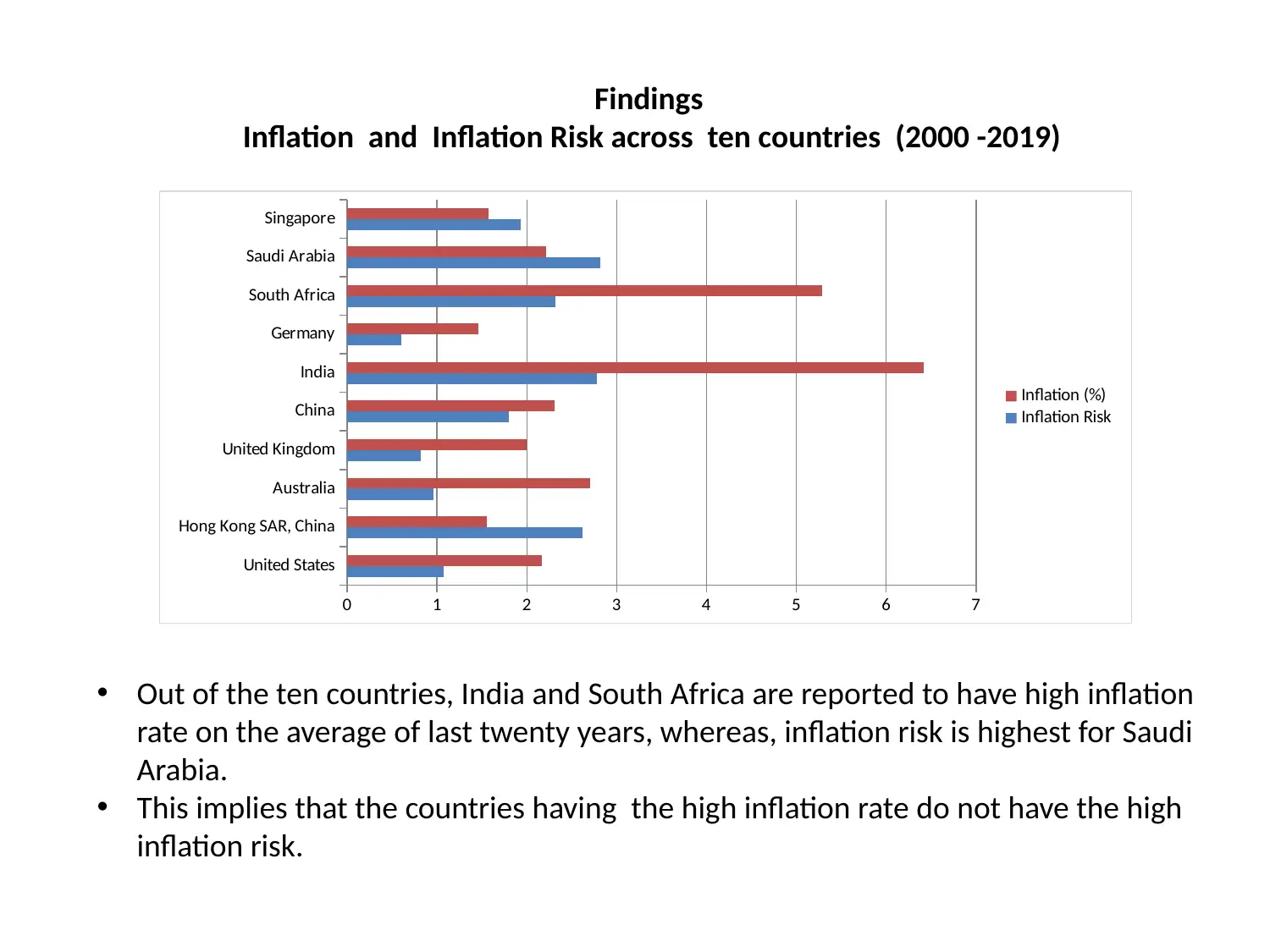
Inflation and Inflation Risk across ten countries (2000 -2019)
United States
Hong Kong SAR, China
Australia
United Kingdom
China
India
Germany
South Africa
Saudi Arabia
Singapore
0 1 2 3 4 5 6 7
Inflation (%)
Inflation Risk
Out of the ten countries, India and South Africa are reported to have high inflation
rate on the average of last twenty years, whereas, inflation risk is highest for Saudi
Arabia.
This implies that the countries having the high inflation rate do not have the high
inflation risk.
Document Page
Results and Discussion
From the findings, it can be inferred that average inflation rate is high for the
developing countries than the developed countries.
High inflation rate of these countries can be related to the countries’ growing
income inequality and lack of control on the price regulation (Liu, Margaritis
and Qiao 2016).
Both India and South Africa have recorded level of income inequality.
Moreover, inflation risk aggravates the unemployment situation of the
economy (Eraker, Shaliastovich and Wang 2016).
Unemployment rate in Saudi Arabia has been exhibiting upward trend since
2008.
Unemployment rate has surged up 5.92% in 2018 from 4.57% in 2000 (Statista
2020).
tabler-icon-diamond-filled.svg

Paraphrase This Document

Need a fresh take? Get an instant paraphrase of this document with our AI Paraphraser
Document Page
Global scenario on Inflation
India and South Africa are marked as developing countries.
Inflation triggers a great challenge for the consumers as well as for the
banking sector (Bekaert and Ermolov 2019).
Central Bank generally raises the interest rate as to reduce the inflation
rate.
The increasing interest rate results in the improvement of the investment
cost leading to lower production capacity (Yao, Li and Lai 2016)
Henceforth, the interest rate is again proposed to cut down to encourage
the investment process.
Recently, the bank rate has faced a record fall of 1% to control the
inflation rate in Australia.
Document Page
Rule of laws on inflation control
According to the macroeconomic policy makers, inflation and money supply are
closely related.
Inflation is the quantitative measure of the expenditure capability of the
customers.
Inflation occurs due to continuous development in the average demand.
The demand increases when money supply intensifies (Jareño, Ferrer and
Miroslavova 2016).
Inflation and open market operation are the principle mechanisms to control
the money supply.
Document Page
Government intervention across the countries
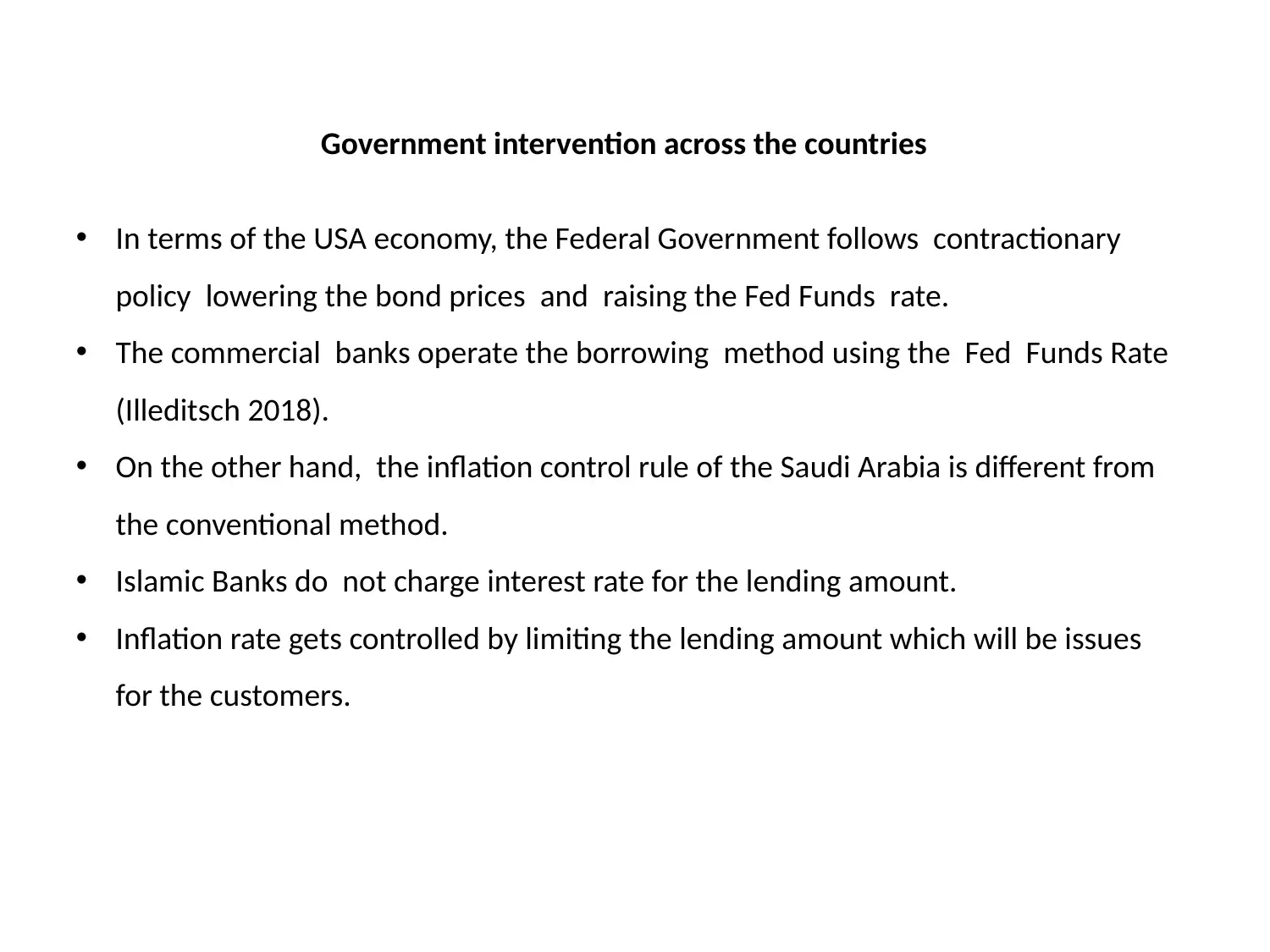
In terms of the USA economy, the Federal Government follows contractionary
policy lowering the bond prices and raising the Fed Funds rate.
The commercial banks operate the borrowing method using the Fed Funds Rate
(Illeditsch 2018).
On the other hand, the inflation control rule of the Saudi Arabia is different from
the conventional method.
Islamic Banks do not charge interest rate for the lending amount.
Inflation rate gets controlled by limiting the lending amount which will be issues
for the customers.
tabler-icon-diamond-filled.svg

Paraphrase This Document

Need a fresh take? Get an instant paraphrase of this document with our AI Paraphraser
Document Page
Conclusion
According to the findings, both developed and developing are critically
affected by the growing inflation rate. A number of significant
macroeconomic indicators, such as, unemployment rate, aggregate demand
and aggregate supply receives detrimental impacts if inflation rate is not
appropriately controlled.
Document Page
Reference list
Data.worldbank.org. (2020). Inflation, consumer prices (annual %) | Data. [online]
Available at: https://data.worldbank.org/indicator/FP.CPI.TOTL.ZG [Accessed 28 Mar.
2020].
Statista. (2020). Saudi Arabia - unemployment rate from 1999 to 2019 | Statista.
[online] Available at: https://www.statista.com/statistics/262524/unemployment-rate-
in-saudi-arabia/ [Accessed 28 Mar. 2020].
Liu, M.H., Margaritis, D. and Qiao, Z., 2016. The global financial crisis and retail interest
rate pass-through in Australia. Review of Pacific Basin Financial Markets and
Policies, 19(04), p.1650026.
Bekaert, G. and Ermolov, A., 2019. Inflation-Linked versus Nominal Bond Yields: On
Liquidity and Inflation Risk Premiums Around the World. Available at SSRN 3402785.
Jareño, F., Ferrer, R. and Miroslavova, S., 2016. US stock market sensitivity to interest
and inflation rates: a quantile regression approach. Applied Economics, 48(26), pp.2469-
2481.
chevron_up_icon
1 out of 14
circle_padding
hide_on_mobile
zoom_out_icon
[object Object]