An Investigation into Organisational Culture and Innovation Management
VerifiedAdded on 2022/12/26
|22
|5798
|67
Report
AI Summary
This research project investigates the influence of organizational culture on innovation management, focusing on Corinthia London as a case study. The report begins with an executive summary, followed by an introduction outlining the research aim, objectives, and questions. A literature review explores the concepts of organizational culture and innovation management, the role of culture in the workplace, and the relationship between the two. The methodology section details the research philosophy (positivism), approach (deductive), strategy (survey), and choice (quantitative). Data analysis and findings are presented, followed by a critical appraisal, recommendations, and suggestions. The report concludes with a summary of the key findings and their implications. The research utilizes the research onion framework to guide the methodology and employs a survey to gather quantitative data. The study aims to identify the specific impacts of organizational culture on innovation, offering valuable insights into the interplay between these two critical aspects of organizational success.
Research Project 7

Paraphrase This Document
Need a fresh take? Get an instant paraphrase of this document with our AI Paraphraser

EXECUTIVE SUMMARY
Contents
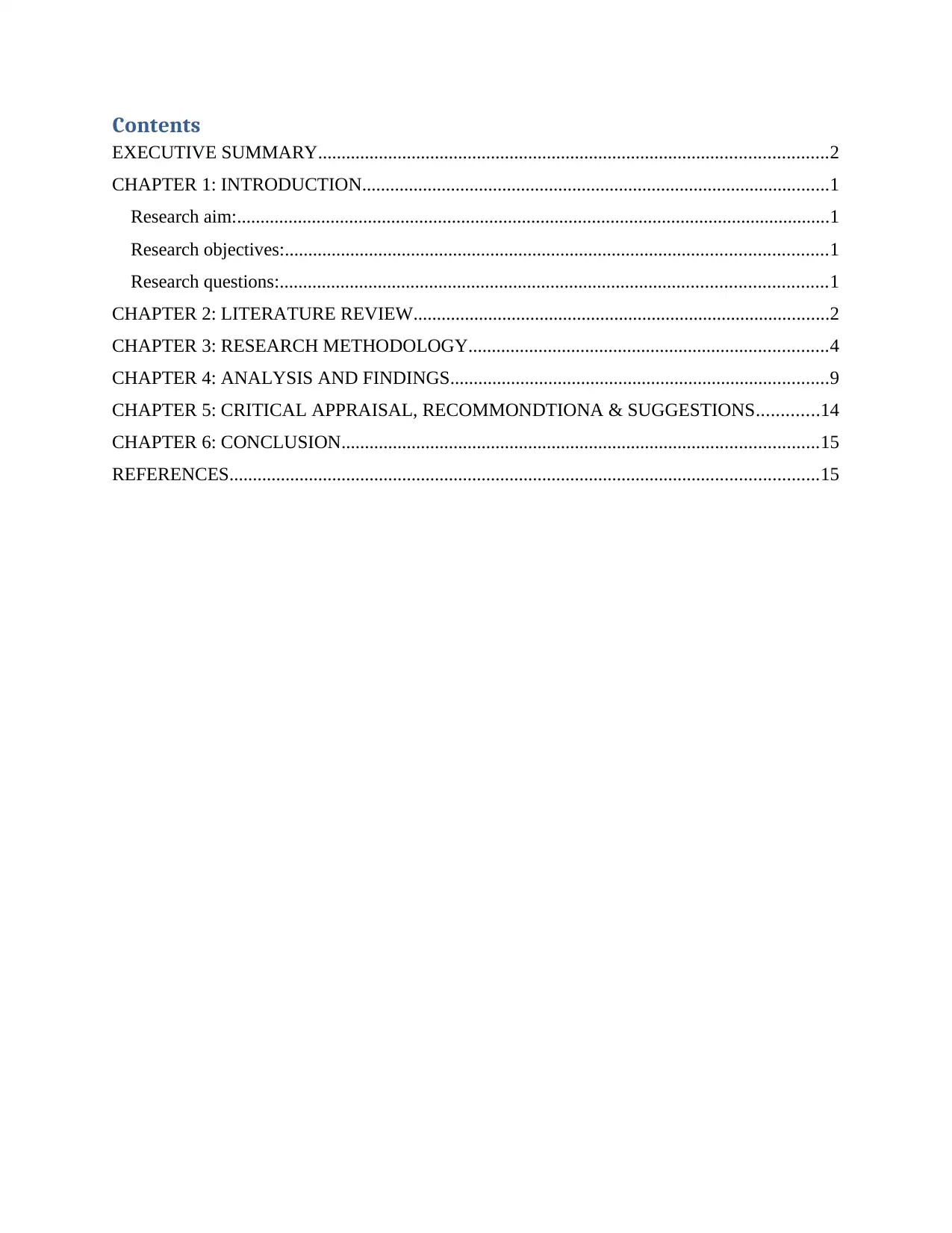
EXECUTIVE SUMMARY.............................................................................................................2
CHAPTER 1: INTRODUCTION....................................................................................................1
Research aim:...............................................................................................................................1
Research objectives:....................................................................................................................1
Research questions:.....................................................................................................................1
CHAPTER 2: LITERATURE REVIEW.........................................................................................2
CHAPTER 3: RESEARCH METHODOLOGY.............................................................................4
CHAPTER 4: ANALYSIS AND FINDINGS.................................................................................9
CHAPTER 5: CRITICAL APPRAISAL, RECOMMONDTIONA & SUGGESTIONS.............14
CHAPTER 6: CONCLUSION......................................................................................................15
REFERENCES..............................................................................................................................15
EXECUTIVE SUMMARY.............................................................................................................2
CHAPTER 1: INTRODUCTION....................................................................................................1
Research aim:...............................................................................................................................1
Research objectives:....................................................................................................................1
Research questions:.....................................................................................................................1
CHAPTER 2: LITERATURE REVIEW.........................................................................................2
CHAPTER 3: RESEARCH METHODOLOGY.............................................................................4
CHAPTER 4: ANALYSIS AND FINDINGS.................................................................................9
CHAPTER 5: CRITICAL APPRAISAL, RECOMMONDTIONA & SUGGESTIONS.............14
CHAPTER 6: CONCLUSION......................................................................................................15
REFERENCES..............................................................................................................................15
⊘ This is a preview!⊘
Do you want full access?
Subscribe today to unlock all pages.

Trusted by 1+ million students worldwide

Paraphrase This Document
Need a fresh take? Get an instant paraphrase of this document with our AI Paraphraser
CHAPTER 1: INTRODUCTION
Research Title- An investigation into the organisational culture and its influence on innovation
management.
Research aim:
Main aim of the present investigation is “To identify the influence of organisational
culture on innovation management”. A case of study Corinthia London
Research objectives:
To develop basic knowledge regarding the organisational culture and innovation
management.
To determine the role of organisational culture within a workplace.
To examine the relationship between organisational culture and innovation management.
Research questions:
What is the concept of innovation management and organisational culture?
What are the effective and essential roles of organisational culture within a workplace?
What is the relationship between organisational culture and innovation management?
Background of the research- The key to a successful organisation is to have a culture supported
to a strongly held and widely shared set of beliefs that are based on strategy and framework.
When a company has strong culture, three things happen such as employees know how top
management wants them to respond to any condition, workers believe that the desired response
is the effective one and manpower know that they will be rewarded for showing the values of the
company (Kraśnicka, Głód and Wronka-Pośpiech, 2018). This kind of organisational culture
creates or imposes positive impact as well as support innovation management. For the
completion of this assessment, Corinthia London is considered. It is a hotel and former British
government building, located on a triangular site among Trafalgar Square and Thames
Embankment. This current research is based on the topic as the influence of organisational
culture on innovation management. Moreover, it will discuss about the literature review, research
1
Research Title- An investigation into the organisational culture and its influence on innovation
management.
Research aim:
Main aim of the present investigation is “To identify the influence of organisational
culture on innovation management”. A case of study Corinthia London
Research objectives:
To develop basic knowledge regarding the organisational culture and innovation
management.
To determine the role of organisational culture within a workplace.
To examine the relationship between organisational culture and innovation management.
Research questions:
What is the concept of innovation management and organisational culture?
What are the effective and essential roles of organisational culture within a workplace?
What is the relationship between organisational culture and innovation management?
Background of the research- The key to a successful organisation is to have a culture supported
to a strongly held and widely shared set of beliefs that are based on strategy and framework.
When a company has strong culture, three things happen such as employees know how top
management wants them to respond to any condition, workers believe that the desired response
is the effective one and manpower know that they will be rewarded for showing the values of the
company (Kraśnicka, Głód and Wronka-Pośpiech, 2018). This kind of organisational culture
creates or imposes positive impact as well as support innovation management. For the
completion of this assessment, Corinthia London is considered. It is a hotel and former British
government building, located on a triangular site among Trafalgar Square and Thames
Embankment. This current research is based on the topic as the influence of organisational
culture on innovation management. Moreover, it will discuss about the literature review, research
1
methodology and data analysis. Furthermore, the research will consider data about
recommendations and conclusion by including information as per the topic.
Approach and methodology- It refers to the tools and techniques which are basically use by the
research in order to complete the research project. There is a research methodology framework
which is named as Research Onion (Afuah, 2020). It contains different layers and the research
will consider these methods in order to collection of information according to research area in
order to meet research objectives.
CHAPTER 2: LITERATURE REVIEW
The basic knowledge regarding the organisational culture and innovation management
As per the view of Shayah H. (2019), the capability to innovate is one of the main aspects
and components in the competitiveness of any firm. Innovation management is the process of
administrating innovative ideas. For this idea to have a real impact, it requires to be turned into
something actionable. Thus, innovation management can be defined as the method new ideas are
developed and refined until they become a reality. Innovation can also be a vehicle to attract top
talent which is more likely to want to work for a business successfully driving forward
innovation. They then become faithful workers who value the opportunity to be a part of the
innovation process. Empowering workers to be creative is a big part because it support in making
development in the business. Innovation management is important for the firm because its the
only method by which the company can transform big ideas into reality and benefit from the
optimistic outcomes.
According to Ceausu I. (2017), the concept of organisational culture refers to the way that
administrators implementing and determining the administration of innovation are conducted.
Organisational structure can take various forms basing on the size of the organisation, it
innovation policy, the innovation strategy and objectives, its centre and its organisational nature,
among other things. Ideally it should involve the entire company, even though this is not always
potential or feasible (Frishammar and et. al., 2019). Even if everyone takes part in the innovation
process in some way or another, some individual will nevertheless be more considered and have
greater accountability. Organisational culture is what offers personality and identity to a
company. Each organisation has its own culture, synthesized in the values, beliefs and
aspirations shared by members of the company. There are different cultures which can be opted
and followed by the venture.
2
recommendations and conclusion by including information as per the topic.
Approach and methodology- It refers to the tools and techniques which are basically use by the
research in order to complete the research project. There is a research methodology framework
which is named as Research Onion (Afuah, 2020). It contains different layers and the research
will consider these methods in order to collection of information according to research area in
order to meet research objectives.
CHAPTER 2: LITERATURE REVIEW
The basic knowledge regarding the organisational culture and innovation management
As per the view of Shayah H. (2019), the capability to innovate is one of the main aspects
and components in the competitiveness of any firm. Innovation management is the process of
administrating innovative ideas. For this idea to have a real impact, it requires to be turned into
something actionable. Thus, innovation management can be defined as the method new ideas are
developed and refined until they become a reality. Innovation can also be a vehicle to attract top
talent which is more likely to want to work for a business successfully driving forward
innovation. They then become faithful workers who value the opportunity to be a part of the
innovation process. Empowering workers to be creative is a big part because it support in making
development in the business. Innovation management is important for the firm because its the
only method by which the company can transform big ideas into reality and benefit from the
optimistic outcomes.
According to Ceausu I. (2017), the concept of organisational culture refers to the way that
administrators implementing and determining the administration of innovation are conducted.
Organisational structure can take various forms basing on the size of the organisation, it
innovation policy, the innovation strategy and objectives, its centre and its organisational nature,
among other things. Ideally it should involve the entire company, even though this is not always
potential or feasible (Frishammar and et. al., 2019). Even if everyone takes part in the innovation
process in some way or another, some individual will nevertheless be more considered and have
greater accountability. Organisational culture is what offers personality and identity to a
company. Each organisation has its own culture, synthesized in the values, beliefs and
aspirations shared by members of the company. There are different cultures which can be opted
and followed by the venture.
2
⊘ This is a preview!⊘
Do you want full access?
Subscribe today to unlock all pages.
Trusted by 1+ million students worldwide
The role of organisational culture within a workplace
As per the view of Moseley C. (2021), organisational culture plays an effective role in the
development of the firm as well as its successful running. It is crucial as it defined the venture’s
internal and external identity, reflects the core values of the firm and supports to keep the best
employees etc. Organisation culture is perceived differently by enterprises. There are businesses
that realise its significance and spend proportionately to either develop or sustain an optimistic
culture when there are others who have mistreated it altogether (De Massis and et. al., 2018).
Though it is hard to statistically demonstrate the influence of organisational culture, it is believed
that workers from organisations with a strong organisational culture experience a sense of
belonging, involvement and commitment regarding their company which is required critical for
development (The Role of Organization Culture in an Organization. 2020). There are different
roles of organisational culture, some of them as:
Organisational culture goes a long way in creating the brand image of the firm. The work
culture offers an identity to the firm.
Along with this, organisational culture plays an effective role in shaping the way workers
interact with their place of work. A healthy and friendly workplace culture motivates
workers to stay encouraged and loyal to administration. Also, the work culture promotes
healthy relationships between the workforces.
An organisational culture also supports build an emotional attachment to the firm and
improves a sense if unity in the working environment.
The relationship between organisational culture and innovation management
According to Eskiler E. (2016), Culture is one of the most important social environmental
aspects in a company. Thus it affects the life and development of a firm. Organisational culture is
paradigm that permits the form to see the reality of the culture. This paradigm presents routine
processes, categories and good or bad solutions for a firm. It also awares people about how to
behave in their firm (Roscoe and et. al., 2019). Also, innovation has become the base of the
development and innovation has become the vase of development and competiveness in the
global economy. The organisational culture and innovation management have good relation
because due having effective organisational culture, they can make creation in the business and
manage the innovations which take place within the firm.
3
As per the view of Moseley C. (2021), organisational culture plays an effective role in the
development of the firm as well as its successful running. It is crucial as it defined the venture’s
internal and external identity, reflects the core values of the firm and supports to keep the best
employees etc. Organisation culture is perceived differently by enterprises. There are businesses
that realise its significance and spend proportionately to either develop or sustain an optimistic
culture when there are others who have mistreated it altogether (De Massis and et. al., 2018).
Though it is hard to statistically demonstrate the influence of organisational culture, it is believed
that workers from organisations with a strong organisational culture experience a sense of
belonging, involvement and commitment regarding their company which is required critical for
development (The Role of Organization Culture in an Organization. 2020). There are different
roles of organisational culture, some of them as:
Organisational culture goes a long way in creating the brand image of the firm. The work
culture offers an identity to the firm.
Along with this, organisational culture plays an effective role in shaping the way workers
interact with their place of work. A healthy and friendly workplace culture motivates
workers to stay encouraged and loyal to administration. Also, the work culture promotes
healthy relationships between the workforces.
An organisational culture also supports build an emotional attachment to the firm and
improves a sense if unity in the working environment.
The relationship between organisational culture and innovation management
According to Eskiler E. (2016), Culture is one of the most important social environmental
aspects in a company. Thus it affects the life and development of a firm. Organisational culture is
paradigm that permits the form to see the reality of the culture. This paradigm presents routine
processes, categories and good or bad solutions for a firm. It also awares people about how to
behave in their firm (Roscoe and et. al., 2019). Also, innovation has become the base of the
development and innovation has become the vase of development and competiveness in the
global economy. The organisational culture and innovation management have good relation
because due having effective organisational culture, they can make creation in the business and
manage the innovations which take place within the firm.
3
Paraphrase This Document
Need a fresh take? Get an instant paraphrase of this document with our AI Paraphraser
CHAPTER 3: RESEARCH METHODOLOGY
Research philosophy- It is the first coat of the research onion framework. There are three
key kinds of research philosophy such positivism, realism and pragmatism. Positivist research
takes the view that knowledge subsists outside of what’s being decided. With the support of this
technique, knowledge can only be true, false or meaningless. Basically, if something is not found
to be true or false, it no longer holds any ground and is thus discharged (Lee and Kang, 2018).
Also, interpretivism underlines the influence that social and cultural backdrop. With this kind of
philosophy, the researcher plays an efficient and active role in the research, because it is required
to draw a holistic view of the responder and their actions thoughts and meanings. Whereas
pragmatic method of research underlines the importance of utilising the best techniques potential
to research phenomena. The key objective is to approach study from a practical point of view,
where knowledge is not fixed, but instead is constantly questioned and understood. With this
aim, pragmatism includes of an aspect of investigator involvement and subjectivity, basically
when drawing conclusions based on participants responses and analysis. Within this current
research project, the surveyor will opt positivist research philosophy. This study is included by
the surveyor as it is independent from the research and there are not stipulations for human
interest within the research. Along with this, it also associated with a phenomenology
philosophy. This tool connects to the viewpoint that investigator needs to centres n facts while
phenomenology centres in the meaning and has condition for human interest.
Research approach- This layer consist two forms like inductive and deductive. An
inductive approach could be used in the research of an otherwise unknown community. There is
very less knowledge about this community, and thus, research would have to be conducted to
collect information on the population, thus directing to the data concepts. Deductive approach
would be included when searching modifications in the physical properties of animals over time,
as this would likely be rooted in the concept of evaluation (Tian and et. al., 2018). Inductive
approaches are generally used with the qualitative research and deductive approach tends with
quantitative research basically begins with theory as a foundation, where progress is made by
hypothesis testing. in this existing study, the research will make use of deductive approach as it
can support the individual who think logically as well as make meaningful decisions in the place
of work. Thus metal tool supports professionals to come to conclusions based on the base
4
Research philosophy- It is the first coat of the research onion framework. There are three
key kinds of research philosophy such positivism, realism and pragmatism. Positivist research
takes the view that knowledge subsists outside of what’s being decided. With the support of this
technique, knowledge can only be true, false or meaningless. Basically, if something is not found
to be true or false, it no longer holds any ground and is thus discharged (Lee and Kang, 2018).
Also, interpretivism underlines the influence that social and cultural backdrop. With this kind of
philosophy, the researcher plays an efficient and active role in the research, because it is required
to draw a holistic view of the responder and their actions thoughts and meanings. Whereas
pragmatic method of research underlines the importance of utilising the best techniques potential
to research phenomena. The key objective is to approach study from a practical point of view,
where knowledge is not fixed, but instead is constantly questioned and understood. With this
aim, pragmatism includes of an aspect of investigator involvement and subjectivity, basically
when drawing conclusions based on participants responses and analysis. Within this current
research project, the surveyor will opt positivist research philosophy. This study is included by
the surveyor as it is independent from the research and there are not stipulations for human
interest within the research. Along with this, it also associated with a phenomenology
philosophy. This tool connects to the viewpoint that investigator needs to centres n facts while
phenomenology centres in the meaning and has condition for human interest.
Research approach- This layer consist two forms like inductive and deductive. An
inductive approach could be used in the research of an otherwise unknown community. There is
very less knowledge about this community, and thus, research would have to be conducted to
collect information on the population, thus directing to the data concepts. Deductive approach
would be included when searching modifications in the physical properties of animals over time,
as this would likely be rooted in the concept of evaluation (Tian and et. al., 2018). Inductive
approaches are generally used with the qualitative research and deductive approach tends with
quantitative research basically begins with theory as a foundation, where progress is made by
hypothesis testing. in this existing study, the research will make use of deductive approach as it
can support the individual who think logically as well as make meaningful decisions in the place
of work. Thus metal tool supports professionals to come to conclusions based on the base
4
assumed to be true or by taking a general assumption and turning it into a more specific idea and
action.
Research strategy- There is number of research strategies that can be opted by the
investigator in context of accomplishment of the research study and accomplishing research
objectives. Experimental, action research, case study, survey and many more. In this current
research document, the researcher will include survey as a method or strategy of research in
context of attainment of the research aim (Leonidou and et. al., 2018). It is opted by the surveyor
as this technique utilised for gathering information from a predefined team of representatives in
order to gather information and insights into diverse topics of interest. They can have different
motives and researchers can conduct it in different manners basing on the method chosen and the
research aim. Also, this plan opts quantitative research method as with the support of it, the
individual can assemble statistical data and fresh information.
Research choice-It is another phase of research onion that is concerned with quantitative
and qualitative methods, Qualitative research is generally exploratory research, it is basically
utilised to earn an understanding of highlighting reasons, views and encouragement. It offers
underlines in to the issue or supports to improve ideas and hypothesis for potential quantitative
research. Qualitative research is also utilised to uncover trends in ideas as well as dive deeper in
to the complexity. Qualitative data collection tolls vary using unstructured or semi structured
tools. Some common methods include like focus group, individual interviews and observations.
The sample size basically small and representatives are chosen to meet a provided section.
Basically, quantitative methods are utilised to determine and assess relationships between
people, individuals their environment as well as motives that drive people’s behaviour and
activity. This plan does not impose rigid rules and process similar to quantitative methods.
Additionally, they derive the research process from the information itself.
Quantitative research is utilised to enumerate the problem by way of creating numerical
and statistical data which can be converted in to usable form. It is utilised to count attitudes,
opinions, behaviours and other defined variables and analyse outcomes from a larger sample
population (Zuraik and Kelly, 2019). This study tool generally utilised measurable data to frame
acts and uncover patterns in study. This specific research is much designed than qualitative data
collections techniques. This plan includes different forms like mobile survey, online, survey and
paper survey, face to face interview, online poll and systematic observations. In this current
5
action.
Research strategy- There is number of research strategies that can be opted by the
investigator in context of accomplishment of the research study and accomplishing research
objectives. Experimental, action research, case study, survey and many more. In this current
research document, the researcher will include survey as a method or strategy of research in
context of attainment of the research aim (Leonidou and et. al., 2018). It is opted by the surveyor
as this technique utilised for gathering information from a predefined team of representatives in
order to gather information and insights into diverse topics of interest. They can have different
motives and researchers can conduct it in different manners basing on the method chosen and the
research aim. Also, this plan opts quantitative research method as with the support of it, the
individual can assemble statistical data and fresh information.
Research choice-It is another phase of research onion that is concerned with quantitative
and qualitative methods, Qualitative research is generally exploratory research, it is basically
utilised to earn an understanding of highlighting reasons, views and encouragement. It offers
underlines in to the issue or supports to improve ideas and hypothesis for potential quantitative
research. Qualitative research is also utilised to uncover trends in ideas as well as dive deeper in
to the complexity. Qualitative data collection tolls vary using unstructured or semi structured
tools. Some common methods include like focus group, individual interviews and observations.
The sample size basically small and representatives are chosen to meet a provided section.
Basically, quantitative methods are utilised to determine and assess relationships between
people, individuals their environment as well as motives that drive people’s behaviour and
activity. This plan does not impose rigid rules and process similar to quantitative methods.
Additionally, they derive the research process from the information itself.
Quantitative research is utilised to enumerate the problem by way of creating numerical
and statistical data which can be converted in to usable form. It is utilised to count attitudes,
opinions, behaviours and other defined variables and analyse outcomes from a larger sample
population (Zuraik and Kelly, 2019). This study tool generally utilised measurable data to frame
acts and uncover patterns in study. This specific research is much designed than qualitative data
collections techniques. This plan includes different forms like mobile survey, online, survey and
paper survey, face to face interview, online poll and systematic observations. In this current
5
⊘ This is a preview!⊘
Do you want full access?
Subscribe today to unlock all pages.
Trusted by 1+ million students worldwide
research project, the researcher will opt quantitative research method as there are a wide range of
numerical tools accessible to define quantitative information. The content which is collected by
quantitative method is in simple graph form to demonstrate the information by test of
correlations among two or more items, to statistical importance. Other tools include
determination which is important for finding relations units of subjects where there is no
noticeable hypothesis and hypothesis testing to find out whether there are genuine differences
among teams.
Data collection- There are two key kind of research which is used by the surveyor in order
to collect information with the aim of completion of the research in more effective and
appropriate form (Tidd and Bessant, 2018). The discriminating aspect among primary and
secondary research is the level of engagement of the research with data collection procedure.
Primary research states to the research that has considered the gathering of original information
about specific research project. During the time of performing research, the investigator gathers
fresh and pure information rather relying on accessible data in databases and other publications.
This sort of research is often performed with the aim of providing new knowledge due to the
primary research is also referred to as original research. By organising primary research,
researchers aim to response questions that have not been replied or even asked before. This level
of originality set up primary study apart from secondary research. Regarding data collection with
the support of primary research, the investigator can consider surveys, interviews, observations
and focus group etc.
Secondary research includes active involvement from the investigator themselves; secondary
research considers the synthesis of data and literature that has been conducted and published by
others. When organising secondary investigation, researchers opt and determine data from
primary research tool. Secondary research is broadly used in several sections of research and
areas such as legal and market research (Turulja and Bajgoric, 2019). The amount of data
accessible on a particular topic may be overshadowing at the starting of the secondary research
process. Research questions should be utilised to lead the surveyor so that they focus on finding
out project specific information. the best source to response a specific study question may vary
widely and a single project will likely need more than one source. Under this tool, the data is
assembled by diverse soruces such as books, journals, magazines, articles, government agencies,
educational institutes and commercial data sources etc. Under this current research study, the
6
numerical tools accessible to define quantitative information. The content which is collected by
quantitative method is in simple graph form to demonstrate the information by test of
correlations among two or more items, to statistical importance. Other tools include
determination which is important for finding relations units of subjects where there is no
noticeable hypothesis and hypothesis testing to find out whether there are genuine differences
among teams.
Data collection- There are two key kind of research which is used by the surveyor in order
to collect information with the aim of completion of the research in more effective and
appropriate form (Tidd and Bessant, 2018). The discriminating aspect among primary and
secondary research is the level of engagement of the research with data collection procedure.
Primary research states to the research that has considered the gathering of original information
about specific research project. During the time of performing research, the investigator gathers
fresh and pure information rather relying on accessible data in databases and other publications.
This sort of research is often performed with the aim of providing new knowledge due to the
primary research is also referred to as original research. By organising primary research,
researchers aim to response questions that have not been replied or even asked before. This level
of originality set up primary study apart from secondary research. Regarding data collection with
the support of primary research, the investigator can consider surveys, interviews, observations
and focus group etc.
Secondary research includes active involvement from the investigator themselves; secondary
research considers the synthesis of data and literature that has been conducted and published by
others. When organising secondary investigation, researchers opt and determine data from
primary research tool. Secondary research is broadly used in several sections of research and
areas such as legal and market research (Turulja and Bajgoric, 2019). The amount of data
accessible on a particular topic may be overshadowing at the starting of the secondary research
process. Research questions should be utilised to lead the surveyor so that they focus on finding
out project specific information. the best source to response a specific study question may vary
widely and a single project will likely need more than one source. Under this tool, the data is
assembled by diverse soruces such as books, journals, magazines, articles, government agencies,
educational institutes and commercial data sources etc. Under this current research study, the
6
Paraphrase This Document
Need a fresh take? Get an instant paraphrase of this document with our AI Paraphraser
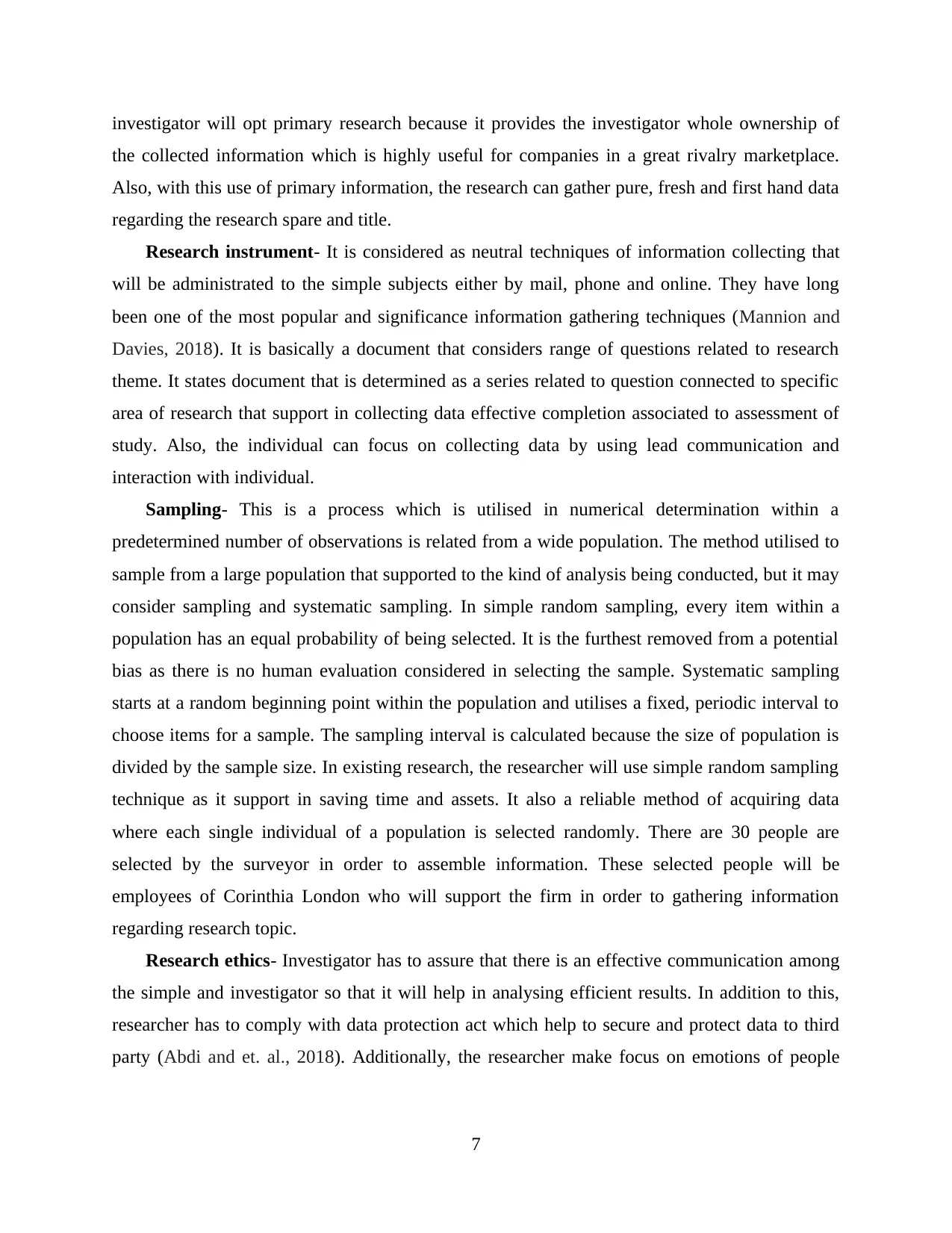
investigator will opt primary research because it provides the investigator whole ownership of
the collected information which is highly useful for companies in a great rivalry marketplace.
Also, with this use of primary information, the research can gather pure, fresh and first hand data
regarding the research spare and title.
Research instrument- It is considered as neutral techniques of information collecting that
will be administrated to the simple subjects either by mail, phone and online. They have long
been one of the most popular and significance information gathering techniques (Mannion and
Davies, 2018). It is basically a document that considers range of questions related to research
theme. It states document that is determined as a series related to question connected to specific
area of research that support in collecting data effective completion associated to assessment of
study. Also, the individual can focus on collecting data by using lead communication and
interaction with individual.
Sampling- This is a process which is utilised in numerical determination within a
predetermined number of observations is related from a wide population. The method utilised to
sample from a large population that supported to the kind of analysis being conducted, but it may
consider sampling and systematic sampling. In simple random sampling, every item within a
population has an equal probability of being selected. It is the furthest removed from a potential
bias as there is no human evaluation considered in selecting the sample. Systematic sampling
starts at a random beginning point within the population and utilises a fixed, periodic interval to
choose items for a sample. The sampling interval is calculated because the size of population is
divided by the sample size. In existing research, the researcher will use simple random sampling
technique as it support in saving time and assets. It also a reliable method of acquiring data
where each single individual of a population is selected randomly. There are 30 people are
selected by the surveyor in order to assemble information. These selected people will be
employees of Corinthia London who will support the firm in order to gathering information
regarding research topic.
Research ethics- Investigator has to assure that there is an effective communication among
the simple and investigator so that it will help in analysing efficient results. In addition to this,
researcher has to comply with data protection act which help to secure and protect data to third
party (Abdi and et. al., 2018). Additionally, the researcher make focus on emotions of people
7
the collected information which is highly useful for companies in a great rivalry marketplace.
Also, with this use of primary information, the research can gather pure, fresh and first hand data
regarding the research spare and title.
Research instrument- It is considered as neutral techniques of information collecting that
will be administrated to the simple subjects either by mail, phone and online. They have long
been one of the most popular and significance information gathering techniques (Mannion and
Davies, 2018). It is basically a document that considers range of questions related to research
theme. It states document that is determined as a series related to question connected to specific
area of research that support in collecting data effective completion associated to assessment of
study. Also, the individual can focus on collecting data by using lead communication and
interaction with individual.
Sampling- This is a process which is utilised in numerical determination within a
predetermined number of observations is related from a wide population. The method utilised to
sample from a large population that supported to the kind of analysis being conducted, but it may
consider sampling and systematic sampling. In simple random sampling, every item within a
population has an equal probability of being selected. It is the furthest removed from a potential
bias as there is no human evaluation considered in selecting the sample. Systematic sampling
starts at a random beginning point within the population and utilises a fixed, periodic interval to
choose items for a sample. The sampling interval is calculated because the size of population is
divided by the sample size. In existing research, the researcher will use simple random sampling
technique as it support in saving time and assets. It also a reliable method of acquiring data
where each single individual of a population is selected randomly. There are 30 people are
selected by the surveyor in order to assemble information. These selected people will be
employees of Corinthia London who will support the firm in order to gathering information
regarding research topic.
Research ethics- Investigator has to assure that there is an effective communication among
the simple and investigator so that it will help in analysing efficient results. In addition to this,
researcher has to comply with data protection act which help to secure and protect data to third
party (Abdi and et. al., 2018). Additionally, the researcher make focus on emotions of people
7
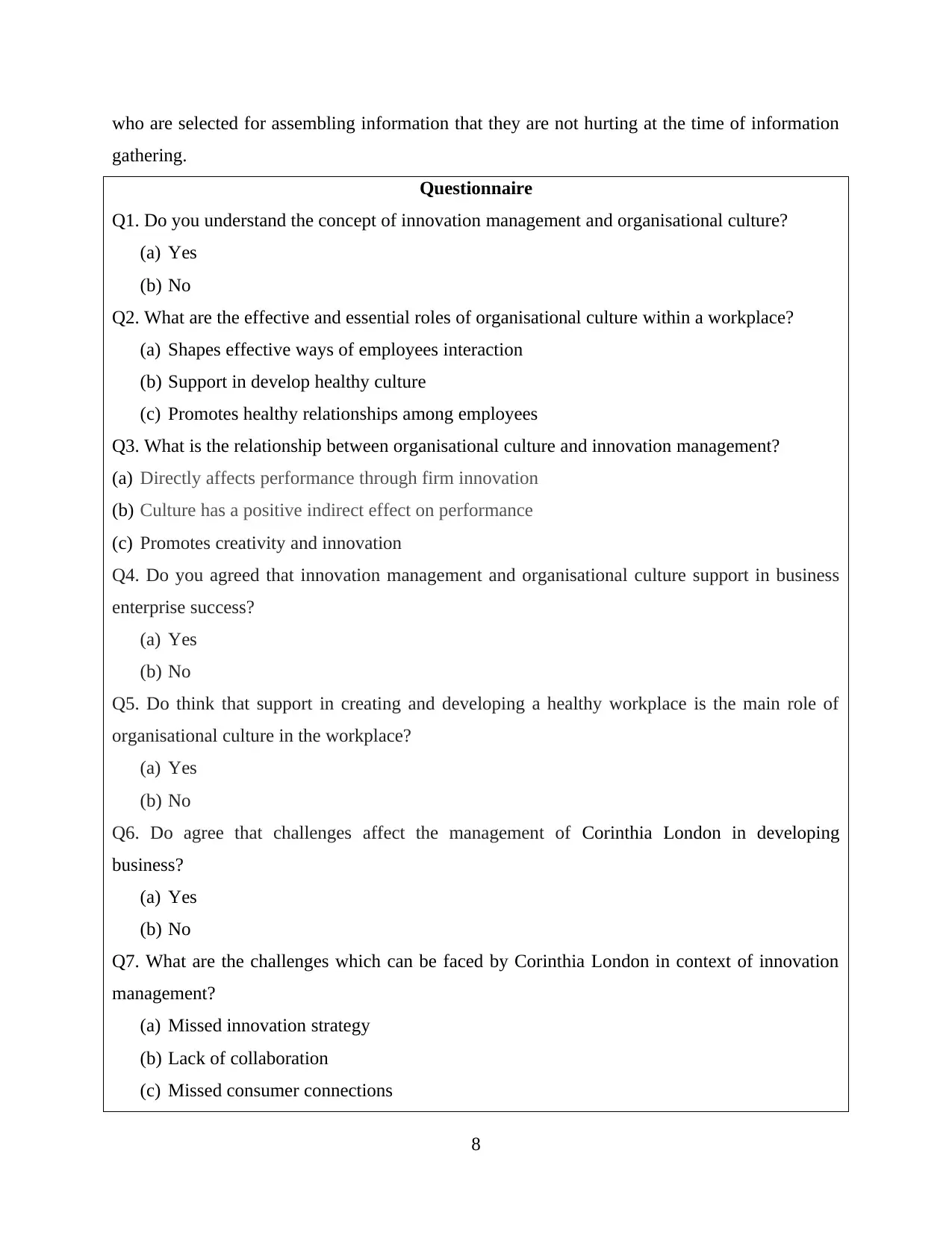
who are selected for assembling information that they are not hurting at the time of information
gathering.
Questionnaire
Q1. Do you understand the concept of innovation management and organisational culture?
(a) Yes
(b) No
Q2. What are the effective and essential roles of organisational culture within a workplace?
(a) Shapes effective ways of employees interaction
(b) Support in develop healthy culture
(c) Promotes healthy relationships among employees
Q3. What is the relationship between organisational culture and innovation management?
(a) Directly affects performance through firm innovation
(b) Culture has a positive indirect effect on performance
(c) Promotes creativity and innovation
Q4. Do you agreed that innovation management and organisational culture support in business
enterprise success?
(a) Yes
(b) No
Q5. Do think that support in creating and developing a healthy workplace is the main role of
organisational culture in the workplace?
(a) Yes
(b) No
Q6. Do agree that challenges affect the management of Corinthia London in developing
business?
(a) Yes
(b) No
Q7. What are the challenges which can be faced by Corinthia London in context of innovation
management?
(a) Missed innovation strategy
(b) Lack of collaboration
(c) Missed consumer connections
8
gathering.
Questionnaire
Q1. Do you understand the concept of innovation management and organisational culture?
(a) Yes
(b) No
Q2. What are the effective and essential roles of organisational culture within a workplace?
(a) Shapes effective ways of employees interaction
(b) Support in develop healthy culture
(c) Promotes healthy relationships among employees
Q3. What is the relationship between organisational culture and innovation management?
(a) Directly affects performance through firm innovation
(b) Culture has a positive indirect effect on performance
(c) Promotes creativity and innovation
Q4. Do you agreed that innovation management and organisational culture support in business
enterprise success?
(a) Yes
(b) No
Q5. Do think that support in creating and developing a healthy workplace is the main role of
organisational culture in the workplace?
(a) Yes
(b) No
Q6. Do agree that challenges affect the management of Corinthia London in developing
business?
(a) Yes
(b) No
Q7. What are the challenges which can be faced by Corinthia London in context of innovation
management?
(a) Missed innovation strategy
(b) Lack of collaboration
(c) Missed consumer connections
8
⊘ This is a preview!⊘
Do you want full access?
Subscribe today to unlock all pages.
Trusted by 1+ million students worldwide

1 out of 22


Related Documents


Your All-in-One AI-Powered Toolkit for Academic Success.
+13062052269
info@desklib.com
Available 24*7 on WhatsApp / Email
![[object Object]](/_next/static/media/star-bottom.7253800d.svg)
Unlock your academic potential
Copyright © 2020–2026 A2Z Services. All Rights Reserved. Developed and managed by ZUCOL.