The Role of Information Systems in Enhancing Business Decision-Making
VerifiedAdded on 2020/04/15
|11
|2825
|51
Essay
AI Summary
The essay explores the pivotal role of Information Systems (IS) in augmenting decision-making capabilities across diverse sectors. It emphasizes how IS contributes to a competitive advantage by enhancing interactions with markets, suppliers, and competitors. Key areas discussed include strategic information management challenges, flexibility in process-aware systems, and privacy concerns in distributed environments. The essay further delves into geographic information systems, security features, and the integration of software-defined networks. Recommendations are provided for implementing IS effectively to maximize benefits, ultimately leading to improved organizational performance.

Running head: INFORMATION SYSTEM
INFORMATION SYSTEM
Name of the Student
Name of the University
Authors Note:
INFORMATION SYSTEM
Name of the Student
Name of the University
Authors Note:

Paraphrase This Document
Need a fresh take? Get an instant paraphrase of this document with our AI Paraphraser
1INFORMATION SYSTEM
Introduction
Many software tools and methods are being used in small and medium organization
which will help in manufacturing products which will help various organization in
synchronization of various enterprise system and manufacturing various process (Laudon and
Laudon, 2013). The ultimate goal behind the implementation of real time communication and
integration of various materials and information (Chourabi et al., 2012). Implementation of new
business system or upgradation of any existing one can be considered to be most valuable for
resource, time and people. During the implementation of information system following area like
planning, analysis of system and requirements, designing, development must be taken into
account.
Aims
The main notion behind this essay is to provide brief idea regarding various types of
information systems (Reichert and Weber, 2012). Justification on the various type of standalone
information system has been discussed. Important areas like efficiency of various process across
organization, improved visibility, accelerated growth, proper IT time and saving of cost,
innovation will be discussed in details in the coming pages of the essay (Romney and Steinbart,
2012). Challenges regarding the implementation of information system like selection of right
technology, implementation of shared data, redefining of various house process and other
consideration will be discussed in the coming pages (Peppard, and Ward, 2016). A list of
recommendation regarding the implementation of information system will be discussed in the
coming pages of the essay.
Objectives
Introduction
Many software tools and methods are being used in small and medium organization
which will help in manufacturing products which will help various organization in
synchronization of various enterprise system and manufacturing various process (Laudon and
Laudon, 2013). The ultimate goal behind the implementation of real time communication and
integration of various materials and information (Chourabi et al., 2012). Implementation of new
business system or upgradation of any existing one can be considered to be most valuable for
resource, time and people. During the implementation of information system following area like
planning, analysis of system and requirements, designing, development must be taken into
account.
Aims
The main notion behind this essay is to provide brief idea regarding various types of
information systems (Reichert and Weber, 2012). Justification on the various type of standalone
information system has been discussed. Important areas like efficiency of various process across
organization, improved visibility, accelerated growth, proper IT time and saving of cost,
innovation will be discussed in details in the coming pages of the essay (Romney and Steinbart,
2012). Challenges regarding the implementation of information system like selection of right
technology, implementation of shared data, redefining of various house process and other
consideration will be discussed in the coming pages (Peppard, and Ward, 2016). A list of
recommendation regarding the implementation of information system will be discussed in the
coming pages of the essay.
Objectives
2INFORMATION SYSTEM
To integrate various type of information systems which can result in getting more
targeted information in various domains like market, suppliers and competitors which will
ultimately help in improving decision making capabilities of a business and will provide a
competitive advantage for various organization Bonham-Carter, 2014).
Discussion
Three type of Information System
Small organization or business should be more concerned about production of quality of
service and also have a notion of turning mountains of data into proper information. For
achieving a competitive advantage various small organization consider information system as the
corporate, tactical and strategies of operation (Venkatesh, Brown and Bala, 2013). For best use
of data as an asset of organization various firms must adopt a strategy for information which
mainly depends on the implementation of information system. This new implementation will
make business transaction easier and will give power to various business leader to have faster
and informed decision (Stair and Reynolds, 2013). Three different type of information system
are transaction processing system, management information system and executive information
system.
Transaction processing system (Operational Information system): A small business makes
use of transaction processing system or TPS which generally result from day to day business
operation like building of paychecks and various orders related to purchasing of goods (Hall,
2012). TPS is much similar to batch system which generally requires the user interaction with
any system in a particular time which will ultimately help the system to collect, retrieve, storing
and modification related to it. In this system a user enters a data of transaction by the help of a
To integrate various type of information systems which can result in getting more
targeted information in various domains like market, suppliers and competitors which will
ultimately help in improving decision making capabilities of a business and will provide a
competitive advantage for various organization Bonham-Carter, 2014).
Discussion
Three type of Information System
Small organization or business should be more concerned about production of quality of
service and also have a notion of turning mountains of data into proper information. For
achieving a competitive advantage various small organization consider information system as the
corporate, tactical and strategies of operation (Venkatesh, Brown and Bala, 2013). For best use
of data as an asset of organization various firms must adopt a strategy for information which
mainly depends on the implementation of information system. This new implementation will
make business transaction easier and will give power to various business leader to have faster
and informed decision (Stair and Reynolds, 2013). Three different type of information system
are transaction processing system, management information system and executive information
system.
Transaction processing system (Operational Information system): A small business makes
use of transaction processing system or TPS which generally result from day to day business
operation like building of paychecks and various orders related to purchasing of goods (Hall,
2012). TPS is much similar to batch system which generally requires the user interaction with
any system in a particular time which will ultimately help the system to collect, retrieve, storing
and modification related to it. In this system a user enters a data of transaction by the help of a
⊘ This is a preview!⊘
Do you want full access?
Subscribe today to unlock all pages.

Trusted by 1+ million students worldwide
3INFORMATION SYSTEM
terminal and after that data is stored in the database and after that a proper output is produce
(Pearlson, Saunders and Galletta, 2016). Let us consider an example for better understanding
where a small business owner has direct a system of bank to have debit in saving account with an
amount of five hundred dollars and after that the amount is credited into account of the
organization. Due to constant system updates a user can easily have updates regarding the data of
TPS like balance in the account.
Decision support system (Tactical Information System) : A DSS or decision support system
will allow managers of small organization and owners makes use of predefined and hoc reports
for providing support for planning of operation and various decision. By making use of DSS a
user can easily find answer to the question which is considered as a method of evaluation of
decision before the adoption or implementation of this particular system (Galliers, and Leidner,
2014). The answer to particular question can easily take the shape of data summary report like
revenue of products by making use of revenue which is generated from quarter report of sales.
For having an analysis various owner of business and managers must make use of interface for
selecting a particular graphic representation which is consider to be key performance for a small
organization which generally tracks the progression towards a particular goal (Sezer et al., 2013).
For example, a manufacturing unit of a dashboard makes use of dashboard for representing the
number of products which is available on particular line.
Executive Support System (Strategic informative System) : Executive support system or ESS
generally contains certain report which are predefined can help various small business owners
and managers to have proper identification regarding the support for strategic planning and
proper decision making. User working on the system can easily click on the ESS screen and can
easily provide predefined graph and report which are generally based on individual early defined
terminal and after that data is stored in the database and after that a proper output is produce
(Pearlson, Saunders and Galletta, 2016). Let us consider an example for better understanding
where a small business owner has direct a system of bank to have debit in saving account with an
amount of five hundred dollars and after that the amount is credited into account of the
organization. Due to constant system updates a user can easily have updates regarding the data of
TPS like balance in the account.
Decision support system (Tactical Information System) : A DSS or decision support system
will allow managers of small organization and owners makes use of predefined and hoc reports
for providing support for planning of operation and various decision. By making use of DSS a
user can easily find answer to the question which is considered as a method of evaluation of
decision before the adoption or implementation of this particular system (Galliers, and Leidner,
2014). The answer to particular question can easily take the shape of data summary report like
revenue of products by making use of revenue which is generated from quarter report of sales.
For having an analysis various owner of business and managers must make use of interface for
selecting a particular graphic representation which is consider to be key performance for a small
organization which generally tracks the progression towards a particular goal (Sezer et al., 2013).
For example, a manufacturing unit of a dashboard makes use of dashboard for representing the
number of products which is available on particular line.
Executive Support System (Strategic informative System) : Executive support system or ESS
generally contains certain report which are predefined can help various small business owners
and managers to have proper identification regarding the support for strategic planning and
proper decision making. User working on the system can easily click on the ESS screen and can
easily provide predefined graph and report which are generally based on individual early defined
Paraphrase This Document
Need a fresh take? Get an instant paraphrase of this document with our AI Paraphraser
4INFORMATION SYSTEM
reports and graphs which are generally based on companywide and various data related to sales,
scheduling and other cost related to accounting (Jones, 2014). The report from ESS generally
defines the issues related to owner and business manager which generally consist of trends from
market and preferences which is received from various buyers. The ESS data also offer certain
tool which will help in prediction of outcomes and analyzing statistics which is based present
data.
Justification of the integration of various types of stand-alone Information System
Integration of various standalone information system can help a business in growing at a
rapid rate. It is very essential for a business to have integrated software application which will
have a single database, codebase and various process of business (Bertot, Jaeger and Hansen,
2012). The advantage of designing information system in this way will ultimately help in cost
saving, better productivity of business.
Efficiency of process across various organization: There are many processes which are
generally encountered in various daily operation like proper management of order, collection of
cash, approval of expense. Automation of these services will led to avoidance of new hires which
are mainly hired to manage various processes.
Improved Visibility: Real time visibility is considered to be important for having decision in
short time. If information can be easily accessed by almost everywhere without wasting much of
the resource for extraction of data and making use of data which is beneficial for having faster
and accurate decision.
Accelerated growth: With the help of integrated software expansion to various location and
proper channels which can be easily accomplished at a much faster rate and all this is possible
reports and graphs which are generally based on companywide and various data related to sales,
scheduling and other cost related to accounting (Jones, 2014). The report from ESS generally
defines the issues related to owner and business manager which generally consist of trends from
market and preferences which is received from various buyers. The ESS data also offer certain
tool which will help in prediction of outcomes and analyzing statistics which is based present
data.
Justification of the integration of various types of stand-alone Information System
Integration of various standalone information system can help a business in growing at a
rapid rate. It is very essential for a business to have integrated software application which will
have a single database, codebase and various process of business (Bertot, Jaeger and Hansen,
2012). The advantage of designing information system in this way will ultimately help in cost
saving, better productivity of business.
Efficiency of process across various organization: There are many processes which are
generally encountered in various daily operation like proper management of order, collection of
cash, approval of expense. Automation of these services will led to avoidance of new hires which
are mainly hired to manage various processes.
Improved Visibility: Real time visibility is considered to be important for having decision in
short time. If information can be easily accessed by almost everywhere without wasting much of
the resource for extraction of data and making use of data which is beneficial for having faster
and accurate decision.
Accelerated growth: With the help of integrated software expansion to various location and
proper channels which can be easily accomplished at a much faster rate and all this is possible
5INFORMATION SYSTEM
because of proper order. Organization can easily upsell and cross sell of products in a more
efficient way due to improved visibility.
Proper IT Time and Saving of Cost: After the implementation of information technology a
user does not need to install and maintain various relation between them and this will ultimately
lead to reduction of cost of operation on the contrary this time can be easily spent by improving
various operation of business (Roman, Zhou, and Lopez, 2013).
Innovation based on user driven: As process changes can be easily implement in an
organization, business user must be able to have experience regarding the tailoring of experience
in such a way that it can easily improve the level of performance (Bertot, Jaeger and Hansen,
2012). Information technology should be designed in such a way that it can easily add value by
having innovative value added solutions.
Challenges to the deployment of information System
Challenges regarding the implementation of information system are choosing of right
solution, implementation of shared data and many other problems related it.
Choosing right technology: Implementation of technology integration generally depends on
customizable off shelf software and building proper application for managing the suite of
organization (Bertot, Jaeger and Hansen, 2012). If the user ends up in surveying of available
products in an organization, then the user may end up in analyzing the data which does not
provide solution to the needs of the organization.
Implementation of shared data: Proper designing of a system which is used for managing
various business data on an integrated basis which has provided a proper configuration of data
which will help in companywide access to information. If a user is expected to manage present
because of proper order. Organization can easily upsell and cross sell of products in a more
efficient way due to improved visibility.
Proper IT Time and Saving of Cost: After the implementation of information technology a
user does not need to install and maintain various relation between them and this will ultimately
lead to reduction of cost of operation on the contrary this time can be easily spent by improving
various operation of business (Roman, Zhou, and Lopez, 2013).
Innovation based on user driven: As process changes can be easily implement in an
organization, business user must be able to have experience regarding the tailoring of experience
in such a way that it can easily improve the level of performance (Bertot, Jaeger and Hansen,
2012). Information technology should be designed in such a way that it can easily add value by
having innovative value added solutions.
Challenges to the deployment of information System
Challenges regarding the implementation of information system are choosing of right
solution, implementation of shared data and many other problems related it.
Choosing right technology: Implementation of technology integration generally depends on
customizable off shelf software and building proper application for managing the suite of
organization (Bertot, Jaeger and Hansen, 2012). If the user ends up in surveying of available
products in an organization, then the user may end up in analyzing the data which does not
provide solution to the needs of the organization.
Implementation of shared data: Proper designing of a system which is used for managing
various business data on an integrated basis which has provided a proper configuration of data
which will help in companywide access to information. If a user is expected to manage present
⊘ This is a preview!⊘
Do you want full access?
Subscribe today to unlock all pages.
Trusted by 1+ million students worldwide
6INFORMATION SYSTEM
network for handling new installation which can easily handle broad range of data which is
easily reachable by its employees, then an ideal solution for management of data so that data can
be easily accessible within provided demand.
Re-defining in house process: Integration of an organization with share data framework does
not combine separate function into single value. It mainly focuses on redefinition of process or
method of how data is stored, distributed and manipulated (Enck et al., 2014). Or a scenario may
arise where a system can easily inherit all the flaws from the past system and will have no new
capabilities (Chen, and Zhang, 2014). Apart from high level definition which your system can
easily achieve the user must have description regarding the how integration efforts can be easily
integrated efforts for new working methods which will improve the various system which they
are going replace.
Other Consideration: IT guidance and assistance will help in finding the best way for
integrating various objectives. Before its implementation system designer can easily analyze the
idea how the employees can operate the system.
Recommendations
In spite of the positive which is associated with the importance of information
system in process of decision making there are many challenges in the
implementation.
The dynamic nature of MIS makes it difficult for some organization to maintain
level with the various principle, strategies, goals and many new ideas.
Proper programming, monitoring and evaluation of MIS generally a lot of expert
which various organization lack.
network for handling new installation which can easily handle broad range of data which is
easily reachable by its employees, then an ideal solution for management of data so that data can
be easily accessible within provided demand.
Re-defining in house process: Integration of an organization with share data framework does
not combine separate function into single value. It mainly focuses on redefinition of process or
method of how data is stored, distributed and manipulated (Enck et al., 2014). Or a scenario may
arise where a system can easily inherit all the flaws from the past system and will have no new
capabilities (Chen, and Zhang, 2014). Apart from high level definition which your system can
easily achieve the user must have description regarding the how integration efforts can be easily
integrated efforts for new working methods which will improve the various system which they
are going replace.
Other Consideration: IT guidance and assistance will help in finding the best way for
integrating various objectives. Before its implementation system designer can easily analyze the
idea how the employees can operate the system.
Recommendations
In spite of the positive which is associated with the importance of information
system in process of decision making there are many challenges in the
implementation.
The dynamic nature of MIS makes it difficult for some organization to maintain
level with the various principle, strategies, goals and many new ideas.
Proper programming, monitoring and evaluation of MIS generally a lot of expert
which various organization lack.
Paraphrase This Document
Need a fresh take? Get an instant paraphrase of this document with our AI Paraphraser
7INFORMATION SYSTEM
Information System is something science oriented while business is an art
oriented platform, so finding a proper platform where this two can be linked is
considered to something difficult for various employees of an organization.
Managers and owners of business should find a way in which tailoring of
information in such a way that it can fit the needs of decision making process in
various ways.
A proper defined information system must be implemented into the system so that
it can easily provide information regarding the working environment.
Conclusion
From the above discussion it can be easily stated various software tools which are used
in organization ranging from small to medium size organization which will help in
manufacturing products. The main notion behind the adoption or implementation of this
information system is nothing but the integration of various materials and information related to
it. Implementation of this information system can be considered to provide valuable resource,
time and people. At the time of implementation of information system following sectors must be
taken into account like monitoring of system and requirements related to it, designing it in a
proper way, development or upgradation which must be taken into consideration. All the three
types of information system have been discussed in details in the above pages of the essay. TPS
or transaction processing system, Decision support system and executive support system has
been provided has been discussed in details. Proper justification has been provided regarding
standalone of information system has been provided. Important zones like efficiency, better
visibility, upgraded growth, better time for IT and saving in matter of cost and innovation has
been discussed in the above pages of the report. Problem and various issue regarding the
Information System is something science oriented while business is an art
oriented platform, so finding a proper platform where this two can be linked is
considered to something difficult for various employees of an organization.
Managers and owners of business should find a way in which tailoring of
information in such a way that it can fit the needs of decision making process in
various ways.
A proper defined information system must be implemented into the system so that
it can easily provide information regarding the working environment.
Conclusion
From the above discussion it can be easily stated various software tools which are used
in organization ranging from small to medium size organization which will help in
manufacturing products. The main notion behind the adoption or implementation of this
information system is nothing but the integration of various materials and information related to
it. Implementation of this information system can be considered to provide valuable resource,
time and people. At the time of implementation of information system following sectors must be
taken into account like monitoring of system and requirements related to it, designing it in a
proper way, development or upgradation which must be taken into consideration. All the three
types of information system have been discussed in details in the above pages of the essay. TPS
or transaction processing system, Decision support system and executive support system has
been provided has been discussed in details. Proper justification has been provided regarding
standalone of information system has been provided. Important zones like efficiency, better
visibility, upgraded growth, better time for IT and saving in matter of cost and innovation has
been discussed in the above pages of the report. Problem and various issue regarding the
8INFORMATION SYSTEM
adaptation of information system like selecting right technology, adaptation of shared data
method and using of various process of house has been discussed in details. A list consisting of
various recommendation regarding the implementation of information system has been discussed
in brief in the above pages of the report. The aims and objectives of this essay has been discussed
in the above pages of the essay. The main notion behind the implementation of various type of
information system which will result in having more in different sectors like market, suppliers
and various competitors and ultimately result in providing better decision-making capabilities for
various organization and business. This ultimately result in providing competitive advantage for
a large number of organization.
adaptation of information system like selecting right technology, adaptation of shared data
method and using of various process of house has been discussed in details. A list consisting of
various recommendation regarding the implementation of information system has been discussed
in brief in the above pages of the report. The aims and objectives of this essay has been discussed
in the above pages of the essay. The main notion behind the implementation of various type of
information system which will result in having more in different sectors like market, suppliers
and various competitors and ultimately result in providing better decision-making capabilities for
various organization and business. This ultimately result in providing competitive advantage for
a large number of organization.
⊘ This is a preview!⊘
Do you want full access?
Subscribe today to unlock all pages.
Trusted by 1+ million students worldwide
9INFORMATION SYSTEM
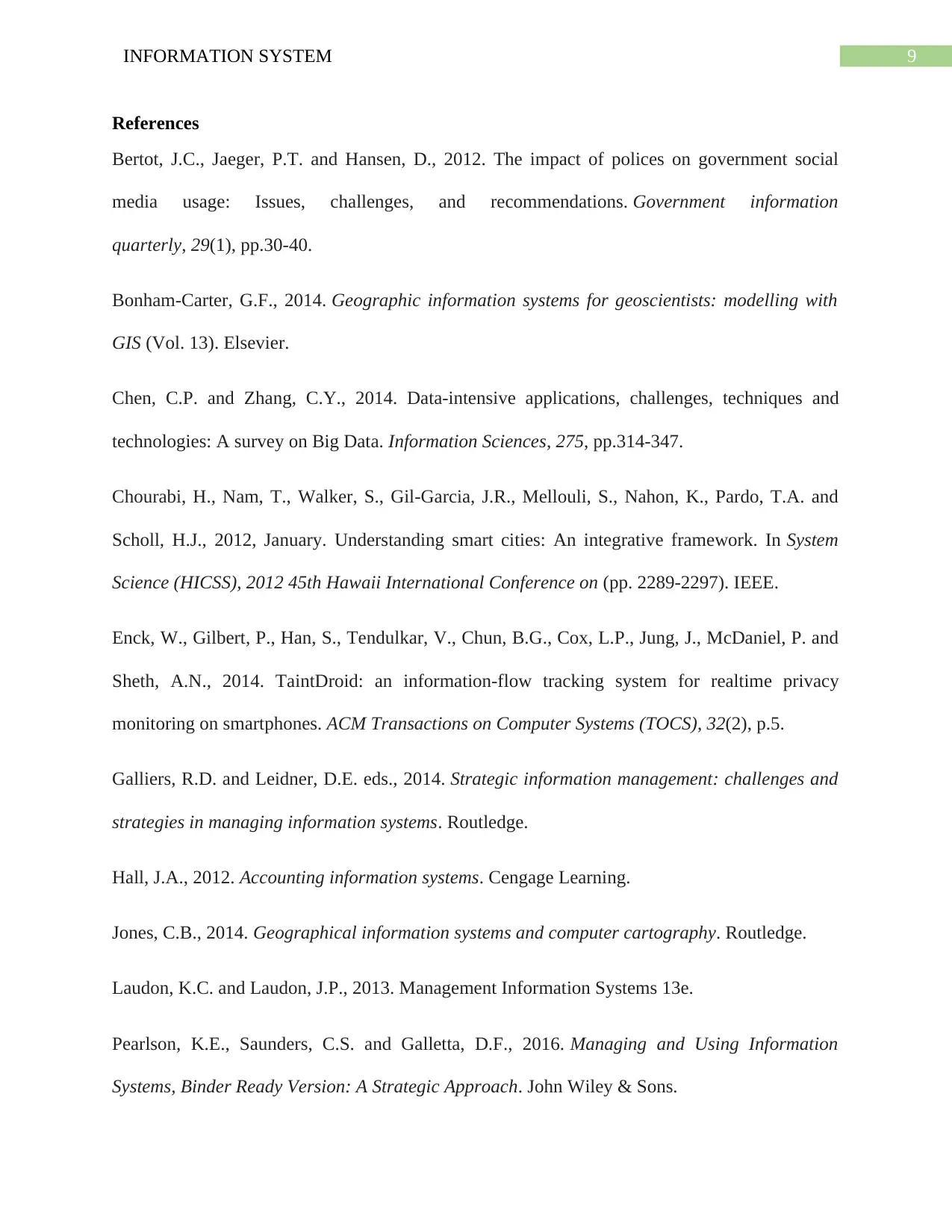
References
Bertot, J.C., Jaeger, P.T. and Hansen, D., 2012. The impact of polices on government social
media usage: Issues, challenges, and recommendations. Government information
quarterly, 29(1), pp.30-40.
Bonham-Carter, G.F., 2014. Geographic information systems for geoscientists: modelling with
GIS (Vol. 13). Elsevier.
Chen, C.P. and Zhang, C.Y., 2014. Data-intensive applications, challenges, techniques and
technologies: A survey on Big Data. Information Sciences, 275, pp.314-347.
Chourabi, H., Nam, T., Walker, S., Gil-Garcia, J.R., Mellouli, S., Nahon, K., Pardo, T.A. and
Scholl, H.J., 2012, January. Understanding smart cities: An integrative framework. In System
Science (HICSS), 2012 45th Hawaii International Conference on (pp. 2289-2297). IEEE.
Enck, W., Gilbert, P., Han, S., Tendulkar, V., Chun, B.G., Cox, L.P., Jung, J., McDaniel, P. and
Sheth, A.N., 2014. TaintDroid: an information-flow tracking system for realtime privacy
monitoring on smartphones. ACM Transactions on Computer Systems (TOCS), 32(2), p.5.
Galliers, R.D. and Leidner, D.E. eds., 2014. Strategic information management: challenges and
strategies in managing information systems. Routledge.
Hall, J.A., 2012. Accounting information systems. Cengage Learning.
Jones, C.B., 2014. Geographical information systems and computer cartography. Routledge.
Laudon, K.C. and Laudon, J.P., 2013. Management Information Systems 13e.
Pearlson, K.E., Saunders, C.S. and Galletta, D.F., 2016. Managing and Using Information
Systems, Binder Ready Version: A Strategic Approach. John Wiley & Sons.
References
Bertot, J.C., Jaeger, P.T. and Hansen, D., 2012. The impact of polices on government social
media usage: Issues, challenges, and recommendations. Government information
quarterly, 29(1), pp.30-40.
Bonham-Carter, G.F., 2014. Geographic information systems for geoscientists: modelling with
GIS (Vol. 13). Elsevier.
Chen, C.P. and Zhang, C.Y., 2014. Data-intensive applications, challenges, techniques and
technologies: A survey on Big Data. Information Sciences, 275, pp.314-347.
Chourabi, H., Nam, T., Walker, S., Gil-Garcia, J.R., Mellouli, S., Nahon, K., Pardo, T.A. and
Scholl, H.J., 2012, January. Understanding smart cities: An integrative framework. In System
Science (HICSS), 2012 45th Hawaii International Conference on (pp. 2289-2297). IEEE.
Enck, W., Gilbert, P., Han, S., Tendulkar, V., Chun, B.G., Cox, L.P., Jung, J., McDaniel, P. and
Sheth, A.N., 2014. TaintDroid: an information-flow tracking system for realtime privacy
monitoring on smartphones. ACM Transactions on Computer Systems (TOCS), 32(2), p.5.
Galliers, R.D. and Leidner, D.E. eds., 2014. Strategic information management: challenges and
strategies in managing information systems. Routledge.
Hall, J.A., 2012. Accounting information systems. Cengage Learning.
Jones, C.B., 2014. Geographical information systems and computer cartography. Routledge.
Laudon, K.C. and Laudon, J.P., 2013. Management Information Systems 13e.
Pearlson, K.E., Saunders, C.S. and Galletta, D.F., 2016. Managing and Using Information
Systems, Binder Ready Version: A Strategic Approach. John Wiley & Sons.
Paraphrase This Document
Need a fresh take? Get an instant paraphrase of this document with our AI Paraphraser
10INFORMATION SYSTEM
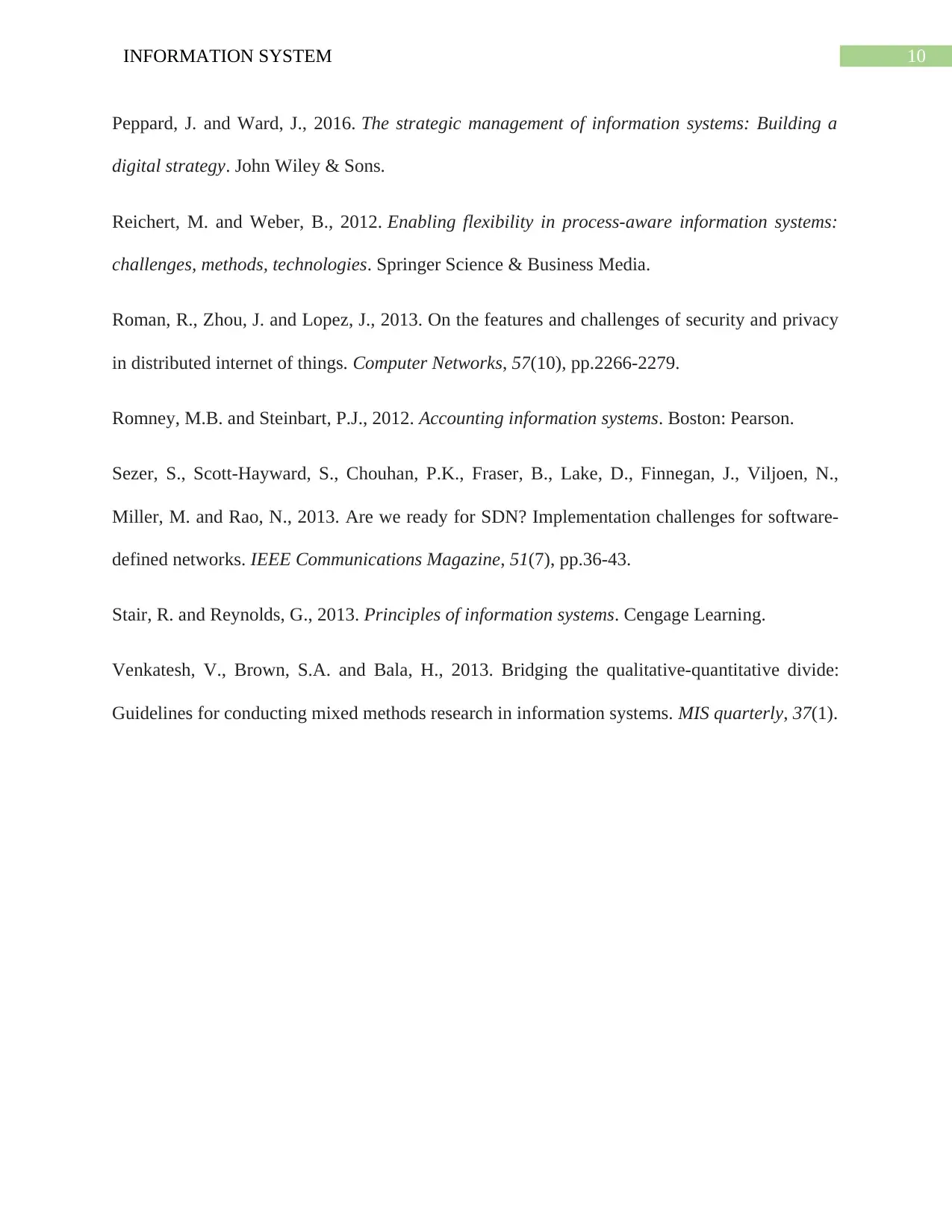
Peppard, J. and Ward, J., 2016. The strategic management of information systems: Building a
digital strategy. John Wiley & Sons.
Reichert, M. and Weber, B., 2012. Enabling flexibility in process-aware information systems:
challenges, methods, technologies. Springer Science & Business Media.
Roman, R., Zhou, J. and Lopez, J., 2013. On the features and challenges of security and privacy
in distributed internet of things. Computer Networks, 57(10), pp.2266-2279.
Romney, M.B. and Steinbart, P.J., 2012. Accounting information systems. Boston: Pearson.
Sezer, S., Scott-Hayward, S., Chouhan, P.K., Fraser, B., Lake, D., Finnegan, J., Viljoen, N.,
Miller, M. and Rao, N., 2013. Are we ready for SDN? Implementation challenges for software-
defined networks. IEEE Communications Magazine, 51(7), pp.36-43.
Stair, R. and Reynolds, G., 2013. Principles of information systems. Cengage Learning.
Venkatesh, V., Brown, S.A. and Bala, H., 2013. Bridging the qualitative-quantitative divide:
Guidelines for conducting mixed methods research in information systems. MIS quarterly, 37(1).
Peppard, J. and Ward, J., 2016. The strategic management of information systems: Building a
digital strategy. John Wiley & Sons.
Reichert, M. and Weber, B., 2012. Enabling flexibility in process-aware information systems:
challenges, methods, technologies. Springer Science & Business Media.
Roman, R., Zhou, J. and Lopez, J., 2013. On the features and challenges of security and privacy
in distributed internet of things. Computer Networks, 57(10), pp.2266-2279.
Romney, M.B. and Steinbart, P.J., 2012. Accounting information systems. Boston: Pearson.
Sezer, S., Scott-Hayward, S., Chouhan, P.K., Fraser, B., Lake, D., Finnegan, J., Viljoen, N.,
Miller, M. and Rao, N., 2013. Are we ready for SDN? Implementation challenges for software-
defined networks. IEEE Communications Magazine, 51(7), pp.36-43.
Stair, R. and Reynolds, G., 2013. Principles of information systems. Cengage Learning.
Venkatesh, V., Brown, S.A. and Bala, H., 2013. Bridging the qualitative-quantitative divide:
Guidelines for conducting mixed methods research in information systems. MIS quarterly, 37(1).

1 out of 11


Related Documents


Your All-in-One AI-Powered Toolkit for Academic Success.
+13062052269
info@desklib.com
Available 24*7 on WhatsApp / Email
![[object Object]](/_next/static/media/star-bottom.7253800d.svg)
Unlock your academic potential
Copyright © 2020–2026 A2Z Services. All Rights Reserved. Developed and managed by ZUCOL.