Critical Analysis of Informal Learning in Modern HRM Context
VerifiedAdded on 2020/01/28
|15
|5239
|78
Essay
AI Summary
This essay critically discusses the significance of informal learning in today's modern workplace, contrasting it with formal learning approaches. It defines both learning types and explores various forms of informal learning, including self-directed, incidental, and socialization. The essay delves into the characteristics of informal learning, such as its unstructured nature and the high motivation of learners. It then reviews relevant learning theories, including behaviorist and social learning theories, and their application in employee development. The analysis highlights the challenges faced in modern workplaces and argues for the greater importance of informal learning, particularly in adapting to rapid changes and diverse workforces. The essay emphasizes the role of human resource management in fostering informal learning to enhance employee skills and organizational success.

Human Resource
Management
1
Management
1

Paraphrase This Document
Need a fresh take? Get an instant paraphrase of this document with our AI Paraphraser
TABLE OF CONTENTS
INTRODUCTION...........................................................................................................................3
“Informal learning is more important than formal learning in today's modern workplace”.
Critically discuss with reference to theories of learning..................................................................3
CONCLUSION .............................................................................................................................13
REFERENCES..............................................................................................................................14
2
INTRODUCTION...........................................................................................................................3
“Informal learning is more important than formal learning in today's modern workplace”.
Critically discuss with reference to theories of learning..................................................................3
CONCLUSION .............................................................................................................................13
REFERENCES..............................................................................................................................14
2
INTRODUCTION
In the contemporary aspect, learning plays a vital role in enhancing the life and skills of
an individual. As with the help of constant grasping, individual can easily amend the required
skills and abilities which they required to perform the task within their job. Basically, there are
two forms of learning that develops and improves the knowledge of individual. These are; formal
and informal learning. In the present scenario, both the learning are essential for an individual; as
it supports them in developing and improving the skills and abilities of the employees while
rendering services in the organization (Parnell, 2010). Informal learning is termed as an activity
that generally relates with the pursuit of acquiring knowledge, understanding and learning that
occurs outside the educational institutions or the place where workshops are offered by the social
institute. Therefore, it can be said that for enabling the employee development and enhancing the
informal learning, places play vital role in amending the education level of individual. In the
modern workplace, there are different factors that drive and influence the informal learning
within the workplace to which employees are desire to learn through effective culture of the
organization and need to supplement the formal one at the workplace.
Presently, the report is carried out to evaluate the effectiveness of informal and formal
learning in developing the employees who are rendering services within the organization.
Furthermore, it will also study that informal learning is essential as compare to the formal
learning in the modern workplace. Informal learning assists the individual in grooming their
inner capabilities and qualities that assist them to render confident services within the workplace.
“INFORMAL LEARNING IS MORE IMPORTANT THAN FORMAL
LEARNING IN TODAY'S MODERN WORKPLACE”. CRITICALLY
DISCUSS WITH REFERENCE TO THEORIES OF LEARNING.
Informal and formal learning
Learning is defined as continuous process that results in enabling the lasting change in
the behaviour of individual through gaining experience (Sanchez, 2011). However, it is also
defined as acquisition of knowledge through continuous study and teaching. Furthermore, the
learning process is also considered as an active engagement of individual with the information
that supports them at the workplace to render proper and effective services. In the past few years,
3
In the contemporary aspect, learning plays a vital role in enhancing the life and skills of
an individual. As with the help of constant grasping, individual can easily amend the required
skills and abilities which they required to perform the task within their job. Basically, there are
two forms of learning that develops and improves the knowledge of individual. These are; formal
and informal learning. In the present scenario, both the learning are essential for an individual; as
it supports them in developing and improving the skills and abilities of the employees while
rendering services in the organization (Parnell, 2010). Informal learning is termed as an activity
that generally relates with the pursuit of acquiring knowledge, understanding and learning that
occurs outside the educational institutions or the place where workshops are offered by the social
institute. Therefore, it can be said that for enabling the employee development and enhancing the
informal learning, places play vital role in amending the education level of individual. In the
modern workplace, there are different factors that drive and influence the informal learning
within the workplace to which employees are desire to learn through effective culture of the
organization and need to supplement the formal one at the workplace.
Presently, the report is carried out to evaluate the effectiveness of informal and formal
learning in developing the employees who are rendering services within the organization.
Furthermore, it will also study that informal learning is essential as compare to the formal
learning in the modern workplace. Informal learning assists the individual in grooming their
inner capabilities and qualities that assist them to render confident services within the workplace.
“INFORMAL LEARNING IS MORE IMPORTANT THAN FORMAL
LEARNING IN TODAY'S MODERN WORKPLACE”. CRITICALLY
DISCUSS WITH REFERENCE TO THEORIES OF LEARNING.
Informal and formal learning
Learning is defined as continuous process that results in enabling the lasting change in
the behaviour of individual through gaining experience (Sanchez, 2011). However, it is also
defined as acquisition of knowledge through continuous study and teaching. Furthermore, the
learning process is also considered as an active engagement of individual with the information
that supports them at the workplace to render proper and effective services. In the past few years,
3
⊘ This is a preview!⊘
Do you want full access?
Subscribe today to unlock all pages.

Trusted by 1+ million students worldwide
the workplace is recognized as an effective environment that supports the employees in learning
new skills that enable to take active part in the changing workplace environment. According to
Baum (2012), the contemporary workplace environment provides rich and comfortable
surroundings to employees so that they can easily acquire learning and skills at the workplace in
order to effectively perform their tasks and activities (Baum, 2012). Basically, there are two
types of learning that is informal and formal. Formal learning is described as a systematic or
planned way through which education and learning is being delivered to the ultimate employees.
This learning is generally delivered within the educational institution, university or the
workplace in the organized manner. On the other hand, informal learning is described as an
effectual form of learning that is being delivered to employees and individual outside the
institution. However, this form of learning is unstructured in nature and drive worker’s
performance in the organization (Laytras and Pablos, 2008).
Forms of informal learning
Generally, there are three forms of informal learning that supports the employees of the
modern environment in acquiring or pursuing the activities. The different forms of informal
learning include-
Self directed learning: In the contemporary workplace situation, it is considered as an
effective form of informal learning under which the individual or the employees are self
motivated towards attaining or gaining the outcome. Employees within the workplace set
their own goals and engage within the learning process without any teacher or educator
(Khan and Farooq, 2010). However, under this form of informal learning, employees are
aware that they are gaining knowledge which would support them in performing the
activities within the workplace.
Incidental learning: Another form of informal learning includes incidental learning that
refers to the experience that occur when employee within the workplace possess no
intention for enabling the gaining experience. But after gaining experience, employees or
individual get aware regarding the acquisition. It has also been assessed that under
incidental learning; employees are not intended to learn or acquire any knowledge (Dabic
and Martinez, 2011).
4
new skills that enable to take active part in the changing workplace environment. According to
Baum (2012), the contemporary workplace environment provides rich and comfortable
surroundings to employees so that they can easily acquire learning and skills at the workplace in
order to effectively perform their tasks and activities (Baum, 2012). Basically, there are two
types of learning that is informal and formal. Formal learning is described as a systematic or
planned way through which education and learning is being delivered to the ultimate employees.
This learning is generally delivered within the educational institution, university or the
workplace in the organized manner. On the other hand, informal learning is described as an
effectual form of learning that is being delivered to employees and individual outside the
institution. However, this form of learning is unstructured in nature and drive worker’s
performance in the organization (Laytras and Pablos, 2008).
Forms of informal learning
Generally, there are three forms of informal learning that supports the employees of the
modern environment in acquiring or pursuing the activities. The different forms of informal
learning include-
Self directed learning: In the contemporary workplace situation, it is considered as an
effective form of informal learning under which the individual or the employees are self
motivated towards attaining or gaining the outcome. Employees within the workplace set
their own goals and engage within the learning process without any teacher or educator
(Khan and Farooq, 2010). However, under this form of informal learning, employees are
aware that they are gaining knowledge which would support them in performing the
activities within the workplace.
Incidental learning: Another form of informal learning includes incidental learning that
refers to the experience that occur when employee within the workplace possess no
intention for enabling the gaining experience. But after gaining experience, employees or
individual get aware regarding the acquisition. It has also been assessed that under
incidental learning; employees are not intended to learn or acquire any knowledge (Dabic
and Martinez, 2011).
4
Paraphrase This Document
Need a fresh take? Get an instant paraphrase of this document with our AI Paraphraser
Socialization: However, another form of gaining informal learning is with the help of
enabling socialization. It is also defined as a tacit learning. Under this form of learning,
individual enables lifelong learning and disseminate the values, attitude, behaviour or
culture while participating in the society. It is an effective form of enabling informal
learning (Brewster and Morely, 2010).
Characteristics of informal learning
There are different attributes and characteristics of informal learning that is effective in
the modern scenario and at the workplace that not only focuses on acquiring the learning but it
also result in amending their values, attitude and behaviour that support them at the modern
workplace to render quality services. The different characteristics of informal learning include-
Informal learning is never organized: One of the common characteristics of informal
learning includes that the learning procedure is never organized in the systematic manner.
In the learning program, there is no descriptive program and plan for gaining the informal
learning (Rohrer and Bjork, 2008).
Spontaneous: Another characteristic of informal learning include its spontaneous and self
generated aspects. The learner or employees are divine to acquire learning as they are
keen interested in knowing and understanding things regarding the topic.
Informal learners are highly motivated: Another attribute of informal learning includes
individual and learners who are often highly motivated in knowing and acquiring the
learning. Unlike the environment of formal learning that is school or any educational
institute informal learners are attentive and intended to acquire or gain the learning to
encourage their knowledge and skills (Simpson, 2010).
No formal curriculum: Another characteristic of informal learning does not include
formal curriculum or course of study that beginner has to follow to grab the informal
learning experience. Therefore, it can be acquired in the form of self directed or with the
help of socialization as through same individual or employee can easily develop and
amend their knowledge in the unconscious manner (Tams, 2008).
Learning theories
There are different theories propounded by many authors that generally identify and
explain that how learners or an individual can acquire and gain the skills and knowledge. The
5
enabling socialization. It is also defined as a tacit learning. Under this form of learning,
individual enables lifelong learning and disseminate the values, attitude, behaviour or
culture while participating in the society. It is an effective form of enabling informal
learning (Brewster and Morely, 2010).
Characteristics of informal learning
There are different attributes and characteristics of informal learning that is effective in
the modern scenario and at the workplace that not only focuses on acquiring the learning but it
also result in amending their values, attitude and behaviour that support them at the modern
workplace to render quality services. The different characteristics of informal learning include-
Informal learning is never organized: One of the common characteristics of informal
learning includes that the learning procedure is never organized in the systematic manner.
In the learning program, there is no descriptive program and plan for gaining the informal
learning (Rohrer and Bjork, 2008).
Spontaneous: Another characteristic of informal learning include its spontaneous and self
generated aspects. The learner or employees are divine to acquire learning as they are
keen interested in knowing and understanding things regarding the topic.
Informal learners are highly motivated: Another attribute of informal learning includes
individual and learners who are often highly motivated in knowing and acquiring the
learning. Unlike the environment of formal learning that is school or any educational
institute informal learners are attentive and intended to acquire or gain the learning to
encourage their knowledge and skills (Simpson, 2010).
No formal curriculum: Another characteristic of informal learning does not include
formal curriculum or course of study that beginner has to follow to grab the informal
learning experience. Therefore, it can be acquired in the form of self directed or with the
help of socialization as through same individual or employee can easily develop and
amend their knowledge in the unconscious manner (Tams, 2008).
Learning theories
There are different theories propounded by many authors that generally identify and
explain that how learners or an individual can acquire and gain the skills and knowledge. The
5
different theories include behaviourist as well as social learning theories (Yazici, 2005). Both the
theories are effective in the contemporary scenario that supports the individual and employees in
developing their skills and abilities so that they may perform their services in the effective
manner. The foremost theory is behaviourist learning theory that generally focuses on the
behaviour of individual. However, this theory also focuses on the situation that how the
individual or employees work and behave in the typical situation. In addition to this, theory is the
one that focuses on observable behaviour of an individual with acquisition of new behaviour.
Behaviourist theory consists of two types of conditions that are classical conditioning and
operant conditioning. Under classical conditioning, it is generally concentrates on presenting the
reward so that they can get proper response. For instance; Ivan Pavlov has focuses on the
classical conditioning aspect under which he has experimented dog that he provided food to dog
when he rang the bell. Therefore, dog salivate when they see the food. Thus, from this
experiment he has stated that while enabling proper reward to the individual they will stimuli and
give proper responses. Another type of conditioning includes operant in which learning among
the individual occurs with enables the positive and negative reward to the individual (Adhikari,
2010). However, if the reward or support follows the outcome to input rendered by an individual,
then in the future the response become more probable. For instance; Author B.F. Skinner has
focused on the operant conditioning aspect by providing the rewards in response to the
individual.
Another individual learning theory includes social learning theory that is developed by
the Albert Bandura. This theory is considered as the combination of cognitive and behaviour
theory of learning that assists in providing an effective learning model that supports wide range
of learning to the individual. Social learning theory includes different assumption that is
psychological process which often takes place in the social environment and is not strictly
behavioural in nature. However, learning is enabling by observing or monitoring the behaviour
of an individual and by reviewing the outcome or result of the behaviour (Nelson, 2014).
Bandura has generally focuses on the three types of model under which person can easily acquire
and gain the learning by using first; a live model under which individual at the workplace
demonstrates or represents the desired behaviour. Another model includes; verbal instruction
under which employees at the workplace describe the behaviour verbally and also assist the other
6
theories are effective in the contemporary scenario that supports the individual and employees in
developing their skills and abilities so that they may perform their services in the effective
manner. The foremost theory is behaviourist learning theory that generally focuses on the
behaviour of individual. However, this theory also focuses on the situation that how the
individual or employees work and behave in the typical situation. In addition to this, theory is the
one that focuses on observable behaviour of an individual with acquisition of new behaviour.
Behaviourist theory consists of two types of conditions that are classical conditioning and
operant conditioning. Under classical conditioning, it is generally concentrates on presenting the
reward so that they can get proper response. For instance; Ivan Pavlov has focuses on the
classical conditioning aspect under which he has experimented dog that he provided food to dog
when he rang the bell. Therefore, dog salivate when they see the food. Thus, from this
experiment he has stated that while enabling proper reward to the individual they will stimuli and
give proper responses. Another type of conditioning includes operant in which learning among
the individual occurs with enables the positive and negative reward to the individual (Adhikari,
2010). However, if the reward or support follows the outcome to input rendered by an individual,
then in the future the response become more probable. For instance; Author B.F. Skinner has
focused on the operant conditioning aspect by providing the rewards in response to the
individual.
Another individual learning theory includes social learning theory that is developed by
the Albert Bandura. This theory is considered as the combination of cognitive and behaviour
theory of learning that assists in providing an effective learning model that supports wide range
of learning to the individual. Social learning theory includes different assumption that is
psychological process which often takes place in the social environment and is not strictly
behavioural in nature. However, learning is enabling by observing or monitoring the behaviour
of an individual and by reviewing the outcome or result of the behaviour (Nelson, 2014).
Bandura has generally focuses on the three types of model under which person can easily acquire
and gain the learning by using first; a live model under which individual at the workplace
demonstrates or represents the desired behaviour. Another model includes; verbal instruction
under which employees at the workplace describe the behaviour verbally and also assist the other
6
⊘ This is a preview!⊘
Do you want full access?
Subscribe today to unlock all pages.
Trusted by 1+ million students worldwide
participants or employees within the workplace that how to engage other ones. Furthermore, the
last model is symbolic through which individual may use the media for responding and enabling
the learning activities (Dann, 2012).
In order to enhance the individual learning, another theory was proposed. It includes self
managed learning that is underpinned by Gregory Bateson's levels of learning. Under this theory,
individual or learner takes active participation in acquiring and developing the knowledge
process through initiating different development programmes and plans. The main aim of self
managed learning is that it results in promoting the transformational erudition among the
individual. However, the model of self directed learning generally focuses on planning and
executing the same so that they may easily enhance their skills and abilities (Keller, 2009).
Although with this model, individual also evaluates and measures his/her own learning without
taking assistance from others.
Challenges at modern workplaces
In the modern workplace and organizations, there are different challenges that exist and
directly affect and impact the individual in enhancing and acquiring the learning process. The
acquiring challenges at the modern workplace generally includes diversified range of personnel,
use of old knowledge models at the workplace, time constraints etc (Merryl and et.al., 2013).
With the diversified range and different learning styles of the learners at the place of
work, the modern challenges gets emerges. Since, the management will devise the program
according to the diverse needs and requirement of the individual. For instance; as the employees
within the organization prefer to gain through the visual images and presentation. Thus, human
resource management of the organization must use the visual aids and tools for developing the
required knowledge and abilities of the employees (Moon, 2013).
Informal learning is more important than formal learning in today's modern workplace
In the today's modern scenario, organizations have become more complex and are needed
to accept the rapid changes that exist within the environment in which they operate their
activities. Therefore, all the employees and professionals must enable constant learning so that
they may easily cope up with the external changes (Rarelin, 2008). However, human resource
managers’ play vital role in developing and processing the knowledge and experience of the
employees or individual as they directly assists in shaping the business. With the increasing
7
last model is symbolic through which individual may use the media for responding and enabling
the learning activities (Dann, 2012).
In order to enhance the individual learning, another theory was proposed. It includes self
managed learning that is underpinned by Gregory Bateson's levels of learning. Under this theory,
individual or learner takes active participation in acquiring and developing the knowledge
process through initiating different development programmes and plans. The main aim of self
managed learning is that it results in promoting the transformational erudition among the
individual. However, the model of self directed learning generally focuses on planning and
executing the same so that they may easily enhance their skills and abilities (Keller, 2009).
Although with this model, individual also evaluates and measures his/her own learning without
taking assistance from others.
Challenges at modern workplaces
In the modern workplace and organizations, there are different challenges that exist and
directly affect and impact the individual in enhancing and acquiring the learning process. The
acquiring challenges at the modern workplace generally includes diversified range of personnel,
use of old knowledge models at the workplace, time constraints etc (Merryl and et.al., 2013).
With the diversified range and different learning styles of the learners at the place of
work, the modern challenges gets emerges. Since, the management will devise the program
according to the diverse needs and requirement of the individual. For instance; as the employees
within the organization prefer to gain through the visual images and presentation. Thus, human
resource management of the organization must use the visual aids and tools for developing the
required knowledge and abilities of the employees (Moon, 2013).
Informal learning is more important than formal learning in today's modern workplace
In the today's modern scenario, organizations have become more complex and are needed
to accept the rapid changes that exist within the environment in which they operate their
activities. Therefore, all the employees and professionals must enable constant learning so that
they may easily cope up with the external changes (Rarelin, 2008). However, human resource
managers’ play vital role in developing and processing the knowledge and experience of the
employees or individual as they directly assists in shaping the business. With the increasing
7
Paraphrase This Document
Need a fresh take? Get an instant paraphrase of this document with our AI Paraphraser
diverse range of human being, it is essential for the human resource manager to align the
learning and education at the administrative centres so that they will assist the manpower in
enhancing and amending the skills to survive in the organization (Trong, 2013). Therefore, it can
be said that to cope up with the modern day challenges, it is essential for HRM of the
organization to focus on the informal learning as compare to the formal learning.
In the present scenario, lifelong learning has considered as an essential concept for the
individual or employees at the workplace; as it supports in acquiring new skills and abilities with
the rapid change within the internal and external environment. For instance, with the
advancement of technology; organization shifts their culture by adopting computerized system at
the workplace for performing the activities. According to Levenberg and Caspi (2010), it is the
duty of human resource management to devise the program for nurturing the employees so that
they can easily perform activities on new equipment and tools (Levenberg and Caspi, 2010).
Therefore, modern organizations must require informal learning so that individual can self direct
their capabilities through the use of modern methods and ways.
Informal learning in the contemporary arena is gaining significant aspect as it enhances
the knowledge as well as also develops the behaviour and attitude of human being who is
rendering services in the organization. With the help of informal learning at the contemporary
workplace, it supports the individual in enhancing their knowledge and performance. It further
assists in gaining the overall success within the industry. Formal and informal learning at the
place of work are different processes as within the prior one, environment management of
organization sets the specific goals and objectives related with gaining learning so that training
and learning department can easily attain the goals in the systematic manner (Hornby, 2005). On
the other hand, under later one, learner are not aware regarding the education; as they informally
seeks to gain the knowledge that assist the workers in acquiring the acquaintance so that they can
perform their job in the successful manner. In the modern environment, organization spends
huge amount of funds in developing and amending the skills of personnel through enabling
formal learning like devising training course and workshops for the workforces so that they can
easily amend and improve their understanding regarding the specific area under which they
perform their activities and services (Lin and Lee, 2014). However, after enabling formal
learning at the modern workplace, they use informal learning techniques to change their
8
learning and education at the administrative centres so that they will assist the manpower in
enhancing and amending the skills to survive in the organization (Trong, 2013). Therefore, it can
be said that to cope up with the modern day challenges, it is essential for HRM of the
organization to focus on the informal learning as compare to the formal learning.
In the present scenario, lifelong learning has considered as an essential concept for the
individual or employees at the workplace; as it supports in acquiring new skills and abilities with
the rapid change within the internal and external environment. For instance, with the
advancement of technology; organization shifts their culture by adopting computerized system at
the workplace for performing the activities. According to Levenberg and Caspi (2010), it is the
duty of human resource management to devise the program for nurturing the employees so that
they can easily perform activities on new equipment and tools (Levenberg and Caspi, 2010).
Therefore, modern organizations must require informal learning so that individual can self direct
their capabilities through the use of modern methods and ways.
Informal learning in the contemporary arena is gaining significant aspect as it enhances
the knowledge as well as also develops the behaviour and attitude of human being who is
rendering services in the organization. With the help of informal learning at the contemporary
workplace, it supports the individual in enhancing their knowledge and performance. It further
assists in gaining the overall success within the industry. Formal and informal learning at the
place of work are different processes as within the prior one, environment management of
organization sets the specific goals and objectives related with gaining learning so that training
and learning department can easily attain the goals in the systematic manner (Hornby, 2005). On
the other hand, under later one, learner are not aware regarding the education; as they informally
seeks to gain the knowledge that assist the workers in acquiring the acquaintance so that they can
perform their job in the successful manner. In the modern environment, organization spends
huge amount of funds in developing and amending the skills of personnel through enabling
formal learning like devising training course and workshops for the workforces so that they can
easily amend and improve their understanding regarding the specific area under which they
perform their activities and services (Lin and Lee, 2014). However, after enabling formal
learning at the modern workplace, they use informal learning techniques to change their
8
behaviour and attitude through observing or monitoring the activities of colleagues at the
workplace, trying the activities by their own to get the desired result etc.
With the constant development in the technology, employees within the organization are
focusing on the different tools that assist them in learning informally that is with the help of
different social media sites (Tynjala, 2008). In the contemporary working, social media sites and
internet are considered as a key medium through which employees can develop and enhance
their knowledge regarding their field or working area. Therefore, enabling informal learning
from the multiple sources directly leads to the empowerment and individual self efficacy. For
instance; informal learning at the modern offices can be acquired through enabling social
gathering or conducting informal meetings with the team members or superior authority that
results in sharing their own ideas and experiences that support the individual in performing
activities in the effective manner. In its contrast, formal learning is considered as a regular
diploma or education that individual pursues from any educational institution or any social
agency. However, the key advantage of enabling the formal learning is that it generally teaches
the skills in the expert way (Informal vs. Formal learning: Whta's the difference, 2012). For
example, for conducting the formal learning at the workplace, Human resource management
must schedule the training activities for the employee’s development in the specific time period.
Informal learning Formal learning
Informal learning gained through performing
daily activities related with family or work.
Learning acquire through educational
institutions or school.
Informal learning is often unstructured as
learners are not aware about gaining of
knowledge.
On the other hand, formal learning is structured
in terms of gaining adequate knowledge and
skills.
Informal learning does not lead with any
certificate (Parnell, 2010).
However, formal learning results in achieving
certificate.
Informal learning is unintentional in nature. While, formal leaning are intentional in nature.
Within the organization, for enabling the employee or workforce development, human
resource management plays a vital function within the organization (Nelson, 2014). As, it
9
workplace, trying the activities by their own to get the desired result etc.
With the constant development in the technology, employees within the organization are
focusing on the different tools that assist them in learning informally that is with the help of
different social media sites (Tynjala, 2008). In the contemporary working, social media sites and
internet are considered as a key medium through which employees can develop and enhance
their knowledge regarding their field or working area. Therefore, enabling informal learning
from the multiple sources directly leads to the empowerment and individual self efficacy. For
instance; informal learning at the modern offices can be acquired through enabling social
gathering or conducting informal meetings with the team members or superior authority that
results in sharing their own ideas and experiences that support the individual in performing
activities in the effective manner. In its contrast, formal learning is considered as a regular
diploma or education that individual pursues from any educational institution or any social
agency. However, the key advantage of enabling the formal learning is that it generally teaches
the skills in the expert way (Informal vs. Formal learning: Whta's the difference, 2012). For
example, for conducting the formal learning at the workplace, Human resource management
must schedule the training activities for the employee’s development in the specific time period.
Informal learning Formal learning
Informal learning gained through performing
daily activities related with family or work.
Learning acquire through educational
institutions or school.
Informal learning is often unstructured as
learners are not aware about gaining of
knowledge.
On the other hand, formal learning is structured
in terms of gaining adequate knowledge and
skills.
Informal learning does not lead with any
certificate (Parnell, 2010).
However, formal learning results in achieving
certificate.
Informal learning is unintentional in nature. While, formal leaning are intentional in nature.
Within the organization, for enabling the employee or workforce development, human
resource management plays a vital function within the organization (Nelson, 2014). As, it
9
⊘ This is a preview!⊘
Do you want full access?
Subscribe today to unlock all pages.
Trusted by 1+ million students worldwide
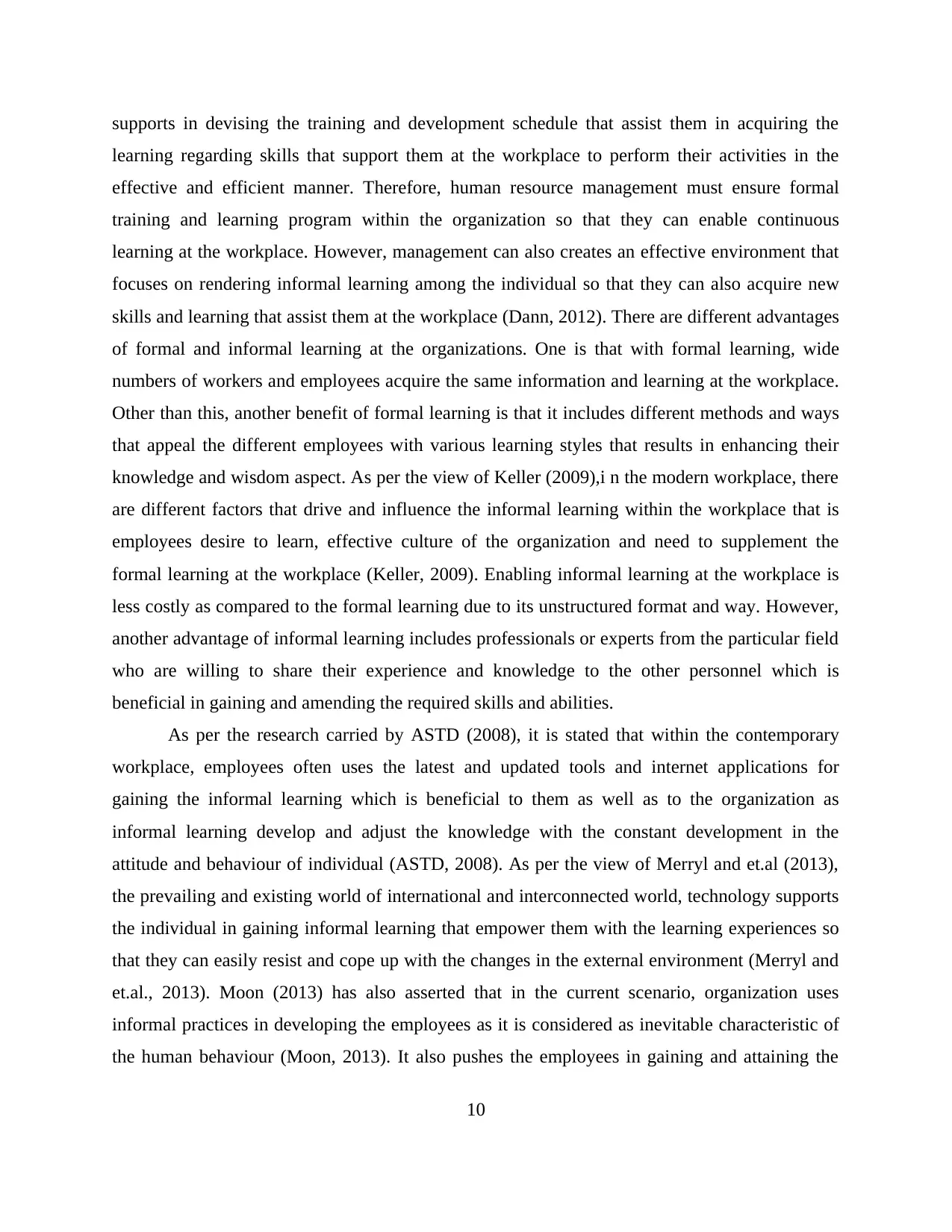
supports in devising the training and development schedule that assist them in acquiring the
learning regarding skills that support them at the workplace to perform their activities in the
effective and efficient manner. Therefore, human resource management must ensure formal
training and learning program within the organization so that they can enable continuous
learning at the workplace. However, management can also creates an effective environment that
focuses on rendering informal learning among the individual so that they can also acquire new
skills and learning that assist them at the workplace (Dann, 2012). There are different advantages
of formal and informal learning at the organizations. One is that with formal learning, wide
numbers of workers and employees acquire the same information and learning at the workplace.
Other than this, another benefit of formal learning is that it includes different methods and ways
that appeal the different employees with various learning styles that results in enhancing their
knowledge and wisdom aspect. As per the view of Keller (2009),i n the modern workplace, there
are different factors that drive and influence the informal learning within the workplace that is
employees desire to learn, effective culture of the organization and need to supplement the
formal learning at the workplace (Keller, 2009). Enabling informal learning at the workplace is
less costly as compared to the formal learning due to its unstructured format and way. However,
another advantage of informal learning includes professionals or experts from the particular field
who are willing to share their experience and knowledge to the other personnel which is
beneficial in gaining and amending the required skills and abilities.
As per the research carried by ASTD (2008), it is stated that within the contemporary
workplace, employees often uses the latest and updated tools and internet applications for
gaining the informal learning which is beneficial to them as well as to the organization as
informal learning develop and adjust the knowledge with the constant development in the
attitude and behaviour of individual (ASTD, 2008). As per the view of Merryl and et.al (2013),
the prevailing and existing world of international and interconnected world, technology supports
the individual in gaining informal learning that empower them with the learning experiences so
that they can easily resist and cope up with the changes in the external environment (Merryl and
et.al., 2013). Moon (2013) has also asserted that in the current scenario, organization uses
informal practices in developing the employees as it is considered as inevitable characteristic of
the human behaviour (Moon, 2013). It also pushes the employees in gaining and attaining the
10
learning regarding skills that support them at the workplace to perform their activities in the
effective and efficient manner. Therefore, human resource management must ensure formal
training and learning program within the organization so that they can enable continuous
learning at the workplace. However, management can also creates an effective environment that
focuses on rendering informal learning among the individual so that they can also acquire new
skills and learning that assist them at the workplace (Dann, 2012). There are different advantages
of formal and informal learning at the organizations. One is that with formal learning, wide
numbers of workers and employees acquire the same information and learning at the workplace.
Other than this, another benefit of formal learning is that it includes different methods and ways
that appeal the different employees with various learning styles that results in enhancing their
knowledge and wisdom aspect. As per the view of Keller (2009),i n the modern workplace, there
are different factors that drive and influence the informal learning within the workplace that is
employees desire to learn, effective culture of the organization and need to supplement the
formal learning at the workplace (Keller, 2009). Enabling informal learning at the workplace is
less costly as compared to the formal learning due to its unstructured format and way. However,
another advantage of informal learning includes professionals or experts from the particular field
who are willing to share their experience and knowledge to the other personnel which is
beneficial in gaining and amending the required skills and abilities.
As per the research carried by ASTD (2008), it is stated that within the contemporary
workplace, employees often uses the latest and updated tools and internet applications for
gaining the informal learning which is beneficial to them as well as to the organization as
informal learning develop and adjust the knowledge with the constant development in the
attitude and behaviour of individual (ASTD, 2008). As per the view of Merryl and et.al (2013),
the prevailing and existing world of international and interconnected world, technology supports
the individual in gaining informal learning that empower them with the learning experiences so
that they can easily resist and cope up with the changes in the external environment (Merryl and
et.al., 2013). Moon (2013) has also asserted that in the current scenario, organization uses
informal practices in developing the employees as it is considered as inevitable characteristic of
the human behaviour (Moon, 2013). It also pushes the employees in gaining and attaining the
10
Paraphrase This Document
Need a fresh take? Get an instant paraphrase of this document with our AI Paraphraser
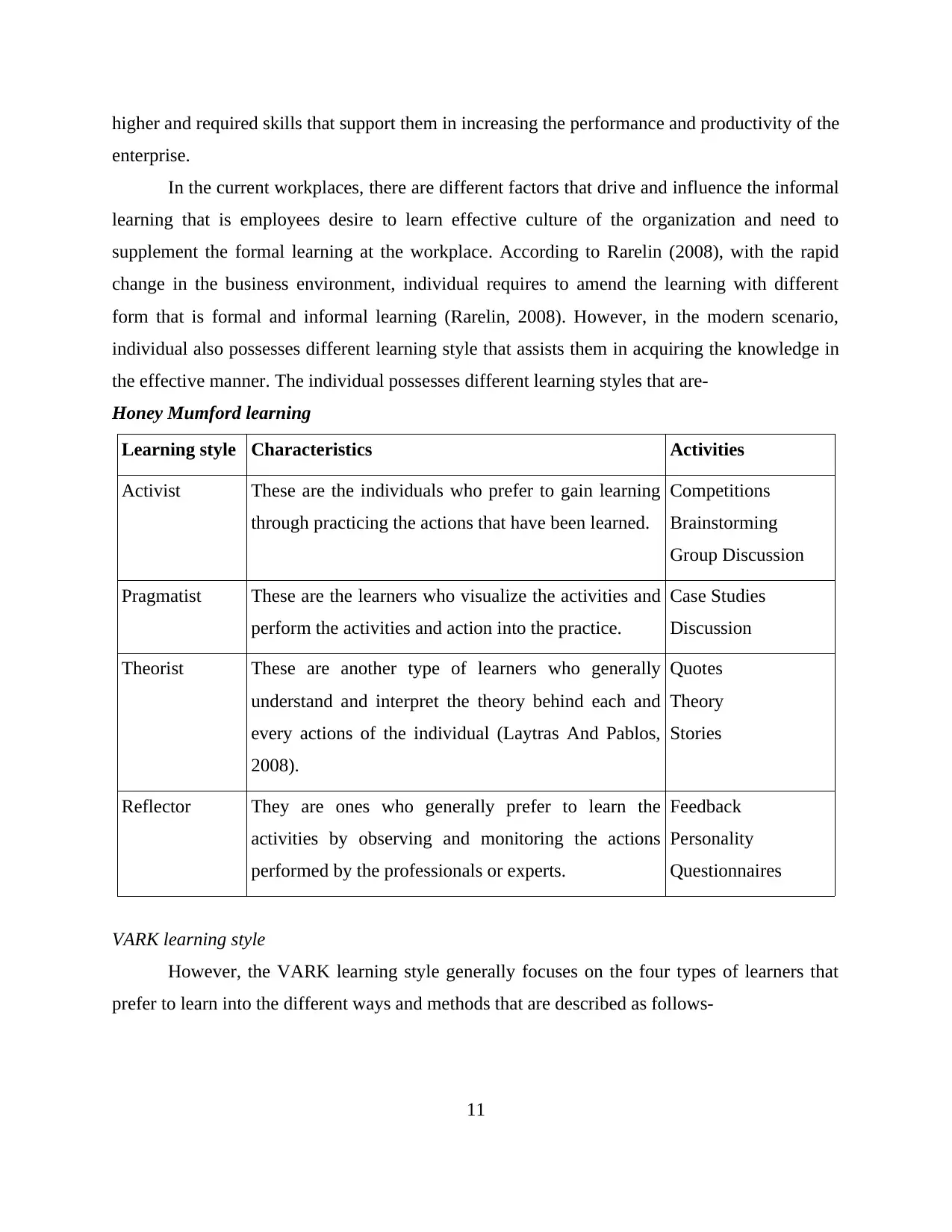
higher and required skills that support them in increasing the performance and productivity of the
enterprise.
In the current workplaces, there are different factors that drive and influence the informal
learning that is employees desire to learn effective culture of the organization and need to
supplement the formal learning at the workplace. According to Rarelin (2008), with the rapid
change in the business environment, individual requires to amend the learning with different
form that is formal and informal learning (Rarelin, 2008). However, in the modern scenario,
individual also possesses different learning style that assists them in acquiring the knowledge in
the effective manner. The individual possesses different learning styles that are-
Honey Mumford learning
Learning style Characteristics Activities
Activist These are the individuals who prefer to gain learning
through practicing the actions that have been learned.
Competitions
Brainstorming
Group Discussion
Pragmatist These are the learners who visualize the activities and
perform the activities and action into the practice.
Case Studies
Discussion
Theorist These are another type of learners who generally
understand and interpret the theory behind each and
every actions of the individual (Laytras And Pablos,
2008).
Quotes
Theory
Stories
Reflector They are ones who generally prefer to learn the
activities by observing and monitoring the actions
performed by the professionals or experts.
Feedback
Personality
Questionnaires
VARK learning style
However, the VARK learning style generally focuses on the four types of learners that
prefer to learn into the different ways and methods that are described as follows-
11
enterprise.
In the current workplaces, there are different factors that drive and influence the informal
learning that is employees desire to learn effective culture of the organization and need to
supplement the formal learning at the workplace. According to Rarelin (2008), with the rapid
change in the business environment, individual requires to amend the learning with different
form that is formal and informal learning (Rarelin, 2008). However, in the modern scenario,
individual also possesses different learning style that assists them in acquiring the knowledge in
the effective manner. The individual possesses different learning styles that are-
Honey Mumford learning
Learning style Characteristics Activities
Activist These are the individuals who prefer to gain learning
through practicing the actions that have been learned.
Competitions
Brainstorming
Group Discussion
Pragmatist These are the learners who visualize the activities and
perform the activities and action into the practice.
Case Studies
Discussion
Theorist These are another type of learners who generally
understand and interpret the theory behind each and
every actions of the individual (Laytras And Pablos,
2008).
Quotes
Theory
Stories
Reflector They are ones who generally prefer to learn the
activities by observing and monitoring the actions
performed by the professionals or experts.
Feedback
Personality
Questionnaires
VARK learning style
However, the VARK learning style generally focuses on the four types of learners that
prefer to learn into the different ways and methods that are described as follows-
11
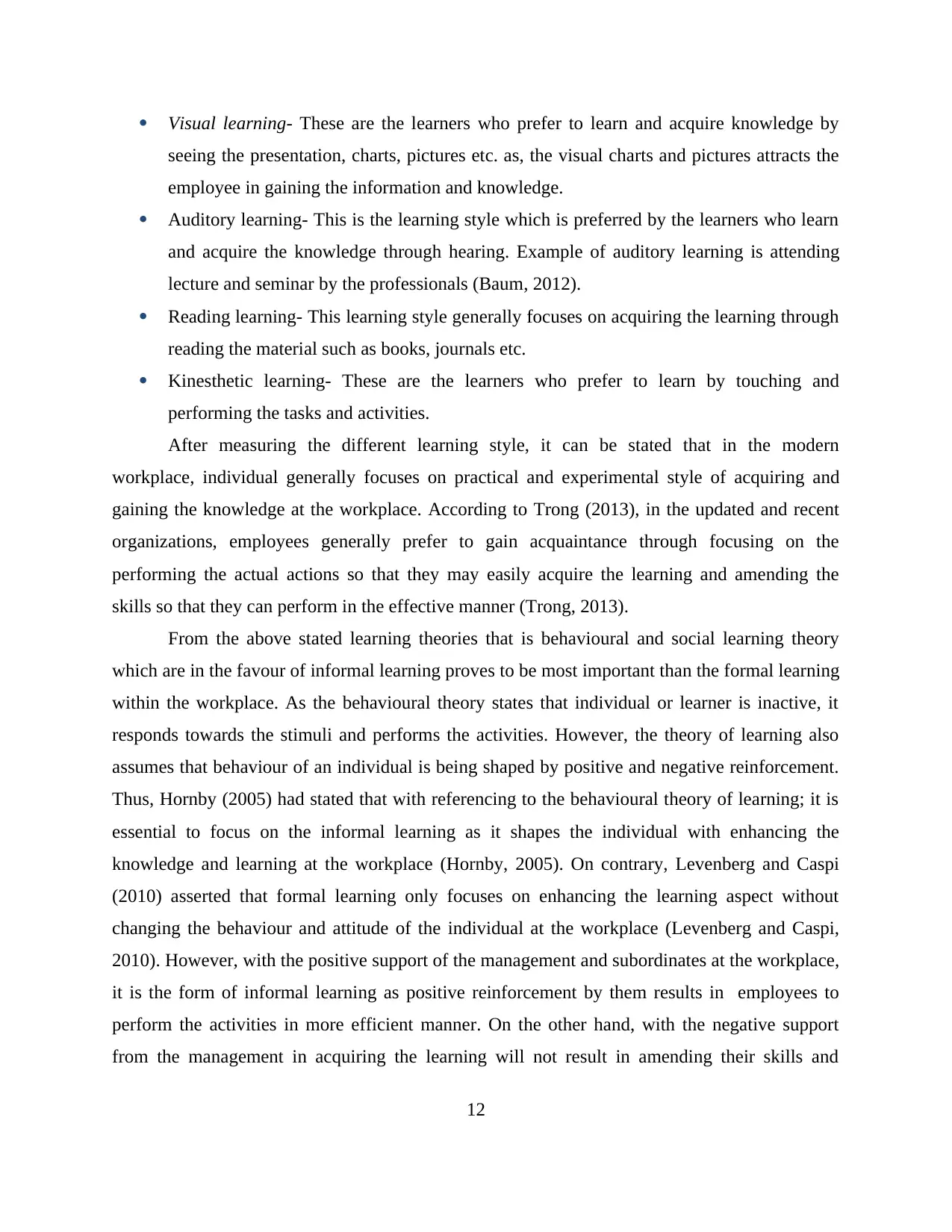
Visual learning- These are the learners who prefer to learn and acquire knowledge by
seeing the presentation, charts, pictures etc. as, the visual charts and pictures attracts the
employee in gaining the information and knowledge.
Auditory learning- This is the learning style which is preferred by the learners who learn
and acquire the knowledge through hearing. Example of auditory learning is attending
lecture and seminar by the professionals (Baum, 2012).
Reading learning- This learning style generally focuses on acquiring the learning through
reading the material such as books, journals etc.
Kinesthetic learning- These are the learners who prefer to learn by touching and
performing the tasks and activities.
After measuring the different learning style, it can be stated that in the modern
workplace, individual generally focuses on practical and experimental style of acquiring and
gaining the knowledge at the workplace. According to Trong (2013), in the updated and recent
organizations, employees generally prefer to gain acquaintance through focusing on the
performing the actual actions so that they may easily acquire the learning and amending the
skills so that they can perform in the effective manner (Trong, 2013).
From the above stated learning theories that is behavioural and social learning theory
which are in the favour of informal learning proves to be most important than the formal learning
within the workplace. As the behavioural theory states that individual or learner is inactive, it
responds towards the stimuli and performs the activities. However, the theory of learning also
assumes that behaviour of an individual is being shaped by positive and negative reinforcement.
Thus, Hornby (2005) had stated that with referencing to the behavioural theory of learning; it is
essential to focus on the informal learning as it shapes the individual with enhancing the
knowledge and learning at the workplace (Hornby, 2005). On contrary, Levenberg and Caspi
(2010) asserted that formal learning only focuses on enhancing the learning aspect without
changing the behaviour and attitude of the individual at the workplace (Levenberg and Caspi,
2010). However, with the positive support of the management and subordinates at the workplace,
it is the form of informal learning as positive reinforcement by them results in employees to
perform the activities in more efficient manner. On the other hand, with the negative support
from the management in acquiring the learning will not result in amending their skills and
12
seeing the presentation, charts, pictures etc. as, the visual charts and pictures attracts the
employee in gaining the information and knowledge.
Auditory learning- This is the learning style which is preferred by the learners who learn
and acquire the knowledge through hearing. Example of auditory learning is attending
lecture and seminar by the professionals (Baum, 2012).
Reading learning- This learning style generally focuses on acquiring the learning through
reading the material such as books, journals etc.
Kinesthetic learning- These are the learners who prefer to learn by touching and
performing the tasks and activities.
After measuring the different learning style, it can be stated that in the modern
workplace, individual generally focuses on practical and experimental style of acquiring and
gaining the knowledge at the workplace. According to Trong (2013), in the updated and recent
organizations, employees generally prefer to gain acquaintance through focusing on the
performing the actual actions so that they may easily acquire the learning and amending the
skills so that they can perform in the effective manner (Trong, 2013).
From the above stated learning theories that is behavioural and social learning theory
which are in the favour of informal learning proves to be most important than the formal learning
within the workplace. As the behavioural theory states that individual or learner is inactive, it
responds towards the stimuli and performs the activities. However, the theory of learning also
assumes that behaviour of an individual is being shaped by positive and negative reinforcement.
Thus, Hornby (2005) had stated that with referencing to the behavioural theory of learning; it is
essential to focus on the informal learning as it shapes the individual with enhancing the
knowledge and learning at the workplace (Hornby, 2005). On contrary, Levenberg and Caspi
(2010) asserted that formal learning only focuses on enhancing the learning aspect without
changing the behaviour and attitude of the individual at the workplace (Levenberg and Caspi,
2010). However, with the positive support of the management and subordinates at the workplace,
it is the form of informal learning as positive reinforcement by them results in employees to
perform the activities in more efficient manner. On the other hand, with the negative support
from the management in acquiring the learning will not result in amending their skills and
12
⊘ This is a preview!⊘
Do you want full access?
Subscribe today to unlock all pages.
Trusted by 1+ million students worldwide

1 out of 15


Related Documents


Your All-in-One AI-Powered Toolkit for Academic Success.
+13062052269
info@desklib.com
Available 24*7 on WhatsApp / Email
![[object Object]](/_next/static/media/star-bottom.7253800d.svg)
Unlock your academic potential
Copyright © 2020–2026 A2Z Services. All Rights Reserved. Developed and managed by ZUCOL.