Information Management Report on Organizing Principles and Systems
VerifiedAdded on 2020/05/08
|8
|1752
|211
Report
AI Summary
This report provides a comprehensive overview of information management, focusing on the Semantic Web and Linked Data. It begins by explaining the Semantic Web's extension of the World Wide Web and the role of Linked Data in libraries, including its benefits and challenges. The report then delves into organizing principles, distinguishing between presentation, logic, and storage, and discusses the distinction between data, information, knowledge, and wisdom. It also includes a description of the Argos organization system and its key components. References to relevant literature are also provided, offering a well-rounded analysis of information management concepts and practices. The report highlights the application of these principles in real-world scenarios and offers insights into the effective management and organization of information resources.

INFORMATION MANAGEMENT
Name of the Student
Name of the University
INFORMATION MANAGEMENT
Name of the Student
Name of the University
Paraphrase This Document
Need a fresh take? Get an instant paraphrase of this document with our AI Paraphraser

1INFORMATION MANAGEMENT
Table of Contents
Task 1: Semantic Web and Linked Data....................................................................................2
Task 2: Linked Data for Libraries..............................................................................................3
Task 3: Organizing principle......................................................................................................4
Task 4: Organizing principle......................................................................................................5
(a) Distinction between Data, Information, Knowledge and Wisdom...................................5
(b) Description of the Argos organization system..................................................................6
References..................................................................................................................................6
Table of Contents
Task 1: Semantic Web and Linked Data....................................................................................2
Task 2: Linked Data for Libraries..............................................................................................3
Task 3: Organizing principle......................................................................................................4
Task 4: Organizing principle......................................................................................................5
(a) Distinction between Data, Information, Knowledge and Wisdom...................................5
(b) Description of the Argos organization system..................................................................6
References..................................................................................................................................6

2INFORMATION MANAGEMENT
Task 1: Semantic Web and Linked Data
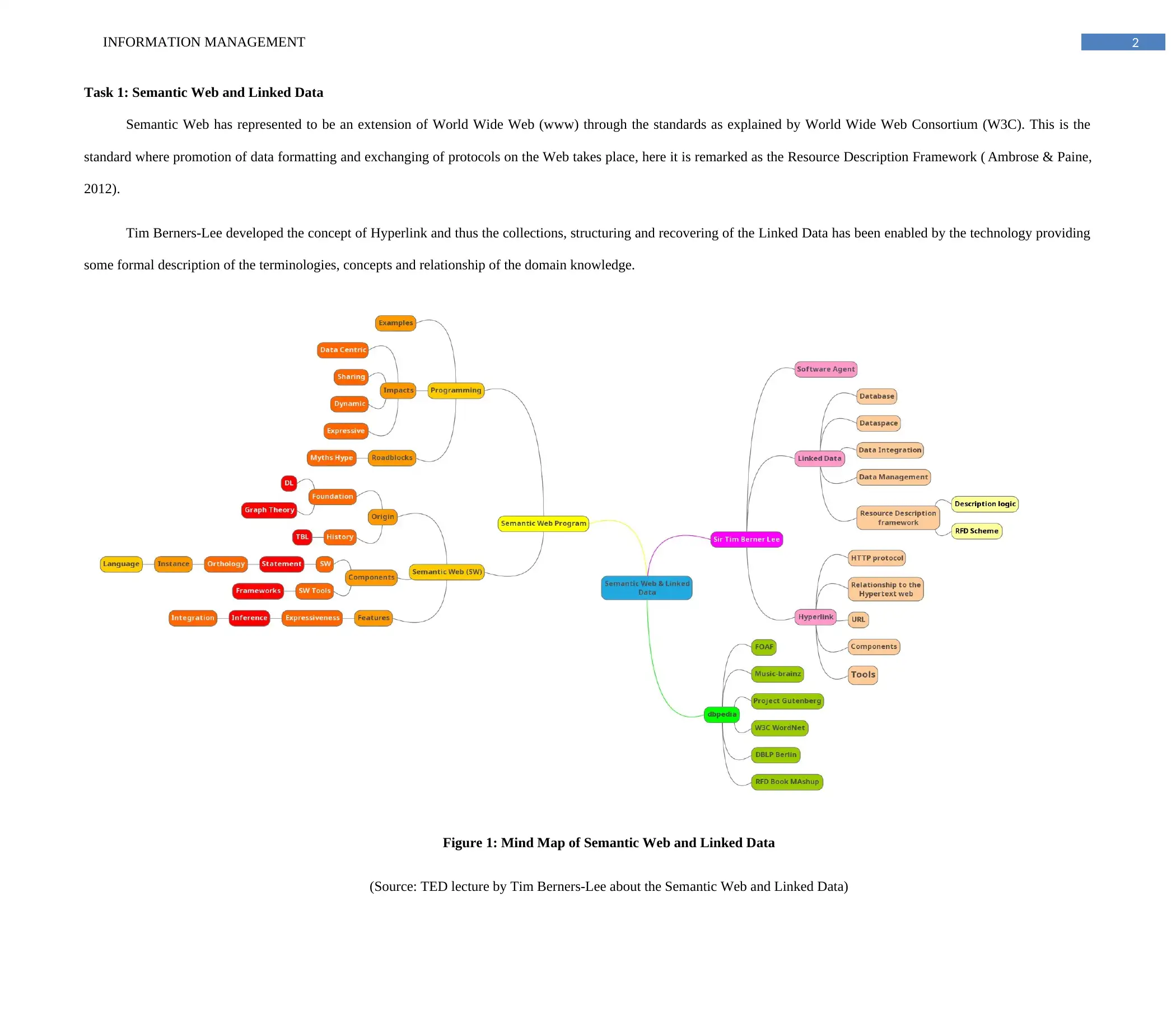
Semantic Web has represented to be an extension of World Wide Web (www) through the standards as explained by World Wide Web Consortium (W3C). This is the
standard where promotion of data formatting and exchanging of protocols on the Web takes place, here it is remarked as the Resource Description Framework ( Ambrose & Paine,
2012).
Tim Berners-Lee developed the concept of Hyperlink and thus the collections, structuring and recovering of the Linked Data has been enabled by the technology providing
some formal description of the terminologies, concepts and relationship of the domain knowledge.
Figure 1: Mind Map of Semantic Web and Linked Data
(Source: TED lecture by Tim Berners-Lee about the Semantic Web and Linked Data)
Task 1: Semantic Web and Linked Data
Semantic Web has represented to be an extension of World Wide Web (www) through the standards as explained by World Wide Web Consortium (W3C). This is the
standard where promotion of data formatting and exchanging of protocols on the Web takes place, here it is remarked as the Resource Description Framework ( Ambrose & Paine,
2012).
Tim Berners-Lee developed the concept of Hyperlink and thus the collections, structuring and recovering of the Linked Data has been enabled by the technology providing
some formal description of the terminologies, concepts and relationship of the domain knowledge.
Figure 1: Mind Map of Semantic Web and Linked Data
(Source: TED lecture by Tim Berners-Lee about the Semantic Web and Linked Data)
⊘ This is a preview!⊘
Do you want full access?
Subscribe today to unlock all pages.

Trusted by 1+ million students worldwide

3INFORMATION MANAGEMENT
Task 2: Linked Data for Libraries
Linked data for library can also be denoted as the (LD4L). The professional data sets
has been published and connected by the Linked Data all over the www. This is all about
producing the data on the internet that is machine-readable and has provided the connecting
as well as the links to some other data sets (Wood et al., 2014). This is the technique of
publishing the data in a way that also could be linked to or from any other data sets.
In the journal “Linked Data for Libraries: Benefits of a conceptual shift from library‐
specific record structures to RDF‐based data models” there has been a discussion about the
necessity of adjusting the current library model to models based on the Linked Data, by the
authors Getaneh Alemu, Brett Stevens, Penny Ross and Jane Chandler. The main concept of
this paper work was to provide some recommendations that initiates from document-centric
and ends to data-centric metadata to make the conceptual shifts (Zaveri et al.,2016). There
are two points from where the challenges of protocols, standards and principles can be
determined: Technical and Conceptual. Advantages of this linked library metadata from the
digital library are: openness of the metadata and sharing, facilitating serendipitous invention
of information of resources, identifying the pattern of resource usage and emergent metadata,
navigation which is facet-based and links that are enriched with metadata.
There are six main suggestions for the libraries and standards agencies for the
challenges faced by linked data are:
The libraries must be rising respected to the disabilities presented by Linked Data.
Adoption of minimal requirement of the principles of Linked Data.
Developing categories- elements, entities and values that is, properties, classes and
instances respectively.
Task 2: Linked Data for Libraries
Linked data for library can also be denoted as the (LD4L). The professional data sets
has been published and connected by the Linked Data all over the www. This is all about
producing the data on the internet that is machine-readable and has provided the connecting
as well as the links to some other data sets (Wood et al., 2014). This is the technique of
publishing the data in a way that also could be linked to or from any other data sets.
In the journal “Linked Data for Libraries: Benefits of a conceptual shift from library‐
specific record structures to RDF‐based data models” there has been a discussion about the
necessity of adjusting the current library model to models based on the Linked Data, by the
authors Getaneh Alemu, Brett Stevens, Penny Ross and Jane Chandler. The main concept of
this paper work was to provide some recommendations that initiates from document-centric
and ends to data-centric metadata to make the conceptual shifts (Zaveri et al.,2016). There
are two points from where the challenges of protocols, standards and principles can be
determined: Technical and Conceptual. Advantages of this linked library metadata from the
digital library are: openness of the metadata and sharing, facilitating serendipitous invention
of information of resources, identifying the pattern of resource usage and emergent metadata,
navigation which is facet-based and links that are enriched with metadata.
There are six main suggestions for the libraries and standards agencies for the
challenges faced by linked data are:
The libraries must be rising respected to the disabilities presented by Linked Data.
Adoption of minimal requirement of the principles of Linked Data.
Developing categories- elements, entities and values that is, properties, classes and
instances respectively.
Paraphrase This Document
Need a fresh take? Get an instant paraphrase of this document with our AI Paraphraser

4INFORMATION MANAGEMENT
Taking decisions on facts that needed to be retained,
Becomes part of the linked data web,
Adoption of an approach of mixed-metadata.
Linked Data has been considered as a solution that enables machine processed and data
centric metadata. Thus, by adopting Linked Data leads to discovering and utilization of
metadata in libraries but there are still chances for the meta data to be modified.
Task 3: Organizing principle
The technique of arranging the resource in organizing system that follows more than
one organizing principles for the achievement of purpose in organizing system. The
principles are generally directive for the designs or the arrangements for the resource
collection which could be ideally expressed by not assuming any particular realization or
implementation. There can be typically three kind of organizational system to be created the
Presentation, Logic and Storage (Hunter, 1988). Representing the organizing principles by
separate designs and implementing process, that merges better with the three-tier architecture.
There is a requirement for the software designers and architects to be familiar to the
architectures: user interfaces (implementation of interactions), business logistics (intentional
arrangement), and data/information (resources).
Programming engineers and originators concur that it is alluring to manufacture
applications that different the capacity of information, the business rationale or capacities that
utilization the information and the UI or introduction segments through which clients or
different applications communicate with the information. This measured design enables each
of the three levels to be overhauled or re-implemented freely to fulfill changed prerequisites
or to exploit new advances. A practically equivalent to qualification is that between a
Taking decisions on facts that needed to be retained,
Becomes part of the linked data web,
Adoption of an approach of mixed-metadata.
Linked Data has been considered as a solution that enables machine processed and data
centric metadata. Thus, by adopting Linked Data leads to discovering and utilization of
metadata in libraries but there are still chances for the meta data to be modified.
Task 3: Organizing principle
The technique of arranging the resource in organizing system that follows more than
one organizing principles for the achievement of purpose in organizing system. The
principles are generally directive for the designs or the arrangements for the resource
collection which could be ideally expressed by not assuming any particular realization or
implementation. There can be typically three kind of organizational system to be created the
Presentation, Logic and Storage (Hunter, 1988). Representing the organizing principles by
separate designs and implementing process, that merges better with the three-tier architecture.
There is a requirement for the software designers and architects to be familiar to the
architectures: user interfaces (implementation of interactions), business logistics (intentional
arrangement), and data/information (resources).
Programming engineers and originators concur that it is alluring to manufacture
applications that different the capacity of information, the business rationale or capacities that
utilization the information and the UI or introduction segments through which clients or
different applications communicate with the information. This measured design enables each
of the three levels to be overhauled or re-implemented freely to fulfill changed prerequisites
or to exploit new advances. A practically equivalent to qualification is that between a

5INFORMATION MANAGEMENT
calculation as a legitimate portrayal of a strategy for taking care of a computational issue and
its execution in a specific programming dialect like Java or Python (Stauffer, 2015).
Our better approach for taking a gander at Organizing Systems accentuates the
significance of recognizing the coveted connections with assets, figuring out which sorting
out standards can empower the associations, and after that choosing how to store and deal
with the assets as per those standards (Larkum, 2013). Applying building thinking to
Organizing Systems makes it less demanding to investigate existing ones and outline new
ones. For instance, another prerequisite to help seeking through a library inventory on an
advanced mobile phone would just influence the introduction level. Presentation, Logic and
Storage illustrates the partition of the introduction, rationale, and capacity levels for four
distinct sorts of library Organizing Systems and for Google Books. No two of them are the
same in each level. Note how a library that utilizations stock robots to deal with the capacity
of books does not uncover this in its higher tiers. Organizing System directly reflects the mix
of the embodiments of information; in this way we can think of the modern library as a
digital Organizing System that primarily relies on digital resources to organize a mixture of
physical and digital ones.
Task 4: Organizing principle
(a) Distinction between Data, Information, Knowledge and Wisdom
The organizing principle contents can be described in four categories: Data,
Information, Knowledge and Wisdom (Antoniou & Van Harmelen, 2004). First three
characteristics relates to the past, only the last one, wisdom deals with the future since that
incorporates with designing and visions of the Organizing principle. The further elaboration
of these principles is as following:
calculation as a legitimate portrayal of a strategy for taking care of a computational issue and
its execution in a specific programming dialect like Java or Python (Stauffer, 2015).
Our better approach for taking a gander at Organizing Systems accentuates the
significance of recognizing the coveted connections with assets, figuring out which sorting
out standards can empower the associations, and after that choosing how to store and deal
with the assets as per those standards (Larkum, 2013). Applying building thinking to
Organizing Systems makes it less demanding to investigate existing ones and outline new
ones. For instance, another prerequisite to help seeking through a library inventory on an
advanced mobile phone would just influence the introduction level. Presentation, Logic and
Storage illustrates the partition of the introduction, rationale, and capacity levels for four
distinct sorts of library Organizing Systems and for Google Books. No two of them are the
same in each level. Note how a library that utilizations stock robots to deal with the capacity
of books does not uncover this in its higher tiers. Organizing System directly reflects the mix
of the embodiments of information; in this way we can think of the modern library as a
digital Organizing System that primarily relies on digital resources to organize a mixture of
physical and digital ones.
Task 4: Organizing principle
(a) Distinction between Data, Information, Knowledge and Wisdom
The organizing principle contents can be described in four categories: Data,
Information, Knowledge and Wisdom (Antoniou & Van Harmelen, 2004). First three
characteristics relates to the past, only the last one, wisdom deals with the future since that
incorporates with designing and visions of the Organizing principle. The further elaboration
of these principles is as following:
⊘ This is a preview!⊘
Do you want full access?
Subscribe today to unlock all pages.

Trusted by 1+ million students worldwide

6INFORMATION MANAGEMENT
Data: It is the raw material that exists simply and thus has no other significance
beyond of its existence. This could be present in any state weather usable or not.
Since these are further modified and are made usable for further utilization
(Blomqvist, 2014).
Information: The processed data that has been made useable for the organizational
purpose are generally known as the Information. Any relational database utilizes the
data stored within.
Knowledge: The accurate collections of information that are intended to be useful are
the knowledge. This happens when someone or something memorizes the information
and implements it in work on the basis of their knowledge (Batley, 2014). Wisdom: This is a non-deterministic, non-probabilistic and extrapolative process that
requires for consciousness of the past thus specifies over the special form of human
programming like the ethics, moral and many more. This gives an understanding
about the data collected, the drawback and how to overcome the drawbacks the next
time.
(b) Description of the Argos organization system
According to Robert J. Glushko, in the chapter 1 (The Discipline of Organizing) there
has been a discussion about the Selected resources, Organizing resources, Designing
resources-based interaction and maintaining resources that are associated to the Argos. It
presents the bringing together idea of an Organizing System-a purposefully orchestrated
accumulation of assets and the associations they support-and after that clarifies the key ideas
and difficulties in the outline and arrangement of Organizing Systems in numerous spaces,
including libraries, historical centers, business data frameworks, individual data
administration, and social figuring. In this book offers a structure for the hypothesis and
routine with regards to sorting out that coordinates data association (IO) and data recovery
Data: It is the raw material that exists simply and thus has no other significance
beyond of its existence. This could be present in any state weather usable or not.
Since these are further modified and are made usable for further utilization
(Blomqvist, 2014).
Information: The processed data that has been made useable for the organizational
purpose are generally known as the Information. Any relational database utilizes the
data stored within.
Knowledge: The accurate collections of information that are intended to be useful are
the knowledge. This happens when someone or something memorizes the information
and implements it in work on the basis of their knowledge (Batley, 2014). Wisdom: This is a non-deterministic, non-probabilistic and extrapolative process that
requires for consciousness of the past thus specifies over the special form of human
programming like the ethics, moral and many more. This gives an understanding
about the data collected, the drawback and how to overcome the drawbacks the next
time.
(b) Description of the Argos organization system
According to Robert J. Glushko, in the chapter 1 (The Discipline of Organizing) there
has been a discussion about the Selected resources, Organizing resources, Designing
resources-based interaction and maintaining resources that are associated to the Argos. It
presents the bringing together idea of an Organizing System-a purposefully orchestrated
accumulation of assets and the associations they support-and after that clarifies the key ideas
and difficulties in the outline and arrangement of Organizing Systems in numerous spaces,
including libraries, historical centers, business data frameworks, individual data
administration, and social figuring. In this book offers a structure for the hypothesis and
routine with regards to sorting out that coordinates data association (IO) and data recovery
Paraphrase This Document
Need a fresh take? Get an instant paraphrase of this document with our AI Paraphraser

7INFORMATION MANAGEMENT
(IR), crossing over the disciplinary gaps amongst Library and Information Science and
Computer Science, each of which sees and shows IO and IR as independent subjects and in
significantly extraordinary ways.
References
Ambrose, T., & Paine, C. (2012). Museum basics. Routledge.
Antoniou, G., & Van Harmelen, F. (2004). A semantic web primer. MIT press.
Batley, S. (2014). Classification in theory and practice. Chandos Publishing.
Blomqvist, E. (2014). The use of Semantic Web technologies for decision support–a survey.
Semantic Web, 5(3), 177-201.
Essential Thesaurus Construction. London: Facet Publishing. Glushko, R.J. (2013).
Larkum, M. (2013). A cellular mechanism for cortical associations: an organizing principle
for the cerebral cortex. Trends in neurosciences, 36(3), 141-151.
Stauffer, A. (2015). Introduction. In Virtual Victorians (pp. 1-8). Palgrave Macmillan US.
The Discipline of Organizing. Cambridge: MIT Press. * Hunter, E.J. (1988).
Wood, D., Zaidman, M., Ruth, L., & Hausenblas, M. (2014). Linked Data. Manning
Publications Co..
Zaveri, A., Rula, A., Maurino, A., Pietrobon, R., Lehmann, J., & Auer, S. (2016). Quality
assessment for linked data: A survey. Semantic Web, 7(1), 63-93.
(IR), crossing over the disciplinary gaps amongst Library and Information Science and
Computer Science, each of which sees and shows IO and IR as independent subjects and in
significantly extraordinary ways.
References
Ambrose, T., & Paine, C. (2012). Museum basics. Routledge.
Antoniou, G., & Van Harmelen, F. (2004). A semantic web primer. MIT press.
Batley, S. (2014). Classification in theory and practice. Chandos Publishing.
Blomqvist, E. (2014). The use of Semantic Web technologies for decision support–a survey.
Semantic Web, 5(3), 177-201.
Essential Thesaurus Construction. London: Facet Publishing. Glushko, R.J. (2013).
Larkum, M. (2013). A cellular mechanism for cortical associations: an organizing principle
for the cerebral cortex. Trends in neurosciences, 36(3), 141-151.
Stauffer, A. (2015). Introduction. In Virtual Victorians (pp. 1-8). Palgrave Macmillan US.
The Discipline of Organizing. Cambridge: MIT Press. * Hunter, E.J. (1988).
Wood, D., Zaidman, M., Ruth, L., & Hausenblas, M. (2014). Linked Data. Manning
Publications Co..
Zaveri, A., Rula, A., Maurino, A., Pietrobon, R., Lehmann, J., & Auer, S. (2016). Quality
assessment for linked data: A survey. Semantic Web, 7(1), 63-93.
1 out of 8
Related Documents
Your All-in-One AI-Powered Toolkit for Academic Success.
+13062052269
info@desklib.com
Available 24*7 on WhatsApp / Email
Unlock your academic potential
Copyright © 2020–2025 A2Z Services. All Rights Reserved. Developed and managed by ZUCOL.