Information and Media: Data, Reliability, Accuracy, and Analysis

Verified

Added on  2020/02/18

|3
|402
|30
Report
AI Summary
This report explores the critical importance of reliable and accurate information in the realm of media. It emphasizes that while readily available information is often accessible, it may not always be trustworthy or suitable for the intended purpose. The report highlights the significance of verifying the sources of information, particularly when using online resources. It underscores that easily accessible information is not always the most valuable, and that prioritizing accuracy over ease of access is crucial for academic research and other applications. The report references several sources to support its points and concludes that the reliability of information is paramount, especially in academic contexts, and that this emphasis can prevent costly rework and ensure the integrity of the work.
Document Page
Running head: MEDIA
Media
Name of the student:
Name of the University:
Author Note:
tabler-icon-diamond-filled.svg

Paraphrase This Document

Need a fresh take? Get an instant paraphrase of this document with our AI Paraphraser
Document Page
1MEDIA
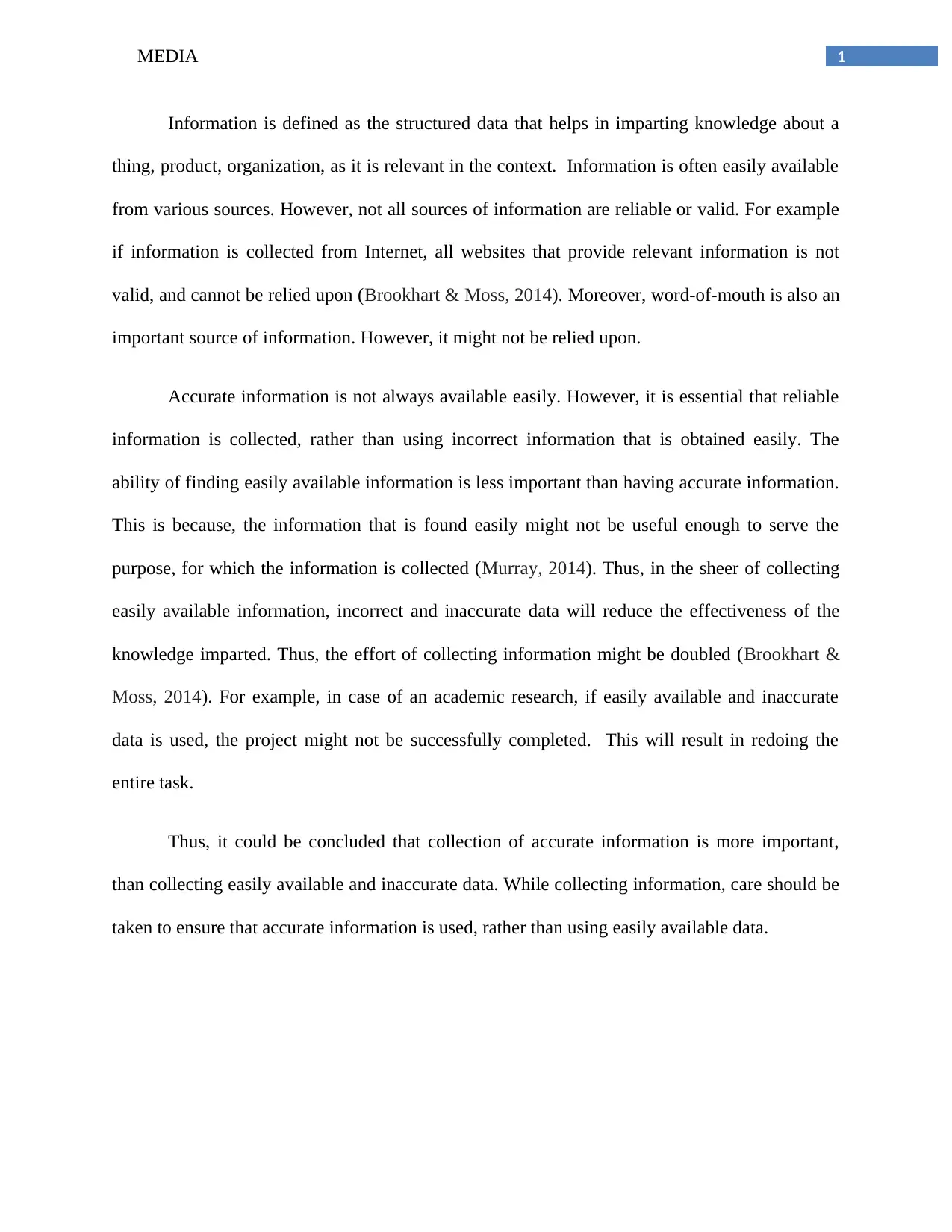
Information is defined as the structured data that helps in imparting knowledge about a
thing, product, organization, as it is relevant in the context. Information is often easily available
from various sources. However, not all sources of information are reliable or valid. For example
if information is collected from Internet, all websites that provide relevant information is not
valid, and cannot be relied upon (Brookhart & Moss, 2014). Moreover, word-of-mouth is also an
important source of information. However, it might not be relied upon.
Accurate information is not always available easily. However, it is essential that reliable
information is collected, rather than using incorrect information that is obtained easily. The
ability of finding easily available information is less important than having accurate information.
This is because, the information that is found easily might not be useful enough to serve the
purpose, for which the information is collected (Murray, 2014). Thus, in the sheer of collecting
easily available information, incorrect and inaccurate data will reduce the effectiveness of the
knowledge imparted. Thus, the effort of collecting information might be doubled (Brookhart &
Moss, 2014). For example, in case of an academic research, if easily available and inaccurate
data is used, the project might not be successfully completed. This will result in redoing the
entire task.
Thus, it could be concluded that collection of accurate information is more important,
than collecting easily available and inaccurate data. While collecting information, care should be
taken to ensure that accurate information is used, rather than using easily available data.
Document Page
2MEDIA
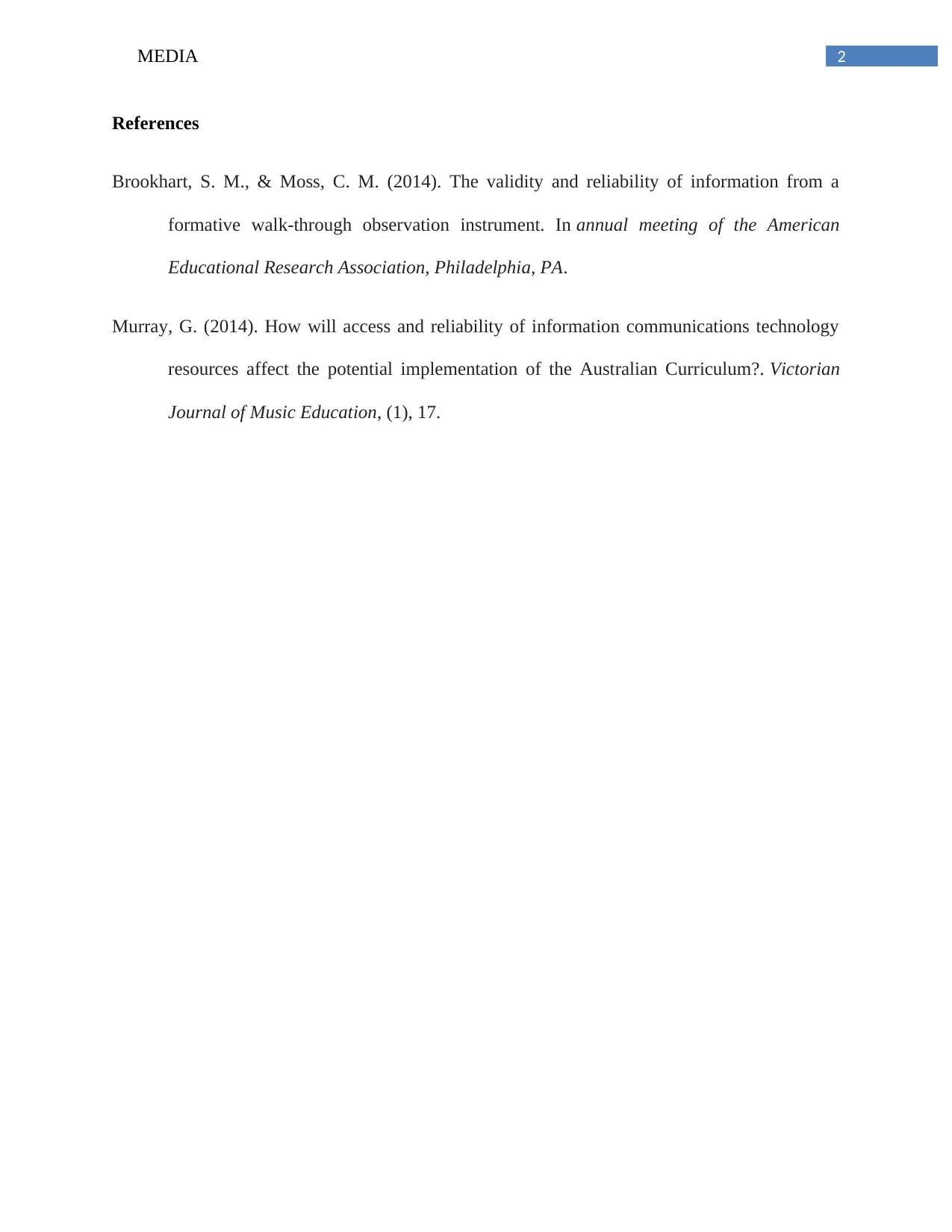
References
Brookhart, S. M., & Moss, C. M. (2014). The validity and reliability of information from a
formative walk-through observation instrument. In annual meeting of the American
Educational Research Association, Philadelphia, PA.
Murray, G. (2014). How will access and reliability of information communications technology
resources affect the potential implementation of the Australian Curriculum?. Victorian
Journal of Music Education, (1), 17.
chevron_up_icon
1 out of 3
circle_padding
hide_on_mobile
zoom_out_icon
[object Object]