The Information Processing Model in TV Advertising: A Critical Review
VerifiedAdded on 2023/06/03
|31
|15281
|413
Report
AI Summary
This report critically examines the dominance of the information processing (IP) model in TV advertising, highlighting its limitations despite evidence supporting the importance of emotional content and creativity. The authors argue that the persistence of this rational, information-based model stems from a sociological desire for simplistic, positivist worldviews. Through a case study involving a snack food commercial that defied conventional research metrics but achieved exceptional real-world success, the report demonstrates the IP model's inadequacy. The authors advocate for a shift towards a Critical Realism perspective in advertising research and practice, suggesting that the current model often leads to misinterpretations and squanders resources in retrofitting successful campaigns to fit information-processing strategies. Ultimately, the report calls for a reevaluation of the assumptions underlying advertising effectiveness, emphasizing the need to consider emotional and relational factors rather than solely focusing on conscious processing of verbal messages.
Fifty years using the wrong model
of advertising1
Dr Robert Heath and Paul Feldwick
University of Bath School of Management
This paper investigates the dominance of the information processing model in TV
advertising.Despite theoreticaland empirical evidencethat supports the
importance of factors such as emotional content and creativity, the authors show
that a rational information-basedpersuasionmodel, which pre-datesthe
development of formal marketing, persists in its domination of almost all TV
advertising development and evaluation. It is postulated that this persistence
derives from a sociological desire to maintain a positivist worldview of simplistic,
well-ordered value systems operated by rational and predictable consumers. The
authors suggest that both advertisers and researchers need to adopt a Critical
Realism perspective in order to move beyond the philosophical straitjacket of this
information processing model, and they summarise the implications that this has
for current research practice.
Introduction: the information processing model of advertising
In 1999 a launch TV commercial for a snack food product aimed at
teenagers was pre-tested. The commercial consisted of a pop song with
meaningless gibberish lyrics, accompanying a series of surreally linked and
sometimes bizarre scenes. In each scene someone is eating the product, but
the ad contained no information as such about the product.
The research was conducted among teenagers using familiar ‘impact and
communication’-type questions such as ‘Did this commercial give you
enough information about the product?’ and ‘Do you think someone
would find this commercial easy to understand?’ From such questions,
average scores were produced for constructs including ‘ease of under-
standing’, ‘believability’, ‘relevance’, ‘branding’ and ‘persuasion’. On all
these, scores were below norms.
International Journal of Market Research Vol. 50 Issue 1
© 2008 The Market Research Society 29
Received (in revised form): 16 September 2007
1 Based on the joint Best Paper award-winning article at the 50th MRS Conference, Brighton, 2007.
Heath.qxp 16/12/2007 09:32 Page 29
of advertising1
Dr Robert Heath and Paul Feldwick
University of Bath School of Management
This paper investigates the dominance of the information processing model in TV
advertising.Despite theoreticaland empirical evidencethat supports the
importance of factors such as emotional content and creativity, the authors show
that a rational information-basedpersuasionmodel, which pre-datesthe
development of formal marketing, persists in its domination of almost all TV
advertising development and evaluation. It is postulated that this persistence
derives from a sociological desire to maintain a positivist worldview of simplistic,
well-ordered value systems operated by rational and predictable consumers. The
authors suggest that both advertisers and researchers need to adopt a Critical
Realism perspective in order to move beyond the philosophical straitjacket of this
information processing model, and they summarise the implications that this has
for current research practice.
Introduction: the information processing model of advertising
In 1999 a launch TV commercial for a snack food product aimed at
teenagers was pre-tested. The commercial consisted of a pop song with
meaningless gibberish lyrics, accompanying a series of surreally linked and
sometimes bizarre scenes. In each scene someone is eating the product, but
the ad contained no information as such about the product.
The research was conducted among teenagers using familiar ‘impact and
communication’-type questions such as ‘Did this commercial give you
enough information about the product?’ and ‘Do you think someone
would find this commercial easy to understand?’ From such questions,
average scores were produced for constructs including ‘ease of under-
standing’, ‘believability’, ‘relevance’, ‘branding’ and ‘persuasion’. On all
these, scores were below norms.
International Journal of Market Research Vol. 50 Issue 1
© 2008 The Market Research Society 29
Received (in revised form): 16 September 2007
1 Based on the joint Best Paper award-winning article at the 50th MRS Conference, Brighton, 2007.
Heath.qxp 16/12/2007 09:32 Page 29

Paraphrase This Document
Need a fresh take? Get an instant paraphrase of this document with our AI Paraphraser
The report drew the following conclusions:
This route does not seem to have worked very well … it hampers understanding
and comprehension of intended message.
The song acts as the biggest hurdle – there is a strong element of dislike which
overrides message takeout, and impressions about the product.
… the taste, or other details about the product are hardly mentioned
spontaneously.
The ad … is seen in terms of its format rather than communication, which results
in relevance, believability and persuasion being low. This is also supported by the
low ease of understanding score.
We feel it may not be appropriate to use this ad as a launch vehicle, given the
above concerns. Probably a more simplistic route (a simple story line) which
emphasises the brand name and benefits clearly would work the best.
What is unusual about this case is not the research methodology or the
constructs measured, which are typical of those used and indeed mandated
by many multinational corporations. What is unusual is that, for reasons
of timing, the advertiser went ahead and ran the ad. The results were
exceptional. It became the most recalled and liked ad among teenagers and
adults for three months in a row, in an independent survey of all
advertising in its geographical market. It achieved high spontaneous recall,
with 93% liking the ad very much – especially the song. In fact, the
campaign became ‘the talk of the town’ with many mentions in the press,
on TV shows, etc. Most importantly, the brand took a substantial share of
the market.
It is not difficult to see why the research got it so wrong. The research
report repeatedly concerns itself with constructs that have no relevance to
an ad that deliberately contains no information. Furthermore, the fact that
the song that was so disliked in the research later proved hugely popular
suggests an important disconnect between the research environment – a
teenager being played a song once or twice by a researcher who is
probably the same age as his parents – and reality – the same teenager
hearing the song repeatedly in social situations among peers (cf. Gladwell
2005, Chapter 5).
In hindsight it seems hard to believe that responsible marketers could
have invested their money in such a misconceived piece of research. Yet in
our experience this type of behaviour is far from atypical. It serves to
demonstratethe extraordinarypower of a mental model so deeply
Fifty years using the wrong model of advertising
30
Heath.qxp 16/12/2007 09:32 Page 30
This route does not seem to have worked very well … it hampers understanding
and comprehension of intended message.
The song acts as the biggest hurdle – there is a strong element of dislike which
overrides message takeout, and impressions about the product.
… the taste, or other details about the product are hardly mentioned
spontaneously.
The ad … is seen in terms of its format rather than communication, which results
in relevance, believability and persuasion being low. This is also supported by the
low ease of understanding score.
We feel it may not be appropriate to use this ad as a launch vehicle, given the
above concerns. Probably a more simplistic route (a simple story line) which
emphasises the brand name and benefits clearly would work the best.
What is unusual about this case is not the research methodology or the
constructs measured, which are typical of those used and indeed mandated
by many multinational corporations. What is unusual is that, for reasons
of timing, the advertiser went ahead and ran the ad. The results were
exceptional. It became the most recalled and liked ad among teenagers and
adults for three months in a row, in an independent survey of all
advertising in its geographical market. It achieved high spontaneous recall,
with 93% liking the ad very much – especially the song. In fact, the
campaign became ‘the talk of the town’ with many mentions in the press,
on TV shows, etc. Most importantly, the brand took a substantial share of
the market.
It is not difficult to see why the research got it so wrong. The research
report repeatedly concerns itself with constructs that have no relevance to
an ad that deliberately contains no information. Furthermore, the fact that
the song that was so disliked in the research later proved hugely popular
suggests an important disconnect between the research environment – a
teenager being played a song once or twice by a researcher who is
probably the same age as his parents – and reality – the same teenager
hearing the song repeatedly in social situations among peers (cf. Gladwell
2005, Chapter 5).
In hindsight it seems hard to believe that responsible marketers could
have invested their money in such a misconceived piece of research. Yet in
our experience this type of behaviour is far from atypical. It serves to
demonstratethe extraordinarypower of a mental model so deeply
Fifty years using the wrong model of advertising
30
Heath.qxp 16/12/2007 09:32 Page 30
embedded in organisational practice that it routinely overrules judgement.
We call this the information processing (IP) model, an umbrella term
commonly used in academia in the US (Meyers-Levy & Malaviya 1999).
The core assumptions and beliefs of the IP model, as it applies to the
case study above, are as follows:
• For any ad to be effective, it must communicate a clear (i.e. verbally
describable) message about the product or service.
• Success in advertising is indicated by ‘recall’ of this message, which
must also be ‘believed’ and ‘understood’.
In addition, it is commonly held that:
• the advertising process is essentially a one-way communication from
the advertiser to the consumer
• the role played by creativity and emotional elements is to support this
communication, either by fostering liking of the advertising, which
transfers to the brand, or by increasing attention, which aids memory
of the key message
• advertising is most effective when processed with high levels of
attention and the active involvement of the viewer.
It should be noted that, in the context of this model, it is seen as
perfectly acceptable, indeed advisable, for advertising to be tested in an
environmentin which individualsare encouragedto give their full
conscious attention to the advertising stimulus being tested.
The universal presence of this model in UK advertising is confirmed in a
research study by Hall and Maclay (1991) into beliefs about advertising
among UK advertisers and agencies. They found the most common model
in use was a hierarchy of effects persuasion model, which relied on impact,
noticeability, branding and communicating a message (1991, p. 17). They
also identified a saliencymodel, which prioritised the creation of
awareness,and an involvementmodel, which stressedthe role of
advertising in creating relationships through affective means. But all these
models strongly endorsed the need for a ‘unique selling proposition to be
clearly established’.Their researchsuggeststhat most practitioners
simultaneously hold beliefs that represent different underlying models. It is
not that people in advertising don’t believe there is a role for creativity, or
that building brand relationships is unimportant. It is that, in practice,
these ‘softer’ values are regarded as less important than, and subservient
International Journal of Market Research Vol. 50 Issue 1
31
Heath.qxp 16/12/2007 09:32 Page 31
We call this the information processing (IP) model, an umbrella term
commonly used in academia in the US (Meyers-Levy & Malaviya 1999).
The core assumptions and beliefs of the IP model, as it applies to the
case study above, are as follows:
• For any ad to be effective, it must communicate a clear (i.e. verbally
describable) message about the product or service.
• Success in advertising is indicated by ‘recall’ of this message, which
must also be ‘believed’ and ‘understood’.
In addition, it is commonly held that:
• the advertising process is essentially a one-way communication from
the advertiser to the consumer
• the role played by creativity and emotional elements is to support this
communication, either by fostering liking of the advertising, which
transfers to the brand, or by increasing attention, which aids memory
of the key message
• advertising is most effective when processed with high levels of
attention and the active involvement of the viewer.
It should be noted that, in the context of this model, it is seen as
perfectly acceptable, indeed advisable, for advertising to be tested in an
environmentin which individualsare encouragedto give their full
conscious attention to the advertising stimulus being tested.
The universal presence of this model in UK advertising is confirmed in a
research study by Hall and Maclay (1991) into beliefs about advertising
among UK advertisers and agencies. They found the most common model
in use was a hierarchy of effects persuasion model, which relied on impact,
noticeability, branding and communicating a message (1991, p. 17). They
also identified a saliencymodel, which prioritised the creation of
awareness,and an involvementmodel, which stressedthe role of
advertising in creating relationships through affective means. But all these
models strongly endorsed the need for a ‘unique selling proposition to be
clearly established’.Their researchsuggeststhat most practitioners
simultaneously hold beliefs that represent different underlying models. It is
not that people in advertising don’t believe there is a role for creativity, or
that building brand relationships is unimportant. It is that, in practice,
these ‘softer’ values are regarded as less important than, and subservient
International Journal of Market Research Vol. 50 Issue 1
31
Heath.qxp 16/12/2007 09:32 Page 31
⊘ This is a preview!⊘
Do you want full access?
Subscribe today to unlock all pages.

Trusted by 1+ million students worldwide
to, the communication of information. Thus ‘creativity’ is fitted into the IP
model using the argumentthat it improves levels of attention or
memorability,or in some other way makes the ‘message’of the
advertisement more powerful.
The current authors can testify from personal experience that various
versions of this IP model have been in common use by practitioners and
marketers for at least the last 50 years, and that it underpins the beliefs of
the vast majority even today. They can also testify that, for much of the
advertising produced by mainstream brand communications agencies, the
model is of limited importance and in some cases completely irrelevant.
Most advertising practitioners intuitively believe that advertising
influences behaviour not simply through the conscious processing of
verbal or factual messages, but by influencing emotions and mediating
‘relationships’ between the consumer and the brand. This leads to a benign
conspiracy between client and agency in which creativity and
communicationare able to coexist (Heath 2004). To support this
conspiracy, huge resources of corporate ingenuity are squandered in retro-
fitting successful campaigns to ‘information processing’ strategies. So we
are led to believethat Heineken’sfamous ‘Refreshesthe parts …’
campaignworked mainly becauseit communicatedthe ‘benefit’ of
refreshment, that the Guinness ‘Surfer’ ad is merely a dramatisation of the
‘benefit’ that Guinness takes a long time to pour, and that the Andrex
‘Puppy’ is no more than a branding device that improves recall that its
toilet paper is ‘soft, strong, and very long’. It is a bit like saying that King
Lear is a great play because it is about families.
The IP model is continually reflected in the language that marketers use.
For example, Duncan and Moriarty, writing in Advertising Age described
advertising as ‘one-way communication: creating and sending messages’
(1999, p. 44). And these same ideas are supported in academia. Jones
describes advertising as an activity that ‘increases people’s knowledge and
changespeople’sattitudes’ (1990, p. 237), and Meyers-Levy and
Malaviya, writing in the Journal of Marketing, consider ‘only theories that
adopt an information-processingperspective’(1999, p. 45). Ambler,
writing about the dominance of informational persuasion in the US, goes
so far as to suggest that ‘a challenge elicits much the same reaction as
questioning your partner’s parentage’ (2000, p. 299). Even Ehrenberg and
Jones, who have popularised the terms ‘strong theory’ for information
processing and conversion and ‘weak theory’ for emotional reinforcement
(Ehrenberg 1974; Jones 1990), load the argument in the same way as the
earlier expressions ‘hard sell’ and ‘soft sell’. In an instrumental, modernist
Fifty years using the wrong model of advertising
32
Heath.qxp 16/12/2007 09:32 Page 32
model using the argumentthat it improves levels of attention or
memorability,or in some other way makes the ‘message’of the
advertisement more powerful.
The current authors can testify from personal experience that various
versions of this IP model have been in common use by practitioners and
marketers for at least the last 50 years, and that it underpins the beliefs of
the vast majority even today. They can also testify that, for much of the
advertising produced by mainstream brand communications agencies, the
model is of limited importance and in some cases completely irrelevant.
Most advertising practitioners intuitively believe that advertising
influences behaviour not simply through the conscious processing of
verbal or factual messages, but by influencing emotions and mediating
‘relationships’ between the consumer and the brand. This leads to a benign
conspiracy between client and agency in which creativity and
communicationare able to coexist (Heath 2004). To support this
conspiracy, huge resources of corporate ingenuity are squandered in retro-
fitting successful campaigns to ‘information processing’ strategies. So we
are led to believethat Heineken’sfamous ‘Refreshesthe parts …’
campaignworked mainly becauseit communicatedthe ‘benefit’ of
refreshment, that the Guinness ‘Surfer’ ad is merely a dramatisation of the
‘benefit’ that Guinness takes a long time to pour, and that the Andrex
‘Puppy’ is no more than a branding device that improves recall that its
toilet paper is ‘soft, strong, and very long’. It is a bit like saying that King
Lear is a great play because it is about families.
The IP model is continually reflected in the language that marketers use.
For example, Duncan and Moriarty, writing in Advertising Age described
advertising as ‘one-way communication: creating and sending messages’
(1999, p. 44). And these same ideas are supported in academia. Jones
describes advertising as an activity that ‘increases people’s knowledge and
changespeople’sattitudes’ (1990, p. 237), and Meyers-Levy and
Malaviya, writing in the Journal of Marketing, consider ‘only theories that
adopt an information-processingperspective’(1999, p. 45). Ambler,
writing about the dominance of informational persuasion in the US, goes
so far as to suggest that ‘a challenge elicits much the same reaction as
questioning your partner’s parentage’ (2000, p. 299). Even Ehrenberg and
Jones, who have popularised the terms ‘strong theory’ for information
processing and conversion and ‘weak theory’ for emotional reinforcement
(Ehrenberg 1974; Jones 1990), load the argument in the same way as the
earlier expressions ‘hard sell’ and ‘soft sell’. In an instrumental, modernist
Fifty years using the wrong model of advertising
32
Heath.qxp 16/12/2007 09:32 Page 32
Paraphrase This Document
Need a fresh take? Get an instant paraphrase of this document with our AI Paraphraser
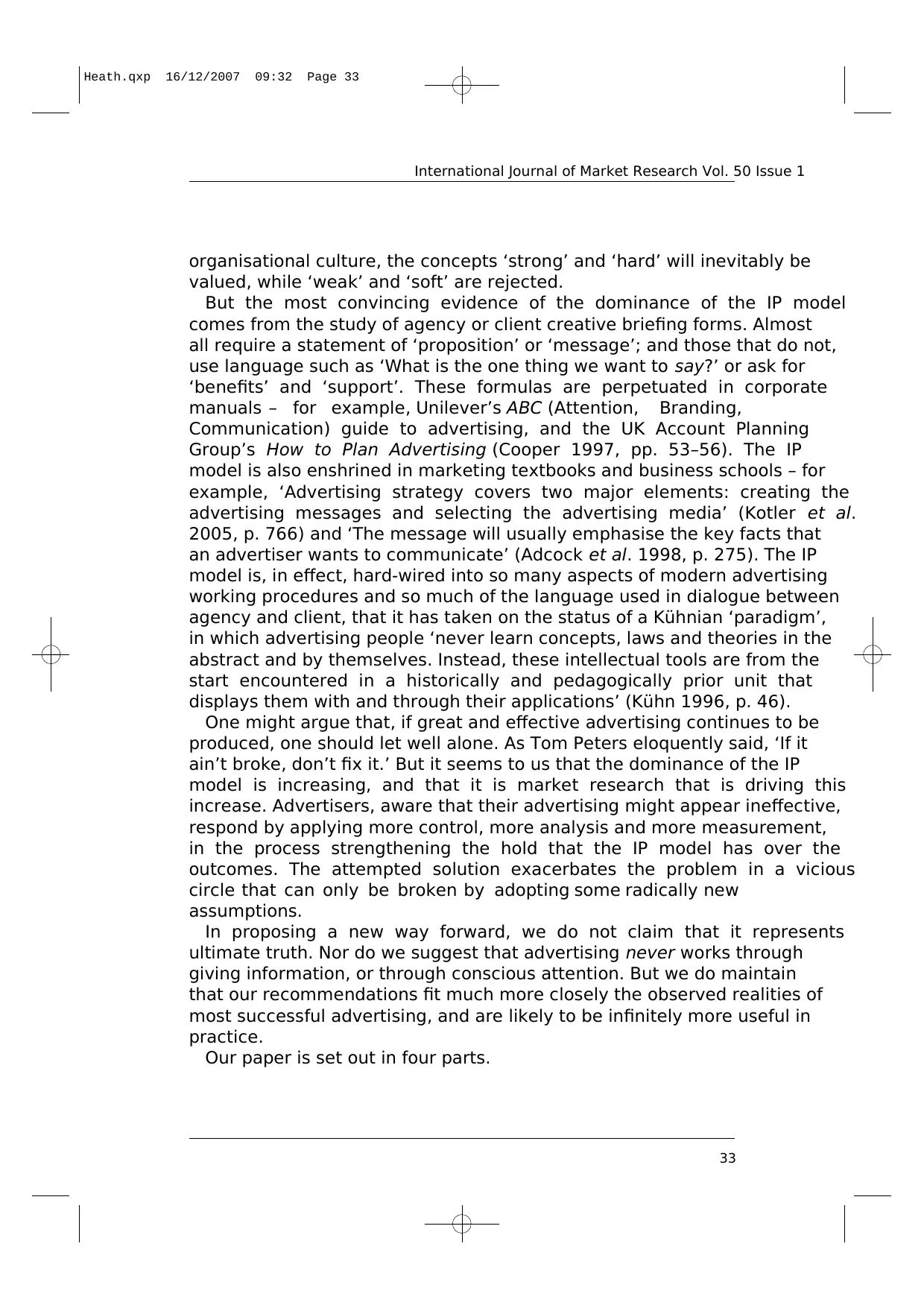
organisational culture, the concepts ‘strong’ and ‘hard’ will inevitably be
valued, while ‘weak’ and ‘soft’ are rejected.
But the most convincing evidence of the dominance of the IP model
comes from the study of agency or client creative briefing forms. Almost
all require a statement of ‘proposition’ or ‘message’; and those that do not,
use language such as ‘What is the one thing we want to say?’ or ask for
‘benefits’ and ‘support’. These formulas are perpetuated in corporate
manuals – for example, Unilever’s ABC (Attention, Branding,
Communication) guide to advertising, and the UK Account Planning
Group’s How to Plan Advertising (Cooper 1997, pp. 53–56). The IP
model is also enshrined in marketing textbooks and business schools – for
example, ‘Advertising strategy covers two major elements: creating the
advertising messages and selecting the advertising media’ (Kotler et al.
2005, p. 766) and ‘The message will usually emphasise the key facts that
an advertiser wants to communicate’ (Adcock et al. 1998, p. 275). The IP
model is, in effect, hard-wired into so many aspects of modern advertising
working procedures and so much of the language used in dialogue between
agency and client, that it has taken on the status of a Kühnian ‘paradigm’,
in which advertising people ‘never learn concepts, laws and theories in the
abstract and by themselves. Instead, these intellectual tools are from the
start encountered in a historically and pedagogically prior unit that
displays them with and through their applications’ (Kühn 1996, p. 46).
One might argue that, if great and effective advertising continues to be
produced, one should let well alone. As Tom Peters eloquently said, ‘If it
ain’t broke, don’t fix it.’ But it seems to us that the dominance of the IP
model is increasing, and that it is market research that is driving this
increase. Advertisers, aware that their advertising might appear ineffective,
respond by applying more control, more analysis and more measurement,
in the process strengthening the hold that the IP model has over the
outcomes. The attempted solution exacerbates the problem in a vicious
circle that can only be broken by adopting some radically new
assumptions.
In proposing a new way forward, we do not claim that it represents
ultimate truth. Nor do we suggest that advertising never works through
giving information, or through conscious attention. But we do maintain
that our recommendations fit much more closely the observed realities of
most successful advertising, and are likely to be infinitely more useful in
practice.
Our paper is set out in four parts.
International Journal of Market Research Vol. 50 Issue 1
33
Heath.qxp 16/12/2007 09:32 Page 33
valued, while ‘weak’ and ‘soft’ are rejected.
But the most convincing evidence of the dominance of the IP model
comes from the study of agency or client creative briefing forms. Almost
all require a statement of ‘proposition’ or ‘message’; and those that do not,
use language such as ‘What is the one thing we want to say?’ or ask for
‘benefits’ and ‘support’. These formulas are perpetuated in corporate
manuals – for example, Unilever’s ABC (Attention, Branding,
Communication) guide to advertising, and the UK Account Planning
Group’s How to Plan Advertising (Cooper 1997, pp. 53–56). The IP
model is also enshrined in marketing textbooks and business schools – for
example, ‘Advertising strategy covers two major elements: creating the
advertising messages and selecting the advertising media’ (Kotler et al.
2005, p. 766) and ‘The message will usually emphasise the key facts that
an advertiser wants to communicate’ (Adcock et al. 1998, p. 275). The IP
model is, in effect, hard-wired into so many aspects of modern advertising
working procedures and so much of the language used in dialogue between
agency and client, that it has taken on the status of a Kühnian ‘paradigm’,
in which advertising people ‘never learn concepts, laws and theories in the
abstract and by themselves. Instead, these intellectual tools are from the
start encountered in a historically and pedagogically prior unit that
displays them with and through their applications’ (Kühn 1996, p. 46).
One might argue that, if great and effective advertising continues to be
produced, one should let well alone. As Tom Peters eloquently said, ‘If it
ain’t broke, don’t fix it.’ But it seems to us that the dominance of the IP
model is increasing, and that it is market research that is driving this
increase. Advertisers, aware that their advertising might appear ineffective,
respond by applying more control, more analysis and more measurement,
in the process strengthening the hold that the IP model has over the
outcomes. The attempted solution exacerbates the problem in a vicious
circle that can only be broken by adopting some radically new
assumptions.
In proposing a new way forward, we do not claim that it represents
ultimate truth. Nor do we suggest that advertising never works through
giving information, or through conscious attention. But we do maintain
that our recommendations fit much more closely the observed realities of
most successful advertising, and are likely to be infinitely more useful in
practice.
Our paper is set out in four parts.
International Journal of Market Research Vol. 50 Issue 1
33
Heath.qxp 16/12/2007 09:32 Page 33
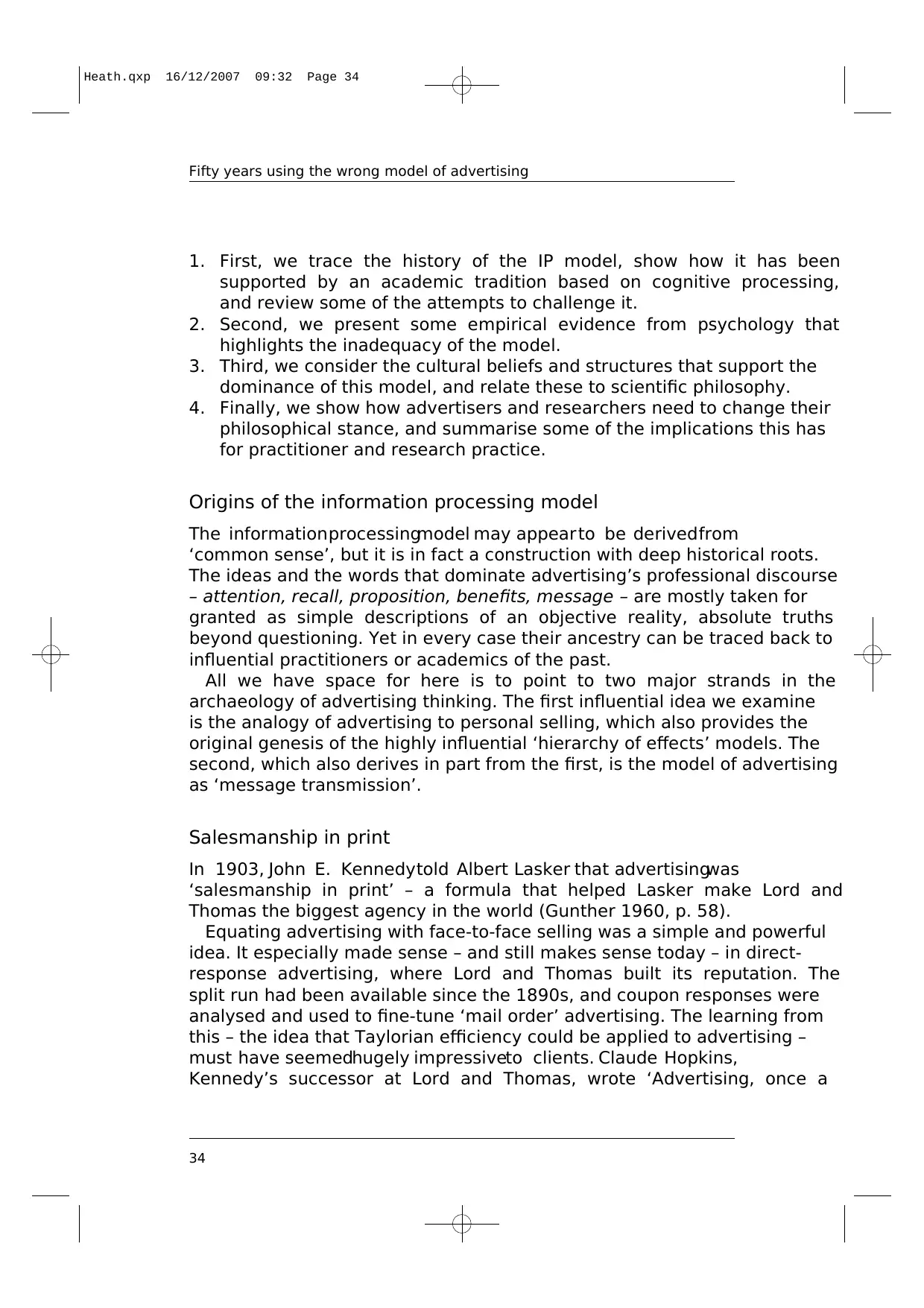
1. First, we trace the history of the IP model, show how it has been
supported by an academic tradition based on cognitive processing,
and review some of the attempts to challenge it.
2. Second, we present some empirical evidence from psychology that
highlights the inadequacy of the model.
3. Third, we consider the cultural beliefs and structures that support the
dominance of this model, and relate these to scientific philosophy.
4. Finally, we show how advertisers and researchers need to change their
philosophical stance, and summarise some of the implications this has
for practitioner and research practice.
Origins of the information processing model
The information processingmodel may appear to be derived from
‘common sense’, but it is in fact a construction with deep historical roots.
The ideas and the words that dominate advertising’s professional discourse
– attention, recall, proposition, benefits, message – are mostly taken for
granted as simple descriptions of an objective reality, absolute truths
beyond questioning. Yet in every case their ancestry can be traced back to
influential practitioners or academics of the past.
All we have space for here is to point to two major strands in the
archaeology of advertising thinking. The first influential idea we examine
is the analogy of advertising to personal selling, which also provides the
original genesis of the highly influential ‘hierarchy of effects’ models. The
second, which also derives in part from the first, is the model of advertising
as ‘message transmission’.
Salesmanship in print
In 1903, John E. Kennedy told Albert Lasker that advertisingwas
‘salesmanship in print’ – a formula that helped Lasker make Lord and
Thomas the biggest agency in the world (Gunther 1960, p. 58).
Equating advertising with face-to-face selling was a simple and powerful
idea. It especially made sense – and still makes sense today – in direct-
response advertising, where Lord and Thomas built its reputation. The
split run had been available since the 1890s, and coupon responses were
analysed and used to fine-tune ‘mail order’ advertising. The learning from
this – the idea that Taylorian efficiency could be applied to advertising –
must have seemedhugely impressiveto clients. Claude Hopkins,
Kennedy’s successor at Lord and Thomas, wrote ‘Advertising, once a
Fifty years using the wrong model of advertising
34
Heath.qxp 16/12/2007 09:32 Page 34
supported by an academic tradition based on cognitive processing,
and review some of the attempts to challenge it.
2. Second, we present some empirical evidence from psychology that
highlights the inadequacy of the model.
3. Third, we consider the cultural beliefs and structures that support the
dominance of this model, and relate these to scientific philosophy.
4. Finally, we show how advertisers and researchers need to change their
philosophical stance, and summarise some of the implications this has
for practitioner and research practice.
Origins of the information processing model
The information processingmodel may appear to be derived from
‘common sense’, but it is in fact a construction with deep historical roots.
The ideas and the words that dominate advertising’s professional discourse
– attention, recall, proposition, benefits, message – are mostly taken for
granted as simple descriptions of an objective reality, absolute truths
beyond questioning. Yet in every case their ancestry can be traced back to
influential practitioners or academics of the past.
All we have space for here is to point to two major strands in the
archaeology of advertising thinking. The first influential idea we examine
is the analogy of advertising to personal selling, which also provides the
original genesis of the highly influential ‘hierarchy of effects’ models. The
second, which also derives in part from the first, is the model of advertising
as ‘message transmission’.
Salesmanship in print
In 1903, John E. Kennedy told Albert Lasker that advertisingwas
‘salesmanship in print’ – a formula that helped Lasker make Lord and
Thomas the biggest agency in the world (Gunther 1960, p. 58).
Equating advertising with face-to-face selling was a simple and powerful
idea. It especially made sense – and still makes sense today – in direct-
response advertising, where Lord and Thomas built its reputation. The
split run had been available since the 1890s, and coupon responses were
analysed and used to fine-tune ‘mail order’ advertising. The learning from
this – the idea that Taylorian efficiency could be applied to advertising –
must have seemedhugely impressiveto clients. Claude Hopkins,
Kennedy’s successor at Lord and Thomas, wrote ‘Advertising, once a
Fifty years using the wrong model of advertising
34
Heath.qxp 16/12/2007 09:32 Page 34
⊘ This is a preview!⊘
Do you want full access?
Subscribe today to unlock all pages.
Trusted by 1+ million students worldwide
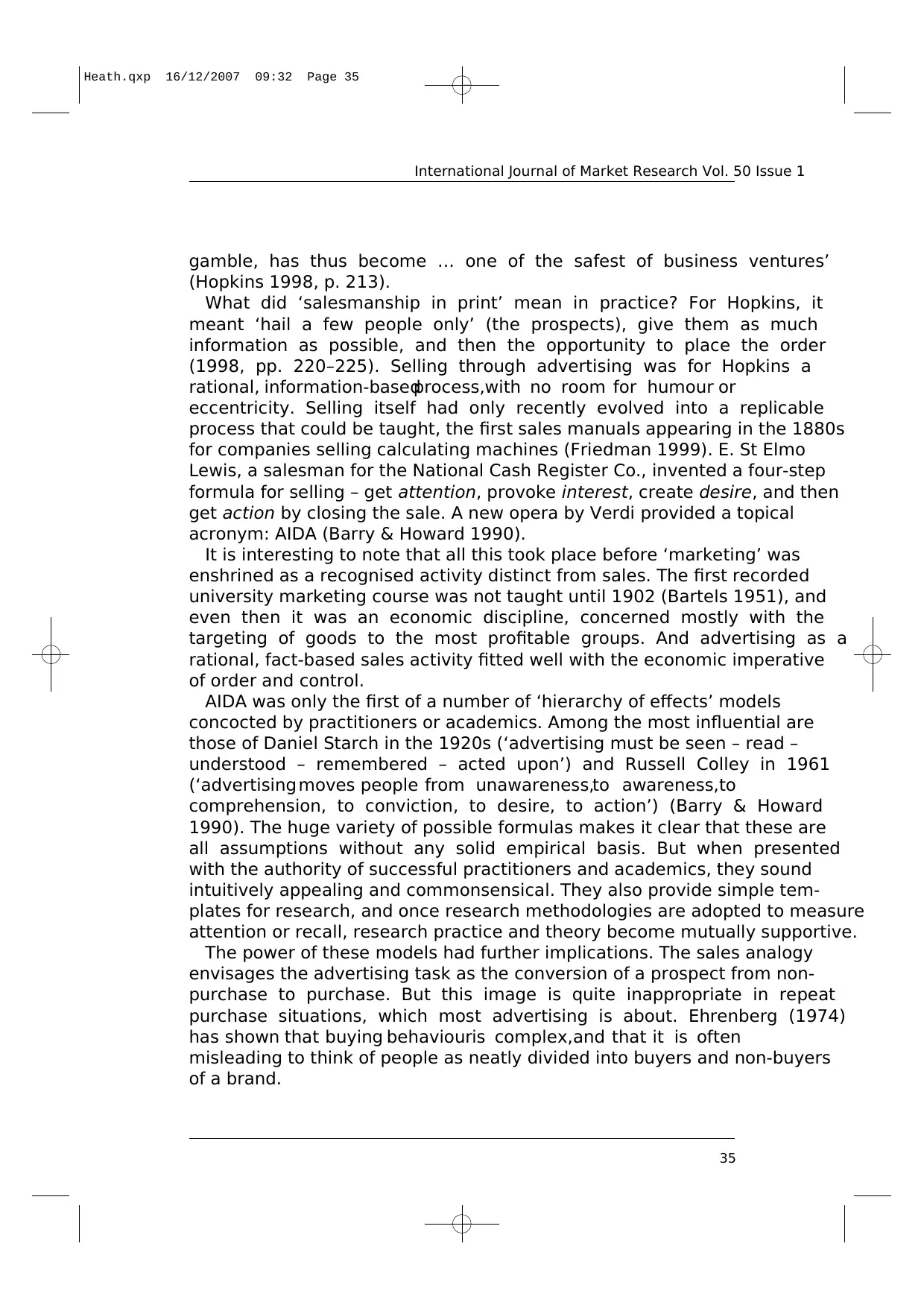
gamble, has thus become … one of the safest of business ventures’
(Hopkins 1998, p. 213).
What did ‘salesmanship in print’ mean in practice? For Hopkins, it
meant ‘hail a few people only’ (the prospects), give them as much
information as possible, and then the opportunity to place the order
(1998, pp. 220–225). Selling through advertising was for Hopkins a
rational, information-basedprocess,with no room for humour or
eccentricity. Selling itself had only recently evolved into a replicable
process that could be taught, the first sales manuals appearing in the 1880s
for companies selling calculating machines (Friedman 1999). E. St Elmo
Lewis, a salesman for the National Cash Register Co., invented a four-step
formula for selling – get attention, provoke interest, create desire, and then
get action by closing the sale. A new opera by Verdi provided a topical
acronym: AIDA (Barry & Howard 1990).
It is interesting to note that all this took place before ‘marketing’ was
enshrined as a recognised activity distinct from sales. The first recorded
university marketing course was not taught until 1902 (Bartels 1951), and
even then it was an economic discipline, concerned mostly with the
targeting of goods to the most profitable groups. And advertising as a
rational, fact-based sales activity fitted well with the economic imperative
of order and control.
AIDA was only the first of a number of ‘hierarchy of effects’ models
concocted by practitioners or academics. Among the most influential are
those of Daniel Starch in the 1920s (‘advertising must be seen – read –
understood – remembered – acted upon’) and Russell Colley in 1961
(‘advertising moves people from unawareness,to awareness,to
comprehension, to conviction, to desire, to action’) (Barry & Howard
1990). The huge variety of possible formulas makes it clear that these are
all assumptions without any solid empirical basis. But when presented
with the authority of successful practitioners and academics, they sound
intuitively appealing and commonsensical. They also provide simple tem-
plates for research, and once research methodologies are adopted to measure
attention or recall, research practice and theory become mutually supportive.
The power of these models had further implications. The sales analogy
envisages the advertising task as the conversion of a prospect from non-
purchase to purchase. But this image is quite inappropriate in repeat
purchase situations, which most advertising is about. Ehrenberg (1974)
has shown that buying behaviouris complex,and that it is often
misleading to think of people as neatly divided into buyers and non-buyers
of a brand.
International Journal of Market Research Vol. 50 Issue 1
35
Heath.qxp 16/12/2007 09:32 Page 35
(Hopkins 1998, p. 213).
What did ‘salesmanship in print’ mean in practice? For Hopkins, it
meant ‘hail a few people only’ (the prospects), give them as much
information as possible, and then the opportunity to place the order
(1998, pp. 220–225). Selling through advertising was for Hopkins a
rational, information-basedprocess,with no room for humour or
eccentricity. Selling itself had only recently evolved into a replicable
process that could be taught, the first sales manuals appearing in the 1880s
for companies selling calculating machines (Friedman 1999). E. St Elmo
Lewis, a salesman for the National Cash Register Co., invented a four-step
formula for selling – get attention, provoke interest, create desire, and then
get action by closing the sale. A new opera by Verdi provided a topical
acronym: AIDA (Barry & Howard 1990).
It is interesting to note that all this took place before ‘marketing’ was
enshrined as a recognised activity distinct from sales. The first recorded
university marketing course was not taught until 1902 (Bartels 1951), and
even then it was an economic discipline, concerned mostly with the
targeting of goods to the most profitable groups. And advertising as a
rational, fact-based sales activity fitted well with the economic imperative
of order and control.
AIDA was only the first of a number of ‘hierarchy of effects’ models
concocted by practitioners or academics. Among the most influential are
those of Daniel Starch in the 1920s (‘advertising must be seen – read –
understood – remembered – acted upon’) and Russell Colley in 1961
(‘advertising moves people from unawareness,to awareness,to
comprehension, to conviction, to desire, to action’) (Barry & Howard
1990). The huge variety of possible formulas makes it clear that these are
all assumptions without any solid empirical basis. But when presented
with the authority of successful practitioners and academics, they sound
intuitively appealing and commonsensical. They also provide simple tem-
plates for research, and once research methodologies are adopted to measure
attention or recall, research practice and theory become mutually supportive.
The power of these models had further implications. The sales analogy
envisages the advertising task as the conversion of a prospect from non-
purchase to purchase. But this image is quite inappropriate in repeat
purchase situations, which most advertising is about. Ehrenberg (1974)
has shown that buying behaviouris complex,and that it is often
misleading to think of people as neatly divided into buyers and non-buyers
of a brand.
International Journal of Market Research Vol. 50 Issue 1
35
Heath.qxp 16/12/2007 09:32 Page 35
Paraphrase This Document
Need a fresh take? Get an instant paraphrase of this document with our AI Paraphraser
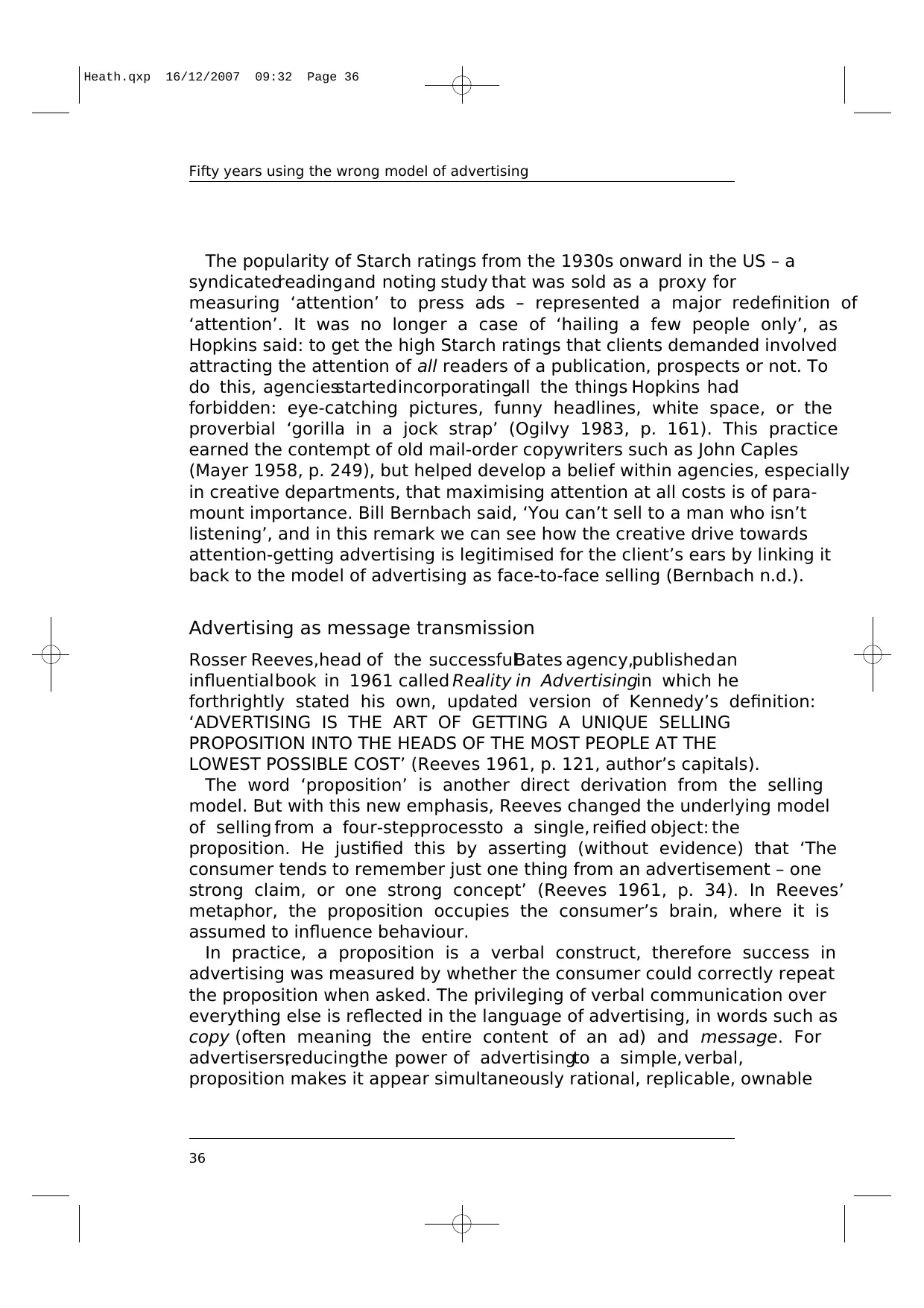
The popularity of Starch ratings from the 1930s onward in the US – a
syndicatedreading and noting study that was sold as a proxy for
measuring ‘attention’ to press ads – represented a major redefinition of
‘attention’. It was no longer a case of ‘hailing a few people only’, as
Hopkins said: to get the high Starch ratings that clients demanded involved
attracting the attention of all readers of a publication, prospects or not. To
do this, agenciesstarted incorporatingall the things Hopkins had
forbidden: eye-catching pictures, funny headlines, white space, or the
proverbial ‘gorilla in a jock strap’ (Ogilvy 1983, p. 161). This practice
earned the contempt of old mail-order copywriters such as John Caples
(Mayer 1958, p. 249), but helped develop a belief within agencies, especially
in creative departments, that maximising attention at all costs is of para-
mount importance. Bill Bernbach said, ‘You can’t sell to a man who isn’t
listening’, and in this remark we can see how the creative drive towards
attention-getting advertising is legitimised for the client’s ears by linking it
back to the model of advertising as face-to-face selling (Bernbach n.d.).
Advertising as message transmission
Rosser Reeves,head of the successfulBates agency,published an
influential book in 1961 called Reality in Advertisingin which he
forthrightly stated his own, updated version of Kennedy’s definition:
‘ADVERTISING IS THE ART OF GETTING A UNIQUE SELLING
PROPOSITION INTO THE HEADS OF THE MOST PEOPLE AT THE
LOWEST POSSIBLE COST’ (Reeves 1961, p. 121, author’s capitals).
The word ‘proposition’ is another direct derivation from the selling
model. But with this new emphasis, Reeves changed the underlying model
of selling from a four-stepprocessto a single, reified object: the
proposition. He justified this by asserting (without evidence) that ‘The
consumer tends to remember just one thing from an advertisement – one
strong claim, or one strong concept’ (Reeves 1961, p. 34). In Reeves’
metaphor, the proposition occupies the consumer’s brain, where it is
assumed to influence behaviour.
In practice, a proposition is a verbal construct, therefore success in
advertising was measured by whether the consumer could correctly repeat
the proposition when asked. The privileging of verbal communication over
everything else is reflected in the language of advertising, in words such as
copy (often meaning the entire content of an ad) and message. For
advertisers,reducingthe power of advertisingto a simple, verbal,
proposition makes it appear simultaneously rational, replicable, ownable
Fifty years using the wrong model of advertising
36
Heath.qxp 16/12/2007 09:32 Page 36
syndicatedreading and noting study that was sold as a proxy for
measuring ‘attention’ to press ads – represented a major redefinition of
‘attention’. It was no longer a case of ‘hailing a few people only’, as
Hopkins said: to get the high Starch ratings that clients demanded involved
attracting the attention of all readers of a publication, prospects or not. To
do this, agenciesstarted incorporatingall the things Hopkins had
forbidden: eye-catching pictures, funny headlines, white space, or the
proverbial ‘gorilla in a jock strap’ (Ogilvy 1983, p. 161). This practice
earned the contempt of old mail-order copywriters such as John Caples
(Mayer 1958, p. 249), but helped develop a belief within agencies, especially
in creative departments, that maximising attention at all costs is of para-
mount importance. Bill Bernbach said, ‘You can’t sell to a man who isn’t
listening’, and in this remark we can see how the creative drive towards
attention-getting advertising is legitimised for the client’s ears by linking it
back to the model of advertising as face-to-face selling (Bernbach n.d.).
Advertising as message transmission
Rosser Reeves,head of the successfulBates agency,published an
influential book in 1961 called Reality in Advertisingin which he
forthrightly stated his own, updated version of Kennedy’s definition:
‘ADVERTISING IS THE ART OF GETTING A UNIQUE SELLING
PROPOSITION INTO THE HEADS OF THE MOST PEOPLE AT THE
LOWEST POSSIBLE COST’ (Reeves 1961, p. 121, author’s capitals).
The word ‘proposition’ is another direct derivation from the selling
model. But with this new emphasis, Reeves changed the underlying model
of selling from a four-stepprocessto a single, reified object: the
proposition. He justified this by asserting (without evidence) that ‘The
consumer tends to remember just one thing from an advertisement – one
strong claim, or one strong concept’ (Reeves 1961, p. 34). In Reeves’
metaphor, the proposition occupies the consumer’s brain, where it is
assumed to influence behaviour.
In practice, a proposition is a verbal construct, therefore success in
advertising was measured by whether the consumer could correctly repeat
the proposition when asked. The privileging of verbal communication over
everything else is reflected in the language of advertising, in words such as
copy (often meaning the entire content of an ad) and message. For
advertisers,reducingthe power of advertisingto a simple, verbal,
proposition makes it appear simultaneously rational, replicable, ownable
Fifty years using the wrong model of advertising
36
Heath.qxp 16/12/2007 09:32 Page 36
and controllable. It therefore fits the culture of most organisations more
comfortably than the advertisement itself, which is a complex assemblage
of visuals, sounds, patterns, and non-verbal cues. Meanwhile, the idea of
the ‘single-minded’proposition is another, like attention, that has
embedded itself firmly in agency creative departments, which continually
demand briefs that are simple, sometimes even ideally a single word.
Reeves’ basic concept of communication is ‘message transmission’, and
success is measured by the accuracy with which what leaves the sender
arrives intact at the receiver.This was an important concept in
communications theory when Reeves was writing: in 1948 Claude Elwood
Shannon, a mathematician working for Bell Laboratories, defined the
problem of communication as ‘to reproduce at a given point in an exact or
approximate way a messageselected at another point’ (Mattelart &
Mattelart 1998, p. 44, emphasis added). Shannon’s work may have been
useful for telephone engineers, but it proved a blind alley in human
communication. A few years after Reality in Advertising, Paul Watzlawick
et al.’s Pragmatics of Human Communication would turn communications
theory on its head by recognising that human communication was a matter
of continual social exchange, involving a number of behavioural modes
besides words, and that as well as being about content, it was perhaps
more importantly about relationships (Watzlawick et al. 1967). These
ideas offer valuable alternatives to the message transmission model, but up
to the present time have been almost entirely ignored by advertising
practitioners and academics.
Support for the IP model from academia
The activities of practitioners are influenced by academia through the
market research industry and through what is taught in business schools.
It is unlikely that the IP model would dominate as strongly as it does
without the support of an academic discourse, which works within the
same fundamental paradigm – dominated by cognition, with emotion
relegated to a secondary role. Professor John Phillip Jones, for example,
speaks of ‘the rational idea enclosed as it were in an emotional envelope
… The commercials should be likable – but the selling message must be
unmistakable’ (2002, p. 36, emphasis added).
It isn’t that other ideas have not been proposed. A substantial body of
work in the 1950s (e.g. Gardner & Levy 1955; Martineau 1957; Dichter
1964) argued for the importance of emotions, symbolic and non-verbal
communication under the banner of the ‘motivation’ or ‘depth’ school of
International Journal of Market Research Vol. 50 Issue 1
37
Heath.qxp 16/12/2007 09:32 Page 37
comfortably than the advertisement itself, which is a complex assemblage
of visuals, sounds, patterns, and non-verbal cues. Meanwhile, the idea of
the ‘single-minded’proposition is another, like attention, that has
embedded itself firmly in agency creative departments, which continually
demand briefs that are simple, sometimes even ideally a single word.
Reeves’ basic concept of communication is ‘message transmission’, and
success is measured by the accuracy with which what leaves the sender
arrives intact at the receiver.This was an important concept in
communications theory when Reeves was writing: in 1948 Claude Elwood
Shannon, a mathematician working for Bell Laboratories, defined the
problem of communication as ‘to reproduce at a given point in an exact or
approximate way a messageselected at another point’ (Mattelart &
Mattelart 1998, p. 44, emphasis added). Shannon’s work may have been
useful for telephone engineers, but it proved a blind alley in human
communication. A few years after Reality in Advertising, Paul Watzlawick
et al.’s Pragmatics of Human Communication would turn communications
theory on its head by recognising that human communication was a matter
of continual social exchange, involving a number of behavioural modes
besides words, and that as well as being about content, it was perhaps
more importantly about relationships (Watzlawick et al. 1967). These
ideas offer valuable alternatives to the message transmission model, but up
to the present time have been almost entirely ignored by advertising
practitioners and academics.
Support for the IP model from academia
The activities of practitioners are influenced by academia through the
market research industry and through what is taught in business schools.
It is unlikely that the IP model would dominate as strongly as it does
without the support of an academic discourse, which works within the
same fundamental paradigm – dominated by cognition, with emotion
relegated to a secondary role. Professor John Phillip Jones, for example,
speaks of ‘the rational idea enclosed as it were in an emotional envelope
… The commercials should be likable – but the selling message must be
unmistakable’ (2002, p. 36, emphasis added).
It isn’t that other ideas have not been proposed. A substantial body of
work in the 1950s (e.g. Gardner & Levy 1955; Martineau 1957; Dichter
1964) argued for the importance of emotions, symbolic and non-verbal
communication under the banner of the ‘motivation’ or ‘depth’ school of
International Journal of Market Research Vol. 50 Issue 1
37
Heath.qxp 16/12/2007 09:32 Page 37
⊘ This is a preview!⊘
Do you want full access?
Subscribe today to unlock all pages.
Trusted by 1+ million students worldwide
advertising research. But the most influential model forthcoming was that
of Lavidge and Steiner (1961), who devised a three-stage sequential model
based upon contemporarypsychologicalthinking. Their hierarchy,
Cognitive→ Affective→ Conative, left no doubt that the ‘realm of
cognition’ was the key to successful advertising, and emotion was a
consequence of cognition whose influence was strictly limited to the
decision-making areas of liking and preference.
Emotion was not seriously addressedagain until Holbrook and
Hirschmann (1982) produced their hedonic experiential model, but even
they demurred to the dominance of the IP model, saying ‘Abandoning the
information processing approach is undesirable, but supplementing and
enriching it with … the experiential perspective could be extremely
fruitful’ (1982, p. 138).
Meanwhile, cognition thrived, as witnessed by the popularity of Brock
and Shavitt’s cognitive response model (1983). The CRM held that, for
advertising messages to be effective, they needed not just to be received,
but to be reinterpreted into the individual’s own thoughts and rehearsed
before being stored (i.e. analysed). This rehearsal of one’s own thoughts
was seen as ‘a more important determinant of persistence of persuasion
than … rehearsal of message arguments’ (1983, p. 91). These ideas led
directly to advertising academia’s ‘most influential theoretical
contribution’ (Beard 2002, p. 72), namely Petty and Cacioppo’s
elaboration likelihood model. In the ELM there are two routes for
persuasion – central and peripheral – which differ according to ‘the extent
to which the attitude change that results … is due to active thinking’ (Petty
& Cacioppo 1996, p. 256). The central processing route is:
controlled, deep, systematic, and effortful … When conditions foster people’s
motivation and ability to engage in issue-relevant thinking, the ‘elaboration
likelihood’ is said to be high. This means that people are likely to attend to the
appeal; attempt to access relevant associations, images, and experiences from
memory … (Petty & Cacioppo 1986, p. 128)
In other words, central processing is attentive, and it is evident from the
word ‘systematic’ that this is what psychologists term goal-driven, or top-
down, processing. Peripheral processing, on the other hand, is ‘automatic,
shallow, heuristic, and mindless’ and ‘based on affective associations or
simple inferences tied to peripheral cues’ (1986, p. 191). And although the
ELM does not use emotion as a primary construct, the statement ‘based on
affective associations’ (1986, p. 191) shows that emotion is at work within
peripheral processing. But Petty and Cacioppo make it clear that they see
Fifty years using the wrong model of advertising
38
Heath.qxp 16/12/2007 09:32 Page 38
of Lavidge and Steiner (1961), who devised a three-stage sequential model
based upon contemporarypsychologicalthinking. Their hierarchy,
Cognitive→ Affective→ Conative, left no doubt that the ‘realm of
cognition’ was the key to successful advertising, and emotion was a
consequence of cognition whose influence was strictly limited to the
decision-making areas of liking and preference.
Emotion was not seriously addressedagain until Holbrook and
Hirschmann (1982) produced their hedonic experiential model, but even
they demurred to the dominance of the IP model, saying ‘Abandoning the
information processing approach is undesirable, but supplementing and
enriching it with … the experiential perspective could be extremely
fruitful’ (1982, p. 138).
Meanwhile, cognition thrived, as witnessed by the popularity of Brock
and Shavitt’s cognitive response model (1983). The CRM held that, for
advertising messages to be effective, they needed not just to be received,
but to be reinterpreted into the individual’s own thoughts and rehearsed
before being stored (i.e. analysed). This rehearsal of one’s own thoughts
was seen as ‘a more important determinant of persistence of persuasion
than … rehearsal of message arguments’ (1983, p. 91). These ideas led
directly to advertising academia’s ‘most influential theoretical
contribution’ (Beard 2002, p. 72), namely Petty and Cacioppo’s
elaboration likelihood model. In the ELM there are two routes for
persuasion – central and peripheral – which differ according to ‘the extent
to which the attitude change that results … is due to active thinking’ (Petty
& Cacioppo 1996, p. 256). The central processing route is:
controlled, deep, systematic, and effortful … When conditions foster people’s
motivation and ability to engage in issue-relevant thinking, the ‘elaboration
likelihood’ is said to be high. This means that people are likely to attend to the
appeal; attempt to access relevant associations, images, and experiences from
memory … (Petty & Cacioppo 1986, p. 128)
In other words, central processing is attentive, and it is evident from the
word ‘systematic’ that this is what psychologists term goal-driven, or top-
down, processing. Peripheral processing, on the other hand, is ‘automatic,
shallow, heuristic, and mindless’ and ‘based on affective associations or
simple inferences tied to peripheral cues’ (1986, p. 191). And although the
ELM does not use emotion as a primary construct, the statement ‘based on
affective associations’ (1986, p. 191) shows that emotion is at work within
peripheral processing. But Petty and Cacioppo make it clear that they see
Fifty years using the wrong model of advertising
38
Heath.qxp 16/12/2007 09:32 Page 38
Paraphrase This Document
Need a fresh take? Get an instant paraphrase of this document with our AI Paraphraser
peripheral processing as a weak advertising route, effective only if tied in
to high levels of repetition. The high-involvement ‘active thinking’ central
route is favoured, because ‘Attitude changes via the Central Route appear
to be more persistent, resistant, and predictive of behaviour than changes
induced via the peripheral route’ (1986, p. 191).
Challenges to the IP model
There has been no shortage of challenges to the IP model. Critics 40 years
ago were pointing to the lack of evidence for recall (Haskins 1964),
creative practitioners such as Bill Bernbach made the case that advertising
should be considered as ‘warm, human persuasion’ (Bernbach n.d.), and
research conferences such as those of the MRS and ESOMAR have seen
numerous award-winning papers challenging aspects of the IP model (e.g.
Lannon & Cooper 1983; Heath 1999; Tasgal 2003; Gordon 2005).
Despite these assaults nothing much has really changed. One challenge of
particular note was made in the 1960s by leading members of the UK
account planning movement,who articulateda coherentmodel of
advertising that challenged the conventional model on several key points:
the dominance of the verbal proposition, the idea that advertising was
solely about sales or conversion, the privileging of rational content-based
communication models over the symbolic or emotional mediating of
relationships. These were repeatedly argued against by King (1967, 1977),
Joyce (1967), Pollitt (in Feldwick 2000), Hedges (1974/1998) and others.
And yet at a fundamental level the belief systems embodied in client
organisationsand researchprotocols never shifted away from the
conventional IP model, as witnessed by the APG How to Plan Advertising
document referred to earlier.
Academic challenges to the IP paradigm have likewise failed to make an
impression on the world of advertising practice. Herb Krugman, as early
as 1965, pointed out that much of the content of TV advertising was
‘trivial and sometimes silly’ and did not fit the traditional persuasion
models prevalent at the time.
Does this suggest that if television bombards us with enough trivia about a
product we may be persuaded to believe it? On the contrary, it suggests that
persuasion as such … is not involved at all and it is a mistake to look for it … as
a test of advertising’s impact … (1965, p. 353)
Working with Norman Mackworth in 1968, Krugman noted the
‘relativelymotionless,focused,or passiveeye characteristicsof TV
International Journal of Market Research Vol. 50 Issue 1
39
Heath.qxp 16/12/2007 09:32 Page 39
to high levels of repetition. The high-involvement ‘active thinking’ central
route is favoured, because ‘Attitude changes via the Central Route appear
to be more persistent, resistant, and predictive of behaviour than changes
induced via the peripheral route’ (1986, p. 191).
Challenges to the IP model
There has been no shortage of challenges to the IP model. Critics 40 years
ago were pointing to the lack of evidence for recall (Haskins 1964),
creative practitioners such as Bill Bernbach made the case that advertising
should be considered as ‘warm, human persuasion’ (Bernbach n.d.), and
research conferences such as those of the MRS and ESOMAR have seen
numerous award-winning papers challenging aspects of the IP model (e.g.
Lannon & Cooper 1983; Heath 1999; Tasgal 2003; Gordon 2005).
Despite these assaults nothing much has really changed. One challenge of
particular note was made in the 1960s by leading members of the UK
account planning movement,who articulateda coherentmodel of
advertising that challenged the conventional model on several key points:
the dominance of the verbal proposition, the idea that advertising was
solely about sales or conversion, the privileging of rational content-based
communication models over the symbolic or emotional mediating of
relationships. These were repeatedly argued against by King (1967, 1977),
Joyce (1967), Pollitt (in Feldwick 2000), Hedges (1974/1998) and others.
And yet at a fundamental level the belief systems embodied in client
organisationsand researchprotocols never shifted away from the
conventional IP model, as witnessed by the APG How to Plan Advertising
document referred to earlier.
Academic challenges to the IP paradigm have likewise failed to make an
impression on the world of advertising practice. Herb Krugman, as early
as 1965, pointed out that much of the content of TV advertising was
‘trivial and sometimes silly’ and did not fit the traditional persuasion
models prevalent at the time.
Does this suggest that if television bombards us with enough trivia about a
product we may be persuaded to believe it? On the contrary, it suggests that
persuasion as such … is not involved at all and it is a mistake to look for it … as
a test of advertising’s impact … (1965, p. 353)
Working with Norman Mackworth in 1968, Krugman noted the
‘relativelymotionless,focused,or passiveeye characteristicsof TV
International Journal of Market Research Vol. 50 Issue 1
39
Heath.qxp 16/12/2007 09:32 Page 39
viewing’(1977, p. 8), and went on to test the brainwaves of a subject
watching TV and reading press advertisements (1971). But his conclusion
that television is a medium of ‘low involvement’ compared to print
encouraged advertisers to expend even more energy on getting viewers to
pay attention.
A second attack by Andrew Ehrenberg proposed that advertising ‘is not
as powerful as is sometimes thought, nor is there any evidence that it
actually works by any strong form of persuasion or manipulation’ (1974,
p. 25). His ‘reinforcement’ model advanced a theory that ‘Advertising’s
main role is to reinforce feelings of satisfaction with brands already being
used’ (1974, p. 33). Ehrenberg saw reinforcement advertising working by
taking ‘an emotional instead of an informative tone’ (1974, p. 27), but his
most controversialassertion was that attitude change was not a
mandatory precursor to purchase; in this respect he was constructing a
model similar to peripheral processing in Petty and Cacioppo’s ELM. The
difference of course was that Ehrenberg saw this type of advertising as
being highly effective, and Petty and Cacioppo regard it as being relatively
ineffective.
In later work Ehrenberg focused more on the role that advertising has in
creating ‘creative publicity’ (Ehrenberg et al. 2002), expressing the view
that ‘advertisements can be effective … simply through publicising the
brand memorably, without having to “persuade” consumers that the
brand is better than they thought before’ (2002, p. 11). But it is significant
that, nearly 30 years after his reinforcement model was first published, he
still in his opening paragraph feels the need to challenge the persuasive IP
model: ‘Many people seem to believe that advertising has a primarily
persuasive function’ (2002, p. 7).
Others have attempted to contest the IP model. Ambler puts the blame
for the dominance of cognitive persuasion on the measurement process:
‘When you get marketing and advertising research showing that logical
persuasion (cognition) is important, probably the reason is that they did
not measure anything else’ (1998, p. 501). Later he proposed a memory
affect cognition (MAC) model based on findings by Damasio, in which he
suggests that cognition can operate as an influence only if affect is in
agreement (Ambler 2000).
Heath (2001) published a formal ‘low involvement processing’ model
(later known as low attention processing model), which set out a number
of psychological principles that underpin the operation of advertising at
low levels of attention. His model is based on three basic ideas:
Fifty years using the wrong model of advertising
40
Heath.qxp 16/12/2007 09:32 Page 40
watching TV and reading press advertisements (1971). But his conclusion
that television is a medium of ‘low involvement’ compared to print
encouraged advertisers to expend even more energy on getting viewers to
pay attention.
A second attack by Andrew Ehrenberg proposed that advertising ‘is not
as powerful as is sometimes thought, nor is there any evidence that it
actually works by any strong form of persuasion or manipulation’ (1974,
p. 25). His ‘reinforcement’ model advanced a theory that ‘Advertising’s
main role is to reinforce feelings of satisfaction with brands already being
used’ (1974, p. 33). Ehrenberg saw reinforcement advertising working by
taking ‘an emotional instead of an informative tone’ (1974, p. 27), but his
most controversialassertion was that attitude change was not a
mandatory precursor to purchase; in this respect he was constructing a
model similar to peripheral processing in Petty and Cacioppo’s ELM. The
difference of course was that Ehrenberg saw this type of advertising as
being highly effective, and Petty and Cacioppo regard it as being relatively
ineffective.
In later work Ehrenberg focused more on the role that advertising has in
creating ‘creative publicity’ (Ehrenberg et al. 2002), expressing the view
that ‘advertisements can be effective … simply through publicising the
brand memorably, without having to “persuade” consumers that the
brand is better than they thought before’ (2002, p. 11). But it is significant
that, nearly 30 years after his reinforcement model was first published, he
still in his opening paragraph feels the need to challenge the persuasive IP
model: ‘Many people seem to believe that advertising has a primarily
persuasive function’ (2002, p. 7).
Others have attempted to contest the IP model. Ambler puts the blame
for the dominance of cognitive persuasion on the measurement process:
‘When you get marketing and advertising research showing that logical
persuasion (cognition) is important, probably the reason is that they did
not measure anything else’ (1998, p. 501). Later he proposed a memory
affect cognition (MAC) model based on findings by Damasio, in which he
suggests that cognition can operate as an influence only if affect is in
agreement (Ambler 2000).
Heath (2001) published a formal ‘low involvement processing’ model
(later known as low attention processing model), which set out a number
of psychological principles that underpin the operation of advertising at
low levels of attention. His model is based on three basic ideas:
Fifty years using the wrong model of advertising
40
Heath.qxp 16/12/2007 09:32 Page 40
⊘ This is a preview!⊘
Do you want full access?
Subscribe today to unlock all pages.
Trusted by 1+ million students worldwide

1 out of 31


Your All-in-One AI-Powered Toolkit for Academic Success.
+13062052269
info@desklib.com
Available 24*7 on WhatsApp / Email
![[object Object]](/_next/static/media/star-bottom.7253800d.svg)
Unlock your academic potential
Copyright © 2020–2026 A2Z Services. All Rights Reserved. Developed and managed by ZUCOL.