Information System Analysis
VerifiedAdded on 2020/03/16
|5
|1109
|156
Essay
AI Summary
The essay discusses the evolving role of Information Technology in modern businesses, emphasizing the importance of managing risks and costs associated with IT investments. It outlines new guidelines for companies to follow, such as spending less, adopting a follower strategy, and focusing on risks rather than opportunities. The essay also highlights the operational risks linked to Information Technology, including technical glitches and security breaches, and stresses the need for strategic planning in IT investments.
Running head: INFORMATION SYSTEM
Information System
Name of Student-
Name of University-
Author Note-
Information System
Name of Student-
Name of University-
Author Note-
Paraphrase This Document
Need a fresh take? Get an instant paraphrase of this document with our AI Paraphraser

1INFORMATION SYSTEM
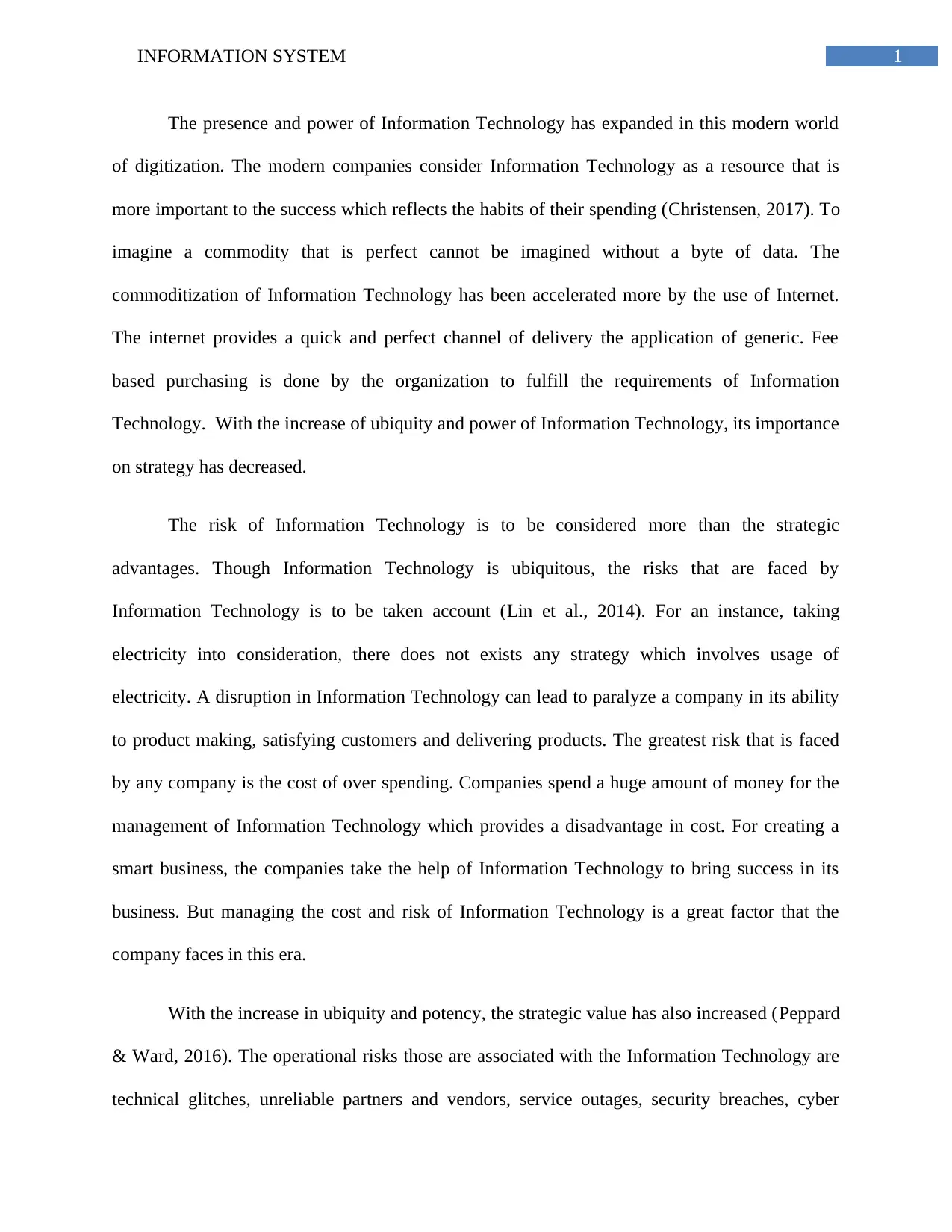
The presence and power of Information Technology has expanded in this modern world
of digitization. The modern companies consider Information Technology as a resource that is
more important to the success which reflects the habits of their spending (Christensen, 2017). To
imagine a commodity that is perfect cannot be imagined without a byte of data. The
commoditization of Information Technology has been accelerated more by the use of Internet.
The internet provides a quick and perfect channel of delivery the application of generic. Fee
based purchasing is done by the organization to fulfill the requirements of Information
Technology. With the increase of ubiquity and power of Information Technology, its importance
on strategy has decreased.
The risk of Information Technology is to be considered more than the strategic
advantages. Though Information Technology is ubiquitous, the risks that are faced by
Information Technology is to be taken account (Lin et al., 2014). For an instance, taking
electricity into consideration, there does not exists any strategy which involves usage of
electricity. A disruption in Information Technology can lead to paralyze a company in its ability
to product making, satisfying customers and delivering products. The greatest risk that is faced
by any company is the cost of over spending. Companies spend a huge amount of money for the
management of Information Technology which provides a disadvantage in cost. For creating a
smart business, the companies take the help of Information Technology to bring success in its
business. But managing the cost and risk of Information Technology is a great factor that the
company faces in this era.
With the increase in ubiquity and potency, the strategic value has also increased (Peppard
& Ward, 2016). The operational risks those are associated with the Information Technology are
technical glitches, unreliable partners and vendors, service outages, security breaches, cyber
The presence and power of Information Technology has expanded in this modern world
of digitization. The modern companies consider Information Technology as a resource that is
more important to the success which reflects the habits of their spending (Christensen, 2017). To
imagine a commodity that is perfect cannot be imagined without a byte of data. The
commoditization of Information Technology has been accelerated more by the use of Internet.
The internet provides a quick and perfect channel of delivery the application of generic. Fee
based purchasing is done by the organization to fulfill the requirements of Information
Technology. With the increase of ubiquity and power of Information Technology, its importance
on strategy has decreased.
The risk of Information Technology is to be considered more than the strategic
advantages. Though Information Technology is ubiquitous, the risks that are faced by
Information Technology is to be taken account (Lin et al., 2014). For an instance, taking
electricity into consideration, there does not exists any strategy which involves usage of
electricity. A disruption in Information Technology can lead to paralyze a company in its ability
to product making, satisfying customers and delivering products. The greatest risk that is faced
by any company is the cost of over spending. Companies spend a huge amount of money for the
management of Information Technology which provides a disadvantage in cost. For creating a
smart business, the companies take the help of Information Technology to bring success in its
business. But managing the cost and risk of Information Technology is a great factor that the
company faces in this era.
With the increase in ubiquity and potency, the strategic value has also increased (Peppard
& Ward, 2016). The operational risks those are associated with the Information Technology are
technical glitches, unreliable partners and vendors, service outages, security breaches, cyber

2INFORMATION SYSTEM
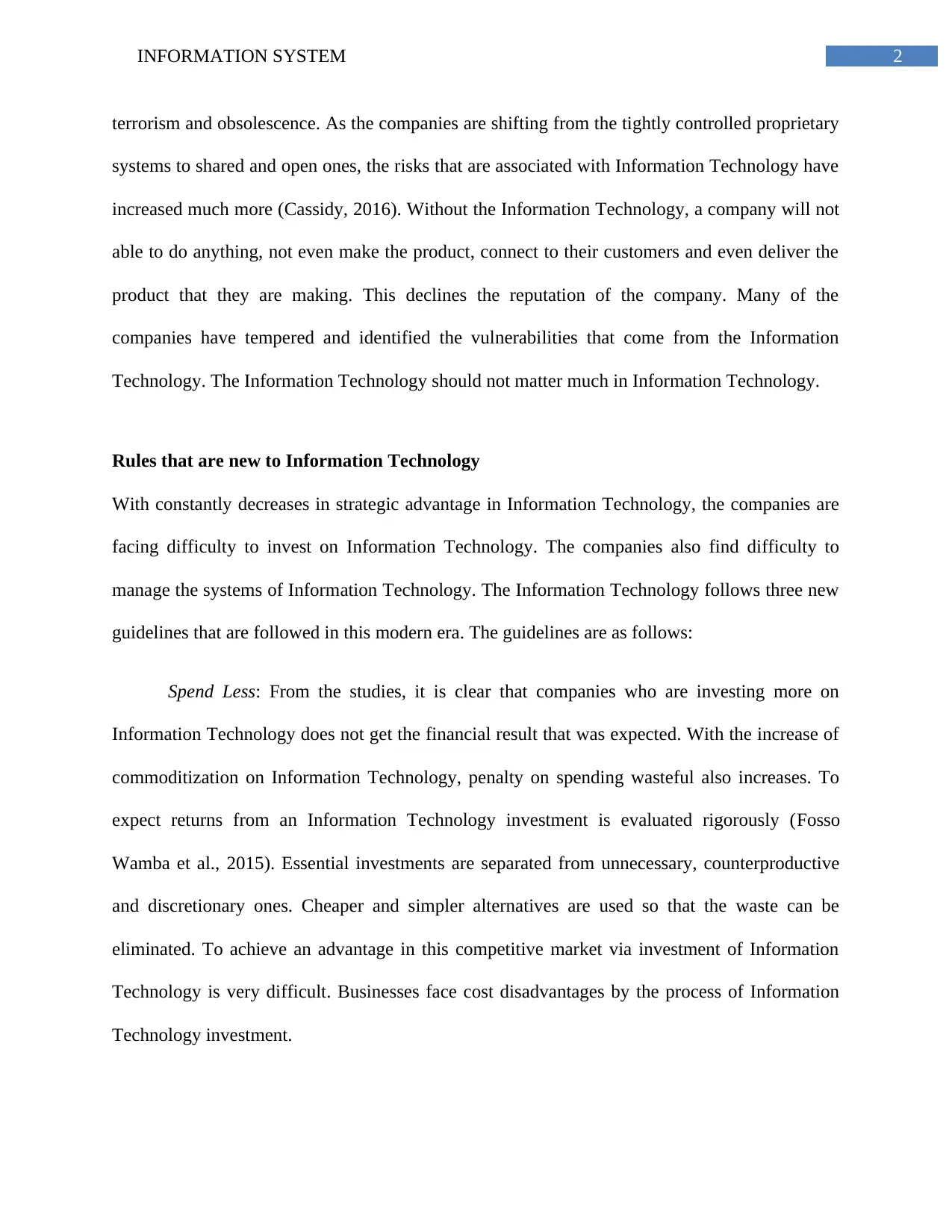
terrorism and obsolescence. As the companies are shifting from the tightly controlled proprietary
systems to shared and open ones, the risks that are associated with Information Technology have
increased much more (Cassidy, 2016). Without the Information Technology, a company will not
able to do anything, not even make the product, connect to their customers and even deliver the
product that they are making. This declines the reputation of the company. Many of the
companies have tempered and identified the vulnerabilities that come from the Information
Technology. The Information Technology should not matter much in Information Technology.
Rules that are new to Information Technology
With constantly decreases in strategic advantage in Information Technology, the companies are
facing difficulty to invest on Information Technology. The companies also find difficulty to
manage the systems of Information Technology. The Information Technology follows three new
guidelines that are followed in this modern era. The guidelines are as follows:
Spend Less: From the studies, it is clear that companies who are investing more on
Information Technology does not get the financial result that was expected. With the increase of
commoditization on Information Technology, penalty on spending wasteful also increases. To
expect returns from an Information Technology investment is evaluated rigorously (Fosso
Wamba et al., 2015). Essential investments are separated from unnecessary, counterproductive
and discretionary ones. Cheaper and simpler alternatives are used so that the waste can be
eliminated. To achieve an advantage in this competitive market via investment of Information
Technology is very difficult. Businesses face cost disadvantages by the process of Information
Technology investment.
terrorism and obsolescence. As the companies are shifting from the tightly controlled proprietary
systems to shared and open ones, the risks that are associated with Information Technology have
increased much more (Cassidy, 2016). Without the Information Technology, a company will not
able to do anything, not even make the product, connect to their customers and even deliver the
product that they are making. This declines the reputation of the company. Many of the
companies have tempered and identified the vulnerabilities that come from the Information
Technology. The Information Technology should not matter much in Information Technology.
Rules that are new to Information Technology
With constantly decreases in strategic advantage in Information Technology, the companies are
facing difficulty to invest on Information Technology. The companies also find difficulty to
manage the systems of Information Technology. The Information Technology follows three new
guidelines that are followed in this modern era. The guidelines are as follows:
Spend Less: From the studies, it is clear that companies who are investing more on
Information Technology does not get the financial result that was expected. With the increase of
commoditization on Information Technology, penalty on spending wasteful also increases. To
expect returns from an Information Technology investment is evaluated rigorously (Fosso
Wamba et al., 2015). Essential investments are separated from unnecessary, counterproductive
and discretionary ones. Cheaper and simpler alternatives are used so that the waste can be
eliminated. To achieve an advantage in this competitive market via investment of Information
Technology is very difficult. Businesses face cost disadvantages by the process of Information
Technology investment.
⊘ This is a preview!⊘
Do you want full access?
Subscribe today to unlock all pages.

Trusted by 1+ million students worldwide

3INFORMATION SYSTEM
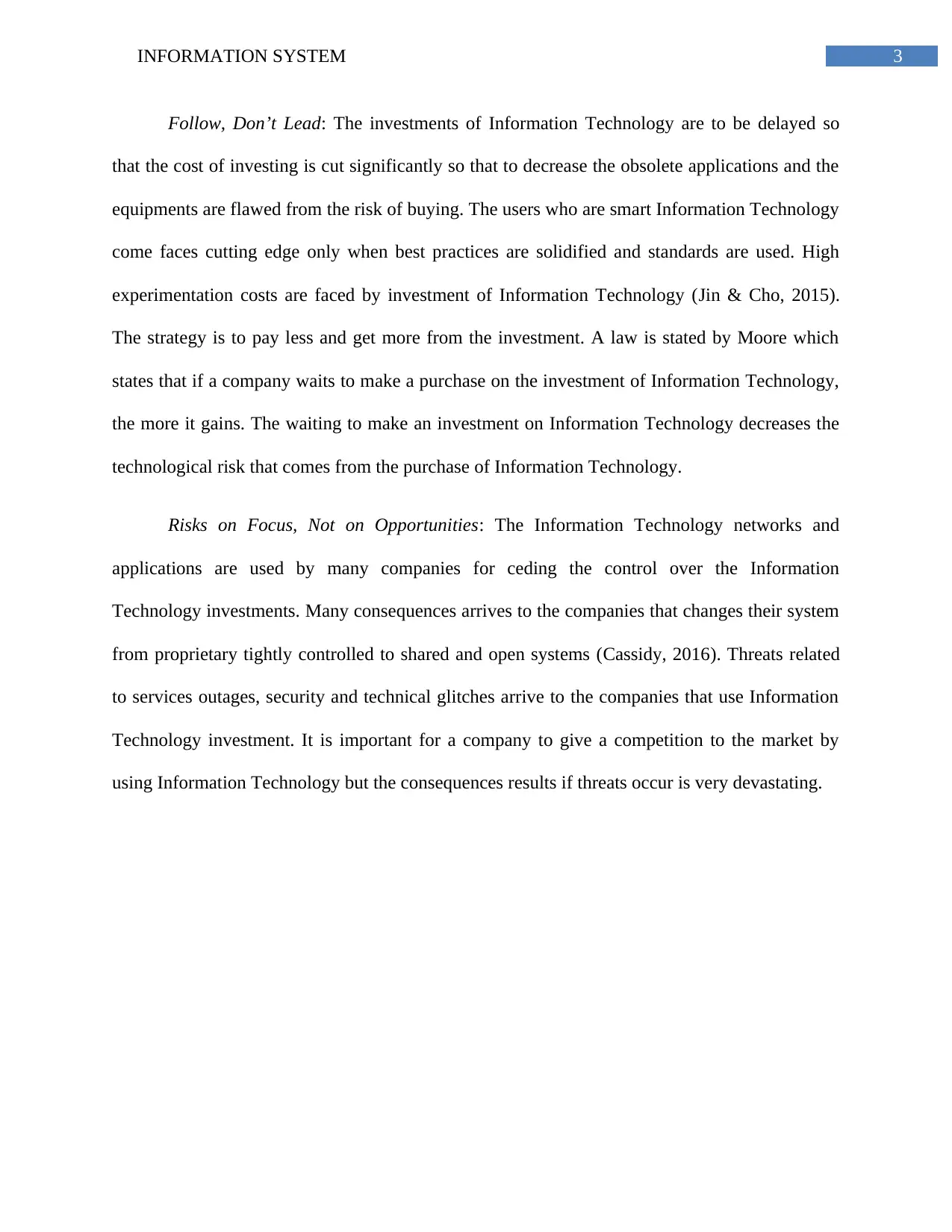
Follow, Don’t Lead: The investments of Information Technology are to be delayed so
that the cost of investing is cut significantly so that to decrease the obsolete applications and the
equipments are flawed from the risk of buying. The users who are smart Information Technology
come faces cutting edge only when best practices are solidified and standards are used. High
experimentation costs are faced by investment of Information Technology (Jin & Cho, 2015).
The strategy is to pay less and get more from the investment. A law is stated by Moore which
states that if a company waits to make a purchase on the investment of Information Technology,
the more it gains. The waiting to make an investment on Information Technology decreases the
technological risk that comes from the purchase of Information Technology.
Risks on Focus, Not on Opportunities: The Information Technology networks and
applications are used by many companies for ceding the control over the Information
Technology investments. Many consequences arrives to the companies that changes their system
from proprietary tightly controlled to shared and open systems (Cassidy, 2016). Threats related
to services outages, security and technical glitches arrive to the companies that use Information
Technology investment. It is important for a company to give a competition to the market by
using Information Technology but the consequences results if threats occur is very devastating.
Follow, Don’t Lead: The investments of Information Technology are to be delayed so
that the cost of investing is cut significantly so that to decrease the obsolete applications and the
equipments are flawed from the risk of buying. The users who are smart Information Technology
come faces cutting edge only when best practices are solidified and standards are used. High
experimentation costs are faced by investment of Information Technology (Jin & Cho, 2015).
The strategy is to pay less and get more from the investment. A law is stated by Moore which
states that if a company waits to make a purchase on the investment of Information Technology,
the more it gains. The waiting to make an investment on Information Technology decreases the
technological risk that comes from the purchase of Information Technology.
Risks on Focus, Not on Opportunities: The Information Technology networks and
applications are used by many companies for ceding the control over the Information
Technology investments. Many consequences arrives to the companies that changes their system
from proprietary tightly controlled to shared and open systems (Cassidy, 2016). Threats related
to services outages, security and technical glitches arrive to the companies that use Information
Technology investment. It is important for a company to give a competition to the market by
using Information Technology but the consequences results if threats occur is very devastating.
Paraphrase This Document
Need a fresh take? Get an instant paraphrase of this document with our AI Paraphraser

4INFORMATION SYSTEM
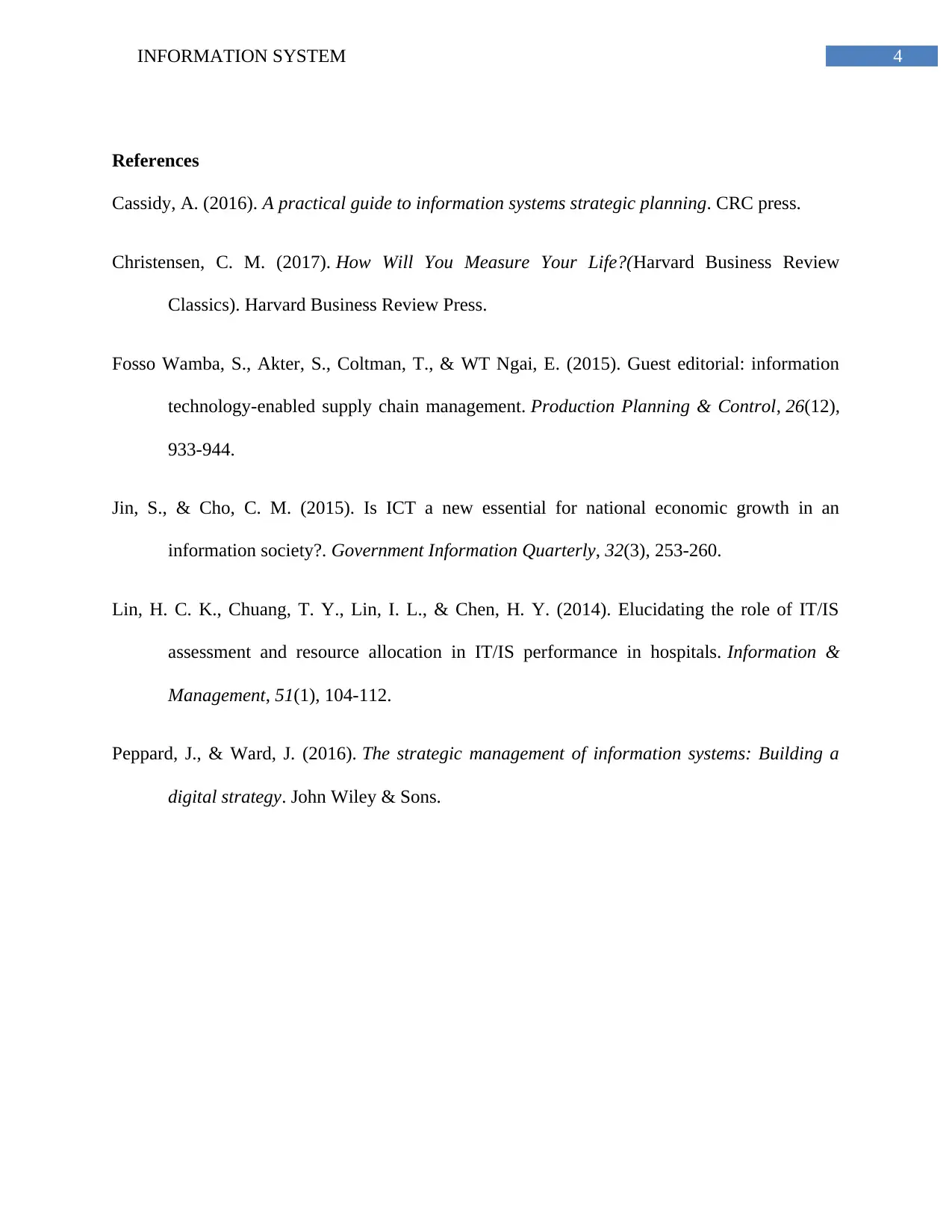
References
Cassidy, A. (2016). A practical guide to information systems strategic planning. CRC press.
Christensen, C. M. (2017). How Will You Measure Your Life?(Harvard Business Review
Classics). Harvard Business Review Press.
Fosso Wamba, S., Akter, S., Coltman, T., & WT Ngai, E. (2015). Guest editorial: information
technology-enabled supply chain management. Production Planning & Control, 26(12),
933-944.
Jin, S., & Cho, C. M. (2015). Is ICT a new essential for national economic growth in an
information society?. Government Information Quarterly, 32(3), 253-260.
Lin, H. C. K., Chuang, T. Y., Lin, I. L., & Chen, H. Y. (2014). Elucidating the role of IT/IS
assessment and resource allocation in IT/IS performance in hospitals. Information &
Management, 51(1), 104-112.
Peppard, J., & Ward, J. (2016). The strategic management of information systems: Building a
digital strategy. John Wiley & Sons.
References
Cassidy, A. (2016). A practical guide to information systems strategic planning. CRC press.
Christensen, C. M. (2017). How Will You Measure Your Life?(Harvard Business Review
Classics). Harvard Business Review Press.
Fosso Wamba, S., Akter, S., Coltman, T., & WT Ngai, E. (2015). Guest editorial: information
technology-enabled supply chain management. Production Planning & Control, 26(12),
933-944.
Jin, S., & Cho, C. M. (2015). Is ICT a new essential for national economic growth in an
information society?. Government Information Quarterly, 32(3), 253-260.
Lin, H. C. K., Chuang, T. Y., Lin, I. L., & Chen, H. Y. (2014). Elucidating the role of IT/IS
assessment and resource allocation in IT/IS performance in hospitals. Information &
Management, 51(1), 104-112.
Peppard, J., & Ward, J. (2016). The strategic management of information systems: Building a
digital strategy. John Wiley & Sons.
1 out of 5
Related Documents
Your All-in-One AI-Powered Toolkit for Academic Success.
+13062052269
info@desklib.com
Available 24*7 on WhatsApp / Email
Unlock your academic potential
Copyright © 2020–2026 A2Z Services. All Rights Reserved. Developed and managed by ZUCOL.