Analyzing Information Systems in Organizations: Accenture's Functions
VerifiedAdded on 2024/06/27
|21
|5668
|163
Report
AI Summary
This report evaluates the information needs within different functional areas of organizations, using Accenture as a case study. It describes various types of information systems, including Transaction Processing Systems (TPS), Management Information Systems (MIS), Decision Support Systems (DSS), Executive Information Systems (ESS), and Data Warehousing Systems, explaining their purpose, functions, and examples. The report further investigates current trends in using information systems applications to solve business problems, and evaluates the suitability of different information systems for various functional areas within Accenture. It also discusses how to use information systems to generate valid, accurate, and useful information for problem-solving, and evaluates alternative methods for addressing these problems, culminating in a conclusion summarizing the key findings and recommendations.
Information Systems in
Organization
1
Organization
1

Paraphrase This Document
Need a fresh take? Get an instant paraphrase of this document with our AI Paraphraser
Table of Contents
List of figures.........................................................................................................................................3
Introduction...........................................................................................................................................4
LO1: Understand information needs within different functional areas of organizations......................5
P1.1 Evaluate the information needs of the different functional areas of an organization...............5
LO2 be able to compare Information Systems......................................................................................7
P2.1 Describe different types of Information Systems......................................................................7
P2.2 Investigate the current trends in using Information Systems applications to solve business
problems.........................................................................................................................................12
P2.3 Evaluate the suitability of Information Systems for different functional areas of an
organization?...................................................................................................................................14
LO3 be able to use Information Systems to produce management information.................................16
P 3.1 Use an information system to generate valid, accurate and useful information for a given
problem...........................................................................................................................................16
P3.2 Evaluate alternative methods of solving the problem.............................................................17
Evaluate alternative methods of solving the problem.....................................................................17
Conclusion...........................................................................................................................................20
Reference............................................................................................................................................21
2
List of figures.........................................................................................................................................3
Introduction...........................................................................................................................................4
LO1: Understand information needs within different functional areas of organizations......................5
P1.1 Evaluate the information needs of the different functional areas of an organization...............5
LO2 be able to compare Information Systems......................................................................................7
P2.1 Describe different types of Information Systems......................................................................7
P2.2 Investigate the current trends in using Information Systems applications to solve business
problems.........................................................................................................................................12
P2.3 Evaluate the suitability of Information Systems for different functional areas of an
organization?...................................................................................................................................14
LO3 be able to use Information Systems to produce management information.................................16
P 3.1 Use an information system to generate valid, accurate and useful information for a given
problem...........................................................................................................................................16
P3.2 Evaluate alternative methods of solving the problem.............................................................17
Evaluate alternative methods of solving the problem.....................................................................17
Conclusion...........................................................................................................................................20
Reference............................................................................................................................................21
2
List of figures
Figure 1: Types of Information system..................................................................................................7
Figure 2: TPS Diagram............................................................................................................................8
Figure 3: MIS Diagram...........................................................................................................................9
Figure 4: DSS Diagram.........................................................................................................................10
Figure 5: ESS Diagrams........................................................................................................................11
Figure 6: Data Warehousing System Diagram.....................................................................................11
Figure 7: MIS System components......................................................................................................18
Figure 8: Decision support system stages............................................................................................19
3
Figure 1: Types of Information system..................................................................................................7
Figure 2: TPS Diagram............................................................................................................................8
Figure 3: MIS Diagram...........................................................................................................................9
Figure 4: DSS Diagram.........................................................................................................................10
Figure 5: ESS Diagrams........................................................................................................................11
Figure 6: Data Warehousing System Diagram.....................................................................................11
Figure 7: MIS System components......................................................................................................18
Figure 8: Decision support system stages............................................................................................19
3
⊘ This is a preview!⊘
Do you want full access?
Subscribe today to unlock all pages.

Trusted by 1+ million students worldwide
Introduction
Accenture is a worldwide organization accessing and proficient facilities secure that provides
operations services, digital technology, consulting & strategy. To increase the quality and service of
its products, Accenture needs the use of an Information System. Different functional area of
Information System such as operational, Research and Development, financial and marketing are
described in this report. How these functional areas help the company in promoting their services,
managing their funds and develop new products is explained in this report. This project also explains
the various types of the information system, their purpose, functions, and examples that can be
used in our company. While Accenture is a worldwide organization accessing and proficient facilities,
it also suffers some problems. How to reduce or minimize these problems using these information
systems are also discussed here. This project also explains the uses of functional areas of different
information systems.
4
Accenture is a worldwide organization accessing and proficient facilities secure that provides
operations services, digital technology, consulting & strategy. To increase the quality and service of
its products, Accenture needs the use of an Information System. Different functional area of
Information System such as operational, Research and Development, financial and marketing are
described in this report. How these functional areas help the company in promoting their services,
managing their funds and develop new products is explained in this report. This project also explains
the various types of the information system, their purpose, functions, and examples that can be
used in our company. While Accenture is a worldwide organization accessing and proficient facilities,
it also suffers some problems. How to reduce or minimize these problems using these information
systems are also discussed here. This project also explains the uses of functional areas of different
information systems.
4
Paraphrase This Document
Need a fresh take? Get an instant paraphrase of this document with our AI Paraphraser
LO1: Understand information needs within different
functional areas of organizations
P1.1 Evaluate the information needs of the different functional areas
of an organization
Accenture is a worldwide organization accessing and proficient facilities secure that provides
operations services, digital technology, consulting & strategy. Through providing matchless facilities
they resolve our client’s hardest challenges. Since 1 September 2009, a coincidence global 500
company, In Dublin, it has been incorporated, Ireland. In 2017, $34.9 billion the company has
reported net revenues, through extra than 425,000 employees portion clients in more than 200
cities in 120 countries. In 2015, in India, the company had around 150,000 staffs, in the US about
48,000, and in the Philippines about 50,000. Accenture’s present customers contain 95 of the
Affluence Worldwide 100 and additional than three-quarters of the Fortune global 500
(Powell.2009).
Under the symbol of ACN, On the New York Accenture is common equality is listed and on 5 July
2011 was added to the S7P 500 index. Accenture company have their own six divisions they are-
Accenture Technology
Accenture Digital
Accenture Strategy
Accenture Operations
Accenture Consulting
Accenture Federal Services
There are four functional areas where the need of information is very huge
1. Operation department
In this department addition of value to some entity is the process of altering inputs into
outputs. As such they determine the extent of customer fulfillment and there are four basic
requirements of the customers right quality, right quantity, right time, and the right place.
The values of goods produced or services rendered increase if these can be provided at a
minimum price. When managing the resources that directly produce the organization
products and services operation department is concerned with the managing. It will go may
wider than these if the resources are generally consisting of material, information, people
and technology (Nyhuis et al.2010).
2. Marketing department
Recognize client’s requirements and services that happen those requirements so advertising
involves of all that a corporation fixes recognize that client’s wants and project products.
Developing a pricing strategy to capture market share while remaining competitive and
determining how the goods and services will be delivered and marketing function also
includes promoting goods and services. Within the marketing functions today social media
marketing is one of the fastest growing sectors in the marketing department (Chen.2011).
3. Finance department
5
functional areas of organizations
P1.1 Evaluate the information needs of the different functional areas
of an organization
Accenture is a worldwide organization accessing and proficient facilities secure that provides
operations services, digital technology, consulting & strategy. Through providing matchless facilities
they resolve our client’s hardest challenges. Since 1 September 2009, a coincidence global 500
company, In Dublin, it has been incorporated, Ireland. In 2017, $34.9 billion the company has
reported net revenues, through extra than 425,000 employees portion clients in more than 200
cities in 120 countries. In 2015, in India, the company had around 150,000 staffs, in the US about
48,000, and in the Philippines about 50,000. Accenture’s present customers contain 95 of the
Affluence Worldwide 100 and additional than three-quarters of the Fortune global 500
(Powell.2009).
Under the symbol of ACN, On the New York Accenture is common equality is listed and on 5 July
2011 was added to the S7P 500 index. Accenture company have their own six divisions they are-
Accenture Technology
Accenture Digital
Accenture Strategy
Accenture Operations
Accenture Consulting
Accenture Federal Services
There are four functional areas where the need of information is very huge
1. Operation department
In this department addition of value to some entity is the process of altering inputs into
outputs. As such they determine the extent of customer fulfillment and there are four basic
requirements of the customers right quality, right quantity, right time, and the right place.
The values of goods produced or services rendered increase if these can be provided at a
minimum price. When managing the resources that directly produce the organization
products and services operation department is concerned with the managing. It will go may
wider than these if the resources are generally consisting of material, information, people
and technology (Nyhuis et al.2010).
2. Marketing department
Recognize client’s requirements and services that happen those requirements so advertising
involves of all that a corporation fixes recognize that client’s wants and project products.
Developing a pricing strategy to capture market share while remaining competitive and
determining how the goods and services will be delivered and marketing function also
includes promoting goods and services. Within the marketing functions today social media
marketing is one of the fastest growing sectors in the marketing department (Chen.2011).
3. Finance department
5
In this department these are related an accounting, they involve planning for managing a
company’s fund and obtaining planning. Analyse the influence that deriving will have on the
economic comfort of the corporation but Economics director’s strategy for equally long and
short-term financial capital needs. A corporation’s economics section responses query
around the long-term charge of copying assets, the implications of financing decisions for
the long-term health of the business and in what way resources must be elevated (loans vs.
stocks).
4. R & D department
Every organization wants to expand their business in the future by making innovations and
creating new ideas. By innovating the ideas and products, the organization gets a new
competitive advantage. For this innovation, the organization needs an R&D (Research and
Development) department. R&D innovate the products by making ideas and creating new
designs and styles. It also searches for the latest updating of economic and technological trends
that helps an organization to produce their products according to these updates trends.
Whenever Accenture wants to develop a new service or product, Research and Development
functional area is needed to thoroughly study the complete process. In this study, the R&D
department first knows the specification of telecom service, then the cost and timeline for the
production of that service. There are so many advantages of using R&D department. Like
Accenture can examine the products and services produced by them, can evaluate those
services that are already given to the customers to ensure that these services are still functional
or not and if there is a requirement of any changes or up gradation, then Accenture can solve
this by taking help from research and development department.
6
company’s fund and obtaining planning. Analyse the influence that deriving will have on the
economic comfort of the corporation but Economics director’s strategy for equally long and
short-term financial capital needs. A corporation’s economics section responses query
around the long-term charge of copying assets, the implications of financing decisions for
the long-term health of the business and in what way resources must be elevated (loans vs.
stocks).
4. R & D department
Every organization wants to expand their business in the future by making innovations and
creating new ideas. By innovating the ideas and products, the organization gets a new
competitive advantage. For this innovation, the organization needs an R&D (Research and
Development) department. R&D innovate the products by making ideas and creating new
designs and styles. It also searches for the latest updating of economic and technological trends
that helps an organization to produce their products according to these updates trends.
Whenever Accenture wants to develop a new service or product, Research and Development
functional area is needed to thoroughly study the complete process. In this study, the R&D
department first knows the specification of telecom service, then the cost and timeline for the
production of that service. There are so many advantages of using R&D department. Like
Accenture can examine the products and services produced by them, can evaluate those
services that are already given to the customers to ensure that these services are still functional
or not and if there is a requirement of any changes or up gradation, then Accenture can solve
this by taking help from research and development department.
6
⊘ This is a preview!⊘
Do you want full access?
Subscribe today to unlock all pages.
Trusted by 1+ million students worldwide
LO2 be able to compare Information Systems
P2.1 Describe different types of Information Systems
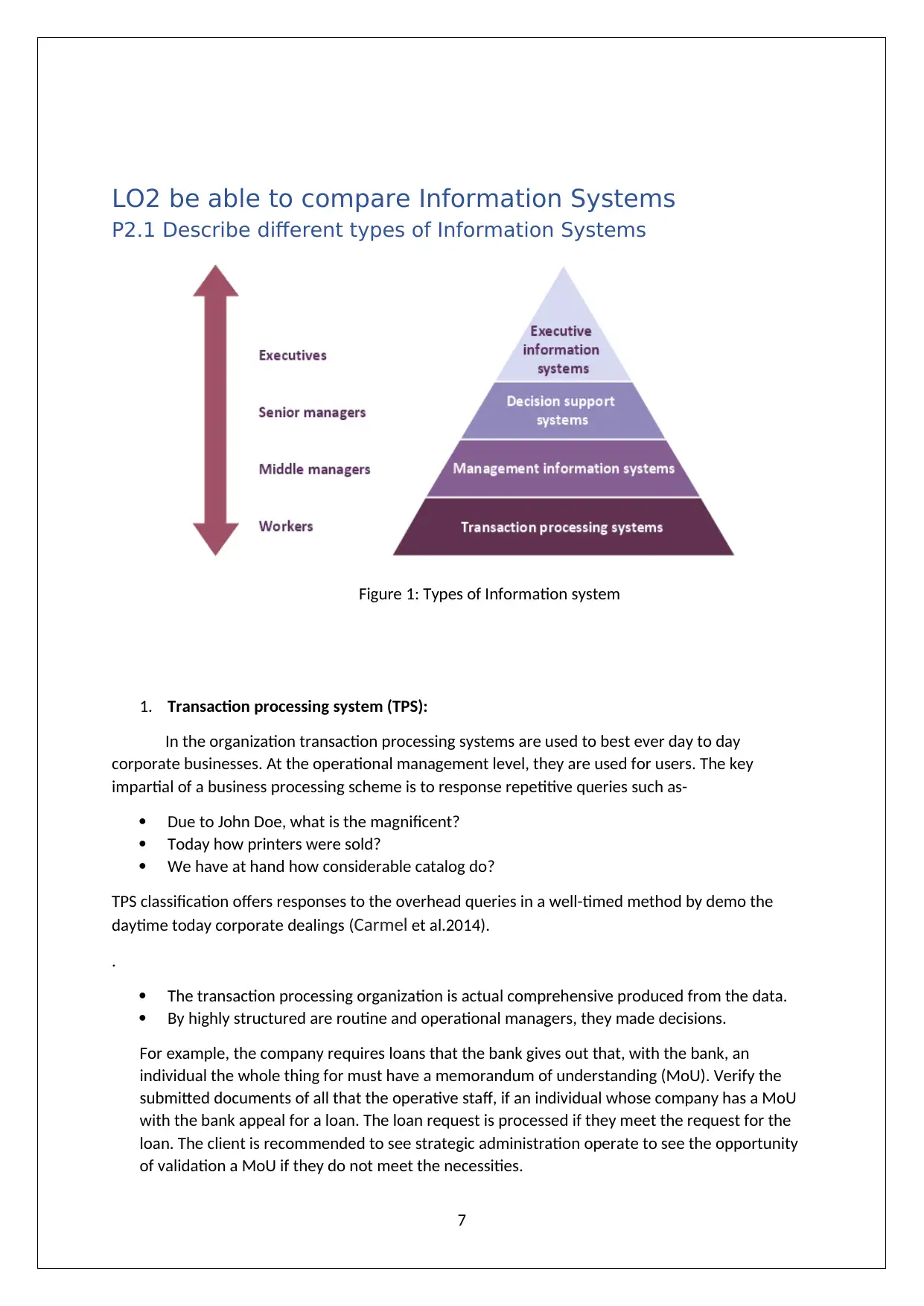
Figure 1: Types of Information system
1. Transaction processing system (TPS):
In the organization transaction processing systems are used to best ever day to day
corporate businesses. At the operational management level, they are used for users. The key
impartial of a business processing scheme is to response repetitive queries such as-
Due to John Doe, what is the magnificent?
Today how printers were sold?
We have at hand how considerable catalog do?
TPS classification offers responses to the overhead queries in a well-timed method by demo the
daytime today corporate dealings (Carmel et al.2014).
.
The transaction processing organization is actual comprehensive produced from the data.
By highly structured are routine and operational managers, they made decisions.
For example, the company requires loans that the bank gives out that, with the bank, an
individual the whole thing for must have a memorandum of understanding (MoU). Verify the
submitted documents of all that the operative staff, if an individual whose company has a MoU
with the bank appeal for a loan. The loan request is processed if they meet the request for the
loan. The client is recommended to see strategic administration operate to see the opportunity
of validation a MoU if they do not meet the necessities.
7
P2.1 Describe different types of Information Systems
Figure 1: Types of Information system
1. Transaction processing system (TPS):
In the organization transaction processing systems are used to best ever day to day
corporate businesses. At the operational management level, they are used for users. The key
impartial of a business processing scheme is to response repetitive queries such as-
Due to John Doe, what is the magnificent?
Today how printers were sold?
We have at hand how considerable catalog do?
TPS classification offers responses to the overhead queries in a well-timed method by demo the
daytime today corporate dealings (Carmel et al.2014).
.
The transaction processing organization is actual comprehensive produced from the data.
By highly structured are routine and operational managers, they made decisions.
For example, the company requires loans that the bank gives out that, with the bank, an
individual the whole thing for must have a memorandum of understanding (MoU). Verify the
submitted documents of all that the operative staff, if an individual whose company has a MoU
with the bank appeal for a loan. The loan request is processed if they meet the request for the
loan. The client is recommended to see strategic administration operate to see the opportunity
of validation a MoU if they do not meet the necessities.
7
Paraphrase This Document
Need a fresh take? Get an instant paraphrase of this document with our AI Paraphraser
Examples of Transaction processing system -
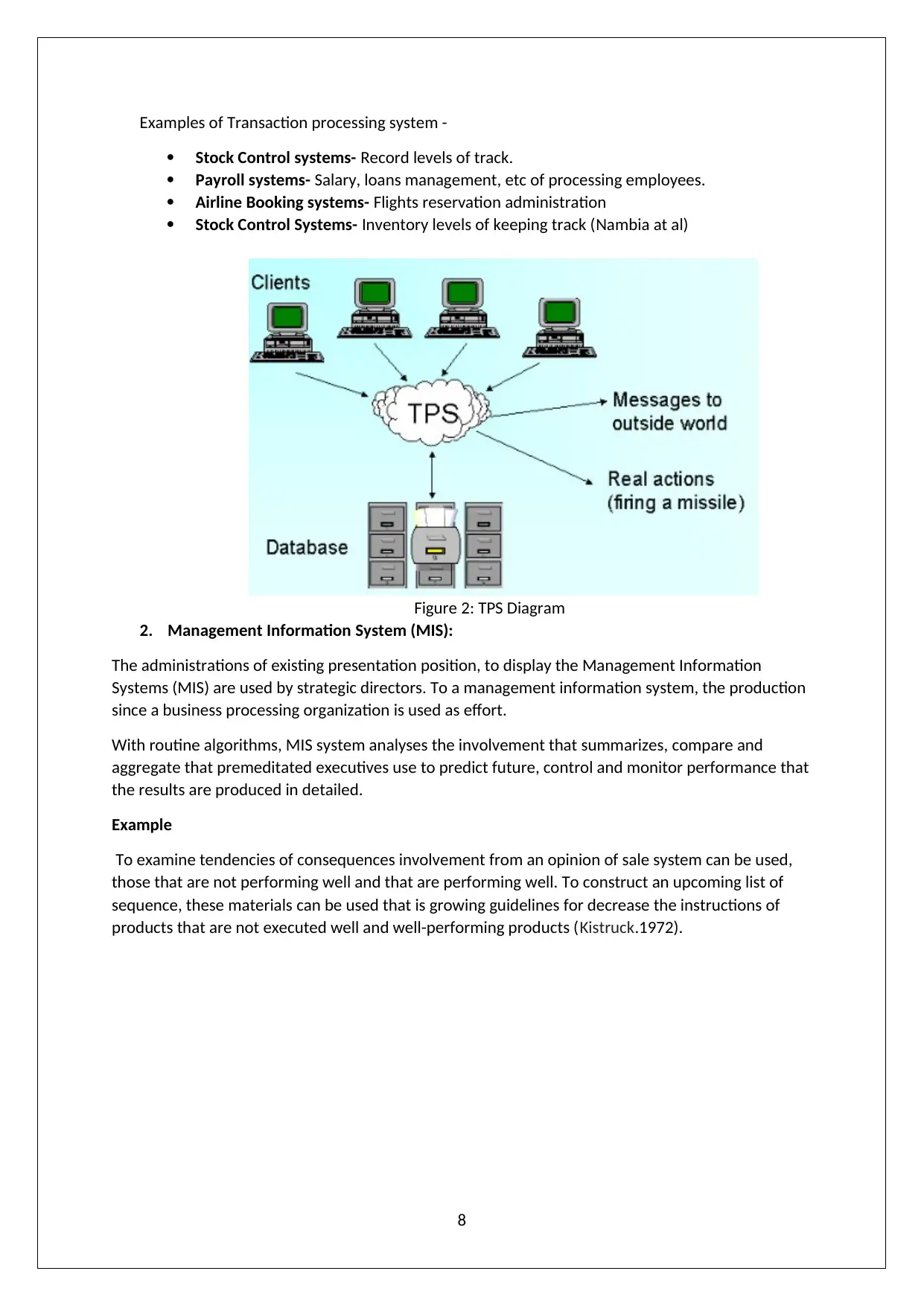
Stock Control systems- Record levels of track.
Payroll systems- Salary, loans management, etc of processing employees.
Airline Booking systems- Flights reservation administration
Stock Control Systems- Inventory levels of keeping track (Nambia at al)
Figure 2: TPS Diagram
2. Management Information System (MIS):
The administrations of existing presentation position, to display the Management Information
Systems (MIS) are used by strategic directors. To a management information system, the production
since a business processing organization is used as effort.
With routine algorithms, MIS system analyses the involvement that summarizes, compare and
aggregate that premeditated executives use to predict future, control and monitor performance that
the results are produced in detailed.
Example
To examine tendencies of consequences involvement from an opinion of sale system can be used,
those that are not performing well and that are performing well. To construct an upcoming list of
sequence, these materials can be used that is growing guidelines for decrease the instructions of
products that are not executed well and well-performing products (Kistruck.1972).
8
Stock Control systems- Record levels of track.
Payroll systems- Salary, loans management, etc of processing employees.
Airline Booking systems- Flights reservation administration
Stock Control Systems- Inventory levels of keeping track (Nambia at al)
Figure 2: TPS Diagram
2. Management Information System (MIS):
The administrations of existing presentation position, to display the Management Information
Systems (MIS) are used by strategic directors. To a management information system, the production
since a business processing organization is used as effort.
With routine algorithms, MIS system analyses the involvement that summarizes, compare and
aggregate that premeditated executives use to predict future, control and monitor performance that
the results are produced in detailed.
Example
To examine tendencies of consequences involvement from an opinion of sale system can be used,
those that are not performing well and that are performing well. To construct an upcoming list of
sequence, these materials can be used that is growing guidelines for decrease the instructions of
products that are not executed well and well-performing products (Kistruck.1972).
8
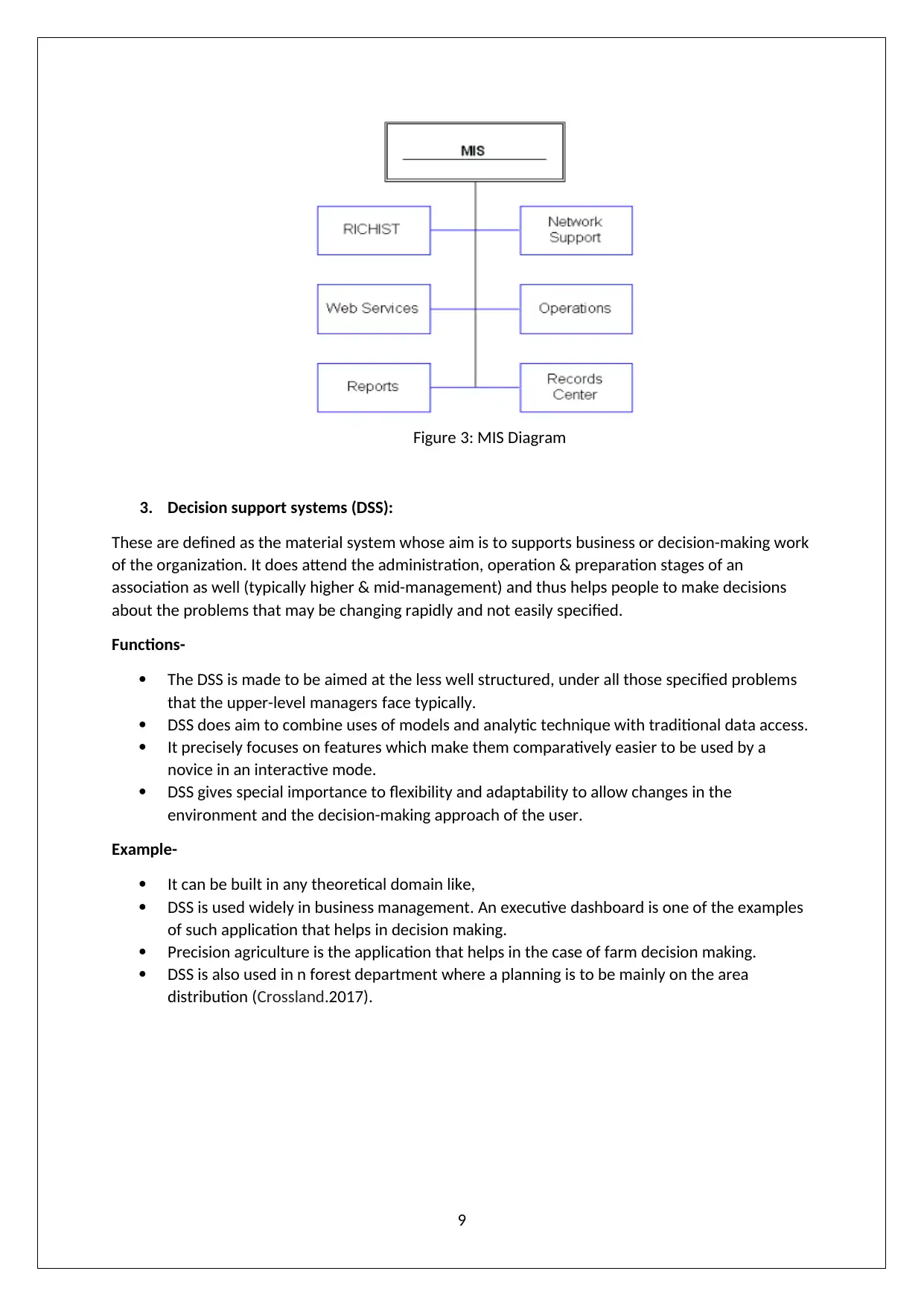
Figure 3: MIS Diagram
3. Decision support systems (DSS):
These are defined as the material system whose aim is to supports business or decision-making work
of the organization. It does attend the administration, operation & preparation stages of an
association as well (typically higher & mid-management) and thus helps people to make decisions
about the problems that may be changing rapidly and not easily specified.
Functions-
The DSS is made to be aimed at the less well structured, under all those specified problems
that the upper-level managers face typically.
DSS does aim to combine uses of models and analytic technique with traditional data access.
It precisely focuses on features which make them comparatively easier to be used by a
novice in an interactive mode.
DSS gives special importance to flexibility and adaptability to allow changes in the
environment and the decision-making approach of the user.
Example-
It can be built in any theoretical domain like,
DSS is used widely in business management. An executive dashboard is one of the examples
of such application that helps in decision making.
Precision agriculture is the application that helps in the case of farm decision making.
DSS is also used in n forest department where a planning is to be mainly on the area
distribution (Crossland.2017).
9
3. Decision support systems (DSS):
These are defined as the material system whose aim is to supports business or decision-making work
of the organization. It does attend the administration, operation & preparation stages of an
association as well (typically higher & mid-management) and thus helps people to make decisions
about the problems that may be changing rapidly and not easily specified.
Functions-
The DSS is made to be aimed at the less well structured, under all those specified problems
that the upper-level managers face typically.
DSS does aim to combine uses of models and analytic technique with traditional data access.
It precisely focuses on features which make them comparatively easier to be used by a
novice in an interactive mode.
DSS gives special importance to flexibility and adaptability to allow changes in the
environment and the decision-making approach of the user.
Example-
It can be built in any theoretical domain like,
DSS is used widely in business management. An executive dashboard is one of the examples
of such application that helps in decision making.
Precision agriculture is the application that helps in the case of farm decision making.
DSS is also used in n forest department where a planning is to be mainly on the area
distribution (Crossland.2017).
9
⊘ This is a preview!⊘
Do you want full access?
Subscribe today to unlock all pages.
Trusted by 1+ million students worldwide
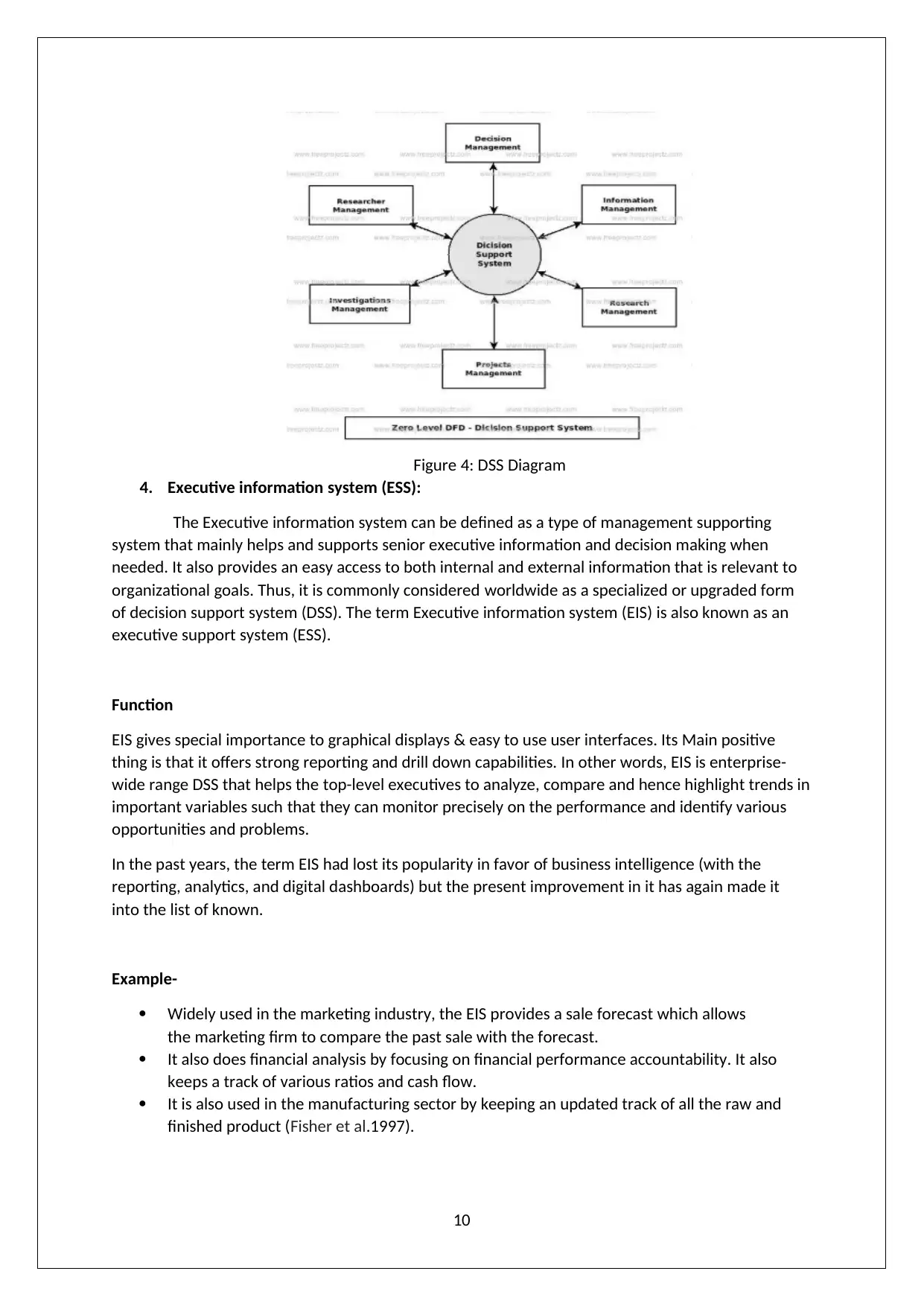
Figure 4: DSS Diagram
4. Executive information system (ESS):
The Executive information system can be defined as a type of management supporting
system that mainly helps and supports senior executive information and decision making when
needed. It also provides an easy access to both internal and external information that is relevant to
organizational goals. Thus, it is commonly considered worldwide as a specialized or upgraded form
of decision support system (DSS). The term Executive information system (EIS) is also known as an
executive support system (ESS).
Function
EIS gives special importance to graphical displays & easy to use user interfaces. Its Main positive
thing is that it offers strong reporting and drill down capabilities. In other words, EIS is enterprise-
wide range DSS that helps the top-level executives to analyze, compare and hence highlight trends in
important variables such that they can monitor precisely on the performance and identify various
opportunities and problems.
In the past years, the term EIS had lost its popularity in favor of business intelligence (with the
reporting, analytics, and digital dashboards) but the present improvement in it has again made it
into the list of known.
Example-
Widely used in the marketing industry, the EIS provides a sale forecast which allows
the marketing firm to compare the past sale with the forecast.
It also does financial analysis by focusing on financial performance accountability. It also
keeps a track of various ratios and cash flow.
It is also used in the manufacturing sector by keeping an updated track of all the raw and
finished product (Fisher et al.1997).
10
4. Executive information system (ESS):
The Executive information system can be defined as a type of management supporting
system that mainly helps and supports senior executive information and decision making when
needed. It also provides an easy access to both internal and external information that is relevant to
organizational goals. Thus, it is commonly considered worldwide as a specialized or upgraded form
of decision support system (DSS). The term Executive information system (EIS) is also known as an
executive support system (ESS).
Function
EIS gives special importance to graphical displays & easy to use user interfaces. Its Main positive
thing is that it offers strong reporting and drill down capabilities. In other words, EIS is enterprise-
wide range DSS that helps the top-level executives to analyze, compare and hence highlight trends in
important variables such that they can monitor precisely on the performance and identify various
opportunities and problems.
In the past years, the term EIS had lost its popularity in favor of business intelligence (with the
reporting, analytics, and digital dashboards) but the present improvement in it has again made it
into the list of known.
Example-
Widely used in the marketing industry, the EIS provides a sale forecast which allows
the marketing firm to compare the past sale with the forecast.
It also does financial analysis by focusing on financial performance accountability. It also
keeps a track of various ratios and cash flow.
It is also used in the manufacturing sector by keeping an updated track of all the raw and
finished product (Fisher et al.1997).
10
Paraphrase This Document
Need a fresh take? Get an instant paraphrase of this document with our AI Paraphraser
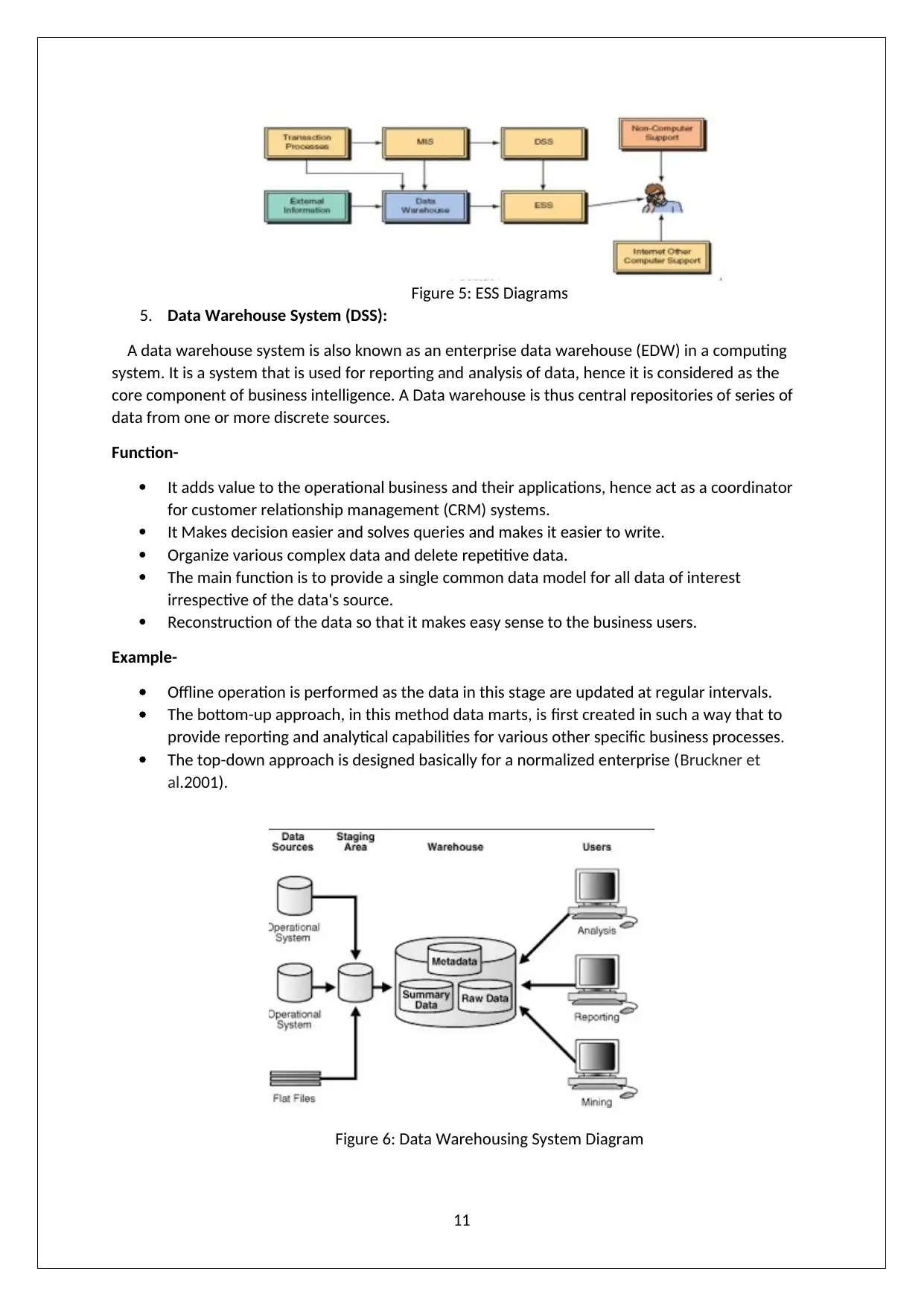
Figure 5: ESS Diagrams
5. Data Warehouse System (DSS):
A data warehouse system is also known as an enterprise data warehouse (EDW) in a computing
system. It is a system that is used for reporting and analysis of data, hence it is considered as the
core component of business intelligence. A Data warehouse is thus central repositories of series of
data from one or more discrete sources.
Function-
It adds value to the operational business and their applications, hence act as a coordinator
for customer relationship management (CRM) systems.
It Makes decision easier and solves queries and makes it easier to write.
Organize various complex data and delete repetitive data.
The main function is to provide a single common data model for all data of interest
irrespective of the data's source.
Reconstruction of the data so that it makes easy sense to the business users.
Example-
Offline operation is performed as the data in this stage are updated at regular intervals.
The bottom-up approach, in this method data marts, is first created in such a way that to
provide reporting and analytical capabilities for various other specific business processes.
The top-down approach is designed basically for a normalized enterprise (Bruckner et
al.2001).
Figure 6: Data Warehousing System Diagram
11
5. Data Warehouse System (DSS):
A data warehouse system is also known as an enterprise data warehouse (EDW) in a computing
system. It is a system that is used for reporting and analysis of data, hence it is considered as the
core component of business intelligence. A Data warehouse is thus central repositories of series of
data from one or more discrete sources.
Function-
It adds value to the operational business and their applications, hence act as a coordinator
for customer relationship management (CRM) systems.
It Makes decision easier and solves queries and makes it easier to write.
Organize various complex data and delete repetitive data.
The main function is to provide a single common data model for all data of interest
irrespective of the data's source.
Reconstruction of the data so that it makes easy sense to the business users.
Example-
Offline operation is performed as the data in this stage are updated at regular intervals.
The bottom-up approach, in this method data marts, is first created in such a way that to
provide reporting and analytical capabilities for various other specific business processes.
The top-down approach is designed basically for a normalized enterprise (Bruckner et
al.2001).
Figure 6: Data Warehousing System Diagram
11
P2.2 Investigate the current trends in using Information Systems
applications to solve business problems
Accenture is a global administration consulting and professional services firm that provides
operation services, strategy, consulting, digital, technology and. But there are some problems arise
while providing services. Currently, there are Information systems that help in solving the company’s
problems by making correct decisions, analyzing and visualizing the complex problems. These
information systems are MIS (Management information system), TIS (transaction processing
system), DSS (Decision Support System) and ESS (Executive Support System).
Transaction processing system: The main problem arises in a company is processing of the
transaction. Definite implementation of transaction processing system is required. This
system includes monitoring and managing of the data transaction. When Accenture
customers make payment on purchasing of respective service, sometimes the transaction
may fail. So, with the help of a transaction processing system, failure of the transaction can
be prevented by rolling back the incompletely executed transaction. Accenture sometimes
also face the problem to manage records in payroll. Payroll is a system that records the
amount of money given to employees. A file is created that has information like name,
address etc. When any changes made in the payroll system, TPS helps in maintaining the
updated data. Benefits of a transaction processing system in the different functional area of
Accenture company are (Weik.2000):
Handling Operations: Transaction Processing System handles many operations of Accenture
Company simultaneously.
Manage Finance area: Transaction processing system manages the financial functional area
and daily transactions of Accenture Company.
But there are some issues arise in a transaction processing system like the security of data, data
accuracy, and validation. Data may be biased from TPS using charts and graph. While using the TPS
information system, there may be chances of loss of information. Operations performed by
Accenture can be automated which may affect the employees who are doing these operations
Decision Support System: Decision support system has positive impacts in different
functional areas of Accenture Company. Accenture company can increase the productivity of
its employees, reduce time in producing services and make correct decisions to obtained
relevant information that can bring profits to the company. Using the DSS information
system, Accenture can also reduce the cost in producing of services by making effective
decisions. Other benefits of DSS that Accenture has are:
12
applications to solve business problems
Accenture is a global administration consulting and professional services firm that provides
operation services, strategy, consulting, digital, technology and. But there are some problems arise
while providing services. Currently, there are Information systems that help in solving the company’s
problems by making correct decisions, analyzing and visualizing the complex problems. These
information systems are MIS (Management information system), TIS (transaction processing
system), DSS (Decision Support System) and ESS (Executive Support System).
Transaction processing system: The main problem arises in a company is processing of the
transaction. Definite implementation of transaction processing system is required. This
system includes monitoring and managing of the data transaction. When Accenture
customers make payment on purchasing of respective service, sometimes the transaction
may fail. So, with the help of a transaction processing system, failure of the transaction can
be prevented by rolling back the incompletely executed transaction. Accenture sometimes
also face the problem to manage records in payroll. Payroll is a system that records the
amount of money given to employees. A file is created that has information like name,
address etc. When any changes made in the payroll system, TPS helps in maintaining the
updated data. Benefits of a transaction processing system in the different functional area of
Accenture company are (Weik.2000):
Handling Operations: Transaction Processing System handles many operations of Accenture
Company simultaneously.
Manage Finance area: Transaction processing system manages the financial functional area
and daily transactions of Accenture Company.
But there are some issues arise in a transaction processing system like the security of data, data
accuracy, and validation. Data may be biased from TPS using charts and graph. While using the TPS
information system, there may be chances of loss of information. Operations performed by
Accenture can be automated which may affect the employees who are doing these operations
Decision Support System: Decision support system has positive impacts in different
functional areas of Accenture Company. Accenture company can increase the productivity of
its employees, reduce time in producing services and make correct decisions to obtained
relevant information that can bring profits to the company. Using the DSS information
system, Accenture can also reduce the cost in producing of services by making effective
decisions. Other benefits of DSS that Accenture has are:
12
⊘ This is a preview!⊘
Do you want full access?
Subscribe today to unlock all pages.
Trusted by 1+ million students worldwide

1 out of 21


Related Documents


Your All-in-One AI-Powered Toolkit for Academic Success.
+13062052269
info@desklib.com
Available 24*7 on WhatsApp / Email
![[object Object]](/_next/static/media/star-bottom.7253800d.svg)
Unlock your academic potential
Copyright © 2020–2026 A2Z Services. All Rights Reserved. Developed and managed by ZUCOL.