Critical Analysis of Latureae's Information Systems - MIS500 Report

Verified

Added on  2022/09/30

|10
|2202
|26
Report
AI Summary
This report provides a critical analysis of the enterprise information systems within the Latureae organization, a health and wellness company. It begins with an introduction to Latureae, established in 2000, and outlines its strategic and operational objectives. The analysis focuses on identifying and evaluating the primary and secondary activities within Latureae's business model, including sub-activities and how they create value. Porter's value chain model is applied to assess these activities, and the report examines the links between value-creating activities and sub-activities. The analysis covers key areas such as human resource management, technological development, procurement, and marketing. Based on the findings, the report offers recommendations for Latureae to maximize profits and enhance customer satisfaction, including suggestions for online services, consumer-producer relationships, and employee training. The report concludes by emphasizing the importance of a smooth flow of primary and secondary activities, the effective use of enterprise information systems, and the application of Porter's value chain analysis for sustainable growth and competitive advantage. References to supporting literature are included.
Document Page
Running Head: FOUNDATIONS OF INFORMATION SYSTEMS 1
Course Title:
Course Code:
Assignment title: Foundations of information system
Student Name:
Student ID Number:
Instructors Name:
Institutional Affiliation:
Date:
tabler-icon-diamond-filled.svg

Paraphrase This Document

Need a fresh take? Get an instant paraphrase of this document with our AI Paraphraser
Document Page
FOUNDATIONS OF INFORMATION SYSTEMS 2
Introduction
The primary aspect of business entities is to make profits and provide excellent services
to its customers. For maximum profit margins, there are several key factors to be taken into
consideration, especially the essential to do with the value chain. The value chain mainly entails
all the business operations and combinations that companies use to generate money (Juščius &
Jonikas, 2013). The chain consists of several subsystems that ensure products and services
move from start to finish, thus revenue generation. In the modern world, we are living in, the
aspect of the business information system is of great importance. The importance is because the
business information system plays a crucial role in making improvements to the business
functions and operations (Neureuther, 2005). Again, the system plays a role in making
transactions easier for business entities by providing a platform for dealing with large volumes of
data in an organized manner.
Concerning that, the primary focus of this word document will be to analyze enterprise
information systems towards the operations of Latureae organization. Through the analysis, one
will be able to evaluate the primary and secondary activities related to Latureae organization.
Besides, the sub-activities of the entity will be analyzed to give a substantial assessment of its
business world. A link between the entity's value-generating activities and the sub-activities will
guarantee an excellent analysis of the business information system. In the study, Porter's value
chain model will be used, and eventually, recommendations will be made so that the company
will perform to its level best.
Document Page
FOUNDATIONS OF INFORMATION SYSTEMS 3
About Latureae Organization
It is a company founded in the year 2,000 whereby its primary goal is to provide health
and wellness services to its customers. Its establishment in the new millennium meant that there
were signs of wellness in the coming future for the Australian citizens. During the period of its
establishment, the firm was well placed. It is because Australia was stable in terms of its
manufacturing and distribution capabilities. Also, there was the presence of an advisory arm,
sturdy culture, and consumer engagement to cater for the wellness of individual needs.
The company deals with products and services that aid in improving the health and the
lifestyle of people through expertise in human nutrition, herbs, vitamins, and minerals. The
company's primary customers are supermarkets and food stores. From the data collected, it is
estimated that Latureae offers its services to approximately a hundred thousand customers
weekly. For a second time, because of customers, preferences, the company has acquired close to
two thousand suppliers. The entity works by making several orders for high-quality goods to
ensure customer satisfaction. This move translates to the high number of suppliers the body has,
thus the reason to incorporate them into the analysis. Through the suppliers and the company's
distribution plan, primary and secondary activities of the business model will be well understood.
Primary and Secondary activities of Latureae business model
According to Swanson (2008), business entities should have a well-formulated strategic
plan to guide them through all its daily operations. The strategic plan should include all the
essential activities that aid in the growth and development of the company. About the Latureae
case, the primary and secondary doings should be well recognized. The recognition of the
activities helps in creating a platform whereby customers’ value chain demand is taken into
Document Page
FOUNDATIONS OF INFORMATION SYSTEMS 4
consideration to guarantee the growth and development of the business. Business entities achieve
their goals by making sure that their primary and secondary activities of operation complement
each other (Seddon, Constantinidis, Tamm & Dod, 2016). The complementation of the business
activities makes companies market leaders in their field of operation through the implementation
of various innovative techniques.
Latureae primary activities include providing value to all its customers in the market and
also warranting that the company remains the leading example in the market through the use of
innovations. Its secondary activities involve providing sustainable development to its customers.
The events are achieved mainly through the providence of quality healthcare services and the
welfare of the community.
Sub activities between the primary and secondary activities
After identifying the principal and the secondary activities of the Latureae Company,
there can be a further breakdown of the events to sub-activities carried out in the entity. Sub
activities oath to be considered severe because they contribute to the achievement of the primary
and the secondary activities. For the success of businesses, a strategic plan should be put in
place to certify that the company’s goal is accomplished (Juščius & Jonikas, 2013). Latureae’s
primary activities are providing value to all its customers in the market and also warranting that
the company remains the leading example in the market. For success in the primary activities,
the business should evaluate the fundamental need of its consumers and indulge itself in the new
innovate products. Through assessing the consumers' needs and indulging in new innovative
products results in fulfilling consumers' satisfaction. Again, there is a need to increase the
rate/number of online sales. Increasing the number of online purchases by 20% rates within
tabler-icon-diamond-filled.svg

Paraphrase This Document

Need a fresh take? Get an instant paraphrase of this document with our AI Paraphraser
Document Page
FOUNDATIONS OF INFORMATION SYSTEMS 5
twelve months translates to increased profits margins and market dominance (Fratini, Ragai &
Wang, 2019).
For the secondary activity of sustainable development, there is the need to put in place
sub-activities to warrant success. The sub-activities to be put in place may include the
providence of community development programs that will boost the relationship between the
organization and its consumers. An excellent example of a community program is the
establishment of a fundraising kitty for the needy. Also, encouraging public participation in the
running of the organization is crucial. Public participation will aid the business in bringing in
new ideas on how the customers need to be served.
Sub activity that creates value/link between creating events and sub-activities
In the business world, there is a need to understand the market prospects that surround an
organization. Understanding the business world translates to the creation of value in the business
operations company caries out. For the Latureae entity, Porter's five-force model will be put into
consideration in the analysis and the evaluation of the sub-activities that create value. In a
nutshell, Kamran (2013) is of opinion that Porter’s five-force model will be evaluated as:
:
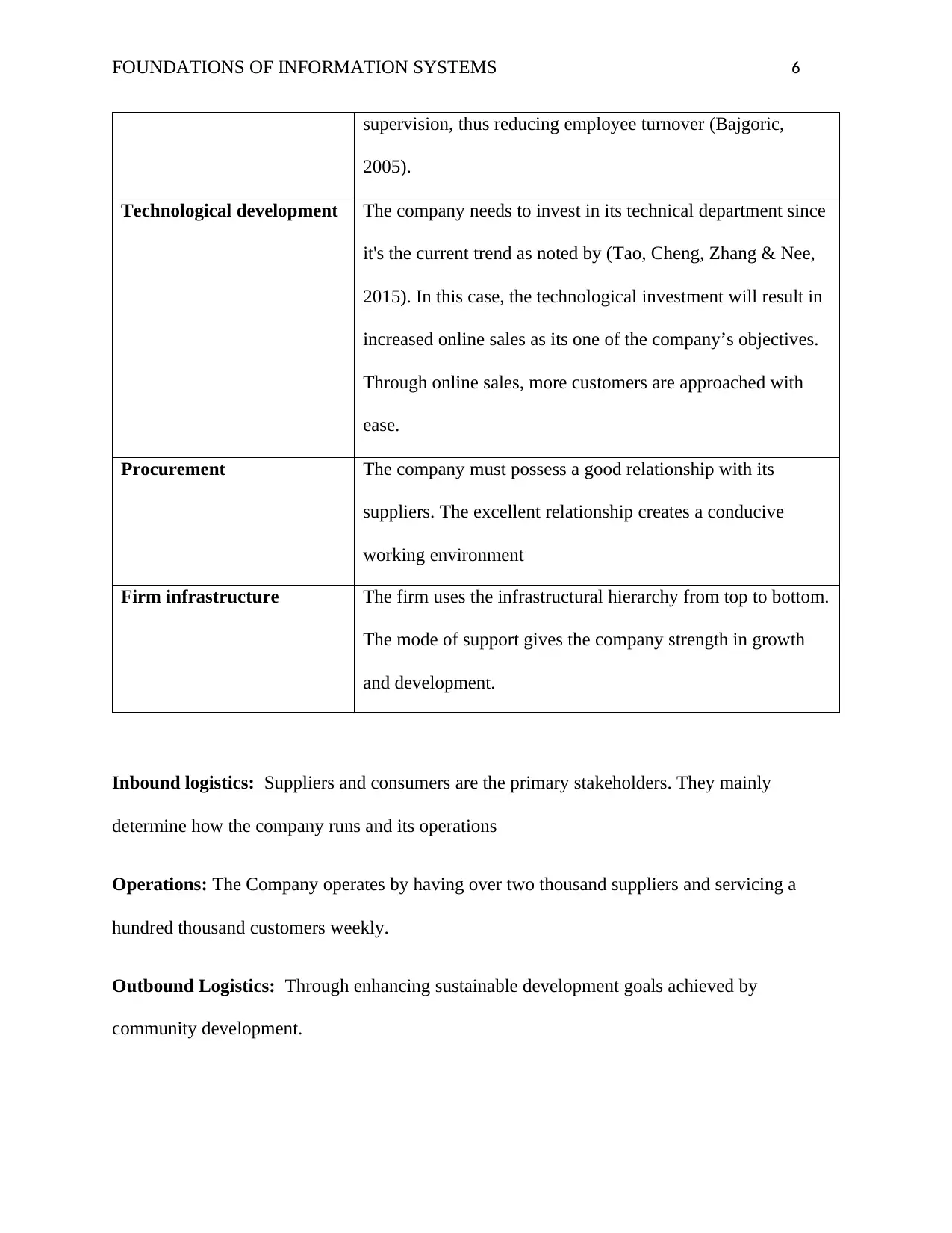
Human resource
management
For success in human resource management, the firm should
reduce the number of employees. This move is by improving
the skills of the employees available, thus enhancing work
efficiency. Again, there can be the incorporation of IT and
machines, which will work effectively under minimal
Document Page
FOUNDATIONS OF INFORMATION SYSTEMS 6
supervision, thus reducing employee turnover (Bajgoric,
2005).
Technological development The company needs to invest in its technical department since
it's the current trend as noted by (Tao, Cheng, Zhang & Nee,
2015). In this case, the technological investment will result in
increased online sales as its one of the company’s objectives.
Through online sales, more customers are approached with
ease.
Procurement The company must possess a good relationship with its
suppliers. The excellent relationship creates a conducive
working environment
Firm infrastructure The firm uses the infrastructural hierarchy from top to bottom.
The mode of support gives the company strength in growth
and development.
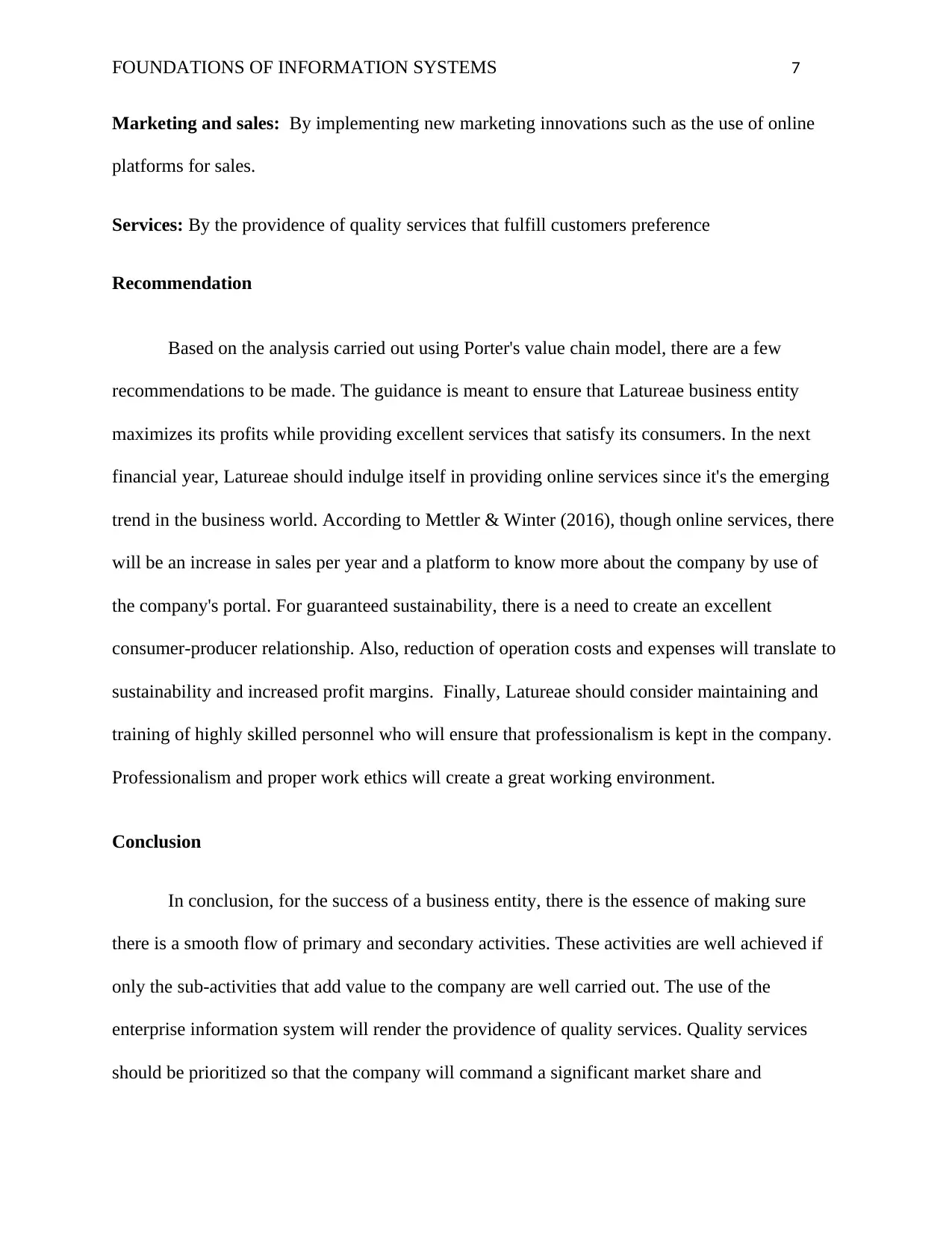
Inbound logistics: Suppliers and consumers are the primary stakeholders. They mainly
determine how the company runs and its operations
Operations: The Company operates by having over two thousand suppliers and servicing a
hundred thousand customers weekly.
Outbound Logistics: Through enhancing sustainable development goals achieved by
community development.
Document Page
FOUNDATIONS OF INFORMATION SYSTEMS 7
Marketing and sales: By implementing new marketing innovations such as the use of online
platforms for sales.
Services: By the providence of quality services that fulfill customers preference
Recommendation
Based on the analysis carried out using Porter's value chain model, there are a few
recommendations to be made. The guidance is meant to ensure that Latureae business entity
maximizes its profits while providing excellent services that satisfy its consumers. In the next
financial year, Latureae should indulge itself in providing online services since it's the emerging
trend in the business world. According to Mettler & Winter (2016), though online services, there
will be an increase in sales per year and a platform to know more about the company by use of
the company's portal. For guaranteed sustainability, there is a need to create an excellent
consumer-producer relationship. Also, reduction of operation costs and expenses will translate to
sustainability and increased profit margins. Finally, Latureae should consider maintaining and
training of highly skilled personnel who will ensure that professionalism is kept in the company.
Professionalism and proper work ethics will create a great working environment.
Conclusion
In conclusion, for the success of a business entity, there is the essence of making sure
there is a smooth flow of primary and secondary activities. These activities are well achieved if
only the sub-activities that add value to the company are well carried out. The use of the
enterprise information system will render the providence of quality services. Quality services
should be prioritized so that the company will command a significant market share and
tabler-icon-diamond-filled.svg

Paraphrase This Document

Need a fresh take? Get an instant paraphrase of this document with our AI Paraphraser
Document Page
FOUNDATIONS OF INFORMATION SYSTEMS 8
eventually have a competitive advantage over others. Furthermore, the company can enhance its
business activities by effectively applying Porter's value chain analysis. Porter's value chain
model will add value to the organization by bringing in innovations that will guarantee
sustainable development and growth of the business.
Document Page
FOUNDATIONS OF INFORMATION SYSTEMS 9
References
Abbasi, A., Sarker, S., & Chiang, R. (2016). Big Data Research in Information Systems: Toward
an Inclusive Research Agenda. Journal Of The Association For Information Systems,
17(2), I-XXXII. doi: 10.17705/1jais.00423
Bajgoric, N. (2005). Continuous Computing Technologies for Improving Performances of
Enterprise Information Systems. International Journal Of Enterprise Information
Systems, 1(4), 70-89. doi: 10.4018/jeis.2005100105
Fratini, L., Ragai, I., & Wang, L. (2019). New trends in manufacturing systems research.
Journal Of Manufacturing Systems, 52, 209-210. doi: 10.1016/j.jmsy.2019.04.009
Giachetti, R.E., (2016). Design of enterprise systems: Theory, architecture, & methods. CRC
Press.
Juščius, V., & Jonikas, D. (2013). Integration of CSR into Value Creation Chain: Conceptual
Framework. Engineering Economics, 24(1). doi: 10.5755/j01.ee.24.1.2016
Kamran, Q. (2013). Complexity the Sixth Competitive Force that Shapes Strategy: A
Cybernetics Approach to 'Porter's Five Forces Model' in Turbulent and Complex
Environments. SSRN Electronic Journal. doi: 10.2139/ssrn.2232901
Mettler, T., & Winter, R. (2016). Are business users social? A design experiment exploring
information sharing in enterprise social systems. Journal Of Information Technology,
31(2), 101-114. doi: 10.1057/jit.2015.28
Document Page
FOUNDATIONS OF INFORMATION SYSTEMS 10
Neureuther, B. (2005). Implementation Of Enterprise Resource Planning In Business
Curriculums. Review Of Business Information Systems (RBIS), 9(4), 7-12. doi:
10.19030/rbis.v9i4.4439
Porter, M.E., (2014). The value chain & competitive advantage. Underst&ing business
processes, 50-66.
Seddon, P., Constantinidis, D., Tamm, T., & Dod, H. (2016). How does business analytics
contribute to business value?. Information Systems Journal, 27(3), 237-269. doi:
10.1111/isj.12101
Swanson, G. (2008). Material flow, material information, and the analytics of integrative
enterprise information systems. Enterprise Information Systems, 2(1), 21-31. doi:
10.1080/17517570701846570
Tao, F., Cheng, Y., Zhang, L., & Nee, A. (2015). Advanced manufacturing systems:
socialization characteristics and trends. Journal Of Intelligent Manufacturing, 28(5),
1079-1094. doi: 10.1007/s10845-015-1042-8
chevron_up_icon
1 out of 10
circle_padding
hide_on_mobile
zoom_out_icon
[object Object]