Course: Information System Aid for Infants/Toddlers in Texas 2008-2016
VerifiedAdded on 2022/09/24
|25
|6224
|30
Report
AI Summary
This report examines the use of information systems and assistive technologies to support infants and toddlers with learning difficulties in Texas from 2008 to 2016. The paper explores the role of information systems in early intervention, including the use of Education Management Information Systems (EMIS) and assistive technologies. It discusses the challenges of identifying learning disabilities in infants and toddlers, the importance of a holistic approach to inclusion, and the various tools and resources available in Texas, such as the Texas Technology Access Project and the Center on Technology and Disability. The report highlights how information systems can address different types of learning problems through tools for listening, math, organization, reading, and writing. The paper emphasizes the need for ongoing assessment and the integration of assistive technology into educational plans to support the independence and success of children with learning disabilities. The research underscores the benefits of early intervention and the positive impact of technology in improving the learning outcomes of children with special needs.

Management 0
Title:
Assignment Name:
Student Name:
Course Name and Number:
Professor:
Date:
Title:
Assignment Name:
Student Name:
Course Name and Number:
Professor:
Date:

Paraphrase This Document
Need a fresh take? Get an instant paraphrase of this document with our AI Paraphraser
Management 1
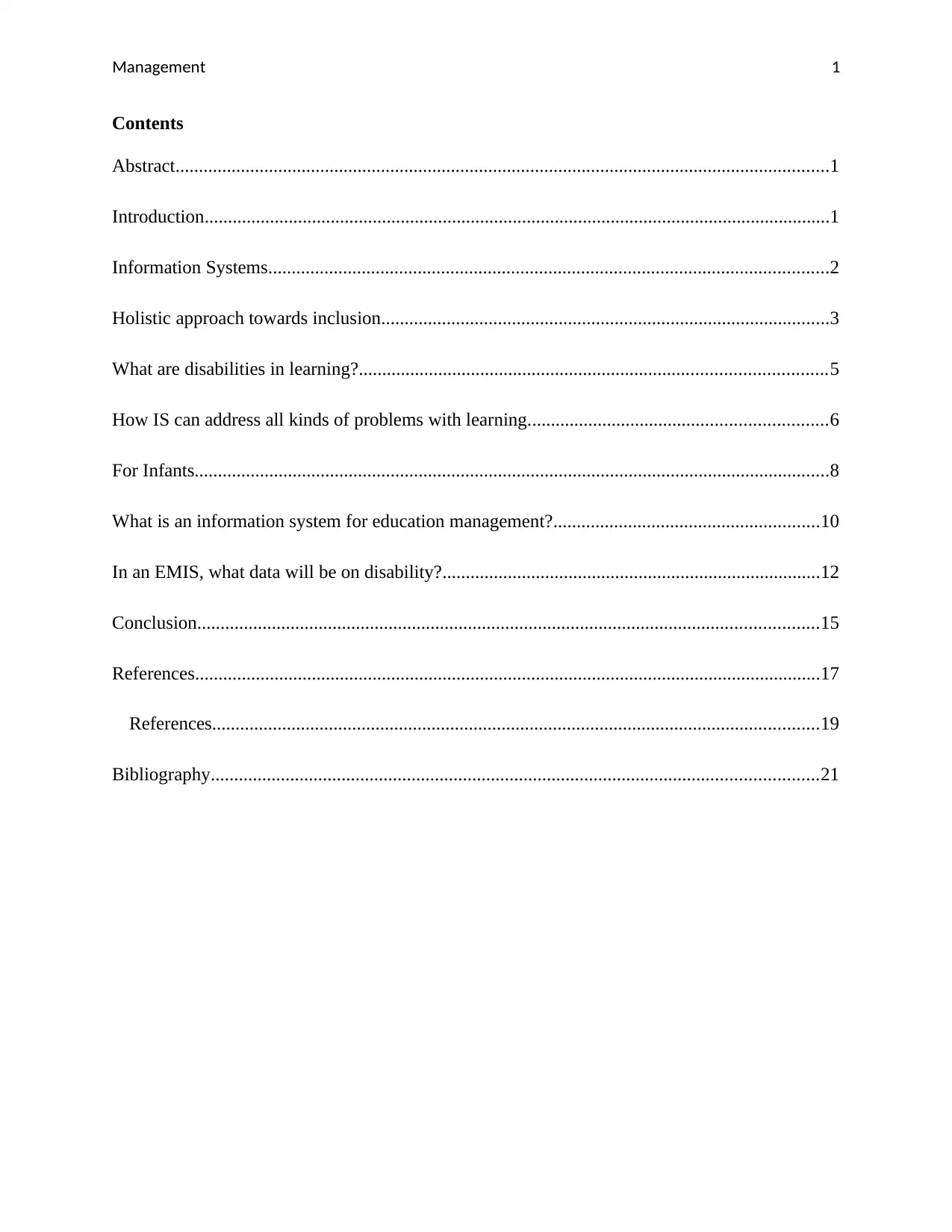
Contents
Abstract............................................................................................................................................1
Introduction......................................................................................................................................1
Information Systems........................................................................................................................2
Holistic approach towards inclusion................................................................................................3
What are disabilities in learning?....................................................................................................5
How IS can address all kinds of problems with learning................................................................6
For Infants........................................................................................................................................8
What is an information system for education management?.........................................................10
In an EMIS, what data will be on disability?.................................................................................12
Conclusion.....................................................................................................................................15
References......................................................................................................................................17
References..................................................................................................................................19
Bibliography..................................................................................................................................21
Contents
Abstract............................................................................................................................................1
Introduction......................................................................................................................................1
Information Systems........................................................................................................................2
Holistic approach towards inclusion................................................................................................3
What are disabilities in learning?....................................................................................................5
How IS can address all kinds of problems with learning................................................................6
For Infants........................................................................................................................................8
What is an information system for education management?.........................................................10
In an EMIS, what data will be on disability?.................................................................................12
Conclusion.....................................................................................................................................15
References......................................................................................................................................17
References..................................................................................................................................19
Bibliography..................................................................................................................................21
Management 2
Abstract
The generic phrase "learning disability" defines different forms of problems in learning.
A learning disability can lead a person to learning with difficulties and to some skills. The ability
to read, write, listen, talk, reason and math most frequently affected. Upon assessment and
eligibility for special education and related services in the infant, school staff and parents must
discuss and establish what is known as an IEP. In the educational life of a child with learning
disabilities, this paper is extremely significant. It defines the needs of the child and the services
provided free of charge by public school to address these needs.
Information systems and assistive technologies have come to the rescue to make the
children feel more inclusive. Helping technology will also allow other students to deal through
their educational difficulties. Assistive technology can extend from low-tech devices, like tape
recorders, to high-tech devices, including machines that read books aloud (which enable a
learner to write with a computer) and speech recognition devices (which enables the pupil to
write).
Introduction
We now live in a global community where we have many opportunities to support
disabled children.
In particular, technologies help learning students with learning difficulties to build
participation in academic and job activities engage in classroom discussions to gain access to
peer-related students and to educators. Studies explored how Technology can affect the
education of students with special requirements (policy, 2020).
Abstract
The generic phrase "learning disability" defines different forms of problems in learning.
A learning disability can lead a person to learning with difficulties and to some skills. The ability
to read, write, listen, talk, reason and math most frequently affected. Upon assessment and
eligibility for special education and related services in the infant, school staff and parents must
discuss and establish what is known as an IEP. In the educational life of a child with learning
disabilities, this paper is extremely significant. It defines the needs of the child and the services
provided free of charge by public school to address these needs.
Information systems and assistive technologies have come to the rescue to make the
children feel more inclusive. Helping technology will also allow other students to deal through
their educational difficulties. Assistive technology can extend from low-tech devices, like tape
recorders, to high-tech devices, including machines that read books aloud (which enable a
learner to write with a computer) and speech recognition devices (which enables the pupil to
write).
Introduction
We now live in a global community where we have many opportunities to support
disabled children.
In particular, technologies help learning students with learning difficulties to build
participation in academic and job activities engage in classroom discussions to gain access to
peer-related students and to educators. Studies explored how Technology can affect the
education of students with special requirements (policy, 2020).
⊘ This is a preview!⊘
Do you want full access?
Subscribe today to unlock all pages.

Trusted by 1+ million students worldwide
Management 3
Technology has done wonders in every field known to man. One such area that has been
drastically improved with its help is medical science. Medicine with proper records and options
has given an opportunity to grow at a never before pace. This is usually done via Information
systems. Information system for the collection, storage, processing and delivery of information,
knowledge and digital items, integrated set of components. In order to conduct and maintain its
operation, companies and other entities rely on information systems, communicate with their
customers and suppliers and compete on the market. Inter-organizational supply chains and
online transactions are managed by information systems. Corporations, for example, use
information systems in financial report preparation, in human resource management and in
online marketing for their future customers. Many large corporations are completely founded
around IT (Spathis & Ananiadis, 2005).
Information Systems
As information systems made a wider range of human activities, they had a profound
effect on society. These processes improved the speed of daily work, allowed people in the
creation and management of new and sometimes more productive relationships, affected
organizational structures and mixtures, changed the type of goods they bought and shaped the
nature of their work. Awareness and information have become important economic tools.
However, the reliance on information technology and new technologies brought new challenges.
The vigorous innovation of the industry and university study is constantly generating new ways
to counter the threats (Gao et al., 2019).
The EMIS is designed particularly to track the delivery of training programs provided by
the institution and control the procurement and procurement of the educational services.
Technology has done wonders in every field known to man. One such area that has been
drastically improved with its help is medical science. Medicine with proper records and options
has given an opportunity to grow at a never before pace. This is usually done via Information
systems. Information system for the collection, storage, processing and delivery of information,
knowledge and digital items, integrated set of components. In order to conduct and maintain its
operation, companies and other entities rely on information systems, communicate with their
customers and suppliers and compete on the market. Inter-organizational supply chains and
online transactions are managed by information systems. Corporations, for example, use
information systems in financial report preparation, in human resource management and in
online marketing for their future customers. Many large corporations are completely founded
around IT (Spathis & Ananiadis, 2005).
Information Systems
As information systems made a wider range of human activities, they had a profound
effect on society. These processes improved the speed of daily work, allowed people in the
creation and management of new and sometimes more productive relationships, affected
organizational structures and mixtures, changed the type of goods they bought and shaped the
nature of their work. Awareness and information have become important economic tools.
However, the reliance on information technology and new technologies brought new challenges.
The vigorous innovation of the industry and university study is constantly generating new ways
to counter the threats (Gao et al., 2019).
The EMIS is designed particularly to track the delivery of training programs provided by
the institution and control the procurement and procurement of the educational services.
Paraphrase This Document
Need a fresh take? Get an instant paraphrase of this document with our AI Paraphraser
Management 4
Education Management Information System (EMIS) Naturally, EMIS has unique functions to
promote the growth of a school in the field of education (Raunch, 2020).
Holistic approach towards inclusion
Many higher education institutions already plan to adopt a holistic management approach
for education that can complement learning processes and enhance the experience of students.
While higher education has been covered a huge area that needs attention is Infants and toddlers
with Learning disability. Such kids need to be included, always in a group setting. They should
not be made to feel that they are different and should be included. Inclusion initially requires a
mechanism to recognize and to act to build inclusive childcare environments. The attitude of
acceptance and compassion and a determination to build an environment of true belonging for
children and their families is required for child care and infant healthcare (Mason, 2019).
Infants and kids may also benefit tremendously from assistive technology services, but
they may not have the ability to use a keyboard or computer. Resent research shows that babies
and kids do not have to learn the use of such equipment until they benefit. For example, many
kids will learn to interact effectively and meet milestones they wouldn't have been able to
achieve otherwise by using a touchscreen tablet.
Amplifying communication tools may allow children who have limited language and
difficulties with oral communication to learn to communicate more effectively. In addition,
babies and children will use more complicated devices as they grow older with the early
implementation of technical technologies.
Education Management Information System (EMIS) Naturally, EMIS has unique functions to
promote the growth of a school in the field of education (Raunch, 2020).
Holistic approach towards inclusion
Many higher education institutions already plan to adopt a holistic management approach
for education that can complement learning processes and enhance the experience of students.
While higher education has been covered a huge area that needs attention is Infants and toddlers
with Learning disability. Such kids need to be included, always in a group setting. They should
not be made to feel that they are different and should be included. Inclusion initially requires a
mechanism to recognize and to act to build inclusive childcare environments. The attitude of
acceptance and compassion and a determination to build an environment of true belonging for
children and their families is required for child care and infant healthcare (Mason, 2019).
Infants and kids may also benefit tremendously from assistive technology services, but
they may not have the ability to use a keyboard or computer. Resent research shows that babies
and kids do not have to learn the use of such equipment until they benefit. For example, many
kids will learn to interact effectively and meet milestones they wouldn't have been able to
achieve otherwise by using a touchscreen tablet.
Amplifying communication tools may allow children who have limited language and
difficulties with oral communication to learn to communicate more effectively. In addition,
babies and children will use more complicated devices as they grow older with the early
implementation of technical technologies.
Management 5
Babies and children will physically benefit from a variety of tools to help them crawl, sit,
walk and explore.
Through childhood, many lifelong skills are established. Nevertheless, it is more difficult
for young children to develop vital skills. AT items and services will help close the gap and
enable babies to learn the same skills as non-disabled babies (Adam, 2020).
Every of us knows the need to feel and to belong. This is the essence of inclusive
childcare, where every mom, infant and adolescent feels like a leading member.
These things can be done if a parent/guardian is able to identify that their child needs
special care. Identification is tough, but one way to do this is to keep track of their
developmental milestones and the other is to contact you nearest centre (Singleton, Horne &
Simmons, 2009).
Tools in Texas
In Texas, for toddlers and infants with learning disabilities, there are various centres like
Children’s Disabilities Information Coalition – CPRC, PEN Project – PTI, PATH Project – PTI,
Team Project, Partners Resource Network, Inc. – PTI.
Some online sources for finding great assistive technology. match children to the right
assistive devices or technology (America, America, America & America, 2020).
Texas Technology Access Project is a program through the University of Texas at Austin.
They loan out devices and offer low-interest loans to purchase assistive technology.
The Center on Technology and Disability helps connect families to the right assistive
technology.
Babies and children will physically benefit from a variety of tools to help them crawl, sit,
walk and explore.
Through childhood, many lifelong skills are established. Nevertheless, it is more difficult
for young children to develop vital skills. AT items and services will help close the gap and
enable babies to learn the same skills as non-disabled babies (Adam, 2020).
Every of us knows the need to feel and to belong. This is the essence of inclusive
childcare, where every mom, infant and adolescent feels like a leading member.
These things can be done if a parent/guardian is able to identify that their child needs
special care. Identification is tough, but one way to do this is to keep track of their
developmental milestones and the other is to contact you nearest centre (Singleton, Horne &
Simmons, 2009).
Tools in Texas
In Texas, for toddlers and infants with learning disabilities, there are various centres like
Children’s Disabilities Information Coalition – CPRC, PEN Project – PTI, PATH Project – PTI,
Team Project, Partners Resource Network, Inc. – PTI.
Some online sources for finding great assistive technology. match children to the right
assistive devices or technology (America, America, America & America, 2020).
Texas Technology Access Project is a program through the University of Texas at Austin.
They loan out devices and offer low-interest loans to purchase assistive technology.
The Center on Technology and Disability helps connect families to the right assistive
technology.
⊘ This is a preview!⊘
Do you want full access?
Subscribe today to unlock all pages.
Trusted by 1+ million students worldwide
Management 6
AbleData connects families to suppliers of medical equipment, assistive technology, and
assistive devices. Their database has facts about more than 40,000 assistive devices.
What are disabilities in learning?
Disability behavior is not infectious, although it may be genetically engineered. It means,
like many other characteristics from our parents and grandparentes, they can be passed to
families through the genes. Someone with a learning disability will still has other relatives that
have had learning difficulties.
Often children with learning difficulties are shocked to discover that one of their parents
had similar issues at school. Today, however, children have a profit over their parents. Learning
experts now know much more about the brain and how it functions, so it is easier for children to
get their support (Van der Molen, Van Luit, Van der Molen, Klugkist & Jongmans, 2010).
The word 'learning disabilities' applies to a heterogeneous group of students whose
development of skills in literacy and calculation is seen to have serious problems. The words
'learning disabilities' and 'special needs' are also often used in this sense. The research included a
report on the ICT use in two outer suburban Melbourne Special Schools and a research on the
function and effect on those school surroundings by the Education Department policies. Studies
at the two special schools showed, by growing self confidence and promoting the development
of valuable living skills, that ICT use can have a very beneficial impact on these students (H,
2019).
AbleData connects families to suppliers of medical equipment, assistive technology, and
assistive devices. Their database has facts about more than 40,000 assistive devices.
What are disabilities in learning?
Disability behavior is not infectious, although it may be genetically engineered. It means,
like many other characteristics from our parents and grandparentes, they can be passed to
families through the genes. Someone with a learning disability will still has other relatives that
have had learning difficulties.
Often children with learning difficulties are shocked to discover that one of their parents
had similar issues at school. Today, however, children have a profit over their parents. Learning
experts now know much more about the brain and how it functions, so it is easier for children to
get their support (Van der Molen, Van Luit, Van der Molen, Klugkist & Jongmans, 2010).
The word 'learning disabilities' applies to a heterogeneous group of students whose
development of skills in literacy and calculation is seen to have serious problems. The words
'learning disabilities' and 'special needs' are also often used in this sense. The research included a
report on the ICT use in two outer suburban Melbourne Special Schools and a research on the
function and effect on those school surroundings by the Education Department policies. Studies
at the two special schools showed, by growing self confidence and promoting the development
of valuable living skills, that ICT use can have a very beneficial impact on these students (H,
2019).
Paraphrase This Document
Need a fresh take? Get an instant paraphrase of this document with our AI Paraphraser
Management 7
Technology is a positive way for many children to improve learning. In addition, LD
students are often more successful if they can use their abilities to work with their disabilities.
How IS can address all kinds of problems with learning.
A school report can be written by a student with trouble writing, by dictating it and by
special software translates it to text. A mathematically challenged child will hold a score with a
peer with a hand-held calculator. An AT that can read his employer's online training manual is
used by a teenager with dyslexia. Students fighting with AT-tools are available:
Listening: Many AT devices can aid people with difficulties in understanding the
language and remembering it. Topic tools such as a college lecture or a conference with multiple
speakers can be used in many environments (Zammar, 2010).
Math: The mathematical assistive devices was designed to help people who have
machine, arrange, coordinate and copy math problems on paper. Users can better configure and
measure simple math issues with the aid of visual and/or audio assistance (Mont, 2020).
Organization and memory: technology at organization and memory can allow people to
prepare, organize and monitor their calendars, schedules, task lists, details on contacts and
different notes. The tools allow him to use special software and portable devices to monitor,
store and retrieve these information.
Reading: There are a wide range of tools available to help people who are having
difficulties reading. Reading Although each tool form works a little differently, all these tools aid
with the speech presentation of text. These tools make it easier to decode, read and understand
(Naidoo, 2010).
Technology is a positive way for many children to improve learning. In addition, LD
students are often more successful if they can use their abilities to work with their disabilities.
How IS can address all kinds of problems with learning.
A school report can be written by a student with trouble writing, by dictating it and by
special software translates it to text. A mathematically challenged child will hold a score with a
peer with a hand-held calculator. An AT that can read his employer's online training manual is
used by a teenager with dyslexia. Students fighting with AT-tools are available:
Listening: Many AT devices can aid people with difficulties in understanding the
language and remembering it. Topic tools such as a college lecture or a conference with multiple
speakers can be used in many environments (Zammar, 2010).
Math: The mathematical assistive devices was designed to help people who have
machine, arrange, coordinate and copy math problems on paper. Users can better configure and
measure simple math issues with the aid of visual and/or audio assistance (Mont, 2020).
Organization and memory: technology at organization and memory can allow people to
prepare, organize and monitor their calendars, schedules, task lists, details on contacts and
different notes. The tools allow him to use special software and portable devices to monitor,
store and retrieve these information.
Reading: There are a wide range of tools available to help people who are having
difficulties reading. Reading Although each tool form works a little differently, all these tools aid
with the speech presentation of text. These tools make it easier to decode, read and understand
(Naidoo, 2010).
Management 8
Writing: The students struggling with writing may use a wide range of supporting
technology tools. Many of these tools help students avoid the actual physical challenge of
writing while others make it easier to read, punctuate, use grammar, use word and arrange
properly.
To accomplish this praiseworthy feat in enhancing the learning of children with learning
difficulties, the ideas behind the application of this technology are known as the learning cycle •
Assistive technology can only strengthen and not replace basic skills. It can be used to teach
basic skills in the course of the education cycle.
• Children with disabilities assistive technology is more than an instructional tool; it is a
simple working device equivalent to pencil and paper for children without disabilities.
Children with disabilities use assist technology to access and use common tools,
complete educational activities and engage in the daily educational environment on an equal
basis with their development peers (Ryan, 2010).
• The introduction of assistive technology does not make educational and business
software / tools available or functional automatically (Chiang & Liu, 2011).
• A specialist, competent in standard and assistance technology, assistive technology
assessment is required to decide if the child needs assistive technology equipment and services
which should be stated in educational plans of children (Murchland & Parkyn, 2010).
Writing: The students struggling with writing may use a wide range of supporting
technology tools. Many of these tools help students avoid the actual physical challenge of
writing while others make it easier to read, punctuate, use grammar, use word and arrange
properly.
To accomplish this praiseworthy feat in enhancing the learning of children with learning
difficulties, the ideas behind the application of this technology are known as the learning cycle •
Assistive technology can only strengthen and not replace basic skills. It can be used to teach
basic skills in the course of the education cycle.
• Children with disabilities assistive technology is more than an instructional tool; it is a
simple working device equivalent to pencil and paper for children without disabilities.
Children with disabilities use assist technology to access and use common tools,
complete educational activities and engage in the daily educational environment on an equal
basis with their development peers (Ryan, 2010).
• The introduction of assistive technology does not make educational and business
software / tools available or functional automatically (Chiang & Liu, 2011).
• A specialist, competent in standard and assistance technology, assistive technology
assessment is required to decide if the child needs assistive technology equipment and services
which should be stated in educational plans of children (Murchland & Parkyn, 2010).
⊘ This is a preview!⊘
Do you want full access?
Subscribe today to unlock all pages.
Trusted by 1+ million students worldwide
Management 9
The assessment of assistive technology will consider alternative and enhanced
communication needs, that is, the capacity of children with disabilities to express needs and
change the environment.
• The ongoing phase should be an assistive technology evaluation to be successful.
It was maintained that adherence to these principles helps to reinforce the independence
of learning disabled children, as these children frequently rely on parents, peers, friends and
instructors for support.
For Infants
In Infants, It is controversial to recognize learning disorders. Some experts think that they
are overstated, a realistic solution for other common learning differences. It is especially difficult
to identify learning impairments in preschoolers and very young children as they learn at very
different levels. According to Liebman, before the third grade of a child, learning disabilities can
not be identified firmly.
It does not mean that you are now to disregard all concerns. For your child's academic
future, early intervention will make a huge difference.
For children and babies with cognitive impairments, normal developmental stages are
often delayed. For example, by the age of 2, many children may articulate a minimal number of
sentences, but a child with a cognitive disability can be unable to speak at all.
The assessment of assistive technology will consider alternative and enhanced
communication needs, that is, the capacity of children with disabilities to express needs and
change the environment.
• The ongoing phase should be an assistive technology evaluation to be successful.
It was maintained that adherence to these principles helps to reinforce the independence
of learning disabled children, as these children frequently rely on parents, peers, friends and
instructors for support.
For Infants
In Infants, It is controversial to recognize learning disorders. Some experts think that they
are overstated, a realistic solution for other common learning differences. It is especially difficult
to identify learning impairments in preschoolers and very young children as they learn at very
different levels. According to Liebman, before the third grade of a child, learning disabilities can
not be identified firmly.
It does not mean that you are now to disregard all concerns. For your child's academic
future, early intervention will make a huge difference.
For children and babies with cognitive impairments, normal developmental stages are
often delayed. For example, by the age of 2, many children may articulate a minimal number of
sentences, but a child with a cognitive disability can be unable to speak at all.
Paraphrase This Document
Need a fresh take? Get an instant paraphrase of this document with our AI Paraphraser
Management 10
Nonetheless, it should be remembered that it does not automatically mean that you have
any kind of cognitive disability only because your baby does not reach some milestone in time.
In different circumstances children and babies are gaining cognitive skills so you do want to let
your doctor know if your child seems to be coming to these milestones. For milder conditions,
once your child is old enough to be able to manage the knowledge, you might not realize that
your child has a mental impairment. You should consult with a child education professional to
determine if the knowledge processing for your children is natural, or whether he or she has a
birth-related learning disorder, if your child does not learn as well, as every other child does.
While the causes of the disabilities are still being hunted, reasoning are that intellectual
disability is not birth injury on its own, it can be caused by birth injury. For example, brain injury
during birth, failure to perform a C-cut emergency, failure in monitoring fetal distress and more
may have been a result of an intellectual disability (Epley, 2013).
When we include the special children into the education system, their data also needs to
be included ("ADHD and Learning Disabilities in Former Late Preterm Infants: A Population-
Based Birth Cohort", 2013).
To order to track the educational system, curriculum management information systems
are used. This must also be at the forefront of every data system that is capable of fulfilling the
goals of implementing policies to improve the engagement, track compliance, and measure the
success of children with disabilities in education. Other data instruments, including household
surveys, including the Multiple Indicator Cluster Survey (MICS) funded by UNICEF can also
play an important role. In reality, as an EMIS only monitors kids at school, more data sources for
considering the issue of out-of-school children are certainly required (Didden & de Moor, 2004).
Nonetheless, it should be remembered that it does not automatically mean that you have
any kind of cognitive disability only because your baby does not reach some milestone in time.
In different circumstances children and babies are gaining cognitive skills so you do want to let
your doctor know if your child seems to be coming to these milestones. For milder conditions,
once your child is old enough to be able to manage the knowledge, you might not realize that
your child has a mental impairment. You should consult with a child education professional to
determine if the knowledge processing for your children is natural, or whether he or she has a
birth-related learning disorder, if your child does not learn as well, as every other child does.
While the causes of the disabilities are still being hunted, reasoning are that intellectual
disability is not birth injury on its own, it can be caused by birth injury. For example, brain injury
during birth, failure to perform a C-cut emergency, failure in monitoring fetal distress and more
may have been a result of an intellectual disability (Epley, 2013).
When we include the special children into the education system, their data also needs to
be included ("ADHD and Learning Disabilities in Former Late Preterm Infants: A Population-
Based Birth Cohort", 2013).
To order to track the educational system, curriculum management information systems
are used. This must also be at the forefront of every data system that is capable of fulfilling the
goals of implementing policies to improve the engagement, track compliance, and measure the
success of children with disabilities in education. Other data instruments, including household
surveys, including the Multiple Indicator Cluster Survey (MICS) funded by UNICEF can also
play an important role. In reality, as an EMIS only monitors kids at school, more data sources for
considering the issue of out-of-school children are certainly required (Didden & de Moor, 2004).
Management 11
EMIS for LD
Nonetheless, EMIS is a crucial source of knowledge to encourage inclusive education.
The goal of this document is not to provide general information on the overall quality
enhancement of EMIS but to provide advice on how an EMIS and other administrative data
sources can better tackle disability issues. The first step in revising an EMIS in order to collect
the information required for promoting child with disabilities is to explain precisely what is
meant by b EMIS (Choy, Lee & Lo, 2004).
Education data shall be collected with well-defined, policy measures in a clear, timely
and reliable manner, in order to be useful. This will fulfill the requirements of every level of the
education system: individual schools, districts or district / regionally education offices, and the
Education Ministry – to facilitate the budgeting and implementation of new policies and
procedures as an evaluative instrument. Similarly, disability data must also be clearly and
accurately defined and should include a wide variety of disability factors. The data will not only
provide information on the existence of child disabilities but also information on environmental
barriers preventing children with such disabilities from being taught. An EMIS gathers these data
in a normal way (Lech & Zamojska, 2017).
What is an information system for education management?
An EMIS consists of a phase in which school data are collected, aggregated, and
recorded. The reporting process includes data collection forms and the framework for
dissemination and analysis of these forms; a method of electronically entry of such forms; the
establishment at the school, regional and national levels of indicators; and finally a series of
EMIS for LD
Nonetheless, EMIS is a crucial source of knowledge to encourage inclusive education.
The goal of this document is not to provide general information on the overall quality
enhancement of EMIS but to provide advice on how an EMIS and other administrative data
sources can better tackle disability issues. The first step in revising an EMIS in order to collect
the information required for promoting child with disabilities is to explain precisely what is
meant by b EMIS (Choy, Lee & Lo, 2004).
Education data shall be collected with well-defined, policy measures in a clear, timely
and reliable manner, in order to be useful. This will fulfill the requirements of every level of the
education system: individual schools, districts or district / regionally education offices, and the
Education Ministry – to facilitate the budgeting and implementation of new policies and
procedures as an evaluative instrument. Similarly, disability data must also be clearly and
accurately defined and should include a wide variety of disability factors. The data will not only
provide information on the existence of child disabilities but also information on environmental
barriers preventing children with such disabilities from being taught. An EMIS gathers these data
in a normal way (Lech & Zamojska, 2017).
What is an information system for education management?
An EMIS consists of a phase in which school data are collected, aggregated, and
recorded. The reporting process includes data collection forms and the framework for
dissemination and analysis of these forms; a method of electronically entry of such forms; the
establishment at the school, regional and national levels of indicators; and finally a series of
⊘ This is a preview!⊘
Do you want full access?
Subscribe today to unlock all pages.
Trusted by 1+ million students worldwide

1 out of 25


Related Documents


Your All-in-One AI-Powered Toolkit for Academic Success.
+13062052269
info@desklib.com
Available 24*7 on WhatsApp / Email
![[object Object]](/_next/static/media/star-bottom.7253800d.svg)
Unlock your academic potential
Copyright © 2020–2026 A2Z Services. All Rights Reserved. Developed and managed by ZUCOL.