Holmes Institute HC1041: Evaluating IT's Impact on Airlines Business
VerifiedAdded on 2022/12/27
|7
|2433
|1
Report
AI Summary
This report analyzes the critical role of information technology in the airline industry. It explores how IT impacts various aspects of the business, including marketing, sales, operations, and customer service. The report examines the benefits of IT implementation, such as increased efficiency, improved customer service, and enhanced financial performance. It also discusses the significance of IT in areas like dynamic pricing and the use of data analytics. The study highlights the importance of IT infrastructure, the need for trained IT experts, and the integration of management systems. The conclusion emphasizes the transformative effect of IT, suggesting that it is essential for airline management and customer acquisition. The report is based on a real-life business case study and aligns with the assessment criteria, providing a comprehensive overview of IT's influence on the airline industry and the strategies needed for effective IT implementation.
Running head: IT IN AIRLINES
IT IN AIRLINES
Name of the Student
Name of the Organization
Author Note
IT IN AIRLINES
Name of the Student
Name of the Organization
Author Note

Paraphrase This Document
Need a fresh take? Get an instant paraphrase of this document with our AI Paraphraser
1IT IN AIRLINES
Table of Contents
Introduction...................................................................................................................2
Impacts of the Information Technology........................................................................2
Significance of the information technology...................................................................4
IT implementation requirements...................................................................................5
Benefits of IT.................................................................................................................6
Conclusion....................................................................................................................7
References...................................................................................................................8
Table of Contents
Introduction...................................................................................................................2
Impacts of the Information Technology........................................................................2
Significance of the information technology...................................................................4
IT implementation requirements...................................................................................5
Benefits of IT.................................................................................................................6
Conclusion....................................................................................................................7
References...................................................................................................................8
2IT IN AIRLINES
Introduction
Information technology is considered to be one of the essential aspects of the
sector of airlines and it has been seen that without the technology of information it
will really become very much difficult and in fact totally impossible for all the various
airlines to operate properly. The specific implementation of the information
technology will be bringing a large number of advantages for the sector of airlines
like the retention of the customers and several services of greater quality (Doganis
2013). Marketing, selling, serving, flight and the operating are all the several five
huge sections which are known to be greatly related to the operations of the sector
of airlines. Apart from all of these sections, there are some major trends which are
highly technological associated with the involvement of the specific transfer of the
several operations of the airlines by the utilization of the particular concept of big
data along with some other kinds of technologies (Milne and Kelly 2014). There is
also a specific kind of management of the relationship with the customers as well.
IT is greatly associated with the sector of Airlines possessing a great
significant effect upon the particular sector of airlines which are greatly noticed to be
well related to all the several sections of the operation of the sector like that of the
marketing, sales and several operations of the entire sector (Kilic, Zaim and Delen
2014). The main aim of the study is to properly analyze all the different kinds of the
impact of IT upon Airlines and a proper analysis of them as well so that all the
several advantages and the disadvantages which the future developments can be
known.
Impacts of the Information Technology
The information technology is known to be playing a great role in the business
of Airlines and this is particularly because of the fact that it is greatly associated with
security along with the ability and the capacity of the airlines. On the other hand, it
has been observed that IT is possessing a great impact upon particular performance
of the airlines involving the area of finance and the environment (Rong, Hongshan
and Jiang 2013). There are basically some sections of the sector of Airlines which
have been well segregated involving the marketing, sales and the operations of the
entire enterprise.
The specific usage of IT within the area of sales and marketing will be actually
making various operators totally capable of preparing various plans along with
providing assistance in the evaluation of the revenue prediction, flight scheduling of
time and so on (Pearson and Merkert 2014). IT will also be incrementing up of all the
various operations for making all of them very much efficient. Several problems are
even analyzed which will be put forward due to the huge generation of data. There is
also some other critical thing which is greatly associated with the specific strategy of
dynamic pricing due to very much lower cost airlines rather than all the several
competitors. There is also a maximization of the profitability together will all the
several revenues and the specific reason which has been behind this is particularly
that the strategy of dynamic pricing is greatly related with the responding depending
upon the market’s condition for gaining a lot of competitiveness (David Mc A 2013).
The utilization of IT will be helping a lot in the appropriate analysis of the price and all
of those which will be beneficial for the organization in directly meeting all the aims
as well as objectives.
Introduction
Information technology is considered to be one of the essential aspects of the
sector of airlines and it has been seen that without the technology of information it
will really become very much difficult and in fact totally impossible for all the various
airlines to operate properly. The specific implementation of the information
technology will be bringing a large number of advantages for the sector of airlines
like the retention of the customers and several services of greater quality (Doganis
2013). Marketing, selling, serving, flight and the operating are all the several five
huge sections which are known to be greatly related to the operations of the sector
of airlines. Apart from all of these sections, there are some major trends which are
highly technological associated with the involvement of the specific transfer of the
several operations of the airlines by the utilization of the particular concept of big
data along with some other kinds of technologies (Milne and Kelly 2014). There is
also a specific kind of management of the relationship with the customers as well.
IT is greatly associated with the sector of Airlines possessing a great
significant effect upon the particular sector of airlines which are greatly noticed to be
well related to all the several sections of the operation of the sector like that of the
marketing, sales and several operations of the entire sector (Kilic, Zaim and Delen
2014). The main aim of the study is to properly analyze all the different kinds of the
impact of IT upon Airlines and a proper analysis of them as well so that all the
several advantages and the disadvantages which the future developments can be
known.
Impacts of the Information Technology
The information technology is known to be playing a great role in the business
of Airlines and this is particularly because of the fact that it is greatly associated with
security along with the ability and the capacity of the airlines. On the other hand, it
has been observed that IT is possessing a great impact upon particular performance
of the airlines involving the area of finance and the environment (Rong, Hongshan
and Jiang 2013). There are basically some sections of the sector of Airlines which
have been well segregated involving the marketing, sales and the operations of the
entire enterprise.
The specific usage of IT within the area of sales and marketing will be actually
making various operators totally capable of preparing various plans along with
providing assistance in the evaluation of the revenue prediction, flight scheduling of
time and so on (Pearson and Merkert 2014). IT will also be incrementing up of all the
various operations for making all of them very much efficient. Several problems are
even analyzed which will be put forward due to the huge generation of data. There is
also some other critical thing which is greatly associated with the specific strategy of
dynamic pricing due to very much lower cost airlines rather than all the several
competitors. There is also a maximization of the profitability together will all the
several revenues and the specific reason which has been behind this is particularly
that the strategy of dynamic pricing is greatly related with the responding depending
upon the market’s condition for gaining a lot of competitiveness (David Mc A 2013).
The utilization of IT will be helping a lot in the appropriate analysis of the price and all
of those which will be beneficial for the organization in directly meeting all the aims
as well as objectives.
⊘ This is a preview!⊘
Do you want full access?
Subscribe today to unlock all pages.

Trusted by 1+ million students worldwide
3IT IN AIRLINES
Additionally, it can be said that Airlines is even associated with the utilization
of the specific channel of sales which is hybrid with that of some other several
channels like the websites of mobile, online agents of travel and so on (Cui et al.
2016). IT is even utilized for offering several services to all the customers like
allowance of the feedbacks upon the official website of the companies or rather
lodging of several complaints upon the internet. This will be in turn associating with
the proper development of a proper channel of sharing information in between all the
customers and the organization. There is also a great role which has been provided
by IT in the procedure of the storage of information and also in facilitating the
particular procedure of sharing information all through the airport or rather on the
outskirts of the airline. This will be actually displaying the proper utilization of the
Business Intelligence (Cui and Li 2015).
The entire concept which has been drawn from the above information is really
very much useful for understanding the basic fact that IT is actually the main tool of
the aspect of the business of Airlines which will not only be helping in the
management of operations but will be also be greatly associated with the help
provided in both the communication as well as the analysis of the several operations
of the specific business (Benítez et al. 2013). It is even known that IT is greatly
associated with the great increment in the speed of operation of the business ( Díaz-
Ramírez, Huertas and Trigos 2014). All the various reasons will be actually
associating with the proper depiction of the basic fact that Airlines will be definitely
requiring IT for both the management as well as for acquiring the customer gaining
capability.
Significance of the information technology
All the several studies which have already been well conducted for the
purpose of depicting the specific correlation in between the airline’s profit and the
utilization of IT is really very much limited. However, such conducted studies as well
as various recommendations which have been offered by the studies helps a lot in
particularly concluding the basic fact that there is a great requirement of developing
several investments of IT for making all the managers of the industry of airline totally
capable of offering specific attention towards all the various processes of the
business and also in becoming very much efficient. The development of a fully clear
strategy of IT must be done which will not only be helping a lot in the management of
several communications but also responsible for an appropriate analysis of all of
those aspects which will be actually perceives as the IT investment returns (Chang
et al. 2014). One particular technology which will be bringing out a number of
benefits for the business of Airlines is the Internet of Things.
Hence, from the above discussion it can be easily concluded that IT will be
having a great significance for the business of Airlines and this particular significance
will be brought by the specific means of adapting appropriate strategies and also by
offering a far better understanding of the specific topology which will be actually
utilized in the airlines industry (Clark 2016). IT is even associated with particularly
enabling the real time monitoring of finances together with the analysis which will be
in turn recording various risks or rather failure which have already occurred or rather
may be occurring. By possessing a monitoring based upon real time, it will be very
much easier to particularly develop all the several strategies of troubleshooting which
will not only be providing help in producing a solution to all the problems linked to
time but will even be providing solution based upon the technology and management
Additionally, it can be said that Airlines is even associated with the utilization
of the specific channel of sales which is hybrid with that of some other several
channels like the websites of mobile, online agents of travel and so on (Cui et al.
2016). IT is even utilized for offering several services to all the customers like
allowance of the feedbacks upon the official website of the companies or rather
lodging of several complaints upon the internet. This will be in turn associating with
the proper development of a proper channel of sharing information in between all the
customers and the organization. There is also a great role which has been provided
by IT in the procedure of the storage of information and also in facilitating the
particular procedure of sharing information all through the airport or rather on the
outskirts of the airline. This will be actually displaying the proper utilization of the
Business Intelligence (Cui and Li 2015).
The entire concept which has been drawn from the above information is really
very much useful for understanding the basic fact that IT is actually the main tool of
the aspect of the business of Airlines which will not only be helping in the
management of operations but will be also be greatly associated with the help
provided in both the communication as well as the analysis of the several operations
of the specific business (Benítez et al. 2013). It is even known that IT is greatly
associated with the great increment in the speed of operation of the business ( Díaz-
Ramírez, Huertas and Trigos 2014). All the various reasons will be actually
associating with the proper depiction of the basic fact that Airlines will be definitely
requiring IT for both the management as well as for acquiring the customer gaining
capability.
Significance of the information technology
All the several studies which have already been well conducted for the
purpose of depicting the specific correlation in between the airline’s profit and the
utilization of IT is really very much limited. However, such conducted studies as well
as various recommendations which have been offered by the studies helps a lot in
particularly concluding the basic fact that there is a great requirement of developing
several investments of IT for making all the managers of the industry of airline totally
capable of offering specific attention towards all the various processes of the
business and also in becoming very much efficient. The development of a fully clear
strategy of IT must be done which will not only be helping a lot in the management of
several communications but also responsible for an appropriate analysis of all of
those aspects which will be actually perceives as the IT investment returns (Chang
et al. 2014). One particular technology which will be bringing out a number of
benefits for the business of Airlines is the Internet of Things.
Hence, from the above discussion it can be easily concluded that IT will be
having a great significance for the business of Airlines and this particular significance
will be brought by the specific means of adapting appropriate strategies and also by
offering a far better understanding of the specific topology which will be actually
utilized in the airlines industry (Clark 2016). IT is even associated with particularly
enabling the real time monitoring of finances together with the analysis which will be
in turn recording various risks or rather failure which have already occurred or rather
may be occurring. By possessing a monitoring based upon real time, it will be very
much easier to particularly develop all the several strategies of troubleshooting which
will not only be providing help in producing a solution to all the problems linked to
time but will even be providing solution based upon the technology and management
Paraphrase This Document
Need a fresh take? Get an instant paraphrase of this document with our AI Paraphraser
4IT IN AIRLINES
of customers for converting the procedures from the very much complex one to that
of the very simple one.
IT implementation requirements
There are a number of requirements for a proper implementation of IT. For
utilizing the information technology, the airline business must be possessing an
appropriate infrastructure of IT together with some other kinds of systems which will
be actually required (Thiel 2014). Apart from the appropriate infrastructure, there is
even an important requirement for properly hiring all the various experts of IT who
will be actually associating with that of offering support to the total infrastructure. All
the various experts must be well responsible for the management of the total
infrastructure of IT. Apart from this, all the several experts will even be totally
responsible for developing a proper design and also for properly implementing the
total infrastructure of information technology. They must be ensuring that the entire
infrastructure which they will be actually implementing is greatly effective for the
overall organizations. After the completion of the proper implementation of the
specific physical structure, there is a requirement for integrating the management
system of the airlines for obtaining help so that various operations will become very
much efficient.
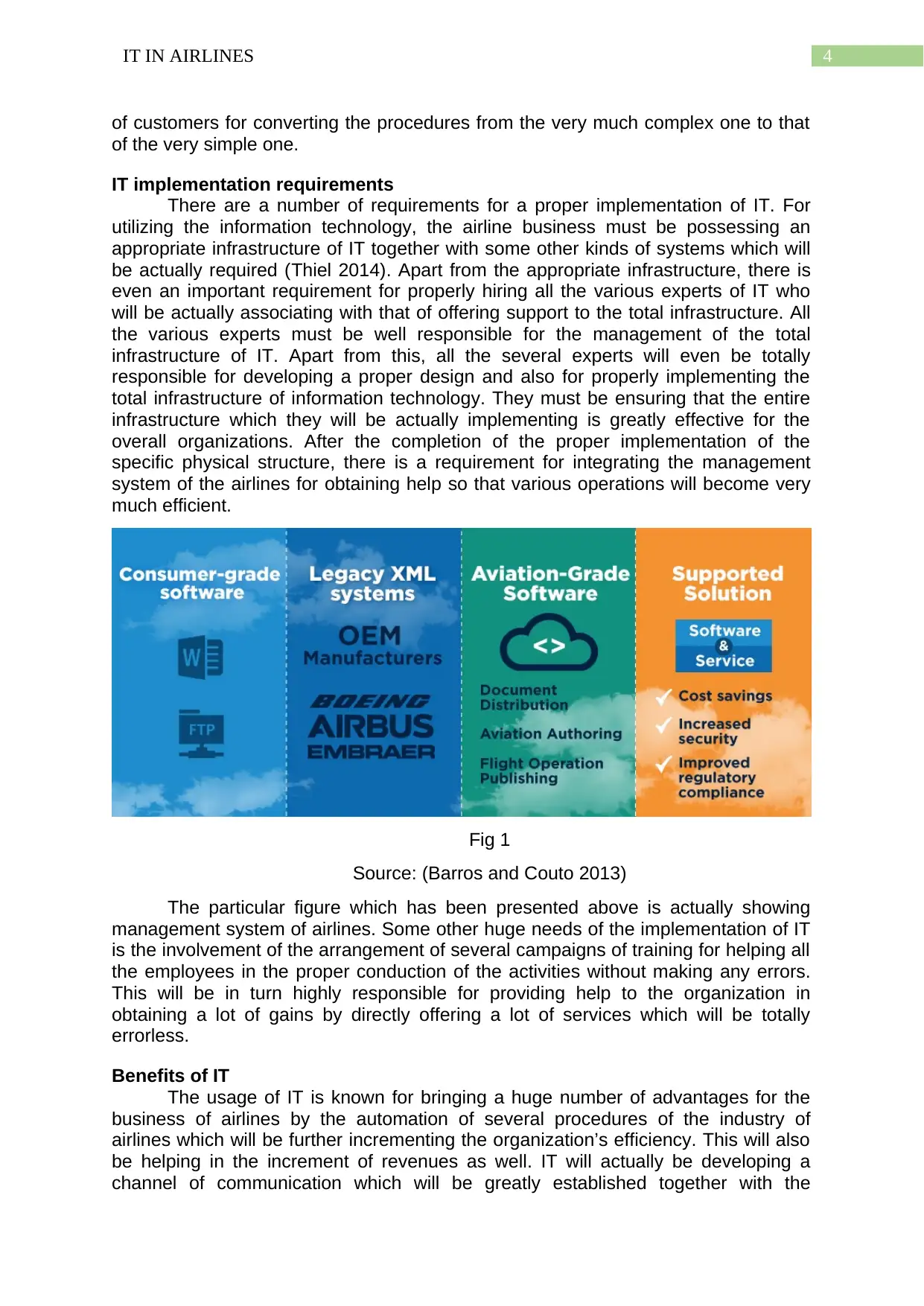
Fig 1
Source: (Barros and Couto 2013)
The particular figure which has been presented above is actually showing
management system of airlines. Some other huge needs of the implementation of IT
is the involvement of the arrangement of several campaigns of training for helping all
the employees in the proper conduction of the activities without making any errors.
This will be in turn highly responsible for providing help to the organization in
obtaining a lot of gains by directly offering a lot of services which will be totally
errorless.
Benefits of IT
The usage of IT is known for bringing a huge number of advantages for the
business of airlines by the automation of several procedures of the industry of
airlines which will be further incrementing the organization’s efficiency. This will also
be helping in the increment of revenues as well. IT will actually be developing a
channel of communication which will be greatly established together with the
of customers for converting the procedures from the very much complex one to that
of the very simple one.
IT implementation requirements
There are a number of requirements for a proper implementation of IT. For
utilizing the information technology, the airline business must be possessing an
appropriate infrastructure of IT together with some other kinds of systems which will
be actually required (Thiel 2014). Apart from the appropriate infrastructure, there is
even an important requirement for properly hiring all the various experts of IT who
will be actually associating with that of offering support to the total infrastructure. All
the various experts must be well responsible for the management of the total
infrastructure of IT. Apart from this, all the several experts will even be totally
responsible for developing a proper design and also for properly implementing the
total infrastructure of information technology. They must be ensuring that the entire
infrastructure which they will be actually implementing is greatly effective for the
overall organizations. After the completion of the proper implementation of the
specific physical structure, there is a requirement for integrating the management
system of the airlines for obtaining help so that various operations will become very
much efficient.
Fig 1
Source: (Barros and Couto 2013)
The particular figure which has been presented above is actually showing
management system of airlines. Some other huge needs of the implementation of IT
is the involvement of the arrangement of several campaigns of training for helping all
the employees in the proper conduction of the activities without making any errors.
This will be in turn highly responsible for providing help to the organization in
obtaining a lot of gains by directly offering a lot of services which will be totally
errorless.
Benefits of IT
The usage of IT is known for bringing a huge number of advantages for the
business of airlines by the automation of several procedures of the industry of
airlines which will be further incrementing the organization’s efficiency. This will also
be helping in the increment of revenues as well. IT will actually be developing a
channel of communication which will be greatly established together with the
5IT IN AIRLINES
improved safety of the information. One specific example is nothing but the several
smart applications which are greatly responsible for a much better operation
management along with offering great service to all the different customers. On the
other hand, automation will be greatly associated with the reduction of several costs
of operation involving the specific cost based upon the recruitment of several staffs
for the management of several procedures.
Conclusion
It can be concluded that the utilization of IT is considered to be one of the
great tool responsible for bringing it a number of alterations to the specific business
of airlines. The study has well highlighted the specific importance of the technology
of information in the particular business of the airlines. It has even been capable of
presenting the particular fact that all the various advantages which have been related
to the specific automatic of various operations are greatly responsible for making
organizations very much efficient. It will be putting forward the requirement of
offering training to all the workers for providing a lot of help in becoming totally
capable of the management of the infrastructure of IT that will be actually properly
designed by all the experts of information technology.
improved safety of the information. One specific example is nothing but the several
smart applications which are greatly responsible for a much better operation
management along with offering great service to all the different customers. On the
other hand, automation will be greatly associated with the reduction of several costs
of operation involving the specific cost based upon the recruitment of several staffs
for the management of several procedures.
Conclusion
It can be concluded that the utilization of IT is considered to be one of the
great tool responsible for bringing it a number of alterations to the specific business
of airlines. The study has well highlighted the specific importance of the technology
of information in the particular business of the airlines. It has even been capable of
presenting the particular fact that all the various advantages which have been related
to the specific automatic of various operations are greatly responsible for making
organizations very much efficient. It will be putting forward the requirement of
offering training to all the workers for providing a lot of help in becoming totally
capable of the management of the infrastructure of IT that will be actually properly
designed by all the experts of information technology.
⊘ This is a preview!⊘
Do you want full access?
Subscribe today to unlock all pages.
Trusted by 1+ million students worldwide
6IT IN AIRLINES
References
Barros, C.P. and Couto, E., 2013. Productivity analysis of European airlines, 2000–
2011. Journal of Air Transport Management, 31, pp.11-13.\
Benítez, R.B.C., Paredes, R.B.C., Lodewijks, G. and Nabais, J.L., 2013. Damp trend
Grey Model forecasting method for airline industry. Expert Systems with
Applications, 40(12), pp.4915-4921.
Chang, Y.T., Park, H.S., Jeong, J.B. and Lee, J.W., 2014. Evaluating economic and
environmental efficiency of global airlines: A SBM-DEA approach. Transportation
Research Part D: Transport and Environment, 27, pp.46-50.
Clark, P., 2016. Buying the big jets: fleet planning for airlines. Routledge.
Cui, Q. and Li, Y., 2015. Evaluating energy efficiency for airlines: An application of
VFB-DEA. Journal of Air Transport Management, 44, pp.34-41.
Cui, Q., Li, Y., Yu, C.L. and Wei, Y.M., 2016. Evaluating energy efficiency for
airlines: an application of virtual frontier dynamic slacks based
measure. Energy, 113, pp.1231-1240.
David Mc A, B., 2013. Service quality and customer satisfaction in the airline
industry: A comparison between legacy airlines and low-cost airlines. American
Journal of Tourism Research, 2(1), pp.67-77.
Díaz-Ramírez, J., Huertas, J.I. and Trigos, F., 2014. Aircraft maintenance, routing,
and crew scheduling planning for airlines with a single fleet and a single
maintenance and crew base. Computers & Industrial Engineering, 75, pp.68-78.
Doganis, R., 2013. Flying off course: The economics of international airlines.
Routledge.
Kilic, H.S., Zaim, S. and Delen, D., 2014. Development of a hybrid methodology for
ERP system selection: The case of Turkish Airlines. Decision Support Systems, 66,
pp.82-92.
Milne, R.J. and Kelly, A.R., 2014. A new method for boarding passengers onto an
airplane. Journal of Air Transport Management, 34, pp.93-100.
Pearson, J. and Merkert, R., 2014. Airlines-within-airlines: A business model moving
East. Journal of Air Transport Management, 38, pp.21-26.
Rong, H.U., Hongshan, X.I.A. and Jiang, Y., 2013. Complex dynamics for airlines'
price competition with differentiation strategy. Journal of Transportation Systems
Engineering and Information Technology, 13(1), pp.11-16.
Thiel, P., 2014. Competition is for losers. The Wall Street Journal, 2.
References
Barros, C.P. and Couto, E., 2013. Productivity analysis of European airlines, 2000–
2011. Journal of Air Transport Management, 31, pp.11-13.\
Benítez, R.B.C., Paredes, R.B.C., Lodewijks, G. and Nabais, J.L., 2013. Damp trend
Grey Model forecasting method for airline industry. Expert Systems with
Applications, 40(12), pp.4915-4921.
Chang, Y.T., Park, H.S., Jeong, J.B. and Lee, J.W., 2014. Evaluating economic and
environmental efficiency of global airlines: A SBM-DEA approach. Transportation
Research Part D: Transport and Environment, 27, pp.46-50.
Clark, P., 2016. Buying the big jets: fleet planning for airlines. Routledge.
Cui, Q. and Li, Y., 2015. Evaluating energy efficiency for airlines: An application of
VFB-DEA. Journal of Air Transport Management, 44, pp.34-41.
Cui, Q., Li, Y., Yu, C.L. and Wei, Y.M., 2016. Evaluating energy efficiency for
airlines: an application of virtual frontier dynamic slacks based
measure. Energy, 113, pp.1231-1240.
David Mc A, B., 2013. Service quality and customer satisfaction in the airline
industry: A comparison between legacy airlines and low-cost airlines. American
Journal of Tourism Research, 2(1), pp.67-77.
Díaz-Ramírez, J., Huertas, J.I. and Trigos, F., 2014. Aircraft maintenance, routing,
and crew scheduling planning for airlines with a single fleet and a single
maintenance and crew base. Computers & Industrial Engineering, 75, pp.68-78.
Doganis, R., 2013. Flying off course: The economics of international airlines.
Routledge.
Kilic, H.S., Zaim, S. and Delen, D., 2014. Development of a hybrid methodology for
ERP system selection: The case of Turkish Airlines. Decision Support Systems, 66,
pp.82-92.
Milne, R.J. and Kelly, A.R., 2014. A new method for boarding passengers onto an
airplane. Journal of Air Transport Management, 34, pp.93-100.
Pearson, J. and Merkert, R., 2014. Airlines-within-airlines: A business model moving
East. Journal of Air Transport Management, 38, pp.21-26.
Rong, H.U., Hongshan, X.I.A. and Jiang, Y., 2013. Complex dynamics for airlines'
price competition with differentiation strategy. Journal of Transportation Systems
Engineering and Information Technology, 13(1), pp.11-16.
Thiel, P., 2014. Competition is for losers. The Wall Street Journal, 2.

1 out of 7


Related Documents


Your All-in-One AI-Powered Toolkit for Academic Success.
+13062052269
info@desklib.com
Available 24*7 on WhatsApp / Email
![[object Object]](/_next/static/media/star-bottom.7253800d.svg)
Unlock your academic potential
Copyright © 2020–2026 A2Z Services. All Rights Reserved. Developed and managed by ZUCOL.