Effects of IT Management on O&G Performance in Oman: Research
VerifiedAdded on 2022/08/15
|46
|12774
|443
Report
AI Summary
This research paper investigates the impact of information technology management on performance efficiency within selected oil and gas companies in Oman. It begins by highlighting the importance of IT in the sector, discussing challenges like fluctuating oil prices and the need for organizational agility. The paper explores how IT can turn data into intelligence, the value of digital transformation, and current IT structures in the region. It examines IT management overviews, executive IT management, and the research's focus, problem, objectives, and questions. The study adopts a dynamic capabilities approach, analyzing IT capability, firm performance, and the significance of IT investments. The paper also addresses the conceptual model and thesis structure, providing a comprehensive analysis of how IT management can enhance performance in the oil and gas industry, including the role of data analysis, machine learning, and the benefits of digitization.
Research Paper
Topic: Effects of Information Technology Management on Performance Efficiency in Selected
Oil and Gas Companies in Oman
Name of the Student
Name of the University
Author Note
Topic: Effects of Information Technology Management on Performance Efficiency in Selected
Oil and Gas Companies in Oman
Name of the Student
Name of the University
Author Note

Paraphrase This Document
Need a fresh take? Get an instant paraphrase of this document with our AI Paraphraser
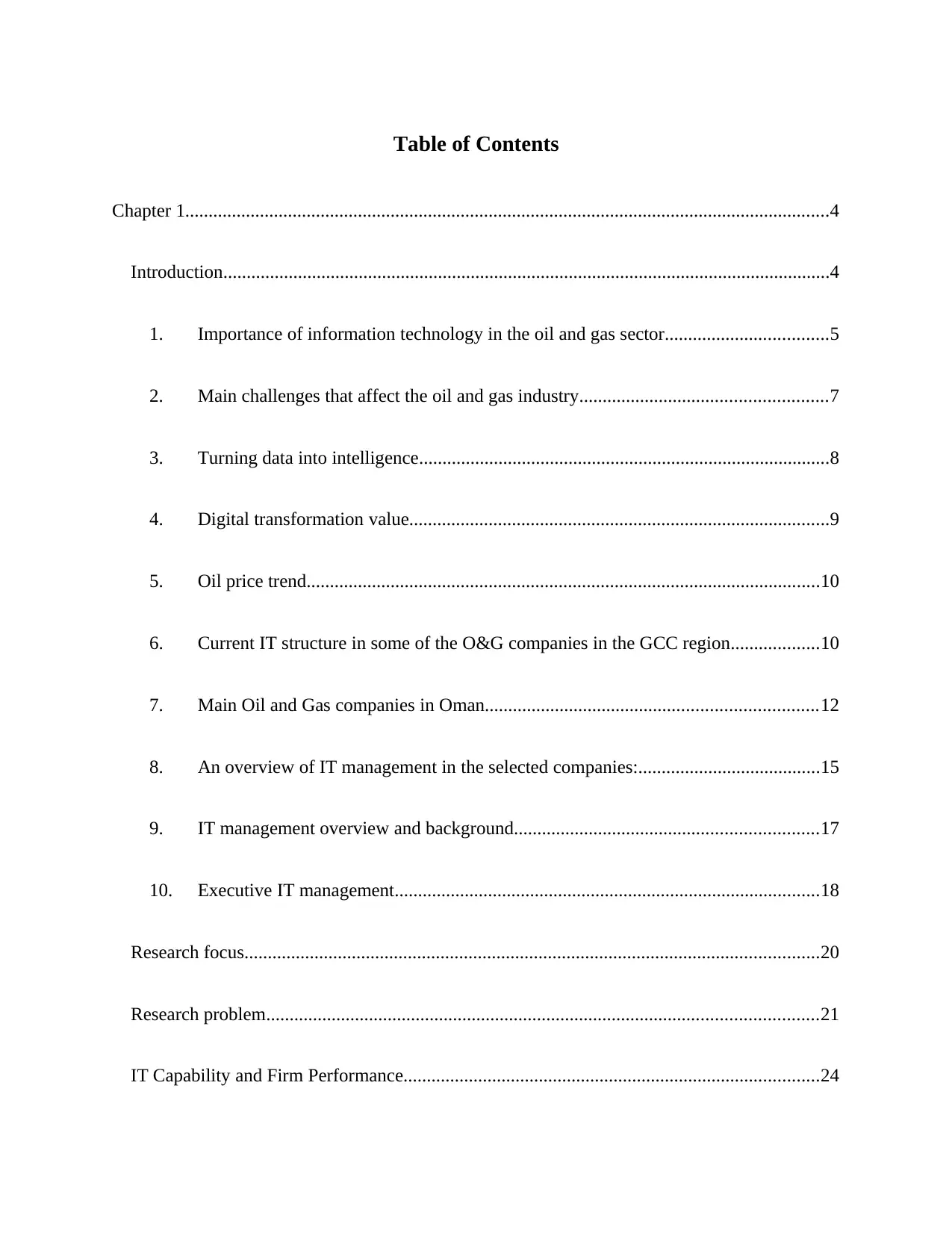
Table of Contents
Chapter 1..........................................................................................................................................4
Introduction..................................................................................................................................4
1. Importance of information technology in the oil and gas sector...................................5
2. Main challenges that affect the oil and gas industry.....................................................7
3. Turning data into intelligence........................................................................................8
4. Digital transformation value..........................................................................................9
5. Oil price trend..............................................................................................................10
6. Current IT structure in some of the O&G companies in the GCC region...................10
7. Main Oil and Gas companies in Oman.......................................................................12
8. An overview of IT management in the selected companies:.......................................15
9. IT management overview and background.................................................................17
10. Executive IT management...........................................................................................18
Research focus...........................................................................................................................20
Research problem......................................................................................................................21
IT Capability and Firm Performance.........................................................................................24
Chapter 1..........................................................................................................................................4
Introduction..................................................................................................................................4
1. Importance of information technology in the oil and gas sector...................................5
2. Main challenges that affect the oil and gas industry.....................................................7
3. Turning data into intelligence........................................................................................8
4. Digital transformation value..........................................................................................9
5. Oil price trend..............................................................................................................10
6. Current IT structure in some of the O&G companies in the GCC region...................10
7. Main Oil and Gas companies in Oman.......................................................................12
8. An overview of IT management in the selected companies:.......................................15
9. IT management overview and background.................................................................17
10. Executive IT management...........................................................................................18
Research focus...........................................................................................................................20
Research problem......................................................................................................................21
IT Capability and Firm Performance.........................................................................................24
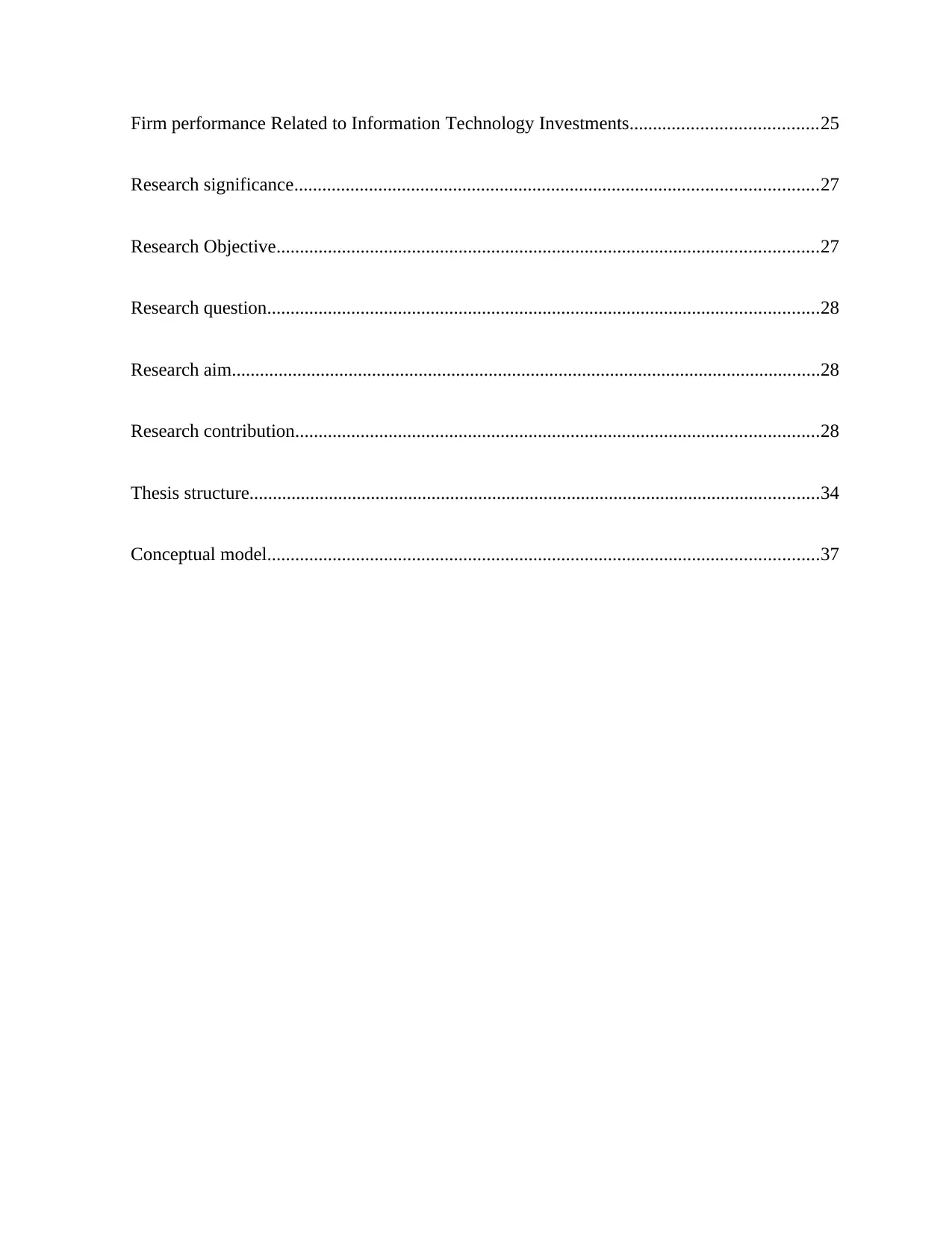
Firm performance Related to Information Technology Investments........................................25
Research significance................................................................................................................27
Research Objective....................................................................................................................27
Research question......................................................................................................................28
Research aim..............................................................................................................................28
Research contribution................................................................................................................28
Thesis structure..........................................................................................................................34
Conceptual model......................................................................................................................37
Research significance................................................................................................................27
Research Objective....................................................................................................................27
Research question......................................................................................................................28
Research aim..............................................................................................................................28
Research contribution................................................................................................................28
Thesis structure..........................................................................................................................34
Conceptual model......................................................................................................................37
⊘ This is a preview!⊘
Do you want full access?
Subscribe today to unlock all pages.

Trusted by 1+ million students worldwide
Chapter 1
Introduction
At present, there is an unpredictable market and a complete fluctuation in oil prices. As a
result of increased competition in the market, both demand and supply are changing at a rapid
rate than it used to (Lu et al. 2019). Considering the situation, both the oil and gas industry needs
to be completely flexible so that they can respond in a quick way with the smooth market
changes and stand collaborative. The point should be noted that competitive organizational
agility has highlighted a huge number of changes (Tasmin and Muazu 2017). It has ultimately
become an essential tool for making responses with respect to both market fears and its opening.
Organizational flexibility focus on the ability of the firm to make a response regarding
the unexpected changes with both rapid and innovative response. In order to develop the
capability, the organization has made a huge investment in information technologies (Mäkitie et
al. 2018). It will merely highlight the question “How does the power of the IT management
authority to enhance its organizational performance.
This research has been adopted to provide a dynamic capability approach for developing
a suitable research framework. The research highlights the dynamic system competencies, which
include both vision capabilities and complete competence understanding (Rana, Vinoba and
AlHumaidan 2017). More specifically, this research work focuses on two of the major issues on
the provided issues. The first point should be from the skills hierarchy and how the study
explores the extent of both IT capability and management capability. This ultimately aims to
affect the overall organizational performance. The complete hierarchy capabilities focus on
Introduction
At present, there is an unpredictable market and a complete fluctuation in oil prices. As a
result of increased competition in the market, both demand and supply are changing at a rapid
rate than it used to (Lu et al. 2019). Considering the situation, both the oil and gas industry needs
to be completely flexible so that they can respond in a quick way with the smooth market
changes and stand collaborative. The point should be noted that competitive organizational
agility has highlighted a huge number of changes (Tasmin and Muazu 2017). It has ultimately
become an essential tool for making responses with respect to both market fears and its opening.
Organizational flexibility focus on the ability of the firm to make a response regarding
the unexpected changes with both rapid and innovative response. In order to develop the
capability, the organization has made a huge investment in information technologies (Mäkitie et
al. 2018). It will merely highlight the question “How does the power of the IT management
authority to enhance its organizational performance.
This research has been adopted to provide a dynamic capability approach for developing
a suitable research framework. The research highlights the dynamic system competencies, which
include both vision capabilities and complete competence understanding (Rana, Vinoba and
AlHumaidan 2017). More specifically, this research work focuses on two of the major issues on
the provided issues. The first point should be from the skills hierarchy and how the study
explores the extent of both IT capability and management capability. This ultimately aims to
affect the overall organizational performance. The complete hierarchy capabilities focus on
Paraphrase This Document
Need a fresh take? Get an instant paraphrase of this document with our AI Paraphraser
views which claim the lower-order capabilities. It can be easily integrated for the generation of
some high-order capabilities. This step ultimately enhances the overall performance of the
organization (Stephenson and Agnew 2016). The point should be noted that both IT capability
and management capability as some of the low-ranked capabilities. This merely highlights that
two capabilities which will ultimately improve the high-rank capabilities.
The second point should be noted from the viewpoint of embedded capabilities that focus
on investigating the organizational structure along with performance measurement. The
capability merely focuses on the contextual aspect, which is seen with the structure, culture, and
social parameters of the firm (Rodriguez and Knapp 2018). The study focus on the
organizational environment that includes various aspects like affiliation, fairness, and
innovativeness. It will ultimately resist the overall impact of IT capability and capability of
management on the overall performance of the organization.
1. Importance of information technology in the oil and gas sector
In the last few years, the demand for IT services has been increased to a large extent. The
domain of information technology has increased a lot for some of the global resources that are
both employment and growth (Scholvin et al. 2017). At present, the IT capabilities stand out to
be important for enhancing the overall perspective of competitiveness on the global platform.
Some of the competitiveness is GDP, tackling energy and defense capabilities.
There has been a growing demand for some advanced capabilities in the domain of
software for both oil and gas projects. It merely focuses on upstream, downstream, and lastly,
midstream domains (Mbugua and Namada 2019). The computer system in the Oil industry is a
level where each and every engineer needs to be completely familiar with the methods of
some high-order capabilities. This step ultimately enhances the overall performance of the
organization (Stephenson and Agnew 2016). The point should be noted that both IT capability
and management capability as some of the low-ranked capabilities. This merely highlights that
two capabilities which will ultimately improve the high-rank capabilities.
The second point should be noted from the viewpoint of embedded capabilities that focus
on investigating the organizational structure along with performance measurement. The
capability merely focuses on the contextual aspect, which is seen with the structure, culture, and
social parameters of the firm (Rodriguez and Knapp 2018). The study focus on the
organizational environment that includes various aspects like affiliation, fairness, and
innovativeness. It will ultimately resist the overall impact of IT capability and capability of
management on the overall performance of the organization.
1. Importance of information technology in the oil and gas sector
In the last few years, the demand for IT services has been increased to a large extent. The
domain of information technology has increased a lot for some of the global resources that are
both employment and growth (Scholvin et al. 2017). At present, the IT capabilities stand out to
be important for enhancing the overall perspective of competitiveness on the global platform.
Some of the competitiveness is GDP, tackling energy and defense capabilities.
There has been a growing demand for some advanced capabilities in the domain of
software for both oil and gas projects. It merely focuses on upstream, downstream, and lastly,
midstream domains (Mbugua and Namada 2019). The computer system in the Oil industry is a
level where each and every engineer needs to be completely familiar with the methods of
calculation. It is mainly done so that it can be applied to the job. IT application stands out to be a
bit familiar with the calculation method that can be applied to the job. IT comes up with a huge
number of applications in the domain of oil and gas (Brun and Urazaliyeva 2019). The
technology has ultimately helped the industry to carry out some deepwater exploration in the
Gulf of Mexico. Also, it has helped in other discoveries, along with reducing the overall impact
on the environment. Information technology comes up with the potential to create some long-
term growth that ultimately resulted in improved productivity in various industries.
Sumbal, Tsui and See-to (2017), has highlighted five external forces which are impact is
huge to the organization. The technical response to this is that only 61% of the technological
development stands out like a critical kind of external force. There are around four areas of oil
and gas production acknowledged as technological development, efficiency in cost, cycle time
for production, high maintenance and production, and lastly, environment.
In order to succeed, all the oil and gas companies need to focus on improving its
operational efficiency that is in terms of drilling and production. The point should be noted that
operation can take advantage of all the asset data in the provided time by making use of some
sophisticated tools and techniques (González-López and Giampietro 2018). It will ultimately
help in improving the domain, reducing the overall cost of operation, and ensuring overall safety.
It merely comprises two parts that are upper and lower. The upstream areas highlight the
exploration and production of both oil and gas products. All the main phases completely include
exploration that is aerial prospecting (first stage), exploration and drilling (Second stage),
development and production (third stage), and lastly, dismantling and rehabilitation (final stage).
On the contrary, downstream completely refers to various domains with complete refining and
oil processing of both oil and crude gas products (Gonzalez-Lopez and Giampietro 2017).
bit familiar with the calculation method that can be applied to the job. IT comes up with a huge
number of applications in the domain of oil and gas (Brun and Urazaliyeva 2019). The
technology has ultimately helped the industry to carry out some deepwater exploration in the
Gulf of Mexico. Also, it has helped in other discoveries, along with reducing the overall impact
on the environment. Information technology comes up with the potential to create some long-
term growth that ultimately resulted in improved productivity in various industries.
Sumbal, Tsui and See-to (2017), has highlighted five external forces which are impact is
huge to the organization. The technical response to this is that only 61% of the technological
development stands out like a critical kind of external force. There are around four areas of oil
and gas production acknowledged as technological development, efficiency in cost, cycle time
for production, high maintenance and production, and lastly, environment.
In order to succeed, all the oil and gas companies need to focus on improving its
operational efficiency that is in terms of drilling and production. The point should be noted that
operation can take advantage of all the asset data in the provided time by making use of some
sophisticated tools and techniques (González-López and Giampietro 2018). It will ultimately
help in improving the domain, reducing the overall cost of operation, and ensuring overall safety.
It merely comprises two parts that are upper and lower. The upstream areas highlight the
exploration and production of both oil and gas products. All the main phases completely include
exploration that is aerial prospecting (first stage), exploration and drilling (Second stage),
development and production (third stage), and lastly, dismantling and rehabilitation (final stage).
On the contrary, downstream completely refers to various domains with complete refining and
oil processing of both oil and crude gas products (Gonzalez-Lopez and Giampietro 2017).
⊘ This is a preview!⊘
Do you want full access?
Subscribe today to unlock all pages.
Trusted by 1+ million students worldwide
Downstream focuses on various domains like refinement, oil process and gas products,
transportation, distribution, and commercialization.
This process and system require complete involvement of production, refining,
exploration and commercialization of both oil and gas, which is very much complex, capital
intensive and needs cutting edge technology (Gunasekaran, Subramanian and Papadopoulos
2017). The domain of oil and gas completely includes some of the complex IT tools needed for
refining operation, joint venture accounting, the process of sales and distribution. Besides, this
focuses on the planning application and maintenance of the plant.
2. Main challenges that affect the oil and gas industry
None of the industries on the global platforms need a diverse human, political,
technological, and mechanical capacity for oil and gas production and exploration industries
(Khan et al. 2017). There has been an ongoing competition for natural resources that has forced
the organization to explore and produce a much hostile approach where some simple task in
logistics stand out to be a bit difficult and even costly. Diversifying the environment stands out
to be unacceptable and challenging due to its complex nature (Scholvin et al. 2017). Even some
of the smart monitoring makes use of a downhole of the sensor, which will help in the monitor
well and is vital for development in the industry.
New technologies within the current system, tools help in providing a global platform for
business partners. This merely focuses on potential and useful data that is being captured and not
generally stored or distributed to any person who can make use of it (Jafari and Nair 2018).
Some of the complex problems with respect to production are sanding, which comprises of sand,
penetration, plug well, and negatively impacting the overall production. It merely requires a
transportation, distribution, and commercialization.
This process and system require complete involvement of production, refining,
exploration and commercialization of both oil and gas, which is very much complex, capital
intensive and needs cutting edge technology (Gunasekaran, Subramanian and Papadopoulos
2017). The domain of oil and gas completely includes some of the complex IT tools needed for
refining operation, joint venture accounting, the process of sales and distribution. Besides, this
focuses on the planning application and maintenance of the plant.
2. Main challenges that affect the oil and gas industry
None of the industries on the global platforms need a diverse human, political,
technological, and mechanical capacity for oil and gas production and exploration industries
(Khan et al. 2017). There has been an ongoing competition for natural resources that has forced
the organization to explore and produce a much hostile approach where some simple task in
logistics stand out to be a bit difficult and even costly. Diversifying the environment stands out
to be unacceptable and challenging due to its complex nature (Scholvin et al. 2017). Even some
of the smart monitoring makes use of a downhole of the sensor, which will help in the monitor
well and is vital for development in the industry.
New technologies within the current system, tools help in providing a global platform for
business partners. This merely focuses on potential and useful data that is being captured and not
generally stored or distributed to any person who can make use of it (Jafari and Nair 2018).
Some of the complex problems with respect to production are sanding, which comprises of sand,
penetration, plug well, and negatively impacting the overall production. It merely requires a
Paraphrase This Document
Need a fresh take? Get an instant paraphrase of this document with our AI Paraphraser
complete understanding of the production issues and tools for its analysis. This merely focuses
on determining some of the historical patterns.
Transformation of the collected data stands out to be useful and relevant for all the
information which makes the critical decision in business. It stands out to be one of the main
issues which this industry is addressing at present. Taking into account the manufacturing
organizations, the supply chain stands out to be a bit complex, which is a combination of various
materials, information and capital (Lu et al. 2019). This particular complexity has given rise to
various issues like reduction of visibility within the operation in the organization. The point
should be noted that inefficiency often leads to poor performance and productivity (Mäkitie et al.
2018). In addition, this also results in inadequate storage of information or even data standing out
to be a shortage of measures needed for proper decision making (Tasmin and Muazu 2017). It
will ultimately result in enhanced compliance standards, which ultimately shortens the overall
product lifecycle.
3. Turning data into intelligence
As a result of the capabilities of the current monitoring system, it can easily produce
around more than a terabyte of data in a single day. The demand approach stands out to be
important for data access and its analysis (Rana, Vinoba and AlHumaidan 2017). Information is
completely based on the change in pressure and temperature with changes in the pump effect and
composition of the fluid. Various kinds of architecture highlighted the slow kind of
interdepartmental communication. Considering the on-demand approach, it can easily provide
some business value by allowing the organization to change these data into information. All
these can be easily directed to the right individual in the right instance by making use of remote
on determining some of the historical patterns.
Transformation of the collected data stands out to be useful and relevant for all the
information which makes the critical decision in business. It stands out to be one of the main
issues which this industry is addressing at present. Taking into account the manufacturing
organizations, the supply chain stands out to be a bit complex, which is a combination of various
materials, information and capital (Lu et al. 2019). This particular complexity has given rise to
various issues like reduction of visibility within the operation in the organization. The point
should be noted that inefficiency often leads to poor performance and productivity (Mäkitie et al.
2018). In addition, this also results in inadequate storage of information or even data standing out
to be a shortage of measures needed for proper decision making (Tasmin and Muazu 2017). It
will ultimately result in enhanced compliance standards, which ultimately shortens the overall
product lifecycle.
3. Turning data into intelligence
As a result of the capabilities of the current monitoring system, it can easily produce
around more than a terabyte of data in a single day. The demand approach stands out to be
important for data access and its analysis (Rana, Vinoba and AlHumaidan 2017). Information is
completely based on the change in pressure and temperature with changes in the pump effect and
composition of the fluid. Various kinds of architecture highlighted the slow kind of
interdepartmental communication. Considering the on-demand approach, it can easily provide
some business value by allowing the organization to change these data into information. All
these can be easily directed to the right individual in the right instance by making use of remote
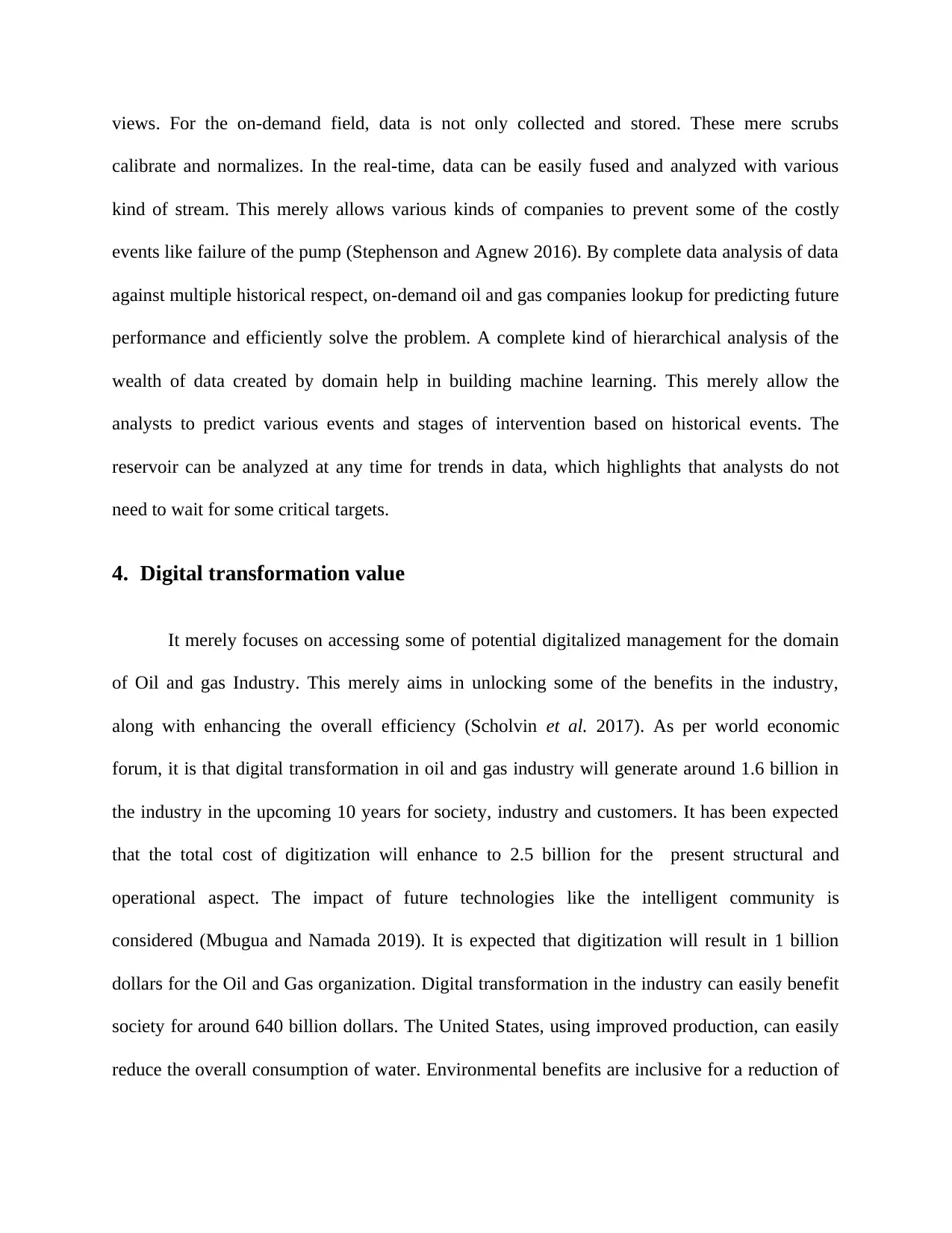
views. For the on-demand field, data is not only collected and stored. These mere scrubs
calibrate and normalizes. In the real-time, data can be easily fused and analyzed with various
kind of stream. This merely allows various kinds of companies to prevent some of the costly
events like failure of the pump (Stephenson and Agnew 2016). By complete data analysis of data
against multiple historical respect, on-demand oil and gas companies lookup for predicting future
performance and efficiently solve the problem. A complete kind of hierarchical analysis of the
wealth of data created by domain help in building machine learning. This merely allow the
analysts to predict various events and stages of intervention based on historical events. The
reservoir can be analyzed at any time for trends in data, which highlights that analysts do not
need to wait for some critical targets.
4. Digital transformation value
It merely focuses on accessing some of potential digitalized management for the domain
of Oil and gas Industry. This merely aims in unlocking some of the benefits in the industry,
along with enhancing the overall efficiency (Scholvin et al. 2017). As per world economic
forum, it is that digital transformation in oil and gas industry will generate around 1.6 billion in
the industry in the upcoming 10 years for society, industry and customers. It has been expected
that the total cost of digitization will enhance to 2.5 billion for the present structural and
operational aspect. The impact of future technologies like the intelligent community is
considered (Mbugua and Namada 2019). It is expected that digitization will result in 1 billion
dollars for the Oil and Gas organization. Digital transformation in the industry can easily benefit
society for around 640 billion dollars. The United States, using improved production, can easily
reduce the overall consumption of water. Environmental benefits are inclusive for a reduction of
calibrate and normalizes. In the real-time, data can be easily fused and analyzed with various
kind of stream. This merely allows various kinds of companies to prevent some of the costly
events like failure of the pump (Stephenson and Agnew 2016). By complete data analysis of data
against multiple historical respect, on-demand oil and gas companies lookup for predicting future
performance and efficiently solve the problem. A complete kind of hierarchical analysis of the
wealth of data created by domain help in building machine learning. This merely allow the
analysts to predict various events and stages of intervention based on historical events. The
reservoir can be analyzed at any time for trends in data, which highlights that analysts do not
need to wait for some critical targets.
4. Digital transformation value
It merely focuses on accessing some of potential digitalized management for the domain
of Oil and gas Industry. This merely aims in unlocking some of the benefits in the industry,
along with enhancing the overall efficiency (Scholvin et al. 2017). As per world economic
forum, it is that digital transformation in oil and gas industry will generate around 1.6 billion in
the industry in the upcoming 10 years for society, industry and customers. It has been expected
that the total cost of digitization will enhance to 2.5 billion for the present structural and
operational aspect. The impact of future technologies like the intelligent community is
considered (Mbugua and Namada 2019). It is expected that digitization will result in 1 billion
dollars for the Oil and Gas organization. Digital transformation in the industry can easily benefit
society for around 640 billion dollars. The United States, using improved production, can easily
reduce the overall consumption of water. Environmental benefits are inclusive for a reduction of
⊘ This is a preview!⊘
Do you want full access?
Subscribe today to unlock all pages.
Trusted by 1+ million students worldwide
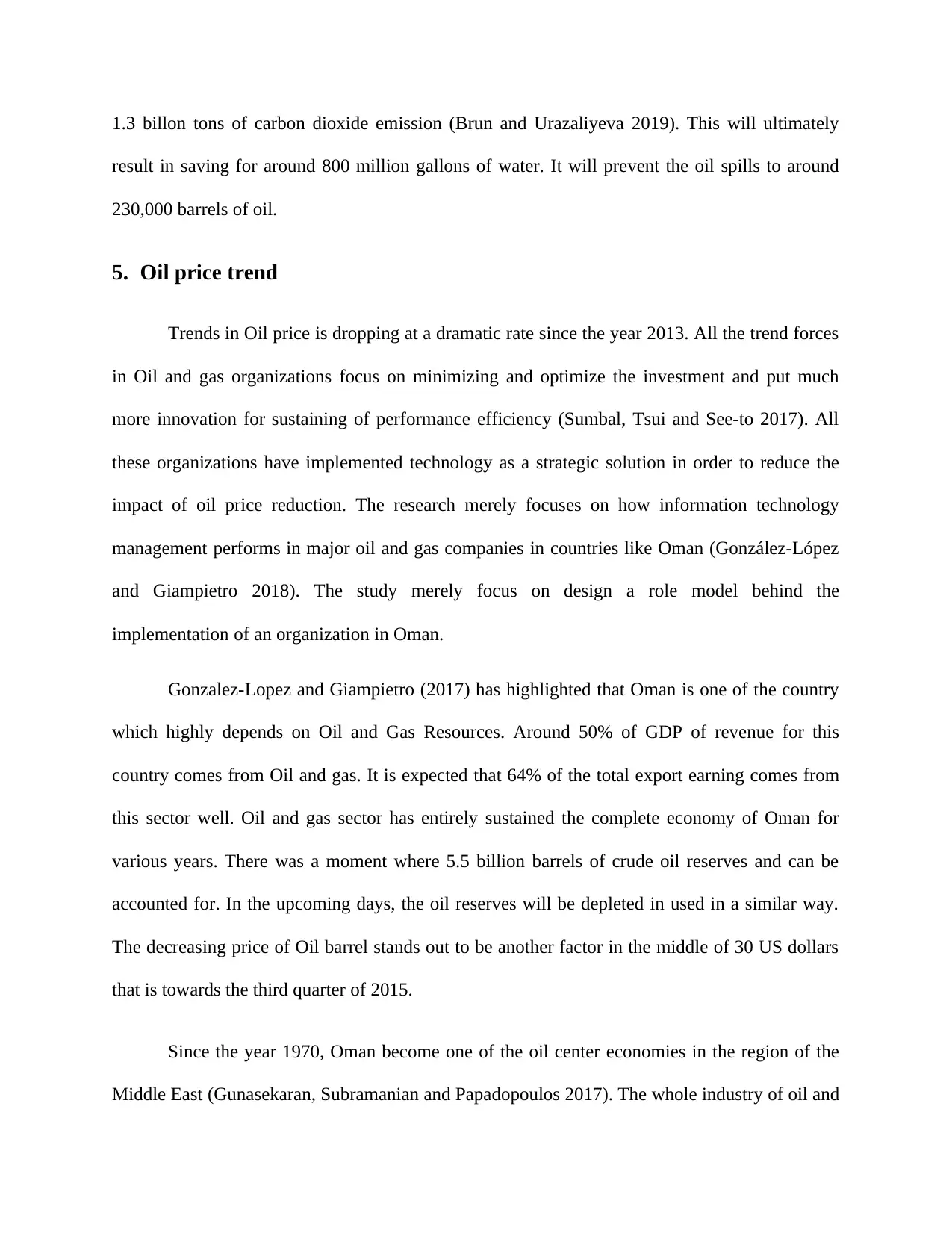
1.3 billon tons of carbon dioxide emission (Brun and Urazaliyeva 2019). This will ultimately
result in saving for around 800 million gallons of water. It will prevent the oil spills to around
230,000 barrels of oil.
5. Oil price trend
Trends in Oil price is dropping at a dramatic rate since the year 2013. All the trend forces
in Oil and gas organizations focus on minimizing and optimize the investment and put much
more innovation for sustaining of performance efficiency (Sumbal, Tsui and See-to 2017). All
these organizations have implemented technology as a strategic solution in order to reduce the
impact of oil price reduction. The research merely focuses on how information technology
management performs in major oil and gas companies in countries like Oman (González-López
and Giampietro 2018). The study merely focus on design a role model behind the
implementation of an organization in Oman.
Gonzalez-Lopez and Giampietro (2017) has highlighted that Oman is one of the country
which highly depends on Oil and Gas Resources. Around 50% of GDP of revenue for this
country comes from Oil and gas. It is expected that 64% of the total export earning comes from
this sector well. Oil and gas sector has entirely sustained the complete economy of Oman for
various years. There was a moment where 5.5 billion barrels of crude oil reserves and can be
accounted for. In the upcoming days, the oil reserves will be depleted in used in a similar way.
The decreasing price of Oil barrel stands out to be another factor in the middle of 30 US dollars
that is towards the third quarter of 2015.
Since the year 1970, Oman become one of the oil center economies in the region of the
Middle East (Gunasekaran, Subramanian and Papadopoulos 2017). The whole industry of oil and
result in saving for around 800 million gallons of water. It will prevent the oil spills to around
230,000 barrels of oil.
5. Oil price trend
Trends in Oil price is dropping at a dramatic rate since the year 2013. All the trend forces
in Oil and gas organizations focus on minimizing and optimize the investment and put much
more innovation for sustaining of performance efficiency (Sumbal, Tsui and See-to 2017). All
these organizations have implemented technology as a strategic solution in order to reduce the
impact of oil price reduction. The research merely focuses on how information technology
management performs in major oil and gas companies in countries like Oman (González-López
and Giampietro 2018). The study merely focus on design a role model behind the
implementation of an organization in Oman.
Gonzalez-Lopez and Giampietro (2017) has highlighted that Oman is one of the country
which highly depends on Oil and Gas Resources. Around 50% of GDP of revenue for this
country comes from Oil and gas. It is expected that 64% of the total export earning comes from
this sector well. Oil and gas sector has entirely sustained the complete economy of Oman for
various years. There was a moment where 5.5 billion barrels of crude oil reserves and can be
accounted for. In the upcoming days, the oil reserves will be depleted in used in a similar way.
The decreasing price of Oil barrel stands out to be another factor in the middle of 30 US dollars
that is towards the third quarter of 2015.
Since the year 1970, Oman become one of the oil center economies in the region of the
Middle East (Gunasekaran, Subramanian and Papadopoulos 2017). The whole industry of oil and
Paraphrase This Document
Need a fresh take? Get an instant paraphrase of this document with our AI Paraphraser
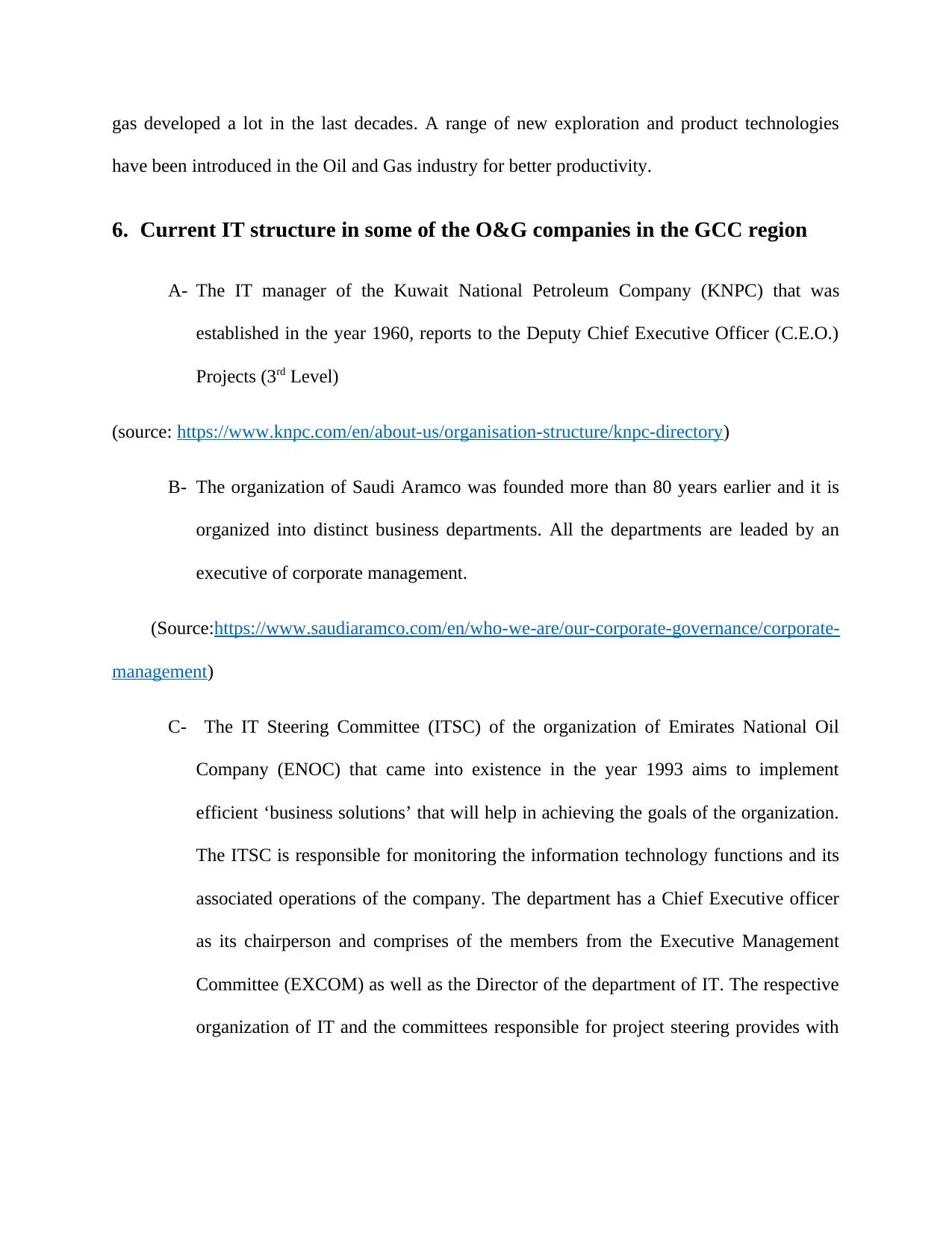
gas developed a lot in the last decades. A range of new exploration and product technologies
have been introduced in the Oil and Gas industry for better productivity.
6. Current IT structure in some of the O&G companies in the GCC region
A- The IT manager of the Kuwait National Petroleum Company (KNPC) that was
established in the year 1960, reports to the Deputy Chief Executive Officer (C.E.O.)
Projects (3rd Level)
(source: https://www.knpc.com/en/about-us/organisation-structure/knpc-directory)
B- The organization of Saudi Aramco was founded more than 80 years earlier and it is
organized into distinct business departments. All the departments are leaded by an
executive of corporate management.
(Source:https://www.saudiaramco.com/en/who-we-are/our-corporate-governance/corporate-
management)
C- The IT Steering Committee (ITSC) of the organization of Emirates National Oil
Company (ENOC) that came into existence in the year 1993 aims to implement
efficient ‘business solutions’ that will help in achieving the goals of the organization.
The ITSC is responsible for monitoring the information technology functions and its
associated operations of the company. The department has a Chief Executive officer
as its chairperson and comprises of the members from the Executive Management
Committee (EXCOM) as well as the Director of the department of IT. The respective
organization of IT and the committees responsible for project steering provides with
have been introduced in the Oil and Gas industry for better productivity.
6. Current IT structure in some of the O&G companies in the GCC region
A- The IT manager of the Kuwait National Petroleum Company (KNPC) that was
established in the year 1960, reports to the Deputy Chief Executive Officer (C.E.O.)
Projects (3rd Level)
(source: https://www.knpc.com/en/about-us/organisation-structure/knpc-directory)
B- The organization of Saudi Aramco was founded more than 80 years earlier and it is
organized into distinct business departments. All the departments are leaded by an
executive of corporate management.
(Source:https://www.saudiaramco.com/en/who-we-are/our-corporate-governance/corporate-
management)
C- The IT Steering Committee (ITSC) of the organization of Emirates National Oil
Company (ENOC) that came into existence in the year 1993 aims to implement
efficient ‘business solutions’ that will help in achieving the goals of the organization.
The ITSC is responsible for monitoring the information technology functions and its
associated operations of the company. The department has a Chief Executive officer
as its chairperson and comprises of the members from the Executive Management
Committee (EXCOM) as well as the Director of the department of IT. The respective
organization of IT and the committees responsible for project steering provides with
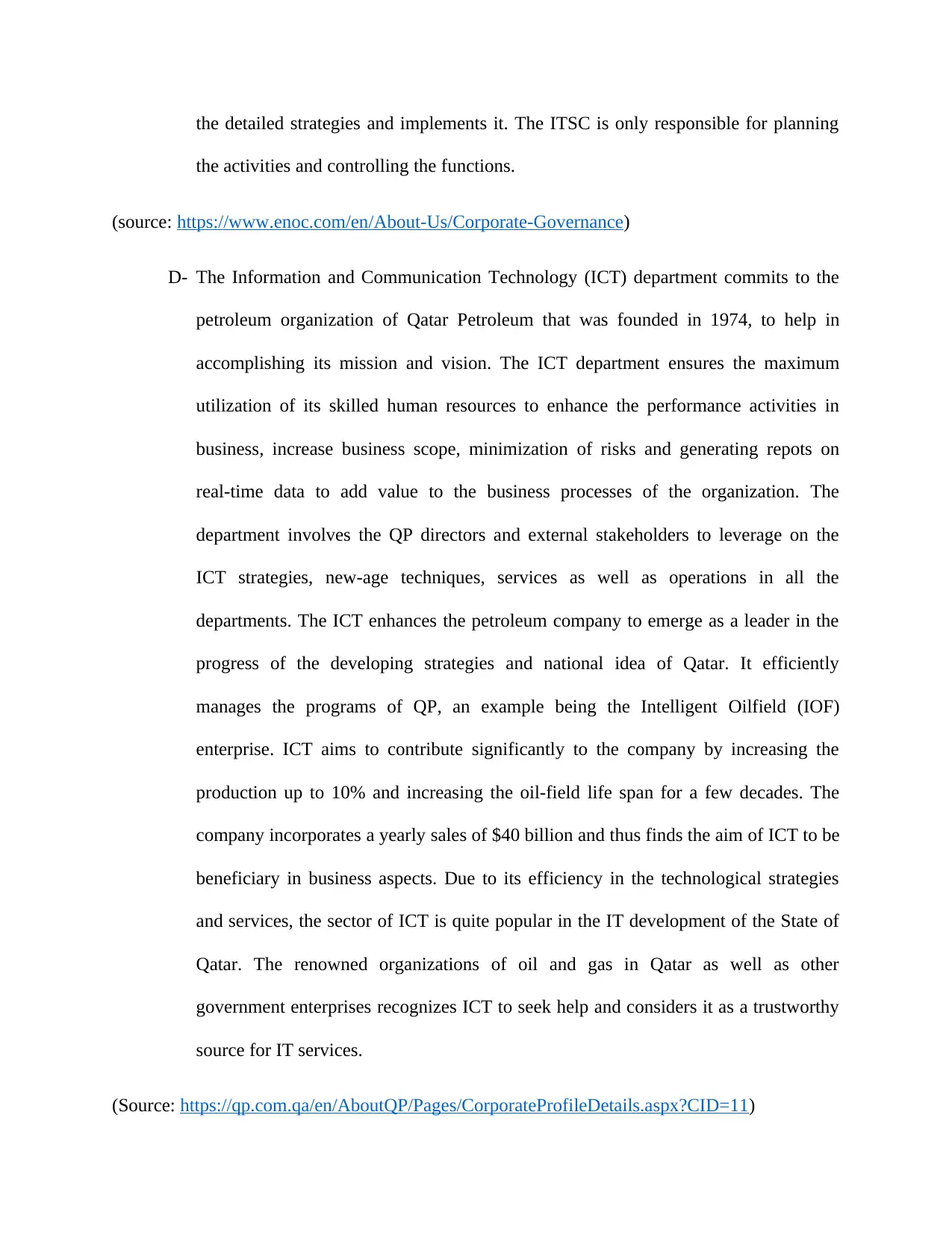
the detailed strategies and implements it. The ITSC is only responsible for planning
the activities and controlling the functions.
(source: https://www.enoc.com/en/About-Us/Corporate-Governance)
D- The Information and Communication Technology (ICT) department commits to the
petroleum organization of Qatar Petroleum that was founded in 1974, to help in
accomplishing its mission and vision. The ICT department ensures the maximum
utilization of its skilled human resources to enhance the performance activities in
business, increase business scope, minimization of risks and generating repots on
real-time data to add value to the business processes of the organization. The
department involves the QP directors and external stakeholders to leverage on the
ICT strategies, new-age techniques, services as well as operations in all the
departments. The ICT enhances the petroleum company to emerge as a leader in the
progress of the developing strategies and national idea of Qatar. It efficiently
manages the programs of QP, an example being the Intelligent Oilfield (IOF)
enterprise. ICT aims to contribute significantly to the company by increasing the
production up to 10% and increasing the oil-field life span for a few decades. The
company incorporates a yearly sales of $40 billion and thus finds the aim of ICT to be
beneficiary in business aspects. Due to its efficiency in the technological strategies
and services, the sector of ICT is quite popular in the IT development of the State of
Qatar. The renowned organizations of oil and gas in Qatar as well as other
government enterprises recognizes ICT to seek help and considers it as a trustworthy
source for IT services.
(Source: https://qp.com.qa/en/AboutQP/Pages/CorporateProfileDetails.aspx?CID=11)
the activities and controlling the functions.
(source: https://www.enoc.com/en/About-Us/Corporate-Governance)
D- The Information and Communication Technology (ICT) department commits to the
petroleum organization of Qatar Petroleum that was founded in 1974, to help in
accomplishing its mission and vision. The ICT department ensures the maximum
utilization of its skilled human resources to enhance the performance activities in
business, increase business scope, minimization of risks and generating repots on
real-time data to add value to the business processes of the organization. The
department involves the QP directors and external stakeholders to leverage on the
ICT strategies, new-age techniques, services as well as operations in all the
departments. The ICT enhances the petroleum company to emerge as a leader in the
progress of the developing strategies and national idea of Qatar. It efficiently
manages the programs of QP, an example being the Intelligent Oilfield (IOF)
enterprise. ICT aims to contribute significantly to the company by increasing the
production up to 10% and increasing the oil-field life span for a few decades. The
company incorporates a yearly sales of $40 billion and thus finds the aim of ICT to be
beneficiary in business aspects. Due to its efficiency in the technological strategies
and services, the sector of ICT is quite popular in the IT development of the State of
Qatar. The renowned organizations of oil and gas in Qatar as well as other
government enterprises recognizes ICT to seek help and considers it as a trustworthy
source for IT services.
(Source: https://qp.com.qa/en/AboutQP/Pages/CorporateProfileDetails.aspx?CID=11)
⊘ This is a preview!⊘
Do you want full access?
Subscribe today to unlock all pages.
Trusted by 1+ million students worldwide

1 out of 46


Related Documents


Your All-in-One AI-Powered Toolkit for Academic Success.
+13062052269
info@desklib.com
Available 24*7 on WhatsApp / Email
![[object Object]](/_next/static/media/star-bottom.7253800d.svg)
Unlock your academic potential
Copyright © 2020–2026 A2Z Services. All Rights Reserved. Developed and managed by ZUCOL.