Informative Speech Outline: Pragmatism, Mentoring, and Benefits

Verified

Added on  2023/03/29

|3
|424
|103
Homework Assignment
AI Summary
This assignment presents two informative speech outlines. The first outline focuses on pragmatism, covering its educational implications, forms (humanistic, experimental, nominalist, biological), and principles (pluralism, change, utilitarianism, individualism). It includes a detailed introduction with an attention getter, purpose statement, credibility, significance, and preview, followed by body paragraphs exploring the educational aspects and forms, and concluding with a summary of the principles, forms, and educational implications. The second outline discusses the benefits of mentoring, starting with an engaging introduction that highlights personal experiences and the importance of mentoring. It outlines the benefits for both mentees and mentors, structured with an attention getter, significance, credibility, purpose statement, and preview. The body of the speech covers the positive impacts on mentees and mentors, concluding with a summary of the main points. Both outlines adhere to the required structure, including pre-introduction elements, a full introduction, two main points, sub-points, and transitions. The assignment also provides references and a grading rubric for evaluation.
Document Page
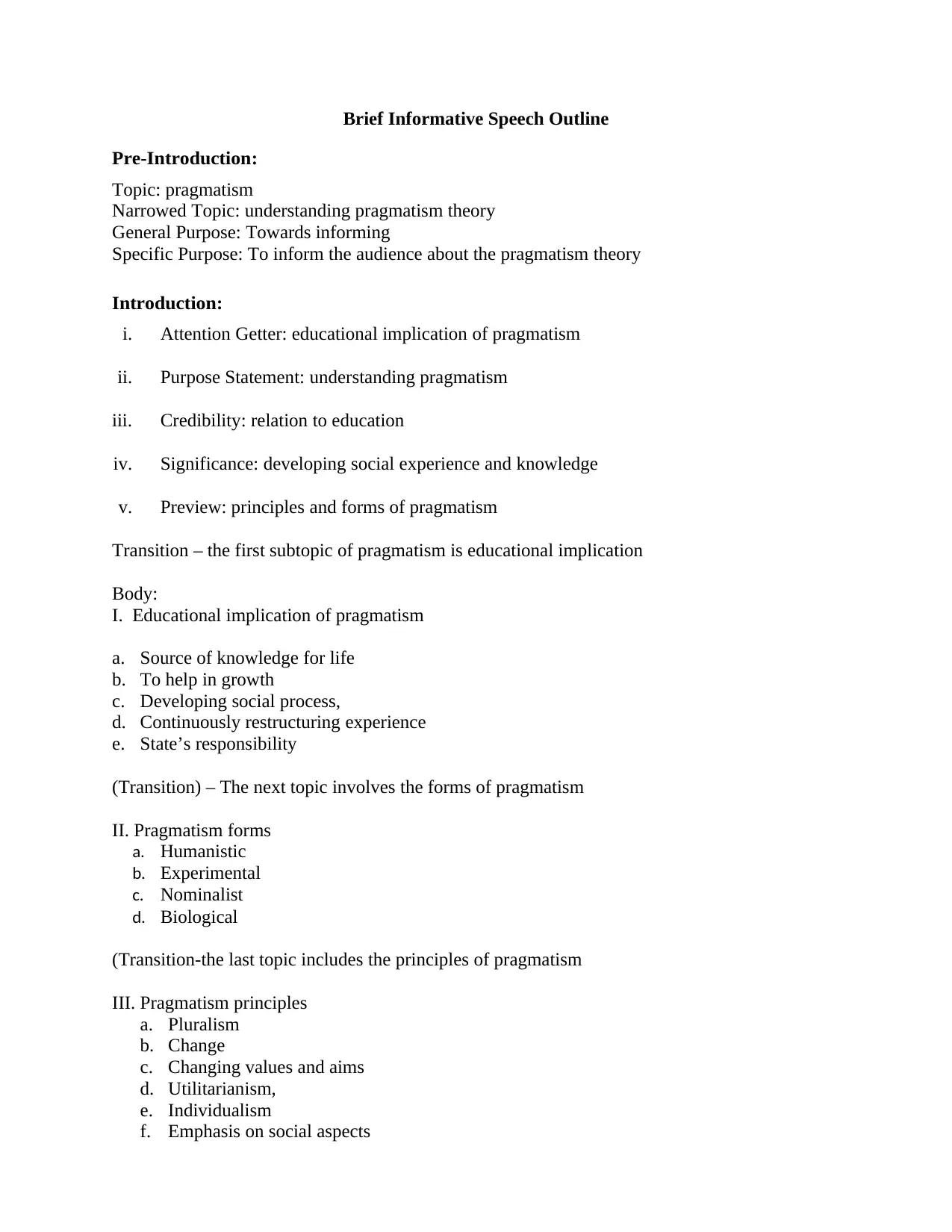
Brief Informative Speech Outline
P re- Introduction:
Topic: pragmatism
Narrowed Topic: understanding pragmatism theory
General Purpose: Towards informing
Specific Purpose: To inform the audience about the pragmatism theory
I ntroduction:
i. Attention Getter: educational implication of pragmatism
ii. Purpose Statement: understanding pragmatism
iii. Credibility: relation to education
iv. Significance: developing social experience and knowledge
v. Preview: principles and forms of pragmatism
Transition – the first subtopic of pragmatism is educational implication
Body:
I. Educational implication of pragmatism
a. Source of knowledge for life
b. To help in growth
c. Developing social process,
d. Continuously restructuring experience
e. State’s responsibility
(Transition) – The next topic involves the forms of pragmatism
II. Pragmatism forms
a. Humanistic
b. Experimental
c. Nominalist
d. Biological
(Transition-the last topic includes the principles of pragmatism
III. Pragmatism principles
a. Pluralism
b. Change
c. Changing values and aims
d. Utilitarianism,
e. Individualism
f. Emphasis on social aspects
tabler-icon-diamond-filled.svg

Paraphrase This Document

Need a fresh take? Get an instant paraphrase of this document with our AI Paraphraser
Document Page
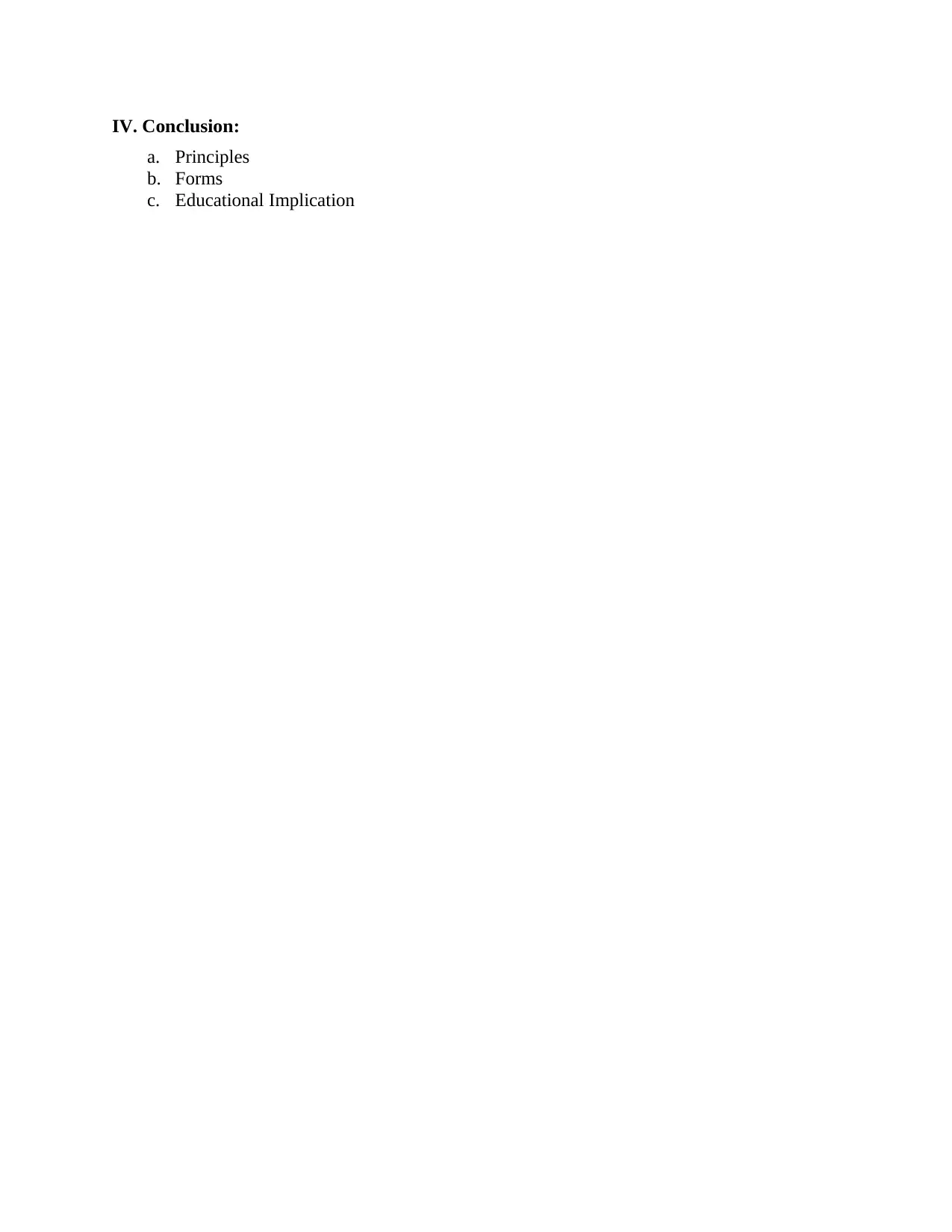
IV. C onclusion:
a. Principles
b. Forms
c. Educational Implication
Document Page
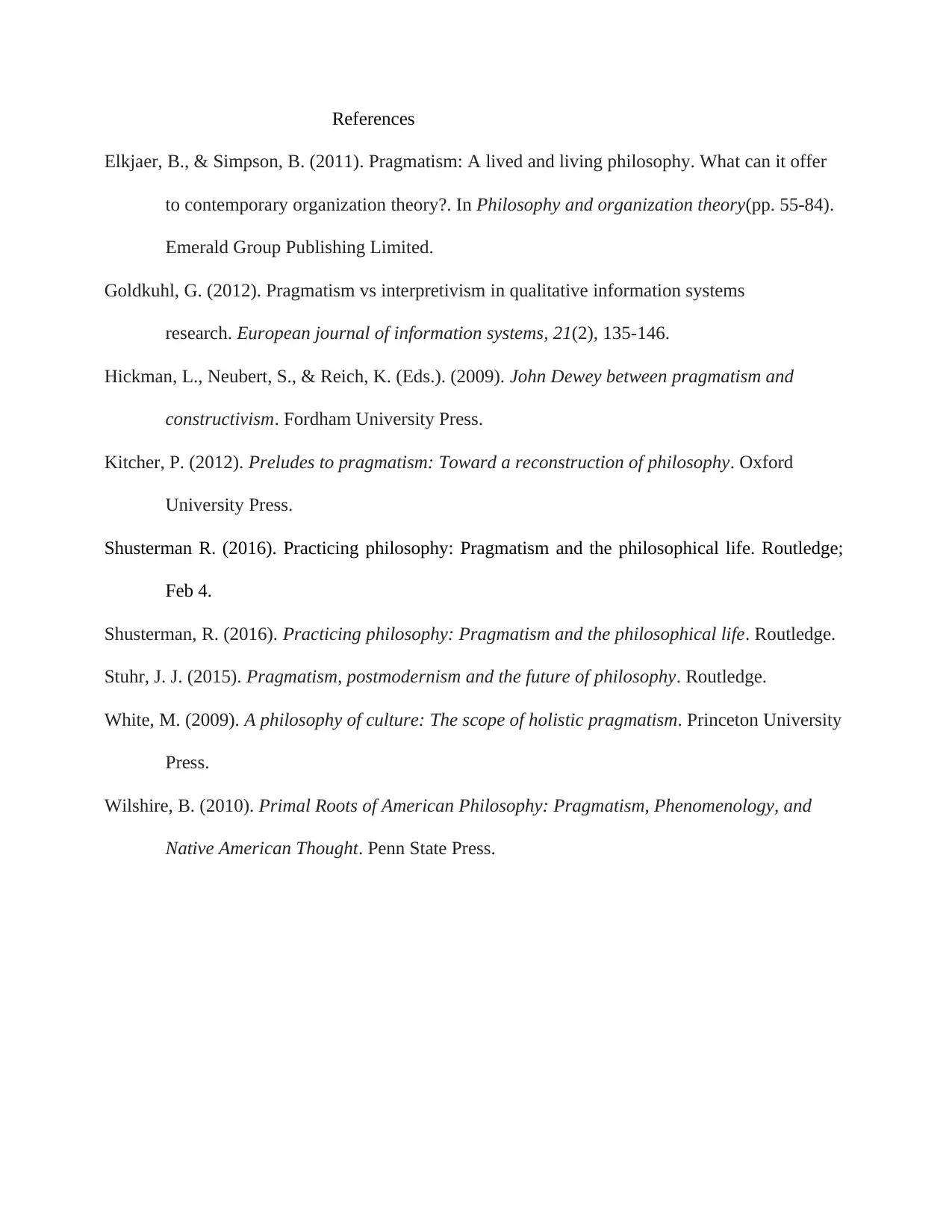
References
Elkjaer, B., & Simpson, B. (2011). Pragmatism: A lived and living philosophy. What can it offer
to contemporary organization theory?. In Philosophy and organization theory(pp. 55-84).
Emerald Group Publishing Limited.
Goldkuhl, G. (2012). Pragmatism vs interpretivism in qualitative information systems
research. European journal of information systems, 21(2), 135-146.
Hickman, L., Neubert, S., & Reich, K. (Eds.). (2009). John Dewey between pragmatism and
constructivism. Fordham University Press.
Kitcher, P. (2012). Preludes to pragmatism: Toward a reconstruction of philosophy. Oxford
University Press.
Shusterman R. (2016). Practicing philosophy: Pragmatism and the philosophical life. Routledge;
Feb 4.
Shusterman, R. (2016). Practicing philosophy: Pragmatism and the philosophical life. Routledge.
Stuhr, J. J. (2015). Pragmatism, postmodernism and the future of philosophy. Routledge.
White, M. (2009). A philosophy of culture: The scope of holistic pragmatism. Princeton University
Press.
Wilshire, B. (2010). Primal Roots of American Philosophy: Pragmatism, Phenomenology, and
Native American Thought. Penn State Press.
chevron_up_icon
1 out of 3
circle_padding
hide_on_mobile
zoom_out_icon
[object Object]