Marketing Management & Digital Communication: Ingogo's Marketing Plan
VerifiedAdded on 2021/05/31
|16
|3702
|54
Report
AI Summary
This report provides a comprehensive marketing plan for Ingogo, an Australian taxi booking app. It begins with an executive summary, followed by an introduction detailing Ingogo's background and objectives. The report includes a situation analysis, problem statement, and an examination of potential market segments. A SWOT analysis is presented, along with an assessment of the target market and positioning. The marketing objectives, financial goals, and marketing strategies, including the marketing mix (product, price, place, promotion, physical evidence, processes, and people), are thoroughly discussed. The report also outlines the implementation and control mechanisms, the promotion mix, and concludes with a summary of key findings and recommendations. The report emphasizes Ingogo's competitive landscape, particularly against Uber, and its strategies for customer acquisition and retention, leveraging digital communication channels and an ethnocentric approach to the Australian market. The report also highlights Ingogo's innovative approach to customer and driver satisfaction, focusing on design-led thinking and partnerships to enhance service offerings.
Running head: MARKETING MANAGEMENT & DIGITAL COMMUNICATION
Ingogo’s Marketing Plan
Student’s name
Name of the Institute
Ingogo’s Marketing Plan
Student’s name
Name of the Institute

Paraphrase This Document
Need a fresh take? Get an instant paraphrase of this document with our AI Paraphraser
MARKETING MANAGEMENT & DIGITAL COMMUNICATION
Executive Summary
The following market plan describes the introduction of the company, its situational
analysis, problem statement, marketing objectives and goals, financial objectives and goal,
implementation plan and promotional mix for the year. The company is set to make a unique
presence in the taxi booking industry which will give tough competition to its competitors. It
aims to operate effectively and efficiently. The company gives special attention to strategies. It
admits that competing in saturated market is difficult but it has its own advantages as well. It is
assumed that business customers look for convenience and seamless service. The company has
used ethnocentric approach of being Australian venture. It claims to understand customers’ needs
better than competitors. It has tied up with Concur to provide cost effective solution.The
company is using sales promotion, social and traditional advertisement to create awareness about
its services and offers in the market. The company is all set to create a good market share in the
Australian market.
Executive Summary
The following market plan describes the introduction of the company, its situational
analysis, problem statement, marketing objectives and goals, financial objectives and goal,
implementation plan and promotional mix for the year. The company is set to make a unique
presence in the taxi booking industry which will give tough competition to its competitors. It
aims to operate effectively and efficiently. The company gives special attention to strategies. It
admits that competing in saturated market is difficult but it has its own advantages as well. It is
assumed that business customers look for convenience and seamless service. The company has
used ethnocentric approach of being Australian venture. It claims to understand customers’ needs
better than competitors. It has tied up with Concur to provide cost effective solution.The
company is using sales promotion, social and traditional advertisement to create awareness about
its services and offers in the market. The company is all set to create a good market share in the
Australian market.
MARKETING MANAGEMENT & DIGITAL COMMUNICATION
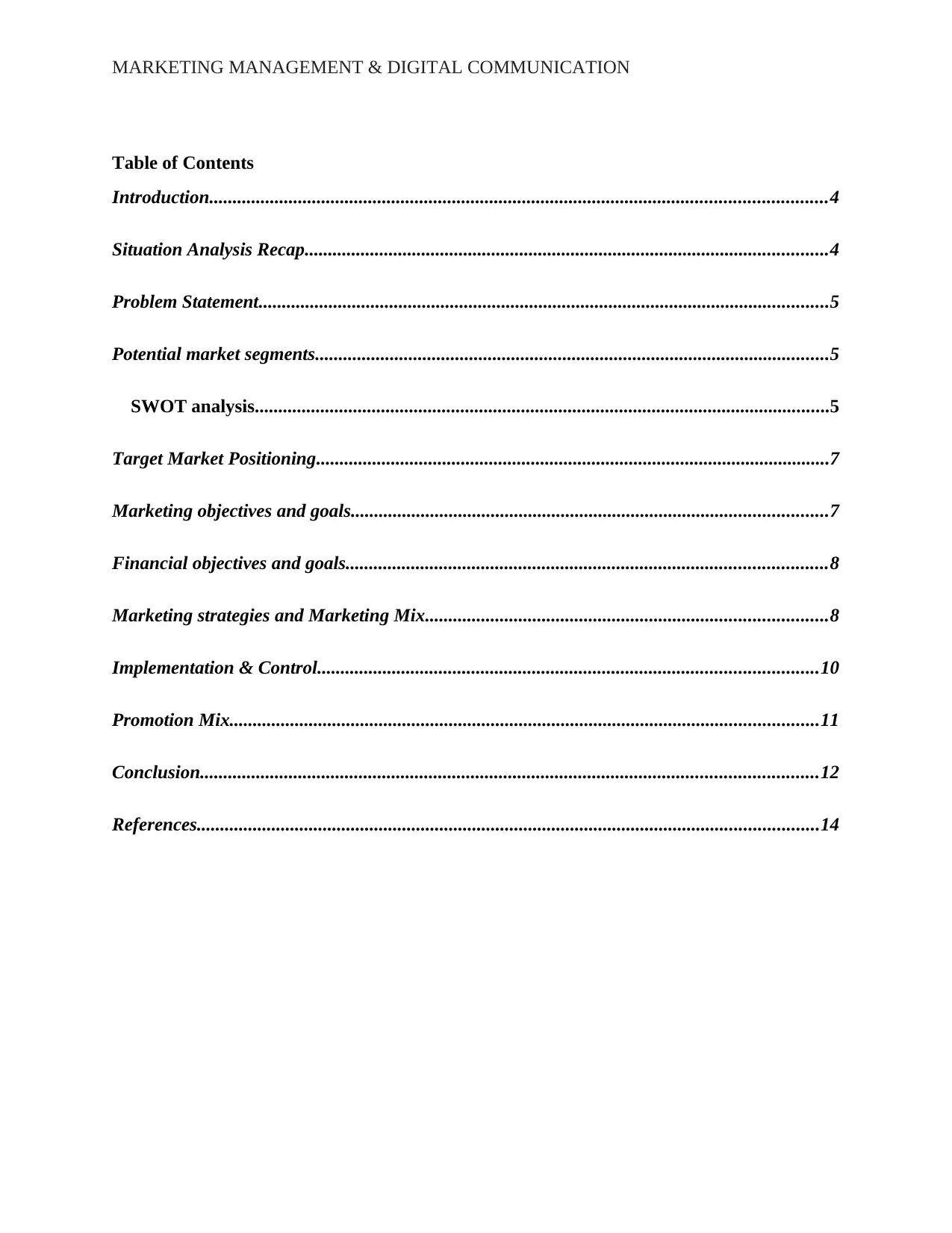
Table of Contents
Introduction....................................................................................................................................4
Situation Analysis Recap................................................................................................................4
Problem Statement..........................................................................................................................5
Potential market segments..............................................................................................................5
SWOT analysis...........................................................................................................................5
Target Market Positioning..............................................................................................................7
Marketing objectives and goals......................................................................................................7
Financial objectives and goals.......................................................................................................8
Marketing strategies and Marketing Mix......................................................................................8
Implementation & Control...........................................................................................................10
Promotion Mix..............................................................................................................................11
Conclusion....................................................................................................................................12
References.....................................................................................................................................14
Table of Contents
Introduction....................................................................................................................................4
Situation Analysis Recap................................................................................................................4
Problem Statement..........................................................................................................................5
Potential market segments..............................................................................................................5
SWOT analysis...........................................................................................................................5
Target Market Positioning..............................................................................................................7
Marketing objectives and goals......................................................................................................7
Financial objectives and goals.......................................................................................................8
Marketing strategies and Marketing Mix......................................................................................8
Implementation & Control...........................................................................................................10
Promotion Mix..............................................................................................................................11
Conclusion....................................................................................................................................12
References.....................................................................................................................................14
⊘ This is a preview!⊘
Do you want full access?
Subscribe today to unlock all pages.

Trusted by 1+ million students worldwide
MARKETING MANAGEMENT & DIGITAL COMMUNICATION
Introduction
Ingogo is Australian taxi booking app. It has introduced payment service named “Ingogo
Now”. Ingogo tries to understand the issue faced by the customers during cab riding and
booking. The insights are then used to bring innovation in the market (Armstrong & Brennan,
2015). The company has huge amount of investment from renowned investors. The app provides
multiple facilities like connecting with the driver, tracking him etc. It guarantees comfort,
convenience, seamless and value-added services to customers. The company is providing cabs in
Sydney, Melbourne, Adelaide, Brisbane and Berth. The key purpose, scope and limitation of this
report can be discussed as:
Purpose: The purpose of this report is to discuss the detailed marketing plans for Ingogo
Scope: This marketing plan is developed for one year
Limitation: This marketing plan is not based on any primary research
Situation Analysis Recap
The mastermind of Ingogo is Hamish Petrie. The idea struck him in 2011. He got
frustrated of taxi booking experience. He realized there is need to create revolution in the market.
So, Hamish was all set to wipe out traditional cab or taxi market in Australia. He has used
Ingogo’s own GPS booking system in the app. The facility has helped taxi service driver to take
the booking (Morse & Clarke, 2016). The company does not own can as well as drivers. So it
acts as intermediary between driver and passenger without worrying about managing the taxi
service company (Gilbey, 2016). Moshtix was an electronic ticketing system launched by
Hamish before Ingogo. This system is then acquired by some company. So the owner has idea of
Introduction
Ingogo is Australian taxi booking app. It has introduced payment service named “Ingogo
Now”. Ingogo tries to understand the issue faced by the customers during cab riding and
booking. The insights are then used to bring innovation in the market (Armstrong & Brennan,
2015). The company has huge amount of investment from renowned investors. The app provides
multiple facilities like connecting with the driver, tracking him etc. It guarantees comfort,
convenience, seamless and value-added services to customers. The company is providing cabs in
Sydney, Melbourne, Adelaide, Brisbane and Berth. The key purpose, scope and limitation of this
report can be discussed as:
Purpose: The purpose of this report is to discuss the detailed marketing plans for Ingogo
Scope: This marketing plan is developed for one year
Limitation: This marketing plan is not based on any primary research
Situation Analysis Recap
The mastermind of Ingogo is Hamish Petrie. The idea struck him in 2011. He got
frustrated of taxi booking experience. He realized there is need to create revolution in the market.
So, Hamish was all set to wipe out traditional cab or taxi market in Australia. He has used
Ingogo’s own GPS booking system in the app. The facility has helped taxi service driver to take
the booking (Morse & Clarke, 2016). The company does not own can as well as drivers. So it
acts as intermediary between driver and passenger without worrying about managing the taxi
service company (Gilbey, 2016). Moshtix was an electronic ticketing system launched by
Hamish before Ingogo. This system is then acquired by some company. So the owner has idea of
Paraphrase This Document
Need a fresh take? Get an instant paraphrase of this document with our AI Paraphraser
MARKETING MANAGEMENT & DIGITAL COMMUNICATION
successfully launching a start-up. Ingogo is a taxi booking app which also has in-app payment
system (Hou, 2018). The service can track the location of driver in real time. Uber and Gocatch
are two major competitors of Ingogo.
Problem Statement
The company is competing in saturated market where major competitor is US based firm
Uber which has deep pockets and international experience (Millar, 2017). Uber already has more
presence than Ingogo. So even being first in the market, Ingogo does not have first mover
advantage. It is necessary for Ingogo to retain and attract customers and drivers.
Potential market segments
The cab booking company, Ingogo, uses private vehicle for transportation
(Schlegelmilch, 2016). The company is not targeting niche market, but it has multiple offers for
business customers. The current Australian taxi market is already saturated, so it is necessary for
company to target broader segment which is also tapped by other players like Uber and Gocatch.
It tries to understand different requirement of drivers (Hassan & Dixit, 2015). The company does
not target any specific cab and driver service agency. Instead, its main focus is on security so it
takes special consideration in verifying the identity of drivers. The company attracts all the
passengers who want quick, hassle free and seamless ride. All these services are provided on
mobile platforms having Android and IOS operating system.
SWOT analysis
Strengths
successfully launching a start-up. Ingogo is a taxi booking app which also has in-app payment
system (Hou, 2018). The service can track the location of driver in real time. Uber and Gocatch
are two major competitors of Ingogo.
Problem Statement
The company is competing in saturated market where major competitor is US based firm
Uber which has deep pockets and international experience (Millar, 2017). Uber already has more
presence than Ingogo. So even being first in the market, Ingogo does not have first mover
advantage. It is necessary for Ingogo to retain and attract customers and drivers.
Potential market segments
The cab booking company, Ingogo, uses private vehicle for transportation
(Schlegelmilch, 2016). The company is not targeting niche market, but it has multiple offers for
business customers. The current Australian taxi market is already saturated, so it is necessary for
company to target broader segment which is also tapped by other players like Uber and Gocatch.
It tries to understand different requirement of drivers (Hassan & Dixit, 2015). The company does
not target any specific cab and driver service agency. Instead, its main focus is on security so it
takes special consideration in verifying the identity of drivers. The company attracts all the
passengers who want quick, hassle free and seamless ride. All these services are provided on
mobile platforms having Android and IOS operating system.
SWOT analysis
Strengths
MARKETING MANAGEMENT & DIGITAL COMMUNICATION
The company is efficient in understanding the requirement of customers and driver
partners. It is technically efficient to build those requirements in their app. It is effectively using
design based thinking to provide better service (Geissdoerfer & Hultink, 2016).It is putting
customers and drivers directly in touch with each other. It has removed the role of intermediaries
(Lin, 2016). It is local company, so it promotes itself through ethnocentric approach. Ingogo is
performing its operations in all major parts of Australia. It has backed by $15 million plus of
funding from renowned investors. Ingogo pays special attention to security. It provides qualified
and licensed drivers.
Weaknesses
Ingogo is present mainly in large cities. So, it is missed out in regional areas. The
company provides app on iPhone and Android. The other operating system like Blackberry RIM
etc. is still missed. The company does not have international market knowledge and deep pockets
like other competitors.
Opportunities
The company is supported by government in terms of product development. It is entering
into other products like payment platform. The company has huge opportunity in terms of market
availability. Its current partners like Qantas are very popular which can give significant visibility
to the company.
Threats
There is huge competition in the market. The government laws in terms of fuel usage are
another consideration. Since company does not own cabs and drivers so lot of dependency on
third party service provider.
The company is efficient in understanding the requirement of customers and driver
partners. It is technically efficient to build those requirements in their app. It is effectively using
design based thinking to provide better service (Geissdoerfer & Hultink, 2016).It is putting
customers and drivers directly in touch with each other. It has removed the role of intermediaries
(Lin, 2016). It is local company, so it promotes itself through ethnocentric approach. Ingogo is
performing its operations in all major parts of Australia. It has backed by $15 million plus of
funding from renowned investors. Ingogo pays special attention to security. It provides qualified
and licensed drivers.
Weaknesses
Ingogo is present mainly in large cities. So, it is missed out in regional areas. The
company provides app on iPhone and Android. The other operating system like Blackberry RIM
etc. is still missed. The company does not have international market knowledge and deep pockets
like other competitors.
Opportunities
The company is supported by government in terms of product development. It is entering
into other products like payment platform. The company has huge opportunity in terms of market
availability. Its current partners like Qantas are very popular which can give significant visibility
to the company.
Threats
There is huge competition in the market. The government laws in terms of fuel usage are
another consideration. Since company does not own cabs and drivers so lot of dependency on
third party service provider.
⊘ This is a preview!⊘
Do you want full access?
Subscribe today to unlock all pages.
Trusted by 1+ million students worldwide
MARKETING MANAGEMENT & DIGITAL COMMUNICATION
Target Market Positioning
Ingogo tries to act as local company. It guarantees to provide excellent service. Some of
its services include advance booking up to two days, online payment, tracking drivers etc. It
abides by all government rules and regulations. It focuses on security of the passenger by
providing professional and licensed drivers. The company claims that it is Australian company
so whatever it does is in the interest of fellow people and nation. The company describes itself as
problem solver. It understands the basic needs and incorporates those needs in their app (Li,
2016). It gives assurance to customers by providing multiple driver options to customers. It uses
designed approach in solving different needs of customers. There is minimal penalty for not
showing up. The service is relevant and economical during peak hours as well.
Marketing objectives and goals
The main objective of company is to increase its market share in Australia. It also wants
to expand itself beyond major cities. The company wants to use its all resources to create a
regional presence. The company wants to increase profitability. It is an innovating company so
wants to make its product innovative and robust. It also looks forward to seeing its business
growing in terms of payment service provider. The company wants to retain and attract the
customers (Ascarza & Provost, 2018). It wants to create brand loyalty. It wants to use its
investment to cater to broad audience. The company wants to create and understand the customer
requirements, design the product and deliver the product which will help customer and will help
in generating profits. The company wants to act one stop shop for all the issues in the taxi
booking industry. The company wants to give priority to driver and customer experience. The
company wants to use design-based approach to compete with competitors. Here it is using
Target Market Positioning
Ingogo tries to act as local company. It guarantees to provide excellent service. Some of
its services include advance booking up to two days, online payment, tracking drivers etc. It
abides by all government rules and regulations. It focuses on security of the passenger by
providing professional and licensed drivers. The company claims that it is Australian company
so whatever it does is in the interest of fellow people and nation. The company describes itself as
problem solver. It understands the basic needs and incorporates those needs in their app (Li,
2016). It gives assurance to customers by providing multiple driver options to customers. It uses
designed approach in solving different needs of customers. There is minimal penalty for not
showing up. The service is relevant and economical during peak hours as well.
Marketing objectives and goals
The main objective of company is to increase its market share in Australia. It also wants
to expand itself beyond major cities. The company wants to use its all resources to create a
regional presence. The company wants to increase profitability. It is an innovating company so
wants to make its product innovative and robust. It also looks forward to seeing its business
growing in terms of payment service provider. The company wants to retain and attract the
customers (Ascarza & Provost, 2018). It wants to create brand loyalty. It wants to use its
investment to cater to broad audience. The company wants to create and understand the customer
requirements, design the product and deliver the product which will help customer and will help
in generating profits. The company wants to act one stop shop for all the issues in the taxi
booking industry. The company wants to give priority to driver and customer experience. The
company wants to use design-based approach to compete with competitors. Here it is using
Paraphrase This Document
Need a fresh take? Get an instant paraphrase of this document with our AI Paraphraser
MARKETING MANAGEMENT & DIGITAL COMMUNICATION
expertise of other business to stand ahead of competitors (Boshyk, 2016). The company will use
ethnocentric and innovative approach to compete locally. Based on above mission and objetives,
the SMART goals for Ingogo can be discussed as:
Increase brand awareness and brand equity by 50% over next one year
Use of marketing channels like social media marketing to increase the penetration by
20% in next 1 year
Use marketing function to focus on Customer Relationship Marketing through social
media channels
Financial objectives and goals
Ingogo has got investment of more than $10 million in funding. Around $4.0 million is
from equity crowd funding platform. The company looks forward in managing balance sheet and
using its assets effectively. The funds will be used to partner with other agencies and provide
best offer to the customers. The company is forecasting $150 million of dividends to its investor.
It has grown its market share to around 11%. Now Ingogo is all set to double it by the next year.
Marketing strategies and Marketing Mix
Ingogo presents itself as innovative cab service booking platform. Its main challenge is
competing with Uber. Ingogo is also trying to be publicly listed in coming year. Customer and
driver convenience is given prime importance. For example drivers were not very efficient in
using technology. Also, during driving it was difficult for them to take a booking by clicking the
specific option. So Ingogo has just made a small change. It has moved up the Select button and
increased its size. So number of job taking has increased since then. The company promises to
expertise of other business to stand ahead of competitors (Boshyk, 2016). The company will use
ethnocentric and innovative approach to compete locally. Based on above mission and objetives,
the SMART goals for Ingogo can be discussed as:
Increase brand awareness and brand equity by 50% over next one year
Use of marketing channels like social media marketing to increase the penetration by
20% in next 1 year
Use marketing function to focus on Customer Relationship Marketing through social
media channels
Financial objectives and goals
Ingogo has got investment of more than $10 million in funding. Around $4.0 million is
from equity crowd funding platform. The company looks forward in managing balance sheet and
using its assets effectively. The funds will be used to partner with other agencies and provide
best offer to the customers. The company is forecasting $150 million of dividends to its investor.
It has grown its market share to around 11%. Now Ingogo is all set to double it by the next year.
Marketing strategies and Marketing Mix
Ingogo presents itself as innovative cab service booking platform. Its main challenge is
competing with Uber. Ingogo is also trying to be publicly listed in coming year. Customer and
driver convenience is given prime importance. For example drivers were not very efficient in
using technology. Also, during driving it was difficult for them to take a booking by clicking the
specific option. So Ingogo has just made a small change. It has moved up the Select button and
increased its size. So number of job taking has increased since then. The company promises to
MARKETING MANAGEMENT & DIGITAL COMMUNICATION
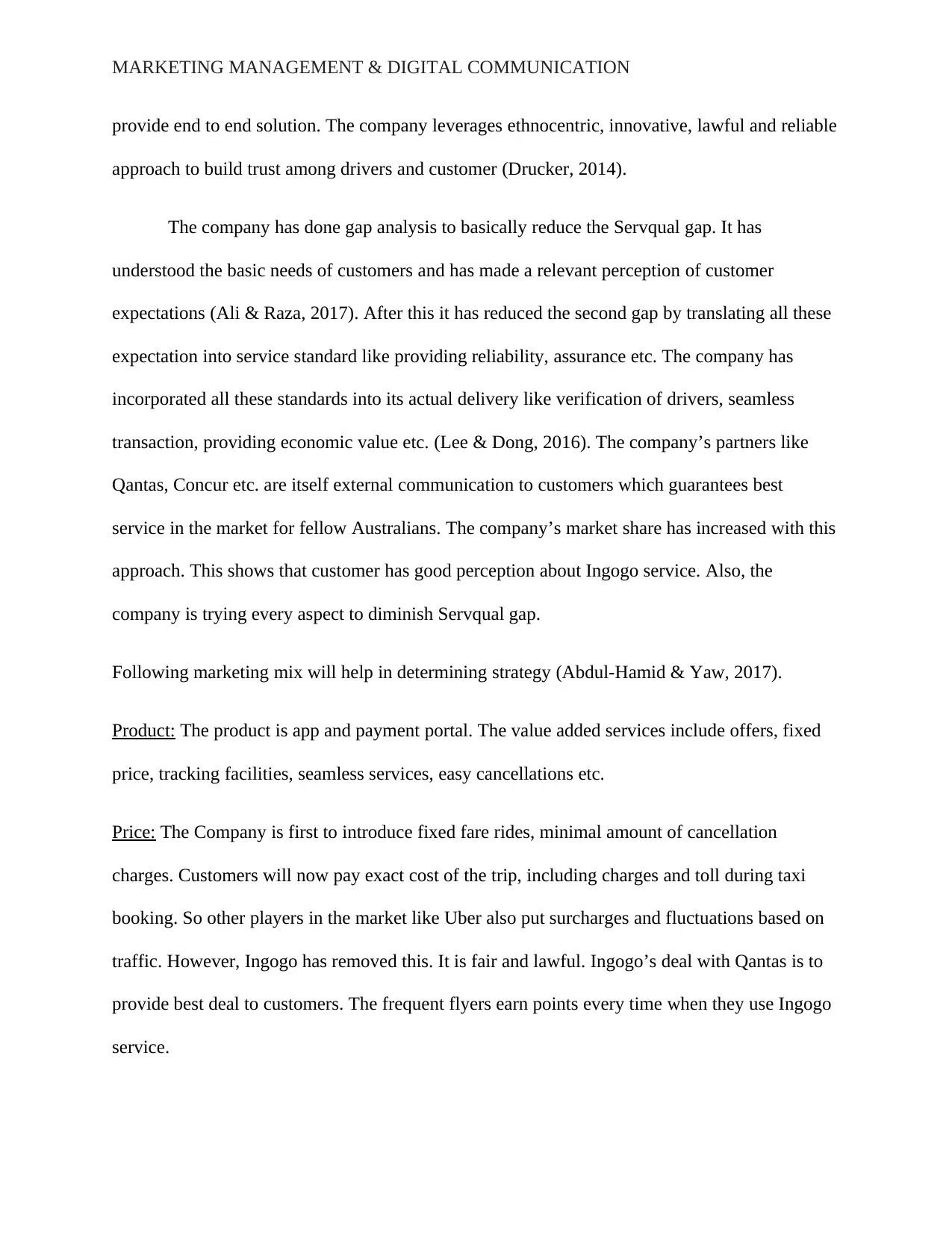
provide end to end solution. The company leverages ethnocentric, innovative, lawful and reliable
approach to build trust among drivers and customer (Drucker, 2014).
The company has done gap analysis to basically reduce the Servqual gap. It has
understood the basic needs of customers and has made a relevant perception of customer
expectations (Ali & Raza, 2017). After this it has reduced the second gap by translating all these
expectation into service standard like providing reliability, assurance etc. The company has
incorporated all these standards into its actual delivery like verification of drivers, seamless
transaction, providing economic value etc. (Lee & Dong, 2016). The company’s partners like
Qantas, Concur etc. are itself external communication to customers which guarantees best
service in the market for fellow Australians. The company’s market share has increased with this
approach. This shows that customer has good perception about Ingogo service. Also, the
company is trying every aspect to diminish Servqual gap.
Following marketing mix will help in determining strategy (Abdul-Hamid & Yaw, 2017).
Product: The product is app and payment portal. The value added services include offers, fixed
price, tracking facilities, seamless services, easy cancellations etc.
Price: The Company is first to introduce fixed fare rides, minimal amount of cancellation
charges. Customers will now pay exact cost of the trip, including charges and toll during taxi
booking. So other players in the market like Uber also put surcharges and fluctuations based on
traffic. However, Ingogo has removed this. It is fair and lawful. Ingogo’s deal with Qantas is to
provide best deal to customers. The frequent flyers earn points every time when they use Ingogo
service.
provide end to end solution. The company leverages ethnocentric, innovative, lawful and reliable
approach to build trust among drivers and customer (Drucker, 2014).
The company has done gap analysis to basically reduce the Servqual gap. It has
understood the basic needs of customers and has made a relevant perception of customer
expectations (Ali & Raza, 2017). After this it has reduced the second gap by translating all these
expectation into service standard like providing reliability, assurance etc. The company has
incorporated all these standards into its actual delivery like verification of drivers, seamless
transaction, providing economic value etc. (Lee & Dong, 2016). The company’s partners like
Qantas, Concur etc. are itself external communication to customers which guarantees best
service in the market for fellow Australians. The company’s market share has increased with this
approach. This shows that customer has good perception about Ingogo service. Also, the
company is trying every aspect to diminish Servqual gap.
Following marketing mix will help in determining strategy (Abdul-Hamid & Yaw, 2017).
Product: The product is app and payment portal. The value added services include offers, fixed
price, tracking facilities, seamless services, easy cancellations etc.
Price: The Company is first to introduce fixed fare rides, minimal amount of cancellation
charges. Customers will now pay exact cost of the trip, including charges and toll during taxi
booking. So other players in the market like Uber also put surcharges and fluctuations based on
traffic. However, Ingogo has removed this. It is fair and lawful. Ingogo’s deal with Qantas is to
provide best deal to customers. The frequent flyers earn points every time when they use Ingogo
service.
⊘ This is a preview!⊘
Do you want full access?
Subscribe today to unlock all pages.
Trusted by 1+ million students worldwide
MARKETING MANAGEMENT & DIGITAL COMMUNICATION
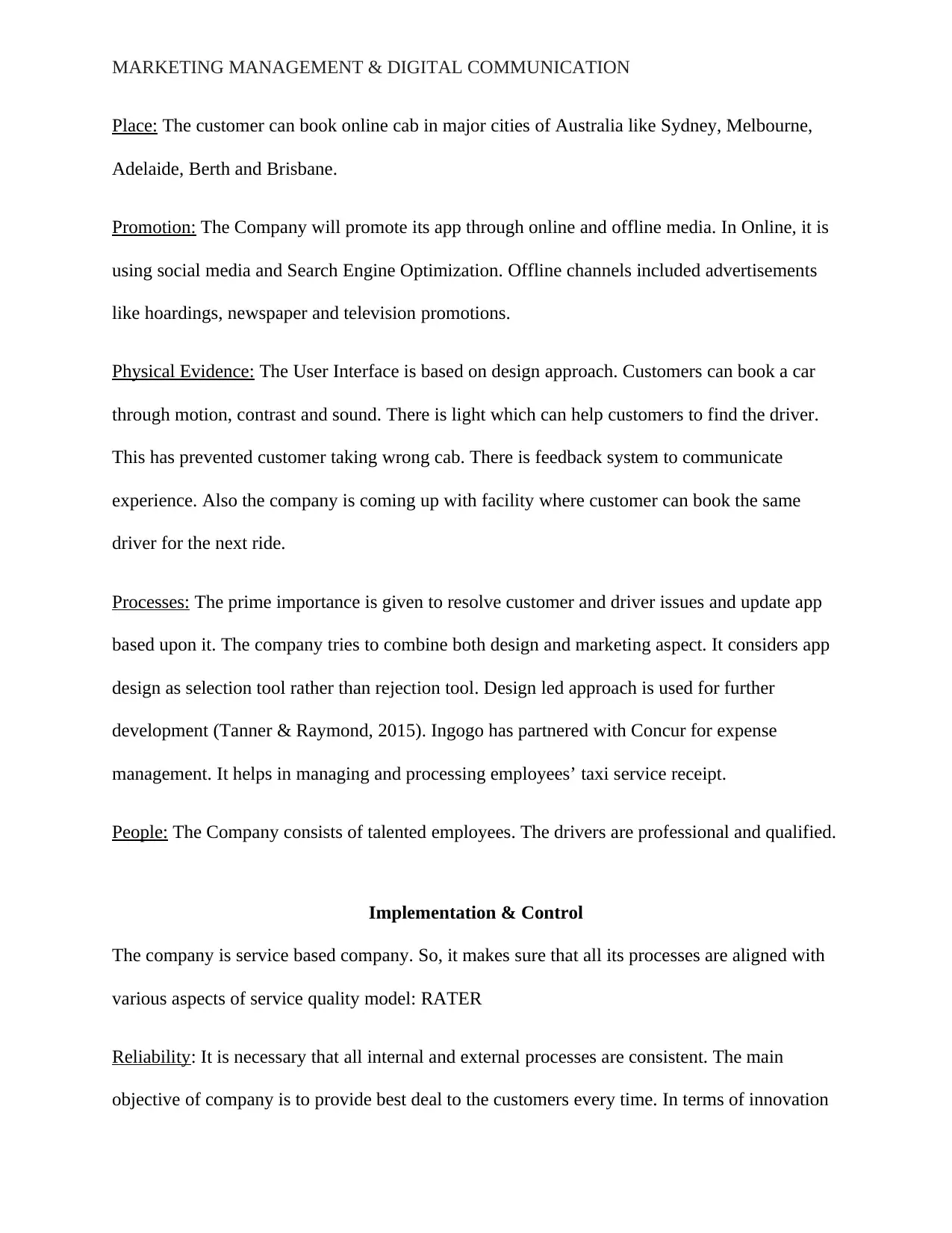
Place: The customer can book online cab in major cities of Australia like Sydney, Melbourne,
Adelaide, Berth and Brisbane.
Promotion: The Company will promote its app through online and offline media. In Online, it is
using social media and Search Engine Optimization. Offline channels included advertisements
like hoardings, newspaper and television promotions.
Physical Evidence: The User Interface is based on design approach. Customers can book a car
through motion, contrast and sound. There is light which can help customers to find the driver.
This has prevented customer taking wrong cab. There is feedback system to communicate
experience. Also the company is coming up with facility where customer can book the same
driver for the next ride.
Processes: The prime importance is given to resolve customer and driver issues and update app
based upon it. The company tries to combine both design and marketing aspect. It considers app
design as selection tool rather than rejection tool. Design led approach is used for further
development (Tanner & Raymond, 2015). Ingogo has partnered with Concur for expense
management. It helps in managing and processing employees’ taxi service receipt.
People: The Company consists of talented employees. The drivers are professional and qualified.
Implementation & Control
The company is service based company. So, it makes sure that all its processes are aligned with
various aspects of service quality model: RATER
Reliability: It is necessary that all internal and external processes are consistent. The main
objective of company is to provide best deal to the customers every time. In terms of innovation
Place: The customer can book online cab in major cities of Australia like Sydney, Melbourne,
Adelaide, Berth and Brisbane.
Promotion: The Company will promote its app through online and offline media. In Online, it is
using social media and Search Engine Optimization. Offline channels included advertisements
like hoardings, newspaper and television promotions.
Physical Evidence: The User Interface is based on design approach. Customers can book a car
through motion, contrast and sound. There is light which can help customers to find the driver.
This has prevented customer taking wrong cab. There is feedback system to communicate
experience. Also the company is coming up with facility where customer can book the same
driver for the next ride.
Processes: The prime importance is given to resolve customer and driver issues and update app
based upon it. The company tries to combine both design and marketing aspect. It considers app
design as selection tool rather than rejection tool. Design led approach is used for further
development (Tanner & Raymond, 2015). Ingogo has partnered with Concur for expense
management. It helps in managing and processing employees’ taxi service receipt.
People: The Company consists of talented employees. The drivers are professional and qualified.
Implementation & Control
The company is service based company. So, it makes sure that all its processes are aligned with
various aspects of service quality model: RATER
Reliability: It is necessary that all internal and external processes are consistent. The main
objective of company is to provide best deal to the customers every time. In terms of innovation
Paraphrase This Document
Need a fresh take? Get an instant paraphrase of this document with our AI Paraphraser
MARKETING MANAGEMENT & DIGITAL COMMUNICATION
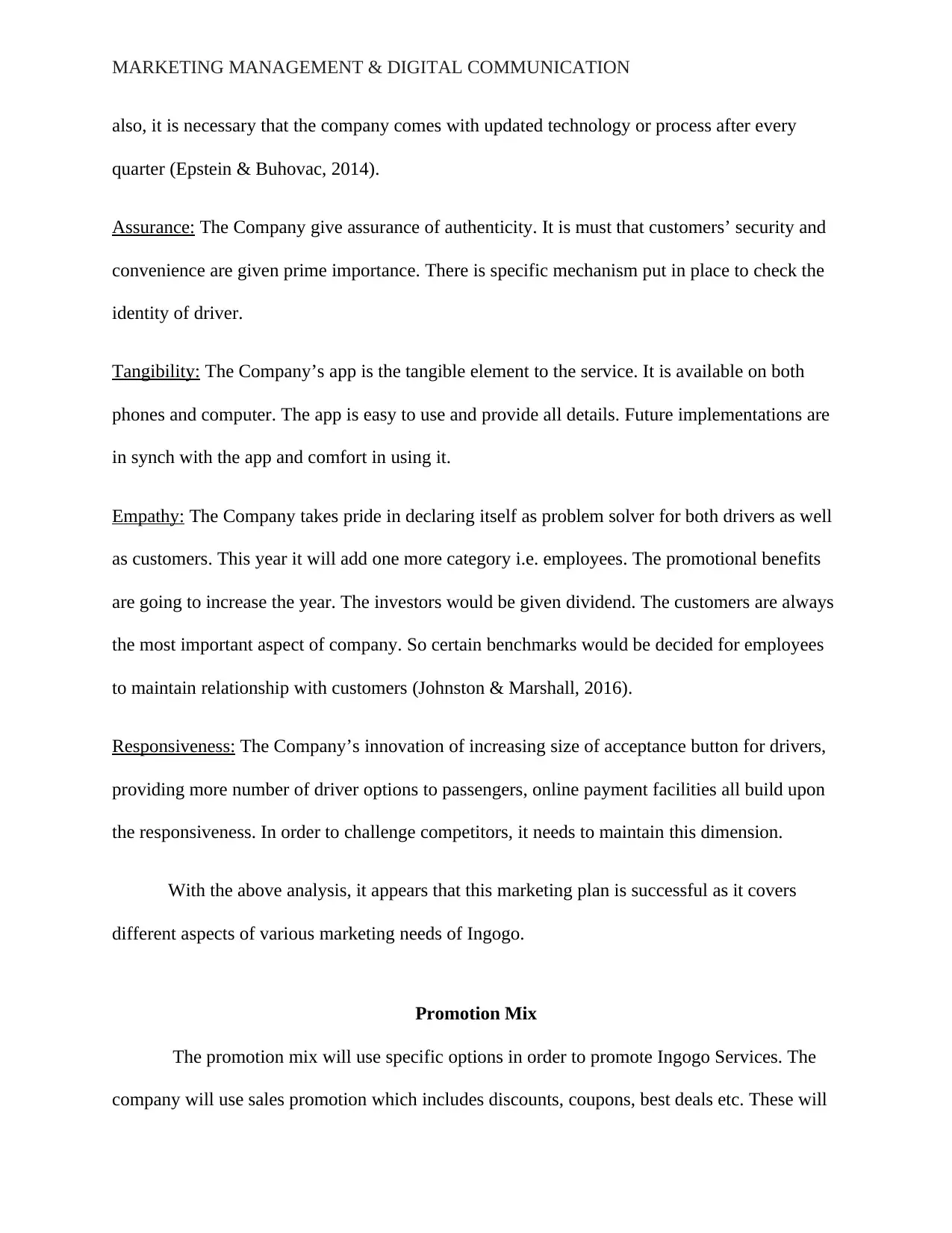
also, it is necessary that the company comes with updated technology or process after every
quarter (Epstein & Buhovac, 2014).
Assurance: The Company give assurance of authenticity. It is must that customers’ security and
convenience are given prime importance. There is specific mechanism put in place to check the
identity of driver.
Tangibility: The Company’s app is the tangible element to the service. It is available on both
phones and computer. The app is easy to use and provide all details. Future implementations are
in synch with the app and comfort in using it.
Empathy: The Company takes pride in declaring itself as problem solver for both drivers as well
as customers. This year it will add one more category i.e. employees. The promotional benefits
are going to increase the year. The investors would be given dividend. The customers are always
the most important aspect of company. So certain benchmarks would be decided for employees
to maintain relationship with customers (Johnston & Marshall, 2016).
Responsiveness: The Company’s innovation of increasing size of acceptance button for drivers,
providing more number of driver options to passengers, online payment facilities all build upon
the responsiveness. In order to challenge competitors, it needs to maintain this dimension.
With the above analysis, it appears that this marketing plan is successful as it covers
different aspects of various marketing needs of Ingogo.
Promotion Mix
The promotion mix will use specific options in order to promote Ingogo Services. The
company will use sales promotion which includes discounts, coupons, best deals etc. These will
also, it is necessary that the company comes with updated technology or process after every
quarter (Epstein & Buhovac, 2014).
Assurance: The Company give assurance of authenticity. It is must that customers’ security and
convenience are given prime importance. There is specific mechanism put in place to check the
identity of driver.
Tangibility: The Company’s app is the tangible element to the service. It is available on both
phones and computer. The app is easy to use and provide all details. Future implementations are
in synch with the app and comfort in using it.
Empathy: The Company takes pride in declaring itself as problem solver for both drivers as well
as customers. This year it will add one more category i.e. employees. The promotional benefits
are going to increase the year. The investors would be given dividend. The customers are always
the most important aspect of company. So certain benchmarks would be decided for employees
to maintain relationship with customers (Johnston & Marshall, 2016).
Responsiveness: The Company’s innovation of increasing size of acceptance button for drivers,
providing more number of driver options to passengers, online payment facilities all build upon
the responsiveness. In order to challenge competitors, it needs to maintain this dimension.
With the above analysis, it appears that this marketing plan is successful as it covers
different aspects of various marketing needs of Ingogo.
Promotion Mix
The promotion mix will use specific options in order to promote Ingogo Services. The
company will use sales promotion which includes discounts, coupons, best deals etc. These will
MARKETING MANAGEMENT & DIGITAL COMMUNICATION
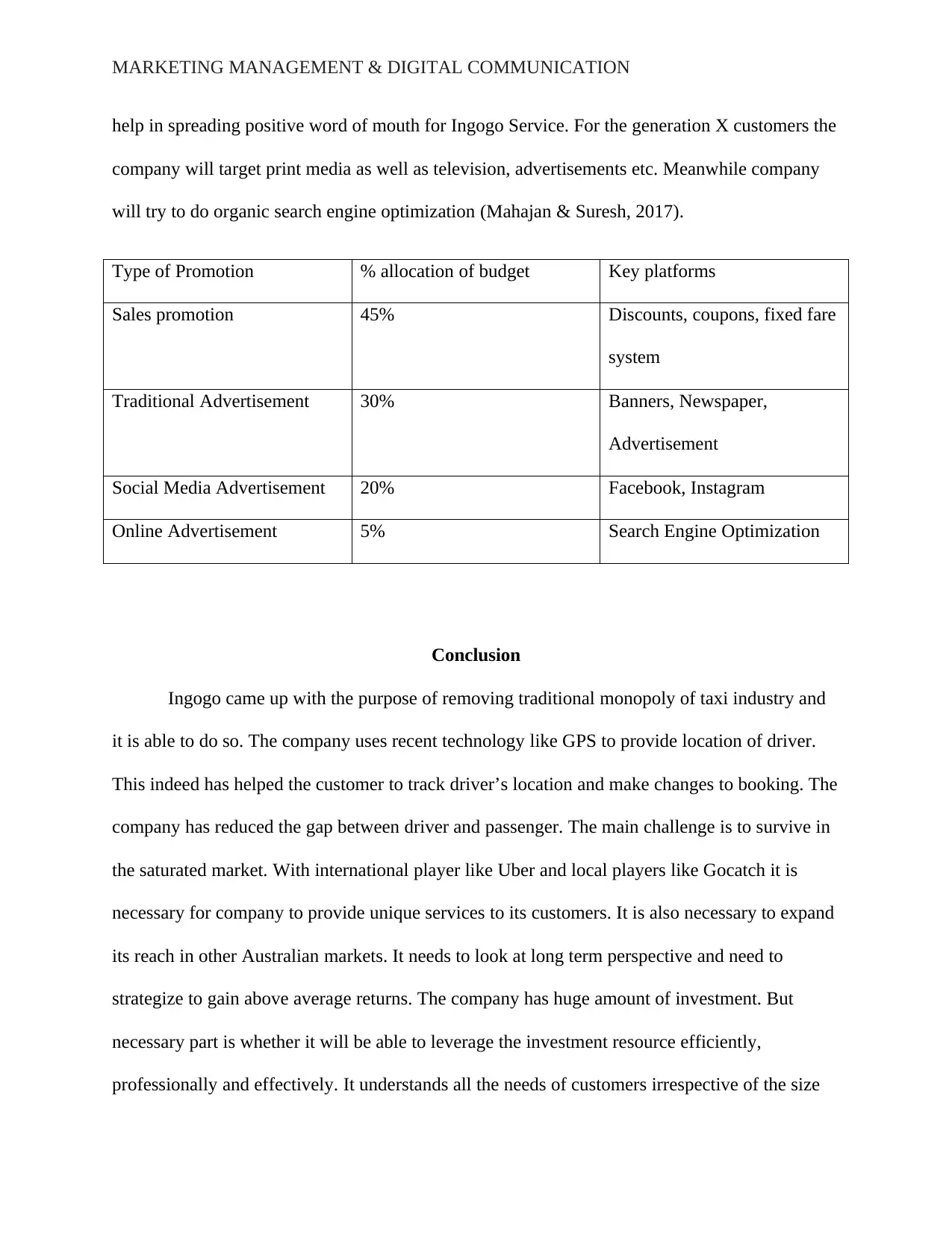
help in spreading positive word of mouth for Ingogo Service. For the generation X customers the
company will target print media as well as television, advertisements etc. Meanwhile company
will try to do organic search engine optimization (Mahajan & Suresh, 2017).
Type of Promotion % allocation of budget Key platforms
Sales promotion 45% Discounts, coupons, fixed fare
system
Traditional Advertisement 30% Banners, Newspaper,
Advertisement
Social Media Advertisement 20% Facebook, Instagram
Online Advertisement 5% Search Engine Optimization
Conclusion
Ingogo came up with the purpose of removing traditional monopoly of taxi industry and
it is able to do so. The company uses recent technology like GPS to provide location of driver.
This indeed has helped the customer to track driver’s location and make changes to booking. The
company has reduced the gap between driver and passenger. The main challenge is to survive in
the saturated market. With international player like Uber and local players like Gocatch it is
necessary for company to provide unique services to its customers. It is also necessary to expand
its reach in other Australian markets. It needs to look at long term perspective and need to
strategize to gain above average returns. The company has huge amount of investment. But
necessary part is whether it will be able to leverage the investment resource efficiently,
professionally and effectively. It understands all the needs of customers irrespective of the size
help in spreading positive word of mouth for Ingogo Service. For the generation X customers the
company will target print media as well as television, advertisements etc. Meanwhile company
will try to do organic search engine optimization (Mahajan & Suresh, 2017).
Type of Promotion % allocation of budget Key platforms
Sales promotion 45% Discounts, coupons, fixed fare
system
Traditional Advertisement 30% Banners, Newspaper,
Advertisement
Social Media Advertisement 20% Facebook, Instagram
Online Advertisement 5% Search Engine Optimization
Conclusion
Ingogo came up with the purpose of removing traditional monopoly of taxi industry and
it is able to do so. The company uses recent technology like GPS to provide location of driver.
This indeed has helped the customer to track driver’s location and make changes to booking. The
company has reduced the gap between driver and passenger. The main challenge is to survive in
the saturated market. With international player like Uber and local players like Gocatch it is
necessary for company to provide unique services to its customers. It is also necessary to expand
its reach in other Australian markets. It needs to look at long term perspective and need to
strategize to gain above average returns. The company has huge amount of investment. But
necessary part is whether it will be able to leverage the investment resource efficiently,
professionally and effectively. It understands all the needs of customers irrespective of the size
⊘ This is a preview!⊘
Do you want full access?
Subscribe today to unlock all pages.
Trusted by 1+ million students worldwide

1 out of 16


Related Documents


Your All-in-One AI-Powered Toolkit for Academic Success.
+13062052269
info@desklib.com
Available 24*7 on WhatsApp / Email
![[object Object]](/_next/static/media/star-bottom.7253800d.svg)
Unlock your academic potential
Copyright © 2020–2026 A2Z Services. All Rights Reserved. Developed and managed by ZUCOL.