MGT530: Ingogo's International Entry Strategy for the Indian Market
VerifiedAdded on 2023/03/30
|14
|4143
|448
Report
AI Summary
This report proposes efficient strategies for Ingogo to expand internationally, specifically focusing on the Indian market. It begins with an executive summary outlining the market opportunity, drawing on prior reports and external environment analysis. The report assesses India's business environment using metrics like the Doing Business Index and Trade Competitive Index, highlighting its attractiveness for the taxi business. It analyzes Ingogo's existing strategies, recommending strategies like leveraging its established price strategies, acquiring local firms, product differentiation, and promotional strategies. The report also addresses human resource considerations, suggesting a mix of ethnocentric and polycentric approaches. The conclusion encourages the implementation of collaborative, distribution, marketing, differentiation, diversification, and human resource strategies to ensure success in the Indian market.
INGOGO ENTRY STRATEGY 1
1 Executive summary
The aim of this report is to propose efficient strategies for Ingogo to expand
internationally. The work started with an introduction which explicates on the market
opportunity in India pinpointing external environment. Borrowing some content from the
previous market report, journal, publication, and textbooks, this report will recommend the best
way the Ingogo Company will start its operation in India.
This work extensively assays India business environment using metrics such as doing
business index and trade competitive index. The two measures indicate that India is a
competitive market for taxi business due to high population, improved infrastructure, sound
government and business policies which provide enabling milieu for international business
(World Bank 2019). As such, the economy seems to be attractive for both national and
international companies.
The report also critically analyses the strategies which igongo uses on its backyard to
provide its product to customers. With huge capital base and willing investors to invest in, the
company is deemed fit to explore a new market. The needs for a new market is to expand its
customer base, increase income, explore more opportunities and lower cost through economies
of scale.
Feasible strategies that were found it be appropriate were to use its well-established price
strategies such as affordable charges, and quality control (ingogo, 2019). The second strategy is
to buy another local firm so that it can operate as a local firm, reduce competition and have many
customers. Additionally, strategies that favor entry strategy includes product differentiation and
promotional and marketing strategy (Albaum &Tse, 2001). Promotional steps call for social
media market, joint venture while product differential involves charging different market
segment different price.
The last part emphasized that the human resource issue are prevalent but the ultimate
solution is using a mix of ethnocentric and polycentric to allow a smooth transition of home
country traditions. Ultimately, the report concludes the report by encouraging the company to
implement includes collaborative strategies, distribution, marketing, differentiation,
diversification, and human resource strategies. In effect, it will be successful.
1 Executive summary
The aim of this report is to propose efficient strategies for Ingogo to expand
internationally. The work started with an introduction which explicates on the market
opportunity in India pinpointing external environment. Borrowing some content from the
previous market report, journal, publication, and textbooks, this report will recommend the best
way the Ingogo Company will start its operation in India.
This work extensively assays India business environment using metrics such as doing
business index and trade competitive index. The two measures indicate that India is a
competitive market for taxi business due to high population, improved infrastructure, sound
government and business policies which provide enabling milieu for international business
(World Bank 2019). As such, the economy seems to be attractive for both national and
international companies.
The report also critically analyses the strategies which igongo uses on its backyard to
provide its product to customers. With huge capital base and willing investors to invest in, the
company is deemed fit to explore a new market. The needs for a new market is to expand its
customer base, increase income, explore more opportunities and lower cost through economies
of scale.
Feasible strategies that were found it be appropriate were to use its well-established price
strategies such as affordable charges, and quality control (ingogo, 2019). The second strategy is
to buy another local firm so that it can operate as a local firm, reduce competition and have many
customers. Additionally, strategies that favor entry strategy includes product differentiation and
promotional and marketing strategy (Albaum &Tse, 2001). Promotional steps call for social
media market, joint venture while product differential involves charging different market
segment different price.
The last part emphasized that the human resource issue are prevalent but the ultimate
solution is using a mix of ethnocentric and polycentric to allow a smooth transition of home
country traditions. Ultimately, the report concludes the report by encouraging the company to
implement includes collaborative strategies, distribution, marketing, differentiation,
diversification, and human resource strategies. In effect, it will be successful.

Paraphrase This Document
Need a fresh take? Get an instant paraphrase of this document with our AI Paraphraser
INGOGO ENTRY STRATEGY 2
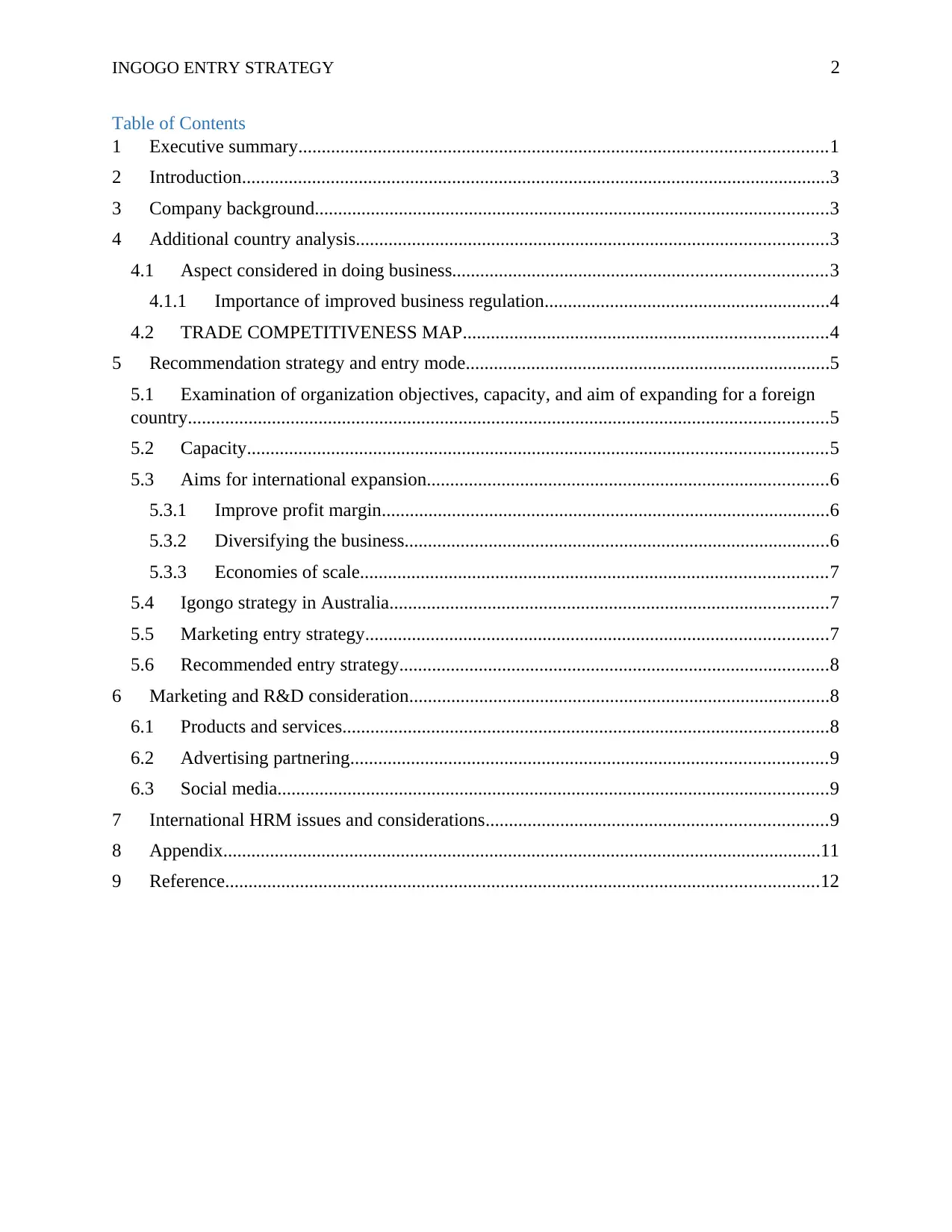
Table of Contents
1 Executive summary.................................................................................................................1
2 Introduction..............................................................................................................................3
3 Company background..............................................................................................................3
4 Additional country analysis.....................................................................................................3
4.1 Aspect considered in doing business................................................................................3
4.1.1 Importance of improved business regulation.............................................................4
4.2 TRADE COMPETITIVENESS MAP..............................................................................4
5 Recommendation strategy and entry mode..............................................................................5
5.1 Examination of organization objectives, capacity, and aim of expanding for a foreign
country.........................................................................................................................................5
5.2 Capacity............................................................................................................................5
5.3 Aims for international expansion......................................................................................6
5.3.1 Improve profit margin................................................................................................6
5.3.2 Diversifying the business...........................................................................................6
5.3.3 Economies of scale....................................................................................................7
5.4 Igongo strategy in Australia..............................................................................................7
5.5 Marketing entry strategy...................................................................................................7
5.6 Recommended entry strategy............................................................................................8
6 Marketing and R&D consideration..........................................................................................8
6.1 Products and services........................................................................................................8
6.2 Advertising partnering......................................................................................................9
6.3 Social media......................................................................................................................9
7 International HRM issues and considerations.........................................................................9
8 Appendix................................................................................................................................11
9 Reference...............................................................................................................................12
Table of Contents
1 Executive summary.................................................................................................................1
2 Introduction..............................................................................................................................3
3 Company background..............................................................................................................3
4 Additional country analysis.....................................................................................................3
4.1 Aspect considered in doing business................................................................................3
4.1.1 Importance of improved business regulation.............................................................4
4.2 TRADE COMPETITIVENESS MAP..............................................................................4
5 Recommendation strategy and entry mode..............................................................................5
5.1 Examination of organization objectives, capacity, and aim of expanding for a foreign
country.........................................................................................................................................5
5.2 Capacity............................................................................................................................5
5.3 Aims for international expansion......................................................................................6
5.3.1 Improve profit margin................................................................................................6
5.3.2 Diversifying the business...........................................................................................6
5.3.3 Economies of scale....................................................................................................7
5.4 Igongo strategy in Australia..............................................................................................7
5.5 Marketing entry strategy...................................................................................................7
5.6 Recommended entry strategy............................................................................................8
6 Marketing and R&D consideration..........................................................................................8
6.1 Products and services........................................................................................................8
6.2 Advertising partnering......................................................................................................9
6.3 Social media......................................................................................................................9
7 International HRM issues and considerations.........................................................................9
8 Appendix................................................................................................................................11
9 Reference...............................................................................................................................12
INGOGO ENTRY STRATEGY 3
2 Introduction
INGOGO is a growing firm that has the potential to expand globally. As such, this work
will focus on Asia specifically India. A brief description will be given as well as that of the
company to show why the region is ideal for INGOGO Company. Further, a SWOT analysis will
be conducted to show a solid feature of the company which enable it to be a market leader than
the other close competitors
The report further highlights why the said country is best to venture in. competitive
strategy of the firm will also be discussed. After explaining this part, the second section
demonstrates the entry strategy and propose a sound recommendation for the market. Moreover,
important market and R&D features including competitive strategy will be mentioned.
Thereafter, challenges that INGOGO might face in managing human resource will be assayed.
Lastly, the report will offer a suggestion on how an organization can do to hone its production
capacity.
3 Company background
Background of INGOGO and India is attached at the appendix
4 Additional country analysis
India designs business policies and supports regulatory delivery to provide a transparent
and predictable business landscape favorable for international competition, business entry, and
expansion (De Groot, Olaf, and Miguel Perez Ludeña, 2014). With this regard, World Bank has
indicator called doing for business which shows the efficacy at which business get incorporated,
obtain permit, get connected to electric, get access to credit, transfer property, protection
investors, enforcing contracts, engaging in international trade However, the index indicates the
small business enterprise faces encounter different issue when they set up and instigate business.
4.1 Aspect considered in doing business
2 Introduction
INGOGO is a growing firm that has the potential to expand globally. As such, this work
will focus on Asia specifically India. A brief description will be given as well as that of the
company to show why the region is ideal for INGOGO Company. Further, a SWOT analysis will
be conducted to show a solid feature of the company which enable it to be a market leader than
the other close competitors
The report further highlights why the said country is best to venture in. competitive
strategy of the firm will also be discussed. After explaining this part, the second section
demonstrates the entry strategy and propose a sound recommendation for the market. Moreover,
important market and R&D features including competitive strategy will be mentioned.
Thereafter, challenges that INGOGO might face in managing human resource will be assayed.
Lastly, the report will offer a suggestion on how an organization can do to hone its production
capacity.
3 Company background
Background of INGOGO and India is attached at the appendix
4 Additional country analysis
India designs business policies and supports regulatory delivery to provide a transparent
and predictable business landscape favorable for international competition, business entry, and
expansion (De Groot, Olaf, and Miguel Perez Ludeña, 2014). With this regard, World Bank has
indicator called doing for business which shows the efficacy at which business get incorporated,
obtain permit, get connected to electric, get access to credit, transfer property, protection
investors, enforcing contracts, engaging in international trade However, the index indicates the
small business enterprise faces encounter different issue when they set up and instigate business.
4.1 Aspect considered in doing business
⊘ This is a preview!⊘
Do you want full access?
Subscribe today to unlock all pages.

Trusted by 1+ million students worldwide
INGOGO ENTRY STRATEGY 4
4.1.1 Importance of improved business regulation
World Bank data indicate that regulatory environment impact affects many facets of
economic outcomes like growth, productivity, informality, and employment (Worldbank.org.,
2019). Recent research concluded that the positive impact of enhancing business regulation
(Adler, Gustavo, 2017). A notable example is that the country has enforced an annual self-
clarification system where an individual can do annual clarification. Also, annual the business
expiration period has been extended from five years to ten years. Such has eliminated annual
renewal of licenses. Competitive federalism approach that India has applied to a business setting
agenda has led to more than 7000 reforms. Those reforms have brought commendable results in
business regulation. For instance, less procedures which has strongly LinkedIn the process of
starting businesses.
According to the world economic forum, India Is ranked as number 58 globally as a
competitive country in the world. It’s competitive as risen from 2007 to 2018, from 55.17 to 58
respectively. In 2015 it performed excellently reaching the highest points while in 2007 it
recorded the lowest index, that it is 71 and 42 respectively.
The recent 2018 report on a global competitive index which examined 140 countries
introduced a new methodology which underscored the value of innovation, human capita agility,
and resiliency (Malhotra, 2014). This market not only the drivers but also the elements of
economic success in the industrial revolution. In effect, the GC1 was changed to 1 to 7 from 0 to
100. The higher the score the successful the country is performing. GCI report is made of 9787
variable that is categorized into 12 pillars with the most invaluable features. This includes
macroeconomic stability, skills, health, ICT adoption, institution, infrastructure, financial system,
labor market, product market, innovation capability, business dynamism, and market size
(International Monetary Fund, 2017b). The below data demonstrates the India competitive index
based on historical data which shows longer term and short term prediction, lowest and hosted
index attained news and surveys census and actual data as updated on 29th June.
4.2 TRADE COMPETITIVENESS MAP
Trade competitive map offers offer market analysis outlook for approximately 240
countries. Each outlook fives a series of tools to give strategic market research, macro-economic
4.1.1 Importance of improved business regulation
World Bank data indicate that regulatory environment impact affects many facets of
economic outcomes like growth, productivity, informality, and employment (Worldbank.org.,
2019). Recent research concluded that the positive impact of enhancing business regulation
(Adler, Gustavo, 2017). A notable example is that the country has enforced an annual self-
clarification system where an individual can do annual clarification. Also, annual the business
expiration period has been extended from five years to ten years. Such has eliminated annual
renewal of licenses. Competitive federalism approach that India has applied to a business setting
agenda has led to more than 7000 reforms. Those reforms have brought commendable results in
business regulation. For instance, less procedures which has strongly LinkedIn the process of
starting businesses.
According to the world economic forum, India Is ranked as number 58 globally as a
competitive country in the world. It’s competitive as risen from 2007 to 2018, from 55.17 to 58
respectively. In 2015 it performed excellently reaching the highest points while in 2007 it
recorded the lowest index, that it is 71 and 42 respectively.
The recent 2018 report on a global competitive index which examined 140 countries
introduced a new methodology which underscored the value of innovation, human capita agility,
and resiliency (Malhotra, 2014). This market not only the drivers but also the elements of
economic success in the industrial revolution. In effect, the GC1 was changed to 1 to 7 from 0 to
100. The higher the score the successful the country is performing. GCI report is made of 9787
variable that is categorized into 12 pillars with the most invaluable features. This includes
macroeconomic stability, skills, health, ICT adoption, institution, infrastructure, financial system,
labor market, product market, innovation capability, business dynamism, and market size
(International Monetary Fund, 2017b). The below data demonstrates the India competitive index
based on historical data which shows longer term and short term prediction, lowest and hosted
index attained news and surveys census and actual data as updated on 29th June.
4.2 TRADE COMPETITIVENESS MAP
Trade competitive map offers offer market analysis outlook for approximately 240
countries. Each outlook fives a series of tools to give strategic market research, macro-economic
Paraphrase This Document
Need a fresh take? Get an instant paraphrase of this document with our AI Paraphraser
INGOGO ENTRY STRATEGY 5
performance, monitor national and industrial performance and formulate trade development
initiatives. Trade competitive index has three indicators to show healthy of the business
environment in each country but we will only concentrate on trade competitive index specifically
for India.
According to 2018 report, India has honed its world market opportunities by diversifying
its product market, supply, trade supporting institution and market by putting more priorities to
sectorial performance, trade development strategies, trade promotion and partnering with other
countries with aim to improve international trade and promote efficient use of the resource
(Zhao, Yongchareon, Cho, Shen, & Dewan, 2018). Further, India is as competitive especially in
the transport sector due to advanced infrastructure. The state has invested heavily on air, railway
and road transport (Asian Infrastructure Investment Bank, 2017). Besides, India has largely
strengthened its transport prices as compared to other Asia countries like Indonesia.
Monetary accommodation is an emerging issue in Asia of which India has maintained its
accommodative stance since 2016. As inflation was decreasing within their target bracket,
growth becomes an area of focus by the legislature (Institute of International Finance (IIF),
2017). The current market interest rate remains low with the possibility of reduction to cushion
onset of depreciation pressure.
5 Recommendation strategy and entry mode
5.1 Examination of organization objectives, capacity, and aim of expanding for a foreign
country
Ingogo business objective is to provide superior transport means. It underpins the need to
offer taxi services with superior services, with fully insures, license vehicle and drivers
(Hoekman, Bernard, and Dirk Willem te Velde, 2017). INGOGO has potential to grow as it
continues to advance its taxi booking app and website as it strives to reach its primary objective
of giving ride-share that is quality, convenience and affordable (ingogo, 2019).
5.2 Capacity
Taxi payment and booking company like Ingogo show the ability to grow more according
to Dolomite 2015 technology report. The firm booking has grown by 1494% since its inception
performance, monitor national and industrial performance and formulate trade development
initiatives. Trade competitive index has three indicators to show healthy of the business
environment in each country but we will only concentrate on trade competitive index specifically
for India.
According to 2018 report, India has honed its world market opportunities by diversifying
its product market, supply, trade supporting institution and market by putting more priorities to
sectorial performance, trade development strategies, trade promotion and partnering with other
countries with aim to improve international trade and promote efficient use of the resource
(Zhao, Yongchareon, Cho, Shen, & Dewan, 2018). Further, India is as competitive especially in
the transport sector due to advanced infrastructure. The state has invested heavily on air, railway
and road transport (Asian Infrastructure Investment Bank, 2017). Besides, India has largely
strengthened its transport prices as compared to other Asia countries like Indonesia.
Monetary accommodation is an emerging issue in Asia of which India has maintained its
accommodative stance since 2016. As inflation was decreasing within their target bracket,
growth becomes an area of focus by the legislature (Institute of International Finance (IIF),
2017). The current market interest rate remains low with the possibility of reduction to cushion
onset of depreciation pressure.
5 Recommendation strategy and entry mode
5.1 Examination of organization objectives, capacity, and aim of expanding for a foreign
country
Ingogo business objective is to provide superior transport means. It underpins the need to
offer taxi services with superior services, with fully insures, license vehicle and drivers
(Hoekman, Bernard, and Dirk Willem te Velde, 2017). INGOGO has potential to grow as it
continues to advance its taxi booking app and website as it strives to reach its primary objective
of giving ride-share that is quality, convenience and affordable (ingogo, 2019).
5.2 Capacity
Taxi payment and booking company like Ingogo show the ability to grow more according
to Dolomite 2015 technology report. The firm booking has grown by 1494% since its inception
INGOGO ENTRY STRATEGY 6
(Deloitte, 2019). The peer taxi booking application is growing as people are moving from
traditional booking platform riposting to better technology, driver, and security. The company
also offer integration for trade business via its zero M-payment system. Accept payment and
allocate funds promptly.
Funding wise, Ingogo raises $12 in C funding making the value of entire business worth
$100 million. Further, the company holds that it has obtained another $16 million from investors
through the website and 8,000 drivers signed up during the same period (ingogo, 2019).
Considering its financial base, the company can comfortably venture international with little fear
of failure. However, the enterprise lacks international exposure, therefore, they might face
significant challenges. Consequently, proper planning must be established for it to enter into the
new market smoothly.
5.3 Aims for international expansion
5.3.1 Improve profit margin
Igogo is constantly looking for more opportunities to increase its revenue stream and
customer base. When growth strategies have reached the national level, a further step is to scout
for international expansion. Distributing company products to other regions increases client base
(Warren & Hutchinson, 2010). As the firm offer compelling solutions to surge prices, it builds
loyalty across the global market, therefore, escalating its profits.
There are cost saving elements while the firm expands internationally. Going to India
reduce cost as the company will be closer to a huge number of customers and further its
investment opportunities. Lower cost of acquiring is therefore compelling reason to grow
internationally.
5.3.2 Diversifying the business
Expanding internationally allows the entity to diversify business operation in many ways.
To start, the company will spread the risk of reduced demand in Australian (Auboin, Marc, and
Floriana Borino, 2017). If there is low season or losses in one country, the other region can
leverage its success. Additionally, the company will tap new opportunities untapped as India has
few online taxi booking system.
(Deloitte, 2019). The peer taxi booking application is growing as people are moving from
traditional booking platform riposting to better technology, driver, and security. The company
also offer integration for trade business via its zero M-payment system. Accept payment and
allocate funds promptly.
Funding wise, Ingogo raises $12 in C funding making the value of entire business worth
$100 million. Further, the company holds that it has obtained another $16 million from investors
through the website and 8,000 drivers signed up during the same period (ingogo, 2019).
Considering its financial base, the company can comfortably venture international with little fear
of failure. However, the enterprise lacks international exposure, therefore, they might face
significant challenges. Consequently, proper planning must be established for it to enter into the
new market smoothly.
5.3 Aims for international expansion
5.3.1 Improve profit margin
Igogo is constantly looking for more opportunities to increase its revenue stream and
customer base. When growth strategies have reached the national level, a further step is to scout
for international expansion. Distributing company products to other regions increases client base
(Warren & Hutchinson, 2010). As the firm offer compelling solutions to surge prices, it builds
loyalty across the global market, therefore, escalating its profits.
There are cost saving elements while the firm expands internationally. Going to India
reduce cost as the company will be closer to a huge number of customers and further its
investment opportunities. Lower cost of acquiring is therefore compelling reason to grow
internationally.
5.3.2 Diversifying the business
Expanding internationally allows the entity to diversify business operation in many ways.
To start, the company will spread the risk of reduced demand in Australian (Auboin, Marc, and
Floriana Borino, 2017). If there is low season or losses in one country, the other region can
leverage its success. Additionally, the company will tap new opportunities untapped as India has
few online taxi booking system.
⊘ This is a preview!⊘
Do you want full access?
Subscribe today to unlock all pages.
Trusted by 1+ million students worldwide
INGOGO ENTRY STRATEGY 7
Exclusivity
The company management has a feasible market strategy which is applied to expand
national wide which can also be applied to other region and be successful. Hence, the need to
apply market information to another region to explore more opportunities.
5.3.3 Economies of scale
Going international is an ideal way to expand the business product to be widely accepted
globally. In the transport and tourism sector, internationalization assists the firm to realize a
greater economy of scales, especially from domestic market which was smaller. Importantly, it
will seek to utilize cheap labor, an abundance of resource and exploit the advantage of the home
brand.
5.4 Igongo strategy in Australia
Ingogo has several business strategies that have made it the leading taxi in Australia. The
first strategies are that it has a cost strategy in that it charges a fixed price. Such a feature helps
the customers to save cost whole traveling since the taxi fare is fair and transparent. Secondly,
the company maintains its price regardless of the season, having no price surge like Uber and
other taxi organization (Chung, 2003), customer can estimate there cost even before travel.
Lastly, safety issues face transport system globally, ingogo takes customer safety and privacy
issues seriously. For that reason, taxi drivers are passed through quality control and stringent
background test. In short, Ingogo focuses on fixed prices, lower prices and safety and privacy of
the consumer. Therefore, penetrating the market easily.
5.5 Marketing entry strategy
Ingogo has two entry strategies, that is, low-cost strategy and buying small other firms
(Gubbi et al., 2010). The low-cost strategy is presented by the ability of the firm to provide its
service below the market average taxi charges. Providing affordable will help gain a competitive
advantage over the local firm who have high charges. Price support can also involve establishing
the price which the firm is practicing in Australia (Arvis et al., 2018). Implementing the same in
India will prove its consistency, fairness, and transparency in the foreign market. Lastly,
competitive information such as consumer safety and privacy.
Exclusivity
The company management has a feasible market strategy which is applied to expand
national wide which can also be applied to other region and be successful. Hence, the need to
apply market information to another region to explore more opportunities.
5.3.3 Economies of scale
Going international is an ideal way to expand the business product to be widely accepted
globally. In the transport and tourism sector, internationalization assists the firm to realize a
greater economy of scales, especially from domestic market which was smaller. Importantly, it
will seek to utilize cheap labor, an abundance of resource and exploit the advantage of the home
brand.
5.4 Igongo strategy in Australia
Ingogo has several business strategies that have made it the leading taxi in Australia. The
first strategies are that it has a cost strategy in that it charges a fixed price. Such a feature helps
the customers to save cost whole traveling since the taxi fare is fair and transparent. Secondly,
the company maintains its price regardless of the season, having no price surge like Uber and
other taxi organization (Chung, 2003), customer can estimate there cost even before travel.
Lastly, safety issues face transport system globally, ingogo takes customer safety and privacy
issues seriously. For that reason, taxi drivers are passed through quality control and stringent
background test. In short, Ingogo focuses on fixed prices, lower prices and safety and privacy of
the consumer. Therefore, penetrating the market easily.
5.5 Marketing entry strategy
Ingogo has two entry strategies, that is, low-cost strategy and buying small other firms
(Gubbi et al., 2010). The low-cost strategy is presented by the ability of the firm to provide its
service below the market average taxi charges. Providing affordable will help gain a competitive
advantage over the local firm who have high charges. Price support can also involve establishing
the price which the firm is practicing in Australia (Arvis et al., 2018). Implementing the same in
India will prove its consistency, fairness, and transparency in the foreign market. Lastly,
competitive information such as consumer safety and privacy.
Paraphrase This Document
Need a fresh take? Get an instant paraphrase of this document with our AI Paraphraser
INGOGO ENTRY STRATEGY 8
Secondly, Igongo can buy the small well-established company so that it can enter into
the local market. Buying local form is appropriate because it reduces competition and increases
market share. However, this approach can be expensive as it is expensive to determine the value
of a company in a foreign market and it needs significant due diligence. One positive aspect of
this move is getting the status of the local company directly they will be able to acquire local
market information easily, treated as a local firm and get a well-established market.
5.6 Recommended entry strategy
It is commendable for Ingogo to use promotional and marketing strategy to enter into the
new market. The empowering driver is one key initiative that should be undertaken Alon, 2013).
Even if the company will employ qualified drivers, motivating them to buy their own car by
offering huge discount and proper repayment scheme by partnering with car manufacturing.
The company can further enter a strategic collaboration with making my trip. A
partnership such as this allows consumers to be picked the rental facility of their choice. In so
doing, people will get used to ingogo brand. Another step is treating the customer with care.
Developing strong customer care center which will deal with customer complains amicably.
Doing this will assist to build customer loyalty.
Product differentiation can suit Igongo marketing tactics. Since India economy is made of
people with different level of income (Hansda & Sanjay, 2016). It will be worth if taxi for small,
middle and high-income class can be put in place. A different class will be attracted to the
different system therefore able to attract all level of consumption.
6 Marketing and R&D consideration
6.1 Products and services
As discussed above, the company can differentiate its product to meet each level of
customer needs. Splitting price according to customer ability will ensure that all level of income
customer is considered. Further, the company will offer low-cost transport as which will be a
competitive edge over the rival firms
Secondly, Igongo can buy the small well-established company so that it can enter into
the local market. Buying local form is appropriate because it reduces competition and increases
market share. However, this approach can be expensive as it is expensive to determine the value
of a company in a foreign market and it needs significant due diligence. One positive aspect of
this move is getting the status of the local company directly they will be able to acquire local
market information easily, treated as a local firm and get a well-established market.
5.6 Recommended entry strategy
It is commendable for Ingogo to use promotional and marketing strategy to enter into the
new market. The empowering driver is one key initiative that should be undertaken Alon, 2013).
Even if the company will employ qualified drivers, motivating them to buy their own car by
offering huge discount and proper repayment scheme by partnering with car manufacturing.
The company can further enter a strategic collaboration with making my trip. A
partnership such as this allows consumers to be picked the rental facility of their choice. In so
doing, people will get used to ingogo brand. Another step is treating the customer with care.
Developing strong customer care center which will deal with customer complains amicably.
Doing this will assist to build customer loyalty.
Product differentiation can suit Igongo marketing tactics. Since India economy is made of
people with different level of income (Hansda & Sanjay, 2016). It will be worth if taxi for small,
middle and high-income class can be put in place. A different class will be attracted to the
different system therefore able to attract all level of consumption.
6 Marketing and R&D consideration
6.1 Products and services
As discussed above, the company can differentiate its product to meet each level of
customer needs. Splitting price according to customer ability will ensure that all level of income
customer is considered. Further, the company will offer low-cost transport as which will be a
competitive edge over the rival firms
INGOGO ENTRY STRATEGY 9
Employing licensed is an invaluable aspect to guarantee travelers are at safe hand.
Additionally, background check test is an assurance that customer will feel safe and secure thus
they will opt for ingogo services. Lastly, the payment system, website, and its mobile app are
efficient with no delays. An efficient system will be a tool which will enable customer sing
company praises and refer friends to the firm.
6.2 Advertising partnering
Igongo can partner with agencies like The Viral Fever which is a web series platform in
India. TVF has many followers and Igongo can take advantage of this and collaborate with it.
6.3 Social media
Igongo can use Facebook, Twitter, LinkedIn, Instagram and other social media site that
can promote the brand in India. Most prominent channels that can be used include newspaper ad,
banner ad, and television ad, for its campaign. The company creates a Facebook page for India
which can be sponsored so that it can reach to any numbers of users (Hooda, 2011). Turning on
the Facebook campaign is a solid move because of a large number of people using the channel
within the region. Various video content persuading the client to download the app would
precipitate people to download the app. The Facebook campaign can increase the rate of
consumer acquisition as well as searching for ingogo app will increase thus increase sales
7 International HRM issues and considerations
The Indian market has one advantage of having an English speaking population therefore,
small training and education will help solve human resource challenge. Both mixes of
ethnocentric and polycentric will be used at the start but for long-run, the company will opt to
have all employees to be an Indian citizen.
Ethnocentric will be incorporated by employing some employee from home country
employees so that they can transfer the culture, tradition, (Noe, Hollenbeck, Gerhart, & Wright,
2017) and the manner in which igongo conducts its operations in Australia. 60% of top
management will consist of employees from Australia while the remaining staff and subordinate
Employing licensed is an invaluable aspect to guarantee travelers are at safe hand.
Additionally, background check test is an assurance that customer will feel safe and secure thus
they will opt for ingogo services. Lastly, the payment system, website, and its mobile app are
efficient with no delays. An efficient system will be a tool which will enable customer sing
company praises and refer friends to the firm.
6.2 Advertising partnering
Igongo can partner with agencies like The Viral Fever which is a web series platform in
India. TVF has many followers and Igongo can take advantage of this and collaborate with it.
6.3 Social media
Igongo can use Facebook, Twitter, LinkedIn, Instagram and other social media site that
can promote the brand in India. Most prominent channels that can be used include newspaper ad,
banner ad, and television ad, for its campaign. The company creates a Facebook page for India
which can be sponsored so that it can reach to any numbers of users (Hooda, 2011). Turning on
the Facebook campaign is a solid move because of a large number of people using the channel
within the region. Various video content persuading the client to download the app would
precipitate people to download the app. The Facebook campaign can increase the rate of
consumer acquisition as well as searching for ingogo app will increase thus increase sales
7 International HRM issues and considerations
The Indian market has one advantage of having an English speaking population therefore,
small training and education will help solve human resource challenge. Both mixes of
ethnocentric and polycentric will be used at the start but for long-run, the company will opt to
have all employees to be an Indian citizen.
Ethnocentric will be incorporated by employing some employee from home country
employees so that they can transfer the culture, tradition, (Noe, Hollenbeck, Gerhart, & Wright,
2017) and the manner in which igongo conducts its operations in Australia. 60% of top
management will consist of employees from Australia while the remaining staff and subordinate
⊘ This is a preview!⊘
Do you want full access?
Subscribe today to unlock all pages.
Trusted by 1+ million students worldwide
INGOGO ENTRY STRATEGY 10
will come from India. However, after 5 years, the enterprise believes that human capital skills
will have been ingrained by the rest of the employees.
Polycentric will be used as most of the drivers and subordinate staff will come from the
country. An individual from the host country is preferred because they know the local market as
well as a legal requirement (Huselid, 2015). Using local also help gain more customer as they
can communicate effectively with them as well as making the company more diverse. Collection
of local and mother country staff will help come up with sound decisions.
Conclusion
The purpose of this report was to examine the capacity of igongo to venture into India
effectively. This work has identified key strategies which the entries need to be prosperous when
expanding internationally. These strategies include collaborative strategies, distribution,,
marketing, differentiation, diversification, and human resource strategies. Within the evaluation,
we have a focus on the gonzo because reflected to be strong in its operation and is most
recognizes in Australia. We have performed evaluation and shown how the firm can effectively
use the strategies to penetrate to the foreign market. This paper reveals that if igongo implements
these strategies it will be able to breakeven within a short period. However, there is still a
significant problem which can hinder such as a change in policies, lack of enough capital,
leadership problem. At the mid of these challenges, enforcing these strategies can overcome
bottleneck and still make profits.
Igongo has strength like fixed prices, no surging prices, quality services, work flexibility,
strong brand, therefore, giving it credit. It possible that the company may face slow growth but
due to its strengths, it may find a new market that supports its growth agenda.
.
will come from India. However, after 5 years, the enterprise believes that human capital skills
will have been ingrained by the rest of the employees.
Polycentric will be used as most of the drivers and subordinate staff will come from the
country. An individual from the host country is preferred because they know the local market as
well as a legal requirement (Huselid, 2015). Using local also help gain more customer as they
can communicate effectively with them as well as making the company more diverse. Collection
of local and mother country staff will help come up with sound decisions.
Conclusion
The purpose of this report was to examine the capacity of igongo to venture into India
effectively. This work has identified key strategies which the entries need to be prosperous when
expanding internationally. These strategies include collaborative strategies, distribution,,
marketing, differentiation, diversification, and human resource strategies. Within the evaluation,
we have a focus on the gonzo because reflected to be strong in its operation and is most
recognizes in Australia. We have performed evaluation and shown how the firm can effectively
use the strategies to penetrate to the foreign market. This paper reveals that if igongo implements
these strategies it will be able to breakeven within a short period. However, there is still a
significant problem which can hinder such as a change in policies, lack of enough capital,
leadership problem. At the mid of these challenges, enforcing these strategies can overcome
bottleneck and still make profits.
Igongo has strength like fixed prices, no surging prices, quality services, work flexibility,
strong brand, therefore, giving it credit. It possible that the company may face slow growth but
due to its strengths, it may find a new market that supports its growth agenda.
.
Paraphrase This Document
Need a fresh take? Get an instant paraphrase of this document with our AI Paraphraser
INGOGO ENTRY STRATEGY 11
8 Appendix
The Company Background Information
Ingogo is all about providing a fair platform to all that includes the drivers and
customers. It is a technology company that has mounted to popularity for many distinct qualities
as compared to other taxi apps like Uber. These distinct qualities are fixed fares, safety,
convenience, professionally trained drivers, frequent flyer points and competitive business
model. On the contrary, Uber follows a surge pricing technology to be imposed on the fares
under certain circumstances like during heavy rainfall (Standing, Standing & Biermann, 2019).
On the other hand, Ingogo offers rides on fixed fares. Ingogo does not employ college students as
drivers. Rather, it attracts people who are professional and full-time drivers (Ingogo.com.au,
2019).
Ingogo provides a payment platform, which is fairly transparent to both drivers
and customers. The company has been the reason to save dollars on taxi travel for hundreds of
Australian leading businesses. It mainly operates in all the Australian major cities. The company
is also being featured in Fairfax Media, SKY NEWS, The Australian and Financial Review
(Ingogo.com.au, 2019). As stated earlier, no to surge pricing has been one of the USPs of
Ingogo. Additionally, customers are not required to pay any hidden charges. Indeed, fixed fares
are quite farer. Ingogo also provides reliable airport bookings. Those willing to book for airports
can book their cab 48 hours ahead to their riding. Ingogo ensures that customers get guaranteed
pickup to the airports (Ingogo.com.au, 2019).
Ingogo can be hugely successful in the chosen market “India”. This possibility is
due to its distinct qualities. Ingogo is different from Uber and Ola in terms of fixed fares.
Notably, Uber and Ola are mostly preferred on Indian roads. One more point that Ingogo does
not charge or use any surge pricing technique whereas both Uber and Ola do this actively
(Ingogo.com.au, 2019). These distinct qualities should receive appreciation from the Indian
people provided that Ingogo maintains a similar service standard as it does in Australia.
Introduction to chosen country (India)
8 Appendix
The Company Background Information
Ingogo is all about providing a fair platform to all that includes the drivers and
customers. It is a technology company that has mounted to popularity for many distinct qualities
as compared to other taxi apps like Uber. These distinct qualities are fixed fares, safety,
convenience, professionally trained drivers, frequent flyer points and competitive business
model. On the contrary, Uber follows a surge pricing technology to be imposed on the fares
under certain circumstances like during heavy rainfall (Standing, Standing & Biermann, 2019).
On the other hand, Ingogo offers rides on fixed fares. Ingogo does not employ college students as
drivers. Rather, it attracts people who are professional and full-time drivers (Ingogo.com.au,
2019).
Ingogo provides a payment platform, which is fairly transparent to both drivers
and customers. The company has been the reason to save dollars on taxi travel for hundreds of
Australian leading businesses. It mainly operates in all the Australian major cities. The company
is also being featured in Fairfax Media, SKY NEWS, The Australian and Financial Review
(Ingogo.com.au, 2019). As stated earlier, no to surge pricing has been one of the USPs of
Ingogo. Additionally, customers are not required to pay any hidden charges. Indeed, fixed fares
are quite farer. Ingogo also provides reliable airport bookings. Those willing to book for airports
can book their cab 48 hours ahead to their riding. Ingogo ensures that customers get guaranteed
pickup to the airports (Ingogo.com.au, 2019).
Ingogo can be hugely successful in the chosen market “India”. This possibility is
due to its distinct qualities. Ingogo is different from Uber and Ola in terms of fixed fares.
Notably, Uber and Ola are mostly preferred on Indian roads. One more point that Ingogo does
not charge or use any surge pricing technique whereas both Uber and Ola do this actively
(Ingogo.com.au, 2019). These distinct qualities should receive appreciation from the Indian
people provided that Ingogo maintains a similar service standard as it does in Australia.
Introduction to chosen country (India)
INGOGO ENTRY STRATEGY 12
Most Indian customers are very selective when it comes to board a ride for reaching the
destination. Those who prefer a convenient ride and wish to reach their destination in quicker
times they rely on taxi apps largely dominated by Uber and Ola in many Indian major cities.
However, they do not at all like paying surge prices, which they are compelled to in critical
situations when they are left with no other option than to ride in either Uber or Ola. Uber and Ola
have already been criticised before in India for imposing a very higher surge pricing (Piolatto,
2015). Demographically, India is a better place to operate with taxi apps as the “Ageing” and
“Millennials” people are growing in the population (Lambert, 2017). Hence, Ingogo will find a
huge consumer base while operating in India. Additionally, Indian people prefer paying fixed
fairer fares over surge prices. They have already been exploited by Uber and Ola for surge
prices; however, they have no other choices than to head for these taxi apps.
9 Reference
Adler, Gustavo, et al. (2017). Gone with the headwinds: Global productivity. IMF Staff
Discussion Note, No. SDN/17/04. Washington, D.C.: International Monetary Fund.
April.
Albaum, G., &Tse, D. K. (2001, August). Adaptation of international marketing strategy
components, competitive advantage, and firm performance: A study of hongkong
exporters. Journal of international marketing, 9(4), 59-81.
Alon, I., Ed. (2013). Chinese economic transition and international marketing strategy. Westport,
Connecticut: Praeger Publishers.
Arvis, J. F., Ojala, L., Wiederer, C., Shepherd, B., Raj, A., Dairabayeva, K., & Kiiski, T.
(2018). Connecting to Compete 2018: Trade Logistics in the Global Economy. World
Bank.
Asian Infrastructure Investment Bank (2017). Annual Report 2016: Connecting Asia for the
future. Available from https://www.aiib.org/en/news-events/news/2016/
annual-report/index.html
Auboin, Marc, and Floriana Borino (2017). The falling elasticity of global trade to economic
activity: Testing the demand channel. WTO Staff Working Papers, No ERSD-2017-09.
Geneva: World Trade Organization, Economic Research and Statistics Division.
Most Indian customers are very selective when it comes to board a ride for reaching the
destination. Those who prefer a convenient ride and wish to reach their destination in quicker
times they rely on taxi apps largely dominated by Uber and Ola in many Indian major cities.
However, they do not at all like paying surge prices, which they are compelled to in critical
situations when they are left with no other option than to ride in either Uber or Ola. Uber and Ola
have already been criticised before in India for imposing a very higher surge pricing (Piolatto,
2015). Demographically, India is a better place to operate with taxi apps as the “Ageing” and
“Millennials” people are growing in the population (Lambert, 2017). Hence, Ingogo will find a
huge consumer base while operating in India. Additionally, Indian people prefer paying fixed
fairer fares over surge prices. They have already been exploited by Uber and Ola for surge
prices; however, they have no other choices than to head for these taxi apps.
9 Reference
Adler, Gustavo, et al. (2017). Gone with the headwinds: Global productivity. IMF Staff
Discussion Note, No. SDN/17/04. Washington, D.C.: International Monetary Fund.
April.
Albaum, G., &Tse, D. K. (2001, August). Adaptation of international marketing strategy
components, competitive advantage, and firm performance: A study of hongkong
exporters. Journal of international marketing, 9(4), 59-81.
Alon, I., Ed. (2013). Chinese economic transition and international marketing strategy. Westport,
Connecticut: Praeger Publishers.
Arvis, J. F., Ojala, L., Wiederer, C., Shepherd, B., Raj, A., Dairabayeva, K., & Kiiski, T.
(2018). Connecting to Compete 2018: Trade Logistics in the Global Economy. World
Bank.
Asian Infrastructure Investment Bank (2017). Annual Report 2016: Connecting Asia for the
future. Available from https://www.aiib.org/en/news-events/news/2016/
annual-report/index.html
Auboin, Marc, and Floriana Borino (2017). The falling elasticity of global trade to economic
activity: Testing the demand channel. WTO Staff Working Papers, No ERSD-2017-09.
Geneva: World Trade Organization, Economic Research and Statistics Division.
⊘ This is a preview!⊘
Do you want full access?
Subscribe today to unlock all pages.
Trusted by 1+ million students worldwide

1 out of 14


Related Documents


Your All-in-One AI-Powered Toolkit for Academic Success.
+13062052269
info@desklib.com
Available 24*7 on WhatsApp / Email
![[object Object]](/_next/static/media/star-bottom.7253800d.svg)
Unlock your academic potential
Copyright © 2020–2026 A2Z Services. All Rights Reserved. Developed and managed by ZUCOL.