Comparative Analysis of Inner Ear Disturbances: Labyrinthitis, BPPV

Verified

Added on  2023/06/15

|7
|1123
|449
Report
AI Summary
This report provides an overview of three common inner ear disturbances: labyrinthitis, benign paroxysmal positional vertigo (BPPV), and Meniere's disease. Labyrinthitis, an inflammatory condition, is explored in terms of its pathophysiology, clinical presentation (including viral, autoimmune, and bacterial types), physical examination findings, diagnostic tools (CT scan, MRI, audiography), and treatment options (hydration, antibiotics, surgery). BPPV, characterized by mismatched sensory information, is discussed concerning its clinical presentation, physical examination, diagnostic Dix-Hallpike maneuver, and treatments like vestibular rehabilitation and canalith repositioning. Meniere's disease, an inner ear disorder with controversial pathophysiology, is examined in terms of its clinical presentation, physical examination findings during remission and acute attacks, diagnostic methods (symptom analysis, audiometry, MRI, CT scan), and treatment strategies focused on symptomatic relief and prophylactic prevention. The report emphasizes the importance of differential diagnosis to accurately identify and manage these conditions.
Document Page
Running head: INNER EAR DISTURBANCE
Inner Ear Disturbance
Name of the Student
Name of the University
Author Note
tabler-icon-diamond-filled.svg

Paraphrase This Document

Need a fresh take? Get an instant paraphrase of this document with our AI Paraphraser
Document Page
1
INNER EAR DISTURBANCE
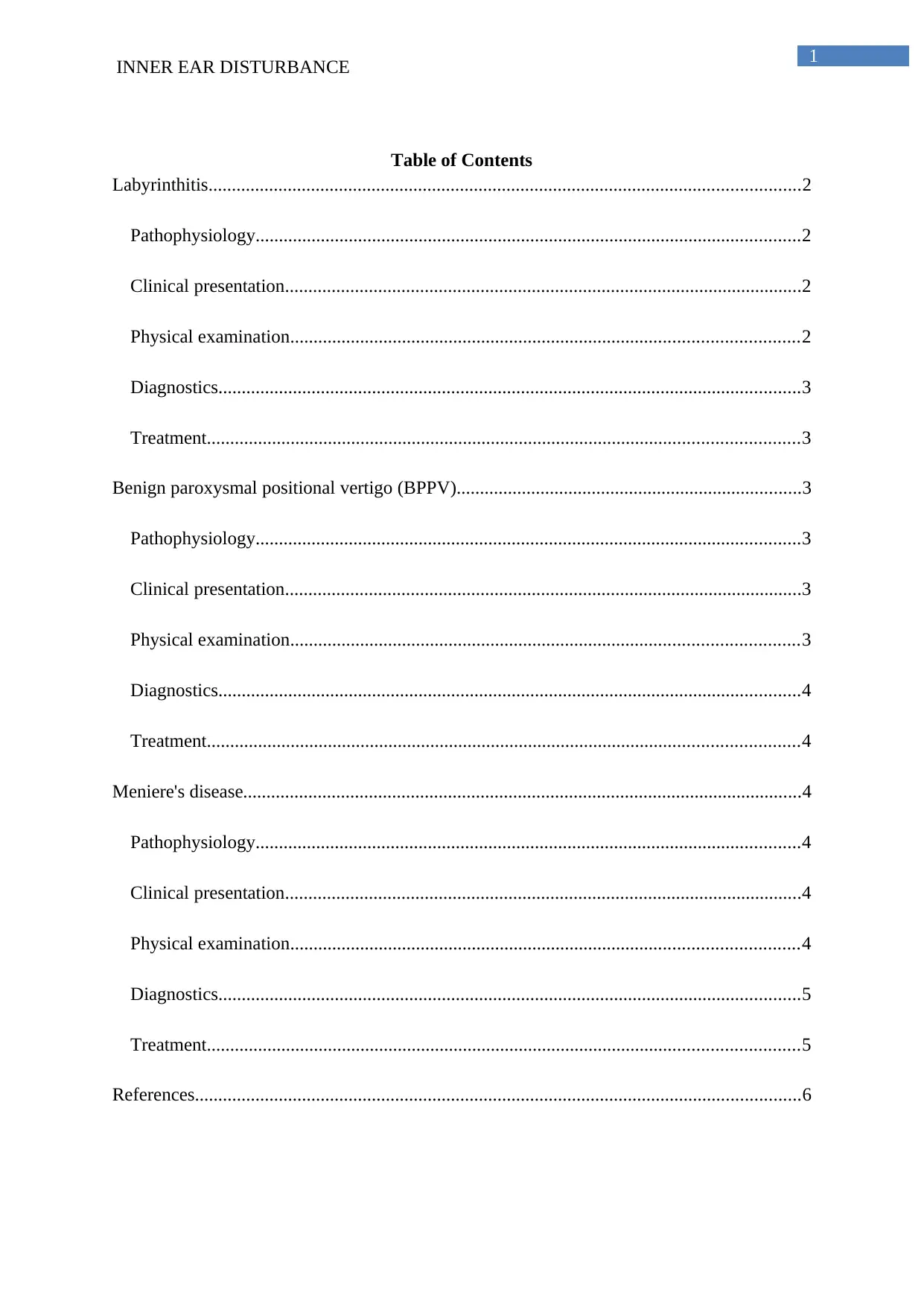
Table of Contents
Labyrinthitis...............................................................................................................................2
Pathophysiology.....................................................................................................................2
Clinical presentation...............................................................................................................2
Physical examination.............................................................................................................2
Diagnostics.............................................................................................................................3
Treatment...............................................................................................................................3
Benign paroxysmal positional vertigo (BPPV)..........................................................................3
Pathophysiology.....................................................................................................................3
Clinical presentation...............................................................................................................3
Physical examination.............................................................................................................3
Diagnostics.............................................................................................................................4
Treatment...............................................................................................................................4
Meniere's disease........................................................................................................................4
Pathophysiology.....................................................................................................................4
Clinical presentation...............................................................................................................4
Physical examination.............................................................................................................4
Diagnostics.............................................................................................................................5
Treatment...............................................................................................................................5
References..................................................................................................................................6
Document Page
2
INNER EAR DISTURBANCE
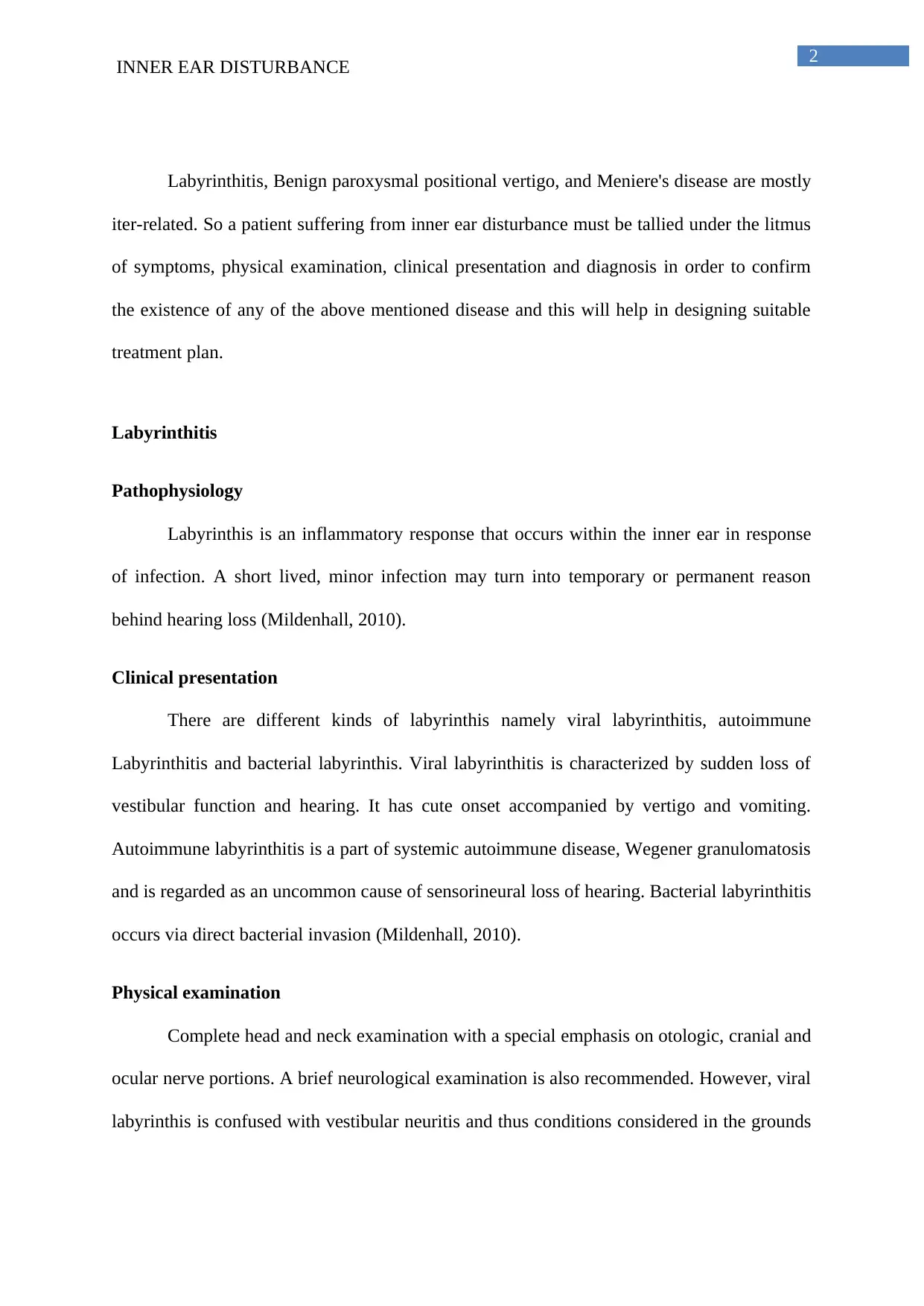
Labyrinthitis, Benign paroxysmal positional vertigo, and Meniere's disease are mostly
iter-related. So a patient suffering from inner ear disturbance must be tallied under the litmus
of symptoms, physical examination, clinical presentation and diagnosis in order to confirm
the existence of any of the above mentioned disease and this will help in designing suitable
treatment plan.
Labyrinthitis
Pathophysiology
Labyrinthis is an inflammatory response that occurs within the inner ear in response
of infection. A short lived, minor infection may turn into temporary or permanent reason
behind hearing loss (Mildenhall, 2010).
Clinical presentation
There are different kinds of labyrinthis namely viral labyrinthitis, autoimmune
Labyrinthitis and bacterial labyrinthis. Viral labyrinthitis is characterized by sudden loss of
vestibular function and hearing. It has cute onset accompanied by vertigo and vomiting.
Autoimmune labyrinthitis is a part of systemic autoimmune disease, Wegener granulomatosis
and is regarded as an uncommon cause of sensorineural loss of hearing. Bacterial labyrinthitis
occurs via direct bacterial invasion (Mildenhall, 2010).
Physical examination
Complete head and neck examination with a special emphasis on otologic, cranial and
ocular nerve portions. A brief neurological examination is also recommended. However, viral
labyrinthis is confused with vestibular neuritis and thus conditions considered in the grounds
Document Page
3
INNER EAR DISTURBANCE
of differential diagnosis of labyrinthitis include cerebellar infarct, presyncopal and
vertebrobasilar insufficiency (Mildenhall, 2010).
Diagnostics
Diagnostic used include computed tomography (CT) scan before lumbar puncture in
case of possible meningitis. CT scan also helps to rule out mastoiditis. Other tool used is
MRI, vestibular testing and audiography (Dommaraju & Perera, 2016).
Treatment
Treatment for viral labyrinthitis includes hydration and bed rest. Antibiotic treatment
is prescribed for the treatment of bacterial labyrinthitis and surgical care is recommended for
labyrinthitis arising from otitis media. Patients with profuse vomiting and nausea are advised
in-patient care along with intravenous and antiemetric medications (Dommaraju & Perera,
2016).
Benign paroxysmal positional vertigo (BPPV)
Pathophysiology
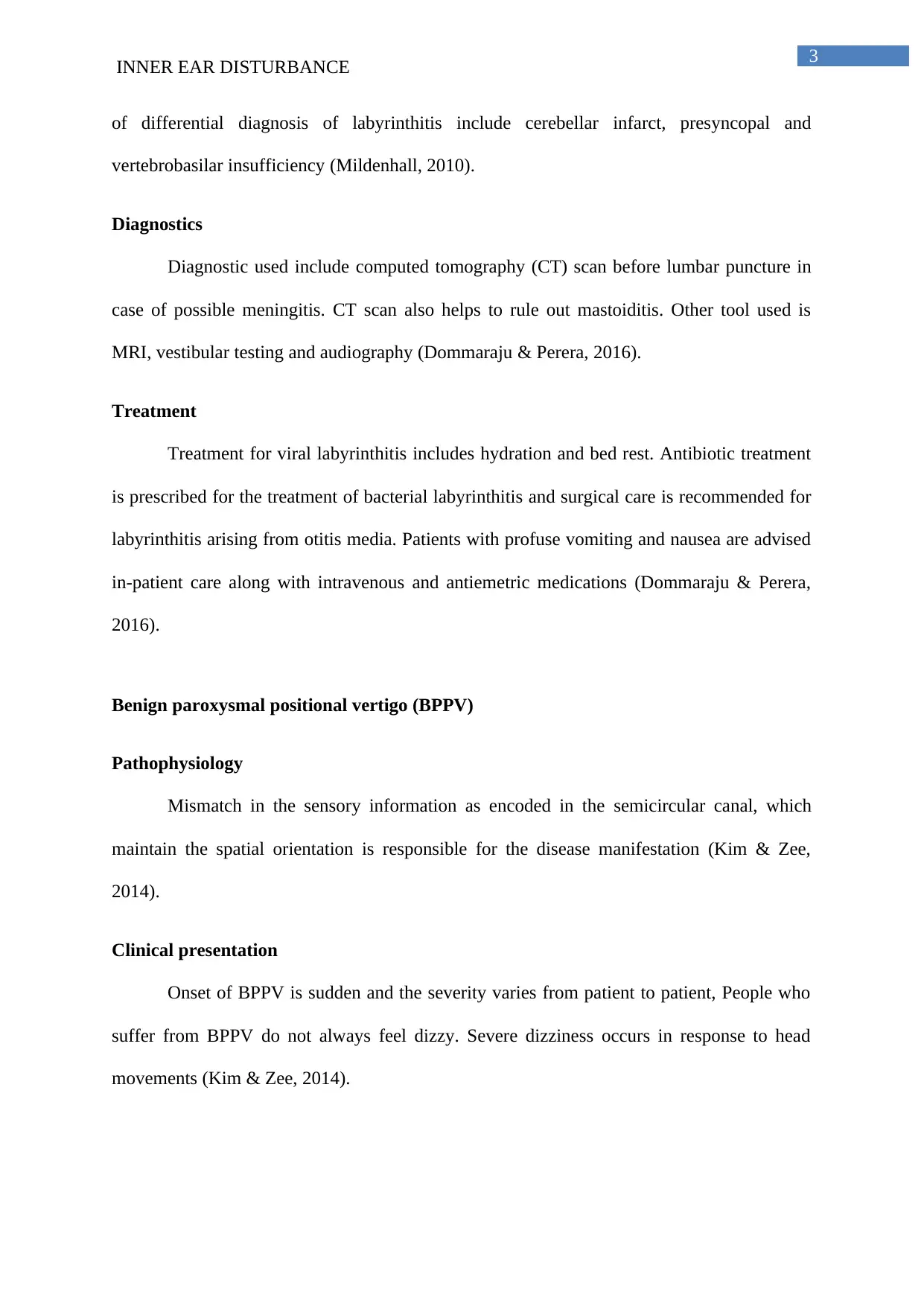
Mismatch in the sensory information as encoded in the semicircular canal, which
maintain the spatial orientation is responsible for the disease manifestation (Kim & Zee,
2014).
Clinical presentation
Onset of BPPV is sudden and the severity varies from patient to patient, People who
suffer from BPPV do not always feel dizzy. Severe dizziness occurs in response to head
movements (Kim & Zee, 2014).
tabler-icon-diamond-filled.svg

Paraphrase This Document

Need a fresh take? Get an instant paraphrase of this document with our AI Paraphraser
Document Page
4
INNER EAR DISTURBANCE
Physical examination
Physical manifestation of the disease varies from patients to patients. In case of
patients with severe BPPV, slightest movement of head is associated with vomiting and
nausea. Patients also have a continual feeling of foggy or cloudy sensorium (Kim & Zee,
2014).
Diagnostics
Dix-Hallpike maneuver is the standard clinical test employed for the detection of
BPPV. It is performed via rapidly moving the patient from sitting position to supine position
with head position at 45-degree to right. After 20-30 sec stand-time, the patient is retured to
sitting position (Kim & Zee, 2014).
Treatment
Main treatment options include watchful waiting, vestibular rehabilitation,
vestibulosuppressant medication, canalith repositioning and surgery (Kim & Zee, 2014).
Meniere's disease
Pathophysiology
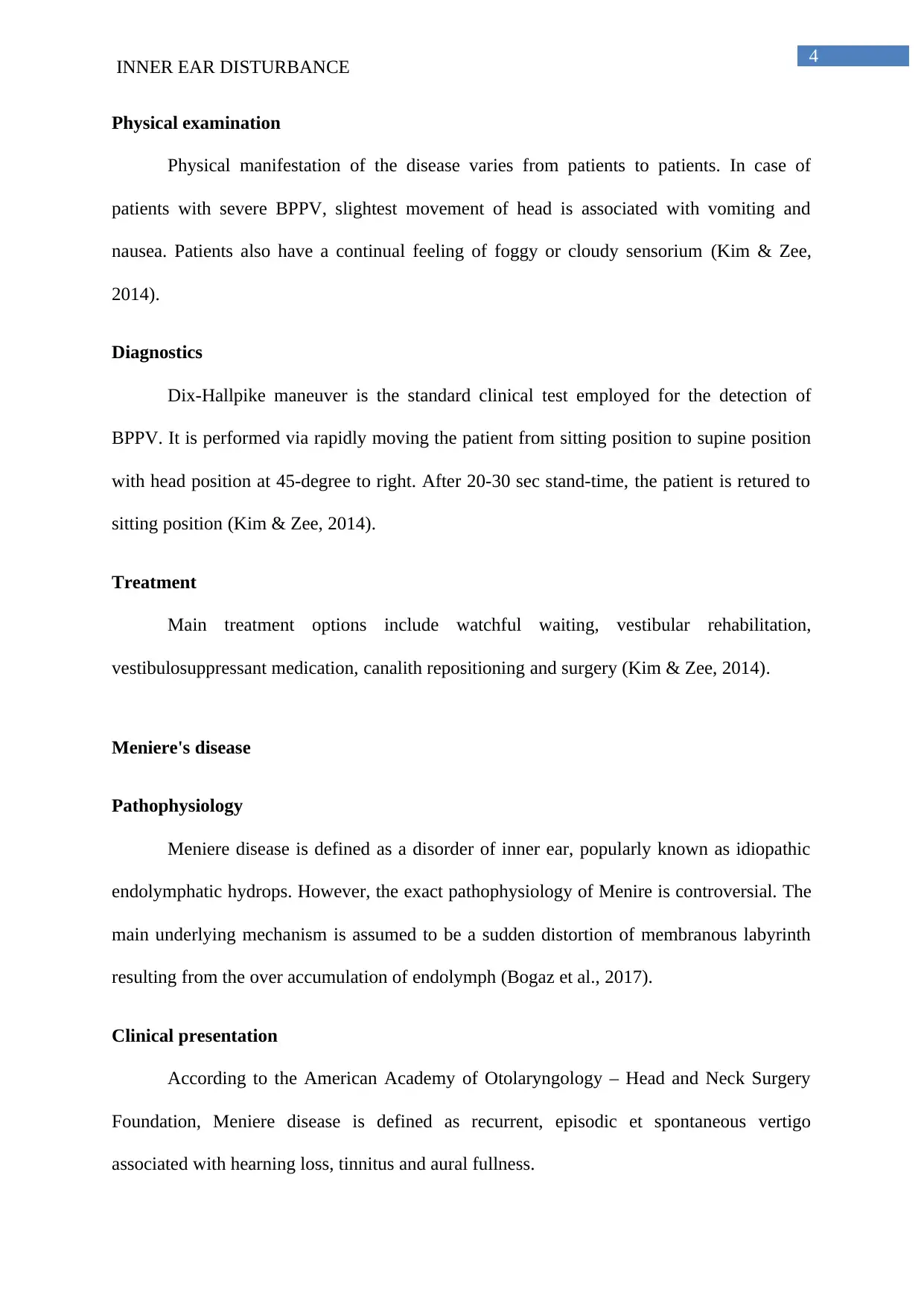
Meniere disease is defined as a disorder of inner ear, popularly known as idiopathic
endolymphatic hydrops. However, the exact pathophysiology of Menire is controversial. The
main underlying mechanism is assumed to be a sudden distortion of membranous labyrinth
resulting from the over accumulation of endolymph (Bogaz et al., 2017).
Clinical presentation
According to the American Academy of Otolaryngology – Head and Neck Surgery
Foundation, Meniere disease is defined as recurrent, episodic et spontaneous vertigo
associated with hearning loss, tinnitus and aural fullness.
Document Page
5
INNER EAR DISTURBANCE
Physical examination
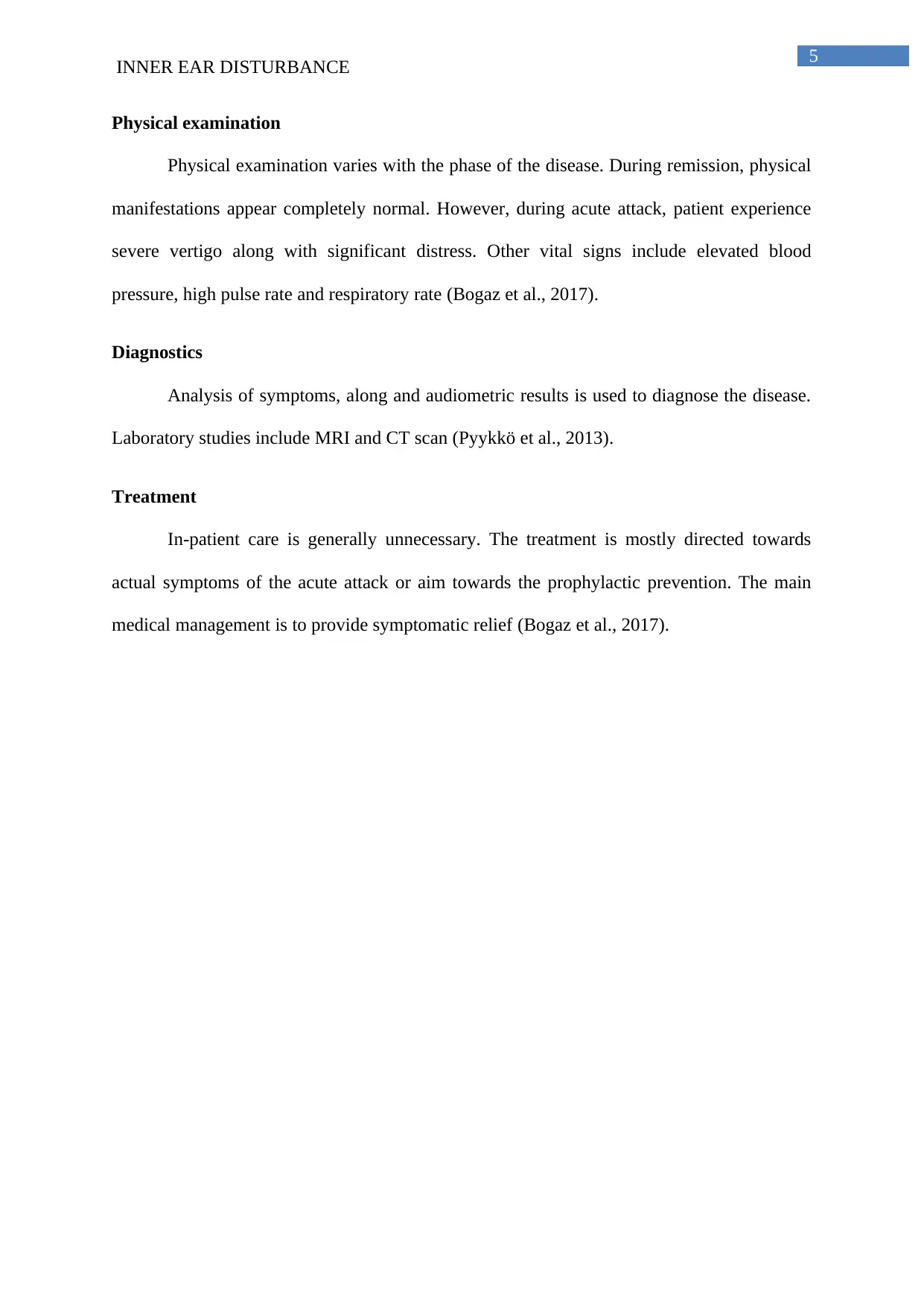
Physical examination varies with the phase of the disease. During remission, physical
manifestations appear completely normal. However, during acute attack, patient experience
severe vertigo along with significant distress. Other vital signs include elevated blood
pressure, high pulse rate and respiratory rate (Bogaz et al., 2017).
Diagnostics
Analysis of symptoms, along and audiometric results is used to diagnose the disease.
Laboratory studies include MRI and CT scan (Pyykkö et al., 2013).
Treatment
In-patient care is generally unnecessary. The treatment is mostly directed towards
actual symptoms of the acute attack or aim towards the prophylactic prevention. The main
medical management is to provide symptomatic relief (Bogaz et al., 2017).
Document Page
6
INNER EAR DISTURBANCE
References
Bogaz, E. A., da Silva, A. F. C., Ribeiro, D. K., & dos Santos Freitas, G. (2017). Meniere’s
Disease Treatment. In Up to Date on Meniere's Disease. InTech.
Dommaraju, S., & Perera, E. (2016). An approach to vertigo in general practice. Australian
family physician, 45(4), 190.
Kim, J. S., & Zee, D. S. (2014). Benign paroxysmal positional vertigo. New England Journal
of Medicine, 370(12), 1138-1147.
Meniere's Disease. (2017). American Academy of Otolaryngology-Head and Neck Surgery.
Retrieved 5 February 2018, from http://www.entnet.org/content/menieres-disease
Mildenhall, J. (2010). The pathophysiology of labyrinthitis. Journal of Paramedic
Practice, 2(7), 297-303.
Pyykkö, I., Nakashima, T., Yoshida, T., Zou, J., & Naganawa, S. (2013). Meniere's disease: a
reappraisal supported by a variable latency of symptoms and the MRI visualisation of
endolymphatic hydrops. BMJ open, 3(2), e001555.
chevron_up_icon
1 out of 7
circle_padding
hide_on_mobile
zoom_out_icon
[object Object]