University: Innovation and Management Decision Making Blog Article
VerifiedAdded on 2023/01/17
|7
|1298
|24
Report
AI Summary
This blog post explores how technological and socio-cultural forces in the business environment necessitate innovation within organizations. It examines the impact of these forces on strategic decision-making and the importance of adapting to rapid advancements, using examples like Apple to illustrate the need for continuous innovation. The article discusses the relevance of data analytics, the balance between technological progress and potential drawbacks, and the role of socio-cultural awareness in driving innovation. It highlights the importance of effective management theories, such as Theory Y and Z, in supporting brainstorming sessions and achieving high productivity and employee satisfaction. The blog emphasizes that successful innovation hinges on understanding the market, embracing diversity, and making value-based decisions to create a smart future for organizations.
Running Head: INNOVATION AND MANAGEMENT DECISION MAKING
Topic- Professional blog article on how forces in the business environment require organizations
to be innovative
Student name
University name
Author notes
Topic- Professional blog article on how forces in the business environment require organizations
to be innovative
Student name
University name
Author notes
Paraphrase This Document
Need a fresh take? Get an instant paraphrase of this document with our AI Paraphraser

2INNOVATION AND MANAGEMENT DECISION MAKING
Be where the world is going…. For the heart and soul of a company is innovation and creativity
Every business only has two core functions- marketing and innovation, where innovation is not
about market timing but is about creating something for the unmet need (Prajogo 2016). Forces
in the business environment that shape the innovative need of the companies are manifold. In this
article focus will be on technological and socio-cultural forces and on the type of management
theories and business decision types that impacts strategic decision-making.
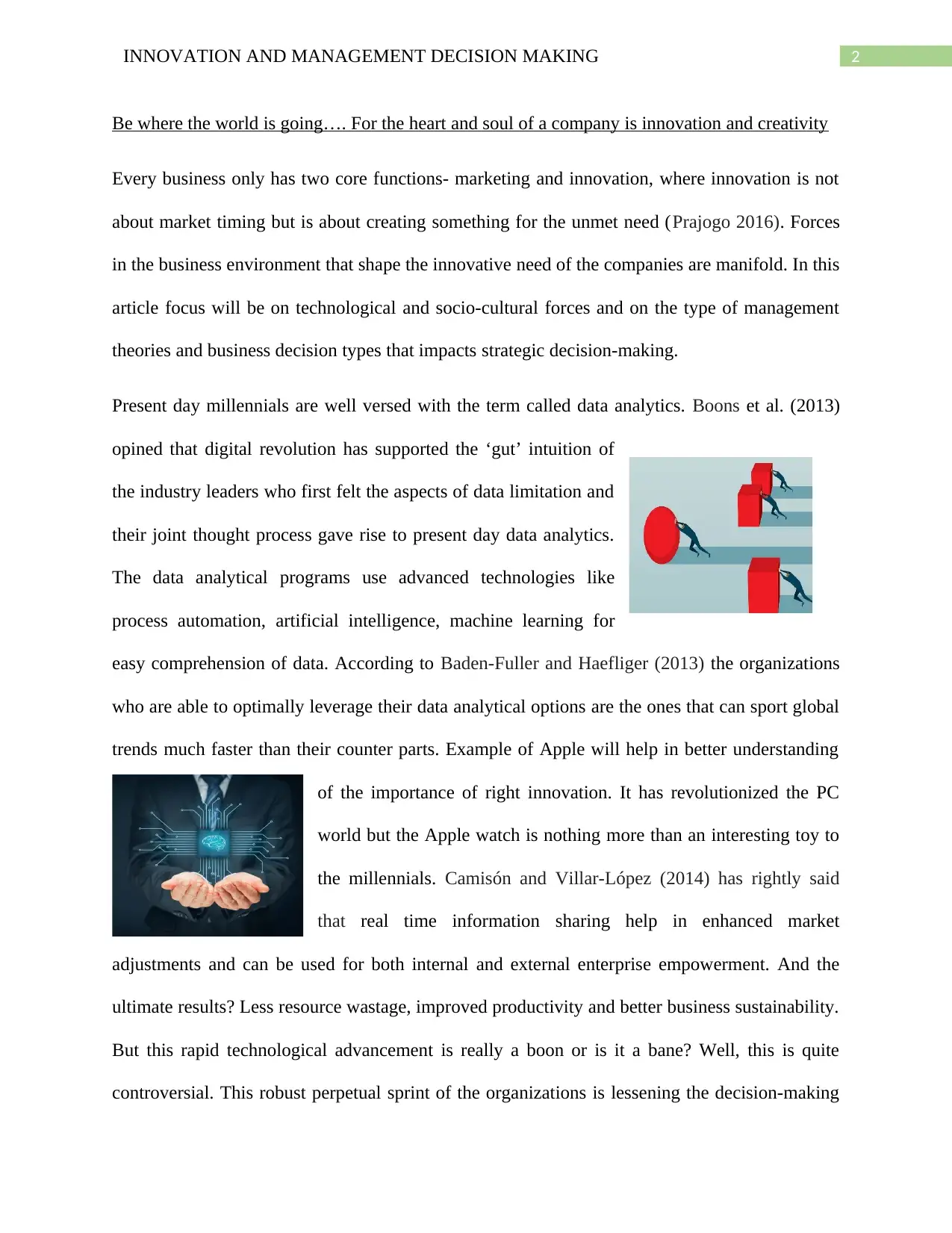
Present day millennials are well versed with the term called data analytics. Boons et al. (2013)
opined that digital revolution has supported the ‘gut’ intuition of
the industry leaders who first felt the aspects of data limitation and
their joint thought process gave rise to present day data analytics.
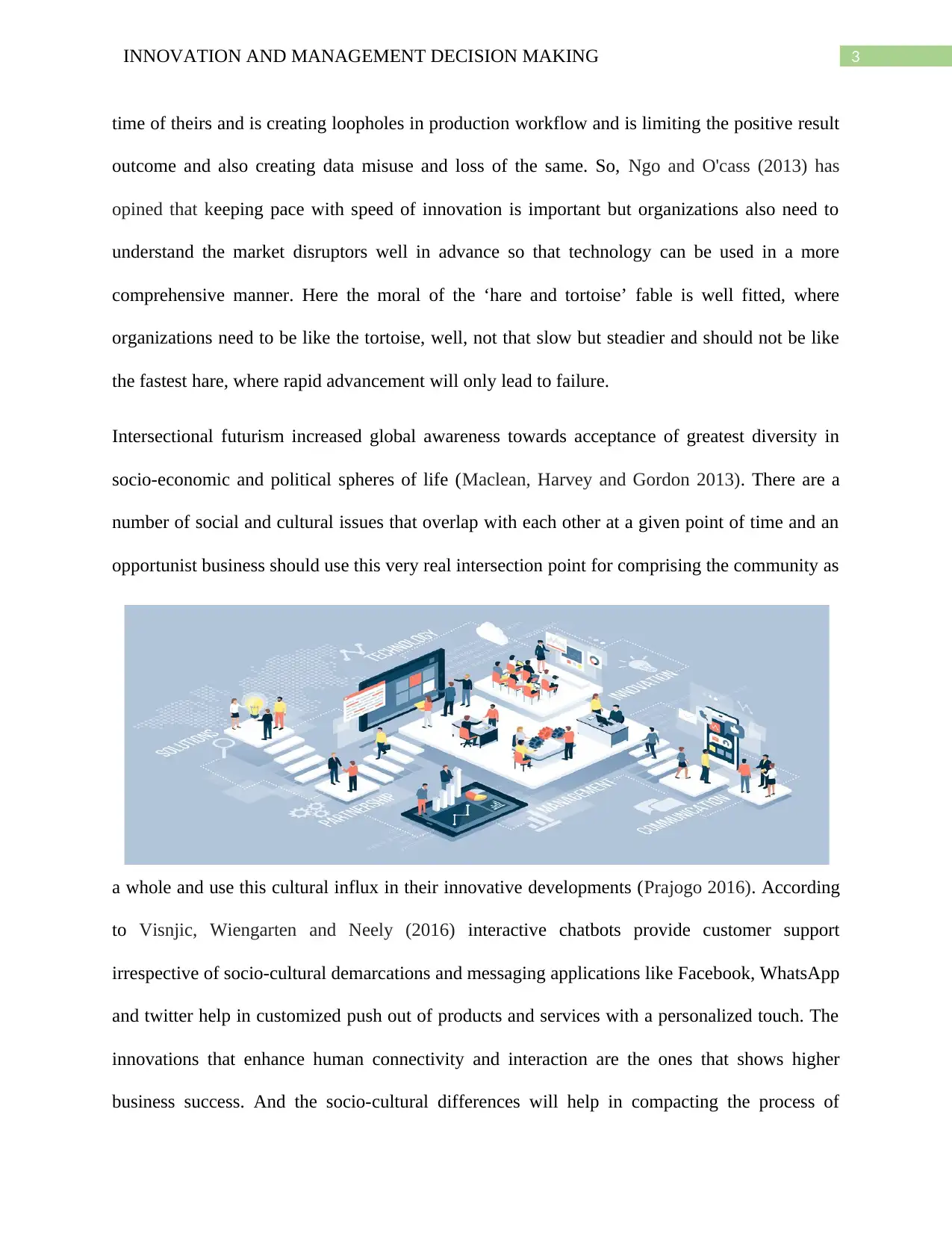
The data analytical programs use advanced technologies like
process automation, artificial intelligence, machine learning for
easy comprehension of data. According to Baden-Fuller and Haefliger (2013) the organizations
who are able to optimally leverage their data analytical options are the ones that can sport global
trends much faster than their counter parts. Example of Apple will help in better understanding
of the importance of right innovation. It has revolutionized the PC
world but the Apple watch is nothing more than an interesting toy to
the millennials. Camisón and Villar-López (2014) has rightly said
that real time information sharing help in enhanced market
adjustments and can be used for both internal and external enterprise empowerment. And the
ultimate results? Less resource wastage, improved productivity and better business sustainability.
But this rapid technological advancement is really a boon or is it a bane? Well, this is quite
controversial. This robust perpetual sprint of the organizations is lessening the decision-making
Be where the world is going…. For the heart and soul of a company is innovation and creativity
Every business only has two core functions- marketing and innovation, where innovation is not
about market timing but is about creating something for the unmet need (Prajogo 2016). Forces
in the business environment that shape the innovative need of the companies are manifold. In this
article focus will be on technological and socio-cultural forces and on the type of management
theories and business decision types that impacts strategic decision-making.
Present day millennials are well versed with the term called data analytics. Boons et al. (2013)
opined that digital revolution has supported the ‘gut’ intuition of
the industry leaders who first felt the aspects of data limitation and
their joint thought process gave rise to present day data analytics.
The data analytical programs use advanced technologies like
process automation, artificial intelligence, machine learning for
easy comprehension of data. According to Baden-Fuller and Haefliger (2013) the organizations
who are able to optimally leverage their data analytical options are the ones that can sport global
trends much faster than their counter parts. Example of Apple will help in better understanding
of the importance of right innovation. It has revolutionized the PC
world but the Apple watch is nothing more than an interesting toy to
the millennials. Camisón and Villar-López (2014) has rightly said
that real time information sharing help in enhanced market
adjustments and can be used for both internal and external enterprise empowerment. And the
ultimate results? Less resource wastage, improved productivity and better business sustainability.
But this rapid technological advancement is really a boon or is it a bane? Well, this is quite
controversial. This robust perpetual sprint of the organizations is lessening the decision-making

3INNOVATION AND MANAGEMENT DECISION MAKING
time of theirs and is creating loopholes in production workflow and is limiting the positive result
outcome and also creating data misuse and loss of the same. So, Ngo and O'cass (2013) has
opined that keeping pace with speed of innovation is important but organizations also need to
understand the market disruptors well in advance so that technology can be used in a more
comprehensive manner. Here the moral of the ‘hare and tortoise’ fable is well fitted, where
organizations need to be like the tortoise, well, not that slow but steadier and should not be like
the fastest hare, where rapid advancement will only lead to failure.
Intersectional futurism increased global awareness towards acceptance of greatest diversity in
socio-economic and political spheres of life (Maclean, Harvey and Gordon 2013). There are a
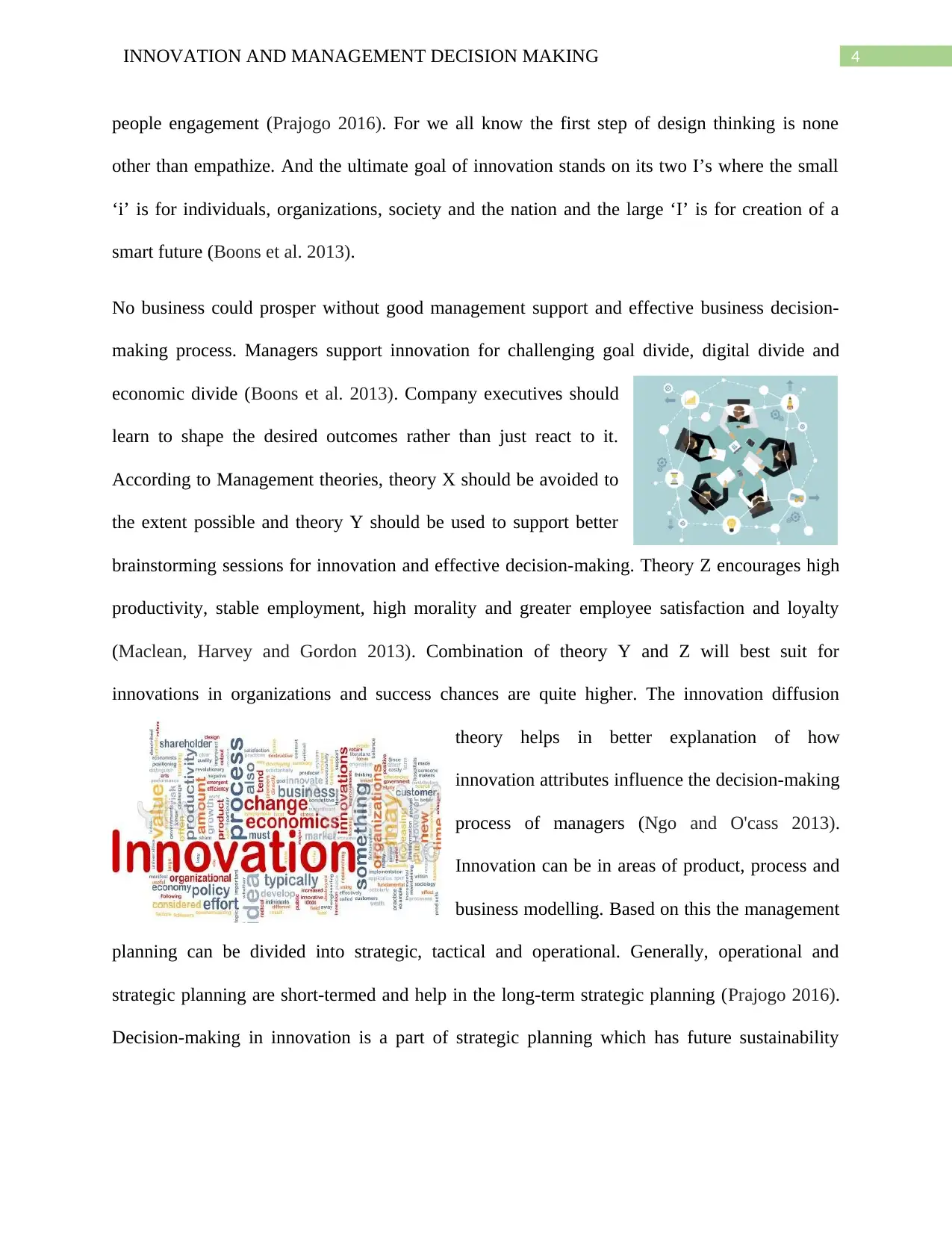
number of social and cultural issues that overlap with each other at a given point of time and an
opportunist business should use this very real intersection point for comprising the community as
a whole and use this cultural influx in their innovative developments (Prajogo 2016). According
to Visnjic, Wiengarten and Neely (2016) interactive chatbots provide customer support
irrespective of socio-cultural demarcations and messaging applications like Facebook, WhatsApp
and twitter help in customized push out of products and services with a personalized touch. The
innovations that enhance human connectivity and interaction are the ones that shows higher
business success. And the socio-cultural differences will help in compacting the process of
time of theirs and is creating loopholes in production workflow and is limiting the positive result
outcome and also creating data misuse and loss of the same. So, Ngo and O'cass (2013) has
opined that keeping pace with speed of innovation is important but organizations also need to
understand the market disruptors well in advance so that technology can be used in a more
comprehensive manner. Here the moral of the ‘hare and tortoise’ fable is well fitted, where
organizations need to be like the tortoise, well, not that slow but steadier and should not be like
the fastest hare, where rapid advancement will only lead to failure.
Intersectional futurism increased global awareness towards acceptance of greatest diversity in
socio-economic and political spheres of life (Maclean, Harvey and Gordon 2013). There are a
number of social and cultural issues that overlap with each other at a given point of time and an
opportunist business should use this very real intersection point for comprising the community as
a whole and use this cultural influx in their innovative developments (Prajogo 2016). According
to Visnjic, Wiengarten and Neely (2016) interactive chatbots provide customer support
irrespective of socio-cultural demarcations and messaging applications like Facebook, WhatsApp
and twitter help in customized push out of products and services with a personalized touch. The
innovations that enhance human connectivity and interaction are the ones that shows higher
business success. And the socio-cultural differences will help in compacting the process of
⊘ This is a preview!⊘
Do you want full access?
Subscribe today to unlock all pages.

Trusted by 1+ million students worldwide

4INNOVATION AND MANAGEMENT DECISION MAKING
people engagement (Prajogo 2016). For we all know the first step of design thinking is none
other than empathize. And the ultimate goal of innovation stands on its two I’s where the small
‘i’ is for individuals, organizations, society and the nation and the large ‘I’ is for creation of a
smart future (Boons et al. 2013).
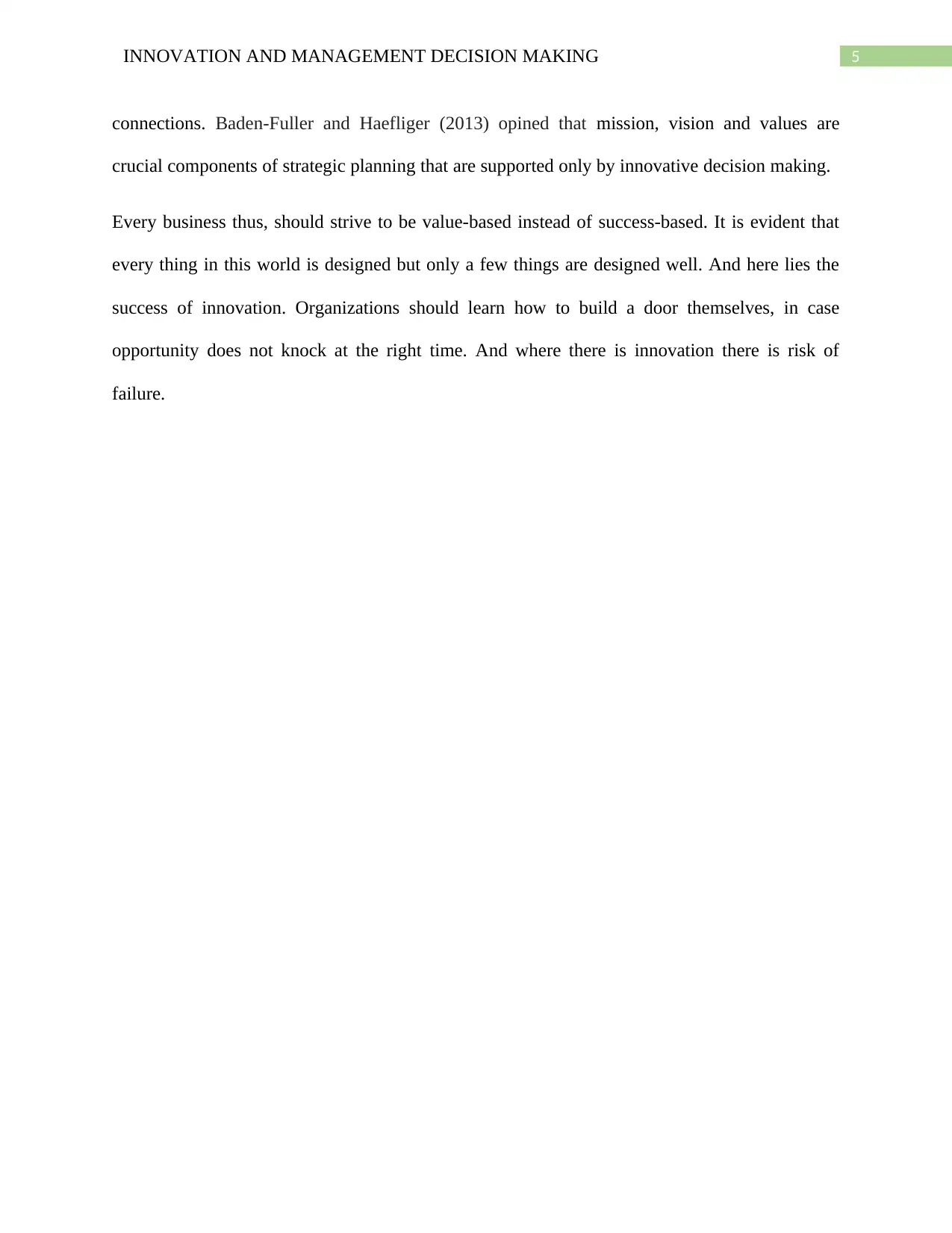
No business could prosper without good management support and effective business decision-
making process. Managers support innovation for challenging goal divide, digital divide and
economic divide (Boons et al. 2013). Company executives should
learn to shape the desired outcomes rather than just react to it.
According to Management theories, theory X should be avoided to
the extent possible and theory Y should be used to support better
brainstorming sessions for innovation and effective decision-making. Theory Z encourages high
productivity, stable employment, high morality and greater employee satisfaction and loyalty
(Maclean, Harvey and Gordon 2013). Combination of theory Y and Z will best suit for
innovations in organizations and success chances are quite higher. The innovation diffusion
theory helps in better explanation of how
innovation attributes influence the decision-making
process of managers (Ngo and O'cass 2013).
Innovation can be in areas of product, process and
business modelling. Based on this the management
planning can be divided into strategic, tactical and operational. Generally, operational and
strategic planning are short-termed and help in the long-term strategic planning (Prajogo 2016).
Decision-making in innovation is a part of strategic planning which has future sustainability
people engagement (Prajogo 2016). For we all know the first step of design thinking is none
other than empathize. And the ultimate goal of innovation stands on its two I’s where the small
‘i’ is for individuals, organizations, society and the nation and the large ‘I’ is for creation of a
smart future (Boons et al. 2013).
No business could prosper without good management support and effective business decision-
making process. Managers support innovation for challenging goal divide, digital divide and
economic divide (Boons et al. 2013). Company executives should
learn to shape the desired outcomes rather than just react to it.
According to Management theories, theory X should be avoided to
the extent possible and theory Y should be used to support better
brainstorming sessions for innovation and effective decision-making. Theory Z encourages high
productivity, stable employment, high morality and greater employee satisfaction and loyalty
(Maclean, Harvey and Gordon 2013). Combination of theory Y and Z will best suit for
innovations in organizations and success chances are quite higher. The innovation diffusion
theory helps in better explanation of how
innovation attributes influence the decision-making
process of managers (Ngo and O'cass 2013).
Innovation can be in areas of product, process and
business modelling. Based on this the management
planning can be divided into strategic, tactical and operational. Generally, operational and
strategic planning are short-termed and help in the long-term strategic planning (Prajogo 2016).
Decision-making in innovation is a part of strategic planning which has future sustainability
Paraphrase This Document
Need a fresh take? Get an instant paraphrase of this document with our AI Paraphraser

5INNOVATION AND MANAGEMENT DECISION MAKING
connections. Baden-Fuller and Haefliger (2013) opined that mission, vision and values are
crucial components of strategic planning that are supported only by innovative decision making.
Every business thus, should strive to be value-based instead of success-based. It is evident that
every thing in this world is designed but only a few things are designed well. And here lies the
success of innovation. Organizations should learn how to build a door themselves, in case
opportunity does not knock at the right time. And where there is innovation there is risk of
failure.
connections. Baden-Fuller and Haefliger (2013) opined that mission, vision and values are
crucial components of strategic planning that are supported only by innovative decision making.
Every business thus, should strive to be value-based instead of success-based. It is evident that
every thing in this world is designed but only a few things are designed well. And here lies the
success of innovation. Organizations should learn how to build a door themselves, in case
opportunity does not knock at the right time. And where there is innovation there is risk of
failure.

6INNOVATION AND MANAGEMENT DECISION MAKING
References
Baden-Fuller, C. and Haefliger, S., 2013. Business models and technological innovation. Long
range planning, 46(6), pp.419-426.
Boons, F., Montalvo, C., Quist, J. and Wagner, M., 2013. Sustainable innovation, business
models and economic performance: an overview. Journal of Cleaner Production, 45, pp.1-8.
Camisón, C. and Villar-López, A., 2014. Organizational innovation as an enabler of
technological innovation capabilities and firm performance. Journal of business research, 67(1),
pp.2891-2902.
Maclean, M., Harvey, C. and Gordon, J., 2013. Social innovation, social entrepreneurship and
the practice of contemporary entrepreneurial philanthropy. International Small Business
Journal, 31(7), pp.747-763.
Ngo, L.V. and O'cass, A., 2013. Innovation and business success: The mediating role of
customer participation. Journal of Business Research, 66(8), pp.1134-1142.
Prajogo, D.I., 2016. The strategic fit between innovation strategies and business environment in
delivering business performance. International Journal of Production Economics, 171, pp.241-
249.
Visnjic, I., Wiengarten, F. and Neely, A., 2016. Only the brave: Product innovation, service
business model innovation, and their impact on performance. Journal of Product Innovation
Management, 33(1), pp.36-52.
References
Baden-Fuller, C. and Haefliger, S., 2013. Business models and technological innovation. Long
range planning, 46(6), pp.419-426.
Boons, F., Montalvo, C., Quist, J. and Wagner, M., 2013. Sustainable innovation, business
models and economic performance: an overview. Journal of Cleaner Production, 45, pp.1-8.
Camisón, C. and Villar-López, A., 2014. Organizational innovation as an enabler of
technological innovation capabilities and firm performance. Journal of business research, 67(1),
pp.2891-2902.
Maclean, M., Harvey, C. and Gordon, J., 2013. Social innovation, social entrepreneurship and
the practice of contemporary entrepreneurial philanthropy. International Small Business
Journal, 31(7), pp.747-763.
Ngo, L.V. and O'cass, A., 2013. Innovation and business success: The mediating role of
customer participation. Journal of Business Research, 66(8), pp.1134-1142.
Prajogo, D.I., 2016. The strategic fit between innovation strategies and business environment in
delivering business performance. International Journal of Production Economics, 171, pp.241-
249.
Visnjic, I., Wiengarten, F. and Neely, A., 2016. Only the brave: Product innovation, service
business model innovation, and their impact on performance. Journal of Product Innovation
Management, 33(1), pp.36-52.
⊘ This is a preview!⊘
Do you want full access?
Subscribe today to unlock all pages.

Trusted by 1+ million students worldwide

7INNOVATION AND MANAGEMENT DECISION MAKING
1 out of 7
Related Documents
Your All-in-One AI-Powered Toolkit for Academic Success.
+13062052269
info@desklib.com
Available 24*7 on WhatsApp / Email
Unlock your academic potential
Copyright © 2020–2025 A2Z Services. All Rights Reserved. Developed and managed by ZUCOL.