Innovation in Leadership: SBIR Feedback Model and Action Plan
VerifiedAdded on 2020/04/21
|12
|2685
|58
Report
AI Summary
This report delves into the core differences between leadership and management, highlighting the innovator versus maintainer roles. It explores the Situation-Behavior-Impact-Request (SBIR) feedback model, emphasizing its effectiveness in delivering constructive criticism. The report also addresses organizational silence, its impact on performance, and the distortion of messages in the workplace. Furthermore, it examines public health advocacy strategies, the distinction between lobbying and advocacy, and the importance of monitoring and evaluating advocacy projects. Part B of the report provides a project management perspective, outlining initial steps, risk assessment, resource management, and action plans, including strategies for addressing alcohol-related health issues and the challenges faced during project execution. The report offers valuable insights into leadership, innovation, and practical project management.
Running head: INNOVATION IN LEADERSHIP
Innovation in Leadership
Name of the student
Name of the university
Author note
Innovation in Leadership
Name of the student
Name of the university
Author note

Paraphrase This Document
Need a fresh take? Get an instant paraphrase of this document with our AI Paraphraser
1
INNOVATION IN LEADERSHIP
Part A
1. The main difference between leadership and management is that the leaders have people
following them and the managers have people who are working for them. Being both at
the same time is a feasible concept. However, there are some standout differences between
the two roles. A leader is someone who invents or innovates, coming up with new notions
and kick starting the shift of the organization into a forward-thinking phase. In contrast to
that, the manager is generally just maintaining what is already established. A manager is
always relying on control, where, on the other hand, the leader inspires trust. Leaders ask
what and why, whereas the managers generally ask questions like how and when. Good
leadership asks for a lot of good verdict, especially in matters of the ability of standing up
to the senior management over any specific point of concern or if there is any aspect that
requires improvement (Northouse).
2. Situation-Behavior-Impact-Request (SBIR) feedback model helps in the delivering of
more effective and direct feedback. It is focused on the comments on any precise situation
and behavior and then it summaries the influence that these behaviors have on other
people. The tool has a simple structure that can be used for giving feedback – situation,
behavior and impact. This kind of feedback structure helps people understand exactly
what they are commenting on and what the reason is for that. Outlining the influence of
their behavior on other people, they would be getting the chance of reflecting on their
actions and thinking about what is needed to be changed. Once the model is applied and
the feedback is delivered the other person needs to be encouraged into thinking regarding
the situation and understanding the influence of his or her behavior (Claiborne, Sirgy).
INNOVATION IN LEADERSHIP
Part A
1. The main difference between leadership and management is that the leaders have people
following them and the managers have people who are working for them. Being both at
the same time is a feasible concept. However, there are some standout differences between
the two roles. A leader is someone who invents or innovates, coming up with new notions
and kick starting the shift of the organization into a forward-thinking phase. In contrast to
that, the manager is generally just maintaining what is already established. A manager is
always relying on control, where, on the other hand, the leader inspires trust. Leaders ask
what and why, whereas the managers generally ask questions like how and when. Good
leadership asks for a lot of good verdict, especially in matters of the ability of standing up
to the senior management over any specific point of concern or if there is any aspect that
requires improvement (Northouse).
2. Situation-Behavior-Impact-Request (SBIR) feedback model helps in the delivering of
more effective and direct feedback. It is focused on the comments on any precise situation
and behavior and then it summaries the influence that these behaviors have on other
people. The tool has a simple structure that can be used for giving feedback – situation,
behavior and impact. This kind of feedback structure helps people understand exactly
what they are commenting on and what the reason is for that. Outlining the influence of
their behavior on other people, they would be getting the chance of reflecting on their
actions and thinking about what is needed to be changed. Once the model is applied and
the feedback is delivered the other person needs to be encouraged into thinking regarding
the situation and understanding the influence of his or her behavior (Claiborne, Sirgy).
2
INNOVATION IN LEADERSHIP
3. Organizational silence is a kind of behavioral choice that can develop or depreciate
organizational performance. Not taking into consideration the fervently difficult
expression, silence might even be conveying approval and sharing, or disfavoring and
opposition, in turn turning into a pressure mechanism for both the organization and the
individuals in it. If the employees are silenced by the organization then they are most often
than not damaging the relationships and stopping growth and innovation. Research has
shown that this inclination of remaining silent instead of just expressing a different
perspective takes place in both individual relations and in organizational ones (Dankoski,
Bickel, Gusic).
Message distortion takes place whenever any message that is sent by one communicator
gets interpreted in a different manner by the receiver of the message. Costly and
complicated instances of message distortion happens in the workplace at the time when
someone is misinterpreting directions regarding a task completion. Even though
distortion cannot get eliminated in a complete manner when any message is getting sent
in any setting, there are different ways in which the distortion can be reduced. Hierarchy
is one of the main reason of messages getting distorted in organizations. The authority,
power and status relationships that are inherent inside the chain of command inside any
organization builds an additional influence on the information distortion (Ruesch).
4. Public health advocacy strategies adopt an upstream approach that recognizes both
individual and personal problems as being reflective often in social conditions. It even
identifies the societal breadth of several public health problems and the resource and
logistical challenges that are inherent while addressing these challenges at an individual
level. Engagement in public health advocacy addresses the clearly political aspects of
INNOVATION IN LEADERSHIP
3. Organizational silence is a kind of behavioral choice that can develop or depreciate
organizational performance. Not taking into consideration the fervently difficult
expression, silence might even be conveying approval and sharing, or disfavoring and
opposition, in turn turning into a pressure mechanism for both the organization and the
individuals in it. If the employees are silenced by the organization then they are most often
than not damaging the relationships and stopping growth and innovation. Research has
shown that this inclination of remaining silent instead of just expressing a different
perspective takes place in both individual relations and in organizational ones (Dankoski,
Bickel, Gusic).
Message distortion takes place whenever any message that is sent by one communicator
gets interpreted in a different manner by the receiver of the message. Costly and
complicated instances of message distortion happens in the workplace at the time when
someone is misinterpreting directions regarding a task completion. Even though
distortion cannot get eliminated in a complete manner when any message is getting sent
in any setting, there are different ways in which the distortion can be reduced. Hierarchy
is one of the main reason of messages getting distorted in organizations. The authority,
power and status relationships that are inherent inside the chain of command inside any
organization builds an additional influence on the information distortion (Ruesch).
4. Public health advocacy strategies adopt an upstream approach that recognizes both
individual and personal problems as being reflective often in social conditions. It even
identifies the societal breadth of several public health problems and the resource and
logistical challenges that are inherent while addressing these challenges at an individual
level. Engagement in public health advocacy addresses the clearly political aspects of
⊘ This is a preview!⊘
Do you want full access?
Subscribe today to unlock all pages.

Trusted by 1+ million students worldwide
3
INNOVATION IN LEADERSHIP
public health and the importance of addressing social determinants of health as a major
element of any strategy for the betterment of the health of populations. It is vital for
supporting and creating environments that support health. Advocacy strategies are drawn
from a variety of strategies, which involves creation and maintenance of effective
coalitions, the application of information and resources for effecting systematic
modifications, and the tactical usage of news media for advancing a public policy
initiative and changing the way in which people live in a community. Most of the time it
even involves bringing together a disparate group for working together towards a common
objective. It can even involve the gathering and presentation of any evidence base for the
wish of any changes, even though that is worth noting that scientific evidence single
handedly is hardly enough for achieving any desired political support for public health
objectives (Katikireddi, Bond, Hilton).
5. Most of the people use the terms lobbying and advocacy simultaneously. However, there
is a distinction between the two that is helpful in better comprehension of the same. If
nonprofit organizations are advocating on their own behalf they are seeking to influence
some traits of the society, no matter if they are appealing to the individuals regarding their
behavior, governments regarding their laws, or the employers regarding their rules.
Lobbying is specifically referred to advocacy attempts that try influencing legislations.
This difference is helpful for keeping in mind as it implies that the laws that limit the
lobbying carried out by nonprofit organizations do not administer other advocacy
activities (Hanegraaff, Braun, De Bièvre, Beyers).
6. The objective of any advocacy strategy or project is improving the lives of ordinary
citizens. In case of development agencies, this implies ordinary citizen in the global south.
INNOVATION IN LEADERSHIP
public health and the importance of addressing social determinants of health as a major
element of any strategy for the betterment of the health of populations. It is vital for
supporting and creating environments that support health. Advocacy strategies are drawn
from a variety of strategies, which involves creation and maintenance of effective
coalitions, the application of information and resources for effecting systematic
modifications, and the tactical usage of news media for advancing a public policy
initiative and changing the way in which people live in a community. Most of the time it
even involves bringing together a disparate group for working together towards a common
objective. It can even involve the gathering and presentation of any evidence base for the
wish of any changes, even though that is worth noting that scientific evidence single
handedly is hardly enough for achieving any desired political support for public health
objectives (Katikireddi, Bond, Hilton).
5. Most of the people use the terms lobbying and advocacy simultaneously. However, there
is a distinction between the two that is helpful in better comprehension of the same. If
nonprofit organizations are advocating on their own behalf they are seeking to influence
some traits of the society, no matter if they are appealing to the individuals regarding their
behavior, governments regarding their laws, or the employers regarding their rules.
Lobbying is specifically referred to advocacy attempts that try influencing legislations.
This difference is helpful for keeping in mind as it implies that the laws that limit the
lobbying carried out by nonprofit organizations do not administer other advocacy
activities (Hanegraaff, Braun, De Bièvre, Beyers).
6. The objective of any advocacy strategy or project is improving the lives of ordinary
citizens. In case of development agencies, this implies ordinary citizen in the global south.
Paraphrase This Document
Need a fresh take? Get an instant paraphrase of this document with our AI Paraphraser
4
INNOVATION IN LEADERSHIP
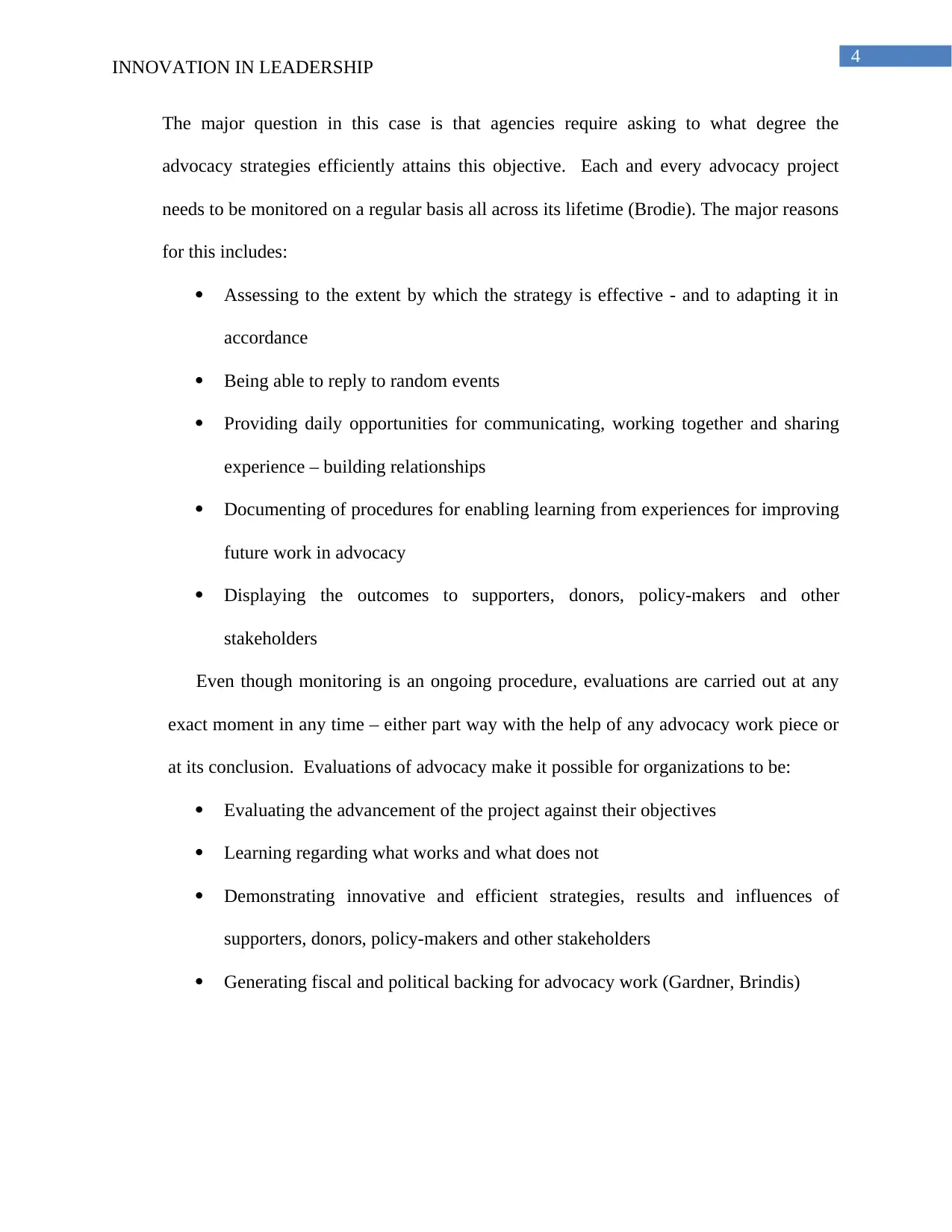
The major question in this case is that agencies require asking to what degree the
advocacy strategies efficiently attains this objective. Each and every advocacy project
needs to be monitored on a regular basis all across its lifetime (Brodie). The major reasons
for this includes:
Assessing to the extent by which the strategy is effective - and to adapting it in
accordance
Being able to reply to random events
Providing daily opportunities for communicating, working together and sharing
experience – building relationships
Documenting of procedures for enabling learning from experiences for improving
future work in advocacy
Displaying the outcomes to supporters, donors, policy-makers and other
stakeholders
Even though monitoring is an ongoing procedure, evaluations are carried out at any
exact moment in any time – either part way with the help of any advocacy work piece or
at its conclusion. Evaluations of advocacy make it possible for organizations to be:
Evaluating the advancement of the project against their objectives
Learning regarding what works and what does not
Demonstrating innovative and efficient strategies, results and influences of
supporters, donors, policy-makers and other stakeholders
Generating fiscal and political backing for advocacy work (Gardner, Brindis)
INNOVATION IN LEADERSHIP
The major question in this case is that agencies require asking to what degree the
advocacy strategies efficiently attains this objective. Each and every advocacy project
needs to be monitored on a regular basis all across its lifetime (Brodie). The major reasons
for this includes:
Assessing to the extent by which the strategy is effective - and to adapting it in
accordance
Being able to reply to random events
Providing daily opportunities for communicating, working together and sharing
experience – building relationships
Documenting of procedures for enabling learning from experiences for improving
future work in advocacy
Displaying the outcomes to supporters, donors, policy-makers and other
stakeholders
Even though monitoring is an ongoing procedure, evaluations are carried out at any
exact moment in any time – either part way with the help of any advocacy work piece or
at its conclusion. Evaluations of advocacy make it possible for organizations to be:
Evaluating the advancement of the project against their objectives
Learning regarding what works and what does not
Demonstrating innovative and efficient strategies, results and influences of
supporters, donors, policy-makers and other stakeholders
Generating fiscal and political backing for advocacy work (Gardner, Brindis)
5
INNOVATION IN LEADERSHIP
Part B
7. The initial steps that are needed to be considered before embarking on the project is
understanding the scope of the project so that its success can be ensured. Everyone who
has a stake in the project must be met with and from them there has to be extracted an
understanding of what the project is, what is already covered, what more is needed to be
done and what is not to be done. Understanding the specification comes next, with the
help of understanding regarding the functioning of the features. There is a need of
eliminating all the ambiguity as much as possible. Depending on the estimates and
features, the timeline of the project needs to be understood so that any suggestions
regarding the features can be implemented on for more timely delivery to the client. The
next most important step that needs to be taken is understanding the risks involved and
what to do to stay one step ahead of those at all times. It is important that old lessons are
dug up for tapping the experience already had. Securing resources is important for any
project for making sure resources are allocated securely and much has been accomplished
in this manner. Participating in a method adoption workshop, multiple meetings have to be
conducted and understating standardized what are to be agreed on the approach in the
direction of delivery of the project. The final thing to do is talking with the stakeholder for
warming up to the cause of the project. It is difficult in understanding what the project is
about and what would be achieved from it (Kerzner).
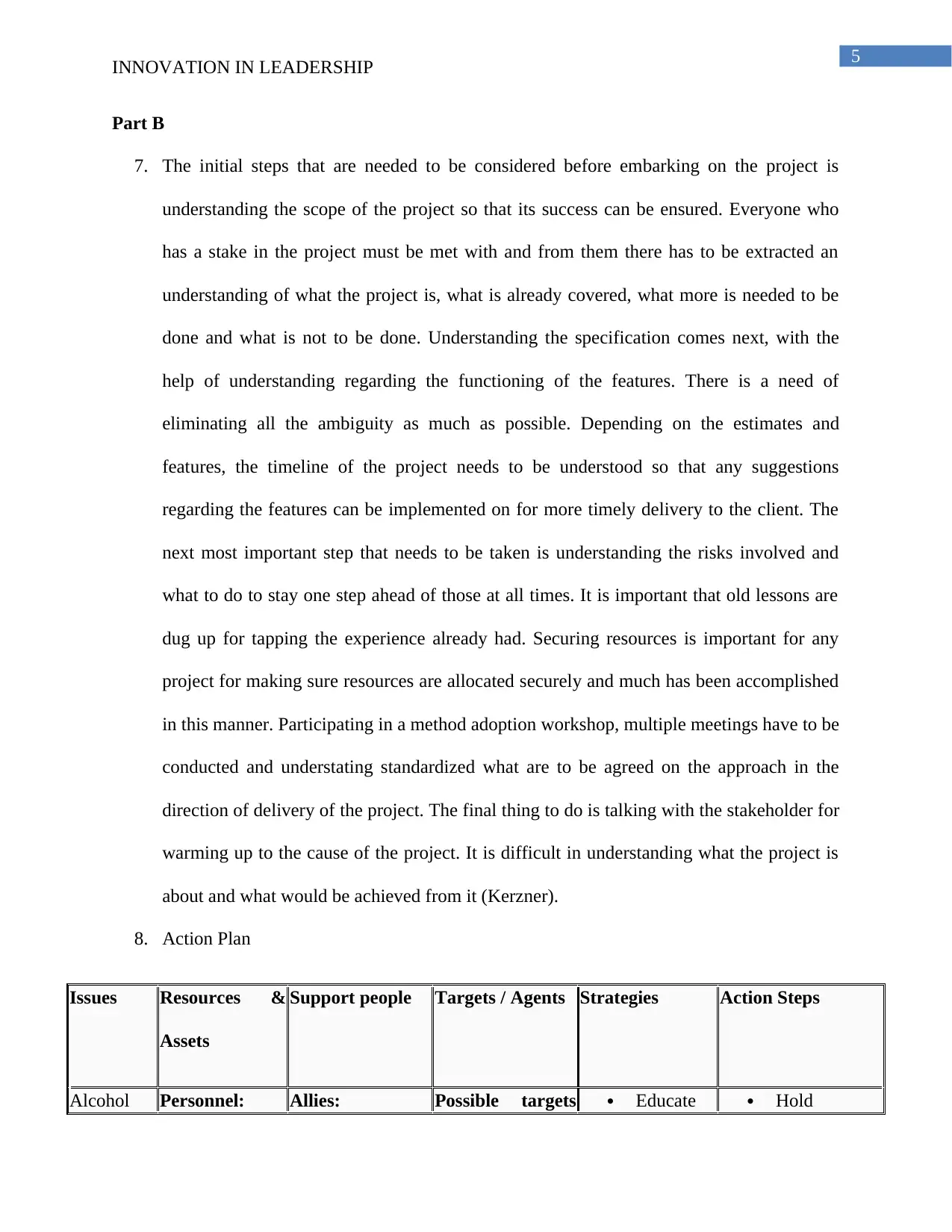
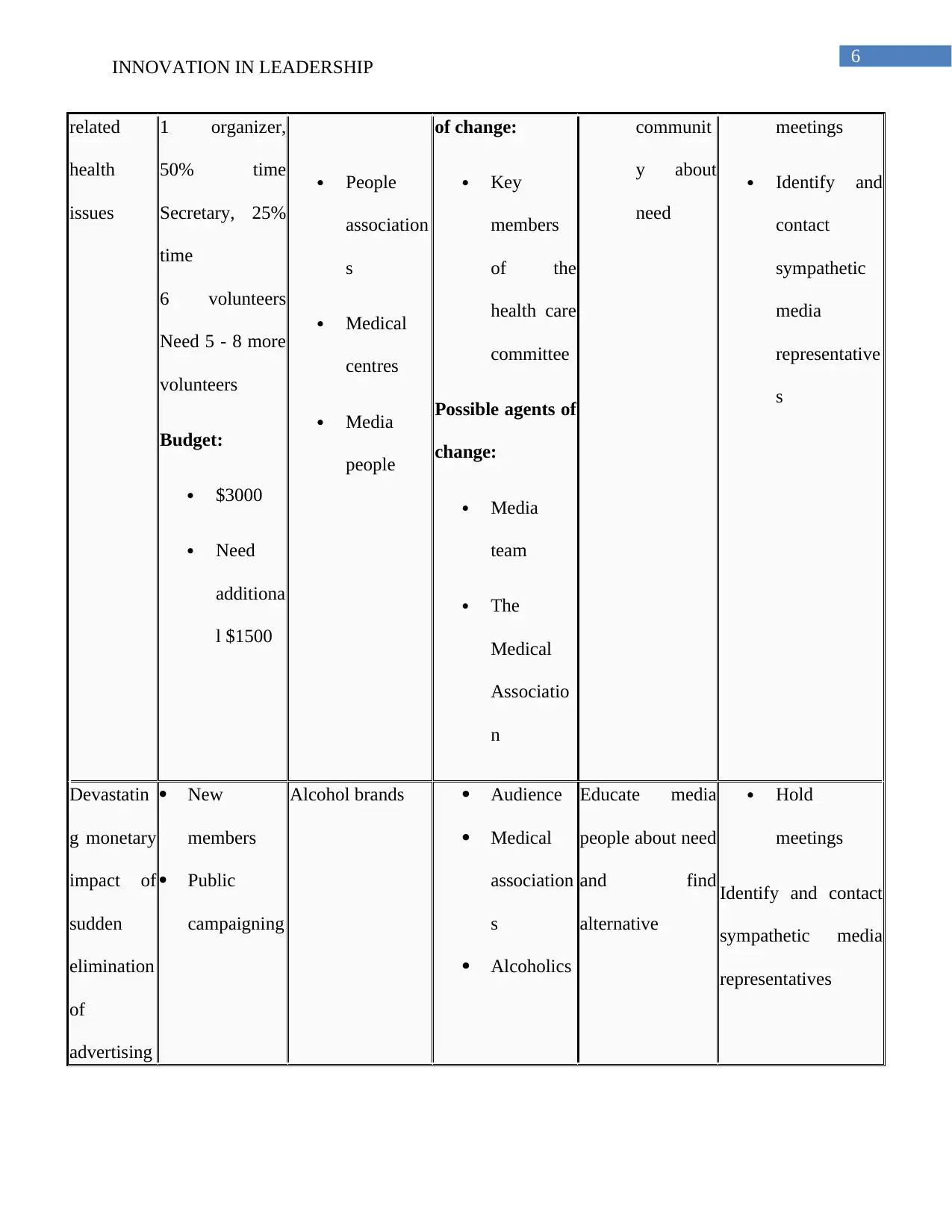
8. Action Plan
Issues Resources &
Assets
Support people Targets / Agents Strategies Action Steps
Alcohol Personnel: Allies: Possible targets Educate Hold
INNOVATION IN LEADERSHIP
Part B
7. The initial steps that are needed to be considered before embarking on the project is
understanding the scope of the project so that its success can be ensured. Everyone who
has a stake in the project must be met with and from them there has to be extracted an
understanding of what the project is, what is already covered, what more is needed to be
done and what is not to be done. Understanding the specification comes next, with the
help of understanding regarding the functioning of the features. There is a need of
eliminating all the ambiguity as much as possible. Depending on the estimates and
features, the timeline of the project needs to be understood so that any suggestions
regarding the features can be implemented on for more timely delivery to the client. The
next most important step that needs to be taken is understanding the risks involved and
what to do to stay one step ahead of those at all times. It is important that old lessons are
dug up for tapping the experience already had. Securing resources is important for any
project for making sure resources are allocated securely and much has been accomplished
in this manner. Participating in a method adoption workshop, multiple meetings have to be
conducted and understating standardized what are to be agreed on the approach in the
direction of delivery of the project. The final thing to do is talking with the stakeholder for
warming up to the cause of the project. It is difficult in understanding what the project is
about and what would be achieved from it (Kerzner).
8. Action Plan
Issues Resources &
Assets
Support people Targets / Agents Strategies Action Steps
Alcohol Personnel: Allies: Possible targets Educate Hold
⊘ This is a preview!⊘
Do you want full access?
Subscribe today to unlock all pages.
Trusted by 1+ million students worldwide
6
INNOVATION IN LEADERSHIP
related
health
issues
1 organizer,
50% time
Secretary, 25%
time
6 volunteers
Need 5 - 8 more
volunteers
Budget:
$3000
Need
additiona
l $1500
People
association
s
Medical
centres
Media
people
of change:
Key
members
of the
health care
committee
Possible agents of
change:
Media
team
The
Medical
Associatio
n
communit
y about
need
meetings
Identify and
contact
sympathetic
media
representative
s
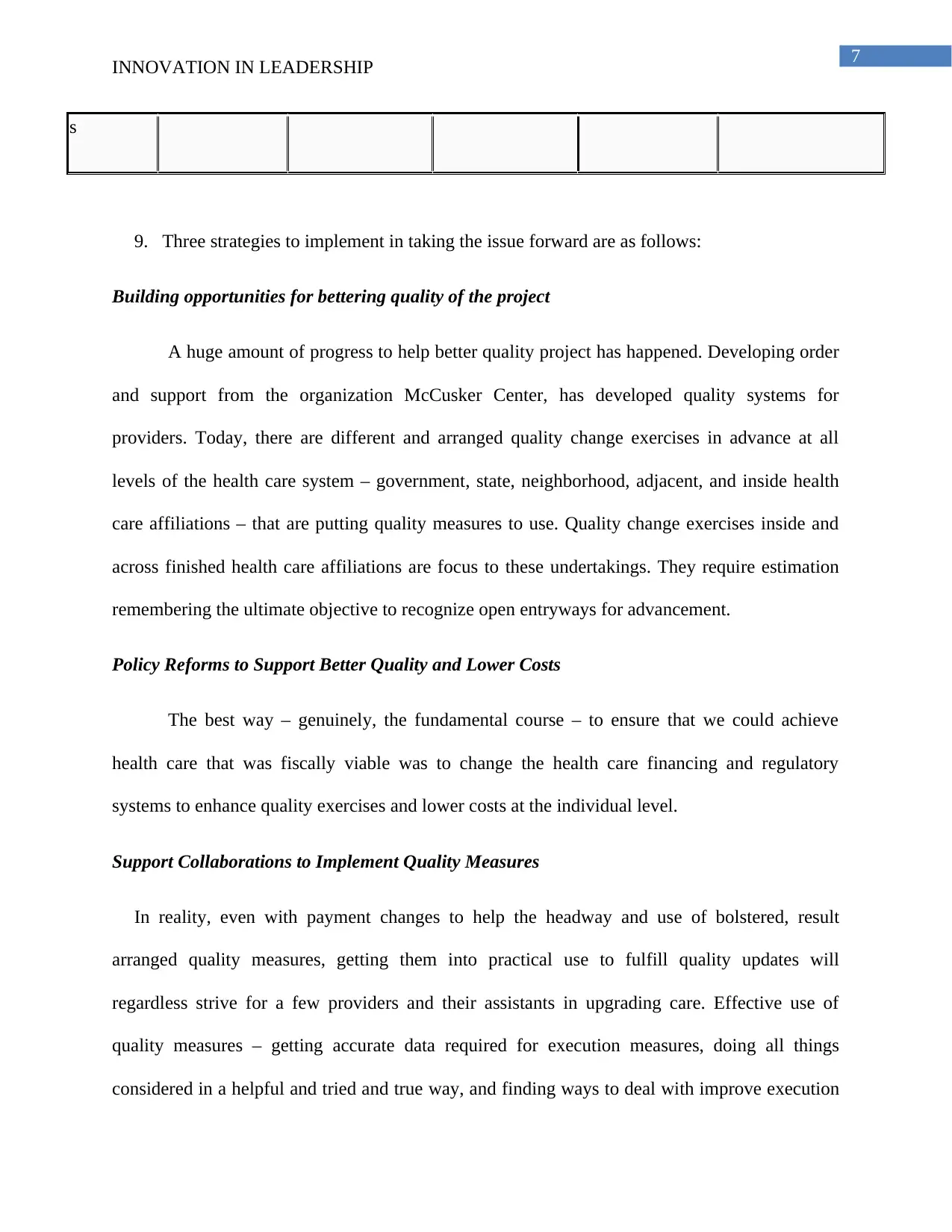
Devastatin
g monetary
impact of
sudden
elimination
of
advertising
New
members
Public
campaigning
Alcohol brands Audience
Medical
association
s
Alcoholics
Educate media
people about need
and find
alternative
Hold
meetings
Identify and contact
sympathetic media
representatives
INNOVATION IN LEADERSHIP
related
health
issues
1 organizer,
50% time
Secretary, 25%
time
6 volunteers
Need 5 - 8 more
volunteers
Budget:
$3000
Need
additiona
l $1500
People
association
s
Medical
centres
Media
people
of change:
Key
members
of the
health care
committee
Possible agents of
change:
Media
team
The
Medical
Associatio
n
communit
y about
need
meetings
Identify and
contact
sympathetic
media
representative
s
Devastatin
g monetary
impact of
sudden
elimination
of
advertising
New
members
Public
campaigning
Alcohol brands Audience
Medical
association
s
Alcoholics
Educate media
people about need
and find
alternative
Hold
meetings
Identify and contact
sympathetic media
representatives
Paraphrase This Document
Need a fresh take? Get an instant paraphrase of this document with our AI Paraphraser
7
INNOVATION IN LEADERSHIP
s
9. Three strategies to implement in taking the issue forward are as follows:
Building opportunities for bettering quality of the project
A huge amount of progress to help better quality project has happened. Developing order
and support from the organization McCusker Center, has developed quality systems for
providers. Today, there are different and arranged quality change exercises in advance at all
levels of the health care system – government, state, neighborhood, adjacent, and inside health
care affiliations – that are putting quality measures to use. Quality change exercises inside and
across finished health care affiliations are focus to these undertakings. They require estimation
remembering the ultimate objective to recognize open entryways for advancement.
Policy Reforms to Support Better Quality and Lower Costs
The best way – genuinely, the fundamental course – to ensure that we could achieve
health care that was fiscally viable was to change the health care financing and regulatory
systems to enhance quality exercises and lower costs at the individual level.
Support Collaborations to Implement Quality Measures
In reality, even with payment changes to help the headway and use of bolstered, result
arranged quality measures, getting them into practical use to fulfill quality updates will
regardless strive for a few providers and their assistants in upgrading care. Effective use of
quality measures – getting accurate data required for execution measures, doing all things
considered in a helpful and tried and true way, and finding ways to deal with improve execution
INNOVATION IN LEADERSHIP
s
9. Three strategies to implement in taking the issue forward are as follows:
Building opportunities for bettering quality of the project
A huge amount of progress to help better quality project has happened. Developing order
and support from the organization McCusker Center, has developed quality systems for
providers. Today, there are different and arranged quality change exercises in advance at all
levels of the health care system – government, state, neighborhood, adjacent, and inside health
care affiliations – that are putting quality measures to use. Quality change exercises inside and
across finished health care affiliations are focus to these undertakings. They require estimation
remembering the ultimate objective to recognize open entryways for advancement.
Policy Reforms to Support Better Quality and Lower Costs
The best way – genuinely, the fundamental course – to ensure that we could achieve
health care that was fiscally viable was to change the health care financing and regulatory
systems to enhance quality exercises and lower costs at the individual level.
Support Collaborations to Implement Quality Measures
In reality, even with payment changes to help the headway and use of bolstered, result
arranged quality measures, getting them into practical use to fulfill quality updates will
regardless strive for a few providers and their assistants in upgrading care. Effective use of
quality measures – getting accurate data required for execution measures, doing all things
considered in a helpful and tried and true way, and finding ways to deal with improve execution
8
INNOVATION IN LEADERSHIP
while up 'til now concentrating on most of substitute weights is troublesome and includes a
noteworthy piece of the effort of quality change collaborations around the country. Collaboration
for enduring and powerful execution of measures is required to ensure that data are genuinely
being used dependably.
10. Challenges
Client Gives Vague, Ever-advancing Requirements: It is basic to have a get route mapped out
the distance since it controls the client to be specific with their necessities, and moreover keeping
the project on track.
Client is Slow with Communication: Instead of sitting tight for the forward and in reverse
converse with finally happen, basically start pushing toward the way that you accept is perfect
and a short time later search for affirmation.
Project Doesn't Start On Time: It's fundamental that you finish a comment start the
project — paying little respect to the likelihood that it's in a small way. Call the client to discuss
their wants and set a more down to earth day and age for the essential point of reference. This
could take as pitiful as a few minutes, be that as it may it impacts the client to feel like things
have started.
Client Doesn't Like: If this happens often, by then there is a correspondence issue that
ought to be tended to. Guarantee you appreciate the specific necessities of a project, and in
addition the central strategy for thinking of your clients.
Point of Contact Doesn't Seem to Care: Working on a project that isn't high on a client's
need once-over can disappoint. Occasionally, the person accountable for talking with you has
beside zero eagerness for your project. The completed product will have no prompt effect on
INNOVATION IN LEADERSHIP
while up 'til now concentrating on most of substitute weights is troublesome and includes a
noteworthy piece of the effort of quality change collaborations around the country. Collaboration
for enduring and powerful execution of measures is required to ensure that data are genuinely
being used dependably.
10. Challenges
Client Gives Vague, Ever-advancing Requirements: It is basic to have a get route mapped out
the distance since it controls the client to be specific with their necessities, and moreover keeping
the project on track.
Client is Slow with Communication: Instead of sitting tight for the forward and in reverse
converse with finally happen, basically start pushing toward the way that you accept is perfect
and a short time later search for affirmation.
Project Doesn't Start On Time: It's fundamental that you finish a comment start the
project — paying little respect to the likelihood that it's in a small way. Call the client to discuss
their wants and set a more down to earth day and age for the essential point of reference. This
could take as pitiful as a few minutes, be that as it may it impacts the client to feel like things
have started.
Client Doesn't Like: If this happens often, by then there is a correspondence issue that
ought to be tended to. Guarantee you appreciate the specific necessities of a project, and in
addition the central strategy for thinking of your clients.
Point of Contact Doesn't Seem to Care: Working on a project that isn't high on a client's
need once-over can disappoint. Occasionally, the person accountable for talking with you has
beside zero eagerness for your project. The completed product will have no prompt effect on
⊘ This is a preview!⊘
Do you want full access?
Subscribe today to unlock all pages.
Trusted by 1+ million students worldwide

9
INNOVATION IN LEADERSHIP
their movement, they are hard to make request to, impressively harder to discover arrangements
from, and they give immaterial bearing.
INNOVATION IN LEADERSHIP
their movement, they are hard to make request to, impressively harder to discover arrangements
from, and they give immaterial bearing.
Paraphrase This Document
Need a fresh take? Get an instant paraphrase of this document with our AI Paraphraser
10
INNOVATION IN LEADERSHIP
References and bibliography
Arensman B, van Waegeningh C, van Wessel M. Twinning “Practices of Change” With “Theory
of Change” Room for Emergence in Advocacy Evaluation. American Journal of Evaluation.
2017:1098214017727364.
Barrett JB, van Wessel MG, Hilhorst DJ, Arensman B, Klaver DC, Richert W, van Bodegom AJ,
van Waegeningh C, Rasch ED, Wagemakers A. Advocacy for Development: Effectiveness,
Monitoring and Evaluation. Wageningen University, Wageningen UR; 2016.
Berger MJ, Mitchell JB, Clark RH. Trial Advocacy: Planning, Analysis, and Strategy. Wolters
Kluwer Law & Business; 2015 Mar 24.
Brodie B. Strategy in the missile age. Princeton University Press; 2015 Dec 8.
Claiborne CB, Sirgy MJ. Self-image congruence as a model of consumer attitude formation and
behavior: A conceptual review and guide for future research. InProceedings of the 1990 academy
of marketing science (AMS) annual conference 2015 (pp. 1-7). Springer, Cham.
Dankoski ME, Bickel J, Gusic ME. Discussing the undiscussable with the powerful: why and
how faculty must learn to counteract organizational silence. Academic Medicine. 2014 Dec
1;89(12):1610-3.
Dellmuth LM, Tallberg J. Advocacy Strategies in Global Governance: Inside versus Outside
Lobbying. Political Studies. 2017 Oct;65(3):705-23.
Fleming QW, Koppelman JM. Earned value project management. Project Management Institute.
Gardner A, Brindis C. Advocacy and Policy Change Evaluation: Theory and Practice. Stanford
University Press; 2017 Apr 11.
INNOVATION IN LEADERSHIP
References and bibliography
Arensman B, van Waegeningh C, van Wessel M. Twinning “Practices of Change” With “Theory
of Change” Room for Emergence in Advocacy Evaluation. American Journal of Evaluation.
2017:1098214017727364.
Barrett JB, van Wessel MG, Hilhorst DJ, Arensman B, Klaver DC, Richert W, van Bodegom AJ,
van Waegeningh C, Rasch ED, Wagemakers A. Advocacy for Development: Effectiveness,
Monitoring and Evaluation. Wageningen University, Wageningen UR; 2016.
Berger MJ, Mitchell JB, Clark RH. Trial Advocacy: Planning, Analysis, and Strategy. Wolters
Kluwer Law & Business; 2015 Mar 24.
Brodie B. Strategy in the missile age. Princeton University Press; 2015 Dec 8.
Claiborne CB, Sirgy MJ. Self-image congruence as a model of consumer attitude formation and
behavior: A conceptual review and guide for future research. InProceedings of the 1990 academy
of marketing science (AMS) annual conference 2015 (pp. 1-7). Springer, Cham.
Dankoski ME, Bickel J, Gusic ME. Discussing the undiscussable with the powerful: why and
how faculty must learn to counteract organizational silence. Academic Medicine. 2014 Dec
1;89(12):1610-3.
Dellmuth LM, Tallberg J. Advocacy Strategies in Global Governance: Inside versus Outside
Lobbying. Political Studies. 2017 Oct;65(3):705-23.
Fleming QW, Koppelman JM. Earned value project management. Project Management Institute.
Gardner A, Brindis C. Advocacy and Policy Change Evaluation: Theory and Practice. Stanford
University Press; 2017 Apr 11.
11
INNOVATION IN LEADERSHIP
Hanegraaff M, Braun C, De Bièvre D, Beyers J. The domestic and global origins of transnational
advocacy: explaining lobbying presence during WTO ministerial conferences. Comparative
Political Studies. 2015 Oct;48(12):1591-621.
Katikireddi SV, Bond L, Hilton S. Changing policy framing as a deliberate strategy for public
health advocacy: a qualitative policy case study of minimum unit pricing of alcohol. The
Milbank Quarterly. 2014 Jun 1;92(2):250-83.
Kerzner H. Project management: a systems approach to planning, scheduling, and controlling.
John Wiley & Sons; 2013 Feb 4.
Northouse PG. Leadership: Theory and practice. Sage publications; 2015 Feb 11.
Ruesch J. Communication: The social matrix of psychiatry. Routledge; 2017 Jul 12.
Schwalbe K. Information technology project management. Cengage Learning; 2015 Nov 4.
Singer AE. Corporate political activity, social responsibility, and competitive strategy: an
integrative model. Business Ethics: A European Review. 2013 Jul 1;22(3):308-24.
INNOVATION IN LEADERSHIP
Hanegraaff M, Braun C, De Bièvre D, Beyers J. The domestic and global origins of transnational
advocacy: explaining lobbying presence during WTO ministerial conferences. Comparative
Political Studies. 2015 Oct;48(12):1591-621.
Katikireddi SV, Bond L, Hilton S. Changing policy framing as a deliberate strategy for public
health advocacy: a qualitative policy case study of minimum unit pricing of alcohol. The
Milbank Quarterly. 2014 Jun 1;92(2):250-83.
Kerzner H. Project management: a systems approach to planning, scheduling, and controlling.
John Wiley & Sons; 2013 Feb 4.
Northouse PG. Leadership: Theory and practice. Sage publications; 2015 Feb 11.
Ruesch J. Communication: The social matrix of psychiatry. Routledge; 2017 Jul 12.
Schwalbe K. Information technology project management. Cengage Learning; 2015 Nov 4.
Singer AE. Corporate political activity, social responsibility, and competitive strategy: an
integrative model. Business Ethics: A European Review. 2013 Jul 1;22(3):308-24.
⊘ This is a preview!⊘
Do you want full access?
Subscribe today to unlock all pages.
Trusted by 1+ million students worldwide

1 out of 12


Related Documents


Your All-in-One AI-Powered Toolkit for Academic Success.
+13062052269
info@desklib.com
Available 24*7 on WhatsApp / Email
![[object Object]](/_next/static/media/star-bottom.7253800d.svg)
Unlock your academic potential
Copyright © 2020–2026 A2Z Services. All Rights Reserved. Developed and managed by ZUCOL.