Innovation and Change Management: Leeds Bradford Airport Report
VerifiedAdded on 2022/08/30
|23
|4700
|19
Report
AI Summary
This report examines the implementation of a bio-metrics system at Leeds Bradford Airport (LBA), focusing on innovation and change management within the aviation industry. The report begins with an executive summary and a table of contents, followed by an introduction that provides background information on LBA and defines innovation. Strategic analysis is conducted using SWOT and PESTEL frameworks to evaluate the internal and external environments. The chosen innovation, the bio-metrics system, is then analyzed. The report explores various change models, including Lewin's, ADKAR, and Kotter's 8-step model, ultimately selecting Kotter's model as the most suitable approach. Leadership, culture, and training requirements are discussed, followed by a conclusion that summarizes the key findings. References and appendices are included to support the analysis. The report aims to provide a comprehensive understanding of the change process required for implementing the bio-metrics system at LBA.
Running head: INNOVATION AND CHANGE
Implementation of Bio-Metrics system at the Leeds Bradford Airport
Innovation & Change Management in the Aviation Industry
By
Mareena Hassan
Date
Implementation of Bio-Metrics system at the Leeds Bradford Airport
Innovation & Change Management in the Aviation Industry
By
Mareena Hassan
Date

Paraphrase This Document
Need a fresh take? Get an instant paraphrase of this document with our AI Paraphraser
1INNOVATION AND CHANGE
Executive Summary:
The study is focused towards the essential evaluation of the change process that is to be
implemented at the Leeds and Bradford Airport. The proposed change is in regards to the
implementation of the bio-metric systems. Various models have been utilized for the essential
evaluation of the change process that is required. The internal and external environment of
the organization have been evaluated through the tools of SWOT and PESTEL. Moving
forward the change models of Lewin, ADKAR and Kotters 8 step models have been
evaluated to understand the best possible change process that need to be implemented. In
regards to the same the Kotter’s 8 step model have been selected as the best process. The
leadership, culture and training requirements have been discussed subsequently.
Executive Summary:
The study is focused towards the essential evaluation of the change process that is to be
implemented at the Leeds and Bradford Airport. The proposed change is in regards to the
implementation of the bio-metric systems. Various models have been utilized for the essential
evaluation of the change process that is required. The internal and external environment of
the organization have been evaluated through the tools of SWOT and PESTEL. Moving
forward the change models of Lewin, ADKAR and Kotters 8 step models have been
evaluated to understand the best possible change process that need to be implemented. In
regards to the same the Kotter’s 8 step model have been selected as the best process. The
leadership, culture and training requirements have been discussed subsequently.
2INNOVATION AND CHANGE
Table of Contents
1. Terms of Reference.............................................................................................................5
2. Introduction.........................................................................................................................5
2.1.1 Organisation Background..............................................................................................5
2.1.2 Nature of the Problem...................................................................................................6
2.1.3 Chosen Innovation........................................................................................................7
3. Investigation and Analysis..................................................................................................7
3.1. Current situation/Problem...........................................................................................7
3.2 Balance Scorecard............................................................................................................9
Analysis of Innovation.............................................................................................................11
Types of Innovation.................................................................................................................12
Change proposal.......................................................................................................................13
Proposed change...................................................................................................................14
Identification of the forces for change.................................................................................14
Identification of the forces against change...........................................................................14
Analysis................................................................................................................................15
Implementation of change........................................................................................................15
Change models.........................................................................................................................16
Leadership................................................................................................................................17
Culture......................................................................................................................................18
Types of culture in LBA management.....................................................................................18
Table of Contents
1. Terms of Reference.............................................................................................................5
2. Introduction.........................................................................................................................5
2.1.1 Organisation Background..............................................................................................5
2.1.2 Nature of the Problem...................................................................................................6
2.1.3 Chosen Innovation........................................................................................................7
3. Investigation and Analysis..................................................................................................7
3.1. Current situation/Problem...........................................................................................7
3.2 Balance Scorecard............................................................................................................9
Analysis of Innovation.............................................................................................................11
Types of Innovation.................................................................................................................12
Change proposal.......................................................................................................................13
Proposed change...................................................................................................................14
Identification of the forces for change.................................................................................14
Identification of the forces against change...........................................................................14
Analysis................................................................................................................................15
Implementation of change........................................................................................................15
Change models.........................................................................................................................16
Leadership................................................................................................................................17
Culture......................................................................................................................................18
Types of culture in LBA management.....................................................................................18
⊘ This is a preview!⊘
Do you want full access?
Subscribe today to unlock all pages.

Trusted by 1+ million students worldwide

3INNOVATION AND CHANGE
Training....................................................................................................................................18
Kotter’s 8 step process.............................................................................................................19
Conclusion................................................................................................................................19
References................................................................................................................................20
Appendices...............................................................................................................................22
Training....................................................................................................................................18
Kotter’s 8 step process.............................................................................................................19
Conclusion................................................................................................................................19
References................................................................................................................................20
Appendices...............................................................................................................................22
Paraphrase This Document
Need a fresh take? Get an instant paraphrase of this document with our AI Paraphraser

4INNOVATION AND CHANGE
List of abbreviations:
LBA – Leeds Bradford Airport
SWOT- Strengths-Weakness-Opportunities and Threats
PESTLE- Political, Economic, Social, Technological, Legal and Environemntal
List of abbreviations:
LBA – Leeds Bradford Airport
SWOT- Strengths-Weakness-Opportunities and Threats
PESTLE- Political, Economic, Social, Technological, Legal and Environemntal
5INNOVATION AND CHANGE
1. Terms of Reference
This report provides an in-depth discussion of the need for innovation and
change process management with respect to the aviation industry. Successful change
implementation relies on strategic planning to align the goals of the organisation with
the proposed change. The report focuses on the Bio-Metrics system as the chosen
innovation focusing on Leeds Bradford Airport (LBA). Therefore, the purpose of
writing this report is to analyse the best Innovation and Change process management
in Aviation to successfully implement the Bio-Metrics at LBA. For innovation and
Change Management, strategic analysis is required to implement the best strategy
while keeping in mind the LBA’s long term goals that include market sustainability.
2. Introduction
2.1.1 Organisation Background
Leeds Bradford Airport (LBA) is situated in Yeadon, in the city of Leeds
Metropolitan District in West Yorkshire, England. The SPAG is operating
commercially since 1931. It aims to provide transport services with an airport with
extraordinary capabilities, which brings businesses closer to the customers. Therefore
they are trying to make LBA a technologically innovative hub that can compete with
the world’s leading giant’s aviation (Welcome to Leeds Bradford, Yorkshire's Airport
| Leeds Bradford Airport 2019). The aviation is continuously ramping up in order to
sustain its position in the market and trying to introduce the Bio-Metrics system at
the Leeds Bradford Airport. For sustainability, aviation requires proper Change and
Innovation management.
1. Terms of Reference
This report provides an in-depth discussion of the need for innovation and
change process management with respect to the aviation industry. Successful change
implementation relies on strategic planning to align the goals of the organisation with
the proposed change. The report focuses on the Bio-Metrics system as the chosen
innovation focusing on Leeds Bradford Airport (LBA). Therefore, the purpose of
writing this report is to analyse the best Innovation and Change process management
in Aviation to successfully implement the Bio-Metrics at LBA. For innovation and
Change Management, strategic analysis is required to implement the best strategy
while keeping in mind the LBA’s long term goals that include market sustainability.
2. Introduction
2.1.1 Organisation Background
Leeds Bradford Airport (LBA) is situated in Yeadon, in the city of Leeds
Metropolitan District in West Yorkshire, England. The SPAG is operating
commercially since 1931. It aims to provide transport services with an airport with
extraordinary capabilities, which brings businesses closer to the customers. Therefore
they are trying to make LBA a technologically innovative hub that can compete with
the world’s leading giant’s aviation (Welcome to Leeds Bradford, Yorkshire's Airport
| Leeds Bradford Airport 2019). The aviation is continuously ramping up in order to
sustain its position in the market and trying to introduce the Bio-Metrics system at
the Leeds Bradford Airport. For sustainability, aviation requires proper Change and
Innovation management.
⊘ This is a preview!⊘
Do you want full access?
Subscribe today to unlock all pages.
Trusted by 1+ million students worldwide
6INNOVATION AND CHANGE
Innovation refers to creative thoughts and new ideas in the form of
technological devices or methods (Volberda, Van Den Bosch, and Heij, 2013). In
other words, innovation relates to the introduction of a new thing. In the absence of
innovation, it means that nothing new is being created and without new concepts,
progress is hindered. When an organisation is not progressing, it destroys its ability to
remain relevant in a highly competitive market. Innovation, in contemporary society,
serves as a tool for achieving a competitive advantage in the business landscape.
Undeniably, innovation is the main rationale behind the existence of modernity
(Volberda, Van Den Bosch and Heij 2013). Adapting to innovation changes is
expensive but change is unavoidable and necessary since innovation leads to positive
change.
2.1.2 Nature of the Problem
Businesses rely on innovation to enhance their productivity, performance, and
efficiency. Innovation mainly helps in transforming the experiences of the customers
and in return giving businesses a competitive edge. Innovation management is very
important for any company to survive because it is through the innovation competitors
get to know how well the company is managed and organized. The main problem that
the Leeds Bradford Airport faced is a security issue of the passengers. The
information of the passengers who travel from other countries to England should be
transparent and their personal information should be with the authorities of the
airlines. This would help the aviation sector to take care of the security problems of
the people of the nation. Organisations can develop innovative ideas that suit their
businesses or develop existing ones. Thus the main purpose of innovation is not only
to create new things but also a new market, new customers as well as a new product.
Innovation refers to creative thoughts and new ideas in the form of
technological devices or methods (Volberda, Van Den Bosch, and Heij, 2013). In
other words, innovation relates to the introduction of a new thing. In the absence of
innovation, it means that nothing new is being created and without new concepts,
progress is hindered. When an organisation is not progressing, it destroys its ability to
remain relevant in a highly competitive market. Innovation, in contemporary society,
serves as a tool for achieving a competitive advantage in the business landscape.
Undeniably, innovation is the main rationale behind the existence of modernity
(Volberda, Van Den Bosch and Heij 2013). Adapting to innovation changes is
expensive but change is unavoidable and necessary since innovation leads to positive
change.
2.1.2 Nature of the Problem
Businesses rely on innovation to enhance their productivity, performance, and
efficiency. Innovation mainly helps in transforming the experiences of the customers
and in return giving businesses a competitive edge. Innovation management is very
important for any company to survive because it is through the innovation competitors
get to know how well the company is managed and organized. The main problem that
the Leeds Bradford Airport faced is a security issue of the passengers. The
information of the passengers who travel from other countries to England should be
transparent and their personal information should be with the authorities of the
airlines. This would help the aviation sector to take care of the security problems of
the people of the nation. Organisations can develop innovative ideas that suit their
businesses or develop existing ones. Thus the main purpose of innovation is not only
to create new things but also a new market, new customers as well as a new product.
Paraphrase This Document
Need a fresh take? Get an instant paraphrase of this document with our AI Paraphraser
7INNOVATION AND CHANGE
2.1.3 Chosen Innovation
The chosen innovation for the aviation sector is that of the introduction of the
biometric system
3. Investigation and Analysis
3.1. Current situation/Problem
Some of the key factors that will be raised by innovation and change management
are LBA’s internal and external environments as well as its competitors in the
Aviation market. The challenges that LBA is already facing for its sustainability can
be analysed through SWOT and PESTEL analysis.
On analysing the strengths of LBA, it can be seen that Leeds Bradford Airport
welcomes over 4 million passengers annually. It provides flights to almost 75
destinations around the world. Its estimated investment is about 28million pounds.
This has been one of the greatest strengths of the LBA. However, it also has its
weaknesses. Leeds Bradford Airport (LBA) is a small airport, which largely caters for
the package holiday crowd and all the pitfalls that go with it. It can be said that the
airport does not have adequate space for the numerous passengers arriving every hour.
LBA has a very strong leading future, as “Route to 2030” is a master plan for
improvements prepared by Leeds Bradford Airport as its strategic development plan
for likely to be the growth plan up to 2030.“Surface access Strategy” is yet another
short, medium and long-term plan in order to improve the surface transport of the
region. Therefore, opportunities for LBA in terms of innovation are endless. Due to
the strategic growth plan in hand, LBA can easily implement Biometrics system at the
Airport. In accordance with this, the immediate threat that LBA is constantly facing is
climate change, which ultimately reduces the number of passengers travelling. LBA
needs a proper strategic plan to overcome this particular threat.
2.1.3 Chosen Innovation
The chosen innovation for the aviation sector is that of the introduction of the
biometric system
3. Investigation and Analysis
3.1. Current situation/Problem
Some of the key factors that will be raised by innovation and change management
are LBA’s internal and external environments as well as its competitors in the
Aviation market. The challenges that LBA is already facing for its sustainability can
be analysed through SWOT and PESTEL analysis.
On analysing the strengths of LBA, it can be seen that Leeds Bradford Airport
welcomes over 4 million passengers annually. It provides flights to almost 75
destinations around the world. Its estimated investment is about 28million pounds.
This has been one of the greatest strengths of the LBA. However, it also has its
weaknesses. Leeds Bradford Airport (LBA) is a small airport, which largely caters for
the package holiday crowd and all the pitfalls that go with it. It can be said that the
airport does not have adequate space for the numerous passengers arriving every hour.
LBA has a very strong leading future, as “Route to 2030” is a master plan for
improvements prepared by Leeds Bradford Airport as its strategic development plan
for likely to be the growth plan up to 2030.“Surface access Strategy” is yet another
short, medium and long-term plan in order to improve the surface transport of the
region. Therefore, opportunities for LBA in terms of innovation are endless. Due to
the strategic growth plan in hand, LBA can easily implement Biometrics system at the
Airport. In accordance with this, the immediate threat that LBA is constantly facing is
climate change, which ultimately reduces the number of passengers travelling. LBA
needs a proper strategic plan to overcome this particular threat.
8INNOVATION AND CHANGE
On making a PESTEL analysis of LBA, it can be said that politically the
aviation sector is affected by a lot number of factors. The airline industry is widely
impacted by regulations and restrictions related to international trade, tax policy, and
competition. It has also impacted by issues like Brexit, war, terrorism, and the
outbreak of diseases such as Ebola. These issues are political. As a result, they require
government intervention. The 2013 aviation policy framework serves the economy.
LBA is the main contributor to UK’s economy (Tang 2017). This framework also
included many leading enterprise zones to be supported by LBA for their growth and
enhancements. Another economic plan, which is Strategic Economic Plan 2016,
clearly recognize Leeds Bradford Airport as a leading employment hub. It is also
under consideration to set up an innovation centre at LBA to carry out innovative
manufacturing.
Leeds Bradford Airport is considered to be one of the best Airport in the town
due to its social responsibility and services that it provides time to its passengers. At
LBA, there’s an airport village which is responsible for social and commercial
activities including accommodations, hospitality and other amenities including hotels,
conference rooms and restaurants. Therefore, it’s very crucial to improve the security
measures at airport by introducing Biometrics system at LBA.
In terms of technology, the Aviation industry is constantly competing to
sustain its position in a market. LBA is using state of the art technology to ensure
maximum security. X-ray scanners are used for checking of luggage. Continuous
glucose monitoring system (CGM) is in operation at LBA for medical purposes.
Another technological aspect is its terminal extension that was approved in December
2018, and its purpose is to introduce new and departure gates, seats, food and
beverage outlets etc. Technological advancements at LBA are countless.
On making a PESTEL analysis of LBA, it can be said that politically the
aviation sector is affected by a lot number of factors. The airline industry is widely
impacted by regulations and restrictions related to international trade, tax policy, and
competition. It has also impacted by issues like Brexit, war, terrorism, and the
outbreak of diseases such as Ebola. These issues are political. As a result, they require
government intervention. The 2013 aviation policy framework serves the economy.
LBA is the main contributor to UK’s economy (Tang 2017). This framework also
included many leading enterprise zones to be supported by LBA for their growth and
enhancements. Another economic plan, which is Strategic Economic Plan 2016,
clearly recognize Leeds Bradford Airport as a leading employment hub. It is also
under consideration to set up an innovation centre at LBA to carry out innovative
manufacturing.
Leeds Bradford Airport is considered to be one of the best Airport in the town
due to its social responsibility and services that it provides time to its passengers. At
LBA, there’s an airport village which is responsible for social and commercial
activities including accommodations, hospitality and other amenities including hotels,
conference rooms and restaurants. Therefore, it’s very crucial to improve the security
measures at airport by introducing Biometrics system at LBA.
In terms of technology, the Aviation industry is constantly competing to
sustain its position in a market. LBA is using state of the art technology to ensure
maximum security. X-ray scanners are used for checking of luggage. Continuous
glucose monitoring system (CGM) is in operation at LBA for medical purposes.
Another technological aspect is its terminal extension that was approved in December
2018, and its purpose is to introduce new and departure gates, seats, food and
beverage outlets etc. Technological advancements at LBA are countless.
⊘ This is a preview!⊘
Do you want full access?
Subscribe today to unlock all pages.
Trusted by 1+ million students worldwide
9INNOVATION AND CHANGE
In accordance with the political, economic, social and technological factors,
there also have been environmental factors that affect the aviation industry to a great
extent. the local air quality control is one such factor that has an impact over the
environment of the industry as a whole. The LBA is also handling few issues such as
the assessment of the change of fuel, and the effects of noise that cause the noise
pollution. Although LBA is an airport, but it strictly enforces law and order situation
in aviation, and almost twenty-four laws are made specifically for aviation and
aircrafts . With the strategic analysis of LBA, it is clearly stated that LBA can survive
and sustain its position in the market in order to achieve its long term goals with
Innovation and change only.
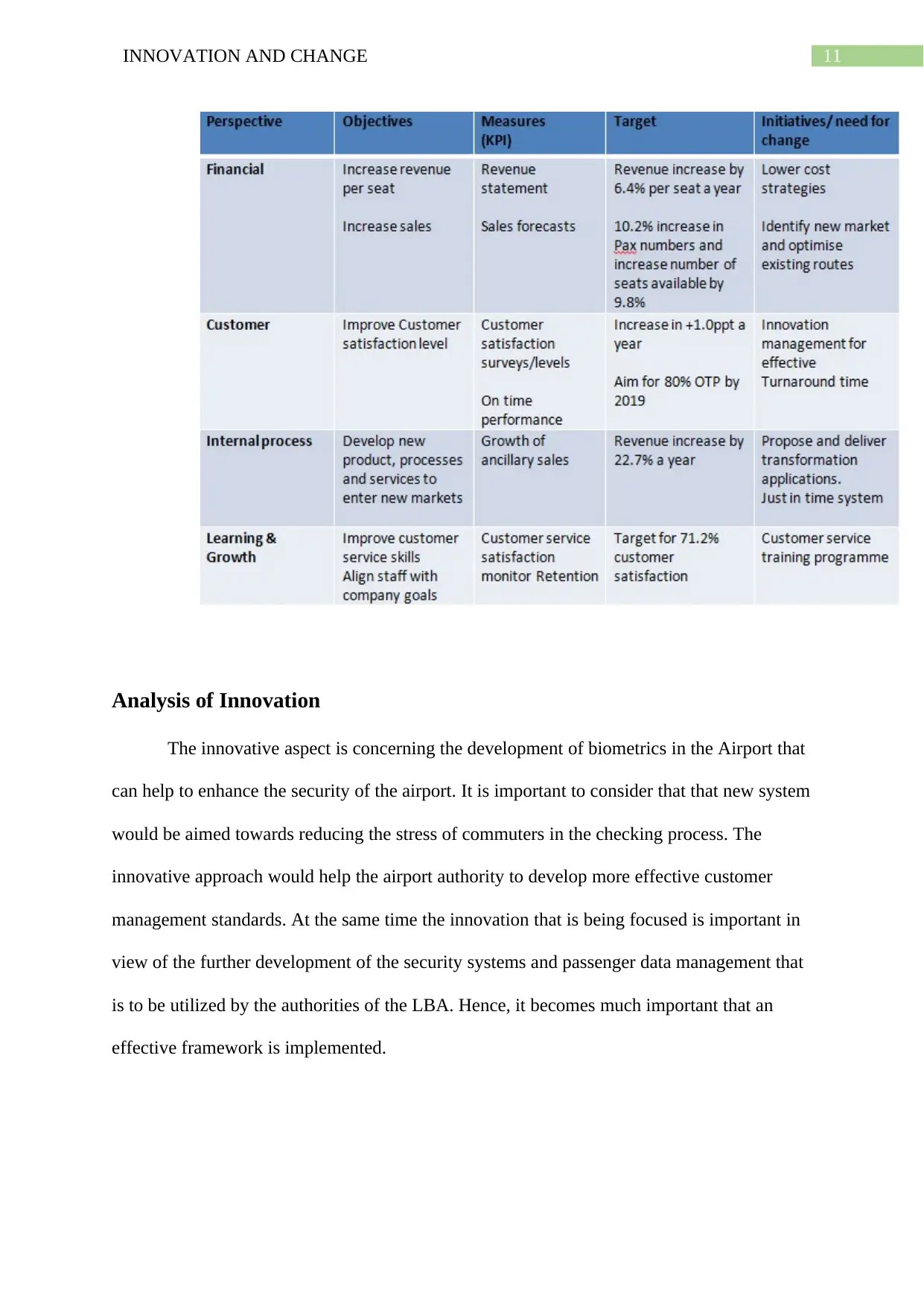
3.2 Balance Scorecard
Financial Performance Perspective
LBA assist millions of air transportation client to reach their destinations
globally. The mission of the company is to inspire the community and becoming the
most preferred airport for its clients through the provision of excellent services and
unique customer experiences and relations. Therefore, it is the duty of the entire
company to concentrate on customer and employee satisfaction, net income creation,
and financial growth and stability. The organisation is highly expected to estimate the
overall operating cost, earnings for each produced share, return on capital and sales.
Consumer Knowledge Perspective
The ability of the airport to achieve growth relies on focusing on customer
satisfaction as its priority. Customers play a crucial role in the growth of results as
revenue is dependent on their responses. The business should be constantly aware of
market trends and ensure that their customers ' needs are met on the market. It can,
therefore, be done for the production of goods that suit their needs. Additional
In accordance with the political, economic, social and technological factors,
there also have been environmental factors that affect the aviation industry to a great
extent. the local air quality control is one such factor that has an impact over the
environment of the industry as a whole. The LBA is also handling few issues such as
the assessment of the change of fuel, and the effects of noise that cause the noise
pollution. Although LBA is an airport, but it strictly enforces law and order situation
in aviation, and almost twenty-four laws are made specifically for aviation and
aircrafts . With the strategic analysis of LBA, it is clearly stated that LBA can survive
and sustain its position in the market in order to achieve its long term goals with
Innovation and change only.
3.2 Balance Scorecard
Financial Performance Perspective
LBA assist millions of air transportation client to reach their destinations
globally. The mission of the company is to inspire the community and becoming the
most preferred airport for its clients through the provision of excellent services and
unique customer experiences and relations. Therefore, it is the duty of the entire
company to concentrate on customer and employee satisfaction, net income creation,
and financial growth and stability. The organisation is highly expected to estimate the
overall operating cost, earnings for each produced share, return on capital and sales.
Consumer Knowledge Perspective
The ability of the airport to achieve growth relies on focusing on customer
satisfaction as its priority. Customers play a crucial role in the growth of results as
revenue is dependent on their responses. The business should be constantly aware of
market trends and ensure that their customers ' needs are met on the market. It can,
therefore, be done for the production of goods that suit their needs. Additional
Paraphrase This Document
Need a fresh take? Get an instant paraphrase of this document with our AI Paraphraser
10INNOVATION AND CHANGE
information should be passed on to consumers about the activities of the company to
ensure that they are connected with the general operations. The organisation can,
therefore, focus on improving its brand image by ensuring that it satisfies and exceeds
the needs of the customers.
Internal Process Perspective
The company has to demonstrate an understanding of the internal environment
which drives its success in the external market. The internal environment mainly
involves servicing efficiency, human resource, revenue production and level of
productivity (Nambisan et al. 2017). The company should provide training to
employees on the use of biometric systems to increase the efficiency and satisfaction
of the employees to counter resistance and high turnover.
Growth and Learning Performance Perspective
Learning and development substantially affect the creativity and adaption of
advanced technologies. LBA operates in an industry where technology advancement
is constant which highlights the need for constant learning and development. An
innovative workforce is a motivated workforce. Managers need to ensure that the
needs of staff are recognized and addressed to promote innovation. In addition, there
is a need to offer learning opportunities to enhance their skilfulness and competence
as they carry out their roles.
information should be passed on to consumers about the activities of the company to
ensure that they are connected with the general operations. The organisation can,
therefore, focus on improving its brand image by ensuring that it satisfies and exceeds
the needs of the customers.
Internal Process Perspective
The company has to demonstrate an understanding of the internal environment
which drives its success in the external market. The internal environment mainly
involves servicing efficiency, human resource, revenue production and level of
productivity (Nambisan et al. 2017). The company should provide training to
employees on the use of biometric systems to increase the efficiency and satisfaction
of the employees to counter resistance and high turnover.
Growth and Learning Performance Perspective
Learning and development substantially affect the creativity and adaption of
advanced technologies. LBA operates in an industry where technology advancement
is constant which highlights the need for constant learning and development. An
innovative workforce is a motivated workforce. Managers need to ensure that the
needs of staff are recognized and addressed to promote innovation. In addition, there
is a need to offer learning opportunities to enhance their skilfulness and competence
as they carry out their roles.
11INNOVATION AND CHANGE
Analysis of Innovation
The innovative aspect is concerning the development of biometrics in the Airport that
can help to enhance the security of the airport. It is important to consider that that new system
would be aimed towards reducing the stress of commuters in the checking process. The
innovative approach would help the airport authority to develop more effective customer
management standards. At the same time the innovation that is being focused is important in
view of the further development of the security systems and passenger data management that
is to be utilized by the authorities of the LBA. Hence, it becomes much important that an
effective framework is implemented.
Analysis of Innovation
The innovative aspect is concerning the development of biometrics in the Airport that
can help to enhance the security of the airport. It is important to consider that that new system
would be aimed towards reducing the stress of commuters in the checking process. The
innovative approach would help the airport authority to develop more effective customer
management standards. At the same time the innovation that is being focused is important in
view of the further development of the security systems and passenger data management that
is to be utilized by the authorities of the LBA. Hence, it becomes much important that an
effective framework is implemented.
⊘ This is a preview!⊘
Do you want full access?
Subscribe today to unlock all pages.
Trusted by 1+ million students worldwide

1 out of 23


Related Documents


Your All-in-One AI-Powered Toolkit for Academic Success.
+13062052269
info@desklib.com
Available 24*7 on WhatsApp / Email
![[object Object]](/_next/static/media/star-bottom.7253800d.svg)
Unlock your academic potential
Copyright © 2020–2026 A2Z Services. All Rights Reserved. Developed and managed by ZUCOL.