Comprehensive Report: Examining Models of Innovation Processes
VerifiedAdded on 2023/06/03
|8
|2764
|330
Report
AI Summary
This report provides a comprehensive overview of various innovation process models, including technology push, market pull, coupling, interactive, network, and open models. It explores the characteristics, strengths, and weaknesses of each model, highlighting their evolution across different generations. The report also delves into the consequences of a partial understanding of the innovation process, discussing potential risks such as failure to meet user needs, lack of technological instrument, inability to gain competitive advantages, and limitations in adapting to market changes. The analysis emphasizes the importance of a holistic approach to innovation and the need for organizations to adopt models that facilitate effective idea generation, product development, and market responsiveness. The report concludes by emphasizing the significance of continuous innovation and the need to adapt to the changing business environment.
Running Head: Innovation and Creativity
0
Innovation and Creativity
Student Name
Date
0
Innovation and Creativity
Student Name
Date

Paraphrase This Document
Need a fresh take? Get an instant paraphrase of this document with our AI Paraphraser

Report on models of innovation processes
1
Table of Contents
Introduction –.............................................................................................................................1
Models of Innovation Process-...................................................................................................2
Consequences of partial understanding of Innovation Process –...............................................5
Conclusion and Recommendation –...........................................................................................6
References –...............................................................................................................................7
1
Table of Contents
Introduction –.............................................................................................................................1
Models of Innovation Process-...................................................................................................2
Consequences of partial understanding of Innovation Process –...............................................5
Conclusion and Recommendation –...........................................................................................6
References –...............................................................................................................................7
Report on models of innovation processes
2
Introduction –
Innovation refers as the process of generating new ideas or suggestion, creative thoughts and
new imagination and covert into useful products and valuable outcomes. It can affect highly
on the business models and the performance and productivity of the organization. It can helps
in maintaining effective supply chain management for the organization. There is involvement
of marketing in the process of innovation. There is process involved in implementing new
products and generation of new ideas and new technology which is known as innovation
process. So, every organization needs ability to innovate new ideas and technology towards
their products or services to gain competitive advantage and to compete in challenging
environment as well as highly changing environment (Bjorklund and Forslund, 2018). There
are various models of innovation process as per different generation and different research
classified different models of innovation process such as Rothwell described six models of
innovation process as technology push, market pull, coupling model, interactive, network
model and open model and he state that the complexity and integrity of models of innovation
process increases with every generation due to new practices and skills in adoption of next
generation from the previous generation. There are various benefits of the models of
innovation process as it helps in adaption of changes to the organization, solving complex
problems, gain competitive advantages, enhancing the performance and productivity of
organization, increasing their growth for longer period of time, maintaining reputation in
market and achieving goals and objectives of the organization (Manceau and Morand, 2014).
But there are also some challenges or limitations or issues of the innovation process models
which are face by the organization in generating new ideas, suggestions and development of
new products or services (Lober, 2010). The report consists of models of the innovation
process including its characteristics, strength and weakness towards the organization and
consequences of the partial understanding of innovation process.
Models of Innovation Process-
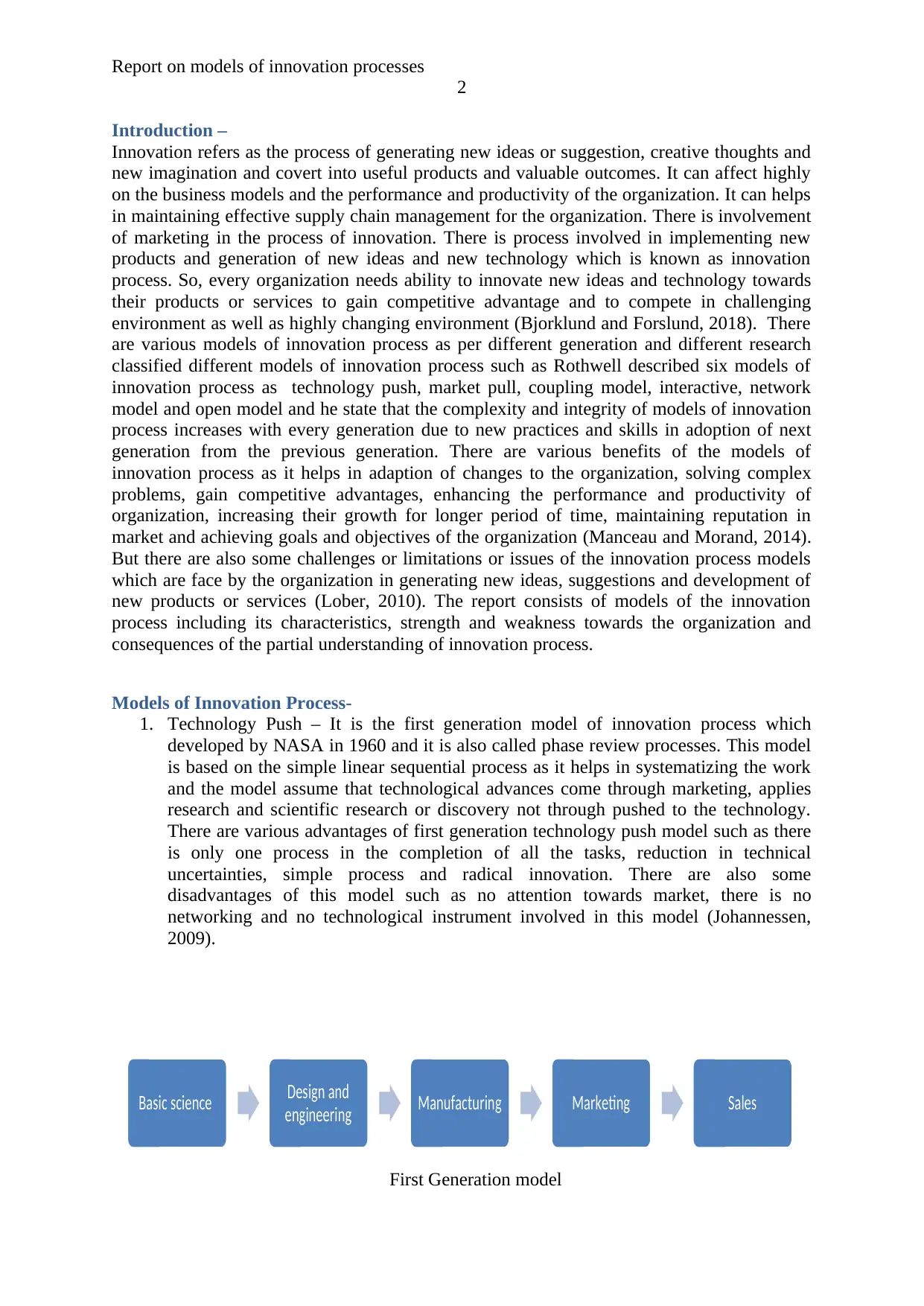
1. Technology Push – It is the first generation model of innovation process which
developed by NASA in 1960 and it is also called phase review processes. This model
is based on the simple linear sequential process as it helps in systematizing the work
and the model assume that technological advances come through marketing, applies
research and scientific research or discovery not through pushed to the technology.
There are various advantages of first generation technology push model such as there
is only one process in the completion of all the tasks, reduction in technical
uncertainties, simple process and radical innovation. There are also some
disadvantages of this model such as no attention towards market, there is no
networking and no technological instrument involved in this model (Johannessen,
2009).
First Generation model
Basic science Design and
engineering Manufacturing Marketing Sales
2
Introduction –
Innovation refers as the process of generating new ideas or suggestion, creative thoughts and
new imagination and covert into useful products and valuable outcomes. It can affect highly
on the business models and the performance and productivity of the organization. It can helps
in maintaining effective supply chain management for the organization. There is involvement
of marketing in the process of innovation. There is process involved in implementing new
products and generation of new ideas and new technology which is known as innovation
process. So, every organization needs ability to innovate new ideas and technology towards
their products or services to gain competitive advantage and to compete in challenging
environment as well as highly changing environment (Bjorklund and Forslund, 2018). There
are various models of innovation process as per different generation and different research
classified different models of innovation process such as Rothwell described six models of
innovation process as technology push, market pull, coupling model, interactive, network
model and open model and he state that the complexity and integrity of models of innovation
process increases with every generation due to new practices and skills in adoption of next
generation from the previous generation. There are various benefits of the models of
innovation process as it helps in adaption of changes to the organization, solving complex
problems, gain competitive advantages, enhancing the performance and productivity of
organization, increasing their growth for longer period of time, maintaining reputation in
market and achieving goals and objectives of the organization (Manceau and Morand, 2014).
But there are also some challenges or limitations or issues of the innovation process models
which are face by the organization in generating new ideas, suggestions and development of
new products or services (Lober, 2010). The report consists of models of the innovation
process including its characteristics, strength and weakness towards the organization and
consequences of the partial understanding of innovation process.
Models of Innovation Process-
1. Technology Push – It is the first generation model of innovation process which
developed by NASA in 1960 and it is also called phase review processes. This model
is based on the simple linear sequential process as it helps in systematizing the work
and the model assume that technological advances come through marketing, applies
research and scientific research or discovery not through pushed to the technology.
There are various advantages of first generation technology push model such as there
is only one process in the completion of all the tasks, reduction in technical
uncertainties, simple process and radical innovation. There are also some
disadvantages of this model such as no attention towards market, there is no
networking and no technological instrument involved in this model (Johannessen,
2009).
First Generation model
Basic science Design and
engineering Manufacturing Marketing Sales
⊘ This is a preview!⊘
Do you want full access?
Subscribe today to unlock all pages.

Trusted by 1+ million students worldwide
Report on models of innovation processes
3
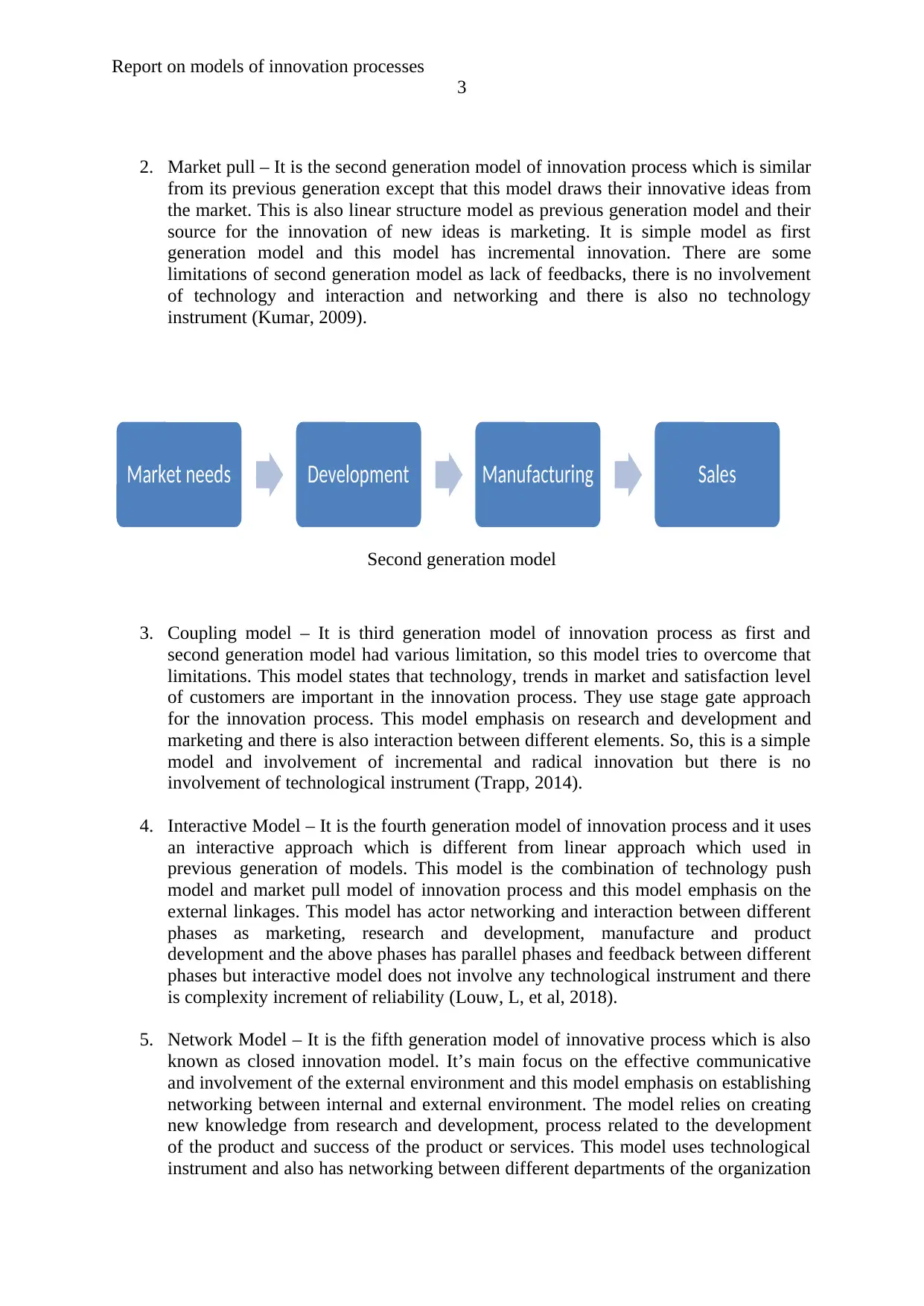
2. Market pull – It is the second generation model of innovation process which is similar
from its previous generation except that this model draws their innovative ideas from
the market. This is also linear structure model as previous generation model and their
source for the innovation of new ideas is marketing. It is simple model as first
generation model and this model has incremental innovation. There are some
limitations of second generation model as lack of feedbacks, there is no involvement
of technology and interaction and networking and there is also no technology
instrument (Kumar, 2009).
Second generation model
3. Coupling model – It is third generation model of innovation process as first and
second generation model had various limitation, so this model tries to overcome that
limitations. This model states that technology, trends in market and satisfaction level
of customers are important in the innovation process. They use stage gate approach
for the innovation process. This model emphasis on research and development and
marketing and there is also interaction between different elements. So, this is a simple
model and involvement of incremental and radical innovation but there is no
involvement of technological instrument (Trapp, 2014).
4. Interactive Model – It is the fourth generation model of innovation process and it uses
an interactive approach which is different from linear approach which used in
previous generation of models. This model is the combination of technology push
model and market pull model of innovation process and this model emphasis on the
external linkages. This model has actor networking and interaction between different
phases as marketing, research and development, manufacture and product
development and the above phases has parallel phases and feedback between different
phases but interactive model does not involve any technological instrument and there
is complexity increment of reliability (Louw, L, et al, 2018).
5. Network Model – It is the fifth generation model of innovative process which is also
known as closed innovation model. It’s main focus on the effective communicative
and involvement of the external environment and this model emphasis on establishing
networking between internal and external environment. The model relies on creating
new knowledge from research and development, process related to the development
of the product and success of the product or services. This model uses technological
instrument and also has networking between different departments of the organization
Market needs Development Manufacturing Sales
3
2. Market pull – It is the second generation model of innovation process which is similar
from its previous generation except that this model draws their innovative ideas from
the market. This is also linear structure model as previous generation model and their
source for the innovation of new ideas is marketing. It is simple model as first
generation model and this model has incremental innovation. There are some
limitations of second generation model as lack of feedbacks, there is no involvement
of technology and interaction and networking and there is also no technology
instrument (Kumar, 2009).
Second generation model
3. Coupling model – It is third generation model of innovation process as first and
second generation model had various limitation, so this model tries to overcome that
limitations. This model states that technology, trends in market and satisfaction level
of customers are important in the innovation process. They use stage gate approach
for the innovation process. This model emphasis on research and development and
marketing and there is also interaction between different elements. So, this is a simple
model and involvement of incremental and radical innovation but there is no
involvement of technological instrument (Trapp, 2014).
4. Interactive Model – It is the fourth generation model of innovation process and it uses
an interactive approach which is different from linear approach which used in
previous generation of models. This model is the combination of technology push
model and market pull model of innovation process and this model emphasis on the
external linkages. This model has actor networking and interaction between different
phases as marketing, research and development, manufacture and product
development and the above phases has parallel phases and feedback between different
phases but interactive model does not involve any technological instrument and there
is complexity increment of reliability (Louw, L, et al, 2018).
5. Network Model – It is the fifth generation model of innovative process which is also
known as closed innovation model. It’s main focus on the effective communicative
and involvement of the external environment and this model emphasis on establishing
networking between internal and external environment. The model relies on creating
new knowledge from research and development, process related to the development
of the product and success of the product or services. This model uses technological
instrument and also has networking between different departments of the organization
Market needs Development Manufacturing Sales
Paraphrase This Document
Need a fresh take? Get an instant paraphrase of this document with our AI Paraphraser
Report on models of innovation processes
4
but this model has complexity in the increment of reliability (Jorgensen and Pedersen,
2018).
6. Open Model – This model is the last or sixth generation of innovation process model
and it focus on the internal as well as external ideas and internal as well as external
paths to the markets. This model is based on the how the combination of internal and
external can help in technological advancement. Open model have risk in the
collaboration with external environment as model assumes there is willingness and
capacity to collaborate with the external environment (Hahn, 2015).
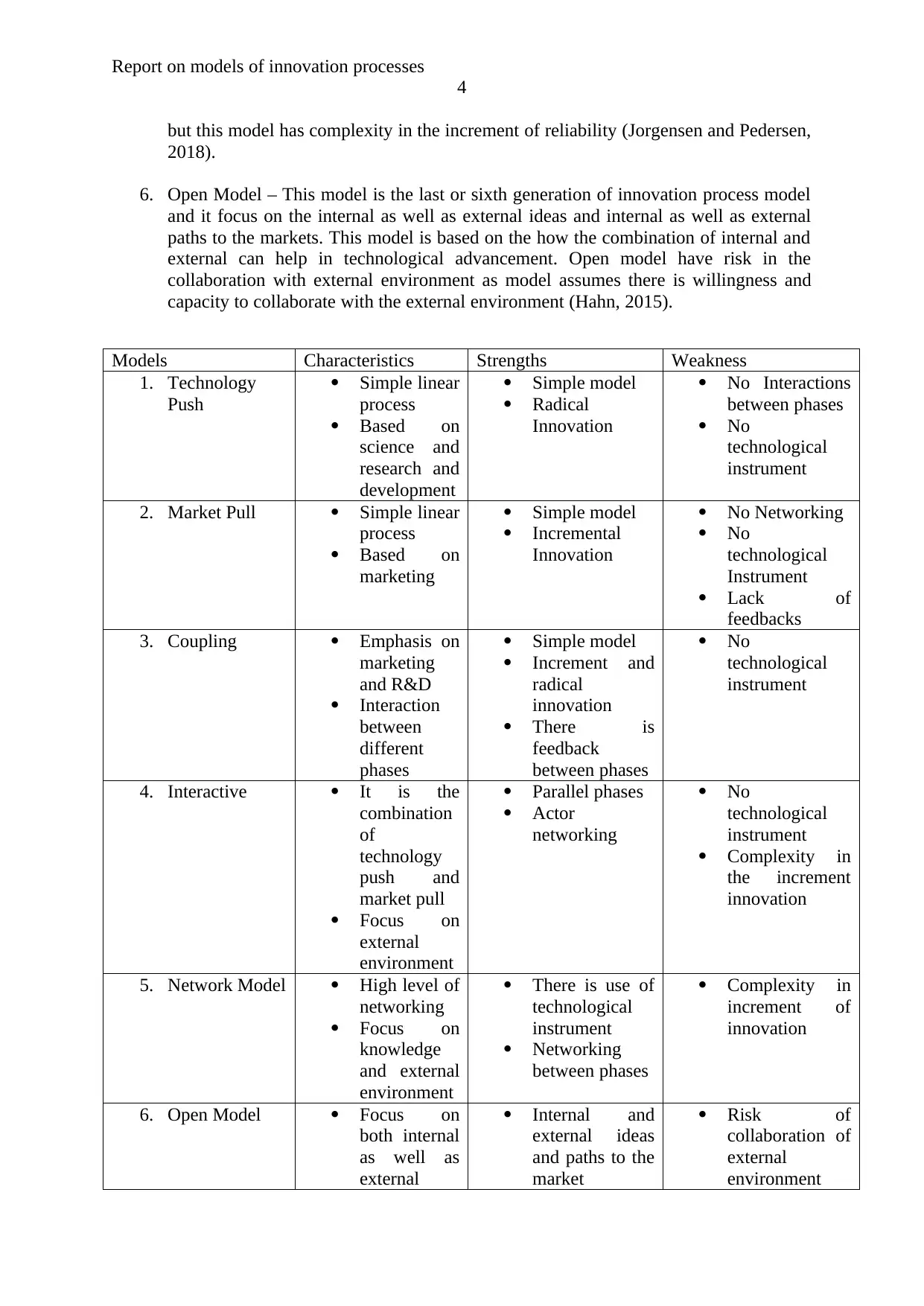
Models Characteristics Strengths Weakness
1. Technology
Push
Simple linear
process
Based on
science and
research and
development
Simple model
Radical
Innovation
No Interactions
between phases
No
technological
instrument
2. Market Pull Simple linear
process
Based on
marketing
Simple model
Incremental
Innovation
No Networking
No
technological
Instrument
Lack of
feedbacks
3. Coupling Emphasis on
marketing
and R&D
Interaction
between
different
phases
Simple model
Increment and
radical
innovation
There is
feedback
between phases
No
technological
instrument
4. Interactive It is the
combination
of
technology
push and
market pull
Focus on
external
environment
Parallel phases
Actor
networking
No
technological
instrument
Complexity in
the increment
innovation
5. Network Model High level of
networking
Focus on
knowledge
and external
environment
There is use of
technological
instrument
Networking
between phases
Complexity in
increment of
innovation
6. Open Model Focus on
both internal
as well as
external
Internal and
external ideas
and paths to the
market
Risk of
collaboration of
external
environment
4
but this model has complexity in the increment of reliability (Jorgensen and Pedersen,
2018).
6. Open Model – This model is the last or sixth generation of innovation process model
and it focus on the internal as well as external ideas and internal as well as external
paths to the markets. This model is based on the how the combination of internal and
external can help in technological advancement. Open model have risk in the
collaboration with external environment as model assumes there is willingness and
capacity to collaborate with the external environment (Hahn, 2015).
Models Characteristics Strengths Weakness
1. Technology
Push
Simple linear
process
Based on
science and
research and
development
Simple model
Radical
Innovation
No Interactions
between phases
No
technological
instrument
2. Market Pull Simple linear
process
Based on
marketing
Simple model
Incremental
Innovation
No Networking
No
technological
Instrument
Lack of
feedbacks
3. Coupling Emphasis on
marketing
and R&D
Interaction
between
different
phases
Simple model
Increment and
radical
innovation
There is
feedback
between phases
No
technological
instrument
4. Interactive It is the
combination
of
technology
push and
market pull
Focus on
external
environment
Parallel phases
Actor
networking
No
technological
instrument
Complexity in
the increment
innovation
5. Network Model High level of
networking
Focus on
knowledge
and external
environment
There is use of
technological
instrument
Networking
between phases
Complexity in
increment of
innovation
6. Open Model Focus on
both internal
as well as
external
Internal and
external ideas
and paths to the
market
Risk of
collaboration of
external
environment
Report on models of innovation processes
5
environment
Consequences of partial understanding of Innovation Process –
There are various consequences or risk of the partial understanding of innovation process and
its impact on the managing innovation. These are the following:
1. When there is only research and development capability as described in first
generation model which is called technology push then its impact on the managing of
innovation as organization may fails to meet the needs of users and their expectations
related to products or services as there is no involvement of technology instrument
(Lacity and Willcocks, 2014).
2. Innovation process model has province of specialists, so there is lack of involvement
of others in managing the innovation process and lack of essential knowledge and
lack of experience related to other perspectives in the research and development
process which was describe in first and second model of innovation process.
3. Innovation process models only focus on the understanding the needs of the
customers and try to fulfil those needs through research and development as they is no
involvement of technology and it leads to inability to gain competitive advantages as
they believes that technological advancement comes after scientific discovery and
research and development in the market as described in technology push model.
4. If innovation process models which are followed by the organization does not involve
technological instrument and does not produce the products or render the services as
per the needs in the market or as per the needs and expectations of the users then
organization cannot achieve its objectives and cannot manage their business through
innovation.
5. Innovation process model has province of large organization then small organization
may be weak as they are highly dependent on the high scale customers, so there is
insignificant for the small organization related to the disruptive innovation as they
does not implement new technology or does not have market opportunities (Joe,
2010).
6. There is only breakthrough change in the six generation of innovation process models
as organization neglect or ignore the importance of incremental innovation and there
incremental performance does not work, so they are unable to gain from some radical
changes throughout six generation innovation process models.
7. Throughout the six generation of innovation process models, there is only single or
silent changes in the next generation than previous generation, so there is no wider
change during the six generation of the models of innovation process.
8. Innovation process models only consider about the target projects which are based on
the strategies, so they lose accident opportunity or does not gain new possibilities.
9. Innovation process models only consider specific individual or due to these models
organization only associated with specific employees in achieving their goals and
objectives, so they may fails to use the creativity or innovative ideas of the other
employees within the organization and organization also fail in improving their
innovation process (Christensen and Raynor, 2013).
10. If innovation process is only seen as an internally generated then organization can be
effect as a not invented and there is no involvement of ideas or suggestion from the
externals or outsiders related to the products or services of the organization and the
development of new products in the organization.
5
environment
Consequences of partial understanding of Innovation Process –
There are various consequences or risk of the partial understanding of innovation process and
its impact on the managing innovation. These are the following:
1. When there is only research and development capability as described in first
generation model which is called technology push then its impact on the managing of
innovation as organization may fails to meet the needs of users and their expectations
related to products or services as there is no involvement of technology instrument
(Lacity and Willcocks, 2014).
2. Innovation process model has province of specialists, so there is lack of involvement
of others in managing the innovation process and lack of essential knowledge and
lack of experience related to other perspectives in the research and development
process which was describe in first and second model of innovation process.
3. Innovation process models only focus on the understanding the needs of the
customers and try to fulfil those needs through research and development as they is no
involvement of technology and it leads to inability to gain competitive advantages as
they believes that technological advancement comes after scientific discovery and
research and development in the market as described in technology push model.
4. If innovation process models which are followed by the organization does not involve
technological instrument and does not produce the products or render the services as
per the needs in the market or as per the needs and expectations of the users then
organization cannot achieve its objectives and cannot manage their business through
innovation.
5. Innovation process model has province of large organization then small organization
may be weak as they are highly dependent on the high scale customers, so there is
insignificant for the small organization related to the disruptive innovation as they
does not implement new technology or does not have market opportunities (Joe,
2010).
6. There is only breakthrough change in the six generation of innovation process models
as organization neglect or ignore the importance of incremental innovation and there
incremental performance does not work, so they are unable to gain from some radical
changes throughout six generation innovation process models.
7. Throughout the six generation of innovation process models, there is only single or
silent changes in the next generation than previous generation, so there is no wider
change during the six generation of the models of innovation process.
8. Innovation process models only consider about the target projects which are based on
the strategies, so they lose accident opportunity or does not gain new possibilities.
9. Innovation process models only consider specific individual or due to these models
organization only associated with specific employees in achieving their goals and
objectives, so they may fails to use the creativity or innovative ideas of the other
employees within the organization and organization also fail in improving their
innovation process (Christensen and Raynor, 2013).
10. If innovation process is only seen as an internally generated then organization can be
effect as a not invented and there is no involvement of ideas or suggestion from the
externals or outsiders related to the products or services of the organization and the
development of new products in the organization.
⊘ This is a preview!⊘
Do you want full access?
Subscribe today to unlock all pages.
Trusted by 1+ million students worldwide
Report on models of innovation processes
6
11. When innovation process models consider only external environment then innovation
is only to identify the needs and expectation of the customers and the market as there
is lack of involvement of internal learning and development of products or services
and development of technological competence (Westerlund and Rajala, 2010).
12. As they only consider single firm or there is no involvement of multiple firms, so
there is no possibilities of networking with various other related organizations to
produce or develop new products and processes for the achievement of the goals and
objectives of the organization.
13. Innovation is only seen as either product or process, there is no relationship between
products and process (Lofsten, 2014).
Conclusion and Recommendation –
Hence, innovation process refer as generating new ideas, implementing new products or
services, creative new thoughts and imaginations and converting them into useful products or
valuable outputs. Researcher classify the innovation process in various models of the
innovation process which is based on the generation as first generation technology push
model, second generation market pull model, third generation coupling model, fourth
generation interactive model, fifth generation networking model and sixth generation open
model. The above models have single or few changes from their previous generation model.
There are also limitations of the innovation process models which impact on the managing
innovation within the organization. As they only focus on the research and development
process either through market or science, so there is no involvement of technological
instrument, they only consider single firm and there is only breakthrough changes, so they
ignore the importance of incremental innovation. Innovation process models consider only
product and process as there is no relationship between them and there is no wider change in
the next generation than previous generation innovation process model.
Yes, there should be seventh generation innovation process model with various
characteristics as huge involvement of technological instrument, networking between
different phases, high level of incremental innovation, creative thinking related to new and
innovative products or services for the organization, there is inter- relationship between
product and process, equally involvement of both internal as well as external environment
and consider all workforce of the organization in the innovation process, so it will help the
organization in the integration of systems and organization, devolved decisions making and
flexible organizational structure, feedback loops between different phases, interdisciplinary
approach and implementation of life circle view for the products or services.
6
11. When innovation process models consider only external environment then innovation
is only to identify the needs and expectation of the customers and the market as there
is lack of involvement of internal learning and development of products or services
and development of technological competence (Westerlund and Rajala, 2010).
12. As they only consider single firm or there is no involvement of multiple firms, so
there is no possibilities of networking with various other related organizations to
produce or develop new products and processes for the achievement of the goals and
objectives of the organization.
13. Innovation is only seen as either product or process, there is no relationship between
products and process (Lofsten, 2014).
Conclusion and Recommendation –
Hence, innovation process refer as generating new ideas, implementing new products or
services, creative new thoughts and imaginations and converting them into useful products or
valuable outputs. Researcher classify the innovation process in various models of the
innovation process which is based on the generation as first generation technology push
model, second generation market pull model, third generation coupling model, fourth
generation interactive model, fifth generation networking model and sixth generation open
model. The above models have single or few changes from their previous generation model.
There are also limitations of the innovation process models which impact on the managing
innovation within the organization. As they only focus on the research and development
process either through market or science, so there is no involvement of technological
instrument, they only consider single firm and there is only breakthrough changes, so they
ignore the importance of incremental innovation. Innovation process models consider only
product and process as there is no relationship between them and there is no wider change in
the next generation than previous generation innovation process model.
Yes, there should be seventh generation innovation process model with various
characteristics as huge involvement of technological instrument, networking between
different phases, high level of incremental innovation, creative thinking related to new and
innovative products or services for the organization, there is inter- relationship between
product and process, equally involvement of both internal as well as external environment
and consider all workforce of the organization in the innovation process, so it will help the
organization in the integration of systems and organization, devolved decisions making and
flexible organizational structure, feedback loops between different phases, interdisciplinary
approach and implementation of life circle view for the products or services.
Paraphrase This Document
Need a fresh take? Get an instant paraphrase of this document with our AI Paraphraser
Report on models of innovation processes
7
References –
Bjorklund, M. and Forslund, H. (2018) Exploring the sustainable logistics innovation process.
Industrial Management & Data Systems, 118(1), pp.204-217.
Christensen, C. and Raynor, M. (2013) The Innovator’s Solution: Creating and Sustaining
Successful Growth. Boston: Harvard Business School Press.
Hahn, T. (2015) Cross- Industry Innovation Processes: Strategic Implications for
Telecommunication Companies. Germany: Springer Gabler.
Joe, T. (2010) Gaining Momentum: Managing the Diffusions of Innovation. London: Imperial
College Press.
Johannessen, J. (2009) A systematic approach to innovation: the interactive innovation
model. Kybernetes, 38(1), pp.158-176.
Jorgensen, S. and Pedersen, L. (2018) Restart Sustainable Business Model Innovation.
Switzerland: Springer Nature Switzerland AG.
Kumar, V. (2009) A process for practicing design innovation. Journal of Business Strategy,
30(2), pp.91-100.
Lacity, M. and Willcocks, L. (2014) Business process outsourcing and dynamic innovation.
Strategic Outsourcing: An International Journal, 7(1), pp.66-92.
Lober, H. (2010) Different Phases of the Innovation Process: An Overview of Challenges and
Customer Integration. Germany: Anchor Academic Publishing.
Lofsten, H. (2014) Product innovation processes and the trade- off between product
innovation performance and business performance. European Journal of Innovation, 17(1),
pp.61-84.
Louw, L., Schutte, C., Seidel, C. and Imser, C. (2018) Towards a Flexible Innovation Process
Model Assuring Quality and Customer Needs. South African Journal of Industrial
Engineering, 29(1), pp.155-168.
Manceau, D. and Morand, P. (2014) A Few Argument in Favour of a Holistic Approach to
Innovation in Economics and Management. Journal of Innovation Economics &
Management, 3(15), pp.101-115.
Trapp, M. (2014) Realising Business Model Innovation: A Strategic Approach for Business
Unit Mangers. Germany: Springer Gabler.
Westerlund, M. and Rajala, R. (2010) Learning and innovation in inter- organizational
network collaboration. Journal of Business & Industrial Marketing, 25(6), pp.435-442.
7
References –
Bjorklund, M. and Forslund, H. (2018) Exploring the sustainable logistics innovation process.
Industrial Management & Data Systems, 118(1), pp.204-217.
Christensen, C. and Raynor, M. (2013) The Innovator’s Solution: Creating and Sustaining
Successful Growth. Boston: Harvard Business School Press.
Hahn, T. (2015) Cross- Industry Innovation Processes: Strategic Implications for
Telecommunication Companies. Germany: Springer Gabler.
Joe, T. (2010) Gaining Momentum: Managing the Diffusions of Innovation. London: Imperial
College Press.
Johannessen, J. (2009) A systematic approach to innovation: the interactive innovation
model. Kybernetes, 38(1), pp.158-176.
Jorgensen, S. and Pedersen, L. (2018) Restart Sustainable Business Model Innovation.
Switzerland: Springer Nature Switzerland AG.
Kumar, V. (2009) A process for practicing design innovation. Journal of Business Strategy,
30(2), pp.91-100.
Lacity, M. and Willcocks, L. (2014) Business process outsourcing and dynamic innovation.
Strategic Outsourcing: An International Journal, 7(1), pp.66-92.
Lober, H. (2010) Different Phases of the Innovation Process: An Overview of Challenges and
Customer Integration. Germany: Anchor Academic Publishing.
Lofsten, H. (2014) Product innovation processes and the trade- off between product
innovation performance and business performance. European Journal of Innovation, 17(1),
pp.61-84.
Louw, L., Schutte, C., Seidel, C. and Imser, C. (2018) Towards a Flexible Innovation Process
Model Assuring Quality and Customer Needs. South African Journal of Industrial
Engineering, 29(1), pp.155-168.
Manceau, D. and Morand, P. (2014) A Few Argument in Favour of a Holistic Approach to
Innovation in Economics and Management. Journal of Innovation Economics &
Management, 3(15), pp.101-115.
Trapp, M. (2014) Realising Business Model Innovation: A Strategic Approach for Business
Unit Mangers. Germany: Springer Gabler.
Westerlund, M. and Rajala, R. (2010) Learning and innovation in inter- organizational
network collaboration. Journal of Business & Industrial Marketing, 25(6), pp.435-442.

1 out of 8


Related Documents


Your All-in-One AI-Powered Toolkit for Academic Success.
+13062052269
info@desklib.com
Available 24*7 on WhatsApp / Email
![[object Object]](/_next/static/media/star-bottom.7253800d.svg)
Unlock your academic potential
Copyright © 2020–2026 A2Z Services. All Rights Reserved. Developed and managed by ZUCOL.