Report: Innovation Imperative for Woolworths Supermarkets (MNGT 1002)
VerifiedAdded on 2023/06/18
|7
|1979
|155
Report
AI Summary
This report examines the critical role of innovation within Woolworths Supermarkets, a leading Australian retailer. It delves into various types of innovation, including product, process, paradigm, and incremental innovation, further exploring the innovation life cycle stages: ideation, project selection, product development, and commercialization. The report highlights the role of innovation in driving organizational growth, changing business models, and fostering social and environmental sustainability. It also addresses the positive implications of innovation, such as increased efficiency, cost reduction, and boosted productivity, alongside potential negative implications like operational, commercial, and financial risks. The importance of innovation for organizational growth, relevance, and differentiation is emphasized, along with challenges like employee empowerment, missing innovation strategies, and missed customer connections. Finally, the report considers the influence of organizational contexts, including leadership, teams, and organizational structure, on fostering innovation within Woolworths Supermarkets.

MNGT 1002
Paraphrase This Document
Need a fresh take? Get an instant paraphrase of this document with our AI Paraphraser

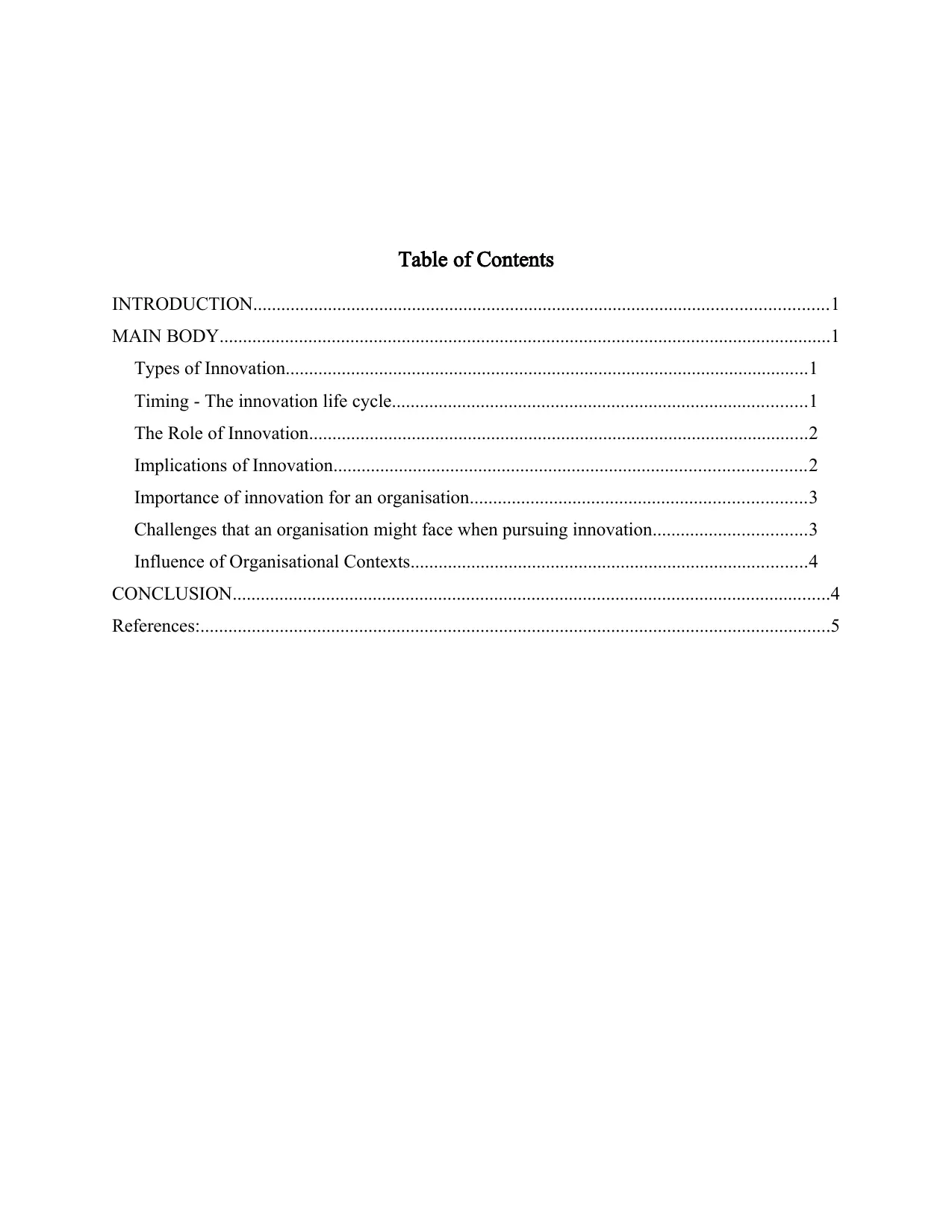
Table of Contents
INTRODUCTION...........................................................................................................................1
MAIN BODY...................................................................................................................................1
Types of Innovation................................................................................................................1
Timing - The innovation life cycle.........................................................................................1
The Role of Innovation...........................................................................................................2
Implications of Innovation.....................................................................................................2
Importance of innovation for an organisation........................................................................3
Challenges that an organisation might face when pursuing innovation.................................3
Influence of Organisational Contexts.....................................................................................4
CONCLUSION................................................................................................................................4
References:.......................................................................................................................................5
INTRODUCTION...........................................................................................................................1
MAIN BODY...................................................................................................................................1
Types of Innovation................................................................................................................1
Timing - The innovation life cycle.........................................................................................1
The Role of Innovation...........................................................................................................2
Implications of Innovation.....................................................................................................2
Importance of innovation for an organisation........................................................................3
Challenges that an organisation might face when pursuing innovation.................................3
Influence of Organisational Contexts.....................................................................................4
CONCLUSION................................................................................................................................4
References:.......................................................................................................................................5

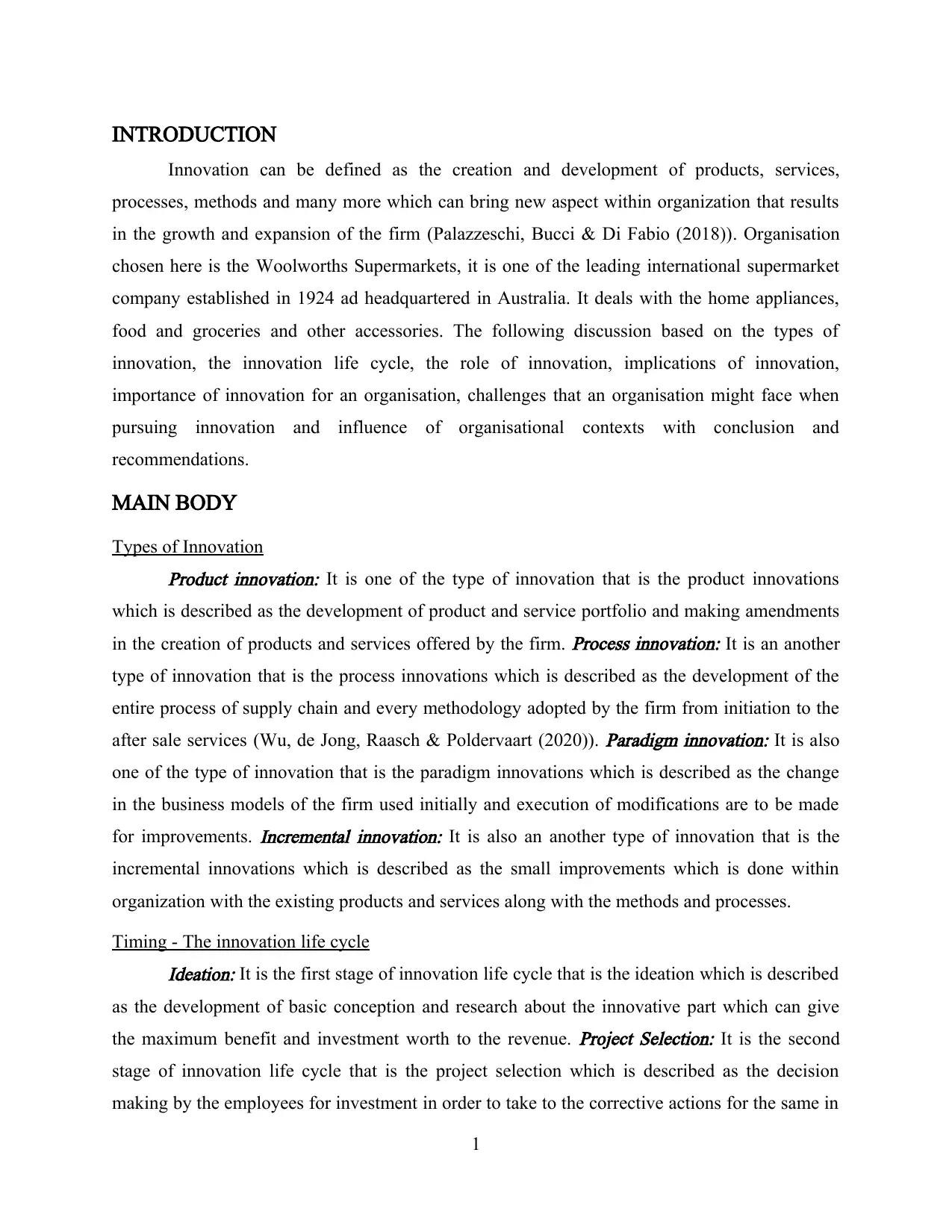
INTRODUCTION
Innovation can be defined as the creation and development of products, services,
processes, methods and many more which can bring new aspect within organization that results
in the growth and expansion of the firm (Palazzeschi, Bucci & Di Fabio (2018)). Organisation
chosen here is the Woolworths Supermarkets, it is one of the leading international supermarket
company established in 1924 ad headquartered in Australia. It deals with the home appliances,
food and groceries and other accessories. The following discussion based on the types of
innovation, the innovation life cycle, the role of innovation, implications of innovation,
importance of innovation for an organisation, challenges that an organisation might face when
pursuing innovation and influence of organisational contexts with conclusion and
recommendations.
MAIN BODY
Types of Innovation
Product innovation: It is one of the type of innovation that is the product innovations
which is described as the development of product and service portfolio and making amendments
in the creation of products and services offered by the firm.
Process innovation: It is an another
type of innovation that is the process innovations which is described as the development of the
entire process of supply chain and every methodology adopted by the firm from initiation to the
after sale services (Wu, de Jong, Raasch & Poldervaart (2020)).
Paradigm innovation: It is also
one of the type of innovation that is the paradigm innovations which is described as the change
in the business models of the firm used initially and execution of modifications are to be made
for improvements.
Incremental innovation: It is also an another type of innovation that is the
incremental innovations which is described as the small improvements which is done within
organization with the existing products and services along with the methods and processes.
Timing - The innovation life cycle
Ideation: It is the first stage of innovation life cycle that is the ideation which is described
as the development of basic conception and research about the innovative part which can give
the maximum benefit and investment worth to the revenue.
Project Selection: It is the second
stage of innovation life cycle that is the project selection which is described as the decision
making by the employees for investment in order to take to the corrective actions for the same in
1
Innovation can be defined as the creation and development of products, services,
processes, methods and many more which can bring new aspect within organization that results
in the growth and expansion of the firm (Palazzeschi, Bucci & Di Fabio (2018)). Organisation
chosen here is the Woolworths Supermarkets, it is one of the leading international supermarket
company established in 1924 ad headquartered in Australia. It deals with the home appliances,
food and groceries and other accessories. The following discussion based on the types of
innovation, the innovation life cycle, the role of innovation, implications of innovation,
importance of innovation for an organisation, challenges that an organisation might face when
pursuing innovation and influence of organisational contexts with conclusion and
recommendations.
MAIN BODY
Types of Innovation
Product innovation: It is one of the type of innovation that is the product innovations
which is described as the development of product and service portfolio and making amendments
in the creation of products and services offered by the firm.
Process innovation: It is an another
type of innovation that is the process innovations which is described as the development of the
entire process of supply chain and every methodology adopted by the firm from initiation to the
after sale services (Wu, de Jong, Raasch & Poldervaart (2020)).
Paradigm innovation: It is also
one of the type of innovation that is the paradigm innovations which is described as the change
in the business models of the firm used initially and execution of modifications are to be made
for improvements.
Incremental innovation: It is also an another type of innovation that is the
incremental innovations which is described as the small improvements which is done within
organization with the existing products and services along with the methods and processes.
Timing - The innovation life cycle
Ideation: It is the first stage of innovation life cycle that is the ideation which is described
as the development of basic conception and research about the innovative part which can give
the maximum benefit and investment worth to the revenue.
Project Selection: It is the second
stage of innovation life cycle that is the project selection which is described as the decision
making by the employees for investment in order to take to the corrective actions for the same in
1
⊘ This is a preview!⊘
Do you want full access?
Subscribe today to unlock all pages.

Trusted by 1+ million students worldwide

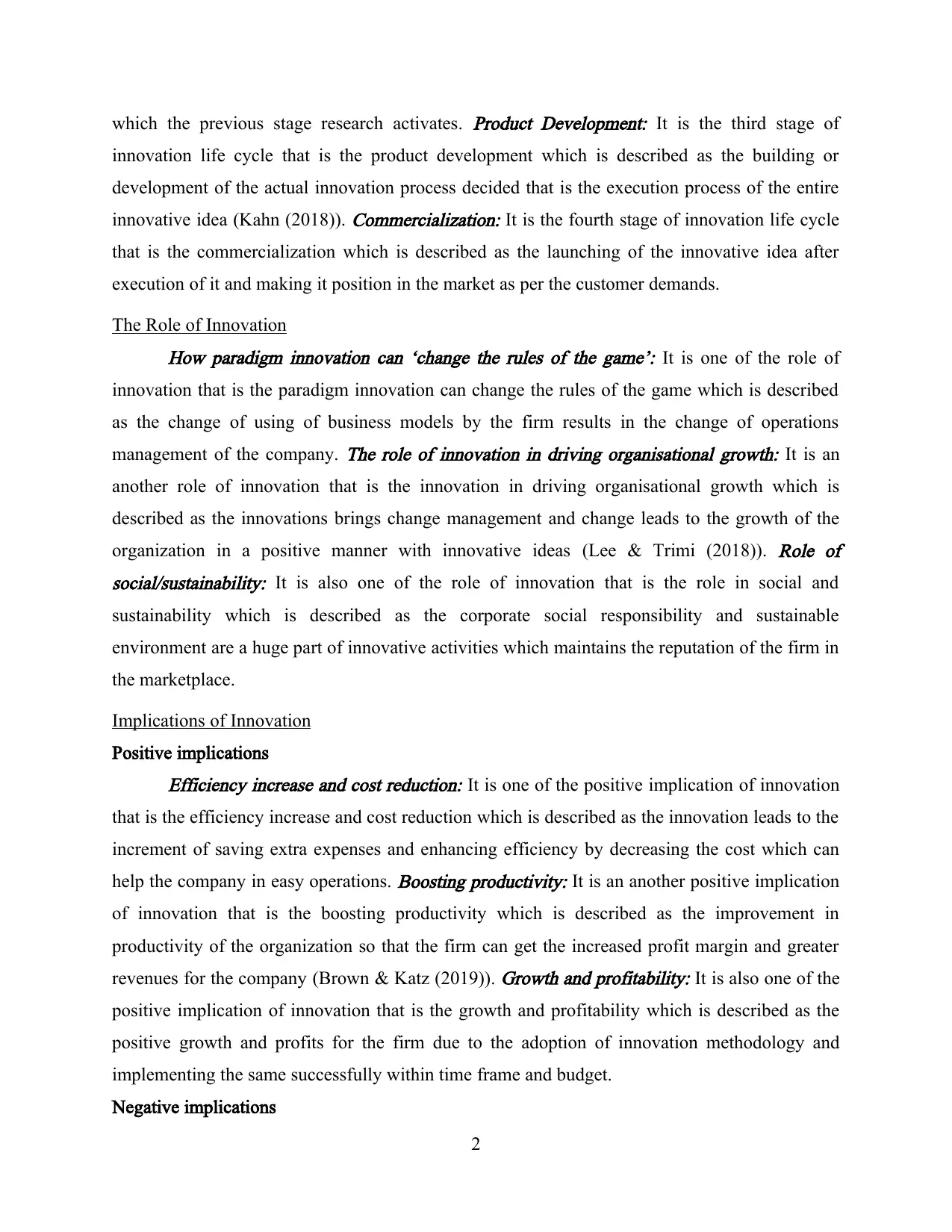
which the previous stage research activates.
Product Development: It is the third stage of
innovation life cycle that is the product development which is described as the building or
development of the actual innovation process decided that is the execution process of the entire
innovative idea (Kahn (2018)).
Commercialization: It is the fourth stage of innovation life cycle
that is the commercialization which is described as the launching of the innovative idea after
execution of it and making it position in the market as per the customer demands.
The Role of Innovation
How paradigm innovation can ‘change the rules of the game’: It is one of the role of
innovation that is the paradigm innovation can change the rules of the game which is described
as the change of using of business models by the firm results in the change of operations
management of the company.
The role of innovation in driving organisational growth: It is an
another role of innovation that is the innovation in driving organisational growth which is
described as the innovations brings change management and change leads to the growth of the
organization in a positive manner with innovative ideas (Lee & Trimi (2018)).
Role of
social/sustainability: It is also one of the role of innovation that is the role in social and
sustainability which is described as the corporate social responsibility and sustainable
environment are a huge part of innovative activities which maintains the reputation of the firm in
the marketplace.
Implications of Innovation
Positive implications
Efficiency increase and cost reduction: It is one of the positive implication of innovation
that is the efficiency increase and cost reduction which is described as the innovation leads to the
increment of saving extra expenses and enhancing efficiency by decreasing the cost which can
help the company in easy operations.
Boosting productivity: It is an another positive implication
of innovation that is the boosting productivity which is described as the improvement in
productivity of the organization so that the firm can get the increased profit margin and greater
revenues for the company (Brown & Katz (2019)).
Growth and profitability: It is also one of the
positive implication of innovation that is the growth and profitability which is described as the
positive growth and profits for the firm due to the adoption of innovation methodology and
implementing the same successfully within time frame and budget.
Negative implications
2
Product Development: It is the third stage of
innovation life cycle that is the product development which is described as the building or
development of the actual innovation process decided that is the execution process of the entire
innovative idea (Kahn (2018)).
Commercialization: It is the fourth stage of innovation life cycle
that is the commercialization which is described as the launching of the innovative idea after
execution of it and making it position in the market as per the customer demands.
The Role of Innovation
How paradigm innovation can ‘change the rules of the game’: It is one of the role of
innovation that is the paradigm innovation can change the rules of the game which is described
as the change of using of business models by the firm results in the change of operations
management of the company.
The role of innovation in driving organisational growth: It is an
another role of innovation that is the innovation in driving organisational growth which is
described as the innovations brings change management and change leads to the growth of the
organization in a positive manner with innovative ideas (Lee & Trimi (2018)).
Role of
social/sustainability: It is also one of the role of innovation that is the role in social and
sustainability which is described as the corporate social responsibility and sustainable
environment are a huge part of innovative activities which maintains the reputation of the firm in
the marketplace.
Implications of Innovation
Positive implications
Efficiency increase and cost reduction: It is one of the positive implication of innovation
that is the efficiency increase and cost reduction which is described as the innovation leads to the
increment of saving extra expenses and enhancing efficiency by decreasing the cost which can
help the company in easy operations.
Boosting productivity: It is an another positive implication
of innovation that is the boosting productivity which is described as the improvement in
productivity of the organization so that the firm can get the increased profit margin and greater
revenues for the company (Brown & Katz (2019)).
Growth and profitability: It is also one of the
positive implication of innovation that is the growth and profitability which is described as the
positive growth and profits for the firm due to the adoption of innovation methodology and
implementing the same successfully within time frame and budget.
Negative implications
2
Paraphrase This Document
Need a fresh take? Get an instant paraphrase of this document with our AI Paraphraser

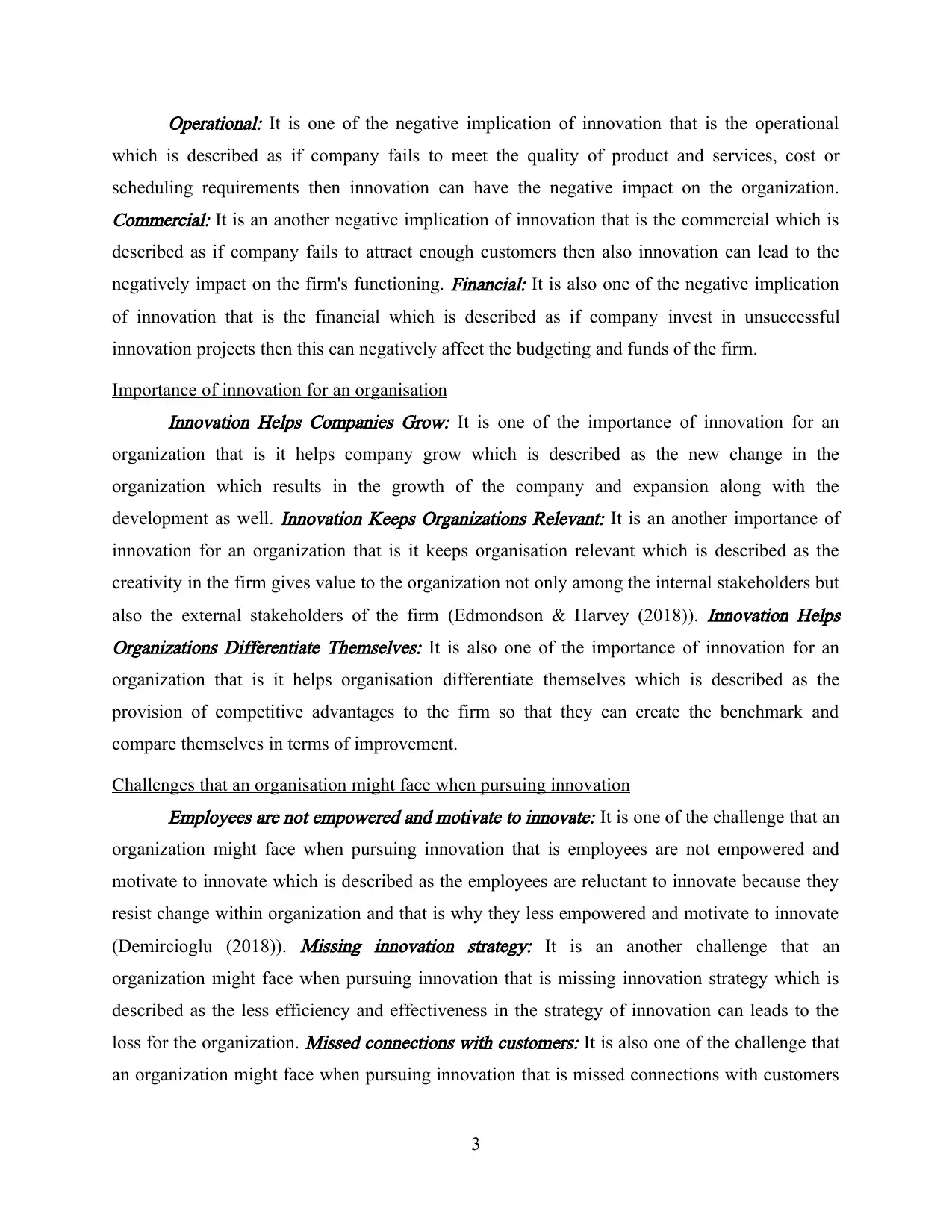
Operational: It is one of the negative implication of innovation that is the operational
which is described as if company fails to meet the quality of product and services, cost or
scheduling requirements then innovation can have the negative impact on the organization.Commercial: It is an another negative implication of innovation that is the commercial which is
described as if company fails to attract enough customers then also innovation can lead to the
negatively impact on the firm's functioning.
Financial: It is also one of the negative implication
of innovation that is the financial which is described as if company invest in unsuccessful
innovation projects then this can negatively affect the budgeting and funds of the firm.
Importance of innovation for an organisation
Innovation Helps Companies Grow: It is one of the importance of innovation for an
organization that is it helps company grow which is described as the new change in the
organization which results in the growth of the company and expansion along with the
development as well.
Innovation Keeps Organizations Relevant: It is an another importance of
innovation for an organization that is it keeps organisation relevant which is described as the
creativity in the firm gives value to the organization not only among the internal stakeholders but
also the external stakeholders of the firm (Edmondson & Harvey (2018)).
Innovation Helps
Organizations Differentiate Themselves: It is also one of the importance of innovation for an
organization that is it helps organisation differentiate themselves which is described as the
provision of competitive advantages to the firm so that they can create the benchmark and
compare themselves in terms of improvement.
Challenges that an organisation might face when pursuing innovation
Employees are not empowered and motivate to innovate: It is one of the challenge that an
organization might face when pursuing innovation that is employees are not empowered and
motivate to innovate which is described as the employees are reluctant to innovate because they
resist change within organization and that is why they less empowered and motivate to innovate
(Demircioglu (2018)).
Missing innovation strategy: It is an another challenge that an
organization might face when pursuing innovation that is missing innovation strategy which is
described as the less efficiency and effectiveness in the strategy of innovation can leads to the
loss for the organization.
Missed connections with customers: It is also one of the challenge that
an organization might face when pursuing innovation that is missed connections with customers
3
which is described as if company fails to meet the quality of product and services, cost or
scheduling requirements then innovation can have the negative impact on the organization.Commercial: It is an another negative implication of innovation that is the commercial which is
described as if company fails to attract enough customers then also innovation can lead to the
negatively impact on the firm's functioning.
Financial: It is also one of the negative implication
of innovation that is the financial which is described as if company invest in unsuccessful
innovation projects then this can negatively affect the budgeting and funds of the firm.
Importance of innovation for an organisation
Innovation Helps Companies Grow: It is one of the importance of innovation for an
organization that is it helps company grow which is described as the new change in the
organization which results in the growth of the company and expansion along with the
development as well.
Innovation Keeps Organizations Relevant: It is an another importance of
innovation for an organization that is it keeps organisation relevant which is described as the
creativity in the firm gives value to the organization not only among the internal stakeholders but
also the external stakeholders of the firm (Edmondson & Harvey (2018)).
Innovation Helps
Organizations Differentiate Themselves: It is also one of the importance of innovation for an
organization that is it helps organisation differentiate themselves which is described as the
provision of competitive advantages to the firm so that they can create the benchmark and
compare themselves in terms of improvement.
Challenges that an organisation might face when pursuing innovation
Employees are not empowered and motivate to innovate: It is one of the challenge that an
organization might face when pursuing innovation that is employees are not empowered and
motivate to innovate which is described as the employees are reluctant to innovate because they
resist change within organization and that is why they less empowered and motivate to innovate
(Demircioglu (2018)).
Missing innovation strategy: It is an another challenge that an
organization might face when pursuing innovation that is missing innovation strategy which is
described as the less efficiency and effectiveness in the strategy of innovation can leads to the
loss for the organization.
Missed connections with customers: It is also one of the challenge that
an organization might face when pursuing innovation that is missed connections with customers
3

which is described as the low interaction and communication flow with the customers can result
in the break of customer relationship.
Influence of Organisational Contexts
Leadership: It is one of the influence of organizational context that is leadership which is
described as the leaders apply their styles and theories as per the needs and requirements of the
innovation strategy to support the innovation.
Teams: It is an another influence of organizational
context that is teams which is described as the team management by managers and leaders are
done by considering the demand and resources of innovation to support innovation (Damanpour,
Sanchez‐Henriquez & Chiu (2018)).
Organisational structure and climate: It is also an another
influence of organizational context that is organisational structure and climate which is described
as the organizational hierarchy has a major role in innovation activities within organization
which includes the structure and climate of the company in order to support the innovation.
CONCLUSION
It is concluded that innovation is an important concept to learn and study so that its
applications can be applied in the world organizations. This is because it brings new ideas and
creativity to the organization for better development of the company. Therefore, it is important to
analyse the types of innovation, it is essential to examine the innovation life cycle, it is
necessary to determine the role of innovation, it is significant to gain the knowledge about
implications of innovation, it is crucial to assess the importance of innovation for an
organisation, it is imperative to investigate the challenges that an organisation might face when
pursuing innovation and it is vital to study the influence of organisational contexts. Hence, this
report covers all such areas in order to better understand the conception of innovation.
4
in the break of customer relationship.
Influence of Organisational Contexts
Leadership: It is one of the influence of organizational context that is leadership which is
described as the leaders apply their styles and theories as per the needs and requirements of the
innovation strategy to support the innovation.
Teams: It is an another influence of organizational
context that is teams which is described as the team management by managers and leaders are
done by considering the demand and resources of innovation to support innovation (Damanpour,
Sanchez‐Henriquez & Chiu (2018)).
Organisational structure and climate: It is also an another
influence of organizational context that is organisational structure and climate which is described
as the organizational hierarchy has a major role in innovation activities within organization
which includes the structure and climate of the company in order to support the innovation.
CONCLUSION
It is concluded that innovation is an important concept to learn and study so that its
applications can be applied in the world organizations. This is because it brings new ideas and
creativity to the organization for better development of the company. Therefore, it is important to
analyse the types of innovation, it is essential to examine the innovation life cycle, it is
necessary to determine the role of innovation, it is significant to gain the knowledge about
implications of innovation, it is crucial to assess the importance of innovation for an
organisation, it is imperative to investigate the challenges that an organisation might face when
pursuing innovation and it is vital to study the influence of organisational contexts. Hence, this
report covers all such areas in order to better understand the conception of innovation.
4
⊘ This is a preview!⊘
Do you want full access?
Subscribe today to unlock all pages.

Trusted by 1+ million students worldwide

References:
Books and Journals
Brown, T., & Katz, B. (2019).
Change by design: How design thinking transforms organizations
and inspires innovation (Vol. 20091). New York, NY: HarperBusiness.
Damanpour, F., Sanchez‐Henriquez, F., & Chiu, H. H. (2018). Internal and external sources and
the adoption of innovations in organizations.
British Journal of Management. 29(4). 712-
730.
Demircioglu, M. A. (2018). The effects of empowerment practices on perceived barriers to
innovation: Evidence from public organizations.
International Journal of Public
Administration. 41(15). 1302-1313.
Edmondson, A. C., & Harvey, J. F. (2018). Cross-boundary teaming for innovation: Integrating
research on teams and knowledge in organizations.
Human Resource Management
Review. 28(4). 347-360.
Kahn, K. B. (2018). Understanding innovation.
Business Horizons. 61(3). 453-460.
Lee, S. M., & Trimi, S. (2018). Innovation for creating a smart future.
Journal of Innovation &
Knowledge. 3(1). 1-8.
Palazzeschi, L., Bucci, O., & Di Fabio, A. (2018). Re-thinking innovation in organizations in the
industry 4.0 scenario: New challenges in a primary prevention perspective.
Frontiers in
psychology,
9, 30.
Wu, C. H., de Jong, J. P., Raasch, C., & Poldervaart, S. (2020). Work process-related lead
userness as an antecedent of innovative behavior and user innovation in
organizations.
Research Policy. 49(6). 103986.
5
Books and Journals
Brown, T., & Katz, B. (2019).
Change by design: How design thinking transforms organizations
and inspires innovation (Vol. 20091). New York, NY: HarperBusiness.
Damanpour, F., Sanchez‐Henriquez, F., & Chiu, H. H. (2018). Internal and external sources and
the adoption of innovations in organizations.
British Journal of Management. 29(4). 712-
730.
Demircioglu, M. A. (2018). The effects of empowerment practices on perceived barriers to
innovation: Evidence from public organizations.
International Journal of Public
Administration. 41(15). 1302-1313.
Edmondson, A. C., & Harvey, J. F. (2018). Cross-boundary teaming for innovation: Integrating
research on teams and knowledge in organizations.
Human Resource Management
Review. 28(4). 347-360.
Kahn, K. B. (2018). Understanding innovation.
Business Horizons. 61(3). 453-460.
Lee, S. M., & Trimi, S. (2018). Innovation for creating a smart future.
Journal of Innovation &
Knowledge. 3(1). 1-8.
Palazzeschi, L., Bucci, O., & Di Fabio, A. (2018). Re-thinking innovation in organizations in the
industry 4.0 scenario: New challenges in a primary prevention perspective.
Frontiers in
psychology,
9, 30.
Wu, C. H., de Jong, J. P., Raasch, C., & Poldervaart, S. (2020). Work process-related lead
userness as an antecedent of innovative behavior and user innovation in
organizations.
Research Policy. 49(6). 103986.
5
1 out of 7
Related Documents
Your All-in-One AI-Powered Toolkit for Academic Success.
+13062052269
info@desklib.com
Available 24*7 on WhatsApp / Email
Unlock your academic potential
Copyright © 2020–2026 A2Z Services. All Rights Reserved. Developed and managed by ZUCOL.