Monash University HI5004 Marketing Plan Project Report
VerifiedAdded on 2022/09/08
|9
|11536
|22
Report
AI Summary
This report, based on a study of 207 Australian manufacturing firms, investigates the relationship between innovation strategies, business environments, and business performance. It examines the impact of dynamic and competitive environments on product and process innovation. The study reveals that dynamic environments enhance the effect of product innovation, while competitive environments weaken it. Conversely, competitive environments strengthen the effect of process innovation. The research highlights the strategic fit between dynamism and product innovation, as well as competitiveness and process innovation. The report discusses the theoretical and practical implications of these findings, emphasizing the importance of aligning innovation strategies with the specific characteristics of the business environment to achieve optimal performance. The assignment aligns with a marketing plan project that requires students to analyze an organization from a marketing perspective and develop a marketing strategy.
The strategic fit between innovation strategies and business
environment in delivering business performance
Daniel I.Prajogon
Department of Management,Monash Business School,Monash University,Australia
a r t i c l e i n f o
Article history:
Received 17 September 2014
Accepted 30 July 2015
Available online 28 August 2015
Keywords:
Innovation strategies
Business environment
Strategic fit
Business performance
a b s t r a c t
This paper examines the role business environments (in terms of dynamism and competitiveness) as
contingency factors which affect the effectiveness of different types of innovation strategies (in terms of
product and process) in delivering business performance.Using the data of 207 manufacturing firms in
Australia,this study shows that dynamic environments strengthen the effect of product innovation on
business performance.Competitive environments,on the other hand, weaken the effectof product
innovation on business performance,but strengthen the effect of process innovation on business per-
formance.Overall,this study demonstrates the strategic fit between dynamism and product innovation
strategy as well as between competitiveness and process innovation strategy.On the other hand,com-
petitiveness also shows a strategic mismatch with product innovation.The theoreticaland practical
implications are discussed.
& 2015 Elsevier B.V.All rights reserved.
1. Introduction
Most studies on innovation have been focused on understanding
how internal organizationalfactors including top management,
human resources,technologicalcapabilities,and organizationalcul-
ture, affect innovation (Aragón-Correaa et al., 2007; Bhattacharya and
Bloch,2004; Canto and Gonzalez,1999; Damanpour,1987; Herzog
and Leker,2010;Murat Ar and Baki,2011;Oke et al.,2013;Sub-
ramanian and Nilakanta, 1996).This is because innovation is seen as
an activity that is within the control of a firm which management can
control or manipulate.In contrast,less is known about the effect of
external factors on innovation.Firm's actions including their innova-
tive activities are contingentupon and are sometimes driven by
externalfactors including customer (market) demand,competitors'
actions,or even government'slegislations(Caruana etal., 2002;
Corrocher and Zirulia,2010; Tao et al.,2010; Tripsas,2008; Yalabik
and Fairchild,2011).In this study,we focus on the effect of dynamic
and competitive environments on innovation strategies (Lumpkin and
Dess,2001; Tidd et al.,2005).
Innovation itself as a concept is multi-dimensional comprising
various types. Product innovation is defined as the development or
use of new components, features and technologies to produce new
products. Product innovation has attracted a significant amount of
attention in the literature (Carranza,2010; Corsino and Gabriele,
2010; Danneels,2002; Fintana and Nesta,2009; Kusiak, 2009;
Page,1993; Verhees and Meulenberg,2004; Wren et al., 2000),
and studies have shown its direct effect on firms'business per-
formance (Bhaskaran,2006; Calantone etal., 1995; Damanpour
and Evan, 1984; Georgellis et al., 2000; Hall and Bagchi-Sen, 2002;
Kayhan et al.,2006; Rauch et al.,2009; Wiklund and Shepherd,
2003,2005).Process innovation is defined as the improvement to
production processes technologies required to produce a product.
Because process innovation typically occurs within the internal
operations of a firm,less is known about process innovation; its
antecedents and consequences,compared to product innovation
(Bonanno and Haworth,1998; Clark and Stoddard,1996; Kraft,
1990; Reichstein and Salter,2006; Weiss,2003).Despite the fact
that both product and process innovation have a positive effect on
business performance (Prajogo and Ahmed,2007), the under-
standing of the external market conditions or characteristics under
which these two different forms of innovation more or less ben-
eficial is limited.
While innovation studies have shown the effectiveness of
innovation as a competitive strategy,they also suggest that such
effectiveness is influenced by the environmental context in which
the firm operates and competes (Barney, 2001; Jansen et al., 2006;
Katila and Shane,2005; Tsai and Yang,2013).This is because the
innovation strategieswhich are effective in improving perfor-
mance in certain environments may not be as effective in other
environments.As a result, managers must seek the fit between
Contents lists available at ScienceDirect
journal homepage: www.elsevier.com/locate/ijpe
Int. J. Production Economics
http://dx.doi.org/10.1016/j.ijpe.2015.07.037
0925-5273/& 2015 Elsevier B.V.All rights reserved.
n Correspondence address: Department ofManagement Monash University PO
Box 197,VIC 3141,Australia.Tel.: þ61 3 9903 2030; fax: þ61 3 9903 2718.
E-mail address: daniel.prajogo@monash.edu
Int. J. Production Economics 171 (2016) 241–249
environment in delivering business performance
Daniel I.Prajogon
Department of Management,Monash Business School,Monash University,Australia
a r t i c l e i n f o
Article history:
Received 17 September 2014
Accepted 30 July 2015
Available online 28 August 2015
Keywords:
Innovation strategies
Business environment
Strategic fit
Business performance
a b s t r a c t
This paper examines the role business environments (in terms of dynamism and competitiveness) as
contingency factors which affect the effectiveness of different types of innovation strategies (in terms of
product and process) in delivering business performance.Using the data of 207 manufacturing firms in
Australia,this study shows that dynamic environments strengthen the effect of product innovation on
business performance.Competitive environments,on the other hand, weaken the effectof product
innovation on business performance,but strengthen the effect of process innovation on business per-
formance.Overall,this study demonstrates the strategic fit between dynamism and product innovation
strategy as well as between competitiveness and process innovation strategy.On the other hand,com-
petitiveness also shows a strategic mismatch with product innovation.The theoreticaland practical
implications are discussed.
& 2015 Elsevier B.V.All rights reserved.
1. Introduction
Most studies on innovation have been focused on understanding
how internal organizationalfactors including top management,
human resources,technologicalcapabilities,and organizationalcul-
ture, affect innovation (Aragón-Correaa et al., 2007; Bhattacharya and
Bloch,2004; Canto and Gonzalez,1999; Damanpour,1987; Herzog
and Leker,2010;Murat Ar and Baki,2011;Oke et al.,2013;Sub-
ramanian and Nilakanta, 1996).This is because innovation is seen as
an activity that is within the control of a firm which management can
control or manipulate.In contrast,less is known about the effect of
external factors on innovation.Firm's actions including their innova-
tive activities are contingentupon and are sometimes driven by
externalfactors including customer (market) demand,competitors'
actions,or even government'slegislations(Caruana etal., 2002;
Corrocher and Zirulia,2010; Tao et al.,2010; Tripsas,2008; Yalabik
and Fairchild,2011).In this study,we focus on the effect of dynamic
and competitive environments on innovation strategies (Lumpkin and
Dess,2001; Tidd et al.,2005).
Innovation itself as a concept is multi-dimensional comprising
various types. Product innovation is defined as the development or
use of new components, features and technologies to produce new
products. Product innovation has attracted a significant amount of
attention in the literature (Carranza,2010; Corsino and Gabriele,
2010; Danneels,2002; Fintana and Nesta,2009; Kusiak, 2009;
Page,1993; Verhees and Meulenberg,2004; Wren et al., 2000),
and studies have shown its direct effect on firms'business per-
formance (Bhaskaran,2006; Calantone etal., 1995; Damanpour
and Evan, 1984; Georgellis et al., 2000; Hall and Bagchi-Sen, 2002;
Kayhan et al.,2006; Rauch et al.,2009; Wiklund and Shepherd,
2003,2005).Process innovation is defined as the improvement to
production processes technologies required to produce a product.
Because process innovation typically occurs within the internal
operations of a firm,less is known about process innovation; its
antecedents and consequences,compared to product innovation
(Bonanno and Haworth,1998; Clark and Stoddard,1996; Kraft,
1990; Reichstein and Salter,2006; Weiss,2003).Despite the fact
that both product and process innovation have a positive effect on
business performance (Prajogo and Ahmed,2007), the under-
standing of the external market conditions or characteristics under
which these two different forms of innovation more or less ben-
eficial is limited.
While innovation studies have shown the effectiveness of
innovation as a competitive strategy,they also suggest that such
effectiveness is influenced by the environmental context in which
the firm operates and competes (Barney, 2001; Jansen et al., 2006;
Katila and Shane,2005; Tsai and Yang,2013).This is because the
innovation strategieswhich are effective in improving perfor-
mance in certain environments may not be as effective in other
environments.As a result, managers must seek the fit between
Contents lists available at ScienceDirect
journal homepage: www.elsevier.com/locate/ijpe
Int. J. Production Economics
http://dx.doi.org/10.1016/j.ijpe.2015.07.037
0925-5273/& 2015 Elsevier B.V.All rights reserved.
n Correspondence address: Department ofManagement Monash University PO
Box 197,VIC 3141,Australia.Tel.: þ61 3 9903 2030; fax: þ61 3 9903 2718.
E-mail address: daniel.prajogo@monash.edu
Int. J. Production Economics 171 (2016) 241–249

Paraphrase This Document
Need a fresh take? Get an instant paraphrase of this document with our AI Paraphraser
firms' innovation strategies and the conditions of its environment
as externalenvironment can moderate the relationship between
firms' innovation strategies and their performance. In other words,
the return generated from innovation is the result of the interac-
tion between business environment and firms'innovation strate-
gies and capabilities (Kerin et al., 1992).However,so far not many
studies have been focused on examining the moderating effect of
business environment on the impact ofinnovation strategies on
firms' performance (Zahra, 1996). Therefore, the primary objective
of this study is to examine the moderating roles of dynamic and
competitive environments on the effectiveness ofproduct and
process innovation in delivering business performance.
Several past studies on innovation have shown the driving roles
of dynamic and competitive environments on both product and
process innovation, thus, treating business environments as
antecedents of innovation strategies (see for example, Damanpour,
2010; Jayaram et al., 2014; Ozsomer et al., 1997).This study is
different from the previous ones in terms of positioning business
environmentand innovation strategies as itconsiders business
environment as the contextualor moderating variables ofinno-
vation strategieswhich influence the effect of the innovation
strategieson business performance.This is because while we
agree with the notion that business environment could drive
strategies; however,from a strategic choice perspective,firms still
can choose the particular strategies they want to implement apart
from the business environmentwherein they operate.As such,
firms can exercise their strategic choice in pursuing specific stra-
tegies regardless the business environments where they operate.
The question asked,therefore,is whether firms' strategic choice
will be effective in delivering business performance considering
the external context of the firms (i.e.business environment),and
this study seeks to address this question with respect to product
and process innovation strategies. Specifically, this study addresses
the questions how effective product and process innovation stra-
tegies in delivering business performance in differentlevels of
dynamism and competitiveness of the environment where firms
operate.
2. Theoretical background,hypotheses,and research
framework
2.1. Product and process innovation strategies
Since Schumpeter's (1934) concept on “creative destruction”,
innovation has been recognized as one of the effective competitive
strategies in business markets today; indeed,it is considered as a
viral strategy not only for building competitive advantage but also
sustaining it (Tidd,2001).Innovation strategies can be defined as
successfulimplementation of creative ideas within organizations
which deliver values to customers (Hurley and Hult, 1998).In the
light of Resource Based Theory (RBT),successfulinnovation stra-
tegies could deliver superior performance as innovation delivers
value to customers,different from competitors (rare) and difficult
to be imitated,and cannot be substituted (Barney,1991; Peteraf,
1993; Wernerfelt, 1984). A number of studies have used RBT as a
theoreticallens in showing the competitive value ofinnovation
strategies in terms ofbusiness performance (Cheng et al.,2014;
Terziovski,2010; Wang,2014).
As mentioned earlier, innovation can be implemented in different
forms,and this study considers two major types of innovation: pro-
duct innovation and process innovation.These two types of innova-
tion have dominated mostdiscussionsand empirical studieson
innovation since they have significant strategic values in delivering
competitive advantage for organizations (Abernathy and Clark, 1988;
Ettlie et al., 1984; Goedhuysand Veugelers,2012; Huiban and
Bouhsina, 1998; Jiang et al.,2013; Kraft, 1990; Shu et al.,2012; Tidd
et al.,2005; Tushman and Nadler, 1986).The categorization of inno-
vation dimensions as product and process is also important because it
relates to the specific organization strategy thata firm adopts to
respond to marketdemand and opportunities by capitalizing on
organizational capability and competence. Managers often encounter
strategicchoice problemswhere they have to choose between
advancing knowledge or technology and embodying them in new
products or pursuing higher return by exploiting the return of current
products by more efficient production system.This problem stems
from the choice between product and process innovation which is
driven by the competitive environment where firms operate (Filipini
and Martini,2010).
Generally product innovation draws a greater attention in the
studies of innovation than process innovation; most probably
because it is considered as more visible to customers and have a
potential of opening of new markets,especially in manufacturing
sectors. In essence, product innovation offers customers with
various values other than the “newness” or “novelty” itself.New
products could improve sales because they have a better perfor-
mance (e.g. reliability or durability), better features (e.g. integrated
facilities), others (including esthetic)compared to the existing
products offered by competitors in the market (Xin et al.,2010).
One aspect of competitive advantage of product innovation is that
customers can see the values relatively clear which could drive
them into the purchasing decision.
H1. Product innovation strategy hasa positive relationship with
business performance.
While product innovations offer strategic advantages in the
marketplace, process innovations are equally important sources of
competitive and strategic advantages.Indeed,process innovations
have an advantage over product innovations since they are often
hidden internally within organizations which make them difficult
to be imitated by competitors (Maine et al., 2012). Therefore, firms
that are focused on process innovations in their strategies may not
be aggressive in developing new products to the markets. Instead,
they may compete in established (mature)markets where the
state of the arts of the products are already well established,and
the primary focus of the strategies is to make and deliver products
(which could be similar to competitors) to customers in higher
values,such as faster,more flexible, or cheaper (Congden and
Schroeder, 1996; Ittner and Larcker, 1997; Klingenberg et al., 2013;
Schroeder, 1990).Furthermore,firms can employ process innova-
tions (in the form of new process technology)as a strategic
scheme to increase entry barriers for competitors;hence, pro-
tecting the firms'markets advantage (Porter,1985).These values
could also be easily communicated and promoted to customers to
affect their purchasing decisions.By and large,both product and
process innovation can be used as competitive strategies to offer
customers with greater values,hence,improving firms'business
performance.Accordingly,we hypothesize:
H2. Processinnovation strategy hasa positive relationship with
business performance.
2.2. Environmental Dynamism and Competitiveness as Contingent
Factors
The characteristics ofbusiness environmenthave been con-
ceptualized in many ways, but most of them can be rooted back to
the work by Dess and Beard (1984). In this study, we focus on two
environmentalconstructs which have been commonly examined
in the past studies of innovation: dynamism and competitiveness
(Covin and Slevin, 1989; Khandwalla., 1977; Ozsomer et al., 1997;
Ward et al., 1995; Zahra, 1996). As we have noted, dynamic
D.I.Prajogo / Int.J. Production Economics 171 (2016) 241–249242
as externalenvironment can moderate the relationship between
firms' innovation strategies and their performance. In other words,
the return generated from innovation is the result of the interac-
tion between business environment and firms'innovation strate-
gies and capabilities (Kerin et al., 1992).However,so far not many
studies have been focused on examining the moderating effect of
business environment on the impact ofinnovation strategies on
firms' performance (Zahra, 1996). Therefore, the primary objective
of this study is to examine the moderating roles of dynamic and
competitive environments on the effectiveness ofproduct and
process innovation in delivering business performance.
Several past studies on innovation have shown the driving roles
of dynamic and competitive environments on both product and
process innovation, thus, treating business environments as
antecedents of innovation strategies (see for example, Damanpour,
2010; Jayaram et al., 2014; Ozsomer et al., 1997).This study is
different from the previous ones in terms of positioning business
environmentand innovation strategies as itconsiders business
environment as the contextualor moderating variables ofinno-
vation strategieswhich influence the effect of the innovation
strategieson business performance.This is because while we
agree with the notion that business environment could drive
strategies; however,from a strategic choice perspective,firms still
can choose the particular strategies they want to implement apart
from the business environmentwherein they operate.As such,
firms can exercise their strategic choice in pursuing specific stra-
tegies regardless the business environments where they operate.
The question asked,therefore,is whether firms' strategic choice
will be effective in delivering business performance considering
the external context of the firms (i.e.business environment),and
this study seeks to address this question with respect to product
and process innovation strategies. Specifically, this study addresses
the questions how effective product and process innovation stra-
tegies in delivering business performance in differentlevels of
dynamism and competitiveness of the environment where firms
operate.
2. Theoretical background,hypotheses,and research
framework
2.1. Product and process innovation strategies
Since Schumpeter's (1934) concept on “creative destruction”,
innovation has been recognized as one of the effective competitive
strategies in business markets today; indeed,it is considered as a
viral strategy not only for building competitive advantage but also
sustaining it (Tidd,2001).Innovation strategies can be defined as
successfulimplementation of creative ideas within organizations
which deliver values to customers (Hurley and Hult, 1998).In the
light of Resource Based Theory (RBT),successfulinnovation stra-
tegies could deliver superior performance as innovation delivers
value to customers,different from competitors (rare) and difficult
to be imitated,and cannot be substituted (Barney,1991; Peteraf,
1993; Wernerfelt, 1984). A number of studies have used RBT as a
theoreticallens in showing the competitive value ofinnovation
strategies in terms ofbusiness performance (Cheng et al.,2014;
Terziovski,2010; Wang,2014).
As mentioned earlier, innovation can be implemented in different
forms,and this study considers two major types of innovation: pro-
duct innovation and process innovation.These two types of innova-
tion have dominated mostdiscussionsand empirical studieson
innovation since they have significant strategic values in delivering
competitive advantage for organizations (Abernathy and Clark, 1988;
Ettlie et al., 1984; Goedhuysand Veugelers,2012; Huiban and
Bouhsina, 1998; Jiang et al.,2013; Kraft, 1990; Shu et al.,2012; Tidd
et al.,2005; Tushman and Nadler, 1986).The categorization of inno-
vation dimensions as product and process is also important because it
relates to the specific organization strategy thata firm adopts to
respond to marketdemand and opportunities by capitalizing on
organizational capability and competence. Managers often encounter
strategicchoice problemswhere they have to choose between
advancing knowledge or technology and embodying them in new
products or pursuing higher return by exploiting the return of current
products by more efficient production system.This problem stems
from the choice between product and process innovation which is
driven by the competitive environment where firms operate (Filipini
and Martini,2010).
Generally product innovation draws a greater attention in the
studies of innovation than process innovation; most probably
because it is considered as more visible to customers and have a
potential of opening of new markets,especially in manufacturing
sectors. In essence, product innovation offers customers with
various values other than the “newness” or “novelty” itself.New
products could improve sales because they have a better perfor-
mance (e.g. reliability or durability), better features (e.g. integrated
facilities), others (including esthetic)compared to the existing
products offered by competitors in the market (Xin et al.,2010).
One aspect of competitive advantage of product innovation is that
customers can see the values relatively clear which could drive
them into the purchasing decision.
H1. Product innovation strategy hasa positive relationship with
business performance.
While product innovations offer strategic advantages in the
marketplace, process innovations are equally important sources of
competitive and strategic advantages.Indeed,process innovations
have an advantage over product innovations since they are often
hidden internally within organizations which make them difficult
to be imitated by competitors (Maine et al., 2012). Therefore, firms
that are focused on process innovations in their strategies may not
be aggressive in developing new products to the markets. Instead,
they may compete in established (mature)markets where the
state of the arts of the products are already well established,and
the primary focus of the strategies is to make and deliver products
(which could be similar to competitors) to customers in higher
values,such as faster,more flexible, or cheaper (Congden and
Schroeder, 1996; Ittner and Larcker, 1997; Klingenberg et al., 2013;
Schroeder, 1990).Furthermore,firms can employ process innova-
tions (in the form of new process technology)as a strategic
scheme to increase entry barriers for competitors;hence, pro-
tecting the firms'markets advantage (Porter,1985).These values
could also be easily communicated and promoted to customers to
affect their purchasing decisions.By and large,both product and
process innovation can be used as competitive strategies to offer
customers with greater values,hence,improving firms'business
performance.Accordingly,we hypothesize:
H2. Processinnovation strategy hasa positive relationship with
business performance.
2.2. Environmental Dynamism and Competitiveness as Contingent
Factors
The characteristics ofbusiness environmenthave been con-
ceptualized in many ways, but most of them can be rooted back to
the work by Dess and Beard (1984). In this study, we focus on two
environmentalconstructs which have been commonly examined
in the past studies of innovation: dynamism and competitiveness
(Covin and Slevin, 1989; Khandwalla., 1977; Ozsomer et al., 1997;
Ward et al., 1995; Zahra, 1996). As we have noted, dynamic
D.I.Prajogo / Int.J. Production Economics 171 (2016) 241–249242
environments are characterized by constant rate ofchange and
flux that open up opportunities and market niches. In such
environments,firms will strive to innovate in products to satisfy
changing customer preferences and secure competitive advantage
(Lumpkin and Dess, 2001). In contrast, competitive or hostile
environments represent the degree ofthreat to firms caused by
fragmented and intense competition due to scarce resources and
tighter profit margins.Firms operating in this kind of environ-
ments commonly put more attention to the conservation of
resources and focused more on economical competitive strategies
(Miller and Friesen, 1983).
Business environment has been recognized as one of the con-
tingency factors in strategic management research as the universal
relevance of competitive strategies has been replaced by con-
tingency view in determining the effectiveness ofthe strategies
(Hambrick and Lei,1985; Miller and Friesen,1983; Venkatraman
and Prescott,1990).For example,Miller (1988) in examining the
contingency view of Porter's generic strategiessuggested that
differentiation strategies would fit better to dynamic or growing
environmentswhile cost leadership strategieswould be more
suitable for mature or stable environments. In assessing the role of
business environmentas a contingency factor (moderator),this
study takes contingency theory of organizations as the theoretical
lens (Donaldson,2001) which suggests thatfirms' strategies or
capabilities must be aligned with the characteristics of the envir-
onment in which it operates in order to deliver competitive
advantage (Donaldson,2001; Lawrence and Lorsch, 1967; Powell,
1992). Literature on RBT also supports the contingency theory and
suggests that the effectiveness of firms'strategies and capabilities
is influenced by the characteristicsof industries and markets
where the firms operate (Barney,2001; Priem and Butler,2001).
This contingency theory is also applied to the case of innova-
tion strategies in the sense that to what extent innovation stra-
tegies will flourish depend on the conditions ofbusiness envir-
onment where they are implemented. For example,Calantone
(1994) argues that to be effective,innovating firms should define
their strategic posture (aggressive versus passive) in contingent to
their competitive environment.Past studies have shown that the
effectiveness of a strategic orientation (including innovativeness)
depends on environmental factors (Cao et al.,2011; Lumpkin and
Dess,2001).For example,the study by Auh and Menguc (2005)
shows that the level of competitiveness of business environment
moderatesthe effectivenessof innovation orientationsin pre-
dicting firms'effectiveness and efficiency performance.Similarly,
the study by Lumpkin and Dess (2001) demonstrates how differ-
ent aspects of entrepreneurial orientation has different impact on
firms' performance in different types of environments.The study
by Jansen et al.(2006) shows the moderating effect ofenviron-
mental dynamism and competitivenesson the relationship
between different types of service innovation orientation
(exploratory and exploitative) and financial performance.Despite
these handful studies,little is known about the moderating roles
of external environmentalfactors on the effectiveness of a firm's
product and process innovation strategies in terms of their effect
on business performance.This issue is worth considering as the
relationship between the characteristics of business environment
(including competition) and innovation strategies (in general)
could be different when product and process innovations are
treated separately (Santos,2009). As such, this study does not
consider innovation as a single construct; rather it is multi-
dimensional(i.e. product and process) based on the notion that
each of the dimensions,while related,has distinctive character-
istics which would fit (and be effective) to different environments.
Literature has recognized that more dynamic business envir-
onments creates a driving force for innovations (Baron and Tang,
2011; Freel,2005; Huse et al.,2005; Lee,2011; Miller and Friesen,
1982; Wang and Chen, 2010). This is because in such environments
customer tastes or preferences change quickly,and firms need to
respond by offering product innovations which fit to the new
needs of the market (Tidd, 2001; Tripsas, 2008). Such products are
typically superior in the sense that they are capable of generating
rent and capturing market share (Levinthal and March, 1993;
Lewin et al.,1999; Miller and Friesen,1983).The combination of
rapid technologicalchanges and knowledge diffusion in dynamic
environments not only drive firms to invest in their innovative
capabilities (including R&D) but also strengthens their competitive
position which results in profitability and market share gain (Zahra
and Bogner,1999).Therefore,more volatile and dynamic envir-
onment would reward the need for firms to produce winning
products that are capable ofimpacting the firms'business per-
formance compared to less volatile and dynamic environments.
Accordingly,we hypothesize:
H3. Environmentaldynamism positively moderates the relationship
between product innovation and business performance such that the
higher the dynamism the stronger the relationship between product
innovation and business performance.
Similarly,dynamic environments also propel firms to conduct
process innovations.One of the reasons is that product innova-
tions commonly require processinnovations as firms need to
adopt new methods or technologies to develop new products in
response to changing demands in dynamic environments (Daim,
2013). In other words,product innovations would naturally drive
process innovations.For example, new product developments
would need innovations in process technology or new ways of
producing and delivering the products faster to seize emerging
new markets (Lumpkin and Dess,2001; Miller and Friesen, 1983).
Furthermore, in highly dynamic environments firms need all kinds
of strategies,particularly innovative strategies that can positively
impact their business performance and give them an increased
financial leverage to compete more effectively in such environ-
ments.For example,new technologies and processes contribute
towards financial leverage and businessperformance through
higher quality products and improved speed of product delivery
(Huse et al.,2005).Thus,highly dynamic environments are more
likely to goad firms to innovate more in impactfuland rent gen-
erating process innovations compared to environments with low
dynamism. Taken together,we propose to test the following
hypotheses.
H4. Environmentaldynamism positively moderates the relationship
between process innovation and business performance such that the
higher the dynamism the stronger the relationship between process
innovation and business performance.
Literature has noted that highly competitive environments will
cause difficulties for firms to compete on the basis of product
innovation as a resultof high number of firms offering similar
products competing in the markets (Zahra and Bogner, 1999).The
difficulties in differentiating the products from the competitors'
require greater efforts and resources to develop new products as
customers have become experienced and knowledgeable on their
expectations from the products offered in markets.This results in
high costs of creating the differentiation values, and, consequently,
firms might not gain significant profits from new products inno-
vation (Iansiti, 1998).On top of this,competitors would be able to
easily match the new products,thus, further eroding the profits
expected from the new products (Porter,1980).Therefore,com-
petitive environments where price war is dominant will not
reward product innovation strategies; indeed,they may hurt the
return of investment in this strategy (Buzzelland Gale,1987).In
support,Miller and Friesen (1983) argue that strong emphasis on
D.I.Prajogo / Int.J. Production Economics 171 (2016) 241–249 243
flux that open up opportunities and market niches. In such
environments,firms will strive to innovate in products to satisfy
changing customer preferences and secure competitive advantage
(Lumpkin and Dess, 2001). In contrast, competitive or hostile
environments represent the degree ofthreat to firms caused by
fragmented and intense competition due to scarce resources and
tighter profit margins.Firms operating in this kind of environ-
ments commonly put more attention to the conservation of
resources and focused more on economical competitive strategies
(Miller and Friesen, 1983).
Business environment has been recognized as one of the con-
tingency factors in strategic management research as the universal
relevance of competitive strategies has been replaced by con-
tingency view in determining the effectiveness ofthe strategies
(Hambrick and Lei,1985; Miller and Friesen,1983; Venkatraman
and Prescott,1990).For example,Miller (1988) in examining the
contingency view of Porter's generic strategiessuggested that
differentiation strategies would fit better to dynamic or growing
environmentswhile cost leadership strategieswould be more
suitable for mature or stable environments. In assessing the role of
business environmentas a contingency factor (moderator),this
study takes contingency theory of organizations as the theoretical
lens (Donaldson,2001) which suggests thatfirms' strategies or
capabilities must be aligned with the characteristics of the envir-
onment in which it operates in order to deliver competitive
advantage (Donaldson,2001; Lawrence and Lorsch, 1967; Powell,
1992). Literature on RBT also supports the contingency theory and
suggests that the effectiveness of firms'strategies and capabilities
is influenced by the characteristicsof industries and markets
where the firms operate (Barney,2001; Priem and Butler,2001).
This contingency theory is also applied to the case of innova-
tion strategies in the sense that to what extent innovation stra-
tegies will flourish depend on the conditions ofbusiness envir-
onment where they are implemented. For example,Calantone
(1994) argues that to be effective,innovating firms should define
their strategic posture (aggressive versus passive) in contingent to
their competitive environment.Past studies have shown that the
effectiveness of a strategic orientation (including innovativeness)
depends on environmental factors (Cao et al.,2011; Lumpkin and
Dess,2001).For example,the study by Auh and Menguc (2005)
shows that the level of competitiveness of business environment
moderatesthe effectivenessof innovation orientationsin pre-
dicting firms'effectiveness and efficiency performance.Similarly,
the study by Lumpkin and Dess (2001) demonstrates how differ-
ent aspects of entrepreneurial orientation has different impact on
firms' performance in different types of environments.The study
by Jansen et al.(2006) shows the moderating effect ofenviron-
mental dynamism and competitivenesson the relationship
between different types of service innovation orientation
(exploratory and exploitative) and financial performance.Despite
these handful studies,little is known about the moderating roles
of external environmentalfactors on the effectiveness of a firm's
product and process innovation strategies in terms of their effect
on business performance.This issue is worth considering as the
relationship between the characteristics of business environment
(including competition) and innovation strategies (in general)
could be different when product and process innovations are
treated separately (Santos,2009). As such, this study does not
consider innovation as a single construct; rather it is multi-
dimensional(i.e. product and process) based on the notion that
each of the dimensions,while related,has distinctive character-
istics which would fit (and be effective) to different environments.
Literature has recognized that more dynamic business envir-
onments creates a driving force for innovations (Baron and Tang,
2011; Freel,2005; Huse et al.,2005; Lee,2011; Miller and Friesen,
1982; Wang and Chen, 2010). This is because in such environments
customer tastes or preferences change quickly,and firms need to
respond by offering product innovations which fit to the new
needs of the market (Tidd, 2001; Tripsas, 2008). Such products are
typically superior in the sense that they are capable of generating
rent and capturing market share (Levinthal and March, 1993;
Lewin et al.,1999; Miller and Friesen,1983).The combination of
rapid technologicalchanges and knowledge diffusion in dynamic
environments not only drive firms to invest in their innovative
capabilities (including R&D) but also strengthens their competitive
position which results in profitability and market share gain (Zahra
and Bogner,1999).Therefore,more volatile and dynamic envir-
onment would reward the need for firms to produce winning
products that are capable ofimpacting the firms'business per-
formance compared to less volatile and dynamic environments.
Accordingly,we hypothesize:
H3. Environmentaldynamism positively moderates the relationship
between product innovation and business performance such that the
higher the dynamism the stronger the relationship between product
innovation and business performance.
Similarly,dynamic environments also propel firms to conduct
process innovations.One of the reasons is that product innova-
tions commonly require processinnovations as firms need to
adopt new methods or technologies to develop new products in
response to changing demands in dynamic environments (Daim,
2013). In other words,product innovations would naturally drive
process innovations.For example, new product developments
would need innovations in process technology or new ways of
producing and delivering the products faster to seize emerging
new markets (Lumpkin and Dess,2001; Miller and Friesen, 1983).
Furthermore, in highly dynamic environments firms need all kinds
of strategies,particularly innovative strategies that can positively
impact their business performance and give them an increased
financial leverage to compete more effectively in such environ-
ments.For example,new technologies and processes contribute
towards financial leverage and businessperformance through
higher quality products and improved speed of product delivery
(Huse et al.,2005).Thus,highly dynamic environments are more
likely to goad firms to innovate more in impactfuland rent gen-
erating process innovations compared to environments with low
dynamism. Taken together,we propose to test the following
hypotheses.
H4. Environmentaldynamism positively moderates the relationship
between process innovation and business performance such that the
higher the dynamism the stronger the relationship between process
innovation and business performance.
Literature has noted that highly competitive environments will
cause difficulties for firms to compete on the basis of product
innovation as a resultof high number of firms offering similar
products competing in the markets (Zahra and Bogner, 1999).The
difficulties in differentiating the products from the competitors'
require greater efforts and resources to develop new products as
customers have become experienced and knowledgeable on their
expectations from the products offered in markets.This results in
high costs of creating the differentiation values, and, consequently,
firms might not gain significant profits from new products inno-
vation (Iansiti, 1998).On top of this,competitors would be able to
easily match the new products,thus, further eroding the profits
expected from the new products (Porter,1980).Therefore,com-
petitive environments where price war is dominant will not
reward product innovation strategies; indeed,they may hurt the
return of investment in this strategy (Buzzelland Gale,1987).In
support,Miller and Friesen (1983) argue that strong emphasis on
D.I.Prajogo / Int.J. Production Economics 171 (2016) 241–249 243
⊘ This is a preview!⊘
Do you want full access?
Subscribe today to unlock all pages.

Trusted by 1+ million students worldwide

product innovation can be perilous when the competitiveness of
the market intensifies.The implication is that although product
innovation is related to improved business performance,in highly
competitive environments (markets),less rent can be generated
from product innovation due to competitors'matching (Levinthal
and March, 1993).Accordingly,we offer the following hypothesis:
H5. Environmentalcompetitivenessmoderates the relationship
between product innovation and business performance such that the
higher the competitivenessthe weaker the relationship between
product innovation and business performance.
As mentioned above,competitive environments are often char-
acterized with price war where the combination of tight profit mar-
gins and cash flows are dominant. The price war is caused by the fact
that customers are no longer able to determine significant qualitative
differencesamong competing productsand, therefore,emphasize
prices in their purchasing decisions.In this situation,firms'strategic
responses willtypically be focused on reducing costs (so as to offer
lower prices to customers). In addition, tight cash flows in competitive
environments also force firms to be more focused on conserving their
limited financial resources.As a result,competitions on costs which
comes from process innovation would be more dominant than com-
petitions on product innovations (Covin et al., 1999).This is because
such innovations are typically hidden from competitors and through
them firms are able to achieve financial conservation that may be vital
to survival and offering of highly competitively priced products in such
environments (Friar,1995; Hambrick,1983; Zahra and Covin,1993).
From product or technologicallife cycle perspective (Klepper,1996)
(Utterback and Abernathy,1975),in a mature industry,larger firms
have greater incentives by focusing on process innovations to serve the
existing customer base. This is because the value of process innovation
is increasing proportionally to the volume of the outputs produced by
the firm (based on economies of scale).In addition,process innova-
tions can positively affect business performance through cost savings
in production technology and processes (Crespiand Pianta,2008).
Therefore, the effectiveness of process innovation in terms of its effect
on business performance increases in more competitive environments.
Taken together,we posit the following hypothesis:
H6. Environmentalcompetitivenessmoderates the relationship
between process innovation and business performance such that the
higher the competitivenessthe strongerthe relationship between
process innovation and business performance.
In terms of conceptual framework,this study adopts the concept
of “fit as moderation” proposed by Venkatraman (1989a).This con-
cept is based on the contingency perspective whose the premise
suggeststhat no strategy is universally superiorregardlessthe
environmentalor organizationalcontext.As mentioned earlier,the
general axiom held in strategic management research suggests that
no strategy is universally superior;thus, researchers have used a
contingency perspective which is operationalized in a moderation
(interaction) relationship models. The contingency perspective has an
underlying theory which suggests that “the impact of the predictor
(e.g., strategy) varies across the different levels of the moderator (e.g.,
environments).In this regard, the fit between the predictor(i.e.
strategy) and the moderator (i.e.environment) determines the cri-
terion variable (i.e.performance)as the moderator willaffectthe
direction or the strength ofthe relation between the strategy and
performance” (Venkatraman, 1989a, p.424). The research model and
the hypotheses tested in this study are presented in Fig. 1.
3. Methods
3.1. Sample and procedures
This cross-sectionalstudy is based on mailed survey of a
sample of Australian manufacturing firms which covervarious
sectors,including food,electronics,wood, textiles,plastics,metal,
and pharmaceutical.In administering the mail survey, we
explained clearly in the cover letter of the survey that the ques-
tionnaire should be directed to middle and senior managers who
have primary responsibilities on strategic operations of the firms.
Out of 1,000 surveys that were mailed out,207 usable responses
were received,accounting for 20.7% response rate.
3.2. Measures
The measures used in this study were all based on those used
in previous studies on similar topics in order to ensure their
content validity. The details of the measures used in this paper are
presented in Table 1. The measures of uncertainty (dynamism) and
hostility (competitiveness) were derived from the study by Jansen
et al. (2006). The scale for environmentaldynamism comprises
five items which reflect continuous and significant changes in the
market as well as customers'demands or new products. The
measure for environmental competitiveness comprises four items
and reflects the intensity of competition in the market brought by
strong competitors with one of the hallmarks being price war.
The scales for product innovation and process innovation strate-
gies were derived from Prajogo and Sohal(2006),Gunday etal.
(2011),and Akgün et al.(2009).Specifically,we measure the extent
to which the innovation strategy is implemented in the organizations
through certain innovative practices.For product innovation strate-
gies, we measure the implementation of these strategies in terms of
new materials,new components,new technologies,and new fea-
tures which are embedded in the new products.Similarly,we mea-
sure process innovation strategies by measuring the implementation
of these strategies in terms of the degree of improvements of relia-
bility and efficiency in the production process,including the use of
advanced technologies which are ahead of competitors.
The business performance scale comprises of three items: sales,
profit, and market share,based on previous studies on operations
strategies and performance (da Silveira, 2005; Li et al., 2006; Ward
and Duray,2000; Yamin et al., 1997).Respondents were asked to
provide their perceived rating of the three performance measures
of their firm relative to the industry average.Past studies have
shown that that the use of perceptualmeasure for performance
still has an acceptable degree ofconsistency when compared to
objective performance or external secondary data (Curkovic et al.,
2000; Forker et al., 1996; Tan et al.,2002; Tracey et al.,2005).
Product Innovation
Strategy
Business
Performance
Process Innovation
Strategy
Environmental
Dynamism
Environmental
Competitiveness
H1
H2
H3 H4
H5 H6
Fig. 1. Research Model.
D.I.Prajogo / Int.J. Production Economics 171 (2016) 241–249244
the market intensifies.The implication is that although product
innovation is related to improved business performance,in highly
competitive environments (markets),less rent can be generated
from product innovation due to competitors'matching (Levinthal
and March, 1993).Accordingly,we offer the following hypothesis:
H5. Environmentalcompetitivenessmoderates the relationship
between product innovation and business performance such that the
higher the competitivenessthe weaker the relationship between
product innovation and business performance.
As mentioned above,competitive environments are often char-
acterized with price war where the combination of tight profit mar-
gins and cash flows are dominant. The price war is caused by the fact
that customers are no longer able to determine significant qualitative
differencesamong competing productsand, therefore,emphasize
prices in their purchasing decisions.In this situation,firms'strategic
responses willtypically be focused on reducing costs (so as to offer
lower prices to customers). In addition, tight cash flows in competitive
environments also force firms to be more focused on conserving their
limited financial resources.As a result,competitions on costs which
comes from process innovation would be more dominant than com-
petitions on product innovations (Covin et al., 1999).This is because
such innovations are typically hidden from competitors and through
them firms are able to achieve financial conservation that may be vital
to survival and offering of highly competitively priced products in such
environments (Friar,1995; Hambrick,1983; Zahra and Covin,1993).
From product or technologicallife cycle perspective (Klepper,1996)
(Utterback and Abernathy,1975),in a mature industry,larger firms
have greater incentives by focusing on process innovations to serve the
existing customer base. This is because the value of process innovation
is increasing proportionally to the volume of the outputs produced by
the firm (based on economies of scale).In addition,process innova-
tions can positively affect business performance through cost savings
in production technology and processes (Crespiand Pianta,2008).
Therefore, the effectiveness of process innovation in terms of its effect
on business performance increases in more competitive environments.
Taken together,we posit the following hypothesis:
H6. Environmentalcompetitivenessmoderates the relationship
between process innovation and business performance such that the
higher the competitivenessthe strongerthe relationship between
process innovation and business performance.
In terms of conceptual framework,this study adopts the concept
of “fit as moderation” proposed by Venkatraman (1989a).This con-
cept is based on the contingency perspective whose the premise
suggeststhat no strategy is universally superiorregardlessthe
environmentalor organizationalcontext.As mentioned earlier,the
general axiom held in strategic management research suggests that
no strategy is universally superior;thus, researchers have used a
contingency perspective which is operationalized in a moderation
(interaction) relationship models. The contingency perspective has an
underlying theory which suggests that “the impact of the predictor
(e.g., strategy) varies across the different levels of the moderator (e.g.,
environments).In this regard, the fit between the predictor(i.e.
strategy) and the moderator (i.e.environment) determines the cri-
terion variable (i.e.performance)as the moderator willaffectthe
direction or the strength ofthe relation between the strategy and
performance” (Venkatraman, 1989a, p.424). The research model and
the hypotheses tested in this study are presented in Fig. 1.
3. Methods
3.1. Sample and procedures
This cross-sectionalstudy is based on mailed survey of a
sample of Australian manufacturing firms which covervarious
sectors,including food,electronics,wood, textiles,plastics,metal,
and pharmaceutical.In administering the mail survey, we
explained clearly in the cover letter of the survey that the ques-
tionnaire should be directed to middle and senior managers who
have primary responsibilities on strategic operations of the firms.
Out of 1,000 surveys that were mailed out,207 usable responses
were received,accounting for 20.7% response rate.
3.2. Measures
The measures used in this study were all based on those used
in previous studies on similar topics in order to ensure their
content validity. The details of the measures used in this paper are
presented in Table 1. The measures of uncertainty (dynamism) and
hostility (competitiveness) were derived from the study by Jansen
et al. (2006). The scale for environmentaldynamism comprises
five items which reflect continuous and significant changes in the
market as well as customers'demands or new products. The
measure for environmental competitiveness comprises four items
and reflects the intensity of competition in the market brought by
strong competitors with one of the hallmarks being price war.
The scales for product innovation and process innovation strate-
gies were derived from Prajogo and Sohal(2006),Gunday etal.
(2011),and Akgün et al.(2009).Specifically,we measure the extent
to which the innovation strategy is implemented in the organizations
through certain innovative practices.For product innovation strate-
gies, we measure the implementation of these strategies in terms of
new materials,new components,new technologies,and new fea-
tures which are embedded in the new products.Similarly,we mea-
sure process innovation strategies by measuring the implementation
of these strategies in terms of the degree of improvements of relia-
bility and efficiency in the production process,including the use of
advanced technologies which are ahead of competitors.
The business performance scale comprises of three items: sales,
profit, and market share,based on previous studies on operations
strategies and performance (da Silveira, 2005; Li et al., 2006; Ward
and Duray,2000; Yamin et al., 1997).Respondents were asked to
provide their perceived rating of the three performance measures
of their firm relative to the industry average.Past studies have
shown that that the use of perceptualmeasure for performance
still has an acceptable degree ofconsistency when compared to
objective performance or external secondary data (Curkovic et al.,
2000; Forker et al., 1996; Tan et al.,2002; Tracey et al.,2005).
Product Innovation
Strategy
Business
Performance
Process Innovation
Strategy
Environmental
Dynamism
Environmental
Competitiveness
H1
H2
H3 H4
H5 H6
Fig. 1. Research Model.
D.I.Prajogo / Int.J. Production Economics 171 (2016) 241–249244
Paraphrase This Document
Need a fresh take? Get an instant paraphrase of this document with our AI Paraphraser
4. Results
4.1. Scale validity and reliability
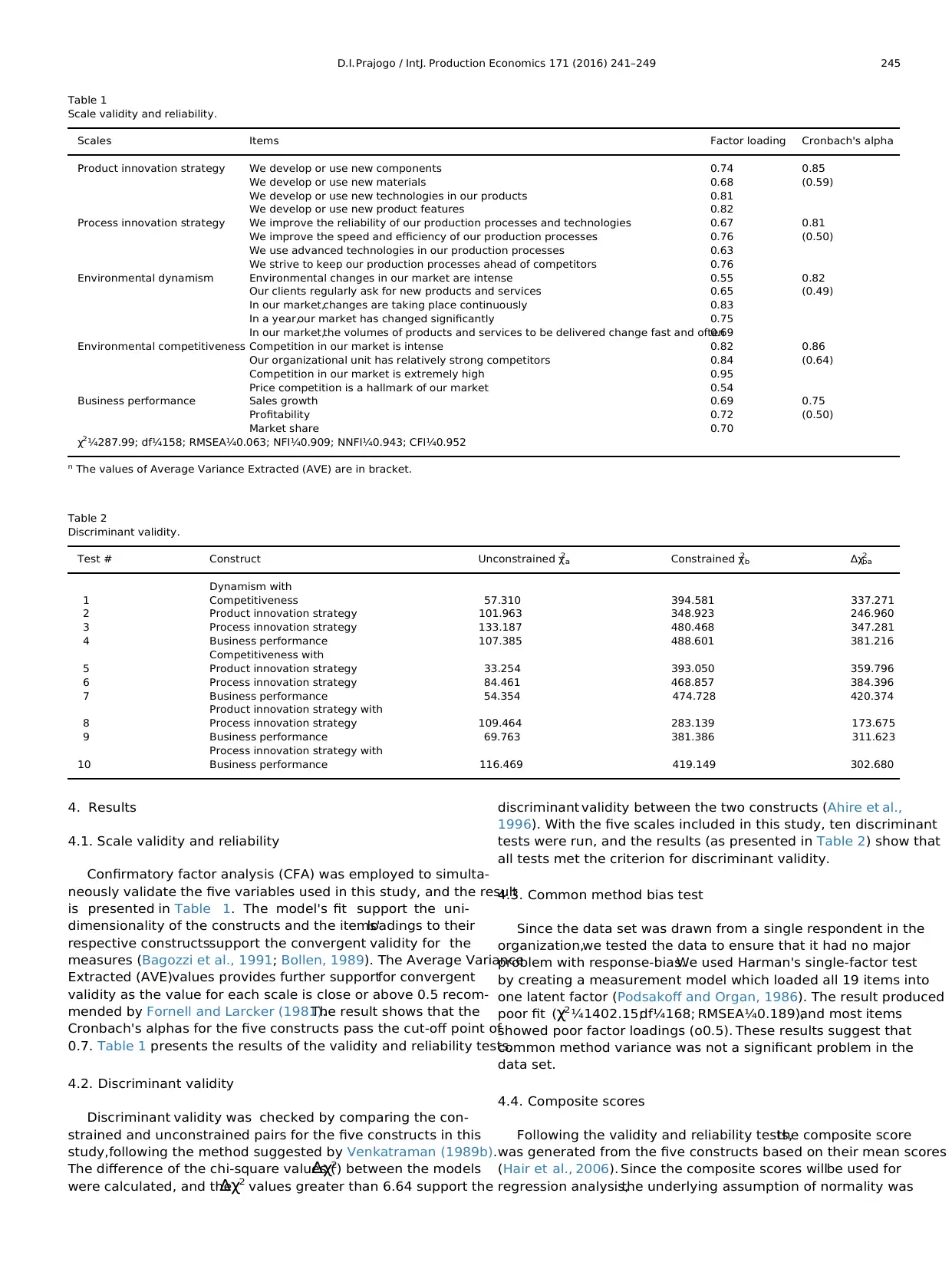
Confirmatory factor analysis (CFA) was employed to simulta-
neously validate the five variables used in this study, and the result
is presented in Table 1. The model's fit support the uni-
dimensionality of the constructs and the items'loadings to their
respective constructssupport the convergent validity for the
measures (Bagozzi et al., 1991; Bollen, 1989). The Average Variance
Extracted (AVE)values provides further supportfor convergent
validity as the value for each scale is close or above 0.5 recom-
mended by Fornell and Larcker (1981).The result shows that the
Cronbach's alphas for the five constructs pass the cut-off point of
0.7. Table 1 presents the results of the validity and reliability tests.
4.2. Discriminant validity
Discriminant validity was checked by comparing the con-
strained and unconstrained pairs for the five constructs in this
study,following the method suggested by Venkatraman (1989b).
The difference of the chi-square values (Δχ2
) between the models
were calculated, and theΔχ2 values greater than 6.64 support the
discriminant validity between the two constructs (Ahire et al.,
1996). With the five scales included in this study, ten discriminant
tests were run, and the results (as presented in Table 2) show that
all tests met the criterion for discriminant validity.
4.3. Common method bias test
Since the data set was drawn from a single respondent in the
organization,we tested the data to ensure that it had no major
problem with response-bias.We used Harman's single-factor test
by creating a measurement model which loaded all 19 items into
one latent factor (Podsakoff and Organ, 1986). The result produced
poor fit (χ2 ¼1402.15;df¼168; RMSEA¼0.189),and most items
showed poor factor loadings (o0.5). These results suggest that
common method variance was not a significant problem in the
data set.
4.4. Composite scores
Following the validity and reliability tests,the composite score
was generated from the five constructs based on their mean scores
(Hair et al., 2006). Since the composite scores willbe used for
regression analysis,the underlying assumption of normality was
Table 1
Scale validity and reliability.
Scales Items Factor loading Cronbach's alpha
Product innovation strategy We develop or use new components 0.74 0.85
We develop or use new materials 0.68 (0.59)
We develop or use new technologies in our products 0.81
We develop or use new product features 0.82
Process innovation strategy We improve the reliability of our production processes and technologies 0.67 0.81
We improve the speed and efficiency of our production processes 0.76 (0.50)
We use advanced technologies in our production processes 0.63
We strive to keep our production processes ahead of competitors 0.76
Environmental dynamism Environmental changes in our market are intense 0.55 0.82
Our clients regularly ask for new products and services 0.65 (0.49)
In our market,changes are taking place continuously 0.83
In a year,our market has changed significantly 0.75
In our market,the volumes of products and services to be delivered change fast and often0.69
Environmental competitiveness Competition in our market is intense 0.82 0.86
Our organizational unit has relatively strong competitors 0.84 (0.64)
Competition in our market is extremely high 0.95
Price competition is a hallmark of our market 0.54
Business performance Sales growth 0.69 0.75
Profitability 0.72 (0.50)
Market share 0.70
χ2 ¼287.99; df¼158; RMSEA¼0.063; NFI¼0.909; NNFI¼0.943; CFI¼0.952
n The values of Average Variance Extracted (AVE) are in bracket.
Table 2
Discriminant validity.
Test # Construct Unconstrained χ2a Constrained χ2b Δχ2
ba
Dynamism with
1 Competitiveness 57.310 394.581 337.271
2 Product innovation strategy 101.963 348.923 246.960
3 Process innovation strategy 133.187 480.468 347.281
4 Business performance 107.385 488.601 381.216
Competitiveness with
5 Product innovation strategy 33.254 393.050 359.796
6 Process innovation strategy 84.461 468.857 384.396
7 Business performance 54.354 474.728 420.374
Product innovation strategy with
8 Process innovation strategy 109.464 283.139 173.675
9 Business performance 69.763 381.386 311.623
Process innovation strategy with
10 Business performance 116.469 419.149 302.680
D.I.Prajogo / Int.J. Production Economics 171 (2016) 241–249 245
4.1. Scale validity and reliability
Confirmatory factor analysis (CFA) was employed to simulta-
neously validate the five variables used in this study, and the result
is presented in Table 1. The model's fit support the uni-
dimensionality of the constructs and the items'loadings to their
respective constructssupport the convergent validity for the
measures (Bagozzi et al., 1991; Bollen, 1989). The Average Variance
Extracted (AVE)values provides further supportfor convergent
validity as the value for each scale is close or above 0.5 recom-
mended by Fornell and Larcker (1981).The result shows that the
Cronbach's alphas for the five constructs pass the cut-off point of
0.7. Table 1 presents the results of the validity and reliability tests.
4.2. Discriminant validity
Discriminant validity was checked by comparing the con-
strained and unconstrained pairs for the five constructs in this
study,following the method suggested by Venkatraman (1989b).
The difference of the chi-square values (Δχ2
) between the models
were calculated, and theΔχ2 values greater than 6.64 support the
discriminant validity between the two constructs (Ahire et al.,
1996). With the five scales included in this study, ten discriminant
tests were run, and the results (as presented in Table 2) show that
all tests met the criterion for discriminant validity.
4.3. Common method bias test
Since the data set was drawn from a single respondent in the
organization,we tested the data to ensure that it had no major
problem with response-bias.We used Harman's single-factor test
by creating a measurement model which loaded all 19 items into
one latent factor (Podsakoff and Organ, 1986). The result produced
poor fit (χ2 ¼1402.15;df¼168; RMSEA¼0.189),and most items
showed poor factor loadings (o0.5). These results suggest that
common method variance was not a significant problem in the
data set.
4.4. Composite scores
Following the validity and reliability tests,the composite score
was generated from the five constructs based on their mean scores
(Hair et al., 2006). Since the composite scores willbe used for
regression analysis,the underlying assumption of normality was
Table 1
Scale validity and reliability.
Scales Items Factor loading Cronbach's alpha
Product innovation strategy We develop or use new components 0.74 0.85
We develop or use new materials 0.68 (0.59)
We develop or use new technologies in our products 0.81
We develop or use new product features 0.82
Process innovation strategy We improve the reliability of our production processes and technologies 0.67 0.81
We improve the speed and efficiency of our production processes 0.76 (0.50)
We use advanced technologies in our production processes 0.63
We strive to keep our production processes ahead of competitors 0.76
Environmental dynamism Environmental changes in our market are intense 0.55 0.82
Our clients regularly ask for new products and services 0.65 (0.49)
In our market,changes are taking place continuously 0.83
In a year,our market has changed significantly 0.75
In our market,the volumes of products and services to be delivered change fast and often0.69
Environmental competitiveness Competition in our market is intense 0.82 0.86
Our organizational unit has relatively strong competitors 0.84 (0.64)
Competition in our market is extremely high 0.95
Price competition is a hallmark of our market 0.54
Business performance Sales growth 0.69 0.75
Profitability 0.72 (0.50)
Market share 0.70
χ2 ¼287.99; df¼158; RMSEA¼0.063; NFI¼0.909; NNFI¼0.943; CFI¼0.952
n The values of Average Variance Extracted (AVE) are in bracket.
Table 2
Discriminant validity.
Test # Construct Unconstrained χ2a Constrained χ2b Δχ2
ba
Dynamism with
1 Competitiveness 57.310 394.581 337.271
2 Product innovation strategy 101.963 348.923 246.960
3 Process innovation strategy 133.187 480.468 347.281
4 Business performance 107.385 488.601 381.216
Competitiveness with
5 Product innovation strategy 33.254 393.050 359.796
6 Process innovation strategy 84.461 468.857 384.396
7 Business performance 54.354 474.728 420.374
Product innovation strategy with
8 Process innovation strategy 109.464 283.139 173.675
9 Business performance 69.763 381.386 311.623
Process innovation strategy with
10 Business performance 116.469 419.149 302.680
D.I.Prajogo / Int.J. Production Economics 171 (2016) 241–249 245
checked based on their skewness and kurtosis,and the results
show that the values fallwithin the acceptable range (71 and
o7, respectively) recommended by Curran et al.(1996).
4.5. Bivariate correlations
Pearson's zero order bivariate correlations are performed as a
preliminary analysis on the relationship among the variables in
this study,and the results are presented in Table 3.Most coeffi-
cient correlations (r) reflect low to medium values; thus,do not
raise major concern on the potential multicollinearity among these
variables.
Both dynamism and competitiveness show positive correla-
tions with both product and process innovation although the
correlation coefficients(r) and the significance level (p-value)
indicate slight differences as dynamism shows a relatively stronger
correlation with product innovation, while competitiveness shows
a relatively stronger correlation with process innovation.
4.6. Hierarchical moderated regression analysis
A hierarchical moderated regression analysis was run to test the
hypotheses,following Venkatraman's (1989a) suggestion that this
method is suitable if the model specifies thatthe performance
outcome (businessperformance)is jointly determined by the
interaction ofthe predictor (innovation strategies) and the mod-
erator (business environment).The result is presented in Table 4.
For the baseline model,both product and process innovation show
a positive effect on business performance (β¼0.23 at po0.01;
β¼0.20 at po0.01 respectively). These findings support H1 and H2.
The moderating effects of environmental dynamism and com-
petitiveness on productand process innovation were tested by
creating the product terms between these variables using their
standardized scores. The findings show that environmental
dynamism strengthens the relationship between product innova-
tion and business performance (β¼0.18 at po0.05),but the same
is not applied to process innovation (β¼ 0.07 at p40.05).
Therefore,H3 is supported, but H4 is not supported.Environ-
mental competitiveness,on the other hand, weakens the rela-
tionship between product innovation and business performance
(β¼ 0.24 at po0.01), but strengthens the relationship between
process innovation and business performance (β¼0.23 at
po0.01). Therefore,both H5 and H6 are supported.The results of
collinearity diagonistic test on the regression model show that the
Variance Inflation Factor (VIF) values range between 1.06 and 2.15
(well below 10); thus,confirming the absence of multicollinearity
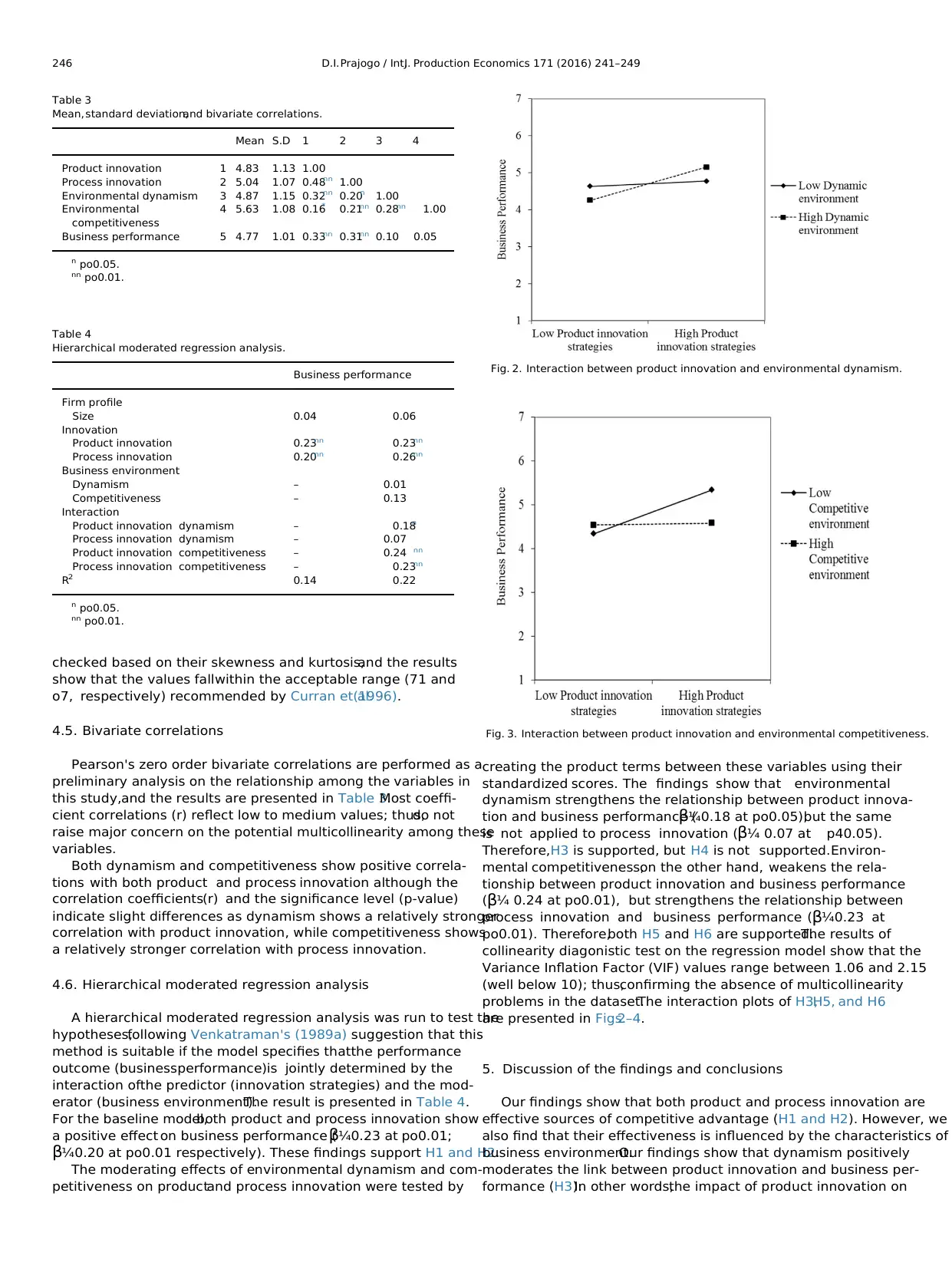
problems in the dataset.The interaction plots of H3,H5, and H6
are presented in Figs.2–4.
5. Discussion of the findings and conclusions
Our findings show that both product and process innovation are
effective sources of competitive advantage (H1 and H2). However, we
also find that their effectiveness is influenced by the characteristics of
business environment.Our findings show that dynamism positively
moderates the link between product innovation and business per-
formance (H3).In other words,the impact of product innovation on
Table 3
Mean,standard deviation,and bivariate correlations.
Mean S.D 1 2 3 4
Product innovation 1 4.83 1.13 1.00
Process innovation 2 5.04 1.07 0.48nn 1.00
Environmental dynamism 3 4.87 1.15 0.32nn 0.20n 1.00
Environmental
competitiveness
4 5.63 1.08 0.16* 0.21nn 0.28nn 1.00
Business performance 5 4.77 1.01 0.33nn 0.31nn 0.10 0.05
n po0.05.
nn po0.01.
Table 4
Hierarchical moderated regression analysis.
Business performance
Firm profile
Size 0.04 0.06
Innovation
Product innovation 0.23nn 0.23nn
Process innovation 0.20nn 0.26nn
Business environment
Dynamism – 0.01
Competitiveness – 0.13
Interaction
Product innovation dynamism – 0.18n
Process innovation dynamism – 0.07
Product innovation competitiveness – 0.24 nn
Process innovation competitiveness – 0.23nn
R2 0.14 0.22
n po0.05.
nn po0.01.
Fig. 2. Interaction between product innovation and environmental dynamism.
Fig. 3. Interaction between product innovation and environmental competitiveness.
D.I.Prajogo / Int.J. Production Economics 171 (2016) 241–249246
show that the values fallwithin the acceptable range (71 and
o7, respectively) recommended by Curran et al.(1996).
4.5. Bivariate correlations
Pearson's zero order bivariate correlations are performed as a
preliminary analysis on the relationship among the variables in
this study,and the results are presented in Table 3.Most coeffi-
cient correlations (r) reflect low to medium values; thus,do not
raise major concern on the potential multicollinearity among these
variables.
Both dynamism and competitiveness show positive correla-
tions with both product and process innovation although the
correlation coefficients(r) and the significance level (p-value)
indicate slight differences as dynamism shows a relatively stronger
correlation with product innovation, while competitiveness shows
a relatively stronger correlation with process innovation.
4.6. Hierarchical moderated regression analysis
A hierarchical moderated regression analysis was run to test the
hypotheses,following Venkatraman's (1989a) suggestion that this
method is suitable if the model specifies thatthe performance
outcome (businessperformance)is jointly determined by the
interaction ofthe predictor (innovation strategies) and the mod-
erator (business environment).The result is presented in Table 4.
For the baseline model,both product and process innovation show
a positive effect on business performance (β¼0.23 at po0.01;
β¼0.20 at po0.01 respectively). These findings support H1 and H2.
The moderating effects of environmental dynamism and com-
petitiveness on productand process innovation were tested by
creating the product terms between these variables using their
standardized scores. The findings show that environmental
dynamism strengthens the relationship between product innova-
tion and business performance (β¼0.18 at po0.05),but the same
is not applied to process innovation (β¼ 0.07 at p40.05).
Therefore,H3 is supported, but H4 is not supported.Environ-
mental competitiveness,on the other hand, weakens the rela-
tionship between product innovation and business performance
(β¼ 0.24 at po0.01), but strengthens the relationship between
process innovation and business performance (β¼0.23 at
po0.01). Therefore,both H5 and H6 are supported.The results of
collinearity diagonistic test on the regression model show that the
Variance Inflation Factor (VIF) values range between 1.06 and 2.15
(well below 10); thus,confirming the absence of multicollinearity
problems in the dataset.The interaction plots of H3,H5, and H6
are presented in Figs.2–4.
5. Discussion of the findings and conclusions
Our findings show that both product and process innovation are
effective sources of competitive advantage (H1 and H2). However, we
also find that their effectiveness is influenced by the characteristics of
business environment.Our findings show that dynamism positively
moderates the link between product innovation and business per-
formance (H3).In other words,the impact of product innovation on
Table 3
Mean,standard deviation,and bivariate correlations.
Mean S.D 1 2 3 4
Product innovation 1 4.83 1.13 1.00
Process innovation 2 5.04 1.07 0.48nn 1.00
Environmental dynamism 3 4.87 1.15 0.32nn 0.20n 1.00
Environmental
competitiveness
4 5.63 1.08 0.16* 0.21nn 0.28nn 1.00
Business performance 5 4.77 1.01 0.33nn 0.31nn 0.10 0.05
n po0.05.
nn po0.01.
Table 4
Hierarchical moderated regression analysis.
Business performance
Firm profile
Size 0.04 0.06
Innovation
Product innovation 0.23nn 0.23nn
Process innovation 0.20nn 0.26nn
Business environment
Dynamism – 0.01
Competitiveness – 0.13
Interaction
Product innovation dynamism – 0.18n
Process innovation dynamism – 0.07
Product innovation competitiveness – 0.24 nn
Process innovation competitiveness – 0.23nn
R2 0.14 0.22
n po0.05.
nn po0.01.
Fig. 2. Interaction between product innovation and environmental dynamism.
Fig. 3. Interaction between product innovation and environmental competitiveness.
D.I.Prajogo / Int.J. Production Economics 171 (2016) 241–249246
⊘ This is a preview!⊘
Do you want full access?
Subscribe today to unlock all pages.
Trusted by 1+ million students worldwide
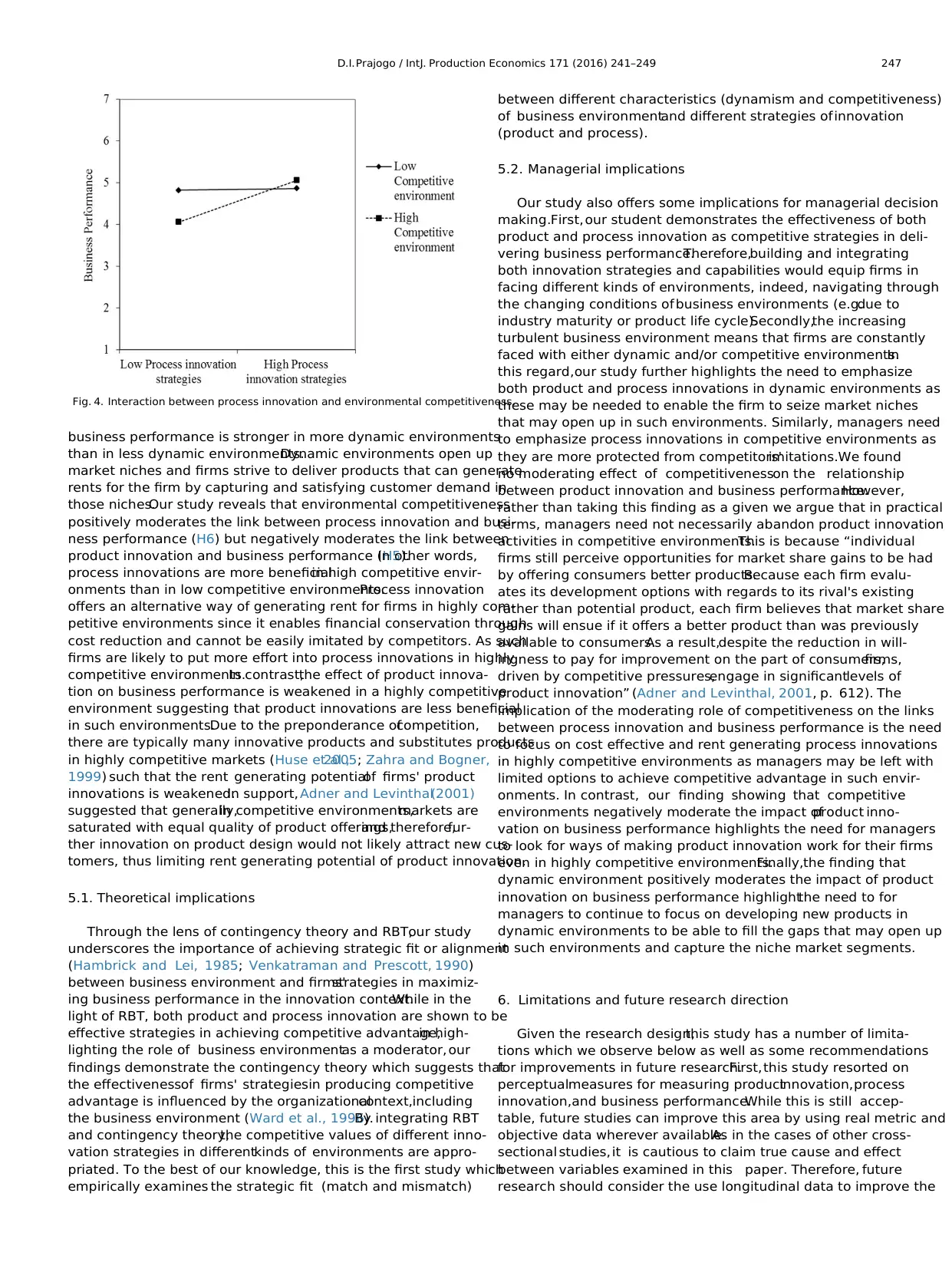
business performance is stronger in more dynamic environments
than in less dynamic environments.Dynamic environments open up
market niches and firms strive to deliver products that can generate
rents for the firm by capturing and satisfying customer demand in
those niches.Our study reveals that environmental competitiveness
positively moderates the link between process innovation and busi-
ness performance (H6) but negatively moderates the link between
product innovation and business performance (H5).In other words,
process innovations are more beneficialin high competitive envir-
onments than in low competitive environments.Process innovation
offers an alternative way of generating rent for firms in highly com-
petitive environments since it enables financial conservation through
cost reduction and cannot be easily imitated by competitors. As such
firms are likely to put more effort into process innovations in highly
competitive environments.In contrast,the effect of product innova-
tion on business performance is weakened in a highly competitive
environment suggesting that product innovations are less beneficial
in such environments.Due to the preponderance ofcompetition,
there are typically many innovative products and substitutes products
in highly competitive markets (Huse et al.,2005; Zahra and Bogner,
1999) such that the rent generating potentialof firms' product
innovations is weakened.In support, Adner and Levinthal(2001)
suggested that generally,in competitive environments,markets are
saturated with equal quality of product offerings,and therefore,fur-
ther innovation on product design would not likely attract new cus-
tomers, thus limiting rent generating potential of product innovation.
5.1. Theoretical implications
Through the lens of contingency theory and RBT,our study
underscores the importance of achieving strategic fit or alignment
(Hambrick and Lei, 1985; Venkatraman and Prescott, 1990)
between business environment and firms'strategies in maximiz-
ing business performance in the innovation context.While in the
light of RBT, both product and process innovation are shown to be
effective strategies in achieving competitive advantage,in high-
lighting the role of business environmentas a moderator, our
findings demonstrate the contingency theory which suggests that
the effectivenessof firms' strategiesin producing competitive
advantage is influenced by the organizationalcontext,including
the business environment (Ward et al., 1996).By integrating RBT
and contingency theory,the competitive values of different inno-
vation strategies in differentkinds of environments are appro-
priated. To the best of our knowledge, this is the first study which
empirically examines the strategic fit (match and mismatch)
between different characteristics (dynamism and competitiveness)
of business environmentand different strategies ofinnovation
(product and process).
5.2. Managerial implications
Our study also offers some implications for managerial decision
making.First, our student demonstrates the effectiveness of both
product and process innovation as competitive strategies in deli-
vering business performance.Therefore,building and integrating
both innovation strategies and capabilities would equip firms in
facing different kinds of environments, indeed, navigating through
the changing conditions of business environments (e.g.due to
industry maturity or product life cycle).Secondly,the increasing
turbulent business environment means that firms are constantly
faced with either dynamic and/or competitive environments.In
this regard,our study further highlights the need to emphasize
both product and process innovations in dynamic environments as
these may be needed to enable the firm to seize market niches
that may open up in such environments. Similarly, managers need
to emphasize process innovations in competitive environments as
they are more protected from competitors'imitations.We found
no moderating effect of competitivenesson the relationship
between product innovation and business performance.However,
rather than taking this finding as a given we argue that in practical
terms, managers need not necessarily abandon product innovation
activities in competitive environments.This is because “individual
firms still perceive opportunities for market share gains to be had
by offering consumers better products.Because each firm evalu-
ates its development options with regards to its rival's existing
rather than potential product, each firm believes that market share
gains will ensue if it offers a better product than was previously
available to consumers.As a result,despite the reduction in will-
ingness to pay for improvement on the part of consumers,firms,
driven by competitive pressures,engage in significantlevels of
product innovation” (Adner and Levinthal, 2001, p. 612). The
implication of the moderating role of competitiveness on the links
between process innovation and business performance is the need
to focus on cost effective and rent generating process innovations
in highly competitive environments as managers may be left with
limited options to achieve competitive advantage in such envir-
onments. In contrast, our finding showing that competitive
environments negatively moderate the impact ofproduct inno-
vation on business performance highlights the need for managers
to look for ways of making product innovation work for their firms
even in highly competitive environments.Finally,the finding that
dynamic environment positively moderates the impact of product
innovation on business performance highlightthe need to for
managers to continue to focus on developing new products in
dynamic environments to be able to fill the gaps that may open up
in such environments and capture the niche market segments.
6. Limitations and future research direction
Given the research design,this study has a number of limita-
tions which we observe below as well as some recommendations
for improvements in future research.First,this study resorted on
perceptualmeasures for measuring productinnovation,process
innovation,and business performance.While this is still accep-
table, future studies can improve this area by using real metric and
objective data wherever available.As in the cases of other cross-
sectional studies, it is cautious to claim true cause and effect
between variables examined in this paper. Therefore, future
research should consider the use longitudinal data to improve the
Fig. 4. Interaction between process innovation and environmental competitiveness.
D.I.Prajogo / Int.J. Production Economics 171 (2016) 241–249 247
than in less dynamic environments.Dynamic environments open up
market niches and firms strive to deliver products that can generate
rents for the firm by capturing and satisfying customer demand in
those niches.Our study reveals that environmental competitiveness
positively moderates the link between process innovation and busi-
ness performance (H6) but negatively moderates the link between
product innovation and business performance (H5).In other words,
process innovations are more beneficialin high competitive envir-
onments than in low competitive environments.Process innovation
offers an alternative way of generating rent for firms in highly com-
petitive environments since it enables financial conservation through
cost reduction and cannot be easily imitated by competitors. As such
firms are likely to put more effort into process innovations in highly
competitive environments.In contrast,the effect of product innova-
tion on business performance is weakened in a highly competitive
environment suggesting that product innovations are less beneficial
in such environments.Due to the preponderance ofcompetition,
there are typically many innovative products and substitutes products
in highly competitive markets (Huse et al.,2005; Zahra and Bogner,
1999) such that the rent generating potentialof firms' product
innovations is weakened.In support, Adner and Levinthal(2001)
suggested that generally,in competitive environments,markets are
saturated with equal quality of product offerings,and therefore,fur-
ther innovation on product design would not likely attract new cus-
tomers, thus limiting rent generating potential of product innovation.
5.1. Theoretical implications
Through the lens of contingency theory and RBT,our study
underscores the importance of achieving strategic fit or alignment
(Hambrick and Lei, 1985; Venkatraman and Prescott, 1990)
between business environment and firms'strategies in maximiz-
ing business performance in the innovation context.While in the
light of RBT, both product and process innovation are shown to be
effective strategies in achieving competitive advantage,in high-
lighting the role of business environmentas a moderator, our
findings demonstrate the contingency theory which suggests that
the effectivenessof firms' strategiesin producing competitive
advantage is influenced by the organizationalcontext,including
the business environment (Ward et al., 1996).By integrating RBT
and contingency theory,the competitive values of different inno-
vation strategies in differentkinds of environments are appro-
priated. To the best of our knowledge, this is the first study which
empirically examines the strategic fit (match and mismatch)
between different characteristics (dynamism and competitiveness)
of business environmentand different strategies ofinnovation
(product and process).
5.2. Managerial implications
Our study also offers some implications for managerial decision
making.First, our student demonstrates the effectiveness of both
product and process innovation as competitive strategies in deli-
vering business performance.Therefore,building and integrating
both innovation strategies and capabilities would equip firms in
facing different kinds of environments, indeed, navigating through
the changing conditions of business environments (e.g.due to
industry maturity or product life cycle).Secondly,the increasing
turbulent business environment means that firms are constantly
faced with either dynamic and/or competitive environments.In
this regard,our study further highlights the need to emphasize
both product and process innovations in dynamic environments as
these may be needed to enable the firm to seize market niches
that may open up in such environments. Similarly, managers need
to emphasize process innovations in competitive environments as
they are more protected from competitors'imitations.We found
no moderating effect of competitivenesson the relationship
between product innovation and business performance.However,
rather than taking this finding as a given we argue that in practical
terms, managers need not necessarily abandon product innovation
activities in competitive environments.This is because “individual
firms still perceive opportunities for market share gains to be had
by offering consumers better products.Because each firm evalu-
ates its development options with regards to its rival's existing
rather than potential product, each firm believes that market share
gains will ensue if it offers a better product than was previously
available to consumers.As a result,despite the reduction in will-
ingness to pay for improvement on the part of consumers,firms,
driven by competitive pressures,engage in significantlevels of
product innovation” (Adner and Levinthal, 2001, p. 612). The
implication of the moderating role of competitiveness on the links
between process innovation and business performance is the need
to focus on cost effective and rent generating process innovations
in highly competitive environments as managers may be left with
limited options to achieve competitive advantage in such envir-
onments. In contrast, our finding showing that competitive
environments negatively moderate the impact ofproduct inno-
vation on business performance highlights the need for managers
to look for ways of making product innovation work for their firms
even in highly competitive environments.Finally,the finding that
dynamic environment positively moderates the impact of product
innovation on business performance highlightthe need to for
managers to continue to focus on developing new products in
dynamic environments to be able to fill the gaps that may open up
in such environments and capture the niche market segments.
6. Limitations and future research direction
Given the research design,this study has a number of limita-
tions which we observe below as well as some recommendations
for improvements in future research.First,this study resorted on
perceptualmeasures for measuring productinnovation,process
innovation,and business performance.While this is still accep-
table, future studies can improve this area by using real metric and
objective data wherever available.As in the cases of other cross-
sectional studies, it is cautious to claim true cause and effect
between variables examined in this paper. Therefore, future
research should consider the use longitudinal data to improve the
Fig. 4. Interaction between process innovation and environmental competitiveness.
D.I.Prajogo / Int.J. Production Economics 171 (2016) 241–249 247
Paraphrase This Document
Need a fresh take? Get an instant paraphrase of this document with our AI Paraphraser
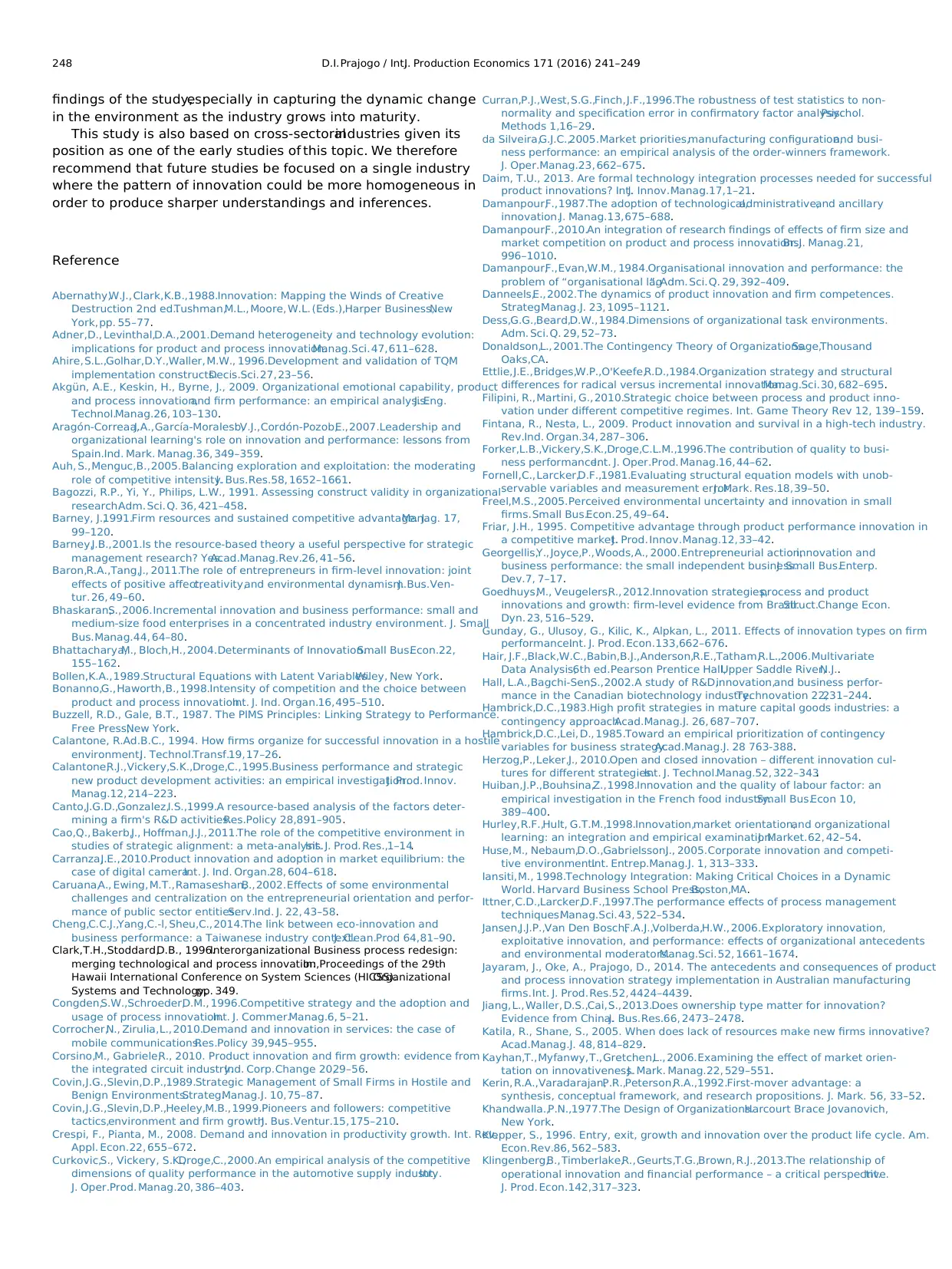
findings of the study,especially in capturing the dynamic change
in the environment as the industry grows into maturity.
This study is also based on cross-sectoralindustries given its
position as one of the early studies of this topic. We therefore
recommend that future studies be focused on a single industry
where the pattern of innovation could be more homogeneous in
order to produce sharper understandings and inferences.
Reference
Abernathy,W.J.,Clark,K.B.,1988.Innovation: Mapping the Winds of Creative
Destruction 2nd ed..Tushman,M.L.,Moore, W.L. (Eds.),Harper Business,New
York,pp. 55–77.
Adner,D., Levinthal,D.A.,2001.Demand heterogeneity and technology evolution:
implications for product and process innovation.Manag.Sci.47,611–628.
Ahire,S.L.,Golhar,D.Y.,Waller,M.W., 1996.Development and validation of TQM
implementation constructs.Decis.Sci.27,23–56.
Akgün, A.E., Keskin, H., Byrne, J., 2009. Organizational emotional capability, product
and process innovation,and firm performance: an empirical analysis.J. Eng.
Technol.Manag.26, 103–130.
Aragón-Correaa,J.A.,García-Moralesb,V.J.,Cordón-Pozob,E.,2007.Leadership and
organizational learning's role on innovation and performance: lessons from
Spain.Ind. Mark. Manag.36, 349–359.
Auh, S.,Menguc,B.,2005.Balancing exploration and exploitation: the moderating
role of competitive intensity.J. Bus.Res.58, 1652–1661.
Bagozzi, R.P., Yi, Y., Philips, L.W., 1991. Assessing construct validity in organizational
research.Adm. Sci.Q. 36, 421–458.
Barney, J.,1991.Firm resources and sustained competitive advantage. J.Manag. 17,
99–120.
Barney,J.B.,2001.Is the resource-based theory a useful perspective for strategic
management research? Yes.Acad.Manag.Rev.26, 41–56.
Baron,R.A.,Tang,J., 2011.The role of entrepreneurs in firm-level innovation: joint
effects of positive affect,creativity,and environmental dynamism.J. Bus.Ven-
tur. 26, 49–60.
Bhaskaran,S.,2006.Incremental innovation and business performance: small and
medium-size food enterprises in a concentrated industry environment. J. Small
Bus.Manag.44, 64–80.
Bhattacharya,M., Bloch,H., 2004.Determinants of Innovation.Small Bus.Econ.22,
155–162.
Bollen,K.A.,1989.Structural Equations with Latent Variables.Wiley, New York.
Bonanno,G.,Haworth,B.,1998.Intensity of competition and the choice between
product and process innovation.Int. J. Ind. Organ.16,495–510.
Buzzell, R.D., Gale, B.T., 1987. The PIMS Principles: Linking Strategy to Performance.
Free Press,New York.
Calantone, R.Ad.B.C., 1994. How firms organize for successful innovation in a hostile
environment.J. Technol.Transf.19,17–26.
Calantone,R.J.,Vickery,S.K.,Droge,C.,1995.Business performance and strategic
new product development activities: an empirical investigation.J. Prod.Innov.
Manag.12,214–223.
Canto,J.G.D.,Gonzalez,I.S.,1999.A resource-based analysis of the factors deter-
mining a firm's R&D activities.Res.Policy 28,891–905.
Cao,Q.,Bakerb,J., Hoffman,J.J., 2011.The role of the competitive environment in
studies of strategic alignment: a meta-analysis.Int. J. Prod. Res.,1–14.
Carranza,J.E.,2010.Product innovation and adoption in market equilibrium: the
case of digital camera.Int. J. Ind. Organ.28, 604–618.
Caruana,A., Ewing,M.T.,Ramaseshan,B.,2002.Effects of some environmental
challenges and centralization on the entrepreneurial orientation and perfor-
mance of public sector entities.Serv.Ind. J. 22, 43–58.
Cheng,C.C.J.,Yang,C.-l, Sheu,C.,2014.The link between eco-innovation and
business performance: a Taiwanese industry context.J. Clean.Prod 64,81–90.
Clark,T.H.,Stoddard,D.B., 1996.Interorganizational Business process redesign:
merging technological and process innovation,In: Proceedings of the 29th
Hawaii International Conference on System Sciences (HICSS).Organizational
Systems and Technology,pp. 349.
Congden,S.W.,Schroeder,D.M., 1996.Competitive strategy and the adoption and
usage of process innovation.Int. J. Commer.Manag.6, 5–21.
Corrocher,N., Zirulia,L.,2010.Demand and innovation in services: the case of
mobile communications.Res.Policy 39,945–955.
Corsino,M., Gabriele,R., 2010. Product innovation and firm growth: evidence from
the integrated circuit industry.Ind. Corp.Change 20,29–56.
Covin,J.G.,Slevin,D.P.,1989.Strategic Management of Small Firms in Hostile and
Benign Environments.Strateg.Manag.J. 10,75–87.
Covin,J.G.,Slevin,D.P.,Heeley,M.B.,1999.Pioneers and followers: competitive
tactics,environment and firm growth.J. Bus.Ventur.15,175–210.
Crespi, F., Pianta, M., 2008. Demand and innovation in productivity growth. Int. Rev.
Appl. Econ.22, 655–672.
Curkovic,S., Vickery, S.K.,Droge,C.,2000.An empirical analysis of the competitive
dimensions of quality performance in the automotive supply industry.Int.
J. Oper.Prod. Manag.20, 386–403.
Curran,P.J.,West,S.G.,Finch,J.F.,1996.The robustness of test statistics to non-
normality and specification error in confirmatory factor analysis.Psychol.
Methods 1,16–29.
da Silveira,G.J.C.,2005.Market priorities,manufacturing configuration,and busi-
ness performance: an empirical analysis of the order-winners framework.
J. Oper.Manag.23, 662–675.
Daim, T.U., 2013. Are formal technology integration processes needed for successful
product innovations? Int.J. Innov.Manag.17,1–21.
Damanpour,F.,1987.The adoption of technological,administrative,and ancillary
innovation.J. Manag.13,675–688.
Damanpour,F.,2010.An integration of research findings of effects of firm size and
market competition on product and process innovations.Br.J. Manag.21,
996–1010.
Damanpour,F.,Evan,W.M., 1984.Organisational innovation and performance: the
problem of “organisational lag”. Adm. Sci.Q. 29, 392–409.
Danneels,E.,2002.The dynamics of product innovation and firm competences.
Strateg.Manag.J. 23, 1095–1121.
Dess,G.G.,Beard,D.W.,1984.Dimensions of organizational task environments.
Adm. Sci.Q. 29, 52–73.
Donaldson,L., 2001.The Contingency Theory of Organizations.Sage,Thousand
Oaks,CA.
Ettlie,J.E.,Bridges,W.P.,O'Keefe,R.D.,1984.Organization strategy and structural
differences for radical versus incremental innovation.Manag.Sci.30,682–695.
Filipini, R.,Martini, G.,2010.Strategic choice between process and product inno-
vation under different competitive regimes. Int. Game Theory Rev 12, 139–159.
Fintana, R., Nesta, L., 2009. Product innovation and survival in a high-tech industry.
Rev.Ind. Organ.34, 287–306.
Forker,L.B.,Vickery,S.K.,Droge,C.L.M.,1996.The contribution of quality to busi-
ness performance.Int. J. Oper.Prod. Manag.16,44–62.
Fornell,C.,Larcker,D.F.,1981.Evaluating structural equation models with unob-
servable variables and measurement error.J. Mark. Res.18,39–50.
Freel,M.S.,2005.Perceived environmental uncertainty and innovation in small
firms.Small Bus.Econ.25, 49–64.
Friar, J.H., 1995. Competitive advantage through product performance innovation in
a competitive market.J. Prod. Innov.Manag.12,33–42.
Georgellis,Y.,Joyce,P.,Woods,A., 2000.Entrepreneurial action,innovation and
business performance: the small independent business.J. Small Bus.Enterp.
Dev.7, 7–17.
Goedhuys,M., Veugelers,R., 2012.Innovation strategies,process and product
innovations and growth: firm-level evidence from Brazil.Struct.Change Econ.
Dyn. 23, 516–529.
Gunday, G., Ulusoy, G., Kilic, K., Alpkan, L., 2011. Effects of innovation types on firm
performance.Int. J. Prod. Econ.133,662–676.
Hair, J.F.,Black,W.C.,Babin,B.J.,Anderson,R.E.,Tatham,R.L.,2006.Multivariate
Data Analysis,6th ed.Pearson Prentice Hall,Upper Saddle River,N.J..
Hall, L.A.,Bagchi-Sen,S.,2002.A study of R&D,innovation,and business perfor-
mance in the Canadian biotechnology industry.Technovation 22,231–244.
Hambrick,D.C.,1983.High profit strategies in mature capital goods industries: a
contingency approach.Acad.Manag.J. 26, 687–707.
Hambrick,D.C.,Lei, D., 1985.Toward an empirical prioritization of contingency
variables for business strategy.Acad.Manag.J. 28 763-388.
Herzog,P.,Leker,J., 2010.Open and closed innovation – different innovation cul-
tures for different strategies.Int. J. Technol.Manag.52, 322–343.
Huiban,J.P.,Bouhsina,Z.,1998.Innovation and the quality of labour factor: an
empirical investigation in the French food industry.Small Bus.Econ 10,
389–400.
Hurley,R.F.,Hult, G.T.M.,1998.Innovation,market orientation,and organizational
learning: an integration and empirical examination.J. Market.62, 42–54.
Huse,M., Nebaum,D.O.,Gabrielsson,J., 2005.Corporate innovation and competi-
tive environment.Int. Entrep.Manag.J. 1, 313–333.
Iansiti,M., 1998.Technology Integration: Making Critical Choices in a Dynamic
World. Harvard Business School Press,Boston,MA.
Ittner,C.D.,Larcker,D.F.,1997.The performance effects of process management
techniques.Manag.Sci.43, 522–534.
Jansen,J.J.P.,Van Den Bosch,F.A.J.,Volberda,H.W., 2006.Exploratory innovation,
exploitative innovation, and performance: effects of organizational antecedents
and environmental moderators.Manag.Sci.52, 1661–1674.
Jayaram, J., Oke, A., Prajogo, D., 2014. The antecedents and consequences of product
and process innovation strategy implementation in Australian manufacturing
firms.Int. J. Prod.Res.52, 4424–4439.
Jiang,L.,Waller,D.S.,Cai,S.,2013.Does ownership type matter for innovation?
Evidence from China.J. Bus.Res.66, 2473–2478.
Katila, R., Shane, S., 2005. When does lack of resources make new firms innovative?
Acad.Manag.J. 48, 814–829.
Kayhan,T.,Myfanwy,T.,Gretchen,L., 2006.Examining the effect of market orien-
tation on innovativeness.J. Mark. Manag.22, 529–551.
Kerin, R.A.,Varadarajan,P.R.,Peterson,R.A.,1992.First-mover advantage: a
synthesis, conceptual framework, and research propositions. J. Mark. 56, 33–52.
Khandwalla.,P.N.,1977.The Design of Organizations.Harcourt Brace Jovanovich,
New York.
Klepper, S., 1996. Entry, exit, growth and innovation over the product life cycle. Am.
Econ.Rev.86, 562–583.
Klingenberg,B.,Timberlake,R.,Geurts,T.G.,Brown,R.J.,2013.The relationship of
operational innovation and financial performance – a critical perspective.Int.
J. Prod. Econ.142,317–323.
D.I.Prajogo / Int.J. Production Economics 171 (2016) 241–249248
in the environment as the industry grows into maturity.
This study is also based on cross-sectoralindustries given its
position as one of the early studies of this topic. We therefore
recommend that future studies be focused on a single industry
where the pattern of innovation could be more homogeneous in
order to produce sharper understandings and inferences.
Reference
Abernathy,W.J.,Clark,K.B.,1988.Innovation: Mapping the Winds of Creative
Destruction 2nd ed..Tushman,M.L.,Moore, W.L. (Eds.),Harper Business,New
York,pp. 55–77.
Adner,D., Levinthal,D.A.,2001.Demand heterogeneity and technology evolution:
implications for product and process innovation.Manag.Sci.47,611–628.
Ahire,S.L.,Golhar,D.Y.,Waller,M.W., 1996.Development and validation of TQM
implementation constructs.Decis.Sci.27,23–56.
Akgün, A.E., Keskin, H., Byrne, J., 2009. Organizational emotional capability, product
and process innovation,and firm performance: an empirical analysis.J. Eng.
Technol.Manag.26, 103–130.
Aragón-Correaa,J.A.,García-Moralesb,V.J.,Cordón-Pozob,E.,2007.Leadership and
organizational learning's role on innovation and performance: lessons from
Spain.Ind. Mark. Manag.36, 349–359.
Auh, S.,Menguc,B.,2005.Balancing exploration and exploitation: the moderating
role of competitive intensity.J. Bus.Res.58, 1652–1661.
Bagozzi, R.P., Yi, Y., Philips, L.W., 1991. Assessing construct validity in organizational
research.Adm. Sci.Q. 36, 421–458.
Barney, J.,1991.Firm resources and sustained competitive advantage. J.Manag. 17,
99–120.
Barney,J.B.,2001.Is the resource-based theory a useful perspective for strategic
management research? Yes.Acad.Manag.Rev.26, 41–56.
Baron,R.A.,Tang,J., 2011.The role of entrepreneurs in firm-level innovation: joint
effects of positive affect,creativity,and environmental dynamism.J. Bus.Ven-
tur. 26, 49–60.
Bhaskaran,S.,2006.Incremental innovation and business performance: small and
medium-size food enterprises in a concentrated industry environment. J. Small
Bus.Manag.44, 64–80.
Bhattacharya,M., Bloch,H., 2004.Determinants of Innovation.Small Bus.Econ.22,
155–162.
Bollen,K.A.,1989.Structural Equations with Latent Variables.Wiley, New York.
Bonanno,G.,Haworth,B.,1998.Intensity of competition and the choice between
product and process innovation.Int. J. Ind. Organ.16,495–510.
Buzzell, R.D., Gale, B.T., 1987. The PIMS Principles: Linking Strategy to Performance.
Free Press,New York.
Calantone, R.Ad.B.C., 1994. How firms organize for successful innovation in a hostile
environment.J. Technol.Transf.19,17–26.
Calantone,R.J.,Vickery,S.K.,Droge,C.,1995.Business performance and strategic
new product development activities: an empirical investigation.J. Prod.Innov.
Manag.12,214–223.
Canto,J.G.D.,Gonzalez,I.S.,1999.A resource-based analysis of the factors deter-
mining a firm's R&D activities.Res.Policy 28,891–905.
Cao,Q.,Bakerb,J., Hoffman,J.J., 2011.The role of the competitive environment in
studies of strategic alignment: a meta-analysis.Int. J. Prod. Res.,1–14.
Carranza,J.E.,2010.Product innovation and adoption in market equilibrium: the
case of digital camera.Int. J. Ind. Organ.28, 604–618.
Caruana,A., Ewing,M.T.,Ramaseshan,B.,2002.Effects of some environmental
challenges and centralization on the entrepreneurial orientation and perfor-
mance of public sector entities.Serv.Ind. J. 22, 43–58.
Cheng,C.C.J.,Yang,C.-l, Sheu,C.,2014.The link between eco-innovation and
business performance: a Taiwanese industry context.J. Clean.Prod 64,81–90.
Clark,T.H.,Stoddard,D.B., 1996.Interorganizational Business process redesign:
merging technological and process innovation,In: Proceedings of the 29th
Hawaii International Conference on System Sciences (HICSS).Organizational
Systems and Technology,pp. 349.
Congden,S.W.,Schroeder,D.M., 1996.Competitive strategy and the adoption and
usage of process innovation.Int. J. Commer.Manag.6, 5–21.
Corrocher,N., Zirulia,L.,2010.Demand and innovation in services: the case of
mobile communications.Res.Policy 39,945–955.
Corsino,M., Gabriele,R., 2010. Product innovation and firm growth: evidence from
the integrated circuit industry.Ind. Corp.Change 20,29–56.
Covin,J.G.,Slevin,D.P.,1989.Strategic Management of Small Firms in Hostile and
Benign Environments.Strateg.Manag.J. 10,75–87.
Covin,J.G.,Slevin,D.P.,Heeley,M.B.,1999.Pioneers and followers: competitive
tactics,environment and firm growth.J. Bus.Ventur.15,175–210.
Crespi, F., Pianta, M., 2008. Demand and innovation in productivity growth. Int. Rev.
Appl. Econ.22, 655–672.
Curkovic,S., Vickery, S.K.,Droge,C.,2000.An empirical analysis of the competitive
dimensions of quality performance in the automotive supply industry.Int.
J. Oper.Prod. Manag.20, 386–403.
Curran,P.J.,West,S.G.,Finch,J.F.,1996.The robustness of test statistics to non-
normality and specification error in confirmatory factor analysis.Psychol.
Methods 1,16–29.
da Silveira,G.J.C.,2005.Market priorities,manufacturing configuration,and busi-
ness performance: an empirical analysis of the order-winners framework.
J. Oper.Manag.23, 662–675.
Daim, T.U., 2013. Are formal technology integration processes needed for successful
product innovations? Int.J. Innov.Manag.17,1–21.
Damanpour,F.,1987.The adoption of technological,administrative,and ancillary
innovation.J. Manag.13,675–688.
Damanpour,F.,2010.An integration of research findings of effects of firm size and
market competition on product and process innovations.Br.J. Manag.21,
996–1010.
Damanpour,F.,Evan,W.M., 1984.Organisational innovation and performance: the
problem of “organisational lag”. Adm. Sci.Q. 29, 392–409.
Danneels,E.,2002.The dynamics of product innovation and firm competences.
Strateg.Manag.J. 23, 1095–1121.
Dess,G.G.,Beard,D.W.,1984.Dimensions of organizational task environments.
Adm. Sci.Q. 29, 52–73.
Donaldson,L., 2001.The Contingency Theory of Organizations.Sage,Thousand
Oaks,CA.
Ettlie,J.E.,Bridges,W.P.,O'Keefe,R.D.,1984.Organization strategy and structural
differences for radical versus incremental innovation.Manag.Sci.30,682–695.
Filipini, R.,Martini, G.,2010.Strategic choice between process and product inno-
vation under different competitive regimes. Int. Game Theory Rev 12, 139–159.
Fintana, R., Nesta, L., 2009. Product innovation and survival in a high-tech industry.
Rev.Ind. Organ.34, 287–306.
Forker,L.B.,Vickery,S.K.,Droge,C.L.M.,1996.The contribution of quality to busi-
ness performance.Int. J. Oper.Prod. Manag.16,44–62.
Fornell,C.,Larcker,D.F.,1981.Evaluating structural equation models with unob-
servable variables and measurement error.J. Mark. Res.18,39–50.
Freel,M.S.,2005.Perceived environmental uncertainty and innovation in small
firms.Small Bus.Econ.25, 49–64.
Friar, J.H., 1995. Competitive advantage through product performance innovation in
a competitive market.J. Prod. Innov.Manag.12,33–42.
Georgellis,Y.,Joyce,P.,Woods,A., 2000.Entrepreneurial action,innovation and
business performance: the small independent business.J. Small Bus.Enterp.
Dev.7, 7–17.
Goedhuys,M., Veugelers,R., 2012.Innovation strategies,process and product
innovations and growth: firm-level evidence from Brazil.Struct.Change Econ.
Dyn. 23, 516–529.
Gunday, G., Ulusoy, G., Kilic, K., Alpkan, L., 2011. Effects of innovation types on firm
performance.Int. J. Prod. Econ.133,662–676.
Hair, J.F.,Black,W.C.,Babin,B.J.,Anderson,R.E.,Tatham,R.L.,2006.Multivariate
Data Analysis,6th ed.Pearson Prentice Hall,Upper Saddle River,N.J..
Hall, L.A.,Bagchi-Sen,S.,2002.A study of R&D,innovation,and business perfor-
mance in the Canadian biotechnology industry.Technovation 22,231–244.
Hambrick,D.C.,1983.High profit strategies in mature capital goods industries: a
contingency approach.Acad.Manag.J. 26, 687–707.
Hambrick,D.C.,Lei, D., 1985.Toward an empirical prioritization of contingency
variables for business strategy.Acad.Manag.J. 28 763-388.
Herzog,P.,Leker,J., 2010.Open and closed innovation – different innovation cul-
tures for different strategies.Int. J. Technol.Manag.52, 322–343.
Huiban,J.P.,Bouhsina,Z.,1998.Innovation and the quality of labour factor: an
empirical investigation in the French food industry.Small Bus.Econ 10,
389–400.
Hurley,R.F.,Hult, G.T.M.,1998.Innovation,market orientation,and organizational
learning: an integration and empirical examination.J. Market.62, 42–54.
Huse,M., Nebaum,D.O.,Gabrielsson,J., 2005.Corporate innovation and competi-
tive environment.Int. Entrep.Manag.J. 1, 313–333.
Iansiti,M., 1998.Technology Integration: Making Critical Choices in a Dynamic
World. Harvard Business School Press,Boston,MA.
Ittner,C.D.,Larcker,D.F.,1997.The performance effects of process management
techniques.Manag.Sci.43, 522–534.
Jansen,J.J.P.,Van Den Bosch,F.A.J.,Volberda,H.W., 2006.Exploratory innovation,
exploitative innovation, and performance: effects of organizational antecedents
and environmental moderators.Manag.Sci.52, 1661–1674.
Jayaram, J., Oke, A., Prajogo, D., 2014. The antecedents and consequences of product
and process innovation strategy implementation in Australian manufacturing
firms.Int. J. Prod.Res.52, 4424–4439.
Jiang,L.,Waller,D.S.,Cai,S.,2013.Does ownership type matter for innovation?
Evidence from China.J. Bus.Res.66, 2473–2478.
Katila, R., Shane, S., 2005. When does lack of resources make new firms innovative?
Acad.Manag.J. 48, 814–829.
Kayhan,T.,Myfanwy,T.,Gretchen,L., 2006.Examining the effect of market orien-
tation on innovativeness.J. Mark. Manag.22, 529–551.
Kerin, R.A.,Varadarajan,P.R.,Peterson,R.A.,1992.First-mover advantage: a
synthesis, conceptual framework, and research propositions. J. Mark. 56, 33–52.
Khandwalla.,P.N.,1977.The Design of Organizations.Harcourt Brace Jovanovich,
New York.
Klepper, S., 1996. Entry, exit, growth and innovation over the product life cycle. Am.
Econ.Rev.86, 562–583.
Klingenberg,B.,Timberlake,R.,Geurts,T.G.,Brown,R.J.,2013.The relationship of
operational innovation and financial performance – a critical perspective.Int.
J. Prod. Econ.142,317–323.
D.I.Prajogo / Int.J. Production Economics 171 (2016) 241–249248

Kraft,K., 1990.Are product- and process- innovations independent of each other?
Appl. Econ.22, 1029–1038.
Kusiak,A., 2009.Innovation: a data-driven approach.Int. J. Prod. Econ.122,
440–448.
Lawrence,P.,Lorsch,J., 1967.Organization and Environment.Harvard Business
School Press,Boston,MA.
Lee,L.T.-S.,2011.The effects of environmental dynamism and team strain on pro-
duct innovation: the moderating role of perceived diversity climate.Afr.J. Bus.
Manag.5, 8740–8752.
Levinthal,D.A.,March, J.G.,1993.The myopia of learning.Strateg.Manag.J. 14,
95–112.
Lewin, A.Y.,Long,C.P.,Carroll,T.N.,1999.The coevolution of new organizational
forms.Organ.Sci.10,535–550.
Li, S., Ragu-Nathan, B., Ragu-Nathan, T.S., Rao, S.S., 2006. The impact of supply chain
management practices on competitive advantage and organizational perfor-
mance.Omega 34,107–124.
Lumpkin,G.T.,Dess,G.G.,2001.Linking two dimensions of entrepreneurial orien-
tation to firm performance: the moderating role of environment and industry
life cycle.J. Bus.Ventur.16,429–451.
Maine, E.,Lubik,S.,Garnsey,E.,2012.Process-based vs.product-based innovation:
value creation by nanotech ventures.Technovation 32,179–192.
Miller, D., 1988. Relating Porter's business strategies to environment and structure:
analysis and performance implications.Acad.Manag.J. 31,280–308.
Miller, D., Friesen, P.H., 1982. Innovation in conservative and entrepreneurial firms:
two models of strategic momentum.Strateg.Manag.J. 3, 1–25.
Miller, D., Friesen,P.H.,1983.Strategy-making and environment:the third link.
Strateg.Manag.J. 4, 221–235.
Murat Ar, I., Baki, B., 2011. Antecedents and performance impacts of product versus
process innovation: empirical evidence from SMEs located in Turkish science
and technology parks.Eur.J. Innov.Manag.14,172–206.
Oke, A., Prajogo, D.I., Jayaram, J., 2013. Strengthening the innovation chain: the role
of internal innovation climate and strategic relationships with supply chain
partners.J. Supply Chain Manag.49, 43–58.
Ozsomer,A., Calantone,R.J.,Di Benedetto,A., 1997.What makes firms more
innovative? A look at organizational and environmental factors.J. Bus.Ind.
Mark. 12,400–416.
Page,A., 1993.Assessing new product development practices and performance:
establishing crucial norms.J. Prod. Innov.Manag.10,273–290.
Peteraf,M.A., 1993.The cornerstones of competitive advantages: a resource-based
view. Strateg.Manag.J. 14,179–192.
Podsakoff,P.M.,Organ,D., 1986.Self-reports in organizational research.J. Manag.
12,531–544.
Porter,M., 1985.Technology and competitive advantage.J. Bus.Strategy 5,60–78.
Porter,M.E.,1980.Competitive Strategy: Techniques for Analyzing Industries and
Competitors.Free Press,New York.
Powell, T.C.,1992.Strategic planning as competitive advantage.Strateg.Manag.
J. 13,551–558.
Prajogo,D.I.,Ahmed,P.K.,2007.The relationships between quality,innovation and
business performance: an empirical study.Int. J. Bus.Perform.Manag.9,
405–426.
Prajogo,D.I.,Sohal,A.S.,2006.The integration of TQM and technology and R&D
management in determining organizational performance – an Australian per-
spective.Omega 34,296–312.
Priem,R.L.,Butler,J.E.,2001.Is the resource-based "view" a useful perspective for
strategic management research? Acad.Manag.Rev 26,22–40.
Rauch, A., Wiklund, J., Lumpkin, G., Frese, M., 2009. Entrepreneurial orientation and
business performance: an assessment of past research and suggestions for the
future.Entrepr.Theory Pract.33, 761–787.
Reichstein,T.,Salter,A., 2006.Investigating the sources of process innovation
among UK manufacturing firms.Ind. Corp.Change 15,653–682.
Santos,C.,2009.Recovering the Sunk Costs of R&D: The Moulds Industry Case.
Schroeder,D.M., 1990.A dynamic perspective on the impact of process innovation
upon competitive strategies.Strateg.Manag.J. 11,25–41.
Schumpeter,J.A., 1934.The Theory of Economic Development: An Inquiry into
Profits,Capital,Credit,Interest and the Business Cycle.Harvard University
Press,Cambridge,Mass.
Shu,C.,Page,At.L.,Gao,S.,Jiang,X., 2012.Managerial ties and firm innovation: is
knowledge creation a missing link? J.Prod. Innov.Manag.29, 125–143.
Subramanian,A., Nilakanta,S.,1996.Organizational innovativeness: exploring the
relationship between organizational determinants of innovation,types of
innovations, and measures of organizational performance. Omega 24, 631–647.
Tan,K.C.,Lyman,S.B.,Wisner, J.D.,2002.Supply chain management: a strategic
perspective.Int. J. Oper.Prod.Manag.22, 614–631.
Tao,L.,Garnsey,E., Probert,D., Ridgman,T.,2010.Innovation as response to
emissions legislation: revisiting the automotive catalytic converter at Johnson
Matthey.R&D Manag.40, 154–168.
Terziovski,M., 2010.Innovation practice and its performance implications in small
and medium enterprises (SMEs) in the manufacturing sector: a resource-based
view. Strateg.Manag.J. 31, 892–902.
Tidd, J., 2001.Innovation management in context: environment,organization and
performance.Int. J. Manag.Rev.3, 169–183.
Tidd, J., Bessant, J., Pavitt, K., 2005. Managing Innovation: Integrating Technological,
Market and Organization Change,3 ed.Wiley, Hoboken.
Tracey,M., Lim, J., Vonderembse,M.A., 2005.The impact of supply-chain man-
agement capabilities on business performance.Supply Chain Manag.: Int.J. 10,
179–191.
Tripsas,M., 2008.Customer preference discontinuities: a trigger for radical tech-
nological change.Manag.Decis.Econ.29, 79–97.
Tsai, K.H., Yang, S.Y., 2013. Firm innovativeness and business performance: the joint
moderating effects of market turbulence and competition.Ind. Mark. Manag.
42, 1279–1294.
Tushman,M., Nadler,D., 1986.Organizing for innovation.Calif.Manag.Rev.28,
74–92.
Utterback,J.M., Abernathy,W.J., 1975.A dynamic model of product and process
innovation.Omega 3,639–656.
Venkatraman, N.,1989a.The concept of fit in strategy research: toward verbal and
statistical correspondence.Acad.Manag.Rev.14,423–444.
Venkatraman,N., 1989b.Strategic orientation of business enterprises: the con-
struct,dimensionality,and measurement.Manag.Sci.35, 942–962.
Venkatraman,N., Prescott,J.E.,1990.Environment-strategy coalignment: an
empirical test of its performance implications.Strateg.Manag.J. 11,1–23.
Verhees,F.J.H.M.,Meulenberg,M.T.G.,2004.Market orientation,innovativeness,
product innovation,and performance in small firms.J. Small Bus.Manag.42,
134–154.
Wang,C.-H.,2014.A longitudinal study of innovation competence and quality
management on firm performance.Innov.: Manag.Policy Pract.16,392–403.
Wang,H., Chen,W.R.,2010.Is firm-specific innovation associated with greater
value appropriation? The roles of environmental dynamism and technological
diversity.Res.Policy 39,141–154.
Ward, P.T.,Bickford,D.J.,Leong,G.K.,1996.Configurations of manufacturing strat-
egy,business strategy,environment and structure.J. Manag.22, 597–626.
Ward, P.T.,Duray,R., 2000.Manufacturing strategy in context: environment,
competitive strategy and manufacturing strategy.J. Oper.Manag.18,123–138.
Ward, P.T., Duray, R., Leong, G.K., Sum, C.C., 1995. Business environment, operations
strategy,and performance: an empirical study of Singapore manufacturers.
J. Oper.Manag.13,99–115.
Weiss,P.,2003.Adoption of product and process innovations in differentiated
markets: the impact of competition.Rev.Ind. Organ.23, 301–314.
Wernerfelt,B.,1984.A resource-based view of the firm.Strateg.Manag.J. 5,
171–180.
Wiklund, J., Shepherd,D., 2003.Knowledge-based resources,entrepreneurial
orientation,and the performance of small and medium-sized businesses.
Strateg.Manag.J. 24, 1307–1314.
Wiklund, J., Shepherd,D., 2005.Entrepreneurial orientation and small business
performance: a configurational approach.J. Bus.Ventur.20, 71–91.
Wren, B.M., Souder, W.E., Berkowitz, D., 2000. Market orientation and new product
development in global industrial firms.Ind. Mark. Manag.29, 601–611.
Xin, J.Y.,Yeung,A.C.L.,Cheng,T.C.E.,2010.First to market: is technological inno-
vation in new product development profitable in health care industries? Int.
J. Prod. Econ.127,129–135.
Yalabik,B.,Fairchild,R.J.,2011.Customer,regulatory,and competitive pressure as
drivers of environmental innovation.Int. J. Prod.Econ.131,519–527.
Yamin,S.,Mavondo,F.,Gunasekaran,A., Sarros,J., 1997.A study of competitive
strategy,organizational innovation and organizational performance among
Australian manufacturing companies.Int. J. Prod.Econ.52, 161–172.
Zahra,S.A.,1996.Technology strategy and financial performance: examining the
moderating role of the firm's competitive environment.J. Bus.Ventur.11,
189–219.
Zahra,S.A.,Bogner,W.C.,1999.Technology strategy and software new ventures'
performance: exploring the moderating effect of the competitive environment.
J. Bus.Ventur.15,135–173.
Zahra,S.A.,Covin,J.G.,1993.Business strategy,technology policy,and firm per-
formance.Strateg.Manag.J. 14,451–478.
D.I.Prajogo / Int.J. Production Economics 171 (2016) 241–249 249
Appl. Econ.22, 1029–1038.
Kusiak,A., 2009.Innovation: a data-driven approach.Int. J. Prod. Econ.122,
440–448.
Lawrence,P.,Lorsch,J., 1967.Organization and Environment.Harvard Business
School Press,Boston,MA.
Lee,L.T.-S.,2011.The effects of environmental dynamism and team strain on pro-
duct innovation: the moderating role of perceived diversity climate.Afr.J. Bus.
Manag.5, 8740–8752.
Levinthal,D.A.,March, J.G.,1993.The myopia of learning.Strateg.Manag.J. 14,
95–112.
Lewin, A.Y.,Long,C.P.,Carroll,T.N.,1999.The coevolution of new organizational
forms.Organ.Sci.10,535–550.
Li, S., Ragu-Nathan, B., Ragu-Nathan, T.S., Rao, S.S., 2006. The impact of supply chain
management practices on competitive advantage and organizational perfor-
mance.Omega 34,107–124.
Lumpkin,G.T.,Dess,G.G.,2001.Linking two dimensions of entrepreneurial orien-
tation to firm performance: the moderating role of environment and industry
life cycle.J. Bus.Ventur.16,429–451.
Maine, E.,Lubik,S.,Garnsey,E.,2012.Process-based vs.product-based innovation:
value creation by nanotech ventures.Technovation 32,179–192.
Miller, D., 1988. Relating Porter's business strategies to environment and structure:
analysis and performance implications.Acad.Manag.J. 31,280–308.
Miller, D., Friesen, P.H., 1982. Innovation in conservative and entrepreneurial firms:
two models of strategic momentum.Strateg.Manag.J. 3, 1–25.
Miller, D., Friesen,P.H.,1983.Strategy-making and environment:the third link.
Strateg.Manag.J. 4, 221–235.
Murat Ar, I., Baki, B., 2011. Antecedents and performance impacts of product versus
process innovation: empirical evidence from SMEs located in Turkish science
and technology parks.Eur.J. Innov.Manag.14,172–206.
Oke, A., Prajogo, D.I., Jayaram, J., 2013. Strengthening the innovation chain: the role
of internal innovation climate and strategic relationships with supply chain
partners.J. Supply Chain Manag.49, 43–58.
Ozsomer,A., Calantone,R.J.,Di Benedetto,A., 1997.What makes firms more
innovative? A look at organizational and environmental factors.J. Bus.Ind.
Mark. 12,400–416.
Page,A., 1993.Assessing new product development practices and performance:
establishing crucial norms.J. Prod. Innov.Manag.10,273–290.
Peteraf,M.A., 1993.The cornerstones of competitive advantages: a resource-based
view. Strateg.Manag.J. 14,179–192.
Podsakoff,P.M.,Organ,D., 1986.Self-reports in organizational research.J. Manag.
12,531–544.
Porter,M., 1985.Technology and competitive advantage.J. Bus.Strategy 5,60–78.
Porter,M.E.,1980.Competitive Strategy: Techniques for Analyzing Industries and
Competitors.Free Press,New York.
Powell, T.C.,1992.Strategic planning as competitive advantage.Strateg.Manag.
J. 13,551–558.
Prajogo,D.I.,Ahmed,P.K.,2007.The relationships between quality,innovation and
business performance: an empirical study.Int. J. Bus.Perform.Manag.9,
405–426.
Prajogo,D.I.,Sohal,A.S.,2006.The integration of TQM and technology and R&D
management in determining organizational performance – an Australian per-
spective.Omega 34,296–312.
Priem,R.L.,Butler,J.E.,2001.Is the resource-based "view" a useful perspective for
strategic management research? Acad.Manag.Rev 26,22–40.
Rauch, A., Wiklund, J., Lumpkin, G., Frese, M., 2009. Entrepreneurial orientation and
business performance: an assessment of past research and suggestions for the
future.Entrepr.Theory Pract.33, 761–787.
Reichstein,T.,Salter,A., 2006.Investigating the sources of process innovation
among UK manufacturing firms.Ind. Corp.Change 15,653–682.
Santos,C.,2009.Recovering the Sunk Costs of R&D: The Moulds Industry Case.
Schroeder,D.M., 1990.A dynamic perspective on the impact of process innovation
upon competitive strategies.Strateg.Manag.J. 11,25–41.
Schumpeter,J.A., 1934.The Theory of Economic Development: An Inquiry into
Profits,Capital,Credit,Interest and the Business Cycle.Harvard University
Press,Cambridge,Mass.
Shu,C.,Page,At.L.,Gao,S.,Jiang,X., 2012.Managerial ties and firm innovation: is
knowledge creation a missing link? J.Prod. Innov.Manag.29, 125–143.
Subramanian,A., Nilakanta,S.,1996.Organizational innovativeness: exploring the
relationship between organizational determinants of innovation,types of
innovations, and measures of organizational performance. Omega 24, 631–647.
Tan,K.C.,Lyman,S.B.,Wisner, J.D.,2002.Supply chain management: a strategic
perspective.Int. J. Oper.Prod.Manag.22, 614–631.
Tao,L.,Garnsey,E., Probert,D., Ridgman,T.,2010.Innovation as response to
emissions legislation: revisiting the automotive catalytic converter at Johnson
Matthey.R&D Manag.40, 154–168.
Terziovski,M., 2010.Innovation practice and its performance implications in small
and medium enterprises (SMEs) in the manufacturing sector: a resource-based
view. Strateg.Manag.J. 31, 892–902.
Tidd, J., 2001.Innovation management in context: environment,organization and
performance.Int. J. Manag.Rev.3, 169–183.
Tidd, J., Bessant, J., Pavitt, K., 2005. Managing Innovation: Integrating Technological,
Market and Organization Change,3 ed.Wiley, Hoboken.
Tracey,M., Lim, J., Vonderembse,M.A., 2005.The impact of supply-chain man-
agement capabilities on business performance.Supply Chain Manag.: Int.J. 10,
179–191.
Tripsas,M., 2008.Customer preference discontinuities: a trigger for radical tech-
nological change.Manag.Decis.Econ.29, 79–97.
Tsai, K.H., Yang, S.Y., 2013. Firm innovativeness and business performance: the joint
moderating effects of market turbulence and competition.Ind. Mark. Manag.
42, 1279–1294.
Tushman,M., Nadler,D., 1986.Organizing for innovation.Calif.Manag.Rev.28,
74–92.
Utterback,J.M., Abernathy,W.J., 1975.A dynamic model of product and process
innovation.Omega 3,639–656.
Venkatraman, N.,1989a.The concept of fit in strategy research: toward verbal and
statistical correspondence.Acad.Manag.Rev.14,423–444.
Venkatraman,N., 1989b.Strategic orientation of business enterprises: the con-
struct,dimensionality,and measurement.Manag.Sci.35, 942–962.
Venkatraman,N., Prescott,J.E.,1990.Environment-strategy coalignment: an
empirical test of its performance implications.Strateg.Manag.J. 11,1–23.
Verhees,F.J.H.M.,Meulenberg,M.T.G.,2004.Market orientation,innovativeness,
product innovation,and performance in small firms.J. Small Bus.Manag.42,
134–154.
Wang,C.-H.,2014.A longitudinal study of innovation competence and quality
management on firm performance.Innov.: Manag.Policy Pract.16,392–403.
Wang,H., Chen,W.R.,2010.Is firm-specific innovation associated with greater
value appropriation? The roles of environmental dynamism and technological
diversity.Res.Policy 39,141–154.
Ward, P.T.,Bickford,D.J.,Leong,G.K.,1996.Configurations of manufacturing strat-
egy,business strategy,environment and structure.J. Manag.22, 597–626.
Ward, P.T.,Duray,R., 2000.Manufacturing strategy in context: environment,
competitive strategy and manufacturing strategy.J. Oper.Manag.18,123–138.
Ward, P.T., Duray, R., Leong, G.K., Sum, C.C., 1995. Business environment, operations
strategy,and performance: an empirical study of Singapore manufacturers.
J. Oper.Manag.13,99–115.
Weiss,P.,2003.Adoption of product and process innovations in differentiated
markets: the impact of competition.Rev.Ind. Organ.23, 301–314.
Wernerfelt,B.,1984.A resource-based view of the firm.Strateg.Manag.J. 5,
171–180.
Wiklund, J., Shepherd,D., 2003.Knowledge-based resources,entrepreneurial
orientation,and the performance of small and medium-sized businesses.
Strateg.Manag.J. 24, 1307–1314.
Wiklund, J., Shepherd,D., 2005.Entrepreneurial orientation and small business
performance: a configurational approach.J. Bus.Ventur.20, 71–91.
Wren, B.M., Souder, W.E., Berkowitz, D., 2000. Market orientation and new product
development in global industrial firms.Ind. Mark. Manag.29, 601–611.
Xin, J.Y.,Yeung,A.C.L.,Cheng,T.C.E.,2010.First to market: is technological inno-
vation in new product development profitable in health care industries? Int.
J. Prod. Econ.127,129–135.
Yalabik,B.,Fairchild,R.J.,2011.Customer,regulatory,and competitive pressure as
drivers of environmental innovation.Int. J. Prod.Econ.131,519–527.
Yamin,S.,Mavondo,F.,Gunasekaran,A., Sarros,J., 1997.A study of competitive
strategy,organizational innovation and organizational performance among
Australian manufacturing companies.Int. J. Prod.Econ.52, 161–172.
Zahra,S.A.,1996.Technology strategy and financial performance: examining the
moderating role of the firm's competitive environment.J. Bus.Ventur.11,
189–219.
Zahra,S.A.,Bogner,W.C.,1999.Technology strategy and software new ventures'
performance: exploring the moderating effect of the competitive environment.
J. Bus.Ventur.15,135–173.
Zahra,S.A.,Covin,J.G.,1993.Business strategy,technology policy,and firm per-
formance.Strateg.Manag.J. 14,451–478.
D.I.Prajogo / Int.J. Production Economics 171 (2016) 241–249 249
⊘ This is a preview!⊘
Do you want full access?
Subscribe today to unlock all pages.
Trusted by 1+ million students worldwide

1 out of 9


Related Documents


Your All-in-One AI-Powered Toolkit for Academic Success.
+13062052269
info@desklib.com
Available 24*7 on WhatsApp / Email
![[object Object]](/_next/static/media/star-bottom.7253800d.svg)
Unlock your academic potential
Copyright © 2020–2026 A2Z Services. All Rights Reserved. Developed and managed by ZUCOL.