Innovation Technology: Analyzing Business Models and Strategies
VerifiedAdded on 2020/12/31
|14
|3903
|103
Report
AI Summary
This report delves into the significance of innovation technology in modern business practices, emphasizing its role in resource management, product offerings, and customer engagement. It highlights how companies like Unilever leverage technology, particularly automation, AI, and robotics, to enhance productivity, cater to diverse consumer preferences, and achieve economies of scale. The report explores the importance of organizing resources effectively to achieve organizational goals, such as customer satisfaction and long-term stability. It examines Unilever's business model, including its value chain and emphasis on sustainable practices, employee empowerment, and supply chain innovation. The report also discusses the concept of business models, their different types, and the distinction between business models and business plans. It concludes by emphasizing the value Unilever creates through its brand, customer loyalty, and competitive advantage, offering products that meet consumer preferences and budgets. The report underscores the importance of innovation in achieving success in today's dynamic market.
INNOVATION
TECHNOLOGY
TECHNOLOGY

Paraphrase This Document
Need a fresh take? Get an instant paraphrase of this document with our AI Paraphraser
TABLE OF CONTENTS
Innovation technology - Importance of innovation in the way a business organisation conducts
and manages it resources, formulate its offerings and reach customers.....................................3
REFERENCES..............................................................................................................................13
Innovation technology - Importance of innovation in the way a business organisation conducts
and manages it resources, formulate its offerings and reach customers.....................................3
REFERENCES..............................................................................................................................13
Innovation technology - Importance of innovation in the way a business organisation conducts
and manages it resources, formulate its offerings and reach customers.
Innovation is the term used for defining a process of creating a new thing or modifying an
existing thing which can provide additional benefits. Business organisations nowadays focuses
significantly on this factor for making themselves highly differentiated from others in the market.
Most of the manufacturing sector organisations such as P&G, Unilever companies, world biggest
consumer goods producing entities have been so successful because of their capabilities of
producing and offering something which best caters to the demand of the target audience.
As per Nambisan and et.al., (2017) another aspect of innovation is that how these
companies apply innovation in their methods for manufacturing the unique and differentiated
goods. The answer is technology. Employing technology in the manufacturing process has
helped these companies in enhancing their productivity, assisted them in undertaking large scale
production through which they have and are availing the benefits of economies of scale.
Consumer goods manufacturing giants of the world have understood the need and importance of
technological innovation and have reinvented themselves by modifying their corporate and
business strategies by making automation, AI and robots as their core strategies.
For example, Unilever is using robots and AI for keeping up with the needs and
expectations of the large base of customers around the world. The company is using robotics and
artificial intelligence in boosting their product variety. The firms in this sector used to focus on
manufacturing millions of same type of goods. However, with the changing trends in the
customers preferences, demand for variety for even mass products has increased. This led the
organisations like Unilever, P&G to continuously invest its resources in R&D for offering wide
variety of consumer goods. Unilever in their packaging unit have employed four delta style
robots for easily handling multiple products sizes due to their capability of switching the cell
programming in just three minutes. Organisation also uses robots and AI machines in palletizing
its different product lines in its packaging area.
In the opinion of the Jones-Evans and Klofsten eds., (2016) innovation is just not about
the out of the box thinking and technology, but it can be occurred in the way of these consumer
goods producing companies organise their resources, how they market the goods, how they reach
their customers, formulate their offerings etc. The only way to survive and succeed in the market
for all types of organisations in every sector is to innovate themselves. The author lays out the
and manages it resources, formulate its offerings and reach customers.
Innovation is the term used for defining a process of creating a new thing or modifying an
existing thing which can provide additional benefits. Business organisations nowadays focuses
significantly on this factor for making themselves highly differentiated from others in the market.
Most of the manufacturing sector organisations such as P&G, Unilever companies, world biggest
consumer goods producing entities have been so successful because of their capabilities of
producing and offering something which best caters to the demand of the target audience.
As per Nambisan and et.al., (2017) another aspect of innovation is that how these
companies apply innovation in their methods for manufacturing the unique and differentiated
goods. The answer is technology. Employing technology in the manufacturing process has
helped these companies in enhancing their productivity, assisted them in undertaking large scale
production through which they have and are availing the benefits of economies of scale.
Consumer goods manufacturing giants of the world have understood the need and importance of
technological innovation and have reinvented themselves by modifying their corporate and
business strategies by making automation, AI and robots as their core strategies.
For example, Unilever is using robots and AI for keeping up with the needs and
expectations of the large base of customers around the world. The company is using robotics and
artificial intelligence in boosting their product variety. The firms in this sector used to focus on
manufacturing millions of same type of goods. However, with the changing trends in the
customers preferences, demand for variety for even mass products has increased. This led the
organisations like Unilever, P&G to continuously invest its resources in R&D for offering wide
variety of consumer goods. Unilever in their packaging unit have employed four delta style
robots for easily handling multiple products sizes due to their capability of switching the cell
programming in just three minutes. Organisation also uses robots and AI machines in palletizing
its different product lines in its packaging area.
In the opinion of the Jones-Evans and Klofsten eds., (2016) innovation is just not about
the out of the box thinking and technology, but it can be occurred in the way of these consumer
goods producing companies organise their resources, how they market the goods, how they reach
their customers, formulate their offerings etc. The only way to survive and succeed in the market
for all types of organisations in every sector is to innovate themselves. The author lays out the
⊘ This is a preview!⊘
Do you want full access?
Subscribe today to unlock all pages.

Trusted by 1+ million students worldwide
importance of organising resources of the company in such a way that it helps in achieving its
organisational goals such as maximization of customer satisfaction, cost effectiveness, higher
profitability and most importantly stability for long term success. Unilever has managed to do for
last few years and the result of which is its market position of being world's one of the top
consumer goods producing giant.
Now taking a look at how Unilever has optimally arranged its resources together for
yielding the maximum outcomes. The corporate policy of the company is to empower its
employees and to advance the human rights with suppliers and business partners. As per
Dodgson, M., (2018) the organisation emphasises on its human capital strength for its eventually
the people from the operations of the company can be made successful. Customer satisfaction
can only be achieved when the employees are happy with their jobs. This is the reason why
company's policies revolves around this factor.
The company in its policy statement has said that it aims to create a culture in the firm
where employees are empowered to act like business owners and entrepreneurs. Unilever has
build a practise where it offers continuous learning and development to its employees so that its
workforce does not regret the decision of joining the company. For the utmost satisfaction of its
workplace, it has altered its business strategies, HR policies where it provides a flexible working
environment to the people, improving their health and altogether well being. Entity focuses on
creating leaders, emphasise developing an owner's mindset in the people that helps people to
grow and nurture in their career while contributing towards organisational goals and objectives.
It has designed its distribution network and supply chain in such an innovative way which has
helped the company in reducing their cost while reaching masses.
According to the Linder, M. and Williander, (2017) a business model can be described
as a structure that backs the viability of company or its product/product lines and lays out the
details of how the business operates, how it makes revenues and what are its action plans and
strategies for achieving its set goals and objectives. Business model Canvas is a strategic
management tool to for creating and documenting existing business model of a company. It a
chart that consist of elements such as value proposition of product, infrastructure, customers,
finances etc.
An example of business canvas model of fashion company is stated below that blue prints the
entire business and its activities.
organisational goals such as maximization of customer satisfaction, cost effectiveness, higher
profitability and most importantly stability for long term success. Unilever has managed to do for
last few years and the result of which is its market position of being world's one of the top
consumer goods producing giant.
Now taking a look at how Unilever has optimally arranged its resources together for
yielding the maximum outcomes. The corporate policy of the company is to empower its
employees and to advance the human rights with suppliers and business partners. As per
Dodgson, M., (2018) the organisation emphasises on its human capital strength for its eventually
the people from the operations of the company can be made successful. Customer satisfaction
can only be achieved when the employees are happy with their jobs. This is the reason why
company's policies revolves around this factor.
The company in its policy statement has said that it aims to create a culture in the firm
where employees are empowered to act like business owners and entrepreneurs. Unilever has
build a practise where it offers continuous learning and development to its employees so that its
workforce does not regret the decision of joining the company. For the utmost satisfaction of its
workplace, it has altered its business strategies, HR policies where it provides a flexible working
environment to the people, improving their health and altogether well being. Entity focuses on
creating leaders, emphasise developing an owner's mindset in the people that helps people to
grow and nurture in their career while contributing towards organisational goals and objectives.
It has designed its distribution network and supply chain in such an innovative way which has
helped the company in reducing their cost while reaching masses.
According to the Linder, M. and Williander, (2017) a business model can be described
as a structure that backs the viability of company or its product/product lines and lays out the
details of how the business operates, how it makes revenues and what are its action plans and
strategies for achieving its set goals and objectives. Business model Canvas is a strategic
management tool to for creating and documenting existing business model of a company. It a
chart that consist of elements such as value proposition of product, infrastructure, customers,
finances etc.
An example of business canvas model of fashion company is stated below that blue prints the
entire business and its activities.
Paraphrase This Document
Need a fresh take? Get an instant paraphrase of this document with our AI Paraphraser
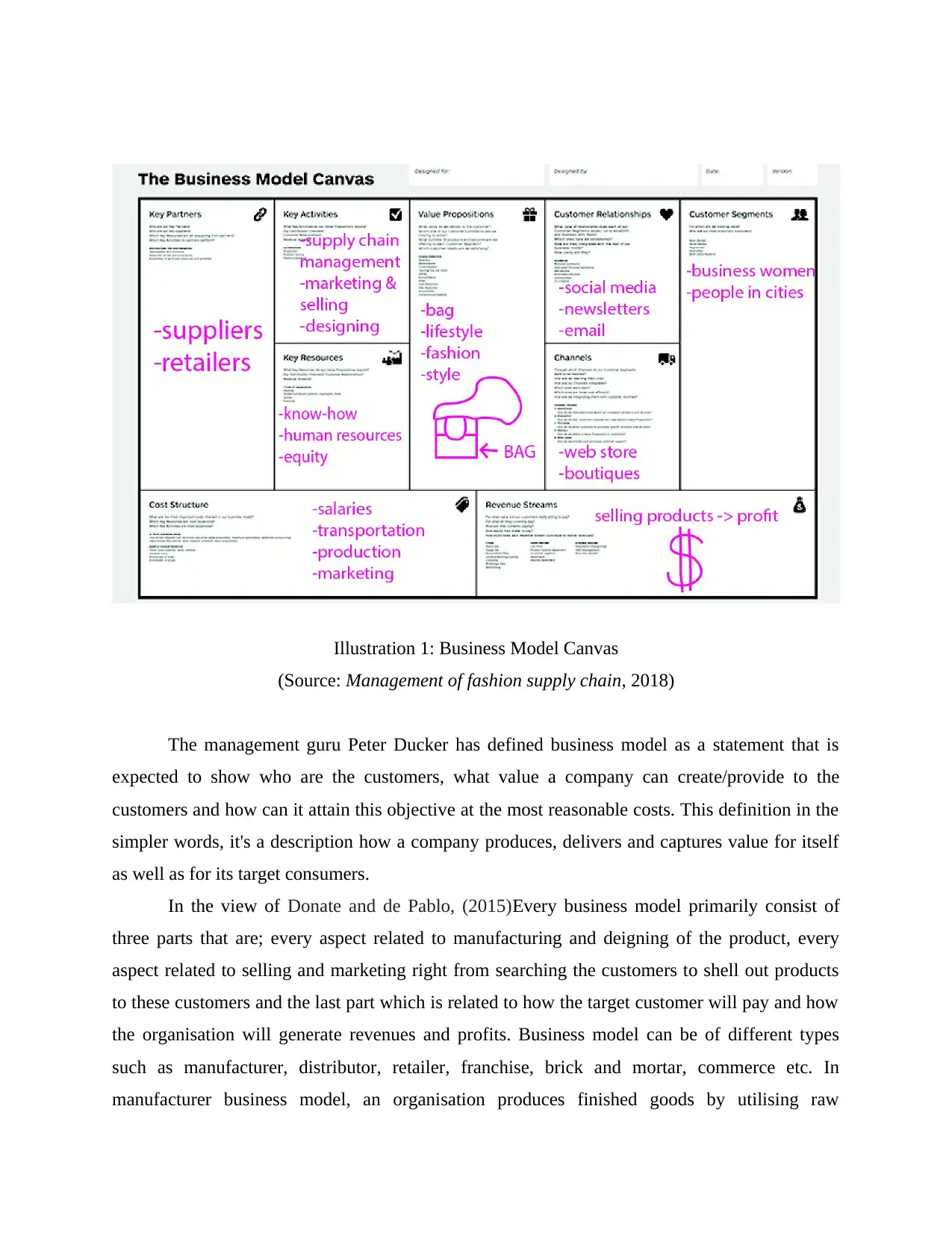
Illustration 1: Business Model Canvas
(Source: Management of fashion supply chain, 2018)
The management guru Peter Ducker has defined business model as a statement that is
expected to show who are the customers, what value a company can create/provide to the
customers and how can it attain this objective at the most reasonable costs. This definition in the
simpler words, it's a description how a company produces, delivers and captures value for itself
as well as for its target consumers.
In the view of Donate and de Pablo, (2015)Every business model primarily consist of
three parts that are; every aspect related to manufacturing and deigning of the product, every
aspect related to selling and marketing right from searching the customers to shell out products
to these customers and the last part which is related to how the target customer will pay and how
the organisation will generate revenues and profits. Business model can be of different types
such as manufacturer, distributor, retailer, franchise, brick and mortar, commerce etc. In
manufacturer business model, an organisation produces finished goods by utilising raw
(Source: Management of fashion supply chain, 2018)
The management guru Peter Ducker has defined business model as a statement that is
expected to show who are the customers, what value a company can create/provide to the
customers and how can it attain this objective at the most reasonable costs. This definition in the
simpler words, it's a description how a company produces, delivers and captures value for itself
as well as for its target consumers.
In the view of Donate and de Pablo, (2015)Every business model primarily consist of
three parts that are; every aspect related to manufacturing and deigning of the product, every
aspect related to selling and marketing right from searching the customers to shell out products
to these customers and the last part which is related to how the target customer will pay and how
the organisation will generate revenues and profits. Business model can be of different types
such as manufacturer, distributor, retailer, franchise, brick and mortar, commerce etc. In
manufacturer business model, an organisation produces finished goods by utilising raw
materials, sells it to mediators generally distributors who finally sells these finished goods to the
end consumers. Retailer buys products from wholesalers or manufactures and sell directly to the
public. Freemium is another type of business model which is becoming popular more than ever
in which firms offered their basic services to its customers for free on the internet but charges
premium for additional services or add-ons. Advertising is also a business model in which
company generates revenues by selling the spaces for advertising.
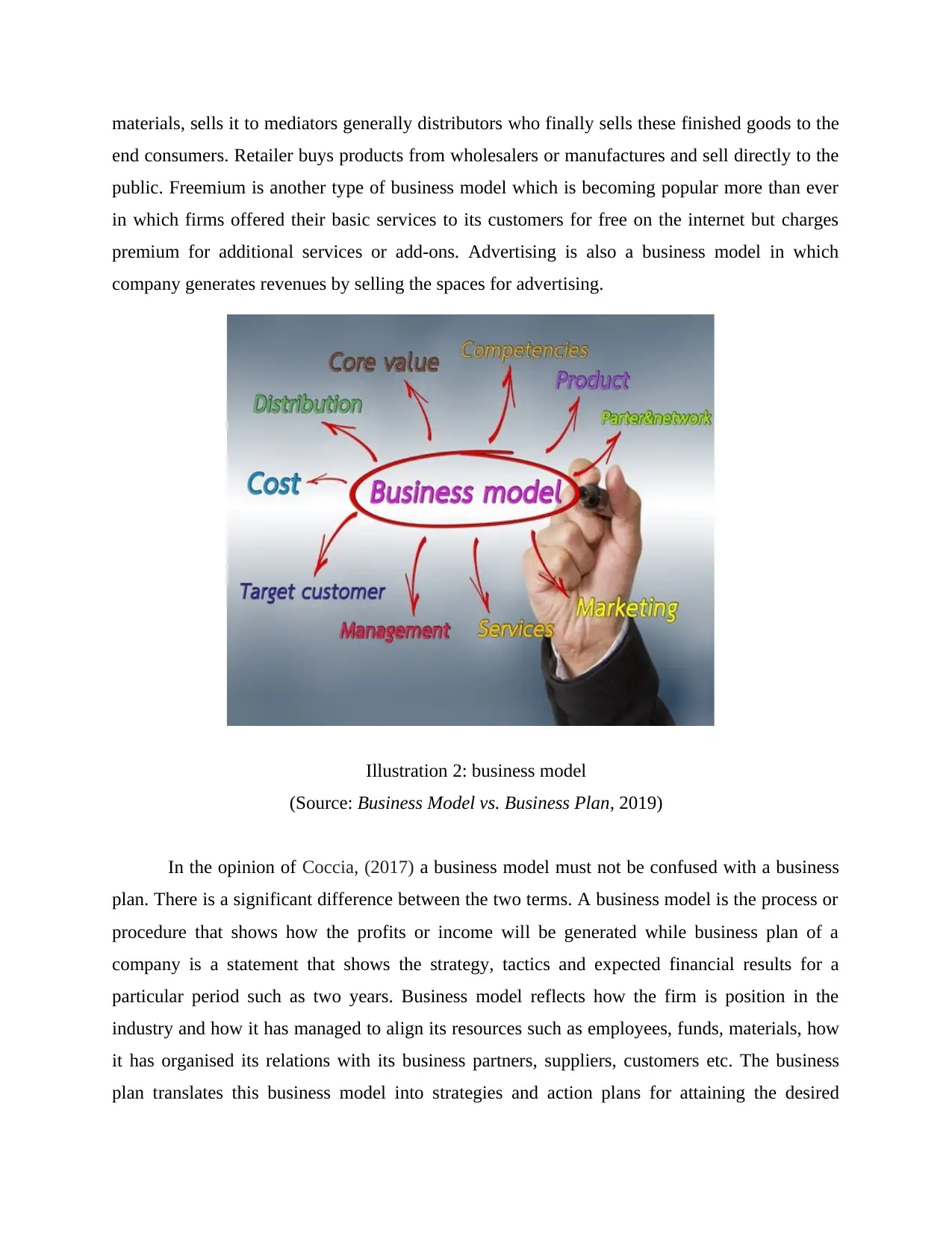
Illustration 2: business model
(Source: Business Model vs. Business Plan, 2019)
In the opinion of Coccia, (2017) a business model must not be confused with a business
plan. There is a significant difference between the two terms. A business model is the process or
procedure that shows how the profits or income will be generated while business plan of a
company is a statement that shows the strategy, tactics and expected financial results for a
particular period such as two years. Business model reflects how the firm is position in the
industry and how it has managed to align its resources such as employees, funds, materials, how
it has organised its relations with its business partners, suppliers, customers etc. The business
plan translates this business model into strategies and action plans for attaining the desired
end consumers. Retailer buys products from wholesalers or manufactures and sell directly to the
public. Freemium is another type of business model which is becoming popular more than ever
in which firms offered their basic services to its customers for free on the internet but charges
premium for additional services or add-ons. Advertising is also a business model in which
company generates revenues by selling the spaces for advertising.
Illustration 2: business model
(Source: Business Model vs. Business Plan, 2019)
In the opinion of Coccia, (2017) a business model must not be confused with a business
plan. There is a significant difference between the two terms. A business model is the process or
procedure that shows how the profits or income will be generated while business plan of a
company is a statement that shows the strategy, tactics and expected financial results for a
particular period such as two years. Business model reflects how the firm is position in the
industry and how it has managed to align its resources such as employees, funds, materials, how
it has organised its relations with its business partners, suppliers, customers etc. The business
plan translates this business model into strategies and action plans for attaining the desired
⊘ This is a preview!⊘
Do you want full access?
Subscribe today to unlock all pages.
Trusted by 1+ million students worldwide
results through the medium of generating profits determined by the business model. So, it can be
said both the terms are related in the sense that these describes how the business is to done but
there is clear distinction between the two as business plan is dependent upon the business model
of a company.
Unilever is the manufacturer of the consumer goods and is the owner of about 400
brands. The company in its annual report has stated out its business model regarding how it aims
to earn profits, who are its customers and how it creates or captures value for its customers and
for itself. The company perceives that sustainable and equitable growth is its only of creating
long term value for its stakeholders. Its stakeholders includes its distributors, suppliers,
customers, shareholders, employees etc. It is for this reason that it has placed sustainable living
at the centre of its business model. Following is the value chain of the company from which it
can be seen that how the company has organised its resources and how it captures value.
said both the terms are related in the sense that these describes how the business is to done but
there is clear distinction between the two as business plan is dependent upon the business model
of a company.
Unilever is the manufacturer of the consumer goods and is the owner of about 400
brands. The company in its annual report has stated out its business model regarding how it aims
to earn profits, who are its customers and how it creates or captures value for its customers and
for itself. The company perceives that sustainable and equitable growth is its only of creating
long term value for its stakeholders. Its stakeholders includes its distributors, suppliers,
customers, shareholders, employees etc. It is for this reason that it has placed sustainable living
at the centre of its business model. Following is the value chain of the company from which it
can be seen that how the company has organised its resources and how it captures value.
Paraphrase This Document
Need a fresh take? Get an instant paraphrase of this document with our AI Paraphraser
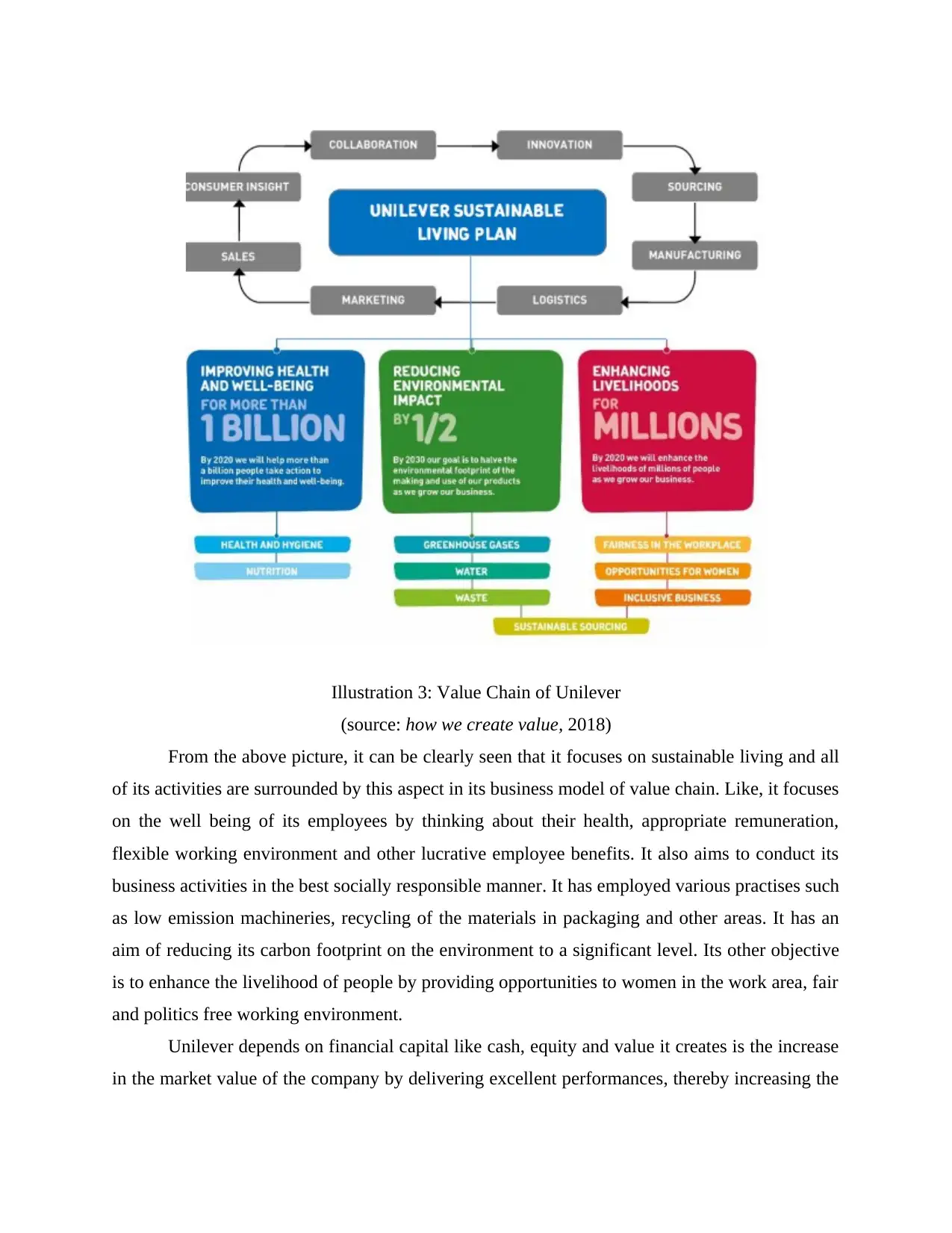
Illustration 3: Value Chain of Unilever
(source: how we create value, 2018)
From the above picture, it can be clearly seen that it focuses on sustainable living and all
of its activities are surrounded by this aspect in its business model of value chain. Like, it focuses
on the well being of its employees by thinking about their health, appropriate remuneration,
flexible working environment and other lucrative employee benefits. It also aims to conduct its
business activities in the best socially responsible manner. It has employed various practises such
as low emission machineries, recycling of the materials in packaging and other areas. It has an
aim of reducing its carbon footprint on the environment to a significant level. Its other objective
is to enhance the livelihood of people by providing opportunities to women in the work area, fair
and politics free working environment.
Unilever depends on financial capital like cash, equity and value it creates is the increase
in the market value of the company by delivering excellent performances, thereby increasing the
(source: how we create value, 2018)
From the above picture, it can be clearly seen that it focuses on sustainable living and all
of its activities are surrounded by this aspect in its business model of value chain. Like, it focuses
on the well being of its employees by thinking about their health, appropriate remuneration,
flexible working environment and other lucrative employee benefits. It also aims to conduct its
business activities in the best socially responsible manner. It has employed various practises such
as low emission machineries, recycling of the materials in packaging and other areas. It has an
aim of reducing its carbon footprint on the environment to a significant level. Its other objective
is to enhance the livelihood of people by providing opportunities to women in the work area, fair
and politics free working environment.
Unilever depends on financial capital like cash, equity and value it creates is the increase
in the market value of the company by delivering excellent performances, thereby increasing the
wealth of the shareholders. It relies on social capital such as its business partners, relations with
its outside stakeholders and the value is created in terms of enhanced livelihood of the people
that are connected or affected by the operations of Unilever. The company uses the natural
capital in the form of natures' resources and the value is developed by giving something back to
the environment. This is done by the company by recycling, pollution free production, less stage
etc. Then most importantly it depends upon human capital which is the talented and highly
skilled workforce of the company that are actually the ones who performs the activities set out
business model and business plan. The value of such resource of the company is created by
developing the employees and providing them the opportunities to grow in the company.
Goffin and Mitchell, (2016) defines value capturing is the ability of the organisation to
generate profits from its transactions. Unilever creates value of its brand which helps it to earn
premium called as profit. People will pay for the goods that can meet the criteria of their
requirements and preferences. Customer loyalty is created on the basis of the quality served to
the target market. The recent time is about the quality and differentiation in company's product
and services. A consumer good should be such that it is hard to substitute and replace by
competitors' product. Such creation helps in building a competitive edge over others in the
market. The value for the customers is created by offering products which makes them feel
good, look good and helps them to get more out of life. In other words, it means providing such
good to the consumers that are capable of meeting consumers preferences, requirements, utility
and most importantly their budgets. Customers wants goods are worthy enough of their hard
earned money.
Saebi and Foss, (2015) has determined the importance of business model for the
organisations because it helps the firms in identifying their target market by the way of value
proposition. It is a statement of the Unilever company that states the problems of the customers,
how these problems could be solved and how the customers would derive value. It basically
shows why Unilever is better than its competitors and why customers should purchase its
products instead of rival firm's products. Then the company finds the segment who have that
problems and in this way, the target market is identified. Sometime innovation can be effective
only when a new segment of the market is targeted by Unilever.
Secondly, the business model of the organisation Unilever specifies the cost structure and
action plans for generation of revenues and profits. These factors are determined with the help of
its outside stakeholders and the value is created in terms of enhanced livelihood of the people
that are connected or affected by the operations of Unilever. The company uses the natural
capital in the form of natures' resources and the value is developed by giving something back to
the environment. This is done by the company by recycling, pollution free production, less stage
etc. Then most importantly it depends upon human capital which is the talented and highly
skilled workforce of the company that are actually the ones who performs the activities set out
business model and business plan. The value of such resource of the company is created by
developing the employees and providing them the opportunities to grow in the company.
Goffin and Mitchell, (2016) defines value capturing is the ability of the organisation to
generate profits from its transactions. Unilever creates value of its brand which helps it to earn
premium called as profit. People will pay for the goods that can meet the criteria of their
requirements and preferences. Customer loyalty is created on the basis of the quality served to
the target market. The recent time is about the quality and differentiation in company's product
and services. A consumer good should be such that it is hard to substitute and replace by
competitors' product. Such creation helps in building a competitive edge over others in the
market. The value for the customers is created by offering products which makes them feel
good, look good and helps them to get more out of life. In other words, it means providing such
good to the consumers that are capable of meeting consumers preferences, requirements, utility
and most importantly their budgets. Customers wants goods are worthy enough of their hard
earned money.
Saebi and Foss, (2015) has determined the importance of business model for the
organisations because it helps the firms in identifying their target market by the way of value
proposition. It is a statement of the Unilever company that states the problems of the customers,
how these problems could be solved and how the customers would derive value. It basically
shows why Unilever is better than its competitors and why customers should purchase its
products instead of rival firm's products. Then the company finds the segment who have that
problems and in this way, the target market is identified. Sometime innovation can be effective
only when a new segment of the market is targeted by Unilever.
Secondly, the business model of the organisation Unilever specifies the cost structure and
action plans for generation of revenues and profits. These factors are determined with the help of
⊘ This is a preview!⊘
Do you want full access?
Subscribe today to unlock all pages.
Trusted by 1+ million students worldwide
value chain and value proposition. It details out the activities of designing of production process
to delivery of products to end users through value chain and serving the target audience as per
the value proposition.
In the view of Linder and Williander, (2017), a business model is very important because
it helps the company in understanding its competition and assist it in positioning its products and
services better in the target market. Once the value chain is defined by Unilever, it can outline
the influence of each factor in the chain on one another. This information is used by the
management of the company in developing their core competencies and competitive advantage.
Clauss, (2017) has stated that innovation has changed the way company used to promote
its products in the global market. Unilever has very effectively used social media for
understanding the preferences of youth and has accordingly developed its products. It has
conducted various promotional events on the online platform such as YouTube, Facebook,
Instagram, Twitter etc. Since, the company is operating on such a big scale where its activities
are spread throughout the world, it has to employ technology in conducting its business. It has
increased the volume of AI devises & technologies in its customer support services for solving
the queries as quick as possible.
It has an integrated internal management system that is linked to its headquarter office.
Such integration helps in enhancing coordination at the global level. The company along with
retailers distributes its products by the way of kiosks, a type of vending machine that offers the
products to customers in exchange of money. This was its innovative strategy of making its
products available to the masses. This helped the company in cutting the cost of intermediaries
and assisted in generating greater profits. Such innovation drew the attention of the people
because it was more convenient and something new that ultimately helped it in increasing its
sales over the last three four years. It has maintained its customer relationships by employing
CRM system that effectively manages the data of such large customers that lets the company in
understanding the data. Such analysis helps in drawing out useful information about the
customers, their habits, their future tendency of purchasing the products etc.
It focuses on cost leadership along with broad brand differentiation strategy. It aims to
capture market providing the quality goods at the most reasonable prices. It also stands out from
the crowd by differentiating its products in terms of packaging, after sales services, designing,
utilities, price, etc. The features of the product provides value to the customer which it expects
to delivery of products to end users through value chain and serving the target audience as per
the value proposition.
In the view of Linder and Williander, (2017), a business model is very important because
it helps the company in understanding its competition and assist it in positioning its products and
services better in the target market. Once the value chain is defined by Unilever, it can outline
the influence of each factor in the chain on one another. This information is used by the
management of the company in developing their core competencies and competitive advantage.
Clauss, (2017) has stated that innovation has changed the way company used to promote
its products in the global market. Unilever has very effectively used social media for
understanding the preferences of youth and has accordingly developed its products. It has
conducted various promotional events on the online platform such as YouTube, Facebook,
Instagram, Twitter etc. Since, the company is operating on such a big scale where its activities
are spread throughout the world, it has to employ technology in conducting its business. It has
increased the volume of AI devises & technologies in its customer support services for solving
the queries as quick as possible.
It has an integrated internal management system that is linked to its headquarter office.
Such integration helps in enhancing coordination at the global level. The company along with
retailers distributes its products by the way of kiosks, a type of vending machine that offers the
products to customers in exchange of money. This was its innovative strategy of making its
products available to the masses. This helped the company in cutting the cost of intermediaries
and assisted in generating greater profits. Such innovation drew the attention of the people
because it was more convenient and something new that ultimately helped it in increasing its
sales over the last three four years. It has maintained its customer relationships by employing
CRM system that effectively manages the data of such large customers that lets the company in
understanding the data. Such analysis helps in drawing out useful information about the
customers, their habits, their future tendency of purchasing the products etc.
It focuses on cost leadership along with broad brand differentiation strategy. It aims to
capture market providing the quality goods at the most reasonable prices. It also stands out from
the crowd by differentiating its products in terms of packaging, after sales services, designing,
utilities, price, etc. The features of the product provides value to the customer which it expects
Paraphrase This Document
Need a fresh take? Get an instant paraphrase of this document with our AI Paraphraser
by paying for the product. Another marketing strategy it has employed for sustaining and
expanding in the market is product development. It has always laid its emphasis on enlarging its
market share by introducing new product for different market segment. Like recently, it has put
more of its energy towards personal care products due to the growing demand of skin care and
personal care products. It then went on to acquire Murad and Dermalogica. The revenues from
these brands resulted in the incremental profits for the company in the year 2015.
Thus, Carayannis, Sindakis, and Walter, (2015) has perfectly said that innovation in the
business model provides a right track and route for moving towards the road of success.
Unilever's business model is successful because it is unique which is hard to copy in terms of
value creation, the model is perfectly aligned and integrated with the current market trends such
as knowing market demands, expectations and serving as per the demands and specifications.
The other reasons of its success is that its business model has very clearly and specifically
established new growth platforms, higher competencies of generating larger profits due to low
cost structure and differentiation which its rival firms cannot easily imitate.
However, Martins, Rindova and Greenbaum, (2015) has criticised the viability of a
business model and has pointed out several pitfalls. The first is that it is a very complex task of
how business is going to conducts is operations. Omission of minute detail can lead to serious
repercussions for the Unilever as entire business strategies are based on the business model.
Other reason why some business model remains unsuccessful is the lack of expertise of drawing
out a detailed statement regarding how the organisation is going to make money and who will be
its customers. Working according to a business model narrows down the scope of organisations
in identifying and capturing business opportunities simply because it was not stated in the model.
For example, Unilever has a business model of manufacturing and selling the good to
distributors. It has not gone for the direct online sale of its products because its business model
does not include such thing.
Another author(Christensen, Bartman and Van Bever, (2016) has expressed its views on
the utility of business model of innovation is that the preparing business model canvas requires
intensive of knowledge of market, own competencies, resources, management knowledge, and
other skills for aligning the current business model with business's dynamic environment. The
most impacting disadvantage of business model is its cost of preparation. This involves hiring of
professionals who specialises in conducting market research for the purpose of developing a
expanding in the market is product development. It has always laid its emphasis on enlarging its
market share by introducing new product for different market segment. Like recently, it has put
more of its energy towards personal care products due to the growing demand of skin care and
personal care products. It then went on to acquire Murad and Dermalogica. The revenues from
these brands resulted in the incremental profits for the company in the year 2015.
Thus, Carayannis, Sindakis, and Walter, (2015) has perfectly said that innovation in the
business model provides a right track and route for moving towards the road of success.
Unilever's business model is successful because it is unique which is hard to copy in terms of
value creation, the model is perfectly aligned and integrated with the current market trends such
as knowing market demands, expectations and serving as per the demands and specifications.
The other reasons of its success is that its business model has very clearly and specifically
established new growth platforms, higher competencies of generating larger profits due to low
cost structure and differentiation which its rival firms cannot easily imitate.
However, Martins, Rindova and Greenbaum, (2015) has criticised the viability of a
business model and has pointed out several pitfalls. The first is that it is a very complex task of
how business is going to conducts is operations. Omission of minute detail can lead to serious
repercussions for the Unilever as entire business strategies are based on the business model.
Other reason why some business model remains unsuccessful is the lack of expertise of drawing
out a detailed statement regarding how the organisation is going to make money and who will be
its customers. Working according to a business model narrows down the scope of organisations
in identifying and capturing business opportunities simply because it was not stated in the model.
For example, Unilever has a business model of manufacturing and selling the good to
distributors. It has not gone for the direct online sale of its products because its business model
does not include such thing.
Another author(Christensen, Bartman and Van Bever, (2016) has expressed its views on
the utility of business model of innovation is that the preparing business model canvas requires
intensive of knowledge of market, own competencies, resources, management knowledge, and
other skills for aligning the current business model with business's dynamic environment. The
most impacting disadvantage of business model is its cost of preparation. This involves hiring of
professionals who specialises in conducting market research for the purpose of developing a
business model which is best suited for the requirement of organisation and its owners. This
makes the developing of business model an expensive affair. It is this reason why some
companies restricts themselves in building a long comprehensive business model for their
business.
At last, it can be concluded that innovation not only in the technology or idea can do
wonders for an organisation but innovation in the business model can help the organisations like
Unilever, P&G to be world's top manufacturer of consumer goods. How the resources of the
company are blended together and how the offerings are served to the customers decides a
competitive advantage of a firm in today's world. It is for this reason why everyone around the
world are focussing on innovation factor for leading and growing in the global market because
customers expects something different which is capable of providing high value to them.
makes the developing of business model an expensive affair. It is this reason why some
companies restricts themselves in building a long comprehensive business model for their
business.
At last, it can be concluded that innovation not only in the technology or idea can do
wonders for an organisation but innovation in the business model can help the organisations like
Unilever, P&G to be world's top manufacturer of consumer goods. How the resources of the
company are blended together and how the offerings are served to the customers decides a
competitive advantage of a firm in today's world. It is for this reason why everyone around the
world are focussing on innovation factor for leading and growing in the global market because
customers expects something different which is capable of providing high value to them.
⊘ This is a preview!⊘
Do you want full access?
Subscribe today to unlock all pages.
Trusted by 1+ million students worldwide

1 out of 14


Related Documents


Your All-in-One AI-Powered Toolkit for Academic Success.
+13062052269
info@desklib.com
Available 24*7 on WhatsApp / Email
![[object Object]](/_next/static/media/star-bottom.7253800d.svg)
Unlock your academic potential
Copyright © 2020–2026 A2Z Services. All Rights Reserved. Developed and managed by ZUCOL.