Innovations in Hospitality: Sensory Marketing and Hotel Performance
VerifiedAdded on 2022/11/25
|14
|7014
|396
Report
AI Summary
This report, published in the International Journal of Environmental & Science Education, explores the critical role of innovation within the hospitality industry, with a specific focus on the implementation of sensory marketing techniques. It delves into the classification of innovations and highlights the challenges associated with their application in hotels. The authors analyze the 'seven sensual notes of hospitality,' including sight, hearing, smell, taste, touch, intuition, and impression, and demonstrate how these elements can be integrated into an innovative hotel marketing mix. The study provides a comparative analysis of research findings, underscoring the impact of these innovations on the performance of hospitality enterprises. The report emphasizes the importance of adapting to changing consumer demands and leveraging intangible assets to create unique experiences and enhance customer satisfaction. The research utilizes a variety of methods, including systems analysis, retrospective analysis, and online surveys, to gather data from sources such as the Russian Federal Agency for Tourism, research institutions, and online surveys conducted among hotel customers. The findings emphasize the importance of personalized service, responsiveness of staff, and the overall quality of service in driving customer satisfaction and loyalty. The report concludes with a discussion of different types of innovations in the hospitality industry, including material, economic, organizational, legal, social, and marketing innovations. The report suggests that hotels can enhance their services and increase quality through innovation management.
CORRESPONDENCE Elena A. Dzhandzhugazova Dzhandzhugazova.EA@rea.ruEkateri
© 2016 Dzhandzhugazova et al. Open Access terms of the Creative Commons Attribution 4.0 International License
(http://creativecommons.org/licenses/by/4.0/) apply. The license permits unrestricted use, distribution, and
reproduction in any medium, on the condition that users give exact credit to the original author(s) and the source,
provide a link to the Creative Commons license, and indicate if they made any changes.
Introduction
The highly competitive environment of the hospitality industry drives the search
for new ways and elements of efficient performance. One of the core trends in
this sphere is the development and application of a variety of innovations and
new elements that can serve as a powerful impetus for the development of the
hospitality industry. Innovations of all kinds are essential for both the viability
and competitiveness of hotel enterprises. The systematic and ubiquitous use of
innovations to ensure the growth of enterprise performance is now recognized by
a wide range of researchers and practicing managers (Dzhandzhugazova et al.,
2015).
INTERNATIONAL JOURNAL OF ENVIRONMENTAL & SCIENCE EDUCATION
2016, VOL. 11, NO. 17, 10387-10400
Innovations in Hospitality Industry
Elena A. Dzhandzhugazovaa, Ekaterina A. Blinovaa, Liubov N. Orlovaa
and Marianna M. Romanovaa
aPlekhanov Russian University of Economics, Moscow, RUSSIA
ABSTRACT
The article focuses on the study of the role and importance of innovation, its
classification, the problems of its application in the hotel industry with emphasis on the
application of sensory marketing tools in the development of the innovative marketing
mix within the hospitality industry. The article provides an analysis of the "seven sensual
notes of hospitality", i.e. "sight", "hearing", "smell", "taste", "touch", "intuition",
"impression". The authors rely on the "sensual notes"in their consideration ofan
innovative hotelmarketing mix, generalizeand systematize the results of studies,
practical examples from the experience of the world best hotels. The authors have
conducted a comparative analysis of research findings pinpointing the impact of the
innovative marketing mix on the performance of hospitality industry enterprises.
KEYWORDS ARTICLE HISTORY
Hotel industry, hospitality, innovation, innovative
hotel marketing mix, sensory marketing
Received 20 May 2016
Revised 29 July 2016
Accepted 13 October 2016
OPEN ACCESS
© 2016 Dzhandzhugazova et al. Open Access terms of the Creative Commons Attribution 4.0 International License
(http://creativecommons.org/licenses/by/4.0/) apply. The license permits unrestricted use, distribution, and
reproduction in any medium, on the condition that users give exact credit to the original author(s) and the source,
provide a link to the Creative Commons license, and indicate if they made any changes.
Introduction
The highly competitive environment of the hospitality industry drives the search
for new ways and elements of efficient performance. One of the core trends in
this sphere is the development and application of a variety of innovations and
new elements that can serve as a powerful impetus for the development of the
hospitality industry. Innovations of all kinds are essential for both the viability
and competitiveness of hotel enterprises. The systematic and ubiquitous use of
innovations to ensure the growth of enterprise performance is now recognized by
a wide range of researchers and practicing managers (Dzhandzhugazova et al.,
2015).
INTERNATIONAL JOURNAL OF ENVIRONMENTAL & SCIENCE EDUCATION
2016, VOL. 11, NO. 17, 10387-10400
Innovations in Hospitality Industry
Elena A. Dzhandzhugazovaa, Ekaterina A. Blinovaa, Liubov N. Orlovaa
and Marianna M. Romanovaa
aPlekhanov Russian University of Economics, Moscow, RUSSIA
ABSTRACT
The article focuses on the study of the role and importance of innovation, its
classification, the problems of its application in the hotel industry with emphasis on the
application of sensory marketing tools in the development of the innovative marketing
mix within the hospitality industry. The article provides an analysis of the "seven sensual
notes of hospitality", i.e. "sight", "hearing", "smell", "taste", "touch", "intuition",
"impression". The authors rely on the "sensual notes"in their consideration ofan
innovative hotelmarketing mix, generalizeand systematize the results of studies,
practical examples from the experience of the world best hotels. The authors have
conducted a comparative analysis of research findings pinpointing the impact of the
innovative marketing mix on the performance of hospitality industry enterprises.
KEYWORDS ARTICLE HISTORY
Hotel industry, hospitality, innovation, innovative
hotel marketing mix, sensory marketing
Received 20 May 2016
Revised 29 July 2016
Accepted 13 October 2016
OPEN ACCESS

Paraphrase This Document
Need a fresh take? Get an instant paraphrase of this document with our AI Paraphraser
10388 E. A. DZHANDZHUGAZOVA ET AL.
There is a wide range of factors affecting the application and development of
innovation, i.e. consistent industry problems, specific mentality of consumers,
cultural and national quirks of the customers enjoying hotel services, etc.(Pine
& Gilmore,1999)
Innovative trend in the hospitality industry is manifested through the
ability to generate diverse innovations, which will ensure the successful
development of a hotel (Zaitseva, 2013).The large-scale application of new
knowledge, as well as its combinations, generates new services, products and
technologies. If a hotel is not involved in any innovation process, its performance
will sooner or later diminish and its competitiveness will be lost (Ilyenkova &
Kuznetsov, 2009).
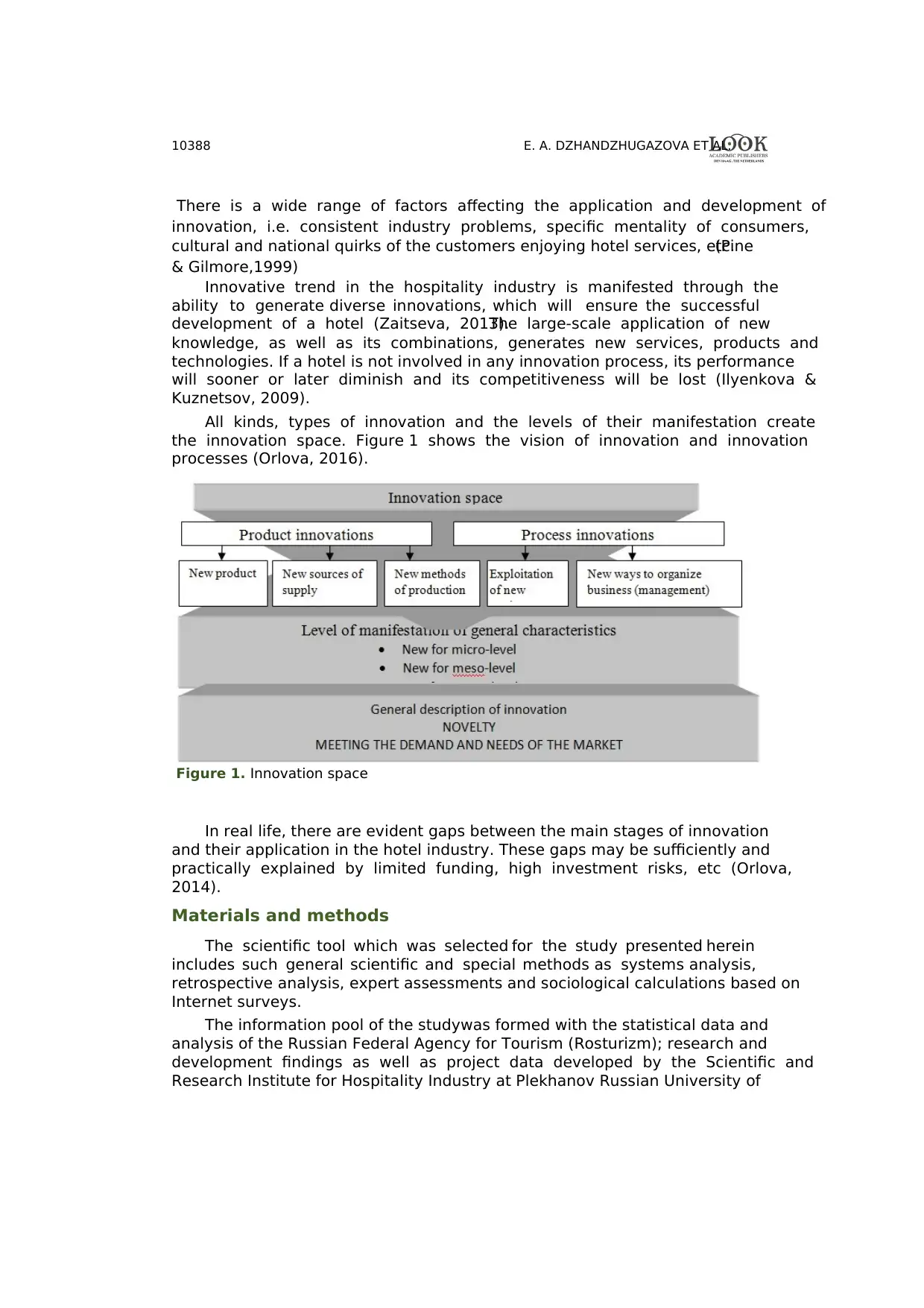
All kinds, types of innovation and the levels of their manifestation create
the innovation space. Figure 1 shows the vision of innovation and innovation
processes (Orlova, 2016).
Figure 1. Innovation space
In real life, there are evident gaps between the main stages of innovation
and their application in the hotel industry. These gaps may be sufficiently and
practically explained by limited funding, high investment risks, etc (Orlova,
2014).
Materials and methods
The scientific tool which was selected for the study presented herein
includes such general scientific and special methods as systems analysis,
retrospective analysis, expert assessments and sociological calculations based on
Internet surveys.
The information pool of the studywas formed with the statistical data and
analysis of the Russian Federal Agency for Tourism (Rosturizm); research and
development findings as well as project data developed by the Scientific and
Research Institute for Hospitality Industry at Plekhanov Russian University of
There is a wide range of factors affecting the application and development of
innovation, i.e. consistent industry problems, specific mentality of consumers,
cultural and national quirks of the customers enjoying hotel services, etc.(Pine
& Gilmore,1999)
Innovative trend in the hospitality industry is manifested through the
ability to generate diverse innovations, which will ensure the successful
development of a hotel (Zaitseva, 2013).The large-scale application of new
knowledge, as well as its combinations, generates new services, products and
technologies. If a hotel is not involved in any innovation process, its performance
will sooner or later diminish and its competitiveness will be lost (Ilyenkova &
Kuznetsov, 2009).
All kinds, types of innovation and the levels of their manifestation create
the innovation space. Figure 1 shows the vision of innovation and innovation
processes (Orlova, 2016).
Figure 1. Innovation space
In real life, there are evident gaps between the main stages of innovation
and their application in the hotel industry. These gaps may be sufficiently and
practically explained by limited funding, high investment risks, etc (Orlova,
2014).
Materials and methods
The scientific tool which was selected for the study presented herein
includes such general scientific and special methods as systems analysis,
retrospective analysis, expert assessments and sociological calculations based on
Internet surveys.
The information pool of the studywas formed with the statistical data and
analysis of the Russian Federal Agency for Tourism (Rosturizm); research and
development findings as well as project data developed by the Scientific and
Research Institute for Hospitality Industry at Plekhanov Russian University of
INTERNATIONAL JOURNAL OF ENVIRONMENTAL & SCIENCE EDUCATION 10389
Economics; publications in recognized local and foreign journals; the electronic
content of Russian and foreign Internet portals.
This article is based on the research of independent research groups,
agencies and companies such as US news & World Report, Milliman,
Entertainment Media Research, Vision Critical, RED as assigned by PPL, DJS,
Top Hotels, Smell and Taste Research Foundation, TripBarometer. With the
informational support of Top Hotels, the authors have made a number of
sociological calculations based on online surveys among hotel customers. The
surveys aimed to identify the attitude of the consumers of hotel services to the
quality of service. The key question in the surveys was, "How would you describe
"high-quality service"?".
Results and Discussion
Innovations in hotel operations
The ability to analyze customer feedback enables hotels to maintain a
certain number of guests; the key criterion of efficiency is primarily how
satisfied the guests are with the hotel services. The retrospective analysis of the
attitude of hotel guests to the hotel service quality conducted in 2000 and 2016
showed the ongoing sensitivity of guests to the quality of service.
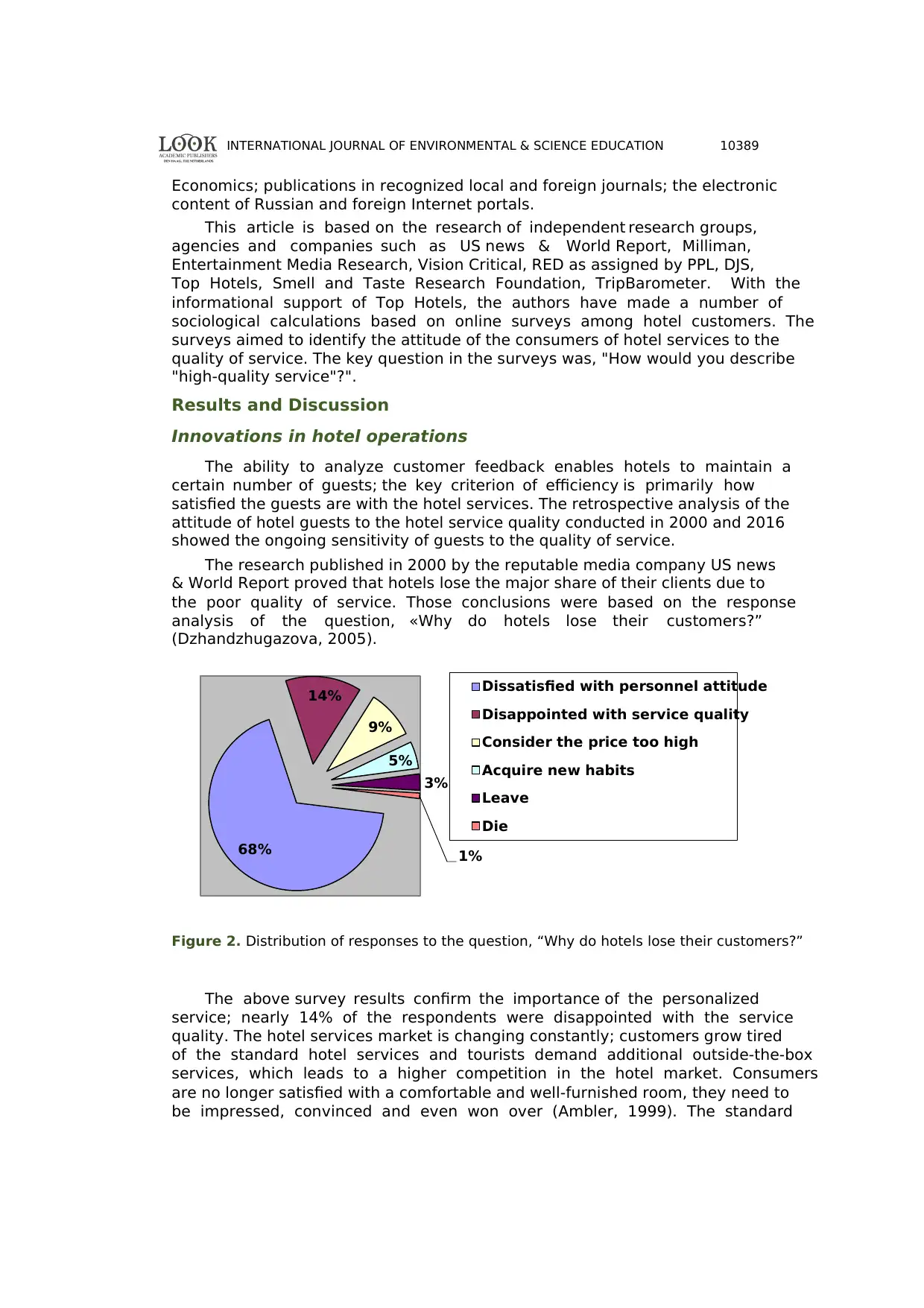
The research published in 2000 by the reputable media company US news
& World Report proved that hotels lose the major share of their clients due to
the poor quality of service. Those conclusions were based on the response
analysis of the question, «Why do hotels lose their customers?”
(Dzhandzhugazova, 2005).
Figure 2. Distribution of responses to the question, “Why do hotels lose their customers?”
The above survey results confirm the importance of the personalized
service; nearly 14% of the respondents were disappointed with the service
quality. The hotel services market is changing constantly; customers grow tired
of the standard hotel services and tourists demand additional outside-the-box
services, which leads to a higher competition in the hotel market. Consumers
are no longer satisfied with a comfortable and well-furnished room, they need to
be impressed, convinced and even won over (Ambler, 1999). The standard
68%
14%
9%
5%
3%
1%
Dissatisfied with personnel attitude
Disappointed with service quality
Consider the price too high
Acquire new habits
Leave
Die
Economics; publications in recognized local and foreign journals; the electronic
content of Russian and foreign Internet portals.
This article is based on the research of independent research groups,
agencies and companies such as US news & World Report, Milliman,
Entertainment Media Research, Vision Critical, RED as assigned by PPL, DJS,
Top Hotels, Smell and Taste Research Foundation, TripBarometer. With the
informational support of Top Hotels, the authors have made a number of
sociological calculations based on online surveys among hotel customers. The
surveys aimed to identify the attitude of the consumers of hotel services to the
quality of service. The key question in the surveys was, "How would you describe
"high-quality service"?".
Results and Discussion
Innovations in hotel operations
The ability to analyze customer feedback enables hotels to maintain a
certain number of guests; the key criterion of efficiency is primarily how
satisfied the guests are with the hotel services. The retrospective analysis of the
attitude of hotel guests to the hotel service quality conducted in 2000 and 2016
showed the ongoing sensitivity of guests to the quality of service.
The research published in 2000 by the reputable media company US news
& World Report proved that hotels lose the major share of their clients due to
the poor quality of service. Those conclusions were based on the response
analysis of the question, «Why do hotels lose their customers?”
(Dzhandzhugazova, 2005).
Figure 2. Distribution of responses to the question, “Why do hotels lose their customers?”
The above survey results confirm the importance of the personalized
service; nearly 14% of the respondents were disappointed with the service
quality. The hotel services market is changing constantly; customers grow tired
of the standard hotel services and tourists demand additional outside-the-box
services, which leads to a higher competition in the hotel market. Consumers
are no longer satisfied with a comfortable and well-furnished room, they need to
be impressed, convinced and even won over (Ambler, 1999). The standard
68%
14%
9%
5%
3%
1%
Dissatisfied with personnel attitude
Disappointed with service quality
Consider the price too high
Acquire new habits
Leave
Die
⊘ This is a preview!⊘
Do you want full access?
Subscribe today to unlock all pages.

Trusted by 1+ million students worldwide
10390 E. A. DZHANDZHUGAZOVA ET AL.
procedure here is to analyze the factors of the competitive potential that
enterprise structures possess. When such potential is properly managed, the
above factors enhance the competitiveness of an enterprise in modern conditions
(Orekhov, 2014). Hotels have to keep improving their services and increasing
their quality through innovation management, because the needs of customers
are ever-changing, new habits are acquired (5%).
Innovation in the hospitality industry depends on the creation of intangible
assets, which means providing the consumer with a benefit worth paying for. In
this regard, the intangible assets may be good mood, spiritual or cultural
development or the provision of a unique experience (Dzhandzhugazova et al.,
2016).
The innovative activity is multifaceted and covers a variety of sectors,
whereas the innovations can be manifested in many forms. Foreign and Russian
scientists (Schumpeter, 2007) have developed various classifications of
innovations to regulate the concept. According to the classification of J.A.
Schumpeter (2007) innovation may refer to: new products, new sources of
supply,new methods of production, the exploitation of new markets and new
ways to organize business (management).
However, all classification criteria cannot reflect the nature and
characteristics of innovations in hospitality industry in its entirety. We believe
that the most suitable in this regard are the following classification criteria: type
of innovation, depth of changes, continuity, type of novelty to the existing
market and innovation time-to-market (Romanova & Chernova, 2015). It should
be noted, however, that few innovations may be characterized using only one of
these criteria; most innovations manifest two or three.
The following table describes the specific ways of implementing different
types of innovations in the hospitality industry.
Table 1. Innovation types in hospitality industry
No. Innovation type Description Specific ways to implement in
hospitality industry
1 Material and
technical
innovations
Creating new materials,
products, services and
technologies, new ways to
deliver services, improving the
old ones
Expanding the range of
specialized and equivalent
accommodation facility
typesaccordingto the needs of
tourists
2 Economic
innovations
The emergence of new markets
caused by the introduction of
new products or technologies,
the creation of new ways to
buy and sell goods, and
economic processes following
the innovation process
Expanding the hospitality industry
organizations from the center to
the periphery, erasing "blank
spots" in the geographical space of
the hospitality industry
3 Organization
and
management
innovations
New solutions and approaches
in managing or organizing the
working process
Implementable in the form of
improving the hospitality models
used by organizations ( European,
Asian, American, Eastern
European models)
4 Legal innovationNew laws or regulations
introduced, as well as
significant changes in the
Simultaneously implementing the
international conventions and
national legislation in the field of
procedure here is to analyze the factors of the competitive potential that
enterprise structures possess. When such potential is properly managed, the
above factors enhance the competitiveness of an enterprise in modern conditions
(Orekhov, 2014). Hotels have to keep improving their services and increasing
their quality through innovation management, because the needs of customers
are ever-changing, new habits are acquired (5%).
Innovation in the hospitality industry depends on the creation of intangible
assets, which means providing the consumer with a benefit worth paying for. In
this regard, the intangible assets may be good mood, spiritual or cultural
development or the provision of a unique experience (Dzhandzhugazova et al.,
2016).
The innovative activity is multifaceted and covers a variety of sectors,
whereas the innovations can be manifested in many forms. Foreign and Russian
scientists (Schumpeter, 2007) have developed various classifications of
innovations to regulate the concept. According to the classification of J.A.
Schumpeter (2007) innovation may refer to: new products, new sources of
supply,new methods of production, the exploitation of new markets and new
ways to organize business (management).
However, all classification criteria cannot reflect the nature and
characteristics of innovations in hospitality industry in its entirety. We believe
that the most suitable in this regard are the following classification criteria: type
of innovation, depth of changes, continuity, type of novelty to the existing
market and innovation time-to-market (Romanova & Chernova, 2015). It should
be noted, however, that few innovations may be characterized using only one of
these criteria; most innovations manifest two or three.
The following table describes the specific ways of implementing different
types of innovations in the hospitality industry.
Table 1. Innovation types in hospitality industry
No. Innovation type Description Specific ways to implement in
hospitality industry
1 Material and
technical
innovations
Creating new materials,
products, services and
technologies, new ways to
deliver services, improving the
old ones
Expanding the range of
specialized and equivalent
accommodation facility
typesaccordingto the needs of
tourists
2 Economic
innovations
The emergence of new markets
caused by the introduction of
new products or technologies,
the creation of new ways to
buy and sell goods, and
economic processes following
the innovation process
Expanding the hospitality industry
organizations from the center to
the periphery, erasing "blank
spots" in the geographical space of
the hospitality industry
3 Organization
and
management
innovations
New solutions and approaches
in managing or organizing the
working process
Implementable in the form of
improving the hospitality models
used by organizations ( European,
Asian, American, Eastern
European models)
4 Legal innovationNew laws or regulations
introduced, as well as
significant changes in the
Simultaneously implementing the
international conventions and
national legislation in the field of
Paraphrase This Document
Need a fresh take? Get an instant paraphrase of this document with our AI Paraphraser
INTERNATIONAL JOURNAL OF ENVIRONMENTAL & SCIENCE EDUCATION 10391
existing ones hospitality, integrating the
national legislation into the
system of international law
5 Social
innovations
New ideas and solutions with
the purpose of addressing the
social and cultural challenges
which the society faces
Implementing new concepts based
on the expanding types of tourism
(business tourism, educational
tourism, eco-tourism, pilgrimage,
etc.)
6 Marketing
innovations
New or significantly improved
marketing methods,
encompassing the major
changes in the design and
packaging of products, applying
new sales techniques and
product (services)
presentations, presenting and
promoting them on the
markets, developing new
pricing strategies
Implementing the results of
market research, experience
shared by experts, research by
competitors, etc., for instance,
developing and introducing the
concept of sensory marketing
Key components of the innovative marketing mix within a hotel
The data of online surveys conducted by the authors in 2016 with the
support of Top Hotels in the form of a poll with the participation of 654
respondents evidenced that modern consumers appreciate high-quality
service: responsiveness of the staff and their readiness to assist (60%) as well as
the individual approach (8%). This transcends the comfort level indicator, which
is a significant litmus paper for the quality of hotel services.
Figure 3. Distributions of responses to the question, “What is the most important aspect in
the work of a hotel in you opinion?”
To date, quality service is based on a new system of relations integrating
non-standard methods and approaches and providing a new perspective on
hospitality marketing mix. These methods include interesting architecture of
hotel buildings, modern landscape design, attractive interiors and a variety of
8%
24%
8%
60% Creating long-term relations, loyalty
programs
High level of comfort
Individual approach
Responsiveness and helpfulness of
personnel
existing ones hospitality, integrating the
national legislation into the
system of international law
5 Social
innovations
New ideas and solutions with
the purpose of addressing the
social and cultural challenges
which the society faces
Implementing new concepts based
on the expanding types of tourism
(business tourism, educational
tourism, eco-tourism, pilgrimage,
etc.)
6 Marketing
innovations
New or significantly improved
marketing methods,
encompassing the major
changes in the design and
packaging of products, applying
new sales techniques and
product (services)
presentations, presenting and
promoting them on the
markets, developing new
pricing strategies
Implementing the results of
market research, experience
shared by experts, research by
competitors, etc., for instance,
developing and introducing the
concept of sensory marketing
Key components of the innovative marketing mix within a hotel
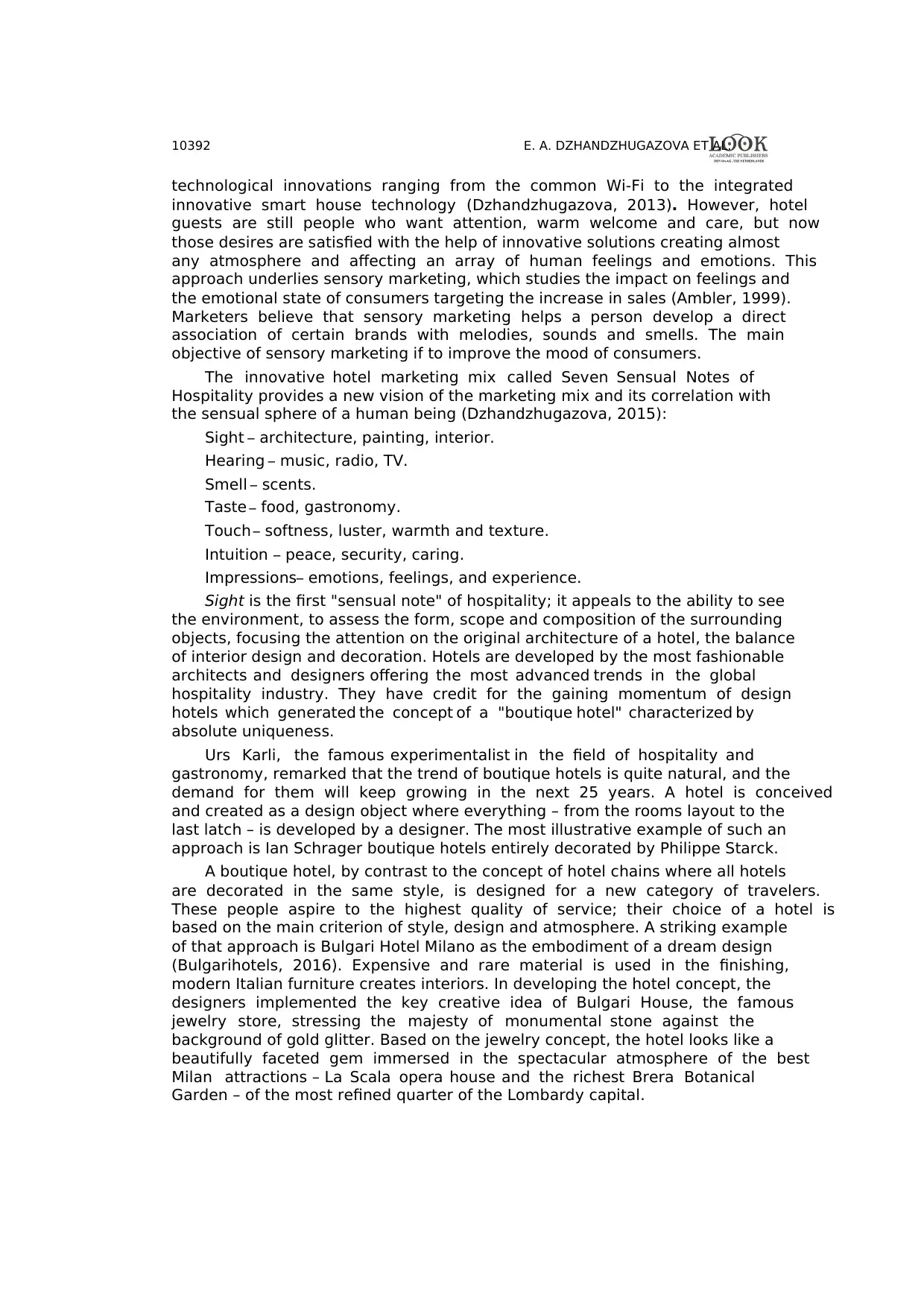
The data of online surveys conducted by the authors in 2016 with the
support of Top Hotels in the form of a poll with the participation of 654
respondents evidenced that modern consumers appreciate high-quality
service: responsiveness of the staff and their readiness to assist (60%) as well as
the individual approach (8%). This transcends the comfort level indicator, which
is a significant litmus paper for the quality of hotel services.
Figure 3. Distributions of responses to the question, “What is the most important aspect in
the work of a hotel in you opinion?”
To date, quality service is based on a new system of relations integrating
non-standard methods and approaches and providing a new perspective on
hospitality marketing mix. These methods include interesting architecture of
hotel buildings, modern landscape design, attractive interiors and a variety of
8%
24%
8%
60% Creating long-term relations, loyalty
programs
High level of comfort
Individual approach
Responsiveness and helpfulness of
personnel
10392 E. A. DZHANDZHUGAZOVA ET AL.
technological innovations ranging from the common Wi-Fi to the integrated
innovative smart house technology (Dzhandzhugazova, 2013). However, hotel
guests are still people who want attention, warm welcome and care, but now
those desires are satisfied with the help of innovative solutions creating almost
any atmosphere and affecting an array of human feelings and emotions. This
approach underlies sensory marketing, which studies the impact on feelings and
the emotional state of consumers targeting the increase in sales (Ambler, 1999).
Marketers believe that sensory marketing helps a person develop a direct
association of certain brands with melodies, sounds and smells. The main
objective of sensory marketing if to improve the mood of consumers.
The innovative hotel marketing mix called Seven Sensual Notes of
Hospitality provides a new vision of the marketing mix and its correlation with
the sensual sphere of a human being (Dzhandzhugazova, 2015):
Sight – architecture, painting, interior.
Hearing – music, radio, TV.
Smell – scents.
Taste – food, gastronomy.
Touch – softness, luster, warmth and texture.
Intuition – peace, security, caring.
Impressions– emotions, feelings, and experience.
Sight is the first "sensual note" of hospitality; it appeals to the ability to see
the environment, to assess the form, scope and composition of the surrounding
objects, focusing the attention on the original architecture of a hotel, the balance
of interior design and decoration. Hotels are developed by the most fashionable
architects and designers offering the most advanced trends in the global
hospitality industry. They have credit for the gaining momentum of design
hotels which generated the concept of a "boutique hotel" characterized by
absolute uniqueness.
Urs Karli, the famous experimentalist in the field of hospitality and
gastronomy, remarked that the trend of boutique hotels is quite natural, and the
demand for them will keep growing in the next 25 years. A hotel is conceived
and created as a design object where everything – from the rooms layout to the
last latch – is developed by a designer. The most illustrative example of such an
approach is Ian Schrager boutique hotels entirely decorated by Philippe Starck.
A boutique hotel, by contrast to the concept of hotel chains where all hotels
are decorated in the same style, is designed for a new category of travelers.
These people aspire to the highest quality of service; their choice of a hotel is
based on the main criterion of style, design and atmosphere. A striking example
of that approach is Bulgari Hotel Milano as the embodiment of a dream design
(Bulgarihotels, 2016). Expensive and rare material is used in the finishing,
modern Italian furniture creates interiors. In developing the hotel concept, the
designers implemented the key creative idea of Bulgari House, the famous
jewelry store, stressing the majesty of monumental stone against the
background of gold glitter. Based on the jewelry concept, the hotel looks like a
beautifully faceted gem immersed in the spectacular atmosphere of the best
Milan attractions – La Scala opera house and the richest Brera Botanical
Garden – of the most refined quarter of the Lombardy capital.
technological innovations ranging from the common Wi-Fi to the integrated
innovative smart house technology (Dzhandzhugazova, 2013). However, hotel
guests are still people who want attention, warm welcome and care, but now
those desires are satisfied with the help of innovative solutions creating almost
any atmosphere and affecting an array of human feelings and emotions. This
approach underlies sensory marketing, which studies the impact on feelings and
the emotional state of consumers targeting the increase in sales (Ambler, 1999).
Marketers believe that sensory marketing helps a person develop a direct
association of certain brands with melodies, sounds and smells. The main
objective of sensory marketing if to improve the mood of consumers.
The innovative hotel marketing mix called Seven Sensual Notes of
Hospitality provides a new vision of the marketing mix and its correlation with
the sensual sphere of a human being (Dzhandzhugazova, 2015):
Sight – architecture, painting, interior.
Hearing – music, radio, TV.
Smell – scents.
Taste – food, gastronomy.
Touch – softness, luster, warmth and texture.
Intuition – peace, security, caring.
Impressions– emotions, feelings, and experience.
Sight is the first "sensual note" of hospitality; it appeals to the ability to see
the environment, to assess the form, scope and composition of the surrounding
objects, focusing the attention on the original architecture of a hotel, the balance
of interior design and decoration. Hotels are developed by the most fashionable
architects and designers offering the most advanced trends in the global
hospitality industry. They have credit for the gaining momentum of design
hotels which generated the concept of a "boutique hotel" characterized by
absolute uniqueness.
Urs Karli, the famous experimentalist in the field of hospitality and
gastronomy, remarked that the trend of boutique hotels is quite natural, and the
demand for them will keep growing in the next 25 years. A hotel is conceived
and created as a design object where everything – from the rooms layout to the
last latch – is developed by a designer. The most illustrative example of such an
approach is Ian Schrager boutique hotels entirely decorated by Philippe Starck.
A boutique hotel, by contrast to the concept of hotel chains where all hotels
are decorated in the same style, is designed for a new category of travelers.
These people aspire to the highest quality of service; their choice of a hotel is
based on the main criterion of style, design and atmosphere. A striking example
of that approach is Bulgari Hotel Milano as the embodiment of a dream design
(Bulgarihotels, 2016). Expensive and rare material is used in the finishing,
modern Italian furniture creates interiors. In developing the hotel concept, the
designers implemented the key creative idea of Bulgari House, the famous
jewelry store, stressing the majesty of monumental stone against the
background of gold glitter. Based on the jewelry concept, the hotel looks like a
beautifully faceted gem immersed in the spectacular atmosphere of the best
Milan attractions – La Scala opera house and the richest Brera Botanical
Garden – of the most refined quarter of the Lombardy capital.
⊘ This is a preview!⊘
Do you want full access?
Subscribe today to unlock all pages.
Trusted by 1+ million students worldwide
INTERNATIONAL JOURNAL OF ENVIRONMENTAL & SCIENCE EDUCATION 10393
The Sound of Music is the second "sensual note" which rests on a person's
ability to hear a variety of sounds and melodies. The modern cafés, restaurants,
hotels and stores tend to use pleasant background music. The practical
marketing proves that music helps create a positive response from the customer
and make them more benevolent to the products and services offered. The
method of "musical suggestion" was applied as early as the beginning of the
twentieth century by the American researcher George Sklaur, who founded one
of the first record companies for the production of a so-called functional music –
Muzak.
Six large-scale studies of the impact of music on customers and staff were
conducted over the recent years. The first large-scale study was undertaken by
Milliman, an independent British company, in 1982. The next two were carried
out by the research group of Entertainment Media Research in 2009 and 2010;
the fourth one was the fruit of Vision Critical in 2012. In May 2013, the research
company RED was assigned by PPL to interview customers and employees of
British travel companies. In 2013, DJS agency examined over 600 businesses in
the West Midlands (Radio-mall, 2016).
Figure 4. Distribution of responses to the question, “What is the effect of good music in
hotels?”
The above findings have shown that 75% of hotel guests like to listen to the
background music in lobbies, bars, restaurants and public areas.
More than one out of four people would choose to pay at least 5% more for
food or drinks in a hotel restaurant or a bar, if there is music playing.
Functional music is a particular necessity in modern hotels in a variety of
areas:the lobby, restrooms, elevators, hallways, spa-centers, etc. Experience
shows that those segments of the hotel space form a general impression of the
guest about the hotel. However, the choice of functional music, as well as other
sensory marketing tools, depends on the types of the hotel space: open space and
private space. Luxury hotels carefully consider all options of functional music
even for lavatories in an attempt to drown any unpleasant or disturbing sounds.
Music also affects the behavior of hotel clients:
The Sound of Music is the second "sensual note" which rests on a person's
ability to hear a variety of sounds and melodies. The modern cafés, restaurants,
hotels and stores tend to use pleasant background music. The practical
marketing proves that music helps create a positive response from the customer
and make them more benevolent to the products and services offered. The
method of "musical suggestion" was applied as early as the beginning of the
twentieth century by the American researcher George Sklaur, who founded one
of the first record companies for the production of a so-called functional music –
Muzak.
Six large-scale studies of the impact of music on customers and staff were
conducted over the recent years. The first large-scale study was undertaken by
Milliman, an independent British company, in 1982. The next two were carried
out by the research group of Entertainment Media Research in 2009 and 2010;
the fourth one was the fruit of Vision Critical in 2012. In May 2013, the research
company RED was assigned by PPL to interview customers and employees of
British travel companies. In 2013, DJS agency examined over 600 businesses in
the West Midlands (Radio-mall, 2016).
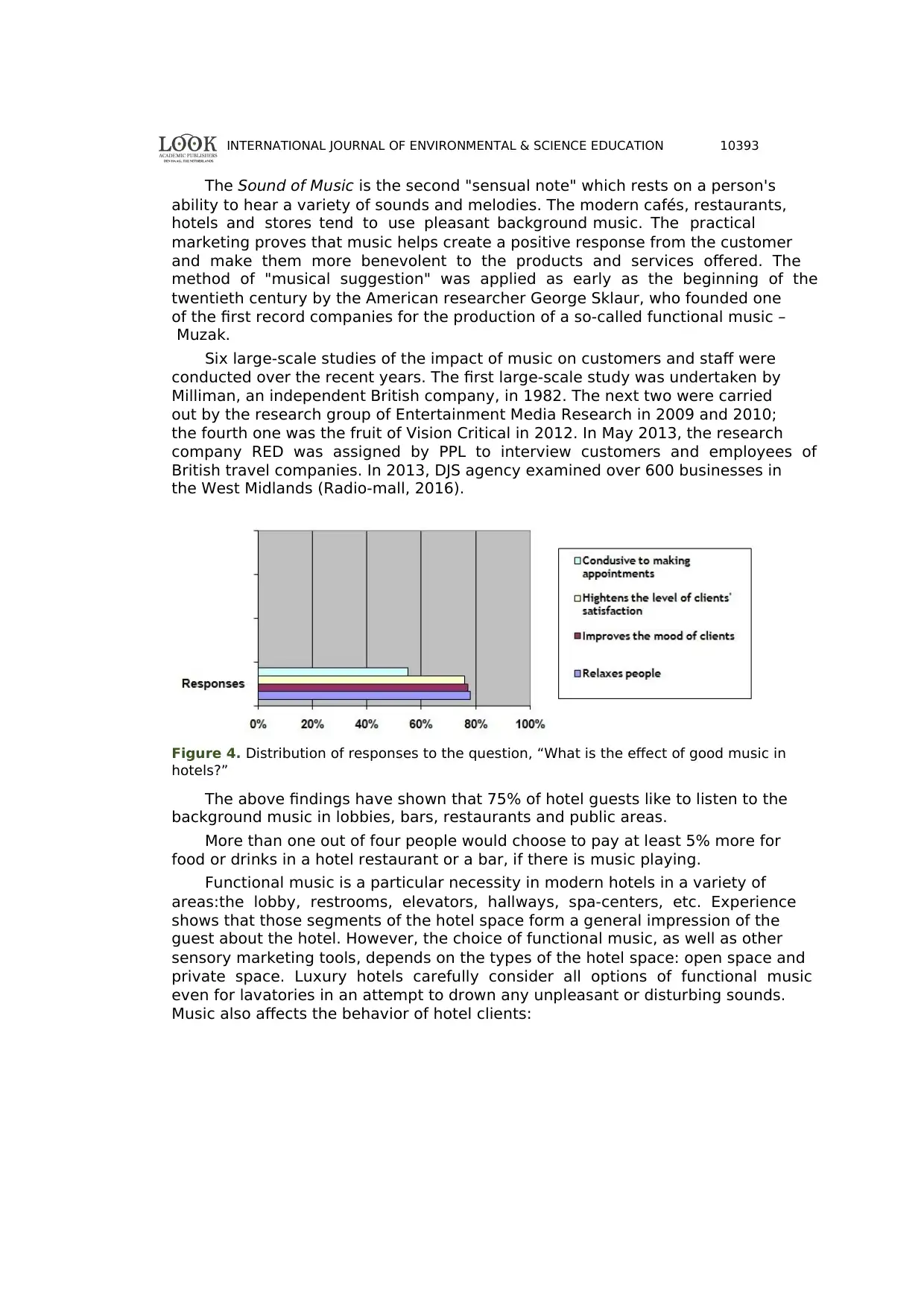
Figure 4. Distribution of responses to the question, “What is the effect of good music in
hotels?”
The above findings have shown that 75% of hotel guests like to listen to the
background music in lobbies, bars, restaurants and public areas.
More than one out of four people would choose to pay at least 5% more for
food or drinks in a hotel restaurant or a bar, if there is music playing.
Functional music is a particular necessity in modern hotels in a variety of
areas:the lobby, restrooms, elevators, hallways, spa-centers, etc. Experience
shows that those segments of the hotel space form a general impression of the
guest about the hotel. However, the choice of functional music, as well as other
sensory marketing tools, depends on the types of the hotel space: open space and
private space. Luxury hotels carefully consider all options of functional music
even for lavatories in an attempt to drown any unpleasant or disturbing sounds.
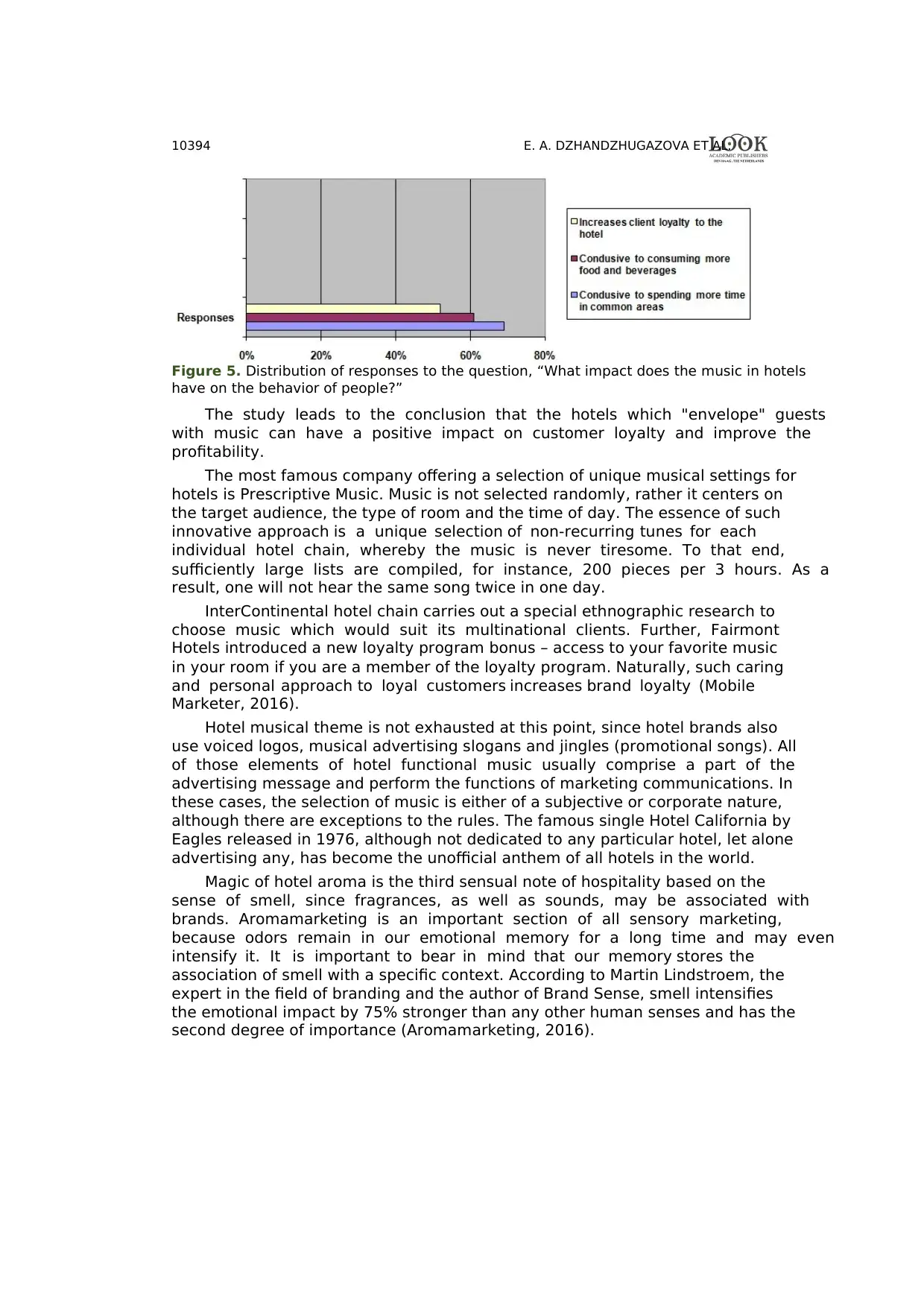
Music also affects the behavior of hotel clients:
Paraphrase This Document
Need a fresh take? Get an instant paraphrase of this document with our AI Paraphraser
10394 E. A. DZHANDZHUGAZOVA ET AL.
Figure 5. Distribution of responses to the question, “What impact does the music in hotels
have on the behavior of people?”
The study leads to the conclusion that the hotels which "envelope" guests
with music can have a positive impact on customer loyalty and improve the
profitability.
The most famous company offering a selection of unique musical settings for
hotels is Prescriptive Music. Music is not selected randomly, rather it centers on
the target audience, the type of room and the time of day. The essence of such
innovative approach is a unique selection of non-recurring tunes for each
individual hotel chain, whereby the music is never tiresome. To that end,
sufficiently large lists are compiled, for instance, 200 pieces per 3 hours. As a
result, one will not hear the same song twice in one day.
InterContinental hotel chain carries out a special ethnographic research to
choose music which would suit its multinational clients. Further, Fairmont
Hotels introduced a new loyalty program bonus – access to your favorite music
in your room if you are a member of the loyalty program. Naturally, such caring
and personal approach to loyal customers increases brand loyalty (Mobile
Marketer, 2016).
Hotel musical theme is not exhausted at this point, since hotel brands also
use voiced logos, musical advertising slogans and jingles (promotional songs). All
of those elements of hotel functional music usually comprise a part of the
advertising message and perform the functions of marketing communications. In
these cases, the selection of music is either of a subjective or corporate nature,
although there are exceptions to the rules. The famous single Hotel California by
Eagles released in 1976, although not dedicated to any particular hotel, let alone
advertising any, has become the unofficial anthem of all hotels in the world.
Magic of hotel aroma is the third sensual note of hospitality based on the
sense of smell, since fragrances, as well as sounds, may be associated with
brands. Aromamarketing is an important section of all sensory marketing,
because odors remain in our emotional memory for a long time and may even
intensify it. It is important to bear in mind that our memory stores the
association of smell with a specific context. According to Martin Lindstroem, the
expert in the field of branding and the author of Brand Sense, smell intensifies
the emotional impact by 75% stronger than any other human senses and has the
second degree of importance (Aromamarketing, 2016).
Figure 5. Distribution of responses to the question, “What impact does the music in hotels
have on the behavior of people?”
The study leads to the conclusion that the hotels which "envelope" guests
with music can have a positive impact on customer loyalty and improve the
profitability.
The most famous company offering a selection of unique musical settings for
hotels is Prescriptive Music. Music is not selected randomly, rather it centers on
the target audience, the type of room and the time of day. The essence of such
innovative approach is a unique selection of non-recurring tunes for each
individual hotel chain, whereby the music is never tiresome. To that end,
sufficiently large lists are compiled, for instance, 200 pieces per 3 hours. As a
result, one will not hear the same song twice in one day.
InterContinental hotel chain carries out a special ethnographic research to
choose music which would suit its multinational clients. Further, Fairmont
Hotels introduced a new loyalty program bonus – access to your favorite music
in your room if you are a member of the loyalty program. Naturally, such caring
and personal approach to loyal customers increases brand loyalty (Mobile
Marketer, 2016).
Hotel musical theme is not exhausted at this point, since hotel brands also
use voiced logos, musical advertising slogans and jingles (promotional songs). All
of those elements of hotel functional music usually comprise a part of the
advertising message and perform the functions of marketing communications. In
these cases, the selection of music is either of a subjective or corporate nature,
although there are exceptions to the rules. The famous single Hotel California by
Eagles released in 1976, although not dedicated to any particular hotel, let alone
advertising any, has become the unofficial anthem of all hotels in the world.
Magic of hotel aroma is the third sensual note of hospitality based on the
sense of smell, since fragrances, as well as sounds, may be associated with
brands. Aromamarketing is an important section of all sensory marketing,
because odors remain in our emotional memory for a long time and may even
intensify it. It is important to bear in mind that our memory stores the
association of smell with a specific context. According to Martin Lindstroem, the
expert in the field of branding and the author of Brand Sense, smell intensifies
the emotional impact by 75% stronger than any other human senses and has the
second degree of importance (Aromamarketing, 2016).
INTERNATIONAL JOURNAL OF ENVIRONMENTAL & SCIENCE EDUCATION 10395
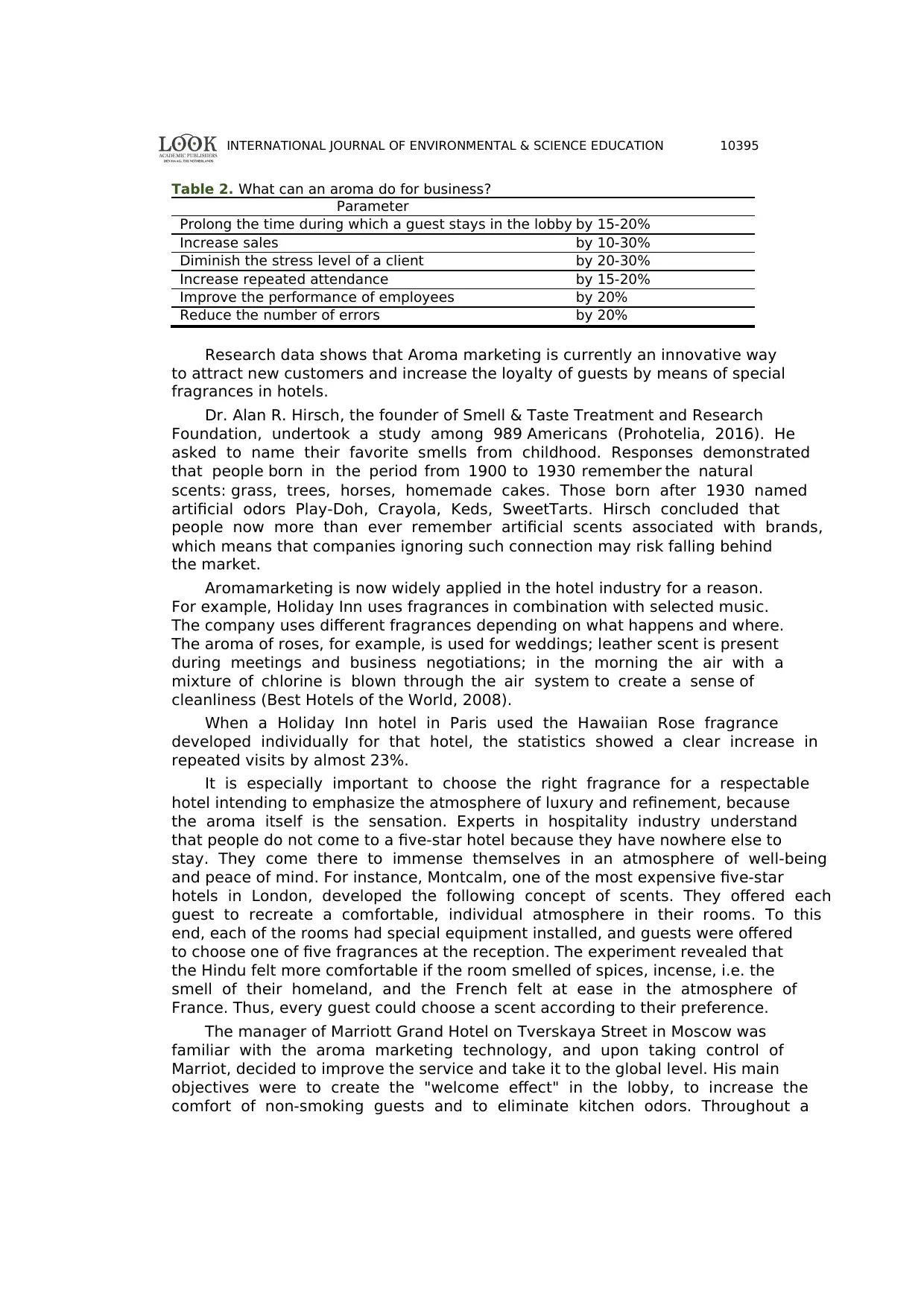
Table 2. What can an aroma do for business?
Parameter
Prolong the time during which a guest stays in the lobby by 15-20%
Increase sales by 10-30%
Diminish the stress level of a client by 20-30%
Increase repeated attendance by 15-20%
Improve the performance of employees by 20%
Reduce the number of errors by 20%
Research data shows that Aroma marketing is currently an innovative way
to attract new customers and increase the loyalty of guests by means of special
fragrances in hotels.
Dr. Alan R. Hirsch, the founder of Smell & Taste Treatment and Research
Foundation, undertook a study among 989 Americans (Prohotelia, 2016). He
asked to name their favorite smells from childhood. Responses demonstrated
that people born in the period from 1900 to 1930 remember the natural
scents: grass, trees, horses, homemade cakes. Those born after 1930 named
artificial odors Play-Doh, Crayola, Keds, SweetTarts. Hirsch concluded that
people now more than ever remember artificial scents associated with brands,
which means that companies ignoring such connection may risk falling behind
the market.
Aromamarketing is now widely applied in the hotel industry for a reason.
For example, Holiday Inn uses fragrances in combination with selected music.
The company uses different fragrances depending on what happens and where.
The aroma of roses, for example, is used for weddings; leather scent is present
during meetings and business negotiations; in the morning the air with a
mixture of chlorine is blown through the air system to create a sense of
cleanliness (Best Hotels of the World, 2008).
When a Holiday Inn hotel in Paris used the Hawaiian Rose fragrance
developed individually for that hotel, the statistics showed a clear increase in
repeated visits by almost 23%.
It is especially important to choose the right fragrance for a respectable
hotel intending to emphasize the atmosphere of luxury and refinement, because
the aroma itself is the sensation. Experts in hospitality industry understand
that people do not come to a five-star hotel because they have nowhere else to
stay. They come there to immense themselves in an atmosphere of well-being
and peace of mind. For instance, Montcalm, one of the most expensive five-star
hotels in London, developed the following concept of scents. They offered each
guest to recreate a comfortable, individual atmosphere in their rooms. To this
end, each of the rooms had special equipment installed, and guests were offered
to choose one of five fragrances at the reception. The experiment revealed that
the Hindu felt more comfortable if the room smelled of spices, incense, i.e. the
smell of their homeland, and the French felt at ease in the atmosphere of
France. Thus, every guest could choose a scent according to their preference.
The manager of Marriott Grand Hotel on Tverskaya Street in Moscow was
familiar with the aroma marketing technology, and upon taking control of
Marriot, decided to improve the service and take it to the global level. His main
objectives were to create the "welcome effect" in the lobby, to increase the
comfort of non-smoking guests and to eliminate kitchen odors. Throughout a
Table 2. What can an aroma do for business?
Parameter
Prolong the time during which a guest stays in the lobby by 15-20%
Increase sales by 10-30%
Diminish the stress level of a client by 20-30%
Increase repeated attendance by 15-20%
Improve the performance of employees by 20%
Reduce the number of errors by 20%
Research data shows that Aroma marketing is currently an innovative way
to attract new customers and increase the loyalty of guests by means of special
fragrances in hotels.
Dr. Alan R. Hirsch, the founder of Smell & Taste Treatment and Research
Foundation, undertook a study among 989 Americans (Prohotelia, 2016). He
asked to name their favorite smells from childhood. Responses demonstrated
that people born in the period from 1900 to 1930 remember the natural
scents: grass, trees, horses, homemade cakes. Those born after 1930 named
artificial odors Play-Doh, Crayola, Keds, SweetTarts. Hirsch concluded that
people now more than ever remember artificial scents associated with brands,
which means that companies ignoring such connection may risk falling behind
the market.
Aromamarketing is now widely applied in the hotel industry for a reason.
For example, Holiday Inn uses fragrances in combination with selected music.
The company uses different fragrances depending on what happens and where.
The aroma of roses, for example, is used for weddings; leather scent is present
during meetings and business negotiations; in the morning the air with a
mixture of chlorine is blown through the air system to create a sense of
cleanliness (Best Hotels of the World, 2008).
When a Holiday Inn hotel in Paris used the Hawaiian Rose fragrance
developed individually for that hotel, the statistics showed a clear increase in
repeated visits by almost 23%.
It is especially important to choose the right fragrance for a respectable
hotel intending to emphasize the atmosphere of luxury and refinement, because
the aroma itself is the sensation. Experts in hospitality industry understand
that people do not come to a five-star hotel because they have nowhere else to
stay. They come there to immense themselves in an atmosphere of well-being
and peace of mind. For instance, Montcalm, one of the most expensive five-star
hotels in London, developed the following concept of scents. They offered each
guest to recreate a comfortable, individual atmosphere in their rooms. To this
end, each of the rooms had special equipment installed, and guests were offered
to choose one of five fragrances at the reception. The experiment revealed that
the Hindu felt more comfortable if the room smelled of spices, incense, i.e. the
smell of their homeland, and the French felt at ease in the atmosphere of
France. Thus, every guest could choose a scent according to their preference.
The manager of Marriott Grand Hotel on Tverskaya Street in Moscow was
familiar with the aroma marketing technology, and upon taking control of
Marriot, decided to improve the service and take it to the global level. His main
objectives were to create the "welcome effect" in the lobby, to increase the
comfort of non-smoking guests and to eliminate kitchen odors. Throughout a
⊘ This is a preview!⊘
Do you want full access?
Subscribe today to unlock all pages.
Trusted by 1+ million students worldwide
10396 E. A. DZHANDZHUGAZOVA ET AL.
year, the aroma technologies of many companies which promised to solve all
problems were tested by Marriot. After three months of testing Marriot signed a
contract with Aromaco for the provision of services, namely aromatization of the
lobby, restaurant areas and the bar. After several months of collaboration
Aromaco experts added the aroma therapeutic "energizing" fragrance to the
basic aroma of figs, which is distributed in the fitness and SPA area (Aromaco,
2016).
Now, upon entering Marriot Grand Hotel, guests are immersed in a
pleasant and delicate aroma of figs, which helps them feel the luxury that is the
hallmark of Marriot hotel chain. And the fitness and SPA area offers guests an
exhilarating and energetic mix of figs and "energizing" aromas, which adds
strength and vigor.
Aroma marketing is essential for Russian hotels because many buildings
were built in Soviet times and now have a specific musty smell, which certainly
does not make the guests happy. Here, the most appropriate method would be to
use nano-aromatizing technology, performing a complete absorption of odors in a
room. Thus, Izmailovo Hotel in Moscow, Vega building, has been using this
innovation for quite a while now.
Taste the hotel is the fourth sensual note of hospitality, where taste is
manifested in cuisine and gastronomic traditions of a hotel. It is common
knowledge that taste sensations as well as smells can evoke associative
connection with some events or objects. Four basic types of taste are sweetness,
bitterness, saltiness and sourness; they are able to render the most subtle and
various sensations, which may likewise be associated with brands. Taste is
indispensible in setting the emotional tone. Taste along with the sense of smell
has proved to affect the sharpness of sight and the acuity of hearing, the degree
of skin sensitivity and overall state of the human emotional sphere. Sweet,
pungent, astringent, tart, slightly sour or bitter tastes create a certain attitude
and complete the sensual picture of the world.
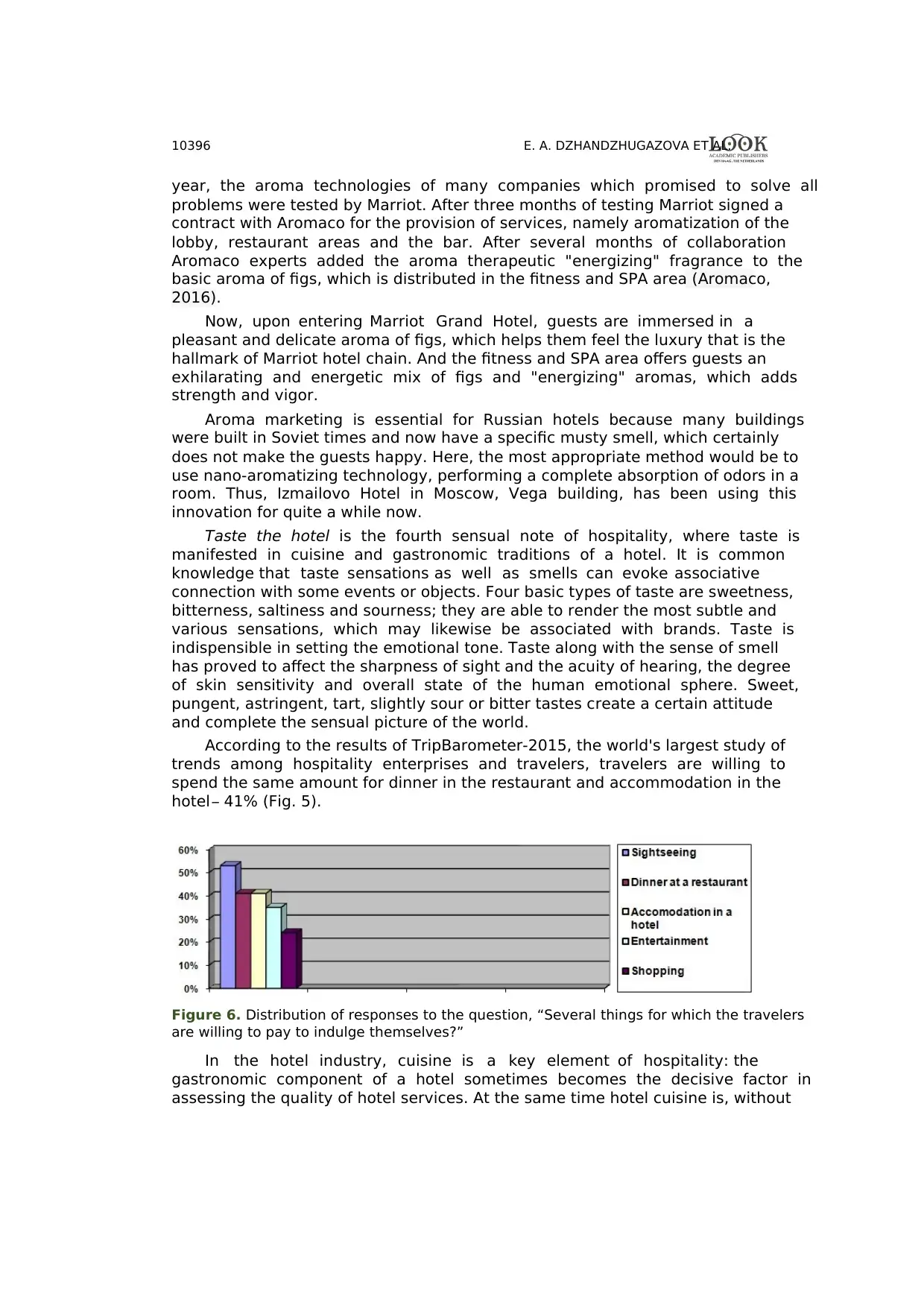
According to the results of TripBarometer-2015, the world's largest study of
trends among hospitality enterprises and travelers, travelers are willing to
spend the same amount for dinner in the restaurant and accommodation in the
hotel – 41% (Fig. 5).
Figure 6. Distribution of responses to the question, “Several things for which the travelers
are willing to pay to indulge themselves?”
In the hotel industry, cuisine is a key element of hospitality: the
gastronomic component of a hotel sometimes becomes the decisive factor in
assessing the quality of hotel services. At the same time hotel cuisine is, without
year, the aroma technologies of many companies which promised to solve all
problems were tested by Marriot. After three months of testing Marriot signed a
contract with Aromaco for the provision of services, namely aromatization of the
lobby, restaurant areas and the bar. After several months of collaboration
Aromaco experts added the aroma therapeutic "energizing" fragrance to the
basic aroma of figs, which is distributed in the fitness and SPA area (Aromaco,
2016).
Now, upon entering Marriot Grand Hotel, guests are immersed in a
pleasant and delicate aroma of figs, which helps them feel the luxury that is the
hallmark of Marriot hotel chain. And the fitness and SPA area offers guests an
exhilarating and energetic mix of figs and "energizing" aromas, which adds
strength and vigor.
Aroma marketing is essential for Russian hotels because many buildings
were built in Soviet times and now have a specific musty smell, which certainly
does not make the guests happy. Here, the most appropriate method would be to
use nano-aromatizing technology, performing a complete absorption of odors in a
room. Thus, Izmailovo Hotel in Moscow, Vega building, has been using this
innovation for quite a while now.
Taste the hotel is the fourth sensual note of hospitality, where taste is
manifested in cuisine and gastronomic traditions of a hotel. It is common
knowledge that taste sensations as well as smells can evoke associative
connection with some events or objects. Four basic types of taste are sweetness,
bitterness, saltiness and sourness; they are able to render the most subtle and
various sensations, which may likewise be associated with brands. Taste is
indispensible in setting the emotional tone. Taste along with the sense of smell
has proved to affect the sharpness of sight and the acuity of hearing, the degree
of skin sensitivity and overall state of the human emotional sphere. Sweet,
pungent, astringent, tart, slightly sour or bitter tastes create a certain attitude
and complete the sensual picture of the world.
According to the results of TripBarometer-2015, the world's largest study of
trends among hospitality enterprises and travelers, travelers are willing to
spend the same amount for dinner in the restaurant and accommodation in the
hotel – 41% (Fig. 5).
Figure 6. Distribution of responses to the question, “Several things for which the travelers
are willing to pay to indulge themselves?”
In the hotel industry, cuisine is a key element of hospitality: the
gastronomic component of a hotel sometimes becomes the decisive factor in
assessing the quality of hotel services. At the same time hotel cuisine is, without
Paraphrase This Document
Need a fresh take? Get an instant paraphrase of this document with our AI Paraphraser
INTERNATIONAL JOURNAL OF ENVIRONMENTAL & SCIENCE EDUCATION 10397
exaggeration, a world of its own created throughout years, decades or even
centuries (Aromagroup, 2016).
The history of the hospitality industry knows examples where a famous
dish or dessert creates the brand of a hotel. Thus, the old Sacher hotel owes its
status as one of the main attractions of the Austrian capital to the famous cake,
which was created by a young pastry chef Franz Sacher. In 1832, the Austrian
Chancellor Metternich was impressed by the taste of that new dessert, and since
then an unknown chef became famous all over Europe. Later he founded a whole
dynasty of confectioners and hoteliers and opened the legendary hotel called
Sacher. Original Sacher– Torte, the famous cake, remains the key advantage of
the hotel. The cake is made according to the original recipe and sold only in the
cafe ofthe hotel– Cafe Sacher Vienna. The recipe of the Original Sacher-Torte
has been kept a secret since its invention in 1832, but anyone can enjoy the
dessert as well asbring the traditional Viennese cake as a souvenir from Austria.
The hotel on the "tip of the fingers"– is based on the fifth sense, i.e. the
sense of touch, allows one to feel the surface of various objects. The perception of
the surrounding elements with the help of touch helps assess their shape, size,
texture, consistency, temperature, dryness or humidity, as well as their position
in space. Tactile (haptic) sensationsare a form of skin sensitivity and may be
manifold, significantly complementing the picture of the world. Furthermore,
the physical contact is essential in selecting goods and service. The feeling of
softness, gloss and cozy warmth of familiar textures give a nostalgic sensation.
This is why digital photos cannot fully replace conventional photographs, and e-
books are no substitutes for paper books with their pleasant rustling pages and
a hard, well-glued spine.
The hotel business never misses the opportunities created by the sense of
touch. An experienced hotelier knows that a guest can learn plenty about the
hotel, or, so to say, "read" it with their fingertips. Bruno Borrione, a designer
who developed the concept of Le Placide hotel in Paris, found an interesting
design solution combining many types of textures. This small hotel emanates
coziness of a family home from its every element, be it the bleached, slightly
rough facade, clay pots rough and porous to the touch, or smooth wooden
shutters. This hotel is quiet and comfortable rather than trendy or pretentious.
There is, however, modesty of the highest quality: velvet sofas, large cushions
with convex patterns one can feel, stone floor with half-worn vintage patterns,
an original staircase with wrought iron railings. (Best Hotels of the World, 2008)
Having described the five sensual notes of hospitality based on our common
sensations–visual, auditory, olfactory, gustatory and tactile– wehave not yet
exhausted the array of human capabilities in the sphere of sensations.
Intuition, called the sixth sense, is important in any business, in the service
sector especially. Intuition, Latin for "contemplation",enables a person to
achieve the necessary understanding of a situation without any logical analysis.
In this case, strict logic gives way to insight, or a so-called "instinct", which
becomes an essential product of past experience. The role of intuition is great
and even indisputable, since intuition is the way for a person to be in the right
place at the right time, make non-standard solutions and find the shortest ways
to the goal, relying on the results of past experience, which are hidden in our sub
consciousness.
exaggeration, a world of its own created throughout years, decades or even
centuries (Aromagroup, 2016).
The history of the hospitality industry knows examples where a famous
dish or dessert creates the brand of a hotel. Thus, the old Sacher hotel owes its
status as one of the main attractions of the Austrian capital to the famous cake,
which was created by a young pastry chef Franz Sacher. In 1832, the Austrian
Chancellor Metternich was impressed by the taste of that new dessert, and since
then an unknown chef became famous all over Europe. Later he founded a whole
dynasty of confectioners and hoteliers and opened the legendary hotel called
Sacher. Original Sacher– Torte, the famous cake, remains the key advantage of
the hotel. The cake is made according to the original recipe and sold only in the
cafe ofthe hotel– Cafe Sacher Vienna. The recipe of the Original Sacher-Torte
has been kept a secret since its invention in 1832, but anyone can enjoy the
dessert as well asbring the traditional Viennese cake as a souvenir from Austria.
The hotel on the "tip of the fingers"– is based on the fifth sense, i.e. the
sense of touch, allows one to feel the surface of various objects. The perception of
the surrounding elements with the help of touch helps assess their shape, size,
texture, consistency, temperature, dryness or humidity, as well as their position
in space. Tactile (haptic) sensationsare a form of skin sensitivity and may be
manifold, significantly complementing the picture of the world. Furthermore,
the physical contact is essential in selecting goods and service. The feeling of
softness, gloss and cozy warmth of familiar textures give a nostalgic sensation.
This is why digital photos cannot fully replace conventional photographs, and e-
books are no substitutes for paper books with their pleasant rustling pages and
a hard, well-glued spine.
The hotel business never misses the opportunities created by the sense of
touch. An experienced hotelier knows that a guest can learn plenty about the
hotel, or, so to say, "read" it with their fingertips. Bruno Borrione, a designer
who developed the concept of Le Placide hotel in Paris, found an interesting
design solution combining many types of textures. This small hotel emanates
coziness of a family home from its every element, be it the bleached, slightly
rough facade, clay pots rough and porous to the touch, or smooth wooden
shutters. This hotel is quiet and comfortable rather than trendy or pretentious.
There is, however, modesty of the highest quality: velvet sofas, large cushions
with convex patterns one can feel, stone floor with half-worn vintage patterns,
an original staircase with wrought iron railings. (Best Hotels of the World, 2008)
Having described the five sensual notes of hospitality based on our common
sensations–visual, auditory, olfactory, gustatory and tactile– wehave not yet
exhausted the array of human capabilities in the sphere of sensations.
Intuition, called the sixth sense, is important in any business, in the service
sector especially. Intuition, Latin for "contemplation",enables a person to
achieve the necessary understanding of a situation without any logical analysis.
In this case, strict logic gives way to insight, or a so-called "instinct", which
becomes an essential product of past experience. The role of intuition is great
and even indisputable, since intuition is the way for a person to be in the right
place at the right time, make non-standard solutions and find the shortest ways
to the goal, relying on the results of past experience, which are hidden in our sub
consciousness.
10398 E. A. DZHANDZHUGAZOVA ET AL.
Tourism market experts have studied the hospitality of European hotels
and determined what countries have hotels which treat their guests in the best
way possible. The friendliness of the serving personnel of the European hotels
was assessed according to a 100-point scale. The survey showed that the most
hospitable personnel in Europe worked at Austrian hotels. In this ranking,
Austria earned 95.5 points. The three leaders also included Italy (95.3) and
Ireland (95.1). The hotels of the northern Europe also differ in their hospitality.
Poland and the Netherlands were ranked next. France earned the 10th place
with its 94.1 points.
Intuition in the hotel business helps personnel to ensure the peace and
safety of their guests even in difficult and unusual situations, providing them
with maximum care and attention. A striking example of intuition in
professional activities is the development of the professional standards of
hospitality and offering guest service within those standards. Any professional
standards are a framework within which people work, but a person is not a
machine and therefore, while observing the prescribed rules, one intuitively feels
the specific aspects of this or that situation, allowing for a quick and correct
decision-making. All professional standards of hospitality are tailored to the
mechanisms of natural human control: the sense of responsibility, empathy,
guilt, pride, etc. But, at the same time, they rest on the common humanitarian
values, and every employee is well aware of that fact.
In particular, the Golden Standards of Hospitality in Ritz-Carlton declare
the necessity of a genuine care and attention to the guests, which means
creating a natural and relaxed atmosphere, telephone etiquette and a
mandatory escort of the guests around the hotel. Those rules must not only be
observed with a mechanical precision, but rather give room to the ability to feel
the situation and make the right decisions. Guests can unfortunately be
challenged and may need the help of the hotel staff. In this case, each employee
of Ritz-Carlton must do their best to comfort the guest and assist them as
quickly as possible even if it is outside their direct duties. For example, a guest
lost his / her luggage and has no personal belongings, or becomes sick, or runs
late for an important meeting; there may be a wide range of difficult situations,
but the personnel must act promptly and reasonably in any of those.
The power of impression is called the "seventh sense". The impression (from
Latin "impressio") is the image, reflection or trace left in the mind of a person by
the surrounding pictures of the world or events. The power of impression always
results from a kind of unique and masterful musical piece, where every "sensual
note" is played.
Upon building its marketing policy, a hotel must weigh the doses of all
sensual elements used as if on the scales. Music, smell, taste, sensitivity of staff,
etc. – at the final stage, all those elements should fall into their places in the
puzzle of the overall impression of the hotel, creating a branded feeling.
Everyone knows the expression "to sink into heart", which means to make a
strong and lasting, perhaps unforgettable, impression. This is the reason why
every hotel aims to ensure that the impression of their guests from staying in
the hotel is not only enjoyable, but also strong. For example, the atmosphere of
Lebombo hotel located in the famous Kruger Park in South Africa can impress
anyone, even the most sophisticated guests (Dzhandzhugazova, 2013).
Everything in the hotel tells the story about an exciting adventure of the life in a
Tourism market experts have studied the hospitality of European hotels
and determined what countries have hotels which treat their guests in the best
way possible. The friendliness of the serving personnel of the European hotels
was assessed according to a 100-point scale. The survey showed that the most
hospitable personnel in Europe worked at Austrian hotels. In this ranking,
Austria earned 95.5 points. The three leaders also included Italy (95.3) and
Ireland (95.1). The hotels of the northern Europe also differ in their hospitality.
Poland and the Netherlands were ranked next. France earned the 10th place
with its 94.1 points.
Intuition in the hotel business helps personnel to ensure the peace and
safety of their guests even in difficult and unusual situations, providing them
with maximum care and attention. A striking example of intuition in
professional activities is the development of the professional standards of
hospitality and offering guest service within those standards. Any professional
standards are a framework within which people work, but a person is not a
machine and therefore, while observing the prescribed rules, one intuitively feels
the specific aspects of this or that situation, allowing for a quick and correct
decision-making. All professional standards of hospitality are tailored to the
mechanisms of natural human control: the sense of responsibility, empathy,
guilt, pride, etc. But, at the same time, they rest on the common humanitarian
values, and every employee is well aware of that fact.
In particular, the Golden Standards of Hospitality in Ritz-Carlton declare
the necessity of a genuine care and attention to the guests, which means
creating a natural and relaxed atmosphere, telephone etiquette and a
mandatory escort of the guests around the hotel. Those rules must not only be
observed with a mechanical precision, but rather give room to the ability to feel
the situation and make the right decisions. Guests can unfortunately be
challenged and may need the help of the hotel staff. In this case, each employee
of Ritz-Carlton must do their best to comfort the guest and assist them as
quickly as possible even if it is outside their direct duties. For example, a guest
lost his / her luggage and has no personal belongings, or becomes sick, or runs
late for an important meeting; there may be a wide range of difficult situations,
but the personnel must act promptly and reasonably in any of those.
The power of impression is called the "seventh sense". The impression (from
Latin "impressio") is the image, reflection or trace left in the mind of a person by
the surrounding pictures of the world or events. The power of impression always
results from a kind of unique and masterful musical piece, where every "sensual
note" is played.
Upon building its marketing policy, a hotel must weigh the doses of all
sensual elements used as if on the scales. Music, smell, taste, sensitivity of staff,
etc. – at the final stage, all those elements should fall into their places in the
puzzle of the overall impression of the hotel, creating a branded feeling.
Everyone knows the expression "to sink into heart", which means to make a
strong and lasting, perhaps unforgettable, impression. This is the reason why
every hotel aims to ensure that the impression of their guests from staying in
the hotel is not only enjoyable, but also strong. For example, the atmosphere of
Lebombo hotel located in the famous Kruger Park in South Africa can impress
anyone, even the most sophisticated guests (Dzhandzhugazova, 2013).
Everything in the hotel tells the story about an exciting adventure of the life in a
⊘ This is a preview!⊘
Do you want full access?
Subscribe today to unlock all pages.
Trusted by 1+ million students worldwide

1 out of 14


Related Documents


Your All-in-One AI-Powered Toolkit for Academic Success.
+13062052269
info@desklib.com
Available 24*7 on WhatsApp / Email
![[object Object]](/_next/static/media/star-bottom.7253800d.svg)
Unlock your academic potential
Copyright © 2020–2026 A2Z Services. All Rights Reserved. Developed and managed by ZUCOL.