INS517: Semler's Leadership & Management in Organization

Verified

Added on  2022/12/27

|4
|819
|92
Essay
AI Summary
This essay provides an analysis of Ricardo Semler's leadership styles, contrasting his early "iron fist" approach with his later democratic management style. The essay examines the impact of these styles on organizational behavior and productivity, including the implementation of employee empowerment and decision-making. It explores the applicability of Semler's methods to a chosen organization, drawing comparisons with behavioral leadership theory. The essay concludes with an overall evaluation of Semler's approach and recommendations for its application in different business environments. The provided solution is a student's assignment, which is published on Desklib, a platform offering AI-based study tools and resources for students.
Document Page
0
Running Head: Organization Behaviour
ORGANIZATIONAL BEHAVIOUR
tabler-icon-diamond-filled.svg

Paraphrase This Document

Need a fresh take? Get an instant paraphrase of this document with our AI Paraphraser
Document Page
1
Organization Behaviour
Identification of the issue
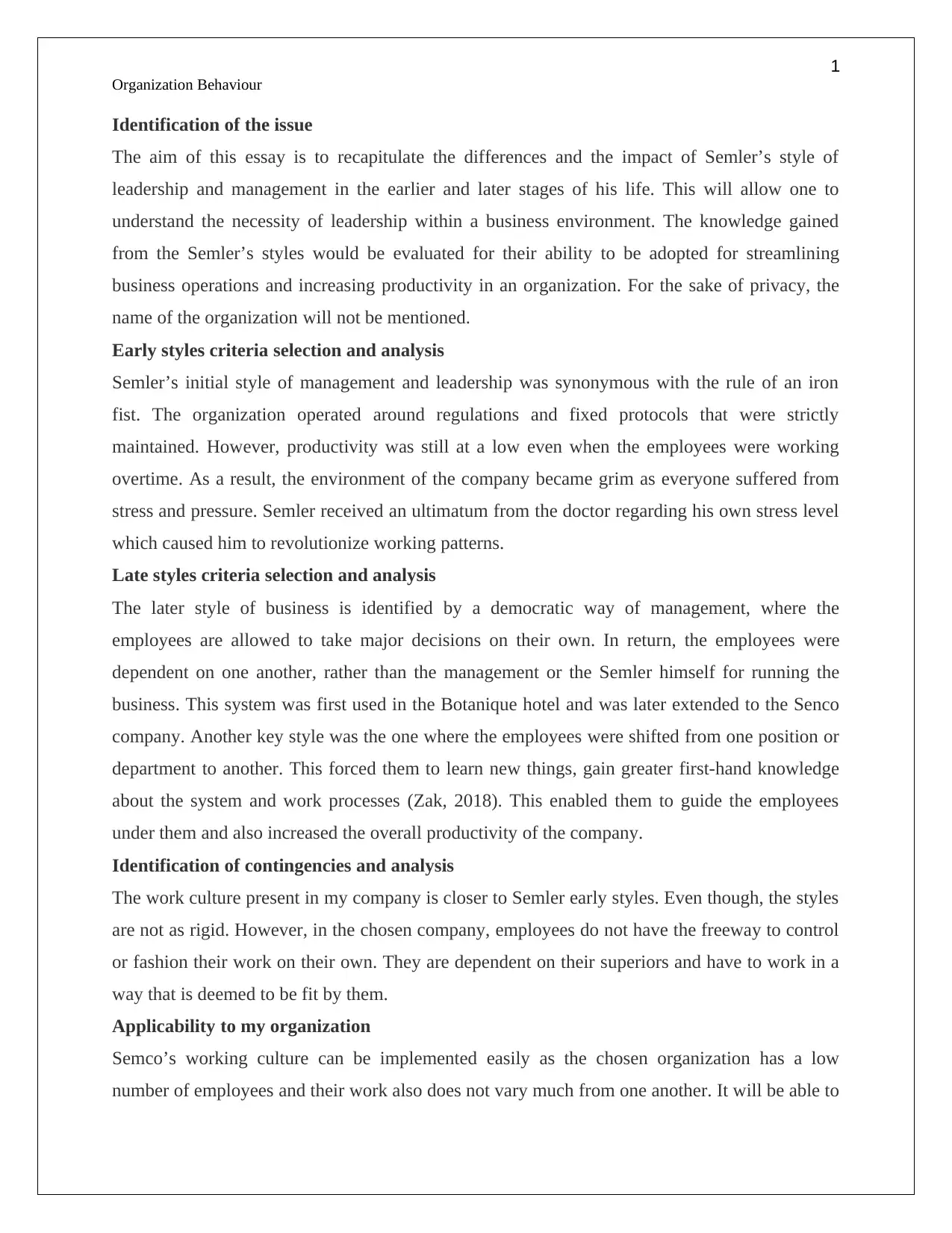
The aim of this essay is to recapitulate the differences and the impact of Semler’s style of
leadership and management in the earlier and later stages of his life. This will allow one to
understand the necessity of leadership within a business environment. The knowledge gained
from the Semler’s styles would be evaluated for their ability to be adopted for streamlining
business operations and increasing productivity in an organization. For the sake of privacy, the
name of the organization will not be mentioned.
Early styles criteria selection and analysis
Semler’s initial style of management and leadership was synonymous with the rule of an iron
fist. The organization operated around regulations and fixed protocols that were strictly
maintained. However, productivity was still at a low even when the employees were working
overtime. As a result, the environment of the company became grim as everyone suffered from
stress and pressure. Semler received an ultimatum from the doctor regarding his own stress level
which caused him to revolutionize working patterns.
Late styles criteria selection and analysis
The later style of business is identified by a democratic way of management, where the
employees are allowed to take major decisions on their own. In return, the employees were
dependent on one another, rather than the management or the Semler himself for running the
business. This system was first used in the Botanique hotel and was later extended to the Senco
company. Another key style was the one where the employees were shifted from one position or
department to another. This forced them to learn new things, gain greater first-hand knowledge
about the system and work processes (Zak, 2018). This enabled them to guide the employees
under them and also increased the overall productivity of the company.
Identification of contingencies and analysis
The work culture present in my company is closer to Semler early styles. Even though, the styles
are not as rigid. However, in the chosen company, employees do not have the freeway to control
or fashion their work on their own. They are dependent on their superiors and have to work in a
way that is deemed to be fit by them.
Applicability to my organization
Semco’s working culture can be implemented easily as the chosen organization has a low
number of employees and their work also does not vary much from one another. It will be able to
Document Page
2
Organization Behaviour
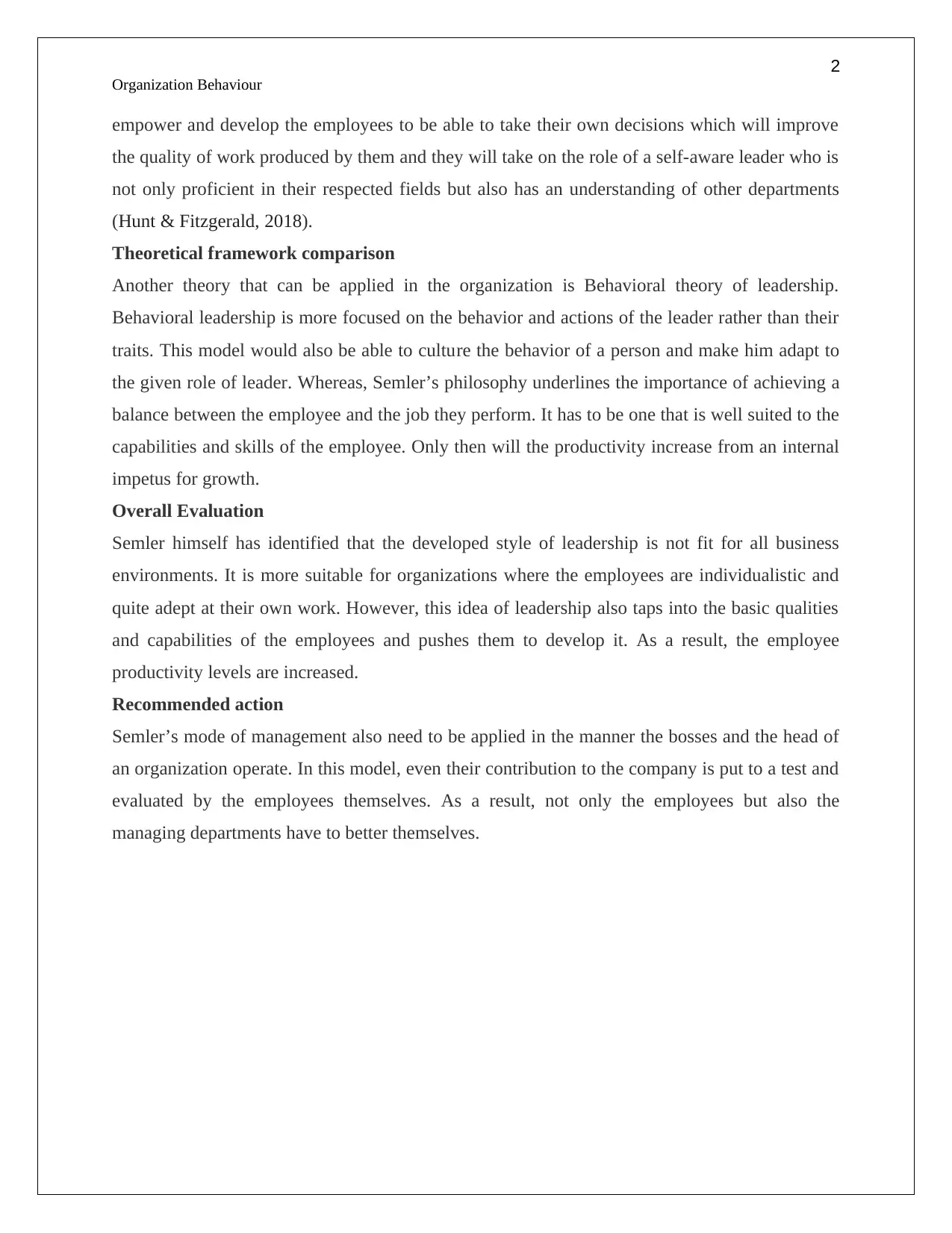
empower and develop the employees to be able to take their own decisions which will improve
the quality of work produced by them and they will take on the role of a self-aware leader who is
not only proficient in their respected fields but also has an understanding of other departments
(Hunt & Fitzgerald, 2018).
Theoretical framework comparison
Another theory that can be applied in the organization is Behavioral theory of leadership.
Behavioral leadership is more focused on the behavior and actions of the leader rather than their
traits. This model would also be able to culture the behavior of a person and make him adapt to
the given role of leader. Whereas, Semler’s philosophy underlines the importance of achieving a
balance between the employee and the job they perform. It has to be one that is well suited to the
capabilities and skills of the employee. Only then will the productivity increase from an internal
impetus for growth.
Overall Evaluation
Semler himself has identified that the developed style of leadership is not fit for all business
environments. It is more suitable for organizations where the employees are individualistic and
quite adept at their own work. However, this idea of leadership also taps into the basic qualities
and capabilities of the employees and pushes them to develop it. As a result, the employee
productivity levels are increased.
Recommended action
Semler’s mode of management also need to be applied in the manner the bosses and the head of
an organization operate. In this model, even their contribution to the company is put to a test and
evaluated by the employees themselves. As a result, not only the employees but also the
managing departments have to better themselves.
Document Page
3
Organization Behaviour
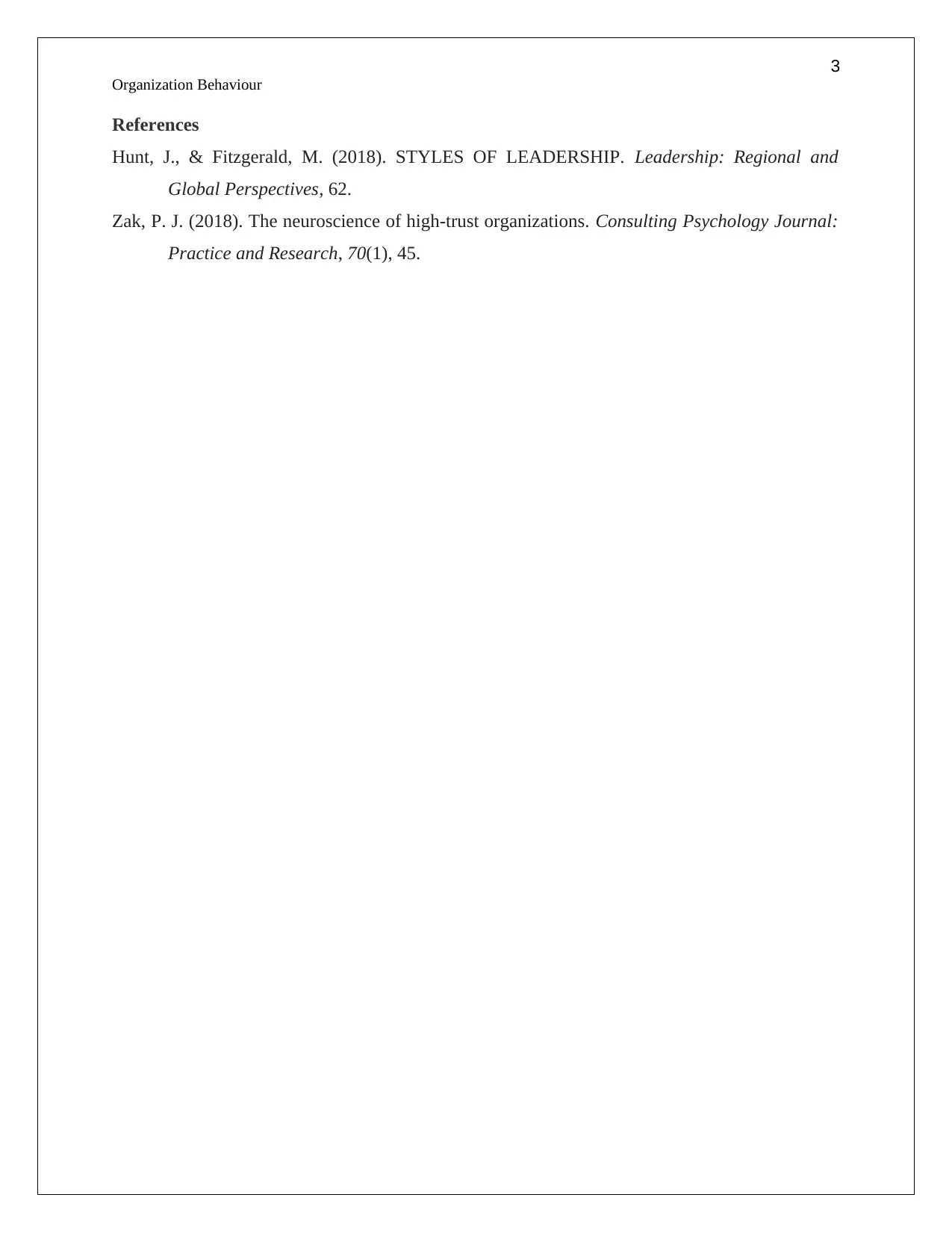
References
Hunt, J., & Fitzgerald, M. (2018). STYLES OF LEADERSHIP. Leadership: Regional and
Global Perspectives, 62.
Zak, P. J. (2018). The neuroscience of high-trust organizations. Consulting Psychology Journal:
Practice and Research, 70(1), 45.
chevron_up_icon
1 out of 4
circle_padding
hide_on_mobile
zoom_out_icon
[object Object]