Accounting 350 Case Study: Fraud Case Analysis of Zarmoon Inshanalli
VerifiedAdded on 2020/05/16
|4
|1226
|351
Case Study
AI Summary
This case study analyzes the fraud committed by Zarmoon Inshanalli, a bookkeeper who embezzled funds from her employers. The analysis delves into the facts of the case, including Inshanalli's history of fraudulent activities, her methods of operation, and the legal consequences she faced. The assignment then applies various theoretical frameworks, such as the Fraud Triangle and the Fraud Scale, to understand the motivations and opportunities that led to the fraud. It explores the role of perceived pressure, opportunity, and rationalization in Inshanalli's actions, as well as the importance of ethics and integrity. Furthermore, the study examines the application of the rationalization theory to explain criminal behavior, highlighting how the offender's gambling addiction and past experiences influenced her decisions. The case concludes by emphasizing the importance of identifying the nature of the fraudster to optimize the application of these theories in explaining the behaviors, providing a comprehensive overview of the causes and consequences of financial fraud.
Fraud Case Analysis-Zarmoon Inshanalli
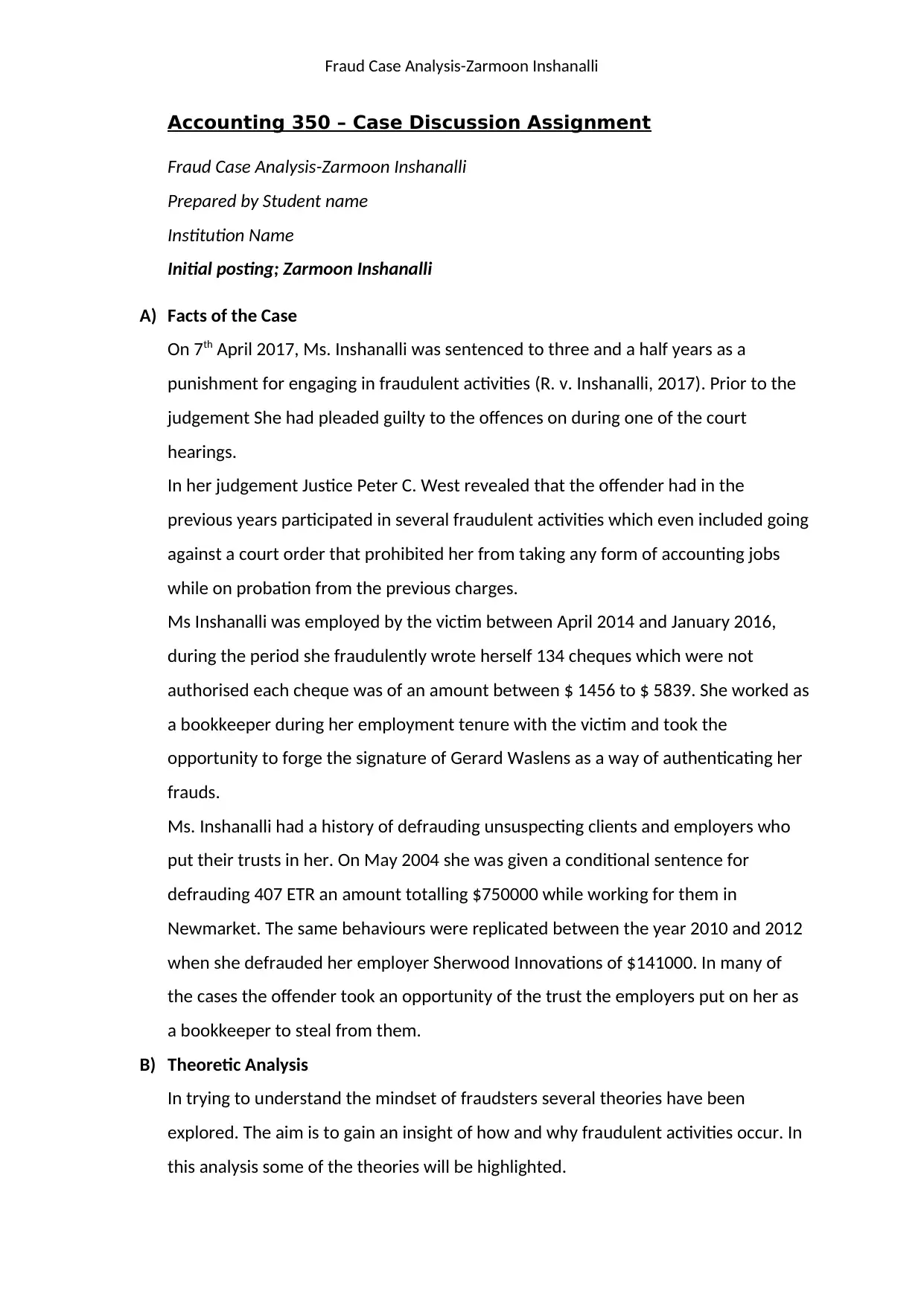
Accounting 350 – Case Discussion Assignment
Fraud Case Analysis-Zarmoon Inshanalli
Prepared by Student name
Institution Name
Initial posting; Zarmoon Inshanalli
A) Facts of the Case
On 7th April 2017, Ms. Inshanalli was sentenced to three and a half years as a
punishment for engaging in fraudulent activities (R. v. Inshanalli, 2017). Prior to the
judgement She had pleaded guilty to the offences on during one of the court
hearings.
In her judgement Justice Peter C. West revealed that the offender had in the
previous years participated in several fraudulent activities which even included going
against a court order that prohibited her from taking any form of accounting jobs
while on probation from the previous charges.
Ms Inshanalli was employed by the victim between April 2014 and January 2016,
during the period she fraudulently wrote herself 134 cheques which were not
authorised each cheque was of an amount between $ 1456 to $ 5839. She worked as
a bookkeeper during her employment tenure with the victim and took the
opportunity to forge the signature of Gerard Waslens as a way of authenticating her
frauds.
Ms. Inshanalli had a history of defrauding unsuspecting clients and employers who
put their trusts in her. On May 2004 she was given a conditional sentence for
defrauding 407 ETR an amount totalling $750000 while working for them in
Newmarket. The same behaviours were replicated between the year 2010 and 2012
when she defrauded her employer Sherwood Innovations of $141000. In many of
the cases the offender took an opportunity of the trust the employers put on her as
a bookkeeper to steal from them.
B) Theoretic Analysis
In trying to understand the mindset of fraudsters several theories have been
explored. The aim is to gain an insight of how and why fraudulent activities occur. In
this analysis some of the theories will be highlighted.
Accounting 350 – Case Discussion Assignment
Fraud Case Analysis-Zarmoon Inshanalli
Prepared by Student name
Institution Name
Initial posting; Zarmoon Inshanalli
A) Facts of the Case
On 7th April 2017, Ms. Inshanalli was sentenced to three and a half years as a
punishment for engaging in fraudulent activities (R. v. Inshanalli, 2017). Prior to the
judgement She had pleaded guilty to the offences on during one of the court
hearings.
In her judgement Justice Peter C. West revealed that the offender had in the
previous years participated in several fraudulent activities which even included going
against a court order that prohibited her from taking any form of accounting jobs
while on probation from the previous charges.
Ms Inshanalli was employed by the victim between April 2014 and January 2016,
during the period she fraudulently wrote herself 134 cheques which were not
authorised each cheque was of an amount between $ 1456 to $ 5839. She worked as
a bookkeeper during her employment tenure with the victim and took the
opportunity to forge the signature of Gerard Waslens as a way of authenticating her
frauds.
Ms. Inshanalli had a history of defrauding unsuspecting clients and employers who
put their trusts in her. On May 2004 she was given a conditional sentence for
defrauding 407 ETR an amount totalling $750000 while working for them in
Newmarket. The same behaviours were replicated between the year 2010 and 2012
when she defrauded her employer Sherwood Innovations of $141000. In many of
the cases the offender took an opportunity of the trust the employers put on her as
a bookkeeper to steal from them.
B) Theoretic Analysis
In trying to understand the mindset of fraudsters several theories have been
explored. The aim is to gain an insight of how and why fraudulent activities occur. In
this analysis some of the theories will be highlighted.
Paraphrase This Document
Need a fresh take? Get an instant paraphrase of this document with our AI Paraphraser

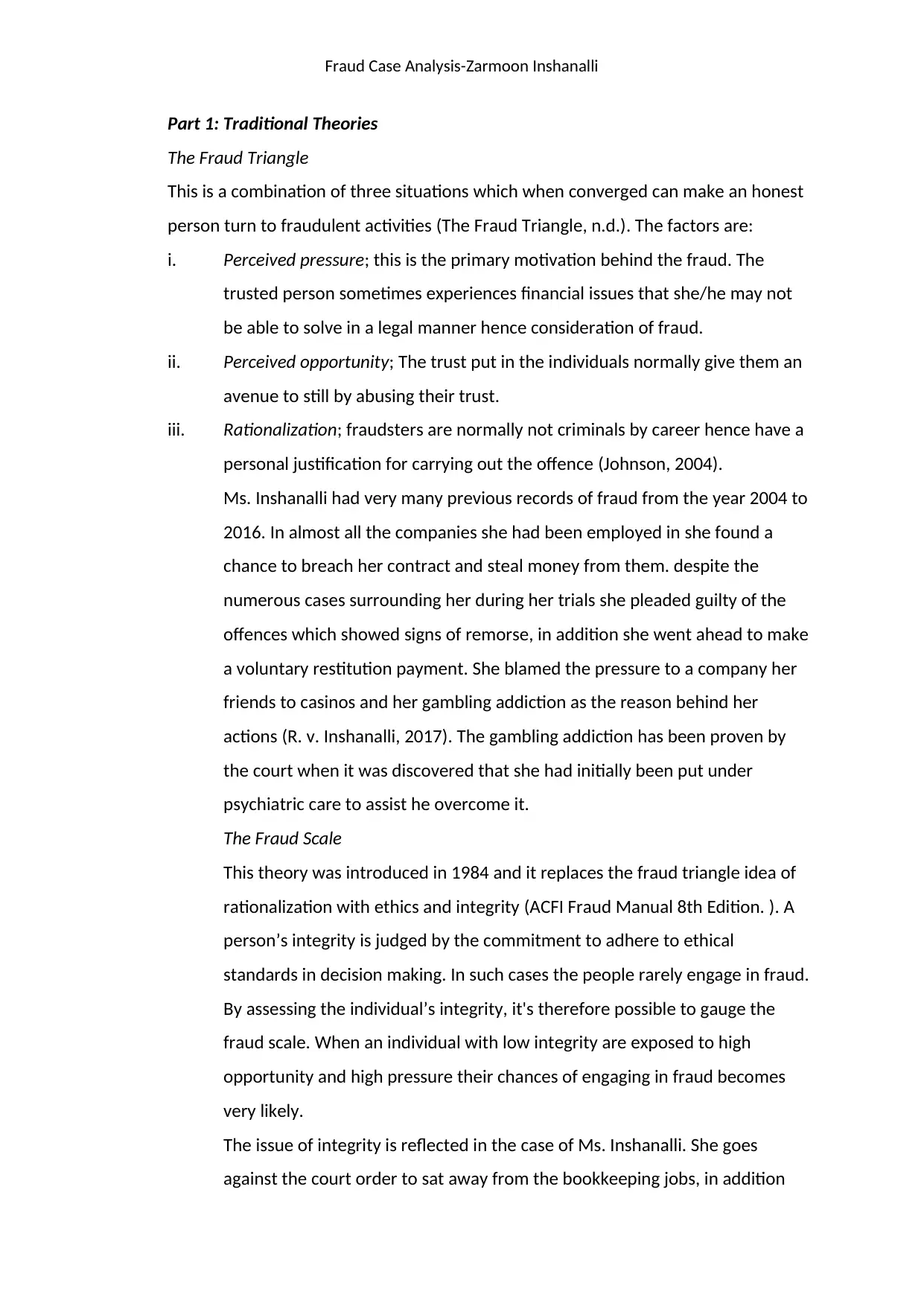
Fraud Case Analysis-Zarmoon Inshanalli
Part 1: Traditional Theories
The Fraud Triangle
This is a combination of three situations which when converged can make an honest
person turn to fraudulent activities (The Fraud Triangle, n.d.). The factors are:
i. Perceived pressure; this is the primary motivation behind the fraud. The
trusted person sometimes experiences financial issues that she/he may not
be able to solve in a legal manner hence consideration of fraud.
ii. Perceived opportunity; The trust put in the individuals normally give them an
avenue to still by abusing their trust.
iii. Rationalization; fraudsters are normally not criminals by career hence have a
personal justification for carrying out the offence (Johnson, 2004).
Ms. Inshanalli had very many previous records of fraud from the year 2004 to
2016. In almost all the companies she had been employed in she found a
chance to breach her contract and steal money from them. despite the
numerous cases surrounding her during her trials she pleaded guilty of the
offences which showed signs of remorse, in addition she went ahead to make
a voluntary restitution payment. She blamed the pressure to a company her
friends to casinos and her gambling addiction as the reason behind her
actions (R. v. Inshanalli, 2017). The gambling addiction has been proven by
the court when it was discovered that she had initially been put under
psychiatric care to assist he overcome it.
The Fraud Scale
This theory was introduced in 1984 and it replaces the fraud triangle idea of
rationalization with ethics and integrity (ACFI Fraud Manual 8th Edition. ). A
person’s integrity is judged by the commitment to adhere to ethical
standards in decision making. In such cases the people rarely engage in fraud.
By assessing the individual’s integrity, it's therefore possible to gauge the
fraud scale. When an individual with low integrity are exposed to high
opportunity and high pressure their chances of engaging in fraud becomes
very likely.
The issue of integrity is reflected in the case of Ms. Inshanalli. She goes
against the court order to sat away from the bookkeeping jobs, in addition
Part 1: Traditional Theories
The Fraud Triangle
This is a combination of three situations which when converged can make an honest
person turn to fraudulent activities (The Fraud Triangle, n.d.). The factors are:
i. Perceived pressure; this is the primary motivation behind the fraud. The
trusted person sometimes experiences financial issues that she/he may not
be able to solve in a legal manner hence consideration of fraud.
ii. Perceived opportunity; The trust put in the individuals normally give them an
avenue to still by abusing their trust.
iii. Rationalization; fraudsters are normally not criminals by career hence have a
personal justification for carrying out the offence (Johnson, 2004).
Ms. Inshanalli had very many previous records of fraud from the year 2004 to
2016. In almost all the companies she had been employed in she found a
chance to breach her contract and steal money from them. despite the
numerous cases surrounding her during her trials she pleaded guilty of the
offences which showed signs of remorse, in addition she went ahead to make
a voluntary restitution payment. She blamed the pressure to a company her
friends to casinos and her gambling addiction as the reason behind her
actions (R. v. Inshanalli, 2017). The gambling addiction has been proven by
the court when it was discovered that she had initially been put under
psychiatric care to assist he overcome it.
The Fraud Scale
This theory was introduced in 1984 and it replaces the fraud triangle idea of
rationalization with ethics and integrity (ACFI Fraud Manual 8th Edition. ). A
person’s integrity is judged by the commitment to adhere to ethical
standards in decision making. In such cases the people rarely engage in fraud.
By assessing the individual’s integrity, it's therefore possible to gauge the
fraud scale. When an individual with low integrity are exposed to high
opportunity and high pressure their chances of engaging in fraud becomes
very likely.
The issue of integrity is reflected in the case of Ms. Inshanalli. She goes
against the court order to sat away from the bookkeeping jobs, in addition

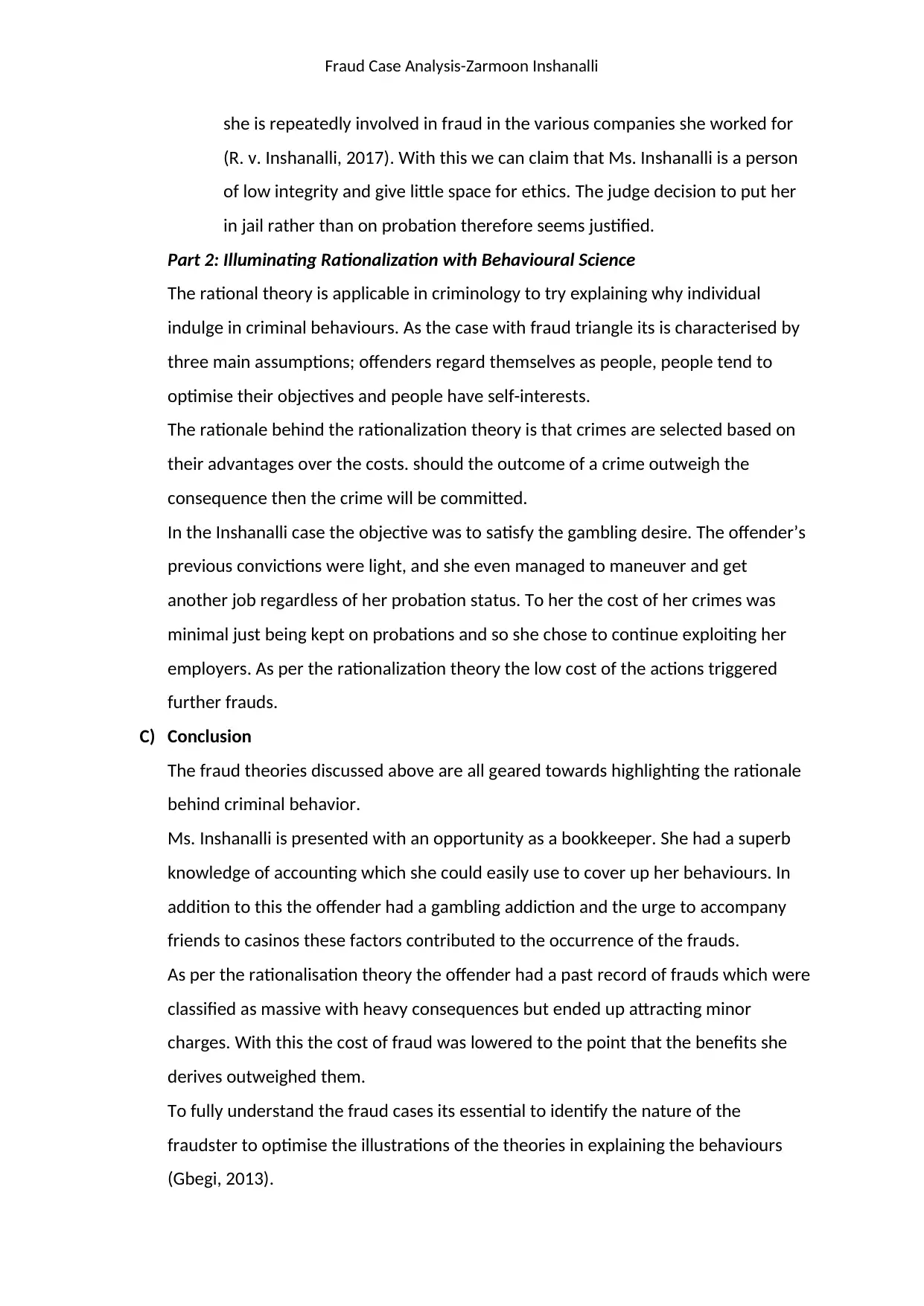
Fraud Case Analysis-Zarmoon Inshanalli
she is repeatedly involved in fraud in the various companies she worked for
(R. v. Inshanalli, 2017). With this we can claim that Ms. Inshanalli is a person
of low integrity and give little space for ethics. The judge decision to put her
in jail rather than on probation therefore seems justified.
Part 2: Illuminating Rationalization with Behavioural Science
The rational theory is applicable in criminology to try explaining why individual
indulge in criminal behaviours. As the case with fraud triangle its is characterised by
three main assumptions; offenders regard themselves as people, people tend to
optimise their objectives and people have self-interests.
The rationale behind the rationalization theory is that crimes are selected based on
their advantages over the costs. should the outcome of a crime outweigh the
consequence then the crime will be committed.
In the Inshanalli case the objective was to satisfy the gambling desire. The offender’s
previous convictions were light, and she even managed to maneuver and get
another job regardless of her probation status. To her the cost of her crimes was
minimal just being kept on probations and so she chose to continue exploiting her
employers. As per the rationalization theory the low cost of the actions triggered
further frauds.
C) Conclusion
The fraud theories discussed above are all geared towards highlighting the rationale
behind criminal behavior.
Ms. Inshanalli is presented with an opportunity as a bookkeeper. She had a superb
knowledge of accounting which she could easily use to cover up her behaviours. In
addition to this the offender had a gambling addiction and the urge to accompany
friends to casinos these factors contributed to the occurrence of the frauds.
As per the rationalisation theory the offender had a past record of frauds which were
classified as massive with heavy consequences but ended up attracting minor
charges. With this the cost of fraud was lowered to the point that the benefits she
derives outweighed them.
To fully understand the fraud cases its essential to identify the nature of the
fraudster to optimise the illustrations of the theories in explaining the behaviours
(Gbegi, 2013).
she is repeatedly involved in fraud in the various companies she worked for
(R. v. Inshanalli, 2017). With this we can claim that Ms. Inshanalli is a person
of low integrity and give little space for ethics. The judge decision to put her
in jail rather than on probation therefore seems justified.
Part 2: Illuminating Rationalization with Behavioural Science
The rational theory is applicable in criminology to try explaining why individual
indulge in criminal behaviours. As the case with fraud triangle its is characterised by
three main assumptions; offenders regard themselves as people, people tend to
optimise their objectives and people have self-interests.
The rationale behind the rationalization theory is that crimes are selected based on
their advantages over the costs. should the outcome of a crime outweigh the
consequence then the crime will be committed.
In the Inshanalli case the objective was to satisfy the gambling desire. The offender’s
previous convictions were light, and she even managed to maneuver and get
another job regardless of her probation status. To her the cost of her crimes was
minimal just being kept on probations and so she chose to continue exploiting her
employers. As per the rationalization theory the low cost of the actions triggered
further frauds.
C) Conclusion
The fraud theories discussed above are all geared towards highlighting the rationale
behind criminal behavior.
Ms. Inshanalli is presented with an opportunity as a bookkeeper. She had a superb
knowledge of accounting which she could easily use to cover up her behaviours. In
addition to this the offender had a gambling addiction and the urge to accompany
friends to casinos these factors contributed to the occurrence of the frauds.
As per the rationalisation theory the offender had a past record of frauds which were
classified as massive with heavy consequences but ended up attracting minor
charges. With this the cost of fraud was lowered to the point that the benefits she
derives outweighed them.
To fully understand the fraud cases its essential to identify the nature of the
fraudster to optimise the illustrations of the theories in explaining the behaviours
(Gbegi, 2013).
⊘ This is a preview!⊘
Do you want full access?
Subscribe today to unlock all pages.

Trusted by 1+ million students worldwide

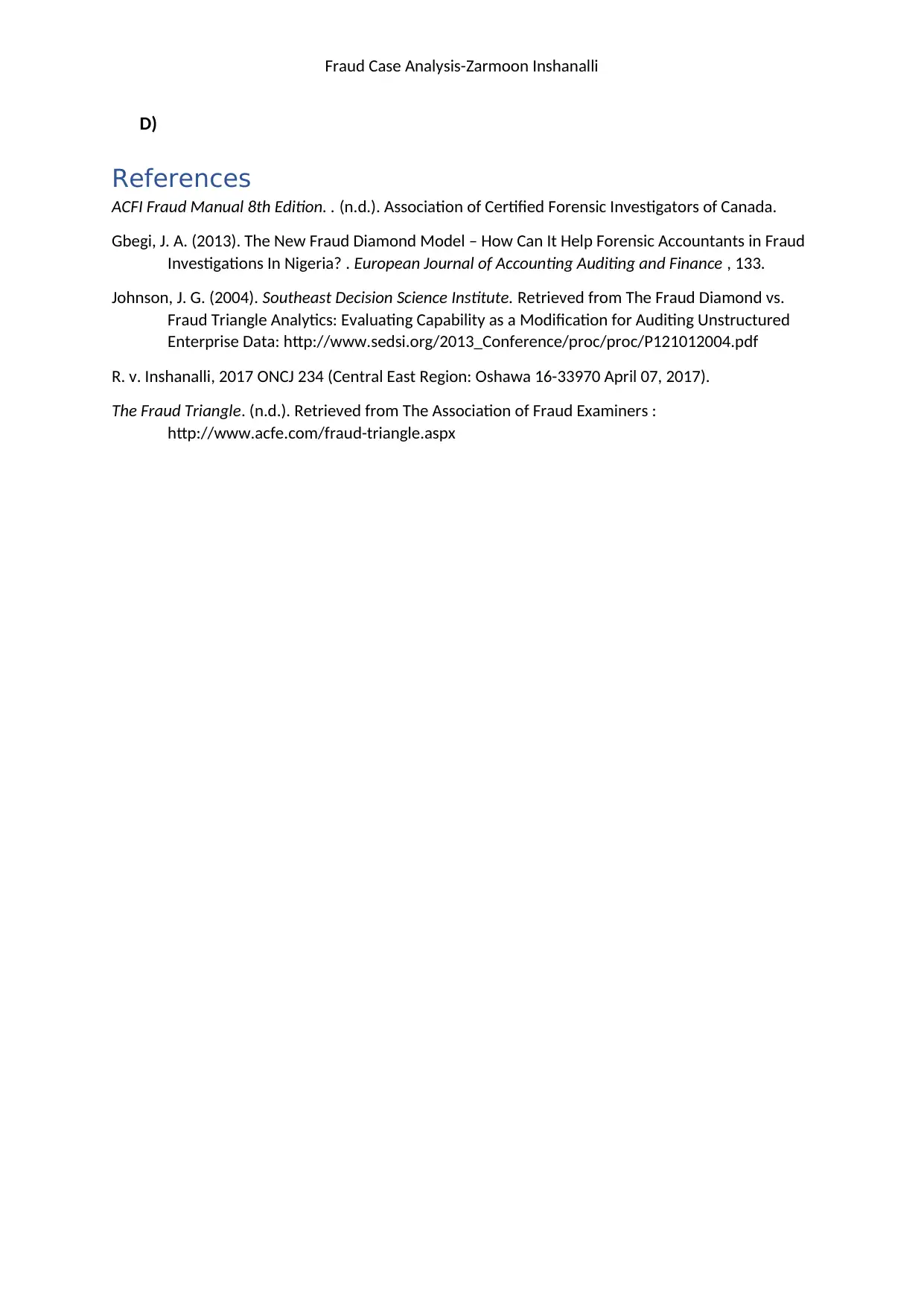
Fraud Case Analysis-Zarmoon Inshanalli
D)
References
ACFI Fraud Manual 8th Edition. . (n.d.). Association of Certified Forensic Investigators of Canada.
Gbegi, J. A. (2013). The New Fraud Diamond Model – How Can It Help Forensic Accountants in Fraud
Investigations In Nigeria? . European Journal of Accounting Auditing and Finance , 133.
Johnson, J. G. (2004). Southeast Decision Science Institute. Retrieved from The Fraud Diamond vs.
Fraud Triangle Analytics: Evaluating Capability as a Modification for Auditing Unstructured
Enterprise Data: http://www.sedsi.org/2013_Conference/proc/proc/P121012004.pdf
R. v. Inshanalli, 2017 ONCJ 234 (Central East Region: Oshawa 16-33970 April 07, 2017).
The Fraud Triangle. (n.d.). Retrieved from The Association of Fraud Examiners :
http://www.acfe.com/fraud-triangle.aspx
D)
References
ACFI Fraud Manual 8th Edition. . (n.d.). Association of Certified Forensic Investigators of Canada.
Gbegi, J. A. (2013). The New Fraud Diamond Model – How Can It Help Forensic Accountants in Fraud
Investigations In Nigeria? . European Journal of Accounting Auditing and Finance , 133.
Johnson, J. G. (2004). Southeast Decision Science Institute. Retrieved from The Fraud Diamond vs.
Fraud Triangle Analytics: Evaluating Capability as a Modification for Auditing Unstructured
Enterprise Data: http://www.sedsi.org/2013_Conference/proc/proc/P121012004.pdf
R. v. Inshanalli, 2017 ONCJ 234 (Central East Region: Oshawa 16-33970 April 07, 2017).
The Fraud Triangle. (n.d.). Retrieved from The Association of Fraud Examiners :
http://www.acfe.com/fraud-triangle.aspx
1 out of 4
Your All-in-One AI-Powered Toolkit for Academic Success.
+13062052269
info@desklib.com
Available 24*7 on WhatsApp / Email
Unlock your academic potential
Copyright © 2020–2025 A2Z Services. All Rights Reserved. Developed and managed by ZUCOL.