Institution: Exploring the Core Qualities of Effective Leadership
VerifiedAdded on 2023/06/11
|7
|1504
|145
Essay
AI Summary
This essay discusses the key qualities of effective leadership, arguing that strong leadership is founded on traits such as maintaining a positive attitude, empowering subordinates through delegation, displaying a high level of confidence, and making decisions based on past lessons. The essay highlights the importance of positivity in energizing employees and maintaining a motivated atmosphere, even during challenging times. It also emphasizes the significance of delegation and empowerment in fostering trust and loyalty within an organization, citing examples like Steve Jobs' delegation to Tim Cook. Confidence is presented as a crucial factor in inspiring subordinates and setting the right tone for the organization, while learning from past experiences is shown to be vital for informed decision-making, using Warren Buffet as an example. The conclusion reinforces these qualities, referencing leaders like Ruimin Zhang and Steve Jobs as embodiments of effective leadership.

LEADERSHIP 1
LEADERSHIP
By
Institution
Instructor
Course
Date
LEADERSHIP
By
Institution
Instructor
Course
Date
Paraphrase This Document
Need a fresh take? Get an instant paraphrase of this document with our AI Paraphraser

LEADERSHIP 2
Introduction
Effective leadership is one of the critical aspects of an organization. Some of the most
successful organizations globally have achieved much of their success because of the input of
their leaders. Multinational Organizations like Apple Inc, Microsoft Corporation, and Haier
Group have had much of their success because of the important roles played by their leaders
(Shah and Mulla, 2013). Leadership refers to the process of leading people towards the
realization of certain objectives. The effectiveness of leaders is based on certain traits and
qualities that they possess. Thesis statement: Strong leadership is founded on certain qualities.
Staying positive even in most challenging situations; Staying positive is one of the
most important qualities of leadership. Because of the central role that leaders play, their general
attitude is likely to be reflected in their employees (Amram, 2009). Positivity is therefore not
only important for a leader but for the entire organization, it plays a major role in energizing
everybody around the organization. Some of the greatest leaders know that the happiness and the
level of motivation of their subordinates is a direct reflection of their leadership attitudes
(Wibbeke and McArthur, 2013). With this knowledge, therefore, such leaders have created a
habit of maintaining a positive attitude even in most dire situations. A positive attitude displayed
by a leader helps in maintaining a happy and relaxed atmosphere in an organization when things
go wrong. Even in the lowest moments such as when an organization is facing multiple
challenges such as low team morale or economic downturn, or in the face of declining sales due
to the quality of goods or other factors, great leaders always stay positive and seek ways of
keeping their subordinates motivated. Ruimin Zhang’s positive attitude when Haier Group was
almost on its knees helped to turn around the fortunes of the organization (Wang and Chee,
2011). Positivity is, therefore, an important quality of effective leaders.
Introduction
Effective leadership is one of the critical aspects of an organization. Some of the most
successful organizations globally have achieved much of their success because of the input of
their leaders. Multinational Organizations like Apple Inc, Microsoft Corporation, and Haier
Group have had much of their success because of the important roles played by their leaders
(Shah and Mulla, 2013). Leadership refers to the process of leading people towards the
realization of certain objectives. The effectiveness of leaders is based on certain traits and
qualities that they possess. Thesis statement: Strong leadership is founded on certain qualities.
Staying positive even in most challenging situations; Staying positive is one of the
most important qualities of leadership. Because of the central role that leaders play, their general
attitude is likely to be reflected in their employees (Amram, 2009). Positivity is therefore not
only important for a leader but for the entire organization, it plays a major role in energizing
everybody around the organization. Some of the greatest leaders know that the happiness and the
level of motivation of their subordinates is a direct reflection of their leadership attitudes
(Wibbeke and McArthur, 2013). With this knowledge, therefore, such leaders have created a
habit of maintaining a positive attitude even in most dire situations. A positive attitude displayed
by a leader helps in maintaining a happy and relaxed atmosphere in an organization when things
go wrong. Even in the lowest moments such as when an organization is facing multiple
challenges such as low team morale or economic downturn, or in the face of declining sales due
to the quality of goods or other factors, great leaders always stay positive and seek ways of
keeping their subordinates motivated. Ruimin Zhang’s positive attitude when Haier Group was
almost on its knees helped to turn around the fortunes of the organization (Wang and Chee,
2011). Positivity is, therefore, an important quality of effective leaders.

LEADERSHIP 3
Empowerment and knowing how and when to delegate; Willingness and ability to
delegate is an important leadership quality. The same applies to the empowerment aspect of
leadership. Some of the greatest leaders are those who have always focused on empowering their
subordinates (Gallos, 2014). Effective leaders are also those who understand that they cannot do
all by themselves. Delegation is the process through which people in leadership positions assign
responsibility or authority to their subordinates to carry out specific responsibilities (Goleman,
2017). Empowerment is also an aspect of giving power and authority to subordinates. Delegation
and empowerment go hand in hand. The effectiveness of a leader is not determined by their
personal output but the output of the organization that they lead. Through delegation and
empowerment, leaders show that they have confidence in the abilities of their subordinates. This
kind of trust and appreciation results in higher motivation and loyalty which are important
aspects of organizational success. The most successful teams are not necessarily the most skilled,
but those founded on trust and combination of the right strengths and skills. A leader like Steve
Jobs was willing and knew how to delegate. Through his willingness and ability to effectively
delegate authority to team members such as Tim Cook, Apple Inc was able to run smoothly even
when he was away for quite some time (Jones, 2017). The ability and willingness to delegate and
empower is, therefore, an important leadership quality.
High level of Confidence; Confidence refers to the ability of someone being certain about
their competencies and skills (Chhokar, Brodbeck and House, 2013). Confidence is characterized
by belief, self-assurance, and self-esteem. Leadership confidence can make a difference in how
an organization functions as a whole. By being confident, a leader knows how to set the right
tone for their organization. World greatest leaders have been known to display an air of
confidence in their organizations. Confidence helps leaders to inspire their subordinates and win
Empowerment and knowing how and when to delegate; Willingness and ability to
delegate is an important leadership quality. The same applies to the empowerment aspect of
leadership. Some of the greatest leaders are those who have always focused on empowering their
subordinates (Gallos, 2014). Effective leaders are also those who understand that they cannot do
all by themselves. Delegation is the process through which people in leadership positions assign
responsibility or authority to their subordinates to carry out specific responsibilities (Goleman,
2017). Empowerment is also an aspect of giving power and authority to subordinates. Delegation
and empowerment go hand in hand. The effectiveness of a leader is not determined by their
personal output but the output of the organization that they lead. Through delegation and
empowerment, leaders show that they have confidence in the abilities of their subordinates. This
kind of trust and appreciation results in higher motivation and loyalty which are important
aspects of organizational success. The most successful teams are not necessarily the most skilled,
but those founded on trust and combination of the right strengths and skills. A leader like Steve
Jobs was willing and knew how to delegate. Through his willingness and ability to effectively
delegate authority to team members such as Tim Cook, Apple Inc was able to run smoothly even
when he was away for quite some time (Jones, 2017). The ability and willingness to delegate and
empower is, therefore, an important leadership quality.
High level of Confidence; Confidence refers to the ability of someone being certain about
their competencies and skills (Chhokar, Brodbeck and House, 2013). Confidence is characterized
by belief, self-assurance, and self-esteem. Leadership confidence can make a difference in how
an organization functions as a whole. By being confident, a leader knows how to set the right
tone for their organization. World greatest leaders have been known to display an air of
confidence in their organizations. Confidence helps leaders to inspire their subordinates and win
⊘ This is a preview!⊘
Do you want full access?
Subscribe today to unlock all pages.

Trusted by 1+ million students worldwide

LEADERSHIP 4
over them. The level of confidence displayed by a leader is directly mirrored in the confidence of
their subordinates (Hind, Wilson and Lenssen, 2009). For example in most challenging times, if
a leader is able to remain calm and poised, the same is likely to be reflected in their subordinates.
In such a case their morale and productivity remain high leading to a quick resolution of the
problem. The level of confidence is based on the inner perception of one’s ability in fulfilling a
certain role. It helps leaders to try out new experiences and be willing to either succeeded or fail.
Ruimin Zhang represents a great example of a leader with confidence. His level of confidence
made to accept a role of becoming a managing director of Qingdao Refrigerator Company which
had more than 10 Million USD in debts by then, with a strong belief that he would change its
fortune (Wang and Chee,2011). Many other people had declined the offer. It’s therefore evident
that confident level distinguishes effective leaders with other leaders.
Making decisions based on past lessons. Some of the most effective leaders shave been
known to use past experiences to guide them in the decision making process. Such leaders
understand that past experiences are sources of important lessons in their leadership career
(Boies, Lvina, and Martens, 2011). Effective leaders are able to use past lessons in dealing with
and making decisions concerning present challenges. Warren Buffet the CEO of Berkshire
Hathaway is a good example of a leader who has used past lessons learnt from investment
failures to guide his present decisions. He is known to have made several investment mistakes
with his purchase of Berkshire Hathaway being the biggest mistake he ever made. He has
however perceived his past investment mistakes as learning points for more wise investment
decisions (Jones, 2017). The ability to use past lessons in making future decisions is, therefore,
an important leadership quality
Conclusion
over them. The level of confidence displayed by a leader is directly mirrored in the confidence of
their subordinates (Hind, Wilson and Lenssen, 2009). For example in most challenging times, if
a leader is able to remain calm and poised, the same is likely to be reflected in their subordinates.
In such a case their morale and productivity remain high leading to a quick resolution of the
problem. The level of confidence is based on the inner perception of one’s ability in fulfilling a
certain role. It helps leaders to try out new experiences and be willing to either succeeded or fail.
Ruimin Zhang represents a great example of a leader with confidence. His level of confidence
made to accept a role of becoming a managing director of Qingdao Refrigerator Company which
had more than 10 Million USD in debts by then, with a strong belief that he would change its
fortune (Wang and Chee,2011). Many other people had declined the offer. It’s therefore evident
that confident level distinguishes effective leaders with other leaders.
Making decisions based on past lessons. Some of the most effective leaders shave been
known to use past experiences to guide them in the decision making process. Such leaders
understand that past experiences are sources of important lessons in their leadership career
(Boies, Lvina, and Martens, 2011). Effective leaders are able to use past lessons in dealing with
and making decisions concerning present challenges. Warren Buffet the CEO of Berkshire
Hathaway is a good example of a leader who has used past lessons learnt from investment
failures to guide his present decisions. He is known to have made several investment mistakes
with his purchase of Berkshire Hathaway being the biggest mistake he ever made. He has
however perceived his past investment mistakes as learning points for more wise investment
decisions (Jones, 2017). The ability to use past lessons in making future decisions is, therefore,
an important leadership quality
Conclusion
Paraphrase This Document
Need a fresh take? Get an instant paraphrase of this document with our AI Paraphraser

LEADERSHIP 5
In conclusion, effective leadership entails specific leadership qualities. Some of the most
common qualities of effective leadership are a high level of confidence, knowing when and how
to delegate; the ability to remain positive even in the face of challenges and ability to use past
failures to guide in decision making. These qualities distinguish between effective and
ineffective leaders. Some effective leaders who embody these important qualities include Warren
Buffet, a US business mogul, Ruimin Zhang, a businessman from China and the current CEO of
Haier group. The qualities were also reflected in the leadership of Apple’s Co-Founder Steve
Jobs
References
Amram, J.Y., 2009. The contribution of emotional and spiritual intelligence to effective business
leadership. Institute of Transpersonal Psychology.
In conclusion, effective leadership entails specific leadership qualities. Some of the most
common qualities of effective leadership are a high level of confidence, knowing when and how
to delegate; the ability to remain positive even in the face of challenges and ability to use past
failures to guide in decision making. These qualities distinguish between effective and
ineffective leaders. Some effective leaders who embody these important qualities include Warren
Buffet, a US business mogul, Ruimin Zhang, a businessman from China and the current CEO of
Haier group. The qualities were also reflected in the leadership of Apple’s Co-Founder Steve
Jobs
References
Amram, J.Y., 2009. The contribution of emotional and spiritual intelligence to effective business
leadership. Institute of Transpersonal Psychology.

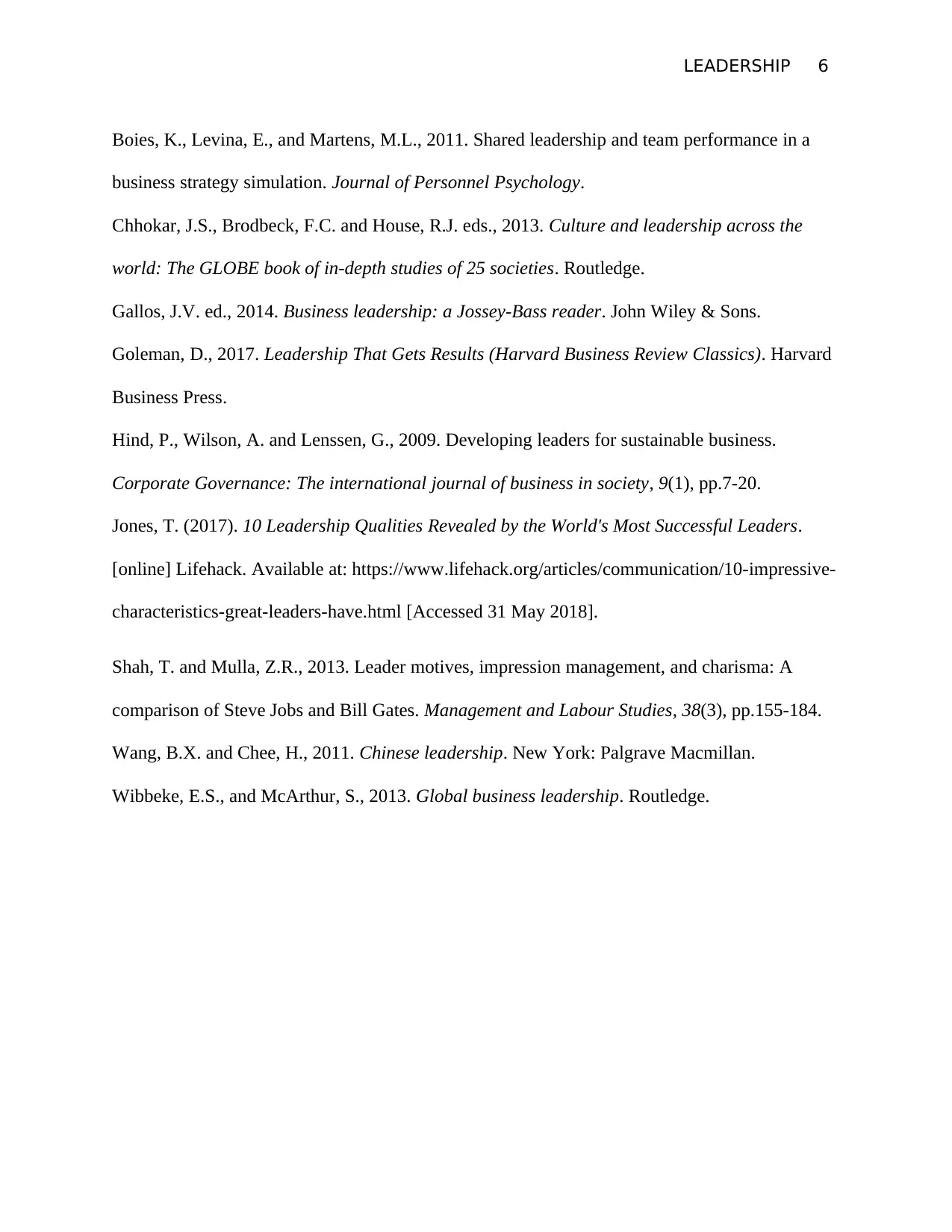
LEADERSHIP 6
Boies, K., Levina, E., and Martens, M.L., 2011. Shared leadership and team performance in a
business strategy simulation. Journal of Personnel Psychology.
Chhokar, J.S., Brodbeck, F.C. and House, R.J. eds., 2013. Culture and leadership across the
world: The GLOBE book of in-depth studies of 25 societies. Routledge.
Gallos, J.V. ed., 2014. Business leadership: a Jossey-Bass reader. John Wiley & Sons.
Goleman, D., 2017. Leadership That Gets Results (Harvard Business Review Classics). Harvard
Business Press.
Hind, P., Wilson, A. and Lenssen, G., 2009. Developing leaders for sustainable business.
Corporate Governance: The international journal of business in society, 9(1), pp.7-20.
Jones, T. (2017). 10 Leadership Qualities Revealed by the World's Most Successful Leaders.
[online] Lifehack. Available at: https://www.lifehack.org/articles/communication/10-impressive-
characteristics-great-leaders-have.html [Accessed 31 May 2018].
Shah, T. and Mulla, Z.R., 2013. Leader motives, impression management, and charisma: A
comparison of Steve Jobs and Bill Gates. Management and Labour Studies, 38(3), pp.155-184.
Wang, B.X. and Chee, H., 2011. Chinese leadership. New York: Palgrave Macmillan.
Wibbeke, E.S., and McArthur, S., 2013. Global business leadership. Routledge.
Boies, K., Levina, E., and Martens, M.L., 2011. Shared leadership and team performance in a
business strategy simulation. Journal of Personnel Psychology.
Chhokar, J.S., Brodbeck, F.C. and House, R.J. eds., 2013. Culture and leadership across the
world: The GLOBE book of in-depth studies of 25 societies. Routledge.
Gallos, J.V. ed., 2014. Business leadership: a Jossey-Bass reader. John Wiley & Sons.
Goleman, D., 2017. Leadership That Gets Results (Harvard Business Review Classics). Harvard
Business Press.
Hind, P., Wilson, A. and Lenssen, G., 2009. Developing leaders for sustainable business.
Corporate Governance: The international journal of business in society, 9(1), pp.7-20.
Jones, T. (2017). 10 Leadership Qualities Revealed by the World's Most Successful Leaders.
[online] Lifehack. Available at: https://www.lifehack.org/articles/communication/10-impressive-
characteristics-great-leaders-have.html [Accessed 31 May 2018].
Shah, T. and Mulla, Z.R., 2013. Leader motives, impression management, and charisma: A
comparison of Steve Jobs and Bill Gates. Management and Labour Studies, 38(3), pp.155-184.
Wang, B.X. and Chee, H., 2011. Chinese leadership. New York: Palgrave Macmillan.
Wibbeke, E.S., and McArthur, S., 2013. Global business leadership. Routledge.
⊘ This is a preview!⊘
Do you want full access?
Subscribe today to unlock all pages.

Trusted by 1+ million students worldwide

LEADERSHIP 7
1 out of 7
Related Documents
Your All-in-One AI-Powered Toolkit for Academic Success.
+13062052269
info@desklib.com
Available 24*7 on WhatsApp / Email
Unlock your academic potential
Copyright © 2020–2025 A2Z Services. All Rights Reserved. Developed and managed by ZUCOL.