Integrated Care: A Comprehensive Approach to Patient Well-being

Verified

Added on  2023/06/04

|4
|521
|464
Essay
AI Summary
This essay explores the concept of integrated care, also known as coordinated or seamless care, and its positive impact on healthcare. It highlights how integrating primary healthcare, substance abuse treatment, and mental health services in a single setting leads to better patient outcomes. The essay argues that integrated care allows clinicians to address patients holistically, identifying behavioral concerns that may trigger conditions like substance abuse. It also suggests that this system reduces the financial burden on patients and fosters a team-oriented approach among practitioners, improving the overall delivery of care and reducing mortality rates in adults with substance abuse and mental health issues. The essay also references a diagram detailing the fundamentals of integrated care, emphasizing the coordination of efforts and knowledge among diverse medical practitioners to enhance service delivery and improve patient health through cultural change processes like communication and commitment.

Document Page
Integrated Care 1
INTEGRATED CARE
Name
Course
Instructor
University
City and State
Date
tabler-icon-diamond-filled.svg

Paraphrase This Document

Need a fresh take? Get an instant paraphrase of this document with our AI Paraphraser
Document Page
Integrated Care 2
Integrated Care
The introduction of integrated care also referred to as coordinated or seamless care has
alleviated many of the challenges countered by patients in attempts to access better health care.
The fragmentation of patient services achieved through the combination of primary health care,
substance abuse, and mental health care in one setting has shown to yield best outcomes for
patients (Kodner, 2009). This undoubtedly proves that the integrated care is the best approach in
treating patients with multiple healthcare needs. When examining an individual, a clinician can
address the individual as a whole and it becomes easier to identify behavioral concerns that
might trigger conditions such as substance abuse in the patient. It is also my firm belief that the
system has lessened the financial burden incurred by patients when seeking for better health care.
Many individuals have access to primary care, but lack the resources to seek medical care from
professionals. This is with the believe that primary care providers can treat mental disorder, yet,
as much as they can provide medication, some cases might be too severe for them to treat
(Brunette, et al., 2008).
Working as a health worker in a hospital I can firmly say that integrated care is not only
beneficial to patients, but also practitioners. In a primary care setting I have witnessed doctors
blending their expertise on the three areas and in turn receive feedback from caregivers and
patients, which consequently improves their delivery of services. In addition, the system has
created a sense of team effort where practitioners can coordinate the delivery of general care and
mental health care for patients with both needs. Such has reduced the mortality in adults with
advanced substance abuse and mental health problems as practitioners can easily monitor the
progress of patients.
Document Page
Integrated Care 3
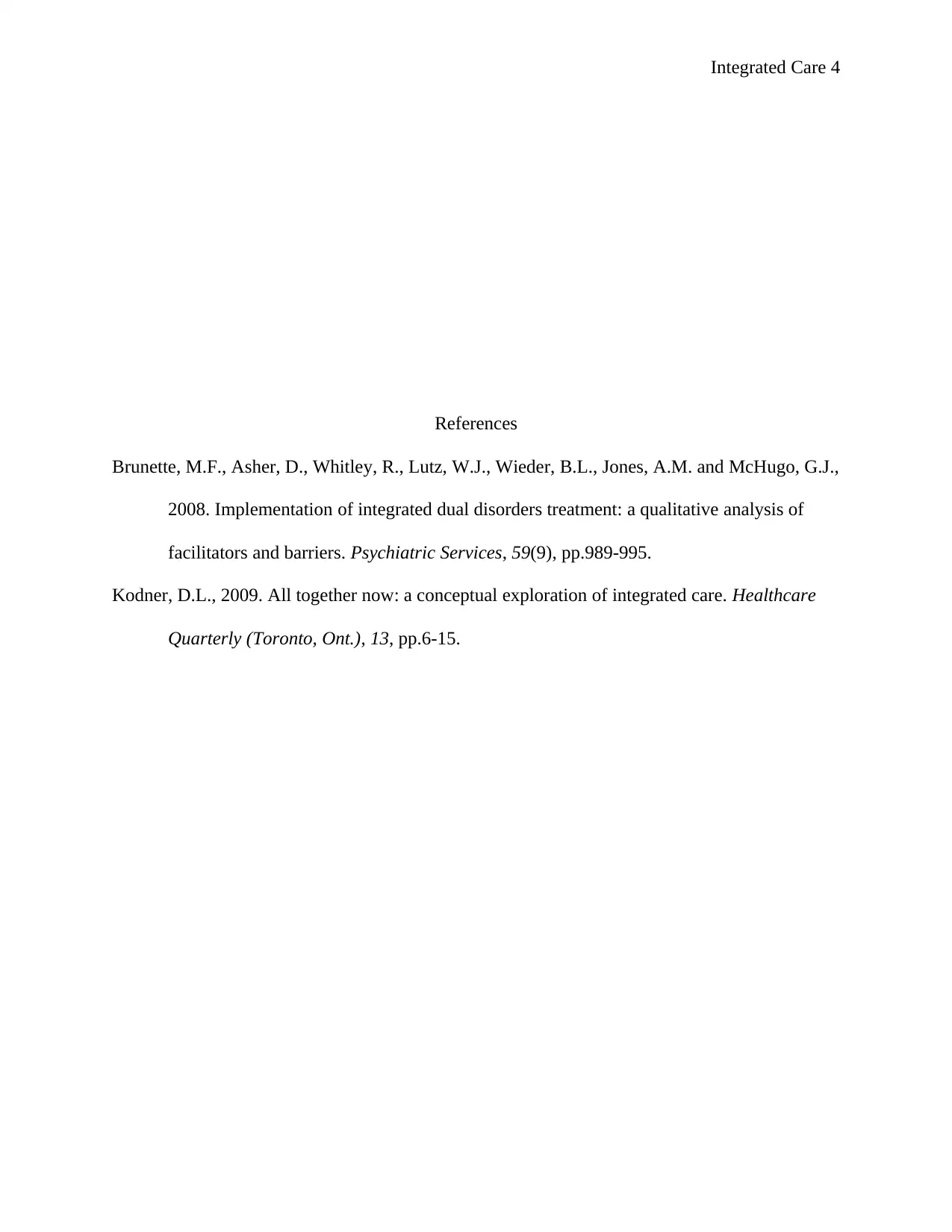
The diagram above details the fundamentals of integrated care in hospital environment. The
guiding principles outline that the program aims to coordinate the efforts and knowledge of the
diverse medical practitioners. The expected outcome in this case is enhanced delivery of services
to patients in order to guarantee improved health. For this to be achieved, the cultural change
process, which includes communication, open space, regular dialogue, incorporation of diversity,
and connectedness and commitment, has to be implemented.
Document Page
Integrated Care 4
References
Brunette, M.F., Asher, D., Whitley, R., Lutz, W.J., Wieder, B.L., Jones, A.M. and McHugo, G.J.,
2008. Implementation of integrated dual disorders treatment: a qualitative analysis of
facilitators and barriers. Psychiatric Services, 59(9), pp.989-995.
Kodner, D.L., 2009. All together now: a conceptual exploration of integrated care. Healthcare
Quarterly (Toronto, Ont.), 13, pp.6-15.
chevron_up_icon
1 out of 4
circle_padding
hide_on_mobile
zoom_out_icon
[object Object]