University History Module: Integrative Summary of Culture Wars

Verified

Added on  2022/10/19

|6
|919
|363
Homework Assignment
AI Summary
This integrative summary examines the historical concept of culture wars, beginning with its origins in 1970s Germany and expanding to a broader definition encompassing clashes of core beliefs, values, and practices across groups, nations, and civilizations. The analysis incorporates perspectives from Karl Marx, particularly his emphasis on class conflict between the bourgeoisie and the proletariat, and the impact of this dynamic on societal relations. The summary also explores the role of liberalism, drawing upon the ideas of John Stuart Mill, and how the concept of personal freedom and individual liberty can be correlated with the conflicts arising from social class hierarchy. By synthesizing material from multiple sources, the paper provides a thoughtful analysis of the significance of culture wars and their relationship to broader societal issues. The analysis also identifies the relevance of these conflicts in shaping historical events and ideologies.
Document Page
Running head: INTEGRATIVE SUMMARY
CULTURE WARS – AN INTEGRATIVE SUMMARY
Name of the Student
Name of the University
Author note
tabler-icon-diamond-filled.svg

Paraphrase This Document

Need a fresh take? Get an instant paraphrase of this document with our AI Paraphraser
Document Page
1INTEGRATIVE SUMMARY
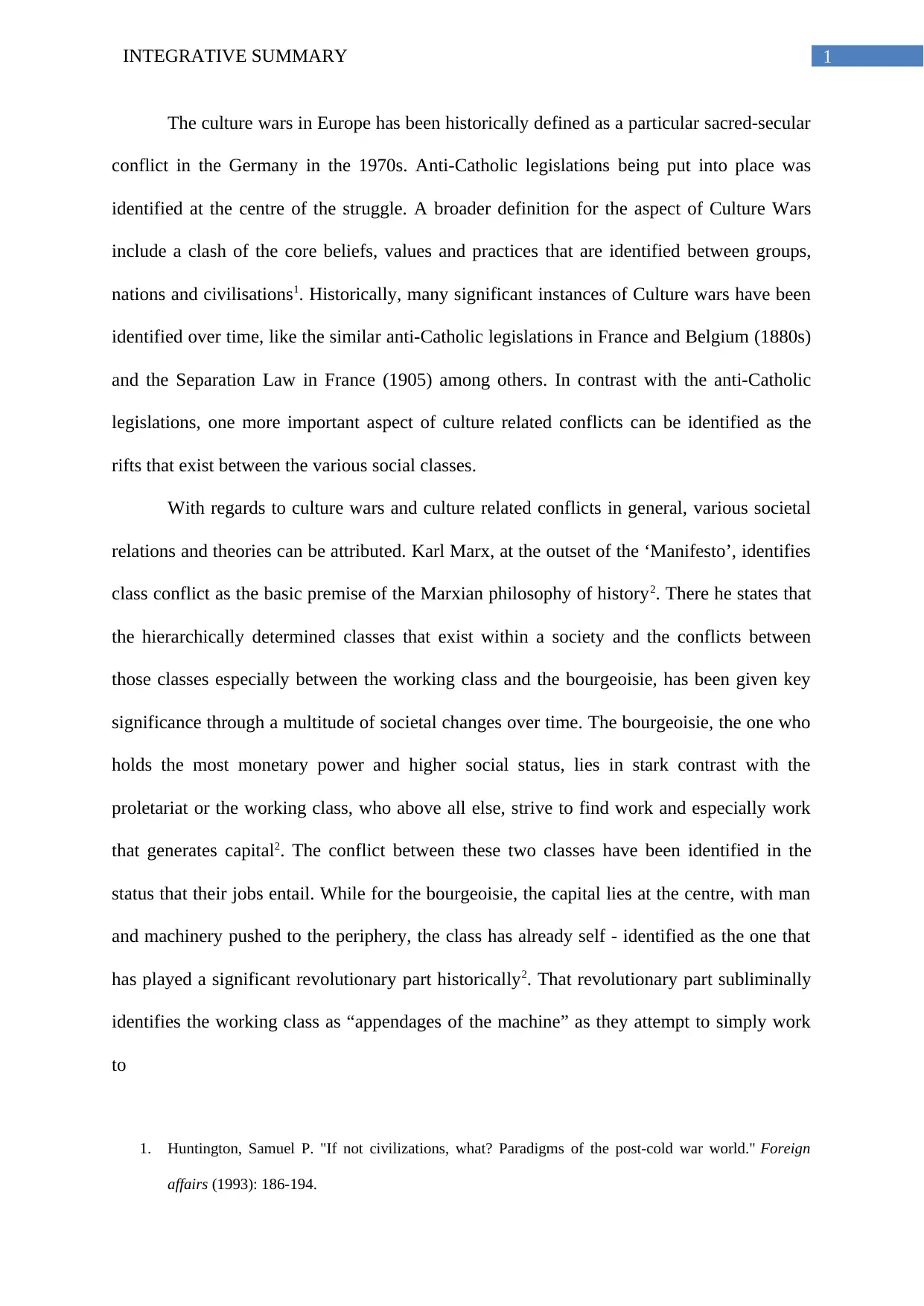
The culture wars in Europe has been historically defined as a particular sacred-secular
conflict in the Germany in the 1970s. Anti-Catholic legislations being put into place was
identified at the centre of the struggle. A broader definition for the aspect of Culture Wars
include a clash of the core beliefs, values and practices that are identified between groups,
nations and civilisations1. Historically, many significant instances of Culture wars have been
identified over time, like the similar anti-Catholic legislations in France and Belgium (1880s)
and the Separation Law in France (1905) among others. In contrast with the anti-Catholic
legislations, one more important aspect of culture related conflicts can be identified as the
rifts that exist between the various social classes.
With regards to culture wars and culture related conflicts in general, various societal
relations and theories can be attributed. Karl Marx, at the outset of the ‘Manifesto’, identifies
class conflict as the basic premise of the Marxian philosophy of history2. There he states that
the hierarchically determined classes that exist within a society and the conflicts between
those classes especially between the working class and the bourgeoisie, has been given key
significance through a multitude of societal changes over time. The bourgeoisie, the one who
holds the most monetary power and higher social status, lies in stark contrast with the
proletariat or the working class, who above all else, strive to find work and especially work
that generates capital2. The conflict between these two classes have been identified in the
status that their jobs entail. While for the bourgeoisie, the capital lies at the centre, with man
and machinery pushed to the periphery, the class has already self - identified as the one that
has played a significant revolutionary part historically2. That revolutionary part subliminally
identifies the working class as “appendages of the machine” as they attempt to simply work
to
1. Huntington, Samuel P. "If not civilizations, what? Paradigms of the post-cold war world." Foreign
affairs (1993): 186-194.
Document Page
2INTEGRATIVE SUMMARY
2. Marx, Karl, and Friedrich Engels. The communist manifesto. Penguin, 2002.
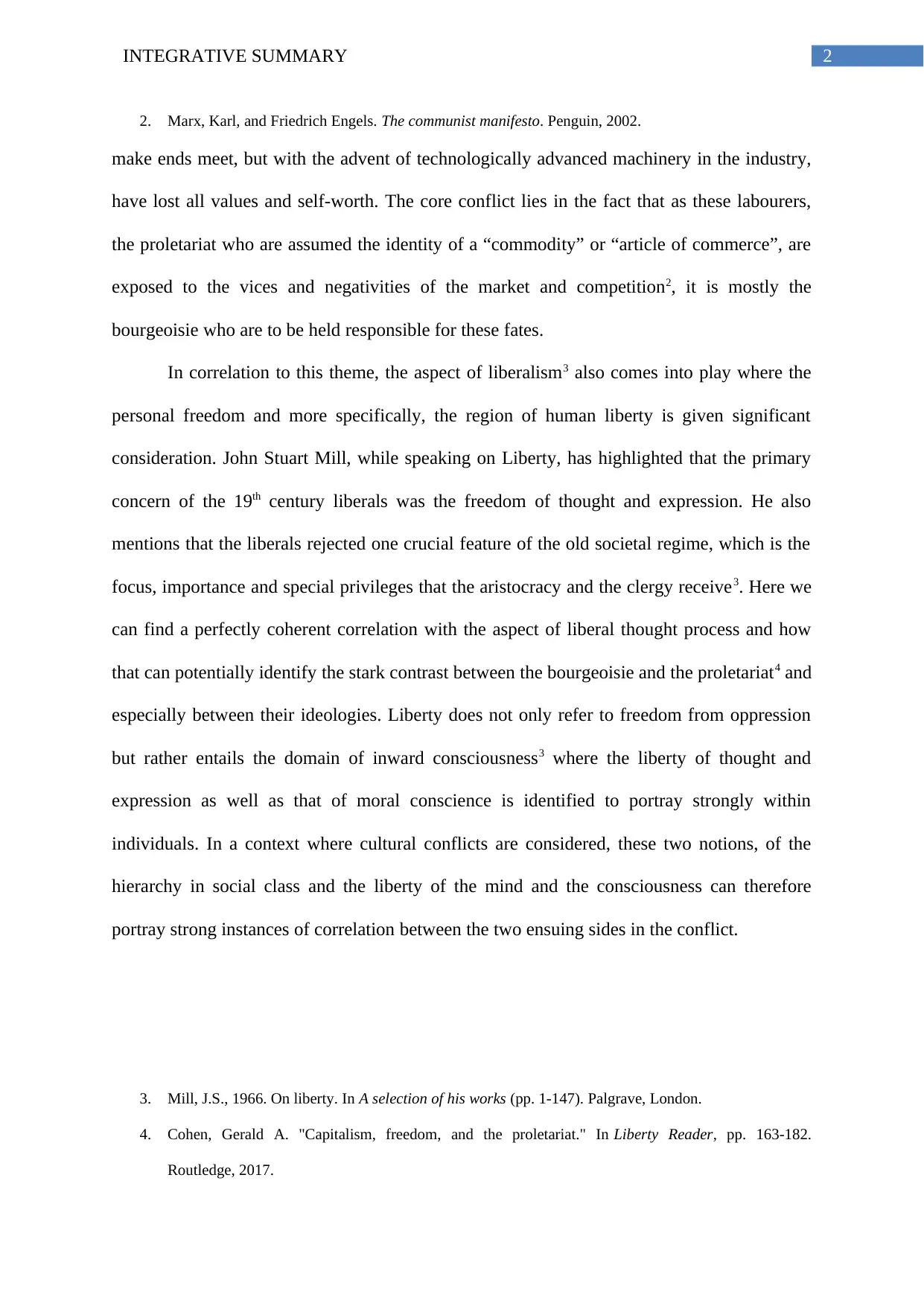
make ends meet, but with the advent of technologically advanced machinery in the industry,
have lost all values and self-worth. The core conflict lies in the fact that as these labourers,
the proletariat who are assumed the identity of a “commodity” or “article of commerce”, are
exposed to the vices and negativities of the market and competition2, it is mostly the
bourgeoisie who are to be held responsible for these fates.
In correlation to this theme, the aspect of liberalism3 also comes into play where the
personal freedom and more specifically, the region of human liberty is given significant
consideration. John Stuart Mill, while speaking on Liberty, has highlighted that the primary
concern of the 19th century liberals was the freedom of thought and expression. He also
mentions that the liberals rejected one crucial feature of the old societal regime, which is the
focus, importance and special privileges that the aristocracy and the clergy receive3. Here we
can find a perfectly coherent correlation with the aspect of liberal thought process and how
that can potentially identify the stark contrast between the bourgeoisie and the proletariat4 and
especially between their ideologies. Liberty does not only refer to freedom from oppression
but rather entails the domain of inward consciousness3 where the liberty of thought and
expression as well as that of moral conscience is identified to portray strongly within
individuals. In a context where cultural conflicts are considered, these two notions, of the
hierarchy in social class and the liberty of the mind and the consciousness can therefore
portray strong instances of correlation between the two ensuing sides in the conflict.
3. Mill, J.S., 1966. On liberty. In A selection of his works (pp. 1-147). Palgrave, London.
4. Cohen, Gerald A. "Capitalism, freedom, and the proletariat." In Liberty Reader, pp. 163-182.
Routledge, 2017.
Document Page
3INTEGRATIVE SUMMARY
tabler-icon-diamond-filled.svg

Paraphrase This Document

Need a fresh take? Get an instant paraphrase of this document with our AI Paraphraser
Document Page
4INTEGRATIVE SUMMARY
References
1. Huntington, Samuel P. "If not civilizations, what? Paradigms of the post-cold war
world." Foreign affairs (1993): 186-194.
2. Marx, Karl, and Friedrich Engels. The communist manifesto. Penguin, 2002.
3. Mill, J.S., 1966. On liberty. In A selection of his works (pp. 1-147). Palgrave, London.
4. Cohen, Gerald A. "Capitalism, freedom, and the proletariat." In Liberty Reader, pp.
163-182. Routledge, 2017.
Document Page
5INTEGRATIVE SUMMARY
Files and pages used
1. The communist manifesto – pages 181 to 186
(MarxandEngelsCommunistManifest.pdf)
2. On Liberty (J.S. Mill) from – pages 155 – 156 (J.S.Millacc.pdf)
3. Samuel Huntington ‘Clash of Civilisations’: Definition of culture wars – Culture
Wars In Europe ppt. Slide 2.
4. The Liberty Reader, chapter 8 – 163 to 164
chevron_up_icon
1 out of 6
circle_padding
hide_on_mobile
zoom_out_icon
[object Object]