Integrative Review: Summary of Professional Ethics in Nursing Article

Verified

Added on  2023/06/11

|5
|734
|393
Report
AI Summary
This report presents a summary of an article focusing on professional ethics in nursing, emphasizing its increasing importance due to the complexities of modern healthcare. The original research, which involved a review of 14 papers from databases like CINAHL, PubMed, and Scopus, highlights the connection between professional ethics and nursing from its early days. Despite existing frameworks, few have practical implications, necessitating further research. Key concepts discussed include responsibility, accountability, beneficence, privacy, confidentiality, and respect for autonomy. The findings suggest limited research in understanding professional ethics in nursing science, which primarily consists of beliefs, values, rights, and obligations aimed at protecting the public and guiding them towards a healthy society. The evolving nature of nursing ethics requires continuous updates, and development in this area can bridge gaps between professionals. A limitation noted is the heterogeneity of the selected studies. The report concludes by referencing relevant works that further elaborate on the themes of dignity-enhancing care and relational ethics in nursing.
Document Page
Running head: ARTICLE SUMMARY
ARTICLE SUMMARY
Name of the Student
Name of the university
Author’s note
tabler-icon-diamond-filled.svg

Paraphrase This Document

Need a fresh take? Get an instant paraphrase of this document with our AI Paraphraser
Document Page
1ARTICLE SUMMARY
Article
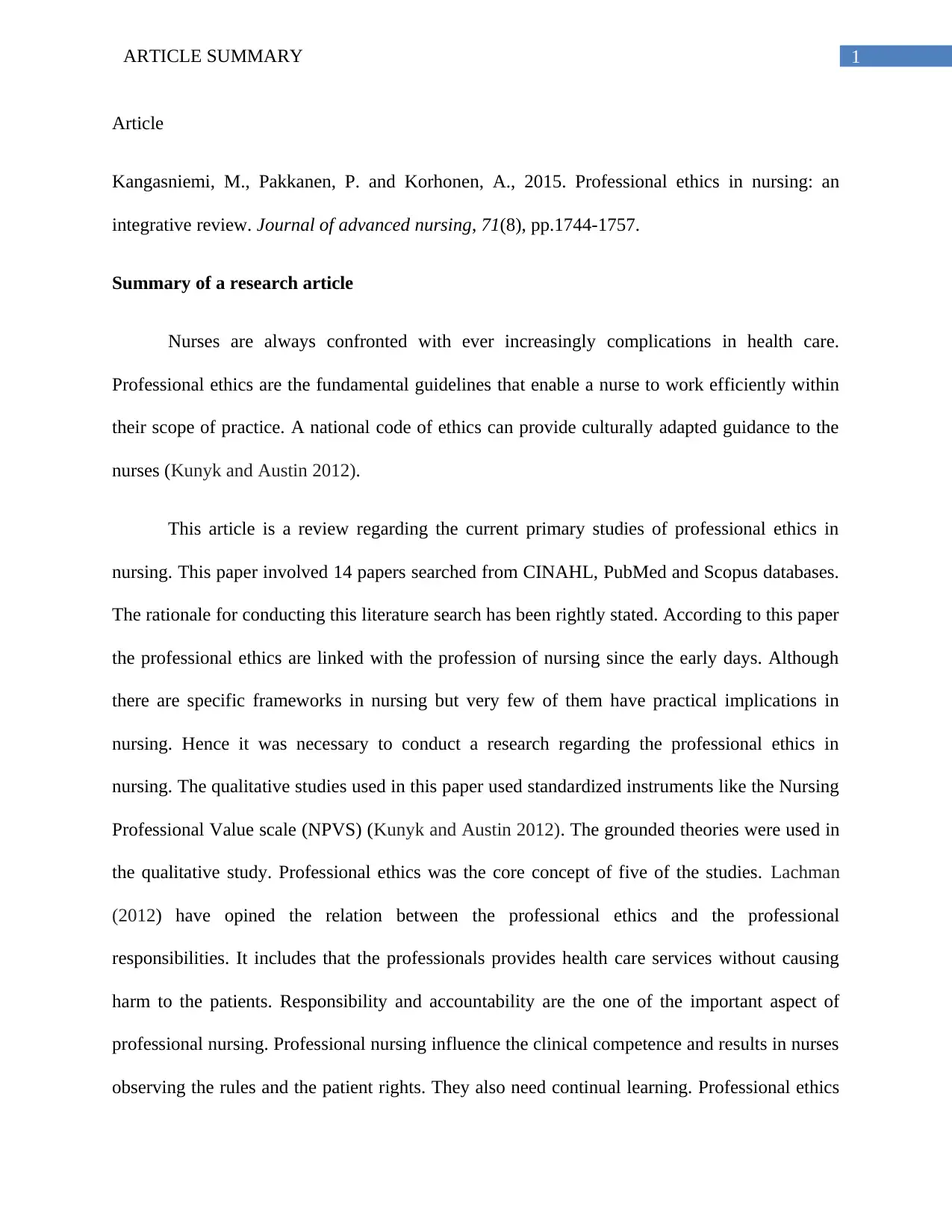
Kangasniemi, M., Pakkanen, P. and Korhonen, A., 2015. Professional ethics in nursing: an
integrative review. Journal of advanced nursing, 71(8), pp.1744-1757.
Summary of a research article
Nurses are always confronted with ever increasingly complications in health care.
Professional ethics are the fundamental guidelines that enable a nurse to work efficiently within
their scope of practice. A national code of ethics can provide culturally adapted guidance to the
nurses (Kunyk and Austin 2012).
This article is a review regarding the current primary studies of professional ethics in
nursing. This paper involved 14 papers searched from CINAHL, PubMed and Scopus databases.
The rationale for conducting this literature search has been rightly stated. According to this paper
the professional ethics are linked with the profession of nursing since the early days. Although
there are specific frameworks in nursing but very few of them have practical implications in
nursing. Hence it was necessary to conduct a research regarding the professional ethics in
nursing. The qualitative studies used in this paper used standardized instruments like the Nursing
Professional Value scale (NPVS) (Kunyk and Austin 2012). The grounded theories were used in
the qualitative study. Professional ethics was the core concept of five of the studies. Lachman
(2012) have opined the relation between the professional ethics and the professional
responsibilities. It includes that the professionals provides health care services without causing
harm to the patients. Responsibility and accountability are the one of the important aspect of
professional nursing. Professional nursing influence the clinical competence and results in nurses
observing the rules and the patient rights. They also need continual learning. Professional ethics
Document Page
2ARTICLE SUMMARY
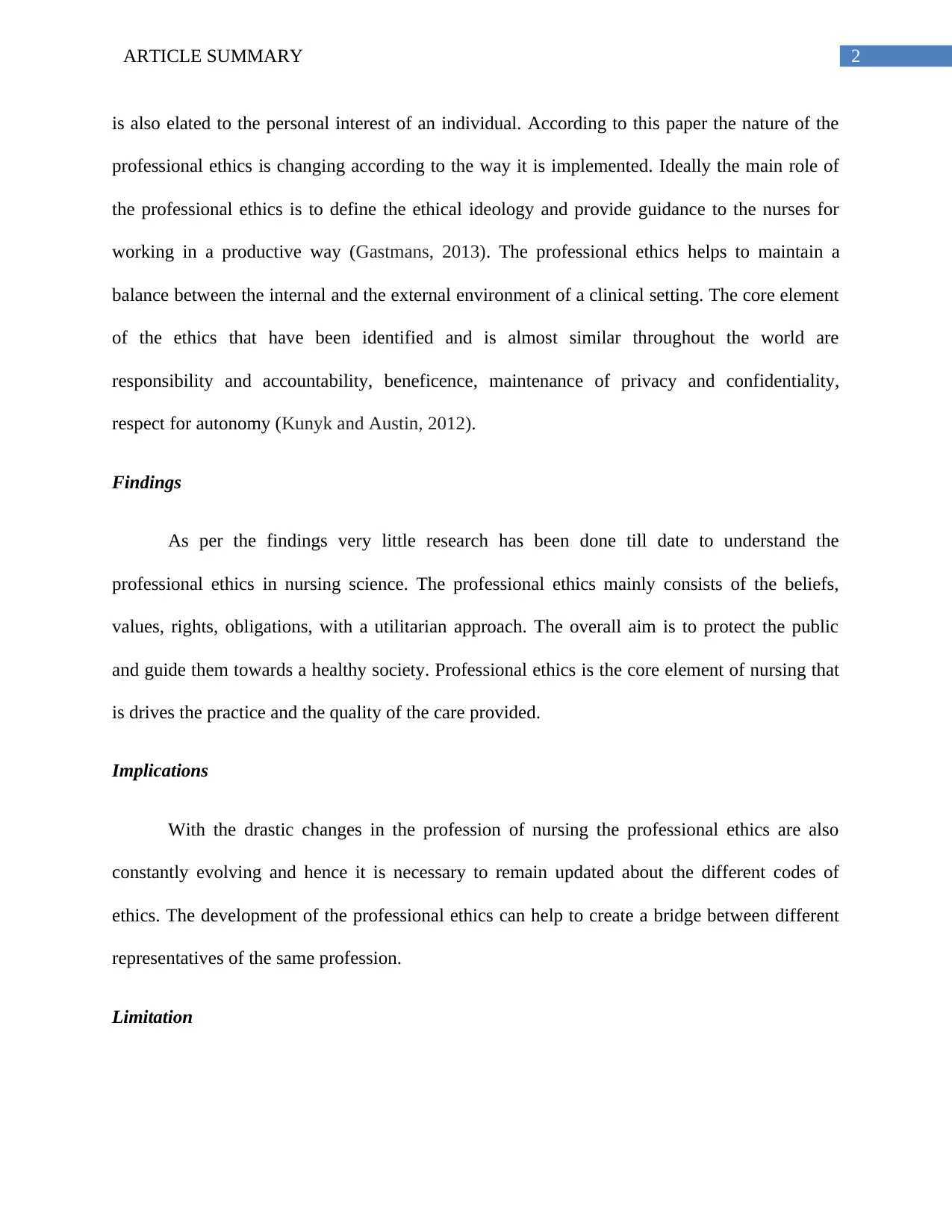
is also elated to the personal interest of an individual. According to this paper the nature of the
professional ethics is changing according to the way it is implemented. Ideally the main role of
the professional ethics is to define the ethical ideology and provide guidance to the nurses for
working in a productive way (Gastmans, 2013). The professional ethics helps to maintain a
balance between the internal and the external environment of a clinical setting. The core element
of the ethics that have been identified and is almost similar throughout the world are
responsibility and accountability, beneficence, maintenance of privacy and confidentiality,
respect for autonomy (Kunyk and Austin, 2012).
Findings
As per the findings very little research has been done till date to understand the
professional ethics in nursing science. The professional ethics mainly consists of the beliefs,
values, rights, obligations, with a utilitarian approach. The overall aim is to protect the public
and guide them towards a healthy society. Professional ethics is the core element of nursing that
is drives the practice and the quality of the care provided.
Implications
With the drastic changes in the profession of nursing the professional ethics are also
constantly evolving and hence it is necessary to remain updated about the different codes of
ethics. The development of the professional ethics can help to create a bridge between different
representatives of the same profession.
Limitation
Document Page
3ARTICLE SUMMARY
The main limitation of the paper is the heterogeneity of the selected studies. Inconsistent
search strategy can generate less appropriate results.
tabler-icon-diamond-filled.svg

Paraphrase This Document

Need a fresh take? Get an instant paraphrase of this document with our AI Paraphraser
Document Page
4ARTICLE SUMMARY
References
Gastmans, C., 2013. Dignity-enhancing nursing care: a foundational ethical framework. Nursing
ethics, 20(2), pp.142-149.
Kangasniemi, M., Pakkanen, P. and Korhonen, A., 2015. Professional ethics in nursing: an
integrative review. Journal of advanced nursing, 71(8), pp.1744-1757.
Kunyk, D. and Austin, W., 2012. Nursing under the influence: A relational ethics
perspective. Nursing ethics, 19(3), pp.380-389.
Lachman, V.D., 2012. Applying the ethics of care to your nursing practice. Medsurg
Nursing, 21(2), p.112.
chevron_up_icon
1 out of 5
circle_padding
hide_on_mobile
zoom_out_icon
[object Object]