Addressing Healthcare Disparities in Intellectual Disability Cases
VerifiedAdded on 2022/11/25
|9
|2674
|3
Report
AI Summary
This report delves into the healthcare challenges faced by individuals with intellectual disabilities, highlighting issues of patient safety, healthcare disparities, and the importance of shared decision-making. Through a case study analysis, the report illustrates how systemic and individual-level factors contribute to inequities in healthcare access and delivery, leading to potentially preventable adverse outcomes. It emphasizes the need for reasonable adjustments in clinical policies and procedures, as well as increased awareness and training among healthcare providers to address these deficiencies. The report also explores the concept of patient safety, including preventable medical errors and the implementation of appropriate interventions. Furthermore, it underscores the significance of person-centered support systems, the measurement of support requirements, and the promotion of quality of life for individuals with intellectual disabilities, aligning with the principles of the UN Convention on the Rights of Persons with Disabilities. The report concludes by advocating for a multifaceted approach that prioritizes patient safety, equitable access to care, and the empowerment of individuals with intellectual disabilities in healthcare settings.
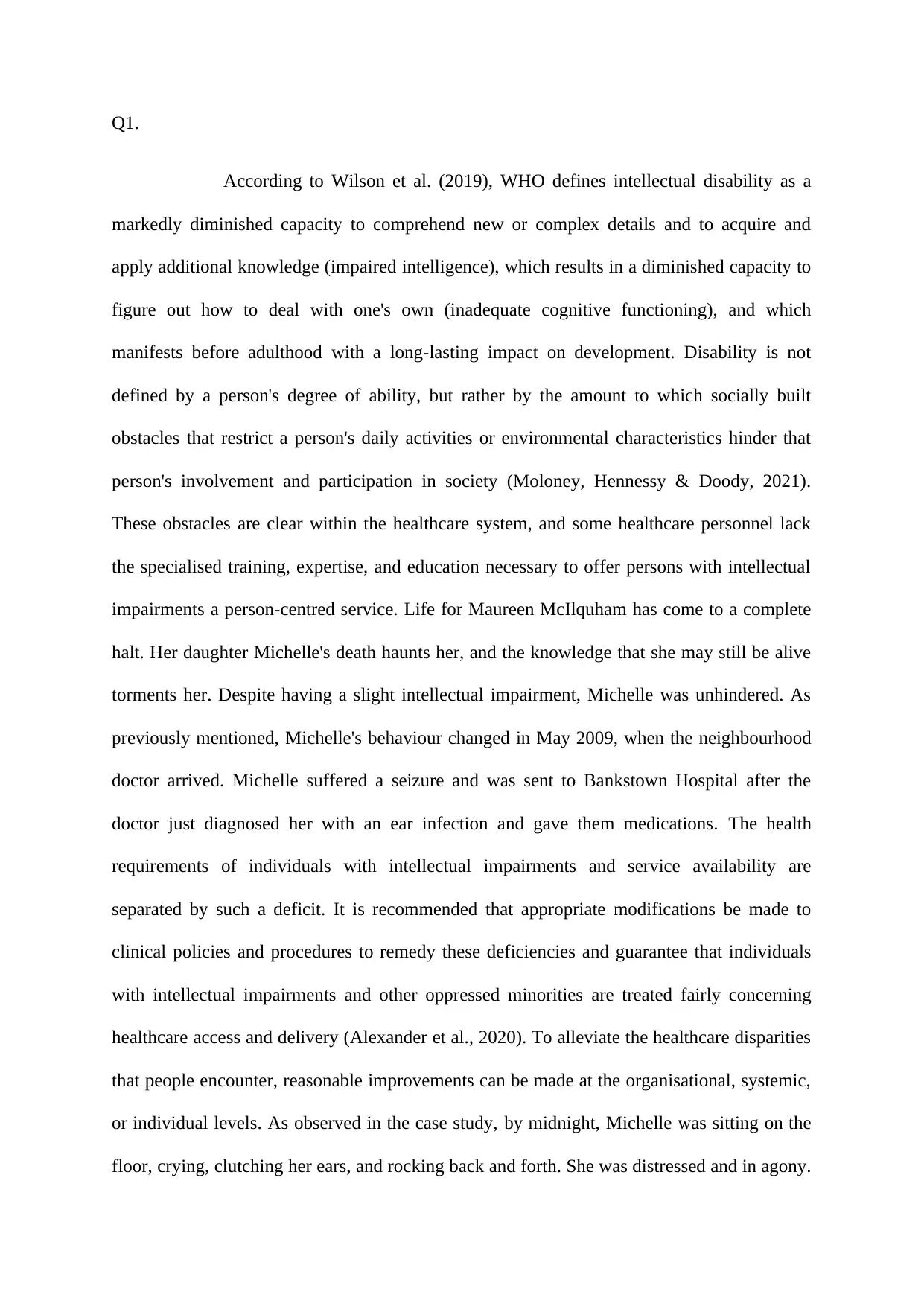
Q1.
According to Wilson et al. (2019), WHO defines intellectual disability as a
markedly diminished capacity to comprehend new or complex details and to acquire and
apply additional knowledge (impaired intelligence), which results in a diminished capacity to
figure out how to deal with one's own (inadequate cognitive functioning), and which
manifests before adulthood with a long-lasting impact on development. Disability is not
defined by a person's degree of ability, but rather by the amount to which socially built
obstacles that restrict a person's daily activities or environmental characteristics hinder that
person's involvement and participation in society (Moloney, Hennessy & Doody, 2021).
These obstacles are clear within the healthcare system, and some healthcare personnel lack
the specialised training, expertise, and education necessary to offer persons with intellectual
impairments a person-centred service. Life for Maureen McIlquham has come to a complete
halt. Her daughter Michelle's death haunts her, and the knowledge that she may still be alive
torments her. Despite having a slight intellectual impairment, Michelle was unhindered. As
previously mentioned, Michelle's behaviour changed in May 2009, when the neighbourhood
doctor arrived. Michelle suffered a seizure and was sent to Bankstown Hospital after the
doctor just diagnosed her with an ear infection and gave them medications. The health
requirements of individuals with intellectual impairments and service availability are
separated by such a deficit. It is recommended that appropriate modifications be made to
clinical policies and procedures to remedy these deficiencies and guarantee that individuals
with intellectual impairments and other oppressed minorities are treated fairly concerning
healthcare access and delivery (Alexander et al., 2020). To alleviate the healthcare disparities
that people encounter, reasonable improvements can be made at the organisational, systemic,
or individual levels. As observed in the case study, by midnight, Michelle was sitting on the
floor, crying, clutching her ears, and rocking back and forth. She was distressed and in agony.
According to Wilson et al. (2019), WHO defines intellectual disability as a
markedly diminished capacity to comprehend new or complex details and to acquire and
apply additional knowledge (impaired intelligence), which results in a diminished capacity to
figure out how to deal with one's own (inadequate cognitive functioning), and which
manifests before adulthood with a long-lasting impact on development. Disability is not
defined by a person's degree of ability, but rather by the amount to which socially built
obstacles that restrict a person's daily activities or environmental characteristics hinder that
person's involvement and participation in society (Moloney, Hennessy & Doody, 2021).
These obstacles are clear within the healthcare system, and some healthcare personnel lack
the specialised training, expertise, and education necessary to offer persons with intellectual
impairments a person-centred service. Life for Maureen McIlquham has come to a complete
halt. Her daughter Michelle's death haunts her, and the knowledge that she may still be alive
torments her. Despite having a slight intellectual impairment, Michelle was unhindered. As
previously mentioned, Michelle's behaviour changed in May 2009, when the neighbourhood
doctor arrived. Michelle suffered a seizure and was sent to Bankstown Hospital after the
doctor just diagnosed her with an ear infection and gave them medications. The health
requirements of individuals with intellectual impairments and service availability are
separated by such a deficit. It is recommended that appropriate modifications be made to
clinical policies and procedures to remedy these deficiencies and guarantee that individuals
with intellectual impairments and other oppressed minorities are treated fairly concerning
healthcare access and delivery (Alexander et al., 2020). To alleviate the healthcare disparities
that people encounter, reasonable improvements can be made at the organisational, systemic,
or individual levels. As observed in the case study, by midnight, Michelle was sitting on the
floor, crying, clutching her ears, and rocking back and forth. She was distressed and in agony.

Paraphrase This Document
Need a fresh take? Get an instant paraphrase of this document with our AI Paraphraser
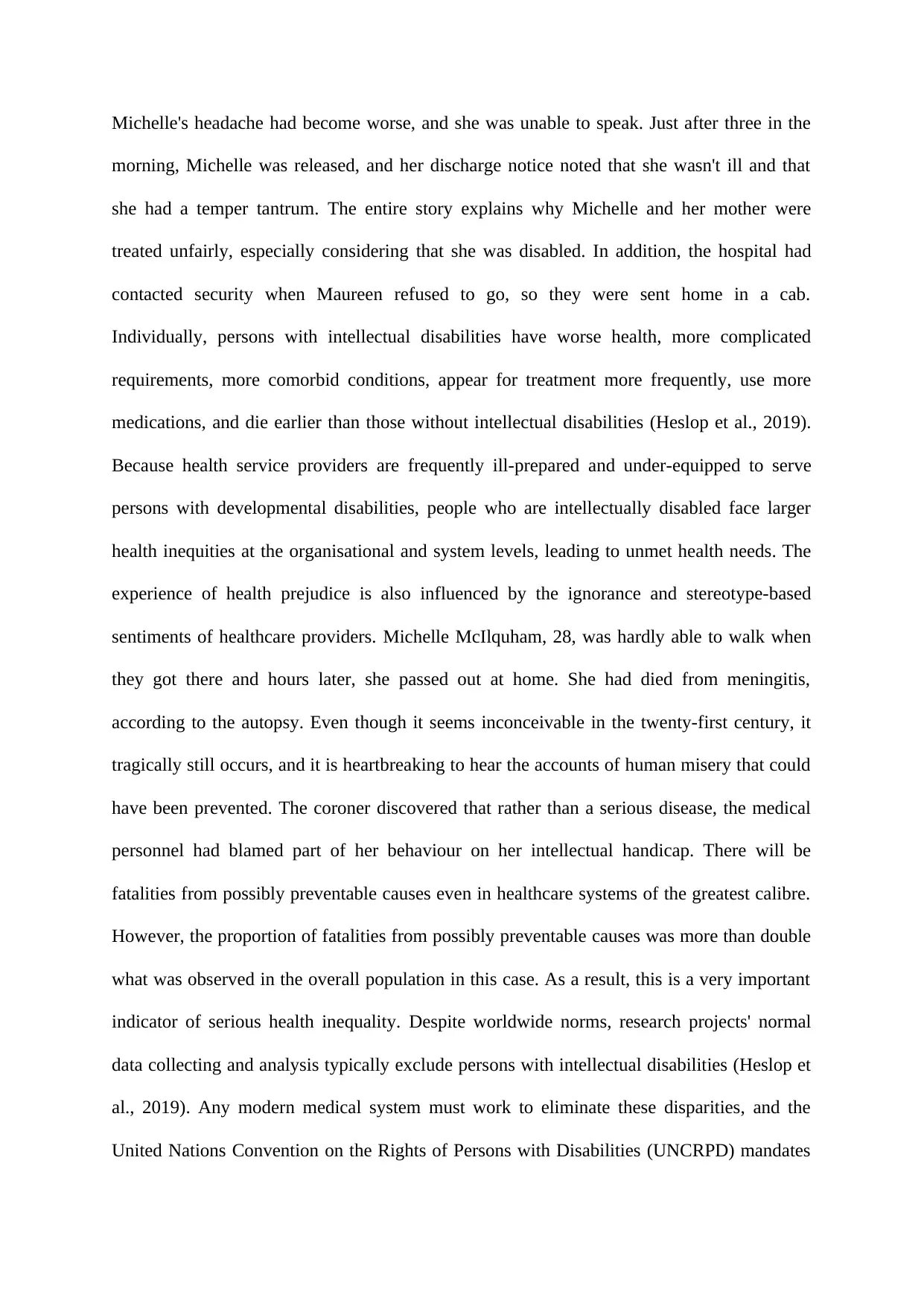
Michelle's headache had become worse, and she was unable to speak. Just after three in the
morning, Michelle was released, and her discharge notice noted that she wasn't ill and that
she had a temper tantrum. The entire story explains why Michelle and her mother were
treated unfairly, especially considering that she was disabled. In addition, the hospital had
contacted security when Maureen refused to go, so they were sent home in a cab.
Individually, persons with intellectual disabilities have worse health, more complicated
requirements, more comorbid conditions, appear for treatment more frequently, use more
medications, and die earlier than those without intellectual disabilities (Heslop et al., 2019).
Because health service providers are frequently ill-prepared and under-equipped to serve
persons with developmental disabilities, people who are intellectually disabled face larger
health inequities at the organisational and system levels, leading to unmet health needs. The
experience of health prejudice is also influenced by the ignorance and stereotype-based
sentiments of healthcare providers. Michelle McIlquham, 28, was hardly able to walk when
they got there and hours later, she passed out at home. She had died from meningitis,
according to the autopsy. Even though it seems inconceivable in the twenty-first century, it
tragically still occurs, and it is heartbreaking to hear the accounts of human misery that could
have been prevented. The coroner discovered that rather than a serious disease, the medical
personnel had blamed part of her behaviour on her intellectual handicap. There will be
fatalities from possibly preventable causes even in healthcare systems of the greatest calibre.
However, the proportion of fatalities from possibly preventable causes was more than double
what was observed in the overall population in this case. As a result, this is a very important
indicator of serious health inequality. Despite worldwide norms, research projects' normal
data collecting and analysis typically exclude persons with intellectual disabilities (Heslop et
al., 2019). Any modern medical system must work to eliminate these disparities, and the
United Nations Convention on the Rights of Persons with Disabilities (UNCRPD) mandates
morning, Michelle was released, and her discharge notice noted that she wasn't ill and that
she had a temper tantrum. The entire story explains why Michelle and her mother were
treated unfairly, especially considering that she was disabled. In addition, the hospital had
contacted security when Maureen refused to go, so they were sent home in a cab.
Individually, persons with intellectual disabilities have worse health, more complicated
requirements, more comorbid conditions, appear for treatment more frequently, use more
medications, and die earlier than those without intellectual disabilities (Heslop et al., 2019).
Because health service providers are frequently ill-prepared and under-equipped to serve
persons with developmental disabilities, people who are intellectually disabled face larger
health inequities at the organisational and system levels, leading to unmet health needs. The
experience of health prejudice is also influenced by the ignorance and stereotype-based
sentiments of healthcare providers. Michelle McIlquham, 28, was hardly able to walk when
they got there and hours later, she passed out at home. She had died from meningitis,
according to the autopsy. Even though it seems inconceivable in the twenty-first century, it
tragically still occurs, and it is heartbreaking to hear the accounts of human misery that could
have been prevented. The coroner discovered that rather than a serious disease, the medical
personnel had blamed part of her behaviour on her intellectual handicap. There will be
fatalities from possibly preventable causes even in healthcare systems of the greatest calibre.
However, the proportion of fatalities from possibly preventable causes was more than double
what was observed in the overall population in this case. As a result, this is a very important
indicator of serious health inequality. Despite worldwide norms, research projects' normal
data collecting and analysis typically exclude persons with intellectual disabilities (Heslop et
al., 2019). Any modern medical system must work to eliminate these disparities, and the
United Nations Convention on the Rights of Persons with Disabilities (UNCRPD) mandates
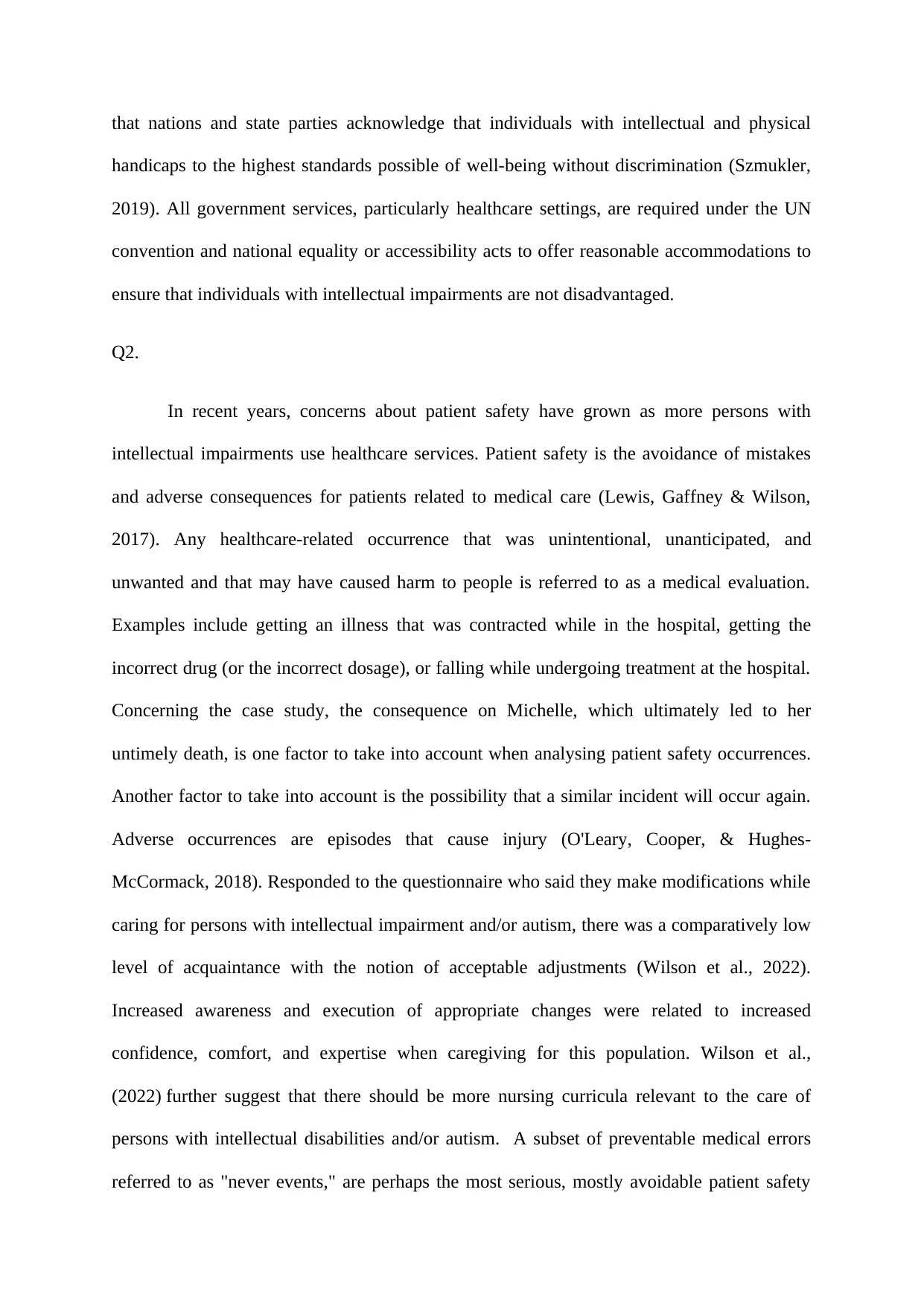
that nations and state parties acknowledge that individuals with intellectual and physical
handicaps to the highest standards possible of well-being without discrimination (Szmukler,
2019). All government services, particularly healthcare settings, are required under the UN
convention and national equality or accessibility acts to offer reasonable accommodations to
ensure that individuals with intellectual impairments are not disadvantaged.
Q2.
In recent years, concerns about patient safety have grown as more persons with
intellectual impairments use healthcare services. Patient safety is the avoidance of mistakes
and adverse consequences for patients related to medical care (Lewis, Gaffney & Wilson,
2017). Any healthcare-related occurrence that was unintentional, unanticipated, and
unwanted and that may have caused harm to people is referred to as a medical evaluation.
Examples include getting an illness that was contracted while in the hospital, getting the
incorrect drug (or the incorrect dosage), or falling while undergoing treatment at the hospital.
Concerning the case study, the consequence on Michelle, which ultimately led to her
untimely death, is one factor to take into account when analysing patient safety occurrences.
Another factor to take into account is the possibility that a similar incident will occur again.
Adverse occurrences are episodes that cause injury (O'Leary, Cooper, & Hughes-
McCormack, 2018). Responded to the questionnaire who said they make modifications while
caring for persons with intellectual impairment and/or autism, there was a comparatively low
level of acquaintance with the notion of acceptable adjustments (Wilson et al., 2022).
Increased awareness and execution of appropriate changes were related to increased
confidence, comfort, and expertise when caregiving for this population. Wilson et al.,
(2022) further suggest that there should be more nursing curricula relevant to the care of
persons with intellectual disabilities and/or autism. A subset of preventable medical errors
referred to as "never events," are perhaps the most serious, mostly avoidable patient safety
handicaps to the highest standards possible of well-being without discrimination (Szmukler,
2019). All government services, particularly healthcare settings, are required under the UN
convention and national equality or accessibility acts to offer reasonable accommodations to
ensure that individuals with intellectual impairments are not disadvantaged.
Q2.
In recent years, concerns about patient safety have grown as more persons with
intellectual impairments use healthcare services. Patient safety is the avoidance of mistakes
and adverse consequences for patients related to medical care (Lewis, Gaffney & Wilson,
2017). Any healthcare-related occurrence that was unintentional, unanticipated, and
unwanted and that may have caused harm to people is referred to as a medical evaluation.
Examples include getting an illness that was contracted while in the hospital, getting the
incorrect drug (or the incorrect dosage), or falling while undergoing treatment at the hospital.
Concerning the case study, the consequence on Michelle, which ultimately led to her
untimely death, is one factor to take into account when analysing patient safety occurrences.
Another factor to take into account is the possibility that a similar incident will occur again.
Adverse occurrences are episodes that cause injury (O'Leary, Cooper, & Hughes-
McCormack, 2018). Responded to the questionnaire who said they make modifications while
caring for persons with intellectual impairment and/or autism, there was a comparatively low
level of acquaintance with the notion of acceptable adjustments (Wilson et al., 2022).
Increased awareness and execution of appropriate changes were related to increased
confidence, comfort, and expertise when caregiving for this population. Wilson et al.,
(2022) further suggest that there should be more nursing curricula relevant to the care of
persons with intellectual disabilities and/or autism. A subset of preventable medical errors
referred to as "never events," are perhaps the most serious, mostly avoidable patient safety
⊘ This is a preview!⊘
Do you want full access?
Subscribe today to unlock all pages.

Trusted by 1+ million students worldwide
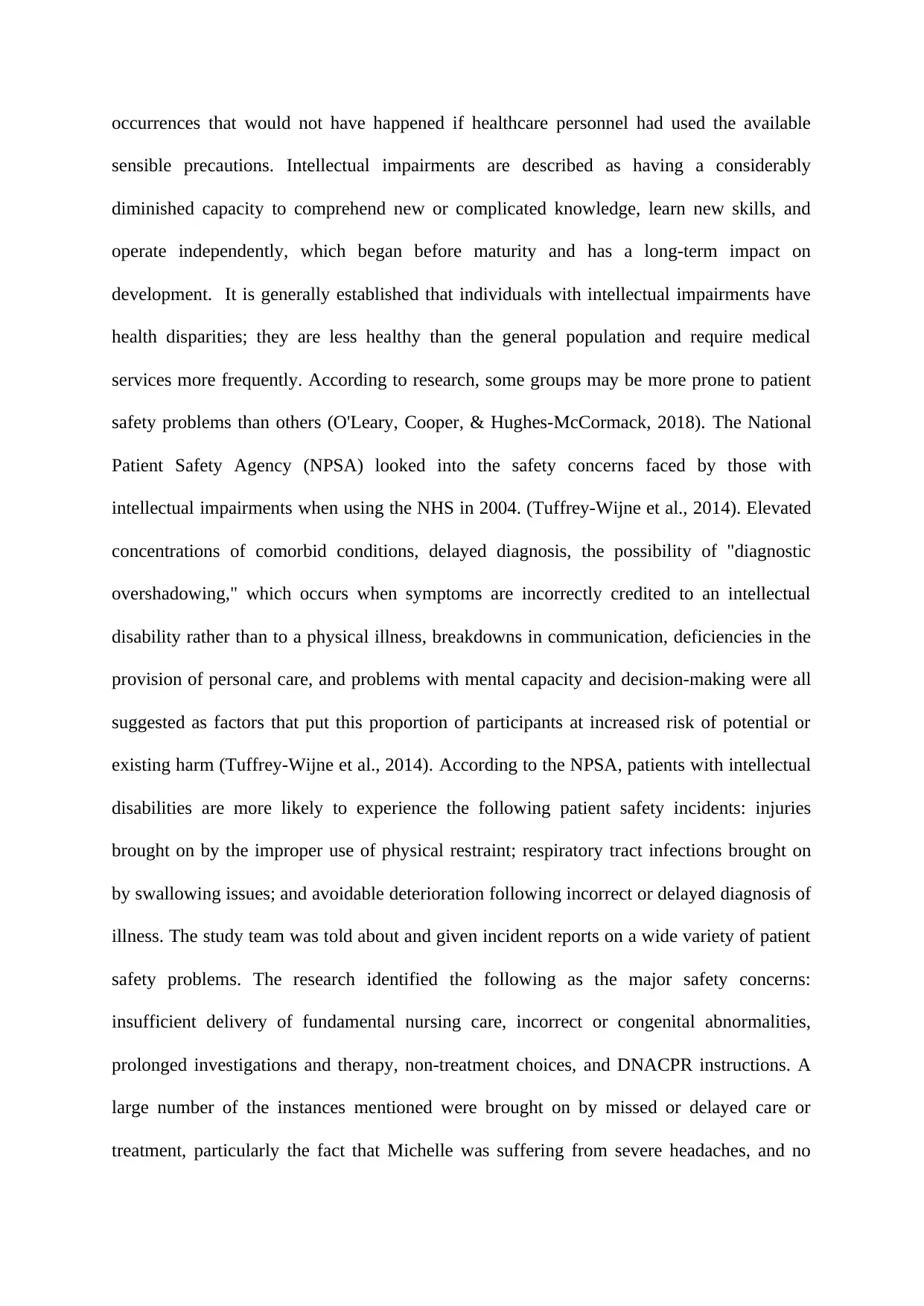
occurrences that would not have happened if healthcare personnel had used the available
sensible precautions. Intellectual impairments are described as having a considerably
diminished capacity to comprehend new or complicated knowledge, learn new skills, and
operate independently, which began before maturity and has a long-term impact on
development. It is generally established that individuals with intellectual impairments have
health disparities; they are less healthy than the general population and require medical
services more frequently. According to research, some groups may be more prone to patient
safety problems than others (O'Leary, Cooper, & Hughes-McCormack, 2018). The National
Patient Safety Agency (NPSA) looked into the safety concerns faced by those with
intellectual impairments when using the NHS in 2004. (Tuffrey-Wijne et al., 2014). Elevated
concentrations of comorbid conditions, delayed diagnosis, the possibility of "diagnostic
overshadowing," which occurs when symptoms are incorrectly credited to an intellectual
disability rather than to a physical illness, breakdowns in communication, deficiencies in the
provision of personal care, and problems with mental capacity and decision-making were all
suggested as factors that put this proportion of participants at increased risk of potential or
existing harm (Tuffrey-Wijne et al., 2014). According to the NPSA, patients with intellectual
disabilities are more likely to experience the following patient safety incidents: injuries
brought on by the improper use of physical restraint; respiratory tract infections brought on
by swallowing issues; and avoidable deterioration following incorrect or delayed diagnosis of
illness. The study team was told about and given incident reports on a wide variety of patient
safety problems. The research identified the following as the major safety concerns:
insufficient delivery of fundamental nursing care, incorrect or congenital abnormalities,
prolonged investigations and therapy, non-treatment choices, and DNACPR instructions. A
large number of the instances mentioned were brought on by missed or delayed care or
treatment, particularly the fact that Michelle was suffering from severe headaches, and no
sensible precautions. Intellectual impairments are described as having a considerably
diminished capacity to comprehend new or complicated knowledge, learn new skills, and
operate independently, which began before maturity and has a long-term impact on
development. It is generally established that individuals with intellectual impairments have
health disparities; they are less healthy than the general population and require medical
services more frequently. According to research, some groups may be more prone to patient
safety problems than others (O'Leary, Cooper, & Hughes-McCormack, 2018). The National
Patient Safety Agency (NPSA) looked into the safety concerns faced by those with
intellectual impairments when using the NHS in 2004. (Tuffrey-Wijne et al., 2014). Elevated
concentrations of comorbid conditions, delayed diagnosis, the possibility of "diagnostic
overshadowing," which occurs when symptoms are incorrectly credited to an intellectual
disability rather than to a physical illness, breakdowns in communication, deficiencies in the
provision of personal care, and problems with mental capacity and decision-making were all
suggested as factors that put this proportion of participants at increased risk of potential or
existing harm (Tuffrey-Wijne et al., 2014). According to the NPSA, patients with intellectual
disabilities are more likely to experience the following patient safety incidents: injuries
brought on by the improper use of physical restraint; respiratory tract infections brought on
by swallowing issues; and avoidable deterioration following incorrect or delayed diagnosis of
illness. The study team was told about and given incident reports on a wide variety of patient
safety problems. The research identified the following as the major safety concerns:
insufficient delivery of fundamental nursing care, incorrect or congenital abnormalities,
prolonged investigations and therapy, non-treatment choices, and DNACPR instructions. A
large number of the instances mentioned were brought on by missed or delayed care or
treatment, particularly the fact that Michelle was suffering from severe headaches, and no
Paraphrase This Document
Need a fresh take? Get an instant paraphrase of this document with our AI Paraphraser
evaluation was done based on that. Instead, it was termed to be her temper tantrum since she
was with intellectual disability. Such disruptions and factual errors were frequently caused by
failing to make the legally required reasonable accommodations for patients with intellectual
disabilities, failing to follow and comprehend the Mental Capacity Act 2005, failing to pay
attention to caregivers, staff perspectives and expertise of mental retardation, and patient
characteristics that may make them more susceptible to safety issues (Northway et al., 2017).
These contributing elements are frequently interconnected and affect organisations, teams of
employees, and patients and caregivers. This shows the necessity for good policies and a
multifaceted strategy to increase the safety of this sensitive clinical setting.
Q3.
In shared decision-making, the patient and the healthcare professional converse and
work together. The best available data on the advantages, dangers, and uncertainties of
therapy is combined with the consumer's values, objectives, and preferences to help that
individual make the best medical decisions possible ("ACSQHC- Shared decision making",
2022). The primary goal of organisations that help people with intellectual impairments is to
improve the quality of life (QOL) of their clients. In a person-centred support system, there
should be congruence between a person's objectives and goals, the assistance that is provided,
and the person's quality of life as a result. It is crucial to change the approach to assisting
individuals in the direction of a comprehensive person-centred approach (input-throughput-
output). Measurement of support requirements and results has been the subject of a
significant amount of research to date. The Supports Intensity Scale, for instance, may be
used to quantify someone's support requirements legitimately and accurately. An individual
support plan should lead to improvements in a person's quality of life. Evidence-based
approaches must include evidence-based outcomes (EBOs). It is necessary to conduct a
reliable and accurate evaluation of the domains connected to the quality of life to ascertain
was with intellectual disability. Such disruptions and factual errors were frequently caused by
failing to make the legally required reasonable accommodations for patients with intellectual
disabilities, failing to follow and comprehend the Mental Capacity Act 2005, failing to pay
attention to caregivers, staff perspectives and expertise of mental retardation, and patient
characteristics that may make them more susceptible to safety issues (Northway et al., 2017).
These contributing elements are frequently interconnected and affect organisations, teams of
employees, and patients and caregivers. This shows the necessity for good policies and a
multifaceted strategy to increase the safety of this sensitive clinical setting.
Q3.
In shared decision-making, the patient and the healthcare professional converse and
work together. The best available data on the advantages, dangers, and uncertainties of
therapy is combined with the consumer's values, objectives, and preferences to help that
individual make the best medical decisions possible ("ACSQHC- Shared decision making",
2022). The primary goal of organisations that help people with intellectual impairments is to
improve the quality of life (QOL) of their clients. In a person-centred support system, there
should be congruence between a person's objectives and goals, the assistance that is provided,
and the person's quality of life as a result. It is crucial to change the approach to assisting
individuals in the direction of a comprehensive person-centred approach (input-throughput-
output). Measurement of support requirements and results has been the subject of a
significant amount of research to date. The Supports Intensity Scale, for instance, may be
used to quantify someone's support requirements legitimately and accurately. An individual
support plan should lead to improvements in a person's quality of life. Evidence-based
approaches must include evidence-based outcomes (EBOs). It is necessary to conduct a
reliable and accurate evaluation of the domains connected to the quality of life to ascertain
this vital point. A vision and a structure are necessary for improving quality of life, assisting
cases like that of Michelle and Maureen, and engaging with treatments and strategies
("National Disability Services (NDS)", 2019). It is crucial to state clearly the context in
which actual assistance is provided to people at this point. Human dignity, participation in
society, transparency to societal structure, equality and equal chances, autonomy and self-
determination, autonomy, and physiological, psychological, and economic well-being are
among the themes that are significant in the CRPD ("National Disability Services (NDS)",
2019). The term "quality of life" refers to multifaceted phenomena made up of fundamental
components of personal well-being. Personal traits and environmental circumstances have an
impact on these areas. One's standard of living is the result of and may be improved through
quality-improving tactics that include cultivating unique abilities, maximising engagement,
offering personalised assistance, and creating chances for personal development.
cases like that of Michelle and Maureen, and engaging with treatments and strategies
("National Disability Services (NDS)", 2019). It is crucial to state clearly the context in
which actual assistance is provided to people at this point. Human dignity, participation in
society, transparency to societal structure, equality and equal chances, autonomy and self-
determination, autonomy, and physiological, psychological, and economic well-being are
among the themes that are significant in the CRPD ("National Disability Services (NDS)",
2019). The term "quality of life" refers to multifaceted phenomena made up of fundamental
components of personal well-being. Personal traits and environmental circumstances have an
impact on these areas. One's standard of living is the result of and may be improved through
quality-improving tactics that include cultivating unique abilities, maximising engagement,
offering personalised assistance, and creating chances for personal development.
⊘ This is a preview!⊘
Do you want full access?
Subscribe today to unlock all pages.
Trusted by 1+ million students worldwide
References:
ACSQHC- Shared decision making. https://www.safetyandquality.gov.au/. (2022). Retrieved
12 August 2022, from https://www.safetyandquality.gov.au/our-work/partnering-
consumers/shared-decision-making.
Alexander, R., Ravi, A., Barclay, H., Sawhney, I., Chester, V., Malcolm, V., ... & Langdon,
P. E. (2020). Guidance for the treatment and management of COVID‐19 among
people with intellectual disabilities. Journal of Policy and Practice in Intellectual
Disabilities, 17(3), 256-269.
https://onlinelibrary.wiley.com/doi/abs/10.1111/jppi.12352
Heslop, P., Turner, S., Read, S., Tucker, J., Seaton, S., & Evans, B. (2019). Implementing
reasonable adjustments for disabled people in healthcare services. Nursing Standard.
http://researchspace.bathspa.ac.uk/11520/
Lewis, P., Gaffney, R. J., & Wilson, N. J. (2017). A narrative review of acute care nurses’
experiences nursing patients with intellectual disability: underprepared,
communication barriers and ambiguity about the role of caregivers. Journal of
Clinical Nursing, 26(11-12), 1473-1484.
https://onlinelibrary.wiley.com/doi/abs/10.1111/jocn.13512
Moloney, M., Hennessy, T., & Doody, O. (2021). Reasonable adjustments for people with
intellectual disability in acute care: a scoping review of the evidence. BMJ
open, 11(2), e039647. https://bmjopen.bmj.com/content/11/2/e039647.abstract
National Disability Services (NDS). Nds.org.au. (2019). Retrieved 12 August 2022, from
https://www.nds.org.au/images/resources/People_with_Disability_and_SDM-
Guide_for_NDIS_Providers_in_NSW.pdf.
ACSQHC- Shared decision making. https://www.safetyandquality.gov.au/. (2022). Retrieved
12 August 2022, from https://www.safetyandquality.gov.au/our-work/partnering-
consumers/shared-decision-making.
Alexander, R., Ravi, A., Barclay, H., Sawhney, I., Chester, V., Malcolm, V., ... & Langdon,
P. E. (2020). Guidance for the treatment and management of COVID‐19 among
people with intellectual disabilities. Journal of Policy and Practice in Intellectual
Disabilities, 17(3), 256-269.
https://onlinelibrary.wiley.com/doi/abs/10.1111/jppi.12352
Heslop, P., Turner, S., Read, S., Tucker, J., Seaton, S., & Evans, B. (2019). Implementing
reasonable adjustments for disabled people in healthcare services. Nursing Standard.
http://researchspace.bathspa.ac.uk/11520/
Lewis, P., Gaffney, R. J., & Wilson, N. J. (2017). A narrative review of acute care nurses’
experiences nursing patients with intellectual disability: underprepared,
communication barriers and ambiguity about the role of caregivers. Journal of
Clinical Nursing, 26(11-12), 1473-1484.
https://onlinelibrary.wiley.com/doi/abs/10.1111/jocn.13512
Moloney, M., Hennessy, T., & Doody, O. (2021). Reasonable adjustments for people with
intellectual disability in acute care: a scoping review of the evidence. BMJ
open, 11(2), e039647. https://bmjopen.bmj.com/content/11/2/e039647.abstract
National Disability Services (NDS). Nds.org.au. (2019). Retrieved 12 August 2022, from
https://www.nds.org.au/images/resources/People_with_Disability_and_SDM-
Guide_for_NDIS_Providers_in_NSW.pdf.
Paraphrase This Document
Need a fresh take? Get an instant paraphrase of this document with our AI Paraphraser
Northway, R., Rees, S., Davies, M., & Williams, S. (2017). Hospital passports, patient safety
and person‐centred care: A review of documents currently used for people with
intellectual disabilities in the UK. Journal of clinical nursing, 26(23-24), 5160-5168.
https://onlinelibrary.wiley.com/doi/abs/10.1111/jocn.14065
O'Leary, L., Cooper, S. A., & Hughes-McCormack, L. (2018). Early death and causes of
death of people with intellectual disabilities: A systematic review. Journal of applied
research in intellectual disabilities: JARID, 31(3), 325–342.
https://doi.org/10.1111/jar.12417
Szmukler, G. (2019). “Capacity”,“best interests”,“will and preferences” and the UN
Convention on the Rights of Persons with Disabilities. World Psychiatry, 18(1), 34-
41. https://onlinelibrary.wiley.com/doi/abs/10.1002/wps.20584
Tuffrey-Wijne, I., Goulding, L., Gordon, V., Abraham, E., Giatras, N., Edwards, C., &
Gillard, S. ORCID: 0000-0002-9686-2232 and Hollins, S.(2014). The challenges in
monitoring and preventing patient safety incidents for people with intellectual
disabilities in NHS acute hospitals: evidence from a mixed-methods study. BMC
Health Services Research, 14, 432. https://openaccess.city.ac.uk/24986/1/The
%20challenges%20in%20monitoring%20and%20preventing%20patient%20safety
%20incidents%20for%20people%20with%20intellectual%20disabilities%20in
%20NHS%20acute%20.pdf
Wilson, N. J., Lin, Z., Villarosa, A., Lewis, P., Philip, P., Sumar, B., & George, A. (2019).
Countering the poor oral health of people with intellectual and developmental
disability: a scoping literature review. BMC Public Health, 19(1), 1-16.
https://bmcpublichealth.biomedcentral.com/articles/10.1186/s12889-019-7863-1
and person‐centred care: A review of documents currently used for people with
intellectual disabilities in the UK. Journal of clinical nursing, 26(23-24), 5160-5168.
https://onlinelibrary.wiley.com/doi/abs/10.1111/jocn.14065
O'Leary, L., Cooper, S. A., & Hughes-McCormack, L. (2018). Early death and causes of
death of people with intellectual disabilities: A systematic review. Journal of applied
research in intellectual disabilities: JARID, 31(3), 325–342.
https://doi.org/10.1111/jar.12417
Szmukler, G. (2019). “Capacity”,“best interests”,“will and preferences” and the UN
Convention on the Rights of Persons with Disabilities. World Psychiatry, 18(1), 34-
41. https://onlinelibrary.wiley.com/doi/abs/10.1002/wps.20584
Tuffrey-Wijne, I., Goulding, L., Gordon, V., Abraham, E., Giatras, N., Edwards, C., &
Gillard, S. ORCID: 0000-0002-9686-2232 and Hollins, S.(2014). The challenges in
monitoring and preventing patient safety incidents for people with intellectual
disabilities in NHS acute hospitals: evidence from a mixed-methods study. BMC
Health Services Research, 14, 432. https://openaccess.city.ac.uk/24986/1/The
%20challenges%20in%20monitoring%20and%20preventing%20patient%20safety
%20incidents%20for%20people%20with%20intellectual%20disabilities%20in
%20NHS%20acute%20.pdf
Wilson, N. J., Lin, Z., Villarosa, A., Lewis, P., Philip, P., Sumar, B., & George, A. (2019).
Countering the poor oral health of people with intellectual and developmental
disability: a scoping literature review. BMC Public Health, 19(1), 1-16.
https://bmcpublichealth.biomedcentral.com/articles/10.1186/s12889-019-7863-1
Wilson, N. J., Pracilio, A., Kersten, M., Morphet, J., Buckely, T., Trollor, J. N., ... & Cashin,
A. (2022). Registered nurses' awareness and implementation of reasonable
adjustments for people with intellectual disability and/or autism. Journal of Advanced
Nursing. https://onlinelibrary.wiley.com/doi/abs/10.1111/jan.15171
A. (2022). Registered nurses' awareness and implementation of reasonable
adjustments for people with intellectual disability and/or autism. Journal of Advanced
Nursing. https://onlinelibrary.wiley.com/doi/abs/10.1111/jan.15171
⊘ This is a preview!⊘
Do you want full access?
Subscribe today to unlock all pages.
Trusted by 1+ million students worldwide

1 out of 9


Related Documents


Your All-in-One AI-Powered Toolkit for Academic Success.
+13062052269
info@desklib.com
Available 24*7 on WhatsApp / Email
![[object Object]](/_next/static/media/star-bottom.7253800d.svg)
Unlock your academic potential
Copyright © 2020–2026 A2Z Services. All Rights Reserved. Developed and managed by ZUCOL.