Intellectual Disability: Support and Needs of Individuals

Verified

Added on  2020/02/24

|4
|855
|104
Essay
AI Summary
This essay explores the multifaceted aspects of intellectual disability, focusing on the support systems and specific needs of individuals affected by it. It begins with an operational definition, emphasizing limitations in intellectual functioning and adaptive behavior across conceptual, social, and practical domains. The essay highlights the importance of understanding the causes, which can be prenatal, perinatal, or postnatal, and the significance of gathering relevant information through history, evaluations, and living conditions to classify the severity of the disability. It then delves into the concept of support and needs, identifying them as common resources with varying intensities for disabled individuals, including normative, felt, comparative, and expressed needs. The essay references the human performance technology (HPT) model, outlining factors affecting human performance, and discusses the evolution of classification models, which now encompass IQ, adaptive behavior, health, participation, context, and support needs. It concludes by emphasizing the importance of clinical judgment, broad knowledge, and interaction with intellectually disabled individuals when classifying the severity of the condition and determining the necessary support systems.
Document Page
Running head: INTELLECTUAL DISABILITY
Support and needs for those who are intellectually disabled
Name of the Student
Name of the University
Author Note
tabler-icon-diamond-filled.svg

Paraphrase This Document

Need a fresh take? Get an instant paraphrase of this document with our AI Paraphraser
Document Page
1
INTELLECTUAL DISABILITY
Answer 1
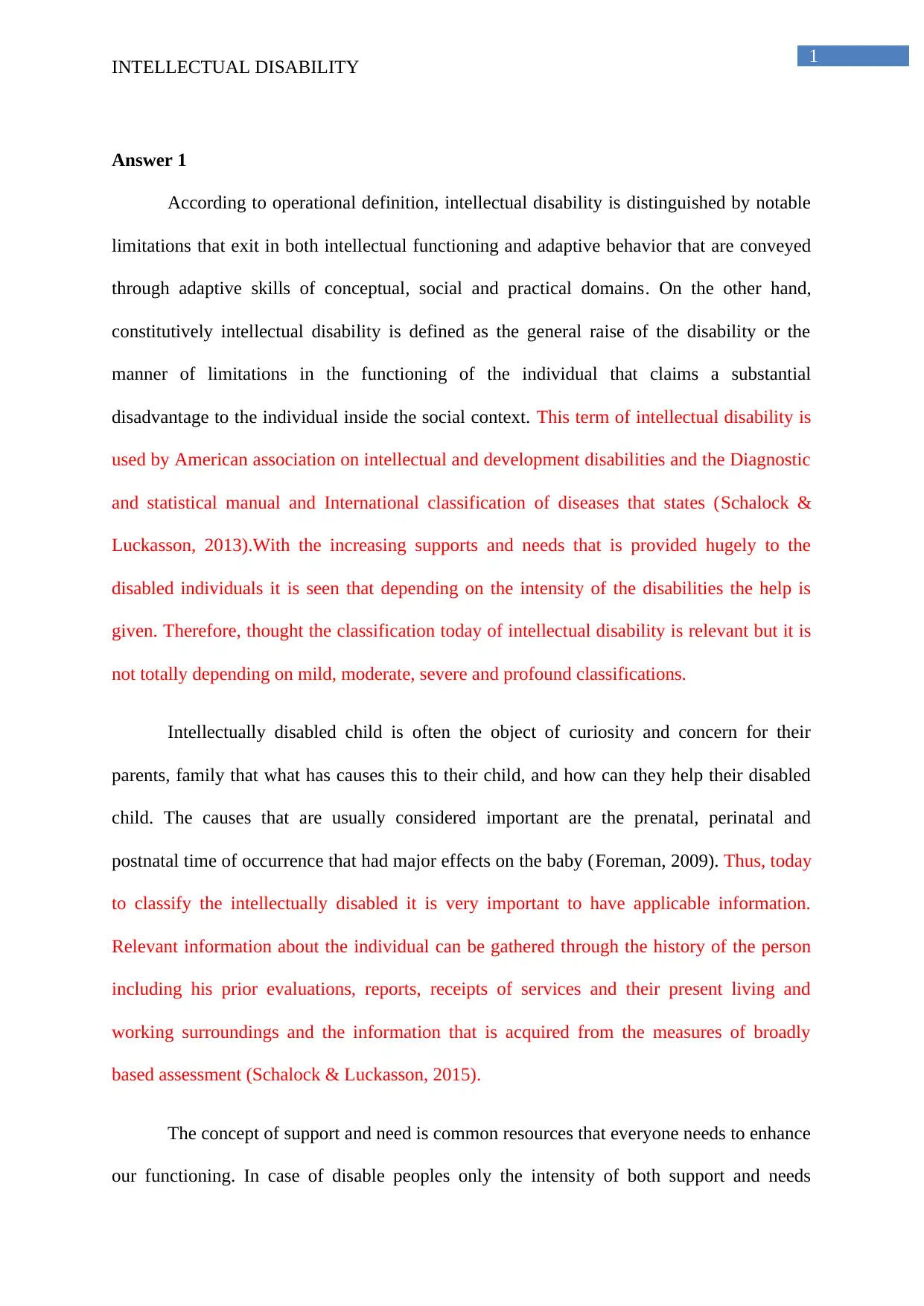
According to operational definition, intellectual disability is distinguished by notable
limitations that exit in both intellectual functioning and adaptive behavior that are conveyed
through adaptive skills of conceptual, social and practical domains. On the other hand,
constitutively intellectual disability is defined as the general raise of the disability or the
manner of limitations in the functioning of the individual that claims a substantial
disadvantage to the individual inside the social context. This term of intellectual disability is
used by American association on intellectual and development disabilities and the Diagnostic
and statistical manual and International classification of diseases that states (Schalock &
Luckasson, 2013).With the increasing supports and needs that is provided hugely to the
disabled individuals it is seen that depending on the intensity of the disabilities the help is
given. Therefore, thought the classification today of intellectual disability is relevant but it is
not totally depending on mild, moderate, severe and profound classifications.
Intellectually disabled child is often the object of curiosity and concern for their
parents, family that what has causes this to their child, and how can they help their disabled
child. The causes that are usually considered important are the prenatal, perinatal and
postnatal time of occurrence that had major effects on the baby (Foreman, 2009). Thus, today
to classify the intellectually disabled it is very important to have applicable information.
Relevant information about the individual can be gathered through the history of the person
including his prior evaluations, reports, receipts of services and their present living and
working surroundings and the information that is acquired from the measures of broadly
based assessment (Schalock & Luckasson, 2015).
The concept of support and need is common resources that everyone needs to enhance
our functioning. In case of disable peoples only the intensity of both support and needs
Document Page
2
INTELLECTUAL DISABILITY
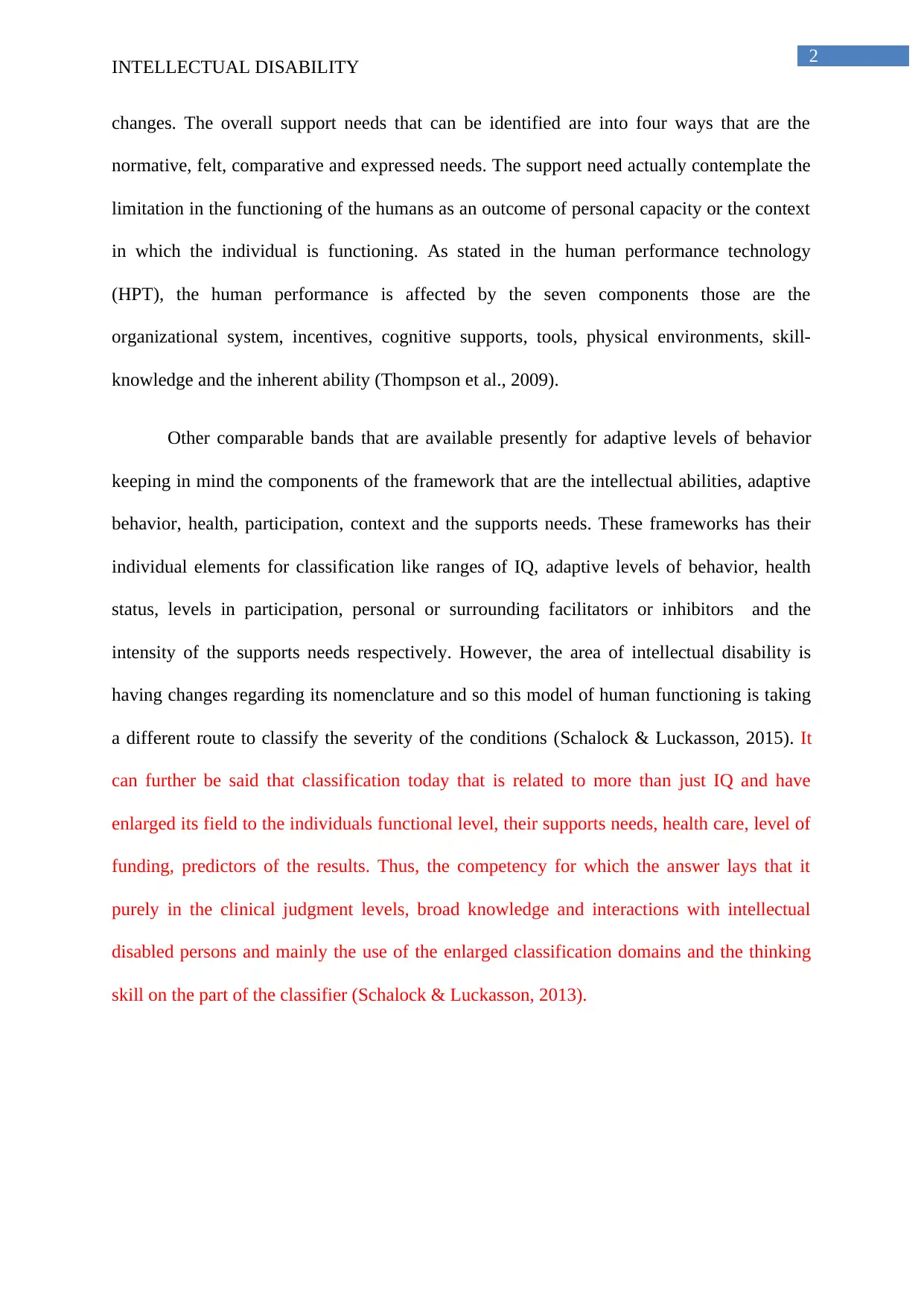
changes. The overall support needs that can be identified are into four ways that are the
normative, felt, comparative and expressed needs. The support need actually contemplate the
limitation in the functioning of the humans as an outcome of personal capacity or the context
in which the individual is functioning. As stated in the human performance technology
(HPT), the human performance is affected by the seven components those are the
organizational system, incentives, cognitive supports, tools, physical environments, skill-
knowledge and the inherent ability (Thompson et al., 2009).
Other comparable bands that are available presently for adaptive levels of behavior
keeping in mind the components of the framework that are the intellectual abilities, adaptive
behavior, health, participation, context and the supports needs. These frameworks has their
individual elements for classification like ranges of IQ, adaptive levels of behavior, health
status, levels in participation, personal or surrounding facilitators or inhibitors and the
intensity of the supports needs respectively. However, the area of intellectual disability is
having changes regarding its nomenclature and so this model of human functioning is taking
a different route to classify the severity of the conditions (Schalock & Luckasson, 2015). It
can further be said that classification today that is related to more than just IQ and have
enlarged its field to the individuals functional level, their supports needs, health care, level of
funding, predictors of the results. Thus, the competency for which the answer lays that it
purely in the clinical judgment levels, broad knowledge and interactions with intellectual
disabled persons and mainly the use of the enlarged classification domains and the thinking
skill on the part of the classifier (Schalock & Luckasson, 2013).
Document Page
3
INTELLECTUAL DISABILITY
References
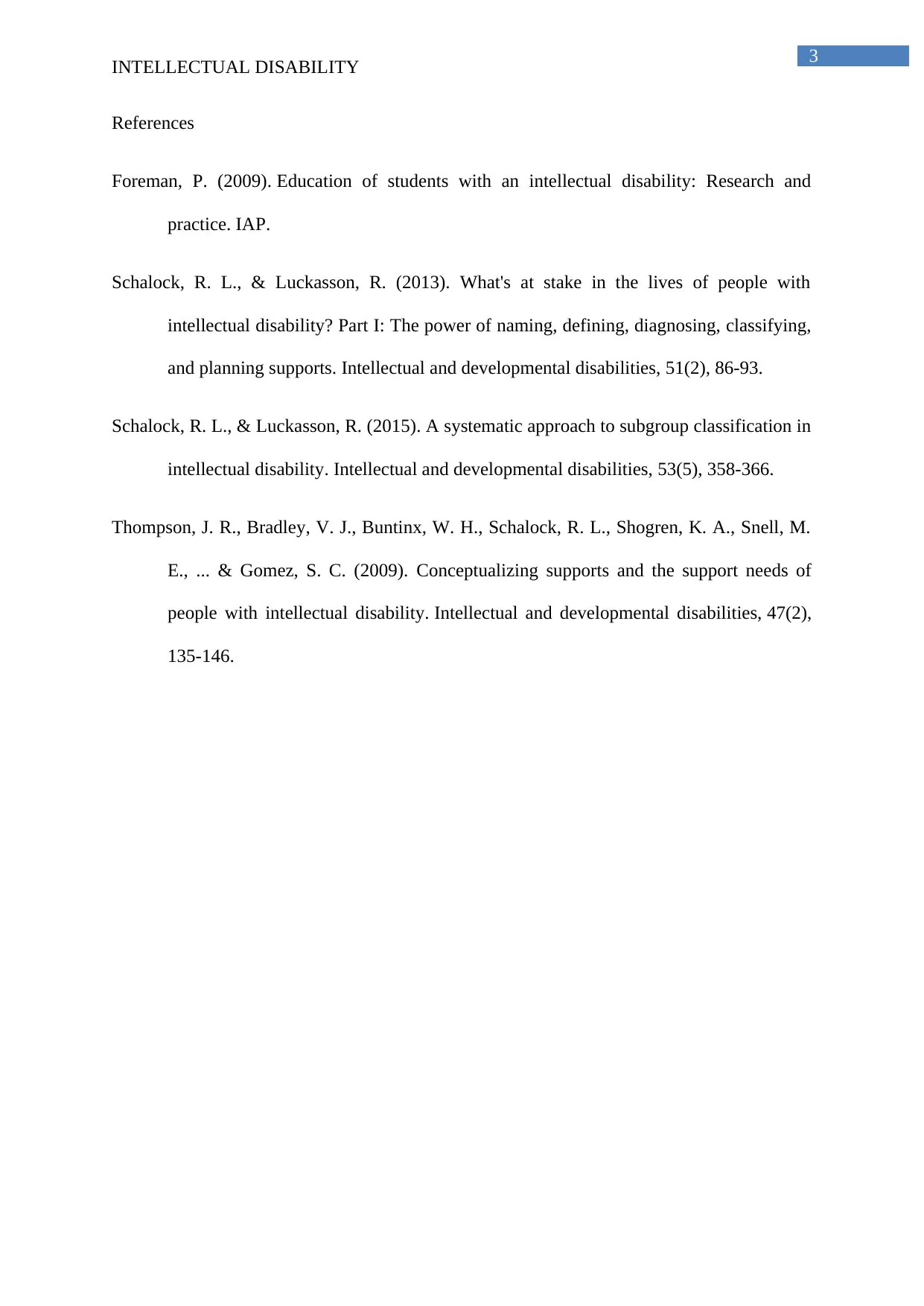
Foreman, P. (2009). Education of students with an intellectual disability: Research and
practice. IAP.
Schalock, R. L., & Luckasson, R. (2013). What's at stake in the lives of people with
intellectual disability? Part I: The power of naming, defining, diagnosing, classifying,
and planning supports. Intellectual and developmental disabilities, 51(2), 86-93.
Schalock, R. L., & Luckasson, R. (2015). A systematic approach to subgroup classification in
intellectual disability. Intellectual and developmental disabilities, 53(5), 358-366.
Thompson, J. R., Bradley, V. J., Buntinx, W. H., Schalock, R. L., Shogren, K. A., Snell, M.
E., ... & Gomez, S. C. (2009). Conceptualizing supports and the support needs of
people with intellectual disability. Intellectual and developmental disabilities, 47(2),
135-146.
chevron_up_icon
1 out of 4
circle_padding
hide_on_mobile
zoom_out_icon
[object Object]