Intellectual Property Law: Copyright and Trademark Analysis

Verified

Added on  2023/01/03

|10
|2301
|61
Report
AI Summary
This report analyzes intellectual property law, specifically focusing on copyright and trademark issues within the UK legal framework. The first part of the report addresses a copyright infringement case involving Polymer Records and the songs created by Nigel, exploring ownership, authorship, and potential legal actions against both Nigel and David. It references the Copyright, Designs and Patents Act 1988 and the Berne Convention. The second part delves into trademark law, examining the process of trademark registration in the UK, the role of the UK Intellectual Property Office (UKIPO), and the criteria for trademark invalidation, including absolute and relative grounds. It provides an analysis of a specific trademark (a bicycle image) for a bicycle hire business, considering its distinctiveness, class of trademark, and potential conflicts with existing trademarks. The report emphasizes the importance of originality, distinctiveness, and the potential for confusion in intellectual property matters, offering legal advice and referencing relevant legislation and case law.
Document Page
Running head: INTELLECTUAL PROPERTY LAW
Intellectual Property Law
Name of the Student
Name of the University
Author Note
tabler-icon-diamond-filled.svg

Paraphrase This Document

Need a fresh take? Get an instant paraphrase of this document with our AI Paraphraser
Document Page
1INTELLECTUAL PROPERTY LAW
Appendix 2
To: Polymer Records
From: Legal Advisor
Date: 12 April 2019
Subject: Advice on Copyright Ownership and Infringement issue
A copyright is an intangible property which subsists in terms of certain subject
matters. In the UK, it is governed by the Copyright, Designs and Patents Act 1988. As held in
the Berne Convention, Article 5(2), copyright exists even when there is no registration of it.
The copyright law in the UK covers copyright protection of the following first subclasses: a)
original literary works; b) original dramatic works; c) original musical works; and d) original
musical works. The copyright protection is given to the creator of the original work who is
presumed to be the first owner (GOV.UK 2019). However, if an original work was created in
the course of employment, then the owner or creator of such work will be considered by the
employer of such creator. In case of joint authorship, the people collaborating of creating the
work would be regarded as the creator of the said work (Bently 2009). As per the UK
copyright law, a person may assign his copyright rights to some other person, for example in
book publishing business or in case of music recording company (GOV.UK 2019).
In this situation, Nigel has created the hit songs in the course of his employment under
the Polymer Records which makes the Polymer records the owner and creator of the hit
songs, even though they were originally created by Nigel. He conducted the service in the
course of his employment that does not give him the right to use or share those songs without
the permission of his employer who is the rightful ‘creator’ of the songs (Bently 2009). Here,
Polymer Records would be eligible to sue Nigel if he share the work with anyone who has no
Document Page
2INTELLECTUAL PROPERTY LAW
authority over it (Rahmatian 2013). In this case, although Nigel had written the songs in his
spare time for his rock band, yet as he delivered them to his employer in the course of his
employment for saving his job, he would no longer be the creator of the songs. Polymer
Records can sue Nigel if he share the songs with his previous band members for any purpose
(Bently 2009).
Polymer Records would be eligible to sue David for he infringed the company’s
copyright right for recording another version of a song without the permission of the
company. The company being the owner and creator of the song deserved to be informed
before he wished to record the song. However, David may defend himself on the ground that
he held the songs with him as a member of the same rock band as Nigel, before Nigel gave
the songs to Polymer Records. In such situation, David would be able to defend himself and
the blame would be shifted to Nigel’s court for delivering a work which was no more
‘original’ and was already shared with the world. Polymer Records would, in any way, be
able to sue either of the parties, that is David or Nigel for the infringement of their copyright
rights (GOV.UK 2019).
Although Nigel can try to defend himself by stating that it was collaborative joint
creation with his rock band members, he would still be sued for sharing a song which is not
‘original’ and unknown to the world, in that case. Polymer Records would be successful to
sue either of the parties and claim damages for copyright infringement (GOV.UK 2019).
Therefore, it is advised to Polymer Records to address the ownership of the song that
has been used by David without the permission of Polymer Records. The company can
establish the fact through its employee Nigel as to time when he actually wrote it; in the
course of his employment or otherwise. The company can ask Nigel to prove whether he had
shared the song with his band members before or after he delivered the songs to the company
to save his position. In case Nigel accept the fact that he had written the songs outside his
Document Page
3INTELLECTUAL PROPERTY LAW
course of employment and that he had shared the songs with his band members before he
gave them to Polymer Records, he would be held liable for not delivering an original song;
here ‘original’ would refer to the fact something that has been already shared with the world
and is not unknown (Rahmatian 2013). If he had shared his songs with his band members
before, in that case he should not have delivered them to Polymer Records to release as an
original work as it breaches the integrity of a company to deliver something as original which
is actually not. However, if it is established that Nigel had not shared the songs with his band
members before delivering them to Polymer Records, then in that case David could be sued
by the company for infringing their copyright right. In any case, the company would be able
to establish the fact that its copyright right was infringed and therefore it deserves damages
from the person who has infringed it. Therefore, it is advised to Polymer Records to address
the ownership of the song that has been used by David without the permission of Polymer
Records or that was already shared by Nigel before delivering it to the company.
tabler-icon-diamond-filled.svg

Paraphrase This Document

Need a fresh take? Get an instant paraphrase of this document with our AI Paraphraser
Document Page
4INTELLECTUAL PROPERTY LAW
References
Berne Convention
Bently, L., 2009. Authorship of popular music in UK copyright law. Information,
Communication & Society, 12(2), pp.179-204.
Copyright, Designs and Patents Act 1988
GOV.UK (2019). How copyright protects your work. [online] GOV.UK. Available at:
https://www.gov.uk/copyright [Accessed 12 May 2019].
Rahmatian, A., 2013. Originality in UK copyright law: The old “skill and labour” doctrine
under pressure. IIC-International Review of Intellectual Property and Competition
Law, 44(1), pp.4-34.
Document Page
5INTELLECTUAL PROPERTY LAW
Appendix 3
A trade mark of a product or service makes it different from another by providing a
unique identity to the product or the service as well as the company offering it. The Trade
Marks Act 1994 governs all the matters relating to trade mark in the UK. The UK Intellectual
Property Office (UKIPO) handles the procedure of registration of trade mark in the UK.
When an application to register a trade mark is put in front of the UKIPO, it examines the
particular trade mark and initially lays down that whether it is available or has already been
taken by some other applicant already. It then determines whether such particular trade mark
has a distinct features and uniqueness to be a trade mark for the product or the company,
whichever the case maybe. The application is made open to criticism and challenges which
can be contested by companies whose has a similar trade mark registered already. Such other
companies may feel threatened by the particular trade mark in question as it may lay down
confusion for the consumers to differentiate between the company and their products.
The first and the foremost things that is considered by UKIPO for registering a trade
mark is that the trade mark to be registered must have certain uniqueness or rather
‘distinctiveness’ of the trade mark, which can be anything even if it is not found the
dictionaries. One can register a unique trade mark which may include words, logo, colour,
sounds, or a combination of the above mentioned aspects.
Therefore, to draft a report for the client regarding his wish to register a trade mark
(picture of a bicycle), the following points are to be analysed. To analyse the given trade
mark that needs to be registered for a bicycle hire business, it needs to be checked whether it
passes the invalidation criteria of trade mark in general. And subsequently the class of trade
mark that suits it. Lastly it needs to be checked whether is challenging any existing trade
mark of the same class or not.
Document Page
6INTELLECTUAL PROPERTY LAW
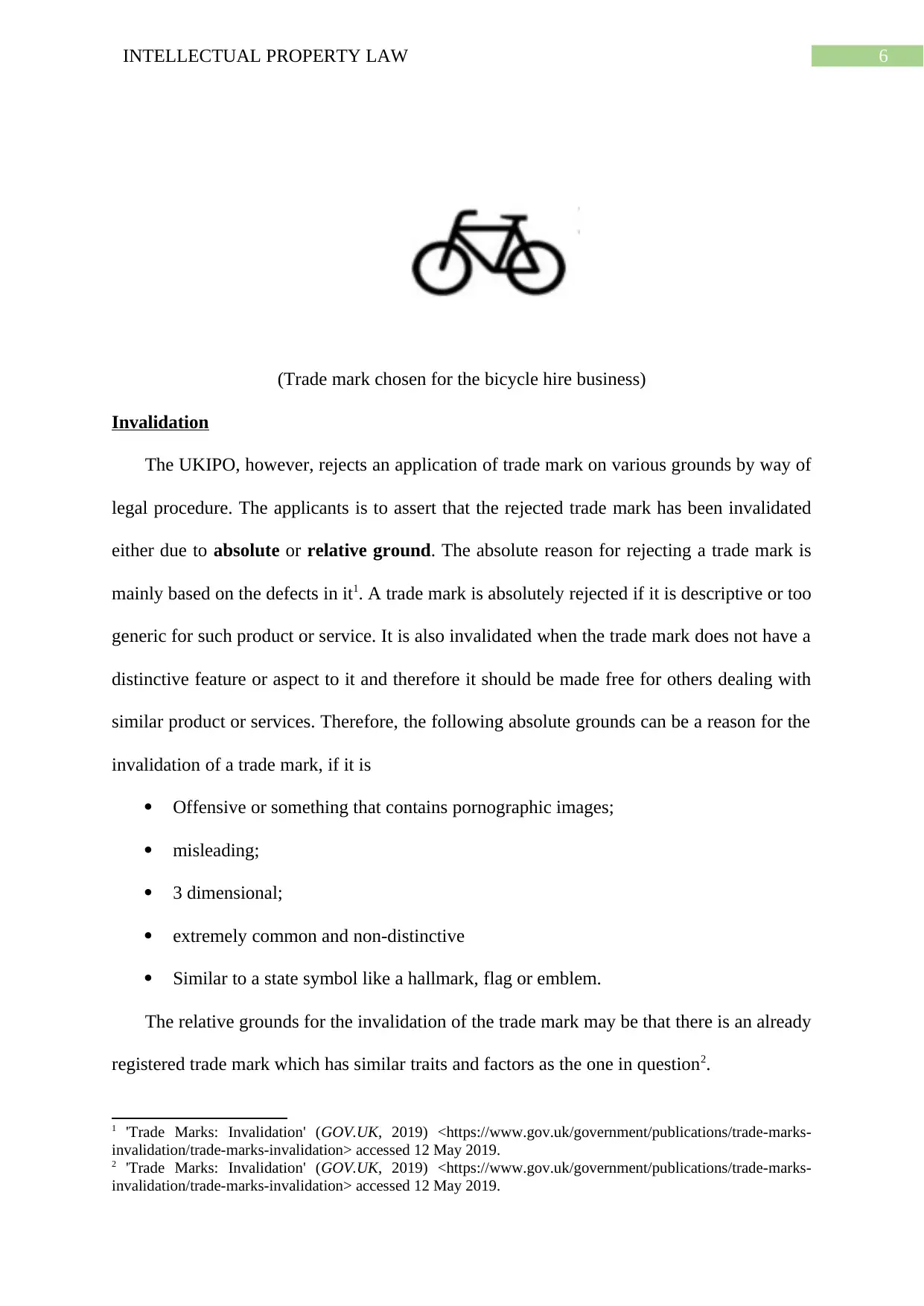
(Trade mark chosen for the bicycle hire business)
Invalidation
The UKIPO, however, rejects an application of trade mark on various grounds by way of
legal procedure. The applicants is to assert that the rejected trade mark has been invalidated
either due to absolute or relative ground. The absolute reason for rejecting a trade mark is
mainly based on the defects in it1. A trade mark is absolutely rejected if it is descriptive or too
generic for such product or service. It is also invalidated when the trade mark does not have a
distinctive feature or aspect to it and therefore it should be made free for others dealing with
similar product or services. Therefore, the following absolute grounds can be a reason for the
invalidation of a trade mark, if it is
Offensive or something that contains pornographic images;
misleading;
3 dimensional;
extremely common and non-distinctive
Similar to a state symbol like a hallmark, flag or emblem.
The relative grounds for the invalidation of the trade mark may be that there is an already
registered trade mark which has similar traits and factors as the one in question2.
1 'Trade Marks: Invalidation' (GOV.UK, 2019) <https://www.gov.uk/government/publications/trade-marks-
invalidation/trade-marks-invalidation> accessed 12 May 2019.
2 'Trade Marks: Invalidation' (GOV.UK, 2019) <https://www.gov.uk/government/publications/trade-marks-
invalidation/trade-marks-invalidation> accessed 12 May 2019.
tabler-icon-diamond-filled.svg

Paraphrase This Document

Need a fresh take? Get an instant paraphrase of this document with our AI Paraphraser
Document Page
7INTELLECTUAL PROPERTY LAW
There are certain grounds under which the application of the trade mark in question can
be rejected. The trade mark in question is a picture of a bicycle which is quite apt for
representing a bicycle hire business. However, it does not exhibit anything uniqueness or
distinctive which can be deduced from the picture, it is extremely simple and common to be a
trade mark for a particular bicycle hire business for it would deprive the other businesses who
would like to deal in the similar genre of business yet do not want to get a trade mark
registered for their business.
Class of trade mark
In UK, a trade mark is registered under one or more of the 45 classes of trade mark
category. The intellectual property office all over the world applies a particular classification
system for trade mark that holds goods and service of similar nature under 45 different
classes which is often called as ‘Nice Classification’. Each of the classes have a list of pre-
approved terms, which are covering the name of the products and services. Class 1-34 covers
the list of goods, while services are contained from 35-45. The trade mark in question has
been categorized under number 18 in the official website of the intellectual Property Office.
Category 18 includes the class of Transport and Equipment for Animal. Under category 18,
the trade mark comes under Division 18.01 that is Land Vehicles and lastly includes the
Section 18.01.05 of Bicycles, Moto Cycles, Motor Scooters, and Tricycles3.
Comparison with an already existing trade mark
3 'Search For A Trade Mark - Intellectual Property Office' (Trademarks.ipo.gov.uk, 2019)
<https://trademarks.ipo.gov.uk/ipo-tmtext> accessed 12 May 2019.
Document Page
8INTELLECTUAL PROPERTY LAW
After running a thorough search through the official website of the Intellectual
Property Office, a similar already registered trade mark has been found which was registered
back in 1997. This trade mark has a name ‘LUCKY BIKE’ registered along with it and thus it
claims the classes 12 and 28. The trade mark in question is quite similar to this one although
they are to be registered in different classes and categories.
Conflict
The two trade marks are quite similar when looked at a glance. It can be confusing to
the consumers for whose convenience a trade mark is actually used; to make the product or
service stand out and more recognizable. The two trade marks looks similar and has similar
logos denoting a business dealing in bicycles. Even though they registered under different
classes, yet there are high chances that the two trade marks can be confusing. Therefore, the
UKIPO might invalidate the application for registering the trade mark in question for
avoiding ambiguity.
Document Page
9INTELLECTUAL PROPERTY LAW
References
'Search For A Trade Mark - Intellectual Property Office' (Trademarks.ipo.gov.uk, 2019)
<https://trademarks.ipo.gov.uk/ipo-tmtext> accessed 12 May 2019
'Trade Marks: Invalidation' (GOV.UK, 2019)
<https://www.gov.uk/government/publications/trade-marks-invalidation/trade-marks-
invalidation> accessed 12 May 2019
chevron_up_icon
1 out of 10
circle_padding
hide_on_mobile
zoom_out_icon
[object Object]