The Role of Language in Global Business Communication Strategies
VerifiedAdded on 2021/05/27
|9
|1474
|80
Presentation
AI Summary
This presentation delves into the critical role of intercultural language in international business communication. It begins with an introduction highlighting the importance of understanding different languages for successful business interactions, particularly in a global context. The presentation then categorizes language into high-context and low-context languages, explaining their characteristics and providing examples. It also addresses language diversity, examining the challenges and issues arising from the presence of multiple languages and dialects in the workplace, including the use of slang, colloquialisms, and argot. Furthermore, the presentation discusses vocabulary equivalence and inequivalence, emphasizing the difficulties in achieving exact translations and offering solutions such as the use of translators. A case study is used to illustrate how language can categorize individuals into groups. The presentation concludes by contrasting linear and non-linear languages and answering questions related to the content. A comprehensive bibliography supports the information provided.

Intercultural Language In
International Business
Paraphrase This Document
Need a fresh take? Get an instant paraphrase of this document with our AI Paraphraser

Introduction
Hello welcome to this presentation , my name is ( clients name)
and I would like to talk to you about how language affects
business communication especially intercultural business.
Unfortunately like most people in the U.S, my understanding of
mandarin is limited to the usually greetings of, “Nǐ hǎo ,
Zǎoshang hǎo, and Zàijiàn,” which mean, “ hello, good morning
and good bye,” respectively. The ability to understand each other
when communication is essential for ensuring relations and
dealings in life and business. This is reflected in the Chinese
saying, “Zài shāngyè jiāoliú zhōng chénggōng de guānjiàn,” which
when loosely translated means , “ in business communication is
key to success.” Understanding language is important because
language holds people together as groups, differentiates them into
groups and controls the manner through which individuals think,
shape concepts, make judgments and perceive actions.
Hello welcome to this presentation , my name is ( clients name)
and I would like to talk to you about how language affects
business communication especially intercultural business.
Unfortunately like most people in the U.S, my understanding of
mandarin is limited to the usually greetings of, “Nǐ hǎo ,
Zǎoshang hǎo, and Zàijiàn,” which mean, “ hello, good morning
and good bye,” respectively. The ability to understand each other
when communication is essential for ensuring relations and
dealings in life and business. This is reflected in the Chinese
saying, “Zài shāngyè jiāoliú zhōng chénggōng de guānjiàn,” which
when loosely translated means , “ in business communication is
key to success.” Understanding language is important because
language holds people together as groups, differentiates them into
groups and controls the manner through which individuals think,
shape concepts, make judgments and perceive actions.

High-and Low Context Language
Language can be categorized in two namely high context and low context language. This slide will review
high context language
High context language refers to language that transmit very little with regards to the explicit message , but
instead focuses greatly on the cultural and nonverbal aspects of that which is not said.
This largely entails reading between the lines by observing the nonverbal cues to understand the messages
intended meaning.
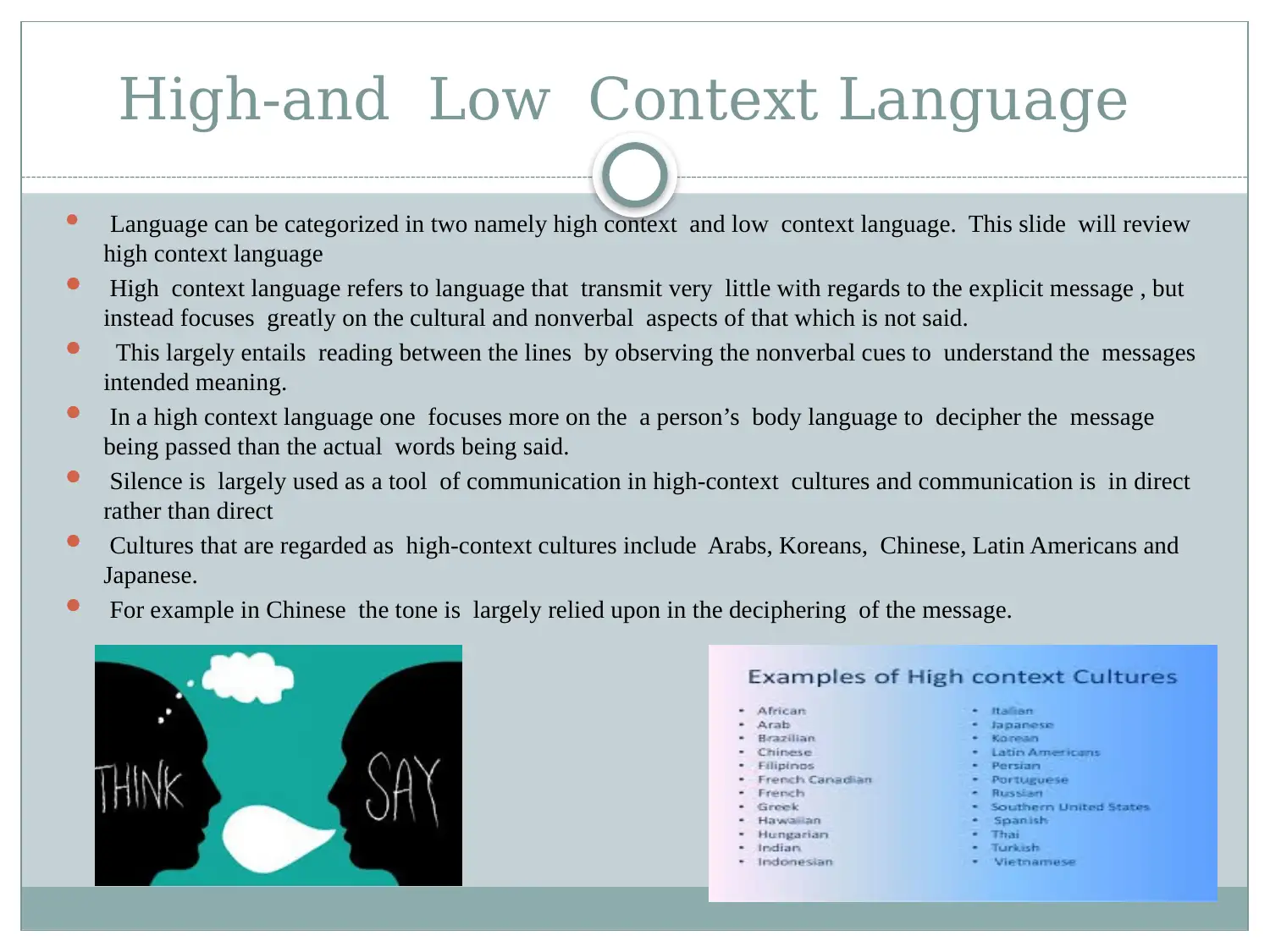
In a high context language one focuses more on the a person’s body language to decipher the message
being passed than the actual words being said.
Silence is largely used as a tool of communication in high-context cultures and communication is in direct
rather than direct
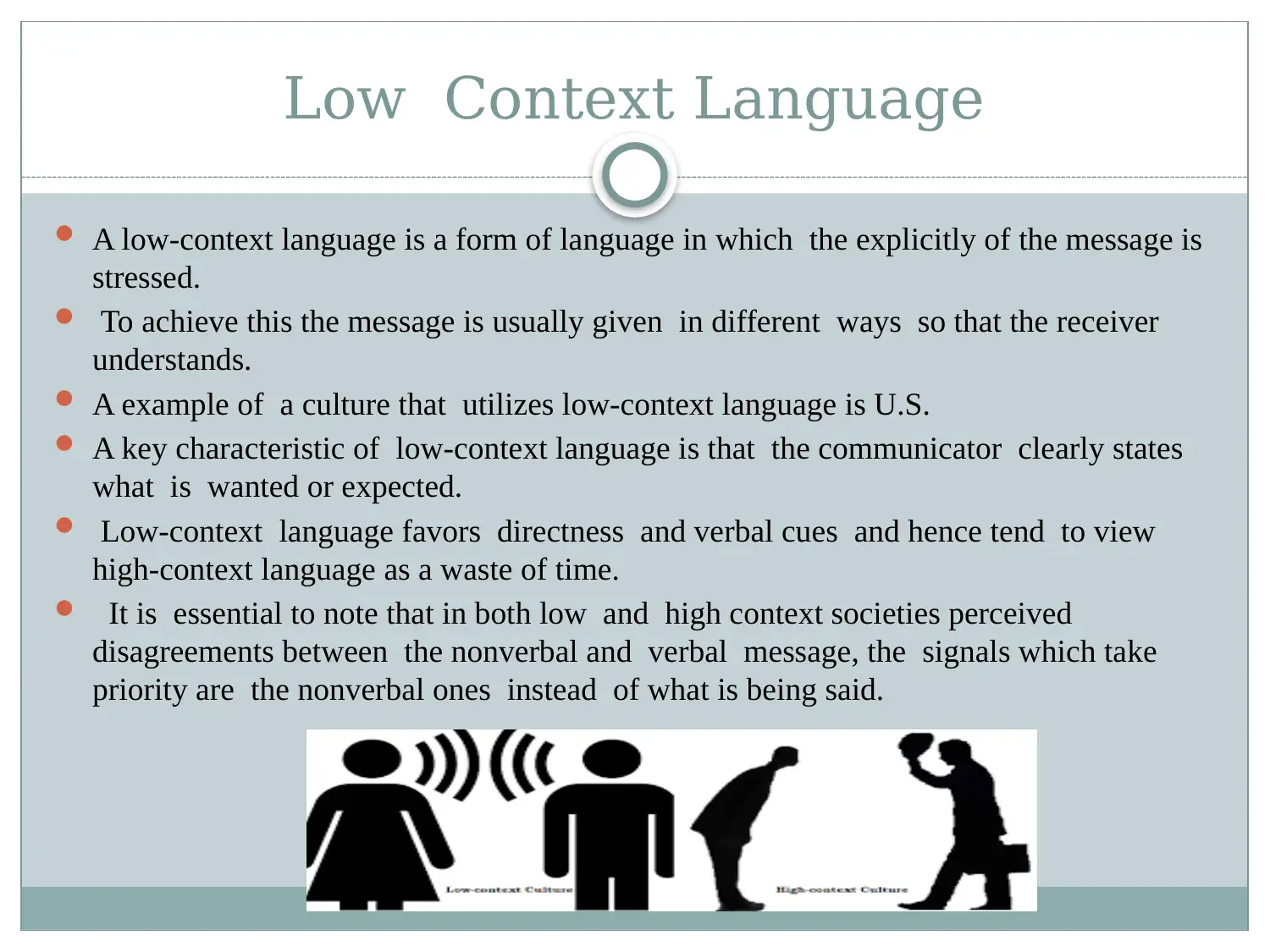
Cultures that are regarded as high-context cultures include Arabs, Koreans, Chinese, Latin Americans and
Japanese.
For example in Chinese the tone is largely relied upon in the deciphering of the message.
Language can be categorized in two namely high context and low context language. This slide will review
high context language
High context language refers to language that transmit very little with regards to the explicit message , but
instead focuses greatly on the cultural and nonverbal aspects of that which is not said.
This largely entails reading between the lines by observing the nonverbal cues to understand the messages
intended meaning.
In a high context language one focuses more on the a person’s body language to decipher the message
being passed than the actual words being said.
Silence is largely used as a tool of communication in high-context cultures and communication is in direct
rather than direct
Cultures that are regarded as high-context cultures include Arabs, Koreans, Chinese, Latin Americans and
Japanese.
For example in Chinese the tone is largely relied upon in the deciphering of the message.
⊘ This is a preview!⊘
Do you want full access?
Subscribe today to unlock all pages.

Trusted by 1+ million students worldwide

Low Context Language
A low-context language is a form of language in which the explicitly of the message is
stressed.
To achieve this the message is usually given in different ways so that the receiver
understands.
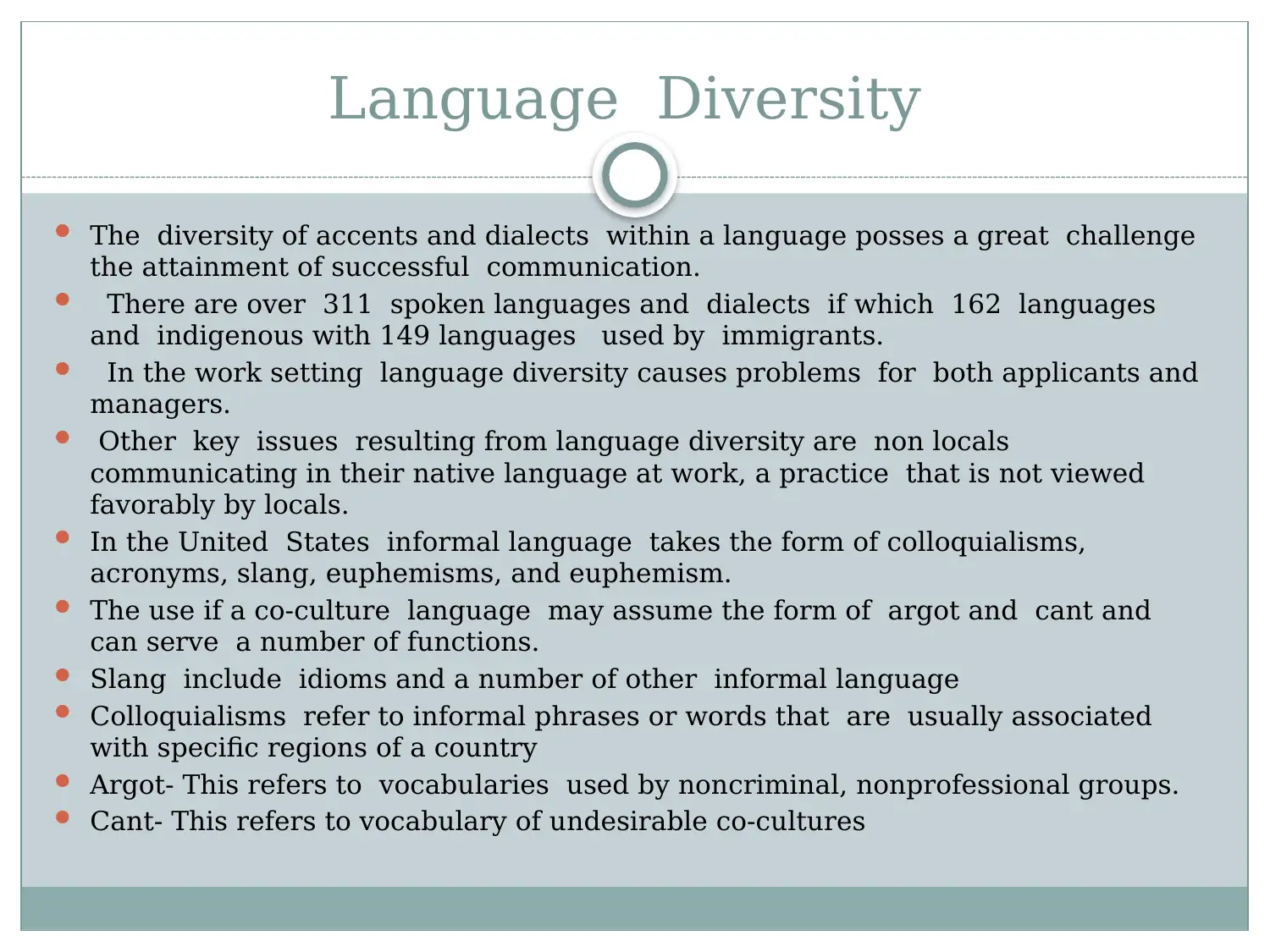
A example of a culture that utilizes low-context language is U.S.
A key characteristic of low-context language is that the communicator clearly states
what is wanted or expected.
Low-context language favors directness and verbal cues and hence tend to view
high-context language as a waste of time.
It is essential to note that in both low and high context societies perceived
disagreements between the nonverbal and verbal message, the signals which take
priority are the nonverbal ones instead of what is being said.
A low-context language is a form of language in which the explicitly of the message is
stressed.
To achieve this the message is usually given in different ways so that the receiver
understands.
A example of a culture that utilizes low-context language is U.S.
A key characteristic of low-context language is that the communicator clearly states
what is wanted or expected.
Low-context language favors directness and verbal cues and hence tend to view
high-context language as a waste of time.
It is essential to note that in both low and high context societies perceived
disagreements between the nonverbal and verbal message, the signals which take
priority are the nonverbal ones instead of what is being said.
Paraphrase This Document
Need a fresh take? Get an instant paraphrase of this document with our AI Paraphraser

Language Diversity
The diversity of accents and dialects within a language posses a great challenge
the attainment of successful communication.
There are over 311 spoken languages and dialects if which 162 languages
and indigenous with 149 languages used by immigrants.
In the work setting language diversity causes problems for both applicants and
managers.
Other key issues resulting from language diversity are non locals
communicating in their native language at work, a practice that is not viewed
favorably by locals.
In the United States informal language takes the form of colloquialisms,
acronyms, slang, euphemisms, and euphemism.
The use if a co-culture language may assume the form of argot and cant and
can serve a number of functions.
Slang include idioms and a number of other informal language
Colloquialisms refer to informal phrases or words that are usually associated
with specific regions of a country
Argot- This refers to vocabularies used by noncriminal, nonprofessional groups.
Cant- This refers to vocabulary of undesirable co-cultures
The diversity of accents and dialects within a language posses a great challenge
the attainment of successful communication.
There are over 311 spoken languages and dialects if which 162 languages
and indigenous with 149 languages used by immigrants.
In the work setting language diversity causes problems for both applicants and
managers.
Other key issues resulting from language diversity are non locals
communicating in their native language at work, a practice that is not viewed
favorably by locals.
In the United States informal language takes the form of colloquialisms,
acronyms, slang, euphemisms, and euphemism.
The use if a co-culture language may assume the form of argot and cant and
can serve a number of functions.
Slang include idioms and a number of other informal language
Colloquialisms refer to informal phrases or words that are usually associated
with specific regions of a country
Argot- This refers to vocabularies used by noncriminal, nonprofessional groups.
Cant- This refers to vocabulary of undesirable co-cultures

Vocabulary Equivalence
The fact that language is influenced by different aspects of culture makes exact the
exact translation from one language to the other almost impossible
There exist a lot of vocabulary inequivalences ranging from grammatical syntactical
equivalences, idiomatic equivalences to experiential and conceptual equivalences.
One of the most popular forms of inequivalences is grammatical syntactical
equivalences.
A person might say “¡Viva la papa!” instead of “¡Viva el papa,” when referring to the
Pope. In doing this the individual will be saying ‘Long Live the Potato,’ instead of ‘Long
Live the Pope.’
This language error is common especially in nonlinear language
This can be solved through the use of translators
Case 4
From the case it is evident that the two Germans use language as a means of
categorizing themselves into different groups.
The use of language in their conversation divides it into two categories namely host
and local language. This is evident
The use of local language serves to introduce the need of an interpreter in the
conversation and makes the other party that does not understand German to feel left
out.
The fact that language is influenced by different aspects of culture makes exact the
exact translation from one language to the other almost impossible
There exist a lot of vocabulary inequivalences ranging from grammatical syntactical
equivalences, idiomatic equivalences to experiential and conceptual equivalences.
One of the most popular forms of inequivalences is grammatical syntactical
equivalences.
A person might say “¡Viva la papa!” instead of “¡Viva el papa,” when referring to the
Pope. In doing this the individual will be saying ‘Long Live the Potato,’ instead of ‘Long
Live the Pope.’
This language error is common especially in nonlinear language
This can be solved through the use of translators
Case 4
From the case it is evident that the two Germans use language as a means of
categorizing themselves into different groups.
The use of language in their conversation divides it into two categories namely host
and local language. This is evident
The use of local language serves to introduce the need of an interpreter in the
conversation and makes the other party that does not understand German to feel left
out.
⊘ This is a preview!⊘
Do you want full access?
Subscribe today to unlock all pages.

Trusted by 1+ million students worldwide

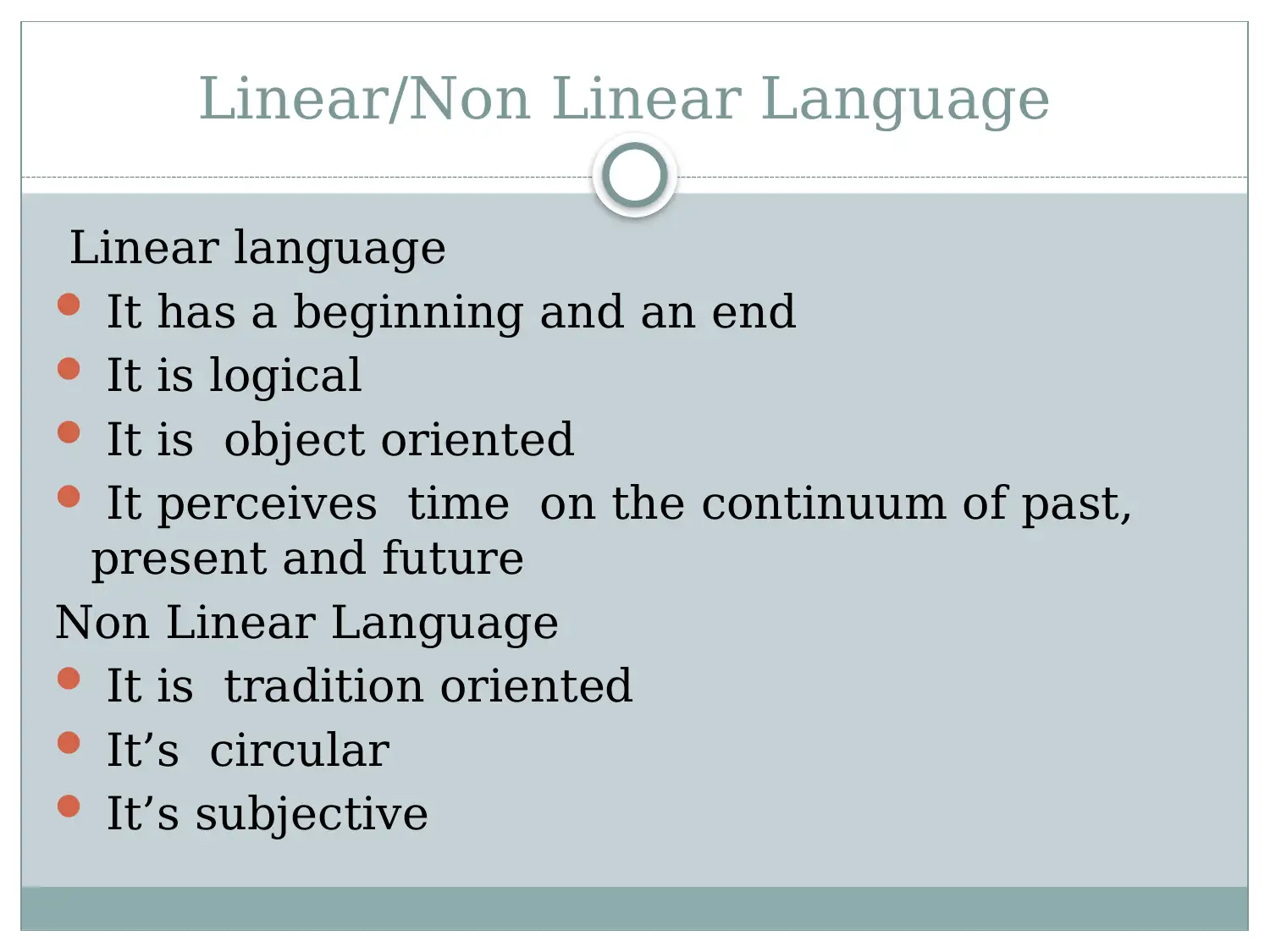
Linear/Non Linear Language
Linear language
It has a beginning and an end
It is logical
It is object oriented
It perceives time on the continuum of past,
present and future
Non Linear Language
It is tradition oriented
It’s circular
It’s subjective
Linear language
It has a beginning and an end
It is logical
It is object oriented
It perceives time on the continuum of past,
present and future
Non Linear Language
It is tradition oriented
It’s circular
It’s subjective
Paraphrase This Document
Need a fresh take? Get an instant paraphrase of this document with our AI Paraphraser

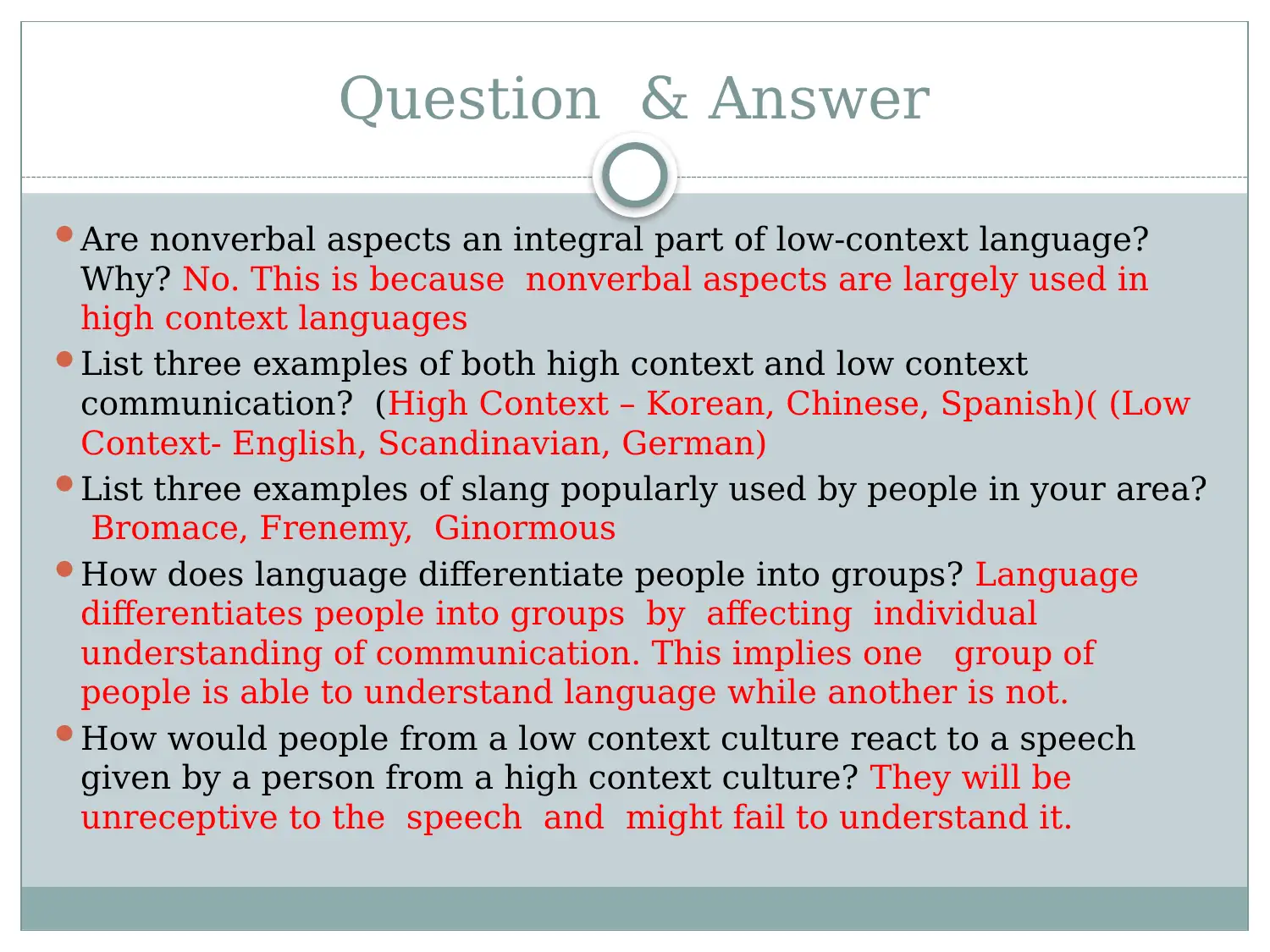
Question & Answer
Are nonverbal aspects an integral part of low-context language?
Why? No. This is because nonverbal aspects are largely used in
high context languages
List three examples of both high context and low context
communication? (High Context – Korean, Chinese, Spanish)( (Low
Context- English, Scandinavian, German)
List three examples of slang popularly used by people in your area?
Bromace, Frenemy, Ginormous
How does language differentiate people into groups? Language
differentiates people into groups by affecting individual
understanding of communication. This implies one group of
people is able to understand language while another is not.
How would people from a low context culture react to a speech
given by a person from a high context culture? They will be
unreceptive to the speech and might fail to understand it.
Are nonverbal aspects an integral part of low-context language?
Why? No. This is because nonverbal aspects are largely used in
high context languages
List three examples of both high context and low context
communication? (High Context – Korean, Chinese, Spanish)( (Low
Context- English, Scandinavian, German)
List three examples of slang popularly used by people in your area?
Bromace, Frenemy, Ginormous
How does language differentiate people into groups? Language
differentiates people into groups by affecting individual
understanding of communication. This implies one group of
people is able to understand language while another is not.
How would people from a low context culture react to a speech
given by a person from a high context culture? They will be
unreceptive to the speech and might fail to understand it.

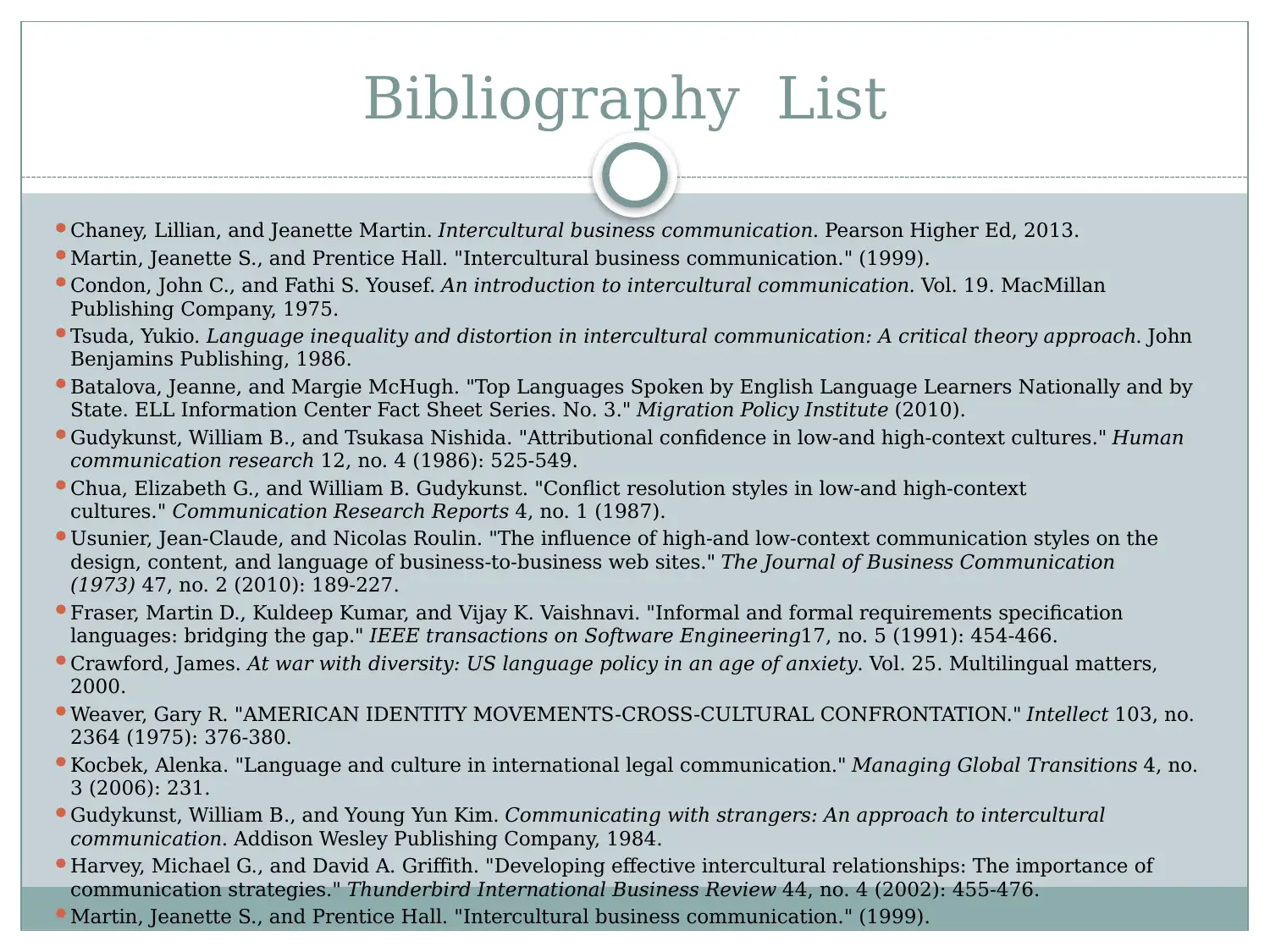
Bibliography List
Chaney, Lillian, and Jeanette Martin. Intercultural business communication. Pearson Higher Ed, 2013.
Martin, Jeanette S., and Prentice Hall. "Intercultural business communication." (1999).
Condon, John C., and Fathi S. Yousef. An introduction to intercultural communication. Vol. 19. MacMillan
Publishing Company, 1975.
Tsuda, Yukio. Language inequality and distortion in intercultural communication: A critical theory approach. John
Benjamins Publishing, 1986.
Batalova, Jeanne, and Margie McHugh. "Top Languages Spoken by English Language Learners Nationally and by
State. ELL Information Center Fact Sheet Series. No. 3." Migration Policy Institute (2010).
Gudykunst, William B., and Tsukasa Nishida. "Attributional confidence in low-and high-context cultures." Human
communication research 12, no. 4 (1986): 525-549.
Chua, Elizabeth G., and William B. Gudykunst. "Conflict resolution styles in low-and high-context
cultures." Communication Research Reports 4, no. 1 (1987).
Usunier, Jean-Claude, and Nicolas Roulin. "The influence of high-and low-context communication styles on the
design, content, and language of business-to-business web sites." The Journal of Business Communication
(1973) 47, no. 2 (2010): 189-227.
Fraser, Martin D., Kuldeep Kumar, and Vijay K. Vaishnavi. "Informal and formal requirements specification
languages: bridging the gap." IEEE transactions on Software Engineering17, no. 5 (1991): 454-466.
Crawford, James. At war with diversity: US language policy in an age of anxiety. Vol. 25. Multilingual matters,
2000.
Weaver, Gary R. "AMERICAN IDENTITY MOVEMENTS-CROSS-CULTURAL CONFRONTATION." Intellect 103, no.
2364 (1975): 376-380.
Kocbek, Alenka. "Language and culture in international legal communication." Managing Global Transitions 4, no.
3 (2006): 231.
Gudykunst, William B., and Young Yun Kim. Communicating with strangers: An approach to intercultural
communication. Addison Wesley Publishing Company, 1984.
Harvey, Michael G., and David A. Griffith. "Developing effective intercultural relationships: The importance of
communication strategies." Thunderbird International Business Review 44, no. 4 (2002): 455-476.
Martin, Jeanette S., and Prentice Hall. "Intercultural business communication." (1999).
Chaney, Lillian, and Jeanette Martin. Intercultural business communication. Pearson Higher Ed, 2013.
Martin, Jeanette S., and Prentice Hall. "Intercultural business communication." (1999).
Condon, John C., and Fathi S. Yousef. An introduction to intercultural communication. Vol. 19. MacMillan
Publishing Company, 1975.
Tsuda, Yukio. Language inequality and distortion in intercultural communication: A critical theory approach. John
Benjamins Publishing, 1986.
Batalova, Jeanne, and Margie McHugh. "Top Languages Spoken by English Language Learners Nationally and by
State. ELL Information Center Fact Sheet Series. No. 3." Migration Policy Institute (2010).
Gudykunst, William B., and Tsukasa Nishida. "Attributional confidence in low-and high-context cultures." Human
communication research 12, no. 4 (1986): 525-549.
Chua, Elizabeth G., and William B. Gudykunst. "Conflict resolution styles in low-and high-context
cultures." Communication Research Reports 4, no. 1 (1987).
Usunier, Jean-Claude, and Nicolas Roulin. "The influence of high-and low-context communication styles on the
design, content, and language of business-to-business web sites." The Journal of Business Communication
(1973) 47, no. 2 (2010): 189-227.
Fraser, Martin D., Kuldeep Kumar, and Vijay K. Vaishnavi. "Informal and formal requirements specification
languages: bridging the gap." IEEE transactions on Software Engineering17, no. 5 (1991): 454-466.
Crawford, James. At war with diversity: US language policy in an age of anxiety. Vol. 25. Multilingual matters,
2000.
Weaver, Gary R. "AMERICAN IDENTITY MOVEMENTS-CROSS-CULTURAL CONFRONTATION." Intellect 103, no.
2364 (1975): 376-380.
Kocbek, Alenka. "Language and culture in international legal communication." Managing Global Transitions 4, no.
3 (2006): 231.
Gudykunst, William B., and Young Yun Kim. Communicating with strangers: An approach to intercultural
communication. Addison Wesley Publishing Company, 1984.
Harvey, Michael G., and David A. Griffith. "Developing effective intercultural relationships: The importance of
communication strategies." Thunderbird International Business Review 44, no. 4 (2002): 455-476.
Martin, Jeanette S., and Prentice Hall. "Intercultural business communication." (1999).
⊘ This is a preview!⊘
Do you want full access?
Subscribe today to unlock all pages.

Trusted by 1+ million students worldwide
1 out of 9
Related Documents
Your All-in-One AI-Powered Toolkit for Academic Success.
+13062052269
info@desklib.com
Available 24*7 on WhatsApp / Email
Unlock your academic potential
Copyright © 2020–2025 A2Z Services. All Rights Reserved. Developed and managed by ZUCOL.