Interlanguage Representation of Past Temporality in Second Language

Verified

Added on  2020/07/22

|6
|1231
|144
Literature Review
AI Summary
This literature review explores the interlanguage representation of past temporality in the context of second and foreign language learning. It examines various studies and theories, including Selinker's concept of interlanguage, Bardovi-Harlig's stages of tense acquisition, and Lightbown and Spada's insights on regular and irregular verb forms. The review also discusses Perdue's Basic Variety, Salaberry's research on English past tense acquisition by Spanish speakers, and Collins' work on L1 influence. It highlights the challenges learners face in mastering tense and aspect, emphasizing the role of pragmatic tools, lexical resources, and verbal morphology. The review references key studies and provides a comprehensive overview of the topic, making it a valuable resource for understanding the complexities of second language acquisition.
Document Page
Interlanguage
representation of past
temporality in a
second and foreign
language learning
context
tabler-icon-diamond-filled.svg

Paraphrase This Document

Need a fresh take? Get an instant paraphrase of this document with our AI Paraphraser
Document Page
Table of Contents
Literature Review.............................................................................................................................1
References........................................................................................................................................3
Document Page
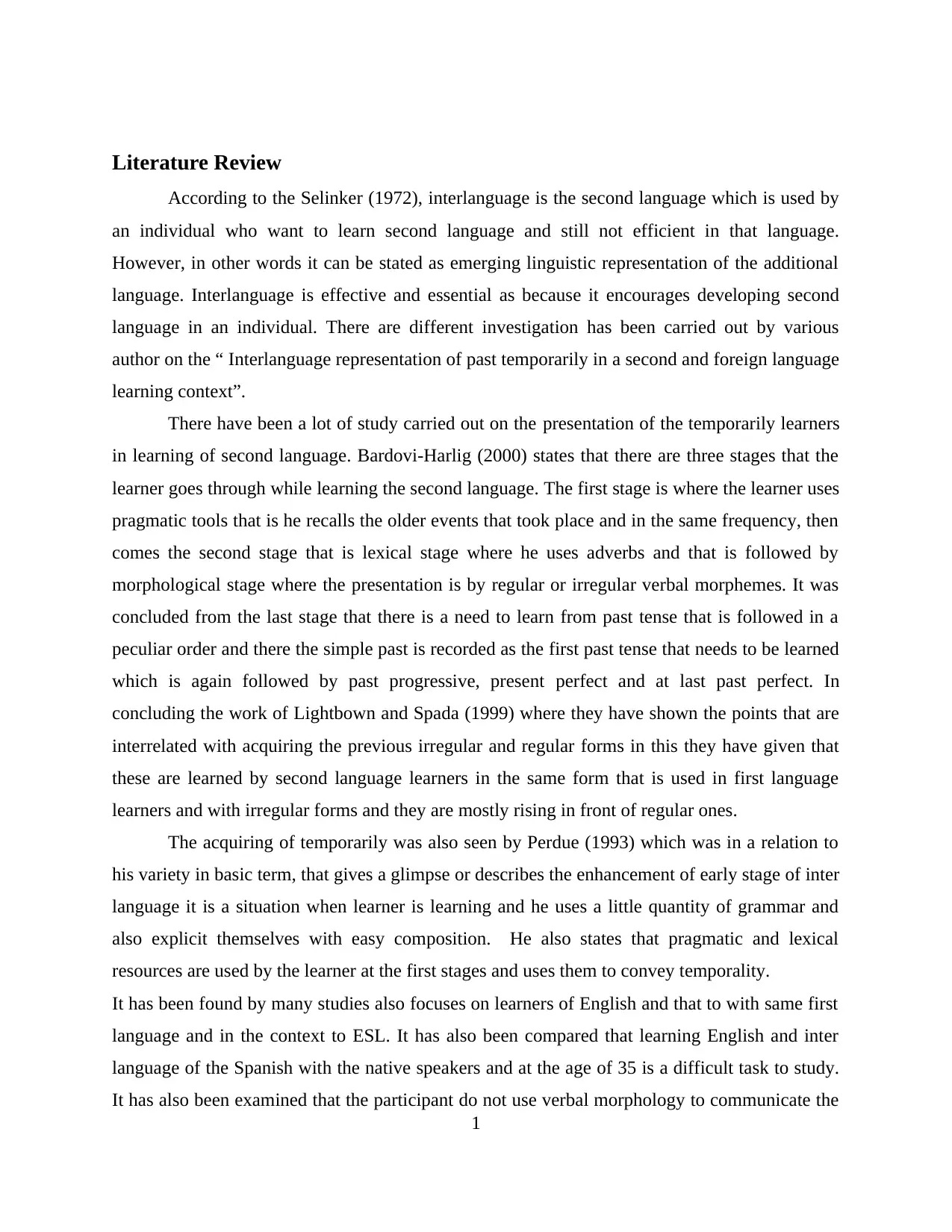
Literature Review
According to the Selinker (1972), interlanguage is the second language which is used by
an individual who want to learn second language and still not efficient in that language.
However, in other words it can be stated as emerging linguistic representation of the additional
language. Interlanguage is effective and essential as because it encourages developing second
language in an individual. There are different investigation has been carried out by various
author on the “ Interlanguage representation of past temporarily in a second and foreign language
learning context”.
There have been a lot of study carried out on the presentation of the temporarily learners
in learning of second language. Bardovi-Harlig (2000) states that there are three stages that the
learner goes through while learning the second language. The first stage is where the learner uses
pragmatic tools that is he recalls the older events that took place and in the same frequency, then
comes the second stage that is lexical stage where he uses adverbs and that is followed by
morphological stage where the presentation is by regular or irregular verbal morphemes. It was
concluded from the last stage that there is a need to learn from past tense that is followed in a
peculiar order and there the simple past is recorded as the first past tense that needs to be learned
which is again followed by past progressive, present perfect and at last past perfect. In
concluding the work of Lightbown and Spada (1999) where they have shown the points that are
interrelated with acquiring the previous irregular and regular forms in this they have given that
these are learned by second language learners in the same form that is used in first language
learners and with irregular forms and they are mostly rising in front of regular ones.
The acquiring of temporarily was also seen by Perdue (1993) which was in a relation to
his variety in basic term, that gives a glimpse or describes the enhancement of early stage of inter
language it is a situation when learner is learning and he uses a little quantity of grammar and
also explicit themselves with easy composition. He also states that pragmatic and lexical
resources are used by the learner at the first stages and uses them to convey temporality.
It has been found by many studies also focuses on learners of English and that to with same first
language and in the context to ESL. It has also been compared that learning English and inter
language of the Spanish with the native speakers and at the age of 35 is a difficult task to study.
It has also been examined that the participant do not use verbal morphology to communicate the
1
Document Page
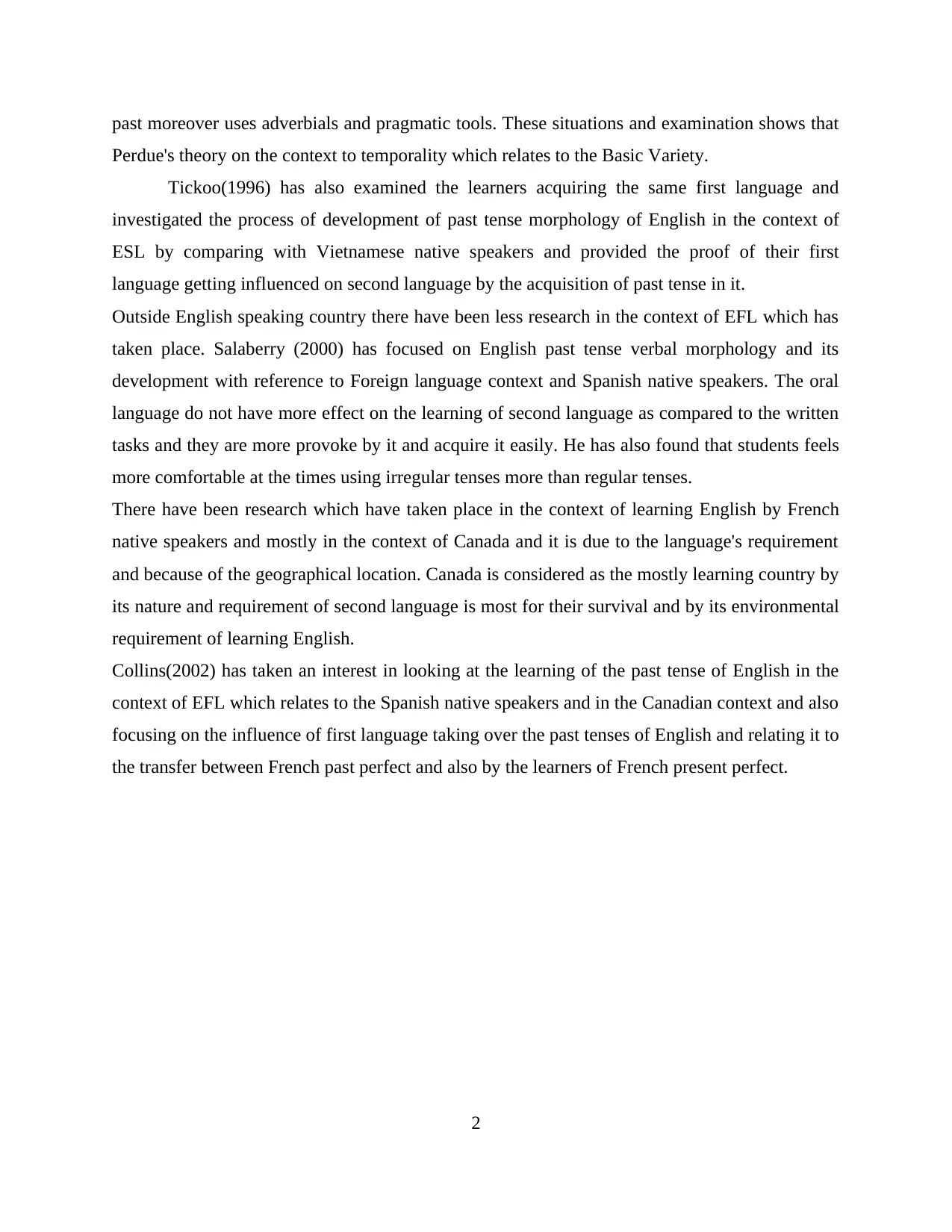
past moreover uses adverbials and pragmatic tools. These situations and examination shows that
Perdue's theory on the context to temporality which relates to the Basic Variety.
Tickoo(1996) has also examined the learners acquiring the same first language and
investigated the process of development of past tense morphology of English in the context of
ESL by comparing with Vietnamese native speakers and provided the proof of their first
language getting influenced on second language by the acquisition of past tense in it.
Outside English speaking country there have been less research in the context of EFL which has
taken place. Salaberry (2000) has focused on English past tense verbal morphology and its
development with reference to Foreign language context and Spanish native speakers. The oral
language do not have more effect on the learning of second language as compared to the written
tasks and they are more provoke by it and acquire it easily. He has also found that students feels
more comfortable at the times using irregular tenses more than regular tenses.
There have been research which have taken place in the context of learning English by French
native speakers and mostly in the context of Canada and it is due to the language's requirement
and because of the geographical location. Canada is considered as the mostly learning country by
its nature and requirement of second language is most for their survival and by its environmental
requirement of learning English.
Collins(2002) has taken an interest in looking at the learning of the past tense of English in the
context of EFL which relates to the Spanish native speakers and in the Canadian context and also
focusing on the influence of first language taking over the past tenses of English and relating it to
the transfer between French past perfect and also by the learners of French present perfect.
2
tabler-icon-diamond-filled.svg

Paraphrase This Document

Need a fresh take? Get an instant paraphrase of this document with our AI Paraphraser
Document Page
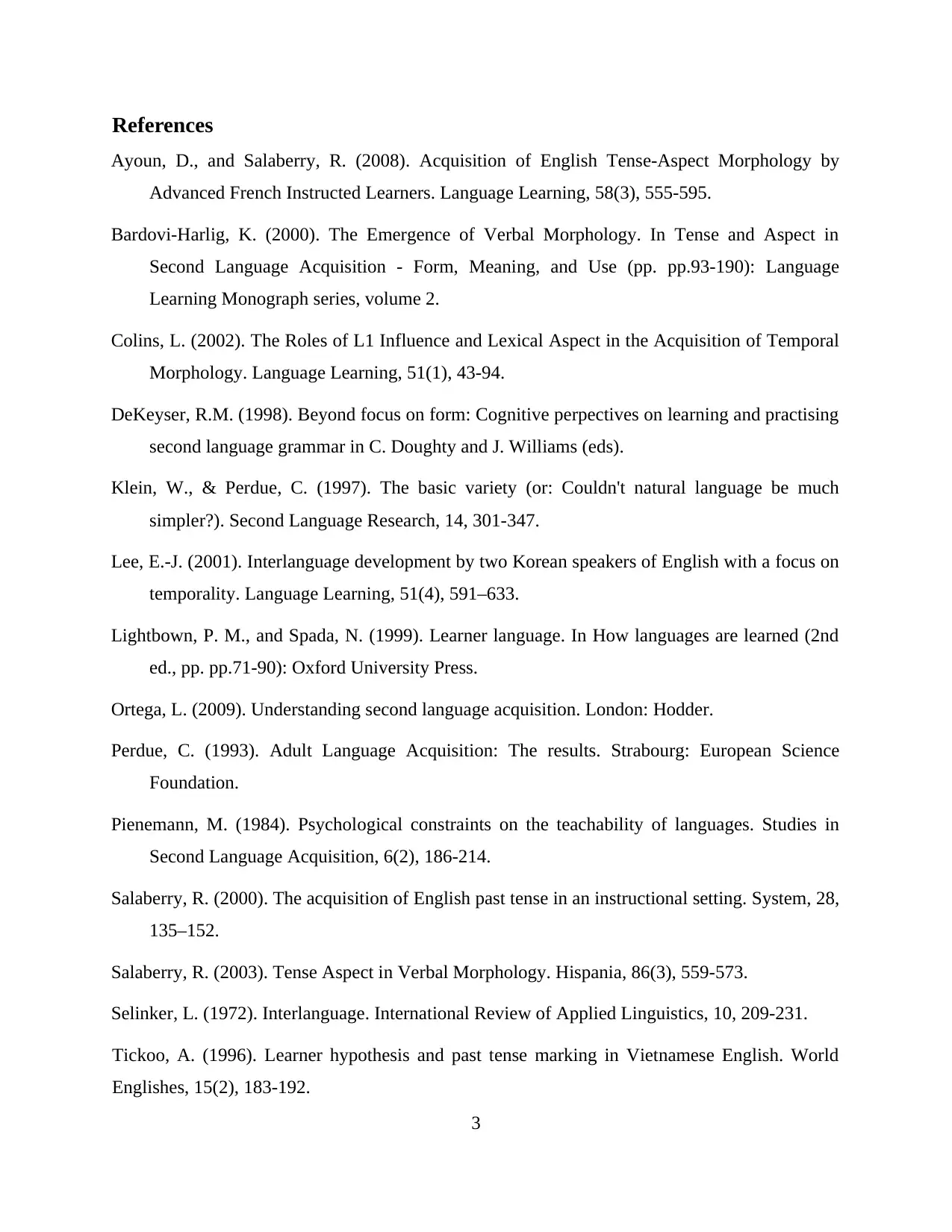
References
Ayoun, D., and Salaberry, R. (2008). Acquisition of English Tense-Aspect Morphology by
Advanced French Instructed Learners. Language Learning, 58(3), 555-595.
Bardovi-Harlig, K. (2000). The Emergence of Verbal Morphology. In Tense and Aspect in
Second Language Acquisition - Form, Meaning, and Use (pp. pp.93-190): Language
Learning Monograph series, volume 2.
Colins, L. (2002). The Roles of L1 Influence and Lexical Aspect in the Acquisition of Temporal
Morphology. Language Learning, 51(1), 43-94.
DeKeyser, R.M. (1998). Beyond focus on form: Cognitive perpectives on learning and practising
second language grammar in C. Doughty and J. Williams (eds).
Klein, W., & Perdue, C. (1997). The basic variety (or: Couldn't natural language be much
simpler?). Second Language Research, 14, 301-347.
Lee, E.-J. (2001). Interlanguage development by two Korean speakers of English with a focus on
temporality. Language Learning, 51(4), 591–633.
Lightbown, P. M., and Spada, N. (1999). Learner language. In How languages are learned (2nd
ed., pp. pp.71-90): Oxford University Press.
Ortega, L. (2009). Understanding second language acquisition. London: Hodder.
Perdue, C. (1993). Adult Language Acquisition: The results. Strabourg: European Science
Foundation.
Pienemann, M. (1984). Psychological constraints on the teachability of languages. Studies in
Second Language Acquisition, 6(2), 186-214.
Salaberry, R. (2000). The acquisition of English past tense in an instructional setting. System, 28,
135–152.
Salaberry, R. (2003). Tense Aspect in Verbal Morphology. Hispania, 86(3), 559-573.
Selinker, L. (1972). Interlanguage. International Review of Applied Linguistics, 10, 209-231.
Tickoo, A. (1996). Learner hypothesis and past tense marking in Vietnamese English. World
Englishes, 15(2), 183-192.
3
Document Page
4
chevron_up_icon
1 out of 6
circle_padding
hide_on_mobile
zoom_out_icon
[object Object]