Auditing Evaluation Report: Internal Controls and Auditing
VerifiedAdded on  2020/04/29
|10
|2178
|82
Report
AI Summary
This report provides a comprehensive analysis of internal controls within organizations, emphasizing their critical role in achieving operational efficiency and ensuring the accuracy of financial reporting. It begins with an introduction to the concept of internal control, which encompasses various measures designed to mitigate risks and uphold regulatory compliance. The report then delves into a literature review, exploring the components of internal control, including the control environment, information and communication systems, control activities, monitoring, and risk assessment. It highlights the significant benefits of implementing internal controls, such as fraud prevention, error reduction, and the facilitation of accurate financial statements. The report also examines how internal controls assist external auditors by providing a framework for assessing organizational integrity and identifying potential errors. Furthermore, it acknowledges the limitations of internal controls, such as management override, lack of monitoring, collusion, and the reliance on human judgment. The conclusion summarizes the importance of internal controls and their impact on ensuring error-free operations, recommending their implementation to safeguard organizational integrity. The report references several academic sources to support its arguments, providing a well-rounded perspective on the subject.
Running head: AUDITING EVALUATION
`
Auditing Evaluation
Student’s Name:
University Name:
Author Note
`
Auditing Evaluation
Student’s Name:
University Name:
Author Note
Paraphrase This Document
Need a fresh take? Get an instant paraphrase of this document with our AI Paraphraser

1AUDITING EVALUATION
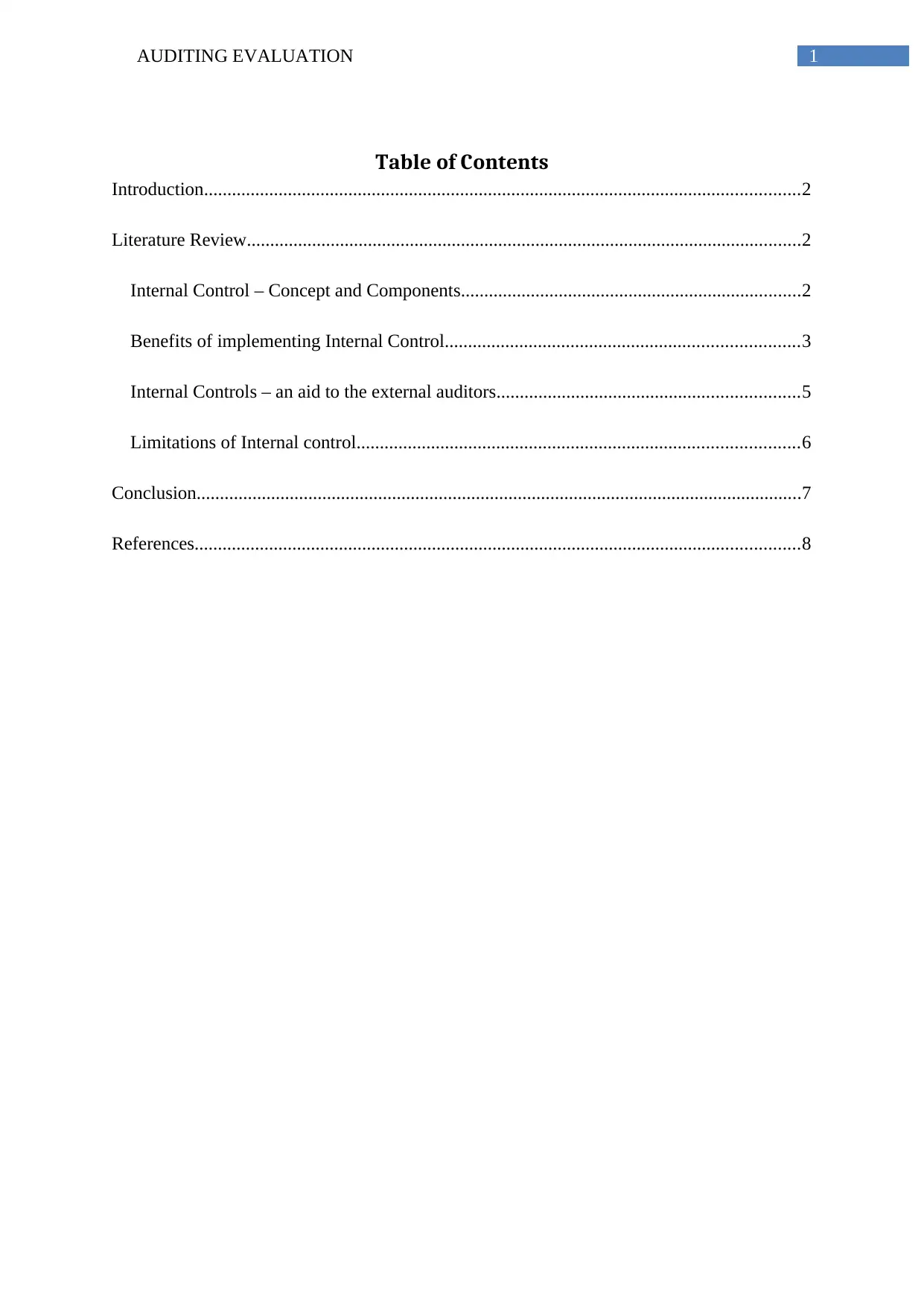
Table of Contents
Introduction................................................................................................................................2
Literature Review.......................................................................................................................2
Internal Control – Concept and Components.........................................................................2
Benefits of implementing Internal Control............................................................................3
Internal Controls – an aid to the external auditors.................................................................5
Limitations of Internal control...............................................................................................6
Conclusion..................................................................................................................................7
References..................................................................................................................................8
Table of Contents
Introduction................................................................................................................................2
Literature Review.......................................................................................................................2
Internal Control – Concept and Components.........................................................................2
Benefits of implementing Internal Control............................................................................3
Internal Controls – an aid to the external auditors.................................................................5
Limitations of Internal control...............................................................................................6
Conclusion..................................................................................................................................7
References..................................................................................................................................8

2AUDITING EVALUATION
Introduction
This particular study focuses upon the concept of internal control persisting in an
organization. Internal control essentially refers to the set of controls that have been
established in an organization in order to enable the organization to achieve its objectives in
terms of efficiency and effectiveness pertaining to the operations of the business. Internal
controls review and recheck the quality of financial reporting and also make sure whether
they comply with the laid down policies and regulations. In more simple terms any control
that is implemented in the organization in order to mitigate risk falls under the purview of
internal controls.
In this particular study the importance of implementing internal controls in an
organization and how the implemented controls have helped the organization in achieving the
company goals have been discussed.
Literature Review
Internal Control – Concept and Components
Internal control refers to the control that has been established inside an organization in
order to strengthen its operational activities and improve the quality of regular day to day
proceedings of business. An internal control in general acts as a catalyst that is it improves or
influences the already implemented positive policies or regulations of an organization. For
instance a successful implementation of internal control lies in segregation of duties.
Segregation of duties in an organization is very important. For example a particular employee
who is responsible for receiving cash from customers should not also be delegated with the
task of recording them in the books. A different employee steps in for handling such a
responsibility and therefore it is at this point that the internal control of segregation of duties
Introduction
This particular study focuses upon the concept of internal control persisting in an
organization. Internal control essentially refers to the set of controls that have been
established in an organization in order to enable the organization to achieve its objectives in
terms of efficiency and effectiveness pertaining to the operations of the business. Internal
controls review and recheck the quality of financial reporting and also make sure whether
they comply with the laid down policies and regulations. In more simple terms any control
that is implemented in the organization in order to mitigate risk falls under the purview of
internal controls.
In this particular study the importance of implementing internal controls in an
organization and how the implemented controls have helped the organization in achieving the
company goals have been discussed.
Literature Review
Internal Control – Concept and Components
Internal control refers to the control that has been established inside an organization in
order to strengthen its operational activities and improve the quality of regular day to day
proceedings of business. An internal control in general acts as a catalyst that is it improves or
influences the already implemented positive policies or regulations of an organization. For
instance a successful implementation of internal control lies in segregation of duties.
Segregation of duties in an organization is very important. For example a particular employee
who is responsible for receiving cash from customers should not also be delegated with the
task of recording them in the books. A different employee steps in for handling such a
responsibility and therefore it is at this point that the internal control of segregation of duties
⊘ This is a preview!⊘
Do you want full access?
Subscribe today to unlock all pages.

Trusted by 1+ million students worldwide

3AUDITING EVALUATION
has been established. Other duties that fall under the principle of internal control are
utilization of technological controls, maintenance of records and conducting independent
regular reviews. These principles of internal control therefore are the reference points of the
management for establishing and implementing procedures for protecting the assets of the
company (Hammersley, Myers & Zhou, 2012).
The components of internal control include Control Environment; Information and
Communication; Control Activities; Monitoring; and Risk Assessment.
Control Environment refers to that component of internal control which determines
the pitch of the organization and instills awareness about such control among the employees.
It lays the basic structure for all other components of internal control.
Information and Communication refers to the processes and systems that help in
identifying, capturing and exchanging information in a structured and framed way so as to
support the employees in carrying out their responsibilities in a proper way.
Control Activities refer to that component of internal control which establishes a set
of regulations and policies for ensuring the execution of the directives set by the
management.
Lastly Monitoring refers to the processes that are required for the purpose of assessing
the quality of the internal control established in the organization over time.
The above mentioned components of internal control make the entire process easy to
understand as well as implement (Hermanson, Smith, & Stephens, 2012).
Benefits of implementing Internal Control
Internal controls not only increase the efficiency of an organization but also simplify
the work done by employees by setting clear goals and by continuously monitoring and
has been established. Other duties that fall under the principle of internal control are
utilization of technological controls, maintenance of records and conducting independent
regular reviews. These principles of internal control therefore are the reference points of the
management for establishing and implementing procedures for protecting the assets of the
company (Hammersley, Myers & Zhou, 2012).
The components of internal control include Control Environment; Information and
Communication; Control Activities; Monitoring; and Risk Assessment.
Control Environment refers to that component of internal control which determines
the pitch of the organization and instills awareness about such control among the employees.
It lays the basic structure for all other components of internal control.
Information and Communication refers to the processes and systems that help in
identifying, capturing and exchanging information in a structured and framed way so as to
support the employees in carrying out their responsibilities in a proper way.
Control Activities refer to that component of internal control which establishes a set
of regulations and policies for ensuring the execution of the directives set by the
management.
Lastly Monitoring refers to the processes that are required for the purpose of assessing
the quality of the internal control established in the organization over time.
The above mentioned components of internal control make the entire process easy to
understand as well as implement (Hermanson, Smith, & Stephens, 2012).
Benefits of implementing Internal Control
Internal controls not only increase the efficiency of an organization but also simplify
the work done by employees by setting clear goals and by continuously monitoring and
Paraphrase This Document
Need a fresh take? Get an instant paraphrase of this document with our AI Paraphraser

4AUDITING EVALUATION
reviewing the quality of the procedure in which the desired results are obtained. However the
major benefits of implementing Internal Control in an organization are that they help in
preventing fraud especially in the financial statements of an organization; they also help in
preventing errors in preparing the financial statements; spotting the errors in the financial
statements is also facilitated by the implementation of internal controls; internal controls also
result in reduced lawsuit and insurance claims.
Internal control prevents fraud by segregating the duties of the employees. For
instance internal control of a bank may require an employee collecting the cheques for cash
withdrawal by customers and another employee authorizing those withdrawals thus
mitigating the chances of fraudulent activity.
Internal controls not only help in preventing fraud but also prevent the occurrence of
errors in business. Reviews at periodic intervals and surprise tests of the quality of the
finished products help in preventing errors. Implementation of internal control in order to
ensure that all the transactions that take place inside an organization are authorized also play
an important role in preventing errors.
Implementation of proper internal control also help in establishing clear, concise and
defined guidelines in relation to the ethical conduct and other management implemented
policies and regulations of the organization. This help in reducing the risk of lawsuits and
costly insurance claims. Essentially the internal controls ensure welfare of the employees.
Internal controls also help to make the financial statements error free. They mitigate
the common occurrences of errors in the financial statements like misappropriation of assets
and material misstatements (Vijayakumar & Nagaraja, 2012).
reviewing the quality of the procedure in which the desired results are obtained. However the
major benefits of implementing Internal Control in an organization are that they help in
preventing fraud especially in the financial statements of an organization; they also help in
preventing errors in preparing the financial statements; spotting the errors in the financial
statements is also facilitated by the implementation of internal controls; internal controls also
result in reduced lawsuit and insurance claims.
Internal control prevents fraud by segregating the duties of the employees. For
instance internal control of a bank may require an employee collecting the cheques for cash
withdrawal by customers and another employee authorizing those withdrawals thus
mitigating the chances of fraudulent activity.
Internal controls not only help in preventing fraud but also prevent the occurrence of
errors in business. Reviews at periodic intervals and surprise tests of the quality of the
finished products help in preventing errors. Implementation of internal control in order to
ensure that all the transactions that take place inside an organization are authorized also play
an important role in preventing errors.
Implementation of proper internal control also help in establishing clear, concise and
defined guidelines in relation to the ethical conduct and other management implemented
policies and regulations of the organization. This help in reducing the risk of lawsuits and
costly insurance claims. Essentially the internal controls ensure welfare of the employees.
Internal controls also help to make the financial statements error free. They mitigate
the common occurrences of errors in the financial statements like misappropriation of assets
and material misstatements (Vijayakumar & Nagaraja, 2012).

5AUDITING EVALUATION
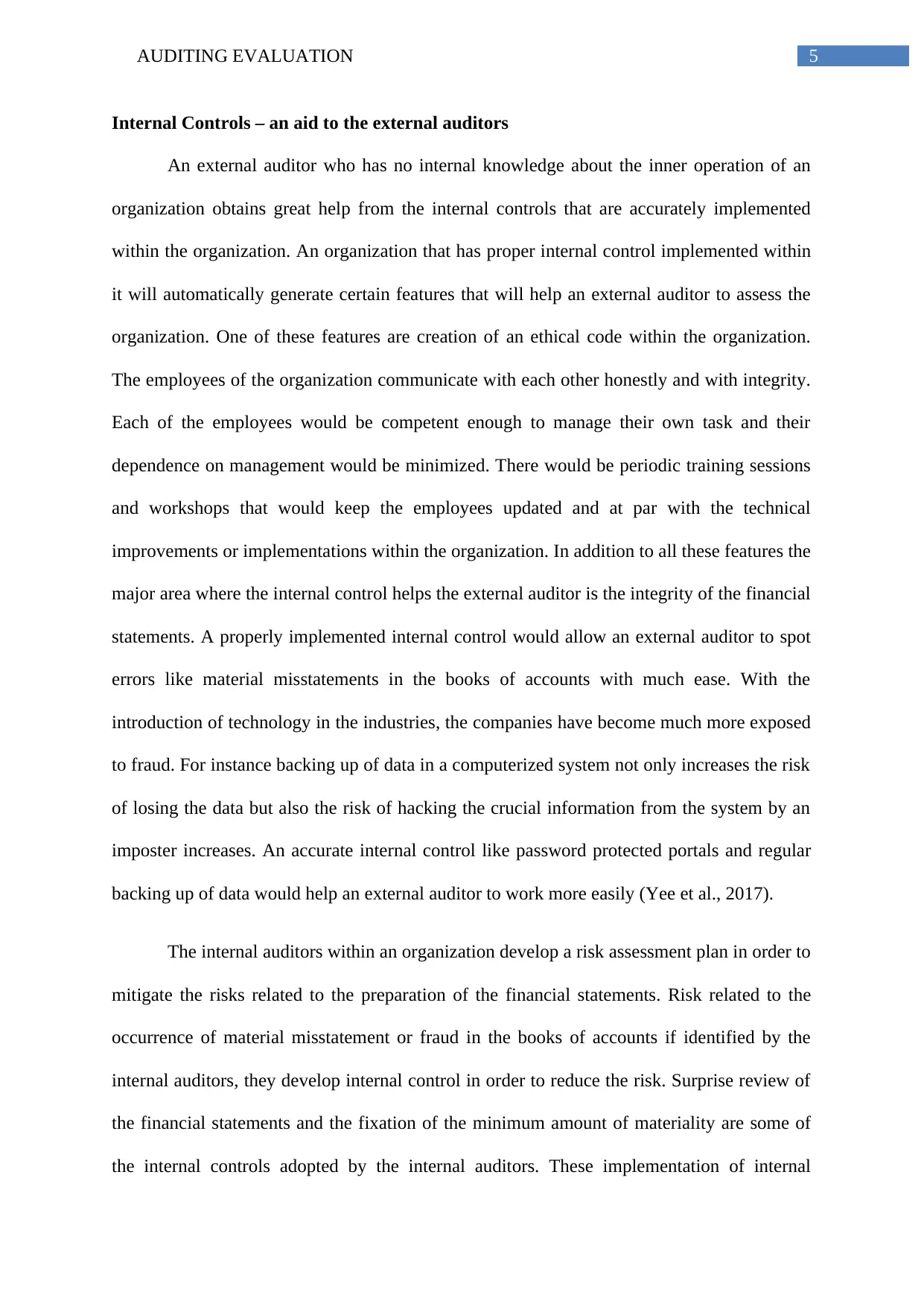
Internal Controls – an aid to the external auditors
An external auditor who has no internal knowledge about the inner operation of an
organization obtains great help from the internal controls that are accurately implemented
within the organization. An organization that has proper internal control implemented within
it will automatically generate certain features that will help an external auditor to assess the
organization. One of these features are creation of an ethical code within the organization.
The employees of the organization communicate with each other honestly and with integrity.
Each of the employees would be competent enough to manage their own task and their
dependence on management would be minimized. There would be periodic training sessions
and workshops that would keep the employees updated and at par with the technical
improvements or implementations within the organization. In addition to all these features the
major area where the internal control helps the external auditor is the integrity of the financial
statements. A properly implemented internal control would allow an external auditor to spot
errors like material misstatements in the books of accounts with much ease. With the
introduction of technology in the industries, the companies have become much more exposed
to fraud. For instance backing up of data in a computerized system not only increases the risk
of losing the data but also the risk of hacking the crucial information from the system by an
imposter increases. An accurate internal control like password protected portals and regular
backing up of data would help an external auditor to work more easily (Yee et al., 2017).
The internal auditors within an organization develop a risk assessment plan in order to
mitigate the risks related to the preparation of the financial statements. Risk related to the
occurrence of material misstatement or fraud in the books of accounts if identified by the
internal auditors, they develop internal control in order to reduce the risk. Surprise review of
the financial statements and the fixation of the minimum amount of materiality are some of
the internal controls adopted by the internal auditors. These implementation of internal
Internal Controls – an aid to the external auditors
An external auditor who has no internal knowledge about the inner operation of an
organization obtains great help from the internal controls that are accurately implemented
within the organization. An organization that has proper internal control implemented within
it will automatically generate certain features that will help an external auditor to assess the
organization. One of these features are creation of an ethical code within the organization.
The employees of the organization communicate with each other honestly and with integrity.
Each of the employees would be competent enough to manage their own task and their
dependence on management would be minimized. There would be periodic training sessions
and workshops that would keep the employees updated and at par with the technical
improvements or implementations within the organization. In addition to all these features the
major area where the internal control helps the external auditor is the integrity of the financial
statements. A properly implemented internal control would allow an external auditor to spot
errors like material misstatements in the books of accounts with much ease. With the
introduction of technology in the industries, the companies have become much more exposed
to fraud. For instance backing up of data in a computerized system not only increases the risk
of losing the data but also the risk of hacking the crucial information from the system by an
imposter increases. An accurate internal control like password protected portals and regular
backing up of data would help an external auditor to work more easily (Yee et al., 2017).
The internal auditors within an organization develop a risk assessment plan in order to
mitigate the risks related to the preparation of the financial statements. Risk related to the
occurrence of material misstatement or fraud in the books of accounts if identified by the
internal auditors, they develop internal control in order to reduce the risk. Surprise review of
the financial statements and the fixation of the minimum amount of materiality are some of
the internal controls adopted by the internal auditors. These implementation of internal
⊘ This is a preview!⊘
Do you want full access?
Subscribe today to unlock all pages.

Trusted by 1+ million students worldwide

6AUDITING EVALUATION
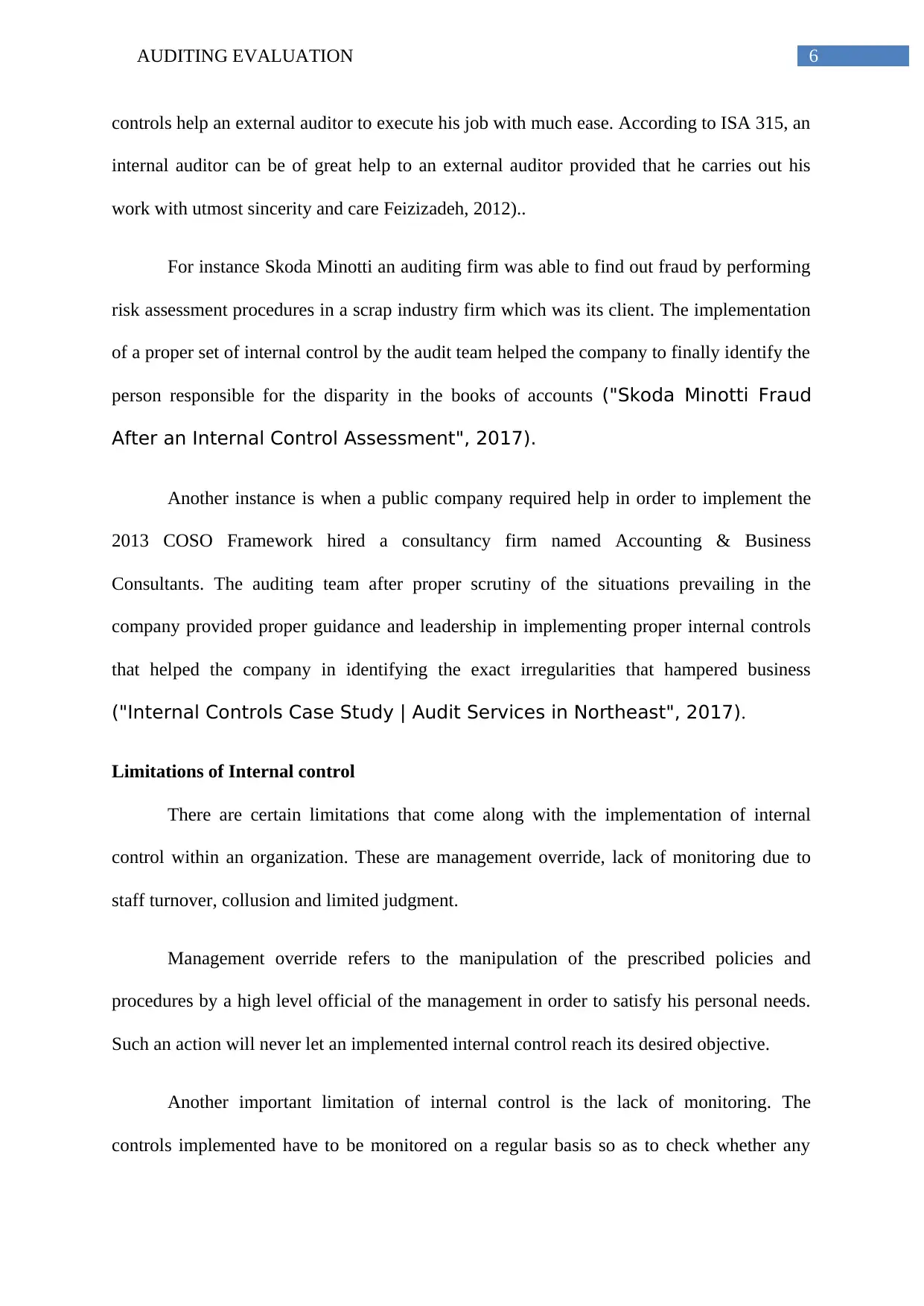
controls help an external auditor to execute his job with much ease. According to ISA 315, an
internal auditor can be of great help to an external auditor provided that he carries out his
work with utmost sincerity and care Feizizadeh, 2012)..
For instance Skoda Minotti an auditing firm was able to find out fraud by performing
risk assessment procedures in a scrap industry firm which was its client. The implementation
of a proper set of internal control by the audit team helped the company to finally identify the
person responsible for the disparity in the books of accounts ("Skoda Minotti Fraud
After an Internal Control Assessment", 2017).
Another instance is when a public company required help in order to implement the
2013 COSO Framework hired a consultancy firm named Accounting & Business
Consultants. The auditing team after proper scrutiny of the situations prevailing in the
company provided proper guidance and leadership in implementing proper internal controls
that helped the company in identifying the exact irregularities that hampered business
("Internal Controls Case Study | Audit Services in Northeast", 2017).
Limitations of Internal control
There are certain limitations that come along with the implementation of internal
control within an organization. These are management override, lack of monitoring due to
staff turnover, collusion and limited judgment.
Management override refers to the manipulation of the prescribed policies and
procedures by a high level official of the management in order to satisfy his personal needs.
Such an action will never let an implemented internal control reach its desired objective.
Another important limitation of internal control is the lack of monitoring. The
controls implemented have to be monitored on a regular basis so as to check whether any
controls help an external auditor to execute his job with much ease. According to ISA 315, an
internal auditor can be of great help to an external auditor provided that he carries out his
work with utmost sincerity and care Feizizadeh, 2012)..
For instance Skoda Minotti an auditing firm was able to find out fraud by performing
risk assessment procedures in a scrap industry firm which was its client. The implementation
of a proper set of internal control by the audit team helped the company to finally identify the
person responsible for the disparity in the books of accounts ("Skoda Minotti Fraud
After an Internal Control Assessment", 2017).
Another instance is when a public company required help in order to implement the
2013 COSO Framework hired a consultancy firm named Accounting & Business
Consultants. The auditing team after proper scrutiny of the situations prevailing in the
company provided proper guidance and leadership in implementing proper internal controls
that helped the company in identifying the exact irregularities that hampered business
("Internal Controls Case Study | Audit Services in Northeast", 2017).
Limitations of Internal control
There are certain limitations that come along with the implementation of internal
control within an organization. These are management override, lack of monitoring due to
staff turnover, collusion and limited judgment.
Management override refers to the manipulation of the prescribed policies and
procedures by a high level official of the management in order to satisfy his personal needs.
Such an action will never let an implemented internal control reach its desired objective.
Another important limitation of internal control is the lack of monitoring. The
controls implemented have to be monitored on a regular basis so as to check whether any
Paraphrase This Document
Need a fresh take? Get an instant paraphrase of this document with our AI Paraphraser

7AUDITING EVALUATION
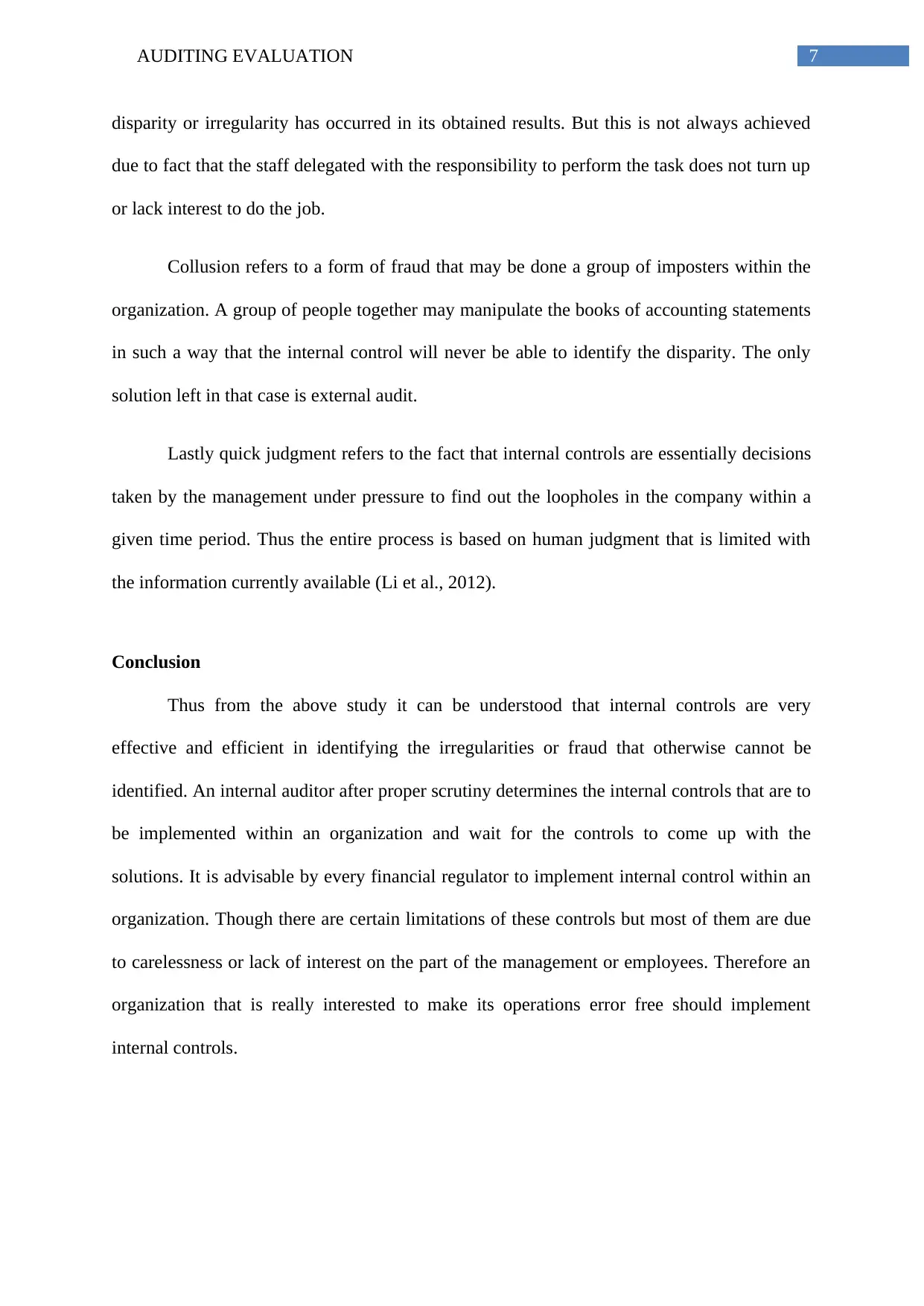
disparity or irregularity has occurred in its obtained results. But this is not always achieved
due to fact that the staff delegated with the responsibility to perform the task does not turn up
or lack interest to do the job.
Collusion refers to a form of fraud that may be done a group of imposters within the
organization. A group of people together may manipulate the books of accounting statements
in such a way that the internal control will never be able to identify the disparity. The only
solution left in that case is external audit.
Lastly quick judgment refers to the fact that internal controls are essentially decisions
taken by the management under pressure to find out the loopholes in the company within a
given time period. Thus the entire process is based on human judgment that is limited with
the information currently available (Li et al., 2012).
Conclusion
Thus from the above study it can be understood that internal controls are very
effective and efficient in identifying the irregularities or fraud that otherwise cannot be
identified. An internal auditor after proper scrutiny determines the internal controls that are to
be implemented within an organization and wait for the controls to come up with the
solutions. It is advisable by every financial regulator to implement internal control within an
organization. Though there are certain limitations of these controls but most of them are due
to carelessness or lack of interest on the part of the management or employees. Therefore an
organization that is really interested to make its operations error free should implement
internal controls.
disparity or irregularity has occurred in its obtained results. But this is not always achieved
due to fact that the staff delegated with the responsibility to perform the task does not turn up
or lack interest to do the job.
Collusion refers to a form of fraud that may be done a group of imposters within the
organization. A group of people together may manipulate the books of accounting statements
in such a way that the internal control will never be able to identify the disparity. The only
solution left in that case is external audit.
Lastly quick judgment refers to the fact that internal controls are essentially decisions
taken by the management under pressure to find out the loopholes in the company within a
given time period. Thus the entire process is based on human judgment that is limited with
the information currently available (Li et al., 2012).
Conclusion
Thus from the above study it can be understood that internal controls are very
effective and efficient in identifying the irregularities or fraud that otherwise cannot be
identified. An internal auditor after proper scrutiny determines the internal controls that are to
be implemented within an organization and wait for the controls to come up with the
solutions. It is advisable by every financial regulator to implement internal control within an
organization. Though there are certain limitations of these controls but most of them are due
to carelessness or lack of interest on the part of the management or employees. Therefore an
organization that is really interested to make its operations error free should implement
internal controls.

8AUDITING EVALUATION
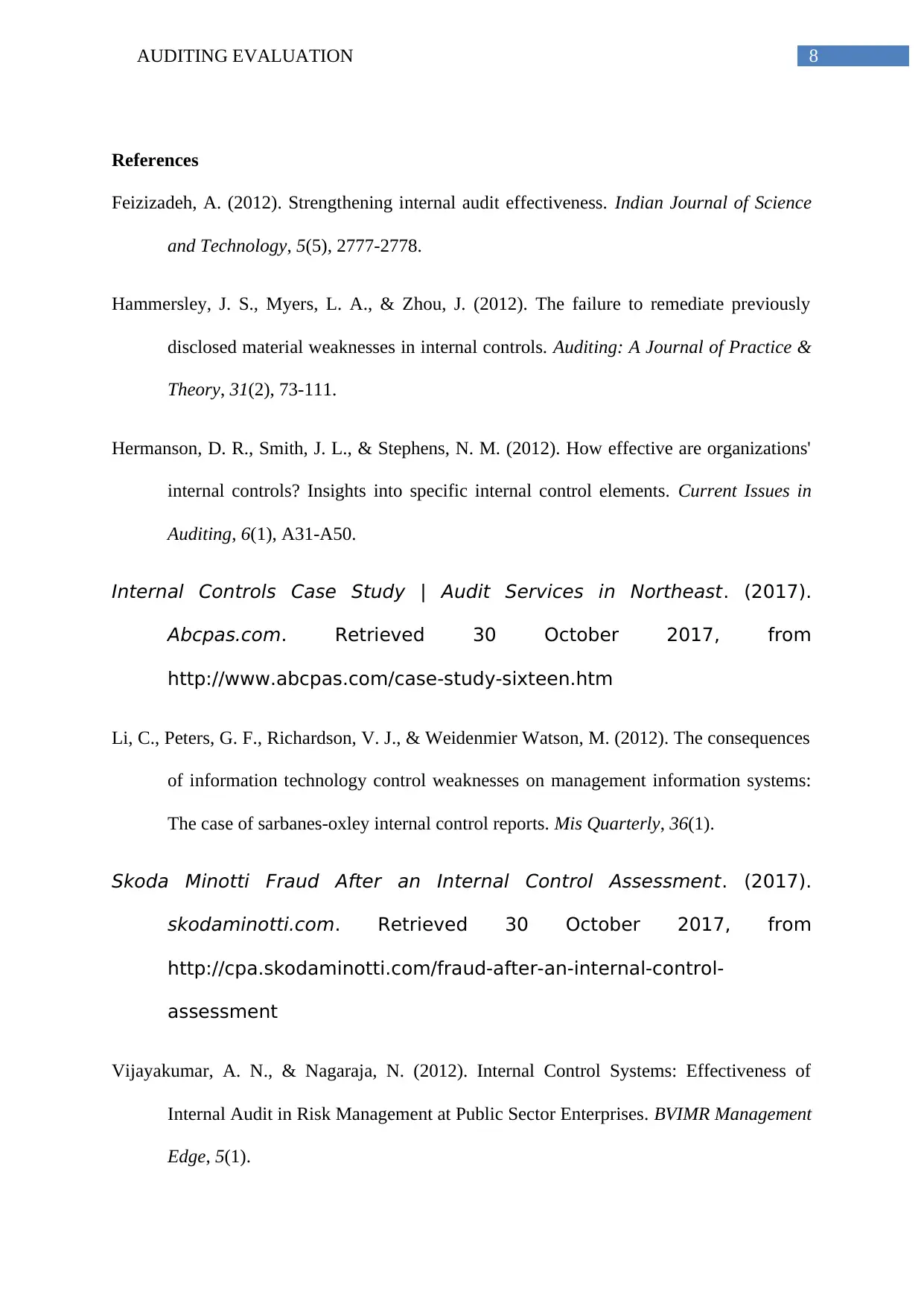
References
Feizizadeh, A. (2012). Strengthening internal audit effectiveness. Indian Journal of Science
and Technology, 5(5), 2777-2778.
Hammersley, J. S., Myers, L. A., & Zhou, J. (2012). The failure to remediate previously
disclosed material weaknesses in internal controls. Auditing: A Journal of Practice &
Theory, 31(2), 73-111.
Hermanson, D. R., Smith, J. L., & Stephens, N. M. (2012). How effective are organizations'
internal controls? Insights into specific internal control elements. Current Issues in
Auditing, 6(1), A31-A50.
Internal Controls Case Study | Audit Services in Northeast. (2017).
Abcpas.com. Retrieved 30 October 2017, from
http://www.abcpas.com/case-study-sixteen.htm
Li, C., Peters, G. F., Richardson, V. J., & Weidenmier Watson, M. (2012). The consequences
of information technology control weaknesses on management information systems:
The case of sarbanes-oxley internal control reports. Mis Quarterly, 36(1).
Skoda Minotti Fraud After an Internal Control Assessment. (2017).
skodaminotti.com. Retrieved 30 October 2017, from
http://cpa.skodaminotti.com/fraud-after-an-internal-control-
assessment
Vijayakumar, A. N., & Nagaraja, N. (2012). Internal Control Systems: Effectiveness of
Internal Audit in Risk Management at Public Sector Enterprises. BVIMR Management
Edge, 5(1).
References
Feizizadeh, A. (2012). Strengthening internal audit effectiveness. Indian Journal of Science
and Technology, 5(5), 2777-2778.
Hammersley, J. S., Myers, L. A., & Zhou, J. (2012). The failure to remediate previously
disclosed material weaknesses in internal controls. Auditing: A Journal of Practice &
Theory, 31(2), 73-111.
Hermanson, D. R., Smith, J. L., & Stephens, N. M. (2012). How effective are organizations'
internal controls? Insights into specific internal control elements. Current Issues in
Auditing, 6(1), A31-A50.
Internal Controls Case Study | Audit Services in Northeast. (2017).
Abcpas.com. Retrieved 30 October 2017, from
http://www.abcpas.com/case-study-sixteen.htm
Li, C., Peters, G. F., Richardson, V. J., & Weidenmier Watson, M. (2012). The consequences
of information technology control weaknesses on management information systems:
The case of sarbanes-oxley internal control reports. Mis Quarterly, 36(1).
Skoda Minotti Fraud After an Internal Control Assessment. (2017).
skodaminotti.com. Retrieved 30 October 2017, from
http://cpa.skodaminotti.com/fraud-after-an-internal-control-
assessment
Vijayakumar, A. N., & Nagaraja, N. (2012). Internal Control Systems: Effectiveness of
Internal Audit in Risk Management at Public Sector Enterprises. BVIMR Management
Edge, 5(1).
⊘ This is a preview!⊘
Do you want full access?
Subscribe today to unlock all pages.

Trusted by 1+ million students worldwide

9AUDITING EVALUATION
Yee, C. S., Sujan, A., James, K., & Leung, J. K. (2017). Perceptions of Singaporean internal
audit customers regarding the role and effectiveness of internal audit. Asian Journal
of Business and Accounting, 1(2), 147-174.
Yee, C. S., Sujan, A., James, K., & Leung, J. K. (2017). Perceptions of Singaporean internal
audit customers regarding the role and effectiveness of internal audit. Asian Journal
of Business and Accounting, 1(2), 147-174.
1 out of 10
Related Documents
Your All-in-One AI-Powered Toolkit for Academic Success.
 +13062052269
info@desklib.com
Available 24*7 on WhatsApp / Email
Unlock your academic potential
Copyright © 2020–2026 A2Z Services. All Rights Reserved. Developed and managed by ZUCOL.