Assessment Task: Internal Control Procedures and Reporting Importance
VerifiedAdded on 2022/11/18
|17
|4948
|69
Report
AI Summary
This report, focusing on internal control procedures and corporate governance, begins by defining corporate governance and highlighting the importance of reporting in maintaining transparency and stakeholder relationships. It details the types of reports distributed, such as periodic, special, and financial reports, and specifies their relevance to different stakeholders. The report then emphasizes the significance of financial reporting for investors, internal decision-making, and internal audits, and for ensuring regulatory compliance. The second part of the report shifts to a case study of Woolworth, outlining its internal control objectives, policies, and procedures, and its commitment to good corporate governance. It details the internal control objectives to ensure authorized transactions, accurate record-keeping, asset security, and adherence to accounting standards. The report also examines the components of the internal control process including control environment, risk assessment, monitoring and review, information and communication.
RUNNING HEAD: IMPLEMENT AND MAINTAIN INTERNAL CONTROL PROCEDURE
0
Implement and Maintain Internal Control Procedures
Student Name
7/17/2019
Report Assessment Task 1
0
Implement and Maintain Internal Control Procedures
Student Name
7/17/2019
Report Assessment Task 1

Paraphrase This Document
Need a fresh take? Get an instant paraphrase of this document with our AI Paraphraser
Implement and maintain internal control procedure
1
Importance of Reporting in Corporate Governance
Introduction
Corporate Governance is the set of rules, regulation, laws, policies and processes that a company
follows or that affects the way the company worked, directed and controlled. Corporate
Governance also includes the maintaining relationship with its stakeholder in a true and honest
manner. Furthermore, corporate governance is defined as a tool through which stakeholders of a
company exercise control over the activities or internal procedure and management so that their
interest will be protected (DuPlessis, et al., 2018). Disclosure of corporate activities through
annual report is one of the important tools for controlling and monitoring managerial behavior.
Reporting is a process of communicating the information to external stakeholders and to
management about how a company is performing over a specific period of time. The scope of
corporate governance is not only limited to maintaining transparent relation between
stakeholders and management instead it also ensures accountability of top management and their
responsibilities towards owners or stakeholders, integrity of information produces and adherence
to the rules (Leuz & Wysocki, 2016). This report highlights the importance of reporting in
corporate governance and types of report that are used or distributed to different stakeholder in
order to maintain transparency in business activities.
Types of Report distributed and to whom with regard to corporate governance
and internal control
Reports are important tool for the management to take decision, reports are prepared by the
management accountant for the management so that they can take decision on the basis of
information provided and the main purpose of report is to ensure transparency between
management and stakeholders. Stakeholders are the people who have interest in the company
that includes customers, shareholders, suppliers, employees, financial institution and government
(Miglani, et al., 2015) Reports are the way through which management get control over the
activities and performance in the company and fulfill the purpose of corporate governance. Some
types of report that can be distributed to internal stakeholders and external stakeholders with
regard to internal control and corporate governance are:
1
Importance of Reporting in Corporate Governance
Introduction
Corporate Governance is the set of rules, regulation, laws, policies and processes that a company
follows or that affects the way the company worked, directed and controlled. Corporate
Governance also includes the maintaining relationship with its stakeholder in a true and honest
manner. Furthermore, corporate governance is defined as a tool through which stakeholders of a
company exercise control over the activities or internal procedure and management so that their
interest will be protected (DuPlessis, et al., 2018). Disclosure of corporate activities through
annual report is one of the important tools for controlling and monitoring managerial behavior.
Reporting is a process of communicating the information to external stakeholders and to
management about how a company is performing over a specific period of time. The scope of
corporate governance is not only limited to maintaining transparent relation between
stakeholders and management instead it also ensures accountability of top management and their
responsibilities towards owners or stakeholders, integrity of information produces and adherence
to the rules (Leuz & Wysocki, 2016). This report highlights the importance of reporting in
corporate governance and types of report that are used or distributed to different stakeholder in
order to maintain transparency in business activities.
Types of Report distributed and to whom with regard to corporate governance
and internal control
Reports are important tool for the management to take decision, reports are prepared by the
management accountant for the management so that they can take decision on the basis of
information provided and the main purpose of report is to ensure transparency between
management and stakeholders. Stakeholders are the people who have interest in the company
that includes customers, shareholders, suppliers, employees, financial institution and government
(Miglani, et al., 2015) Reports are the way through which management get control over the
activities and performance in the company and fulfill the purpose of corporate governance. Some
types of report that can be distributed to internal stakeholders and external stakeholders with
regard to internal control and corporate governance are:
Implement and maintain internal control procedure
2
a.) Periodic Report: These types of report are submitted to management on periodic basis
whether on quarterly basis or on annual basis. That includes sales report, production
report, and funds from operation report and more. These reports are useful for the
management to take decision and to ensure transparency in all the operations or activities.
b.) Special Report: Special report is prepared and submitted to top level management on
demand and whenever needed. These kinds of reports are prepared on a specific problem
or to deal with a typical situation. These reports are given to internal stakeholders and this
support corporate governance and ensure control over internal activities.
c.) Financial Report: Financial report is made for all the stakeholders that have interest in the
company. This report discloses all the information related to profit and losses to the
company during a year and the assets and the liabilities that company have during a year.
d.) Shareholders report: This report is submitted to government as this relates to corporate
governance. Rules and regulation set by the government for tax payers are disclosed in
this report and all the information related to income tax paid by the company are
presented to government.
Significance of Financial Reporting
Financial reporting is transferring of information or reporting of company’s finances to
stakeholders that includes revenues, expenditure, capitals, profits, and cash inflow and out flow
during the year. It is considered as formal records that provide insight into financial information
of the company (Hoitash, et al., 2009). Financial reporting is important for managers, employees,
investors and government in order to take decision and to ensure corporate governance.
Following are the significance of financial reporting:
1. For investing decision by investors and shareholders: Investors and shareholders get
financial information of a company through financial reporting. This is considered as the
reliable source for taking the investment decision by the investors. This is also helpful for
banking institution and credit vendors as they lend the money to the company.
2. For internal decision making: Financial reporting is also important for taking internal
decision or important decision by the management. This information is used by the
internal management of the company to take decision with more evidence and analysis.
2
a.) Periodic Report: These types of report are submitted to management on periodic basis
whether on quarterly basis or on annual basis. That includes sales report, production
report, and funds from operation report and more. These reports are useful for the
management to take decision and to ensure transparency in all the operations or activities.
b.) Special Report: Special report is prepared and submitted to top level management on
demand and whenever needed. These kinds of reports are prepared on a specific problem
or to deal with a typical situation. These reports are given to internal stakeholders and this
support corporate governance and ensure control over internal activities.
c.) Financial Report: Financial report is made for all the stakeholders that have interest in the
company. This report discloses all the information related to profit and losses to the
company during a year and the assets and the liabilities that company have during a year.
d.) Shareholders report: This report is submitted to government as this relates to corporate
governance. Rules and regulation set by the government for tax payers are disclosed in
this report and all the information related to income tax paid by the company are
presented to government.
Significance of Financial Reporting
Financial reporting is transferring of information or reporting of company’s finances to
stakeholders that includes revenues, expenditure, capitals, profits, and cash inflow and out flow
during the year. It is considered as formal records that provide insight into financial information
of the company (Hoitash, et al., 2009). Financial reporting is important for managers, employees,
investors and government in order to take decision and to ensure corporate governance.
Following are the significance of financial reporting:
1. For investing decision by investors and shareholders: Investors and shareholders get
financial information of a company through financial reporting. This is considered as the
reliable source for taking the investment decision by the investors. This is also helpful for
banking institution and credit vendors as they lend the money to the company.
2. For internal decision making: Financial reporting is also important for taking internal
decision or important decision by the management. This information is used by the
internal management of the company to take decision with more evidence and analysis.
⊘ This is a preview!⊘
Do you want full access?
Subscribe today to unlock all pages.

Trusted by 1+ million students worldwide
Implement and maintain internal control procedure
3
3. For improved internal vision: Financial Reporting brings harmony and coordination in
management activities, this is taken as a cohesive, accurate and accessible tool of sharing
information throughout the organization and helpful in decisions related to all financial
activity in an organization.
4. For internal audit and control: Financial reporting is important for the company to raise
funds and to invest funds in an effective way to get higher return. Financial reporting
helps in assessing the various ratios that help the organization to know whether to raise
funds through borrowing or through investors. Financial reporting also facilitates
statutory audits. Internal audit helps in identifying the fraudulent or irrelevant activities in
the organization and also this ensures corporate governance and internal control over the
management activities.
5. Taxes: Taxes are the biggest reason behind financial reporting, as this provides
information about tax paid by the company according to its profit. The government gets
idea through these reports that company is paying taxes in fair manner. Financial
reporting is legally required because it ensure company’s success and performance in a
fair manner (Armstrong, et al., 2015).
Conclusion
Corporate Governance is the system or rules that businesses use to direct their action and justify
their actions. On other hand, financial reporting is sharing or presenting financial information of
the company to stakeholders. Reports are essential part to ensure corporate governance and
transparency in the company. There are various types of reports that are distributed to the
stakeholders and prepared on demand of management to give basis to internal decisions.
Financial report, sales report, periodic report and specific reports are few examples. These
reports are distributed as per the need of party and these reports also ensure transparency and
corporate governance in the organization as everything and every activity of a year is highlighted
in the reports in detail. The importance of financial reporting is more in the eye of management
and for stakeholders as financial information get through financial reporting helps in taking
investment decisions, fair taxes and important for internal control and audit.
Word Count: 1020
3
3. For improved internal vision: Financial Reporting brings harmony and coordination in
management activities, this is taken as a cohesive, accurate and accessible tool of sharing
information throughout the organization and helpful in decisions related to all financial
activity in an organization.
4. For internal audit and control: Financial reporting is important for the company to raise
funds and to invest funds in an effective way to get higher return. Financial reporting
helps in assessing the various ratios that help the organization to know whether to raise
funds through borrowing or through investors. Financial reporting also facilitates
statutory audits. Internal audit helps in identifying the fraudulent or irrelevant activities in
the organization and also this ensures corporate governance and internal control over the
management activities.
5. Taxes: Taxes are the biggest reason behind financial reporting, as this provides
information about tax paid by the company according to its profit. The government gets
idea through these reports that company is paying taxes in fair manner. Financial
reporting is legally required because it ensure company’s success and performance in a
fair manner (Armstrong, et al., 2015).
Conclusion
Corporate Governance is the system or rules that businesses use to direct their action and justify
their actions. On other hand, financial reporting is sharing or presenting financial information of
the company to stakeholders. Reports are essential part to ensure corporate governance and
transparency in the company. There are various types of reports that are distributed to the
stakeholders and prepared on demand of management to give basis to internal decisions.
Financial report, sales report, periodic report and specific reports are few examples. These
reports are distributed as per the need of party and these reports also ensure transparency and
corporate governance in the organization as everything and every activity of a year is highlighted
in the reports in detail. The importance of financial reporting is more in the eye of management
and for stakeholders as financial information get through financial reporting helps in taking
investment decisions, fair taxes and important for internal control and audit.
Word Count: 1020
Paraphrase This Document
Need a fresh take? Get an instant paraphrase of this document with our AI Paraphraser
Implement and maintain internal control procedure
4
References:
Armstrong, S. C., Blouin, J. L., Jagolinzer, A. D. & Larcker, D. F., 2015. Corporate governance,
incentives, and tax avoidance. Journal of Accounting and Economics, 60(1), pp. 1-17.
DuPlessis, J. J., Hargovan, A. & Harris, J., 2018. Principles of contemporary corporate
governance. UK: Cambridge University Press.
Hoitash, U., Hoitash, R. & Bedard, J. C., 2009. Corporate governance and internal control over
financial reporting. The accounting review, 84(3), pp. 839-867.
Leuz, C. & Wysocki, P. D., 2016. The economics of disclosure and financial reporting
regulation: Evidence and suggestions for future research. Journal of Accounting Research, 54(2),
pp. 525-622.
Miglani, S., Ahmed, K. & Henry, D., 2015. Corporate governance structure and financial
distress: Evidence from Australia.. Journal of Accounting and Economics, 11(1), pp. 18-30.
4
References:
Armstrong, S. C., Blouin, J. L., Jagolinzer, A. D. & Larcker, D. F., 2015. Corporate governance,
incentives, and tax avoidance. Journal of Accounting and Economics, 60(1), pp. 1-17.
DuPlessis, J. J., Hargovan, A. & Harris, J., 2018. Principles of contemporary corporate
governance. UK: Cambridge University Press.
Hoitash, U., Hoitash, R. & Bedard, J. C., 2009. Corporate governance and internal control over
financial reporting. The accounting review, 84(3), pp. 839-867.
Leuz, C. & Wysocki, P. D., 2016. The economics of disclosure and financial reporting
regulation: Evidence and suggestions for future research. Journal of Accounting Research, 54(2),
pp. 525-622.
Miglani, S., Ahmed, K. & Henry, D., 2015. Corporate governance structure and financial
distress: Evidence from Australia.. Journal of Accounting and Economics, 11(1), pp. 18-30.
Implement and maintain internal control procedure
5
Report Assessment Task 2
Name of the Company: Woolworth
Woolworth is a supermarket chain in Australia and is the largest food retailer. The company tries
to take care of all its stakeholders and to ensure corporate governance. The management of
Woolworth is separate from its ownership. The primary responsibility of board is the
management of the company through CEO. The board of directors of Woolworth is accountable
to shareholders for every activity and for the performance of the company and board is mainly
responsible for ensuring corporate governance and transparency in the company in order to retain
the interest of stakeholders. The Company has established controls at executive, boards and
business unit level that are formed to safeguard, both externally and internally, the Company's
interests and the integrity of Company reporting with the objective of providing timely
disclosure of all material information to the investment community. These include accounting,
financial reporting, environment, health and safety and other internal control policies and
procedures, which are directed at ensuring the Company fully complies with all regulatory
requirements and community standards (Woolworth, 2019).
Internal Control Objectives
Internal control is defined as the system introduced, maintained and designed by the company’s
management and board of directors to ensure achievement of business objectives while
complying with the laws and rules, safeguarding the assets of the company, maintaining
effectiveness and efficiency in the operations or day to day activities and reliability of financial
statement (Hightower, 2008). Internal control is done in Woolworth to achieve following
objectives or some of the internal control objectives are:
To ensure that all the transaction in the company take place as per the authorization of the
management.
To ensure that all the transactions are recorded in a systematic manner with the accurate
amount and as per the laws and accounting standard. The company aim behind internal
control is to confirm that the financial statement fulfills all the relevant statutory
requirements.
5
Report Assessment Task 2
Name of the Company: Woolworth
Woolworth is a supermarket chain in Australia and is the largest food retailer. The company tries
to take care of all its stakeholders and to ensure corporate governance. The management of
Woolworth is separate from its ownership. The primary responsibility of board is the
management of the company through CEO. The board of directors of Woolworth is accountable
to shareholders for every activity and for the performance of the company and board is mainly
responsible for ensuring corporate governance and transparency in the company in order to retain
the interest of stakeholders. The Company has established controls at executive, boards and
business unit level that are formed to safeguard, both externally and internally, the Company's
interests and the integrity of Company reporting with the objective of providing timely
disclosure of all material information to the investment community. These include accounting,
financial reporting, environment, health and safety and other internal control policies and
procedures, which are directed at ensuring the Company fully complies with all regulatory
requirements and community standards (Woolworth, 2019).
Internal Control Objectives
Internal control is defined as the system introduced, maintained and designed by the company’s
management and board of directors to ensure achievement of business objectives while
complying with the laws and rules, safeguarding the assets of the company, maintaining
effectiveness and efficiency in the operations or day to day activities and reliability of financial
statement (Hightower, 2008). Internal control is done in Woolworth to achieve following
objectives or some of the internal control objectives are:
To ensure that all the transaction in the company take place as per the authorization of the
management.
To ensure that all the transactions are recorded in a systematic manner with the accurate
amount and as per the laws and accounting standard. The company aim behind internal
control is to confirm that the financial statement fulfills all the relevant statutory
requirements.
⊘ This is a preview!⊘
Do you want full access?
Subscribe today to unlock all pages.
Trusted by 1+ million students worldwide
Implement and maintain internal control procedure
6
To provide security to assets of the company from unauthorized use and for this purpose
company use security systems, security guards, and real time tracking devices and anti-
theft devices.
To ensure that company follows all the accounting practices and principles as per the
accounting standard and company’s financial statement should be free from any flaws.
Policies and Procedures and Documentation Standards
Woolworth focuses on good corporate governance in order to enhance long term shareholder
value. In order to achieve the above objectives of internal control the company formed ad
designed various policies and do all the things as per the Australian Standard. Company
formulated or designed a policy named The Company’s Continuous Disclosure policy to achieve
the objective of full disclosure of information to stakeholder at right time. Code of conduct
applies to the employees, directors and consultant of the Woolworth and that state an individual
responsibility towards the company (Woolworth, 2019). There are range of policies which
define the internal control in the company and responsible business practice. There are also
various activities and compliance program across the company to that are designed to promote
and encourage individual efforts and the responsibility and accountability of individual for
reporting unethical practices or activities in the company. Document standard define the process
about the way all the documents that are related to financial transaction should be produced and
stored (Graham, 2015).
Internal Control Procedures to improve performance
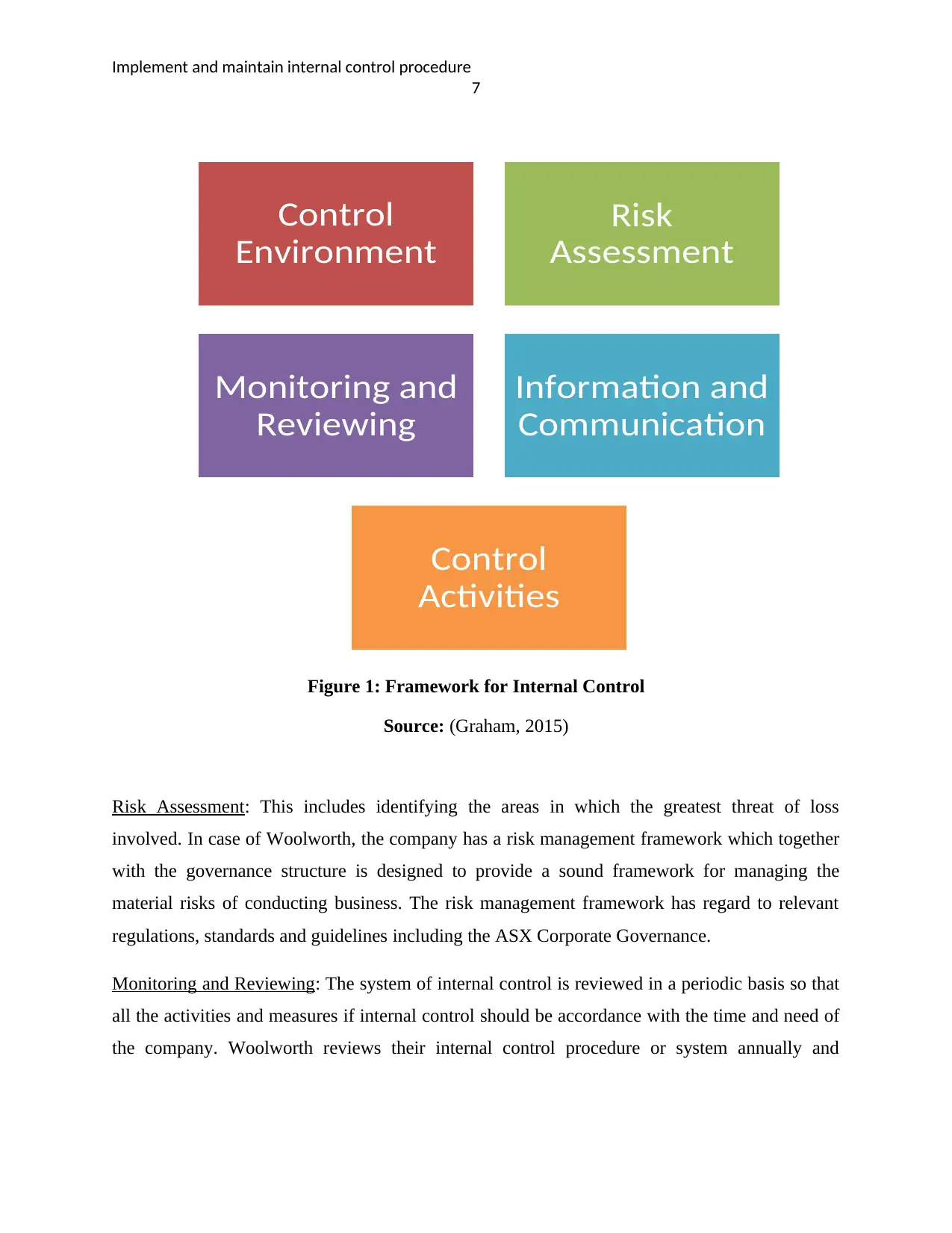
Internal control process consists of five major and interrelated components that are control
environment, risk assessment, control activities, information and communication and monitoring.
Control Environment: Forming sound control environment is important and it is created by the
management through effective communication and flow of information. This involves integrity,
diligence in designing system, commitment of the top management and assigning
responsibilities. The control environment of Woolworth consist of Board of Directors and Senior
executives as they are responsible for risk management framework, financial and other reporting,
monitoring and reviewing the conduct of company’s relationship with key regulators and
reviewing the corporate governance policy of the company.
6
To provide security to assets of the company from unauthorized use and for this purpose
company use security systems, security guards, and real time tracking devices and anti-
theft devices.
To ensure that company follows all the accounting practices and principles as per the
accounting standard and company’s financial statement should be free from any flaws.
Policies and Procedures and Documentation Standards
Woolworth focuses on good corporate governance in order to enhance long term shareholder
value. In order to achieve the above objectives of internal control the company formed ad
designed various policies and do all the things as per the Australian Standard. Company
formulated or designed a policy named The Company’s Continuous Disclosure policy to achieve
the objective of full disclosure of information to stakeholder at right time. Code of conduct
applies to the employees, directors and consultant of the Woolworth and that state an individual
responsibility towards the company (Woolworth, 2019). There are range of policies which
define the internal control in the company and responsible business practice. There are also
various activities and compliance program across the company to that are designed to promote
and encourage individual efforts and the responsibility and accountability of individual for
reporting unethical practices or activities in the company. Document standard define the process
about the way all the documents that are related to financial transaction should be produced and
stored (Graham, 2015).
Internal Control Procedures to improve performance
Internal control process consists of five major and interrelated components that are control
environment, risk assessment, control activities, information and communication and monitoring.
Control Environment: Forming sound control environment is important and it is created by the
management through effective communication and flow of information. This involves integrity,
diligence in designing system, commitment of the top management and assigning
responsibilities. The control environment of Woolworth consist of Board of Directors and Senior
executives as they are responsible for risk management framework, financial and other reporting,
monitoring and reviewing the conduct of company’s relationship with key regulators and
reviewing the corporate governance policy of the company.
Paraphrase This Document
Need a fresh take? Get an instant paraphrase of this document with our AI Paraphraser
Implement and maintain internal control procedure
7
Figure 1: Framework for Internal Control
Source: (Graham, 2015)
Risk Assessment: This includes identifying the areas in which the greatest threat of loss
involved. In case of Woolworth, the company has a risk management framework which together
with the governance structure is designed to provide a sound framework for managing the
material risks of conducting business. The risk management framework has regard to relevant
regulations, standards and guidelines including the ASX Corporate Governance.
Monitoring and Reviewing: The system of internal control is reviewed in a periodic basis so that
all the activities and measures if internal control should be accordance with the time and need of
the company. Woolworth reviews their internal control procedure or system annually and
Control
Environment
Risk
Assessment
Monitoring and
Reviewing
Information and
Communication
Control
Activities
7
Figure 1: Framework for Internal Control
Source: (Graham, 2015)
Risk Assessment: This includes identifying the areas in which the greatest threat of loss
involved. In case of Woolworth, the company has a risk management framework which together
with the governance structure is designed to provide a sound framework for managing the
material risks of conducting business. The risk management framework has regard to relevant
regulations, standards and guidelines including the ASX Corporate Governance.
Monitoring and Reviewing: The system of internal control is reviewed in a periodic basis so that
all the activities and measures if internal control should be accordance with the time and need of
the company. Woolworth reviews their internal control procedure or system annually and
Control
Environment
Risk
Assessment
Monitoring and
Reviewing
Information and
Communication
Control
Activities
Implement and maintain internal control procedure
8
performance of board of directors and top executives are also reviewed as they are in charge of
implementing internal control procedure.
Information and Communication: Communication is the key to ensure strong internal control.
Woolworth communicates its policies and procedures to employees and important information to
their stakeholders with release of the annual report, and through annual general meeting. The
Woolworths Group has established processes to enable the Company to provide shareholders and
the market generally with timely, direct and equal access to relevant information.
Control Activities: Control activities are the activities that occur within an internal control
system. Preventive control activities aim to detect the fraud and error at the first instance.
Detective activities aim is to identify the undesirable or uncertain events or occurrences.
Woolworth controlling activities includes external audit and internal audit. The company has an
internal audit group which is managed by the risk team. Internal audit give services to
management and the board of directors in relation to internal control.
Recommendations
In order to achieve the internal control objectives Woolworth framed various policies and follow
the internal control procedure in an effective way. But in order to ensure more transparency and
to control internal activities the company can work upon the following areas; Company should
opt for effective audit trail for recording of transactions and event related to the company during
a period. Company need to balance the degree of centralization and decentralization as this is the
area that needs control and assistance. If more access is given to employees to reach important
information than chances or fraud and error would increase. Risk assessment should be done in
proper manner by the team and the team should analyses risk associated with the achievement of
operations, financial reporting and goals and objectives. Woolworth can implement various
control activities in order to ensure internal control that are reconciliation, security of assets and
control over information system. Effective actions can be taken by the company against all the
problems that are found during the internal audit. Ongoing monitoring can help the company to
prevent and detect errors speedily. So these suggestions can improve the internal control
procedure of the Woolworth.
8
performance of board of directors and top executives are also reviewed as they are in charge of
implementing internal control procedure.
Information and Communication: Communication is the key to ensure strong internal control.
Woolworth communicates its policies and procedures to employees and important information to
their stakeholders with release of the annual report, and through annual general meeting. The
Woolworths Group has established processes to enable the Company to provide shareholders and
the market generally with timely, direct and equal access to relevant information.
Control Activities: Control activities are the activities that occur within an internal control
system. Preventive control activities aim to detect the fraud and error at the first instance.
Detective activities aim is to identify the undesirable or uncertain events or occurrences.
Woolworth controlling activities includes external audit and internal audit. The company has an
internal audit group which is managed by the risk team. Internal audit give services to
management and the board of directors in relation to internal control.
Recommendations
In order to achieve the internal control objectives Woolworth framed various policies and follow
the internal control procedure in an effective way. But in order to ensure more transparency and
to control internal activities the company can work upon the following areas; Company should
opt for effective audit trail for recording of transactions and event related to the company during
a period. Company need to balance the degree of centralization and decentralization as this is the
area that needs control and assistance. If more access is given to employees to reach important
information than chances or fraud and error would increase. Risk assessment should be done in
proper manner by the team and the team should analyses risk associated with the achievement of
operations, financial reporting and goals and objectives. Woolworth can implement various
control activities in order to ensure internal control that are reconciliation, security of assets and
control over information system. Effective actions can be taken by the company against all the
problems that are found during the internal audit. Ongoing monitoring can help the company to
prevent and detect errors speedily. So these suggestions can improve the internal control
procedure of the Woolworth.
⊘ This is a preview!⊘
Do you want full access?
Subscribe today to unlock all pages.
Trusted by 1+ million students worldwide
Implement and maintain internal control procedure
9
Conclusion
Internal control is a process that ensures attainment of internal control objectives that can be
effectiveness and efficiency in operations, reliability of financial reporting and compliance of
rues and practices with the management. To understand this concept of internal control example
of Woolworth is taken. Woolworth is the largest retailer in Australia. In the above assessment
Woolworth internal control procedures and objectives are analyzed. Woolworth formulated
various policies in order to achieve its internal control objectives, some of the policies are full
disclosure policy, code of conduct, financial reporting on annual basis, disclosure of events and
facts to investors and to government. Internal control procedures of Woolworth consist of five
main components that are control environment, risk assessment, monitoring and reviewing,
information and communication and control activities. These entire elements should be present
in order to make any internal control system effective. By analyzing the internal control
procedure of Woolworth some weaknesses are highlighted on that basis some recommendations
are provided that includes implementing of proper and effective risk management team,
company should balance the centralization and decentralization in the management and company
should opt for quarterly review of accounts and reconciliation. All that can help the company to
make its internal control system more effective.
References:
Woolworth, 2019. Corporate Governance. [Online]
Available at: https://www.woolworthsgroup.com.au/content/Document/Woolworths%20Group
%202017%20-%20Corporate%20Governance%20Statement.pdf
[Accessed 16 July 2019].
Hightower, R., 2008. Internal Controls Policies and Procedures. US: Sage Publications.
Graham, L., 2015. Internal Control Audit and Compliance: Documentation and Testing. Australia: s.n.
Woolworth, 2019. Policies and Procedures. [Online]
Available at: https://www.woolworthsgroup.com.au/content/Document/Dec%202016_Code%20of
%20Conduct.pdf
[Accessed 16 July 2019]
9
Conclusion
Internal control is a process that ensures attainment of internal control objectives that can be
effectiveness and efficiency in operations, reliability of financial reporting and compliance of
rues and practices with the management. To understand this concept of internal control example
of Woolworth is taken. Woolworth is the largest retailer in Australia. In the above assessment
Woolworth internal control procedures and objectives are analyzed. Woolworth formulated
various policies in order to achieve its internal control objectives, some of the policies are full
disclosure policy, code of conduct, financial reporting on annual basis, disclosure of events and
facts to investors and to government. Internal control procedures of Woolworth consist of five
main components that are control environment, risk assessment, monitoring and reviewing,
information and communication and control activities. These entire elements should be present
in order to make any internal control system effective. By analyzing the internal control
procedure of Woolworth some weaknesses are highlighted on that basis some recommendations
are provided that includes implementing of proper and effective risk management team,
company should balance the centralization and decentralization in the management and company
should opt for quarterly review of accounts and reconciliation. All that can help the company to
make its internal control system more effective.
References:
Woolworth, 2019. Corporate Governance. [Online]
Available at: https://www.woolworthsgroup.com.au/content/Document/Woolworths%20Group
%202017%20-%20Corporate%20Governance%20Statement.pdf
[Accessed 16 July 2019].
Hightower, R., 2008. Internal Controls Policies and Procedures. US: Sage Publications.
Graham, L., 2015. Internal Control Audit and Compliance: Documentation and Testing. Australia: s.n.
Woolworth, 2019. Policies and Procedures. [Online]
Available at: https://www.woolworthsgroup.com.au/content/Document/Dec%202016_Code%20of
%20Conduct.pdf
[Accessed 16 July 2019]
Paraphrase This Document
Need a fresh take? Get an instant paraphrase of this document with our AI Paraphraser
Implement and maintain internal control procedure
10
Written Questions Assessment Task 3
1. What does the term corporate governance refer to?
Corporate governance is considered as the set of rules, procedures, practices and processes
by which a company is controlled and directed. Corporate governance essentially involves
balancing the interests of many stakeholders, such as shareholders, senior management
executives, customers, suppliers, financiers, the government, and the community. Since
corporate governance also provides the framework for attaining a company's objectives, it
encompasses practically every sphere of management, from action plans and internal
controls to performance measurement and corporate disclosure (Tricker & Tricker, 2015).
Reference:
Tricker, R. B. & Tricker, R. I., 2015. Corporate governance: Principles, policies, and practices. USA:
Oxford University Press.
2. What are five of the most important recognized and sanctioned authoritative bodies in the
Australian financial service industry?
The financial service industry in Australia is regulated by:
a) Australian Securities and Investment Commission (ASIC)
b) Australian Prudential Regulatory Authority (APRA)
c) Australian Competition and Consumer Commission (ACCC)
d) Council of financial Regulator (CFR)
e) The Reserve Bank of Australia (RBA)
3. What is internal control?
Internal control is a process of achieving the organizational objectives through reliable
financial reporting, compliance with laws, regulation and policies. It is considered as the
means by which company can direct, measure and control its resources in an effective and
10
Written Questions Assessment Task 3
1. What does the term corporate governance refer to?
Corporate governance is considered as the set of rules, procedures, practices and processes
by which a company is controlled and directed. Corporate governance essentially involves
balancing the interests of many stakeholders, such as shareholders, senior management
executives, customers, suppliers, financiers, the government, and the community. Since
corporate governance also provides the framework for attaining a company's objectives, it
encompasses practically every sphere of management, from action plans and internal
controls to performance measurement and corporate disclosure (Tricker & Tricker, 2015).
Reference:
Tricker, R. B. & Tricker, R. I., 2015. Corporate governance: Principles, policies, and practices. USA:
Oxford University Press.
2. What are five of the most important recognized and sanctioned authoritative bodies in the
Australian financial service industry?
The financial service industry in Australia is regulated by:
a) Australian Securities and Investment Commission (ASIC)
b) Australian Prudential Regulatory Authority (APRA)
c) Australian Competition and Consumer Commission (ACCC)
d) Council of financial Regulator (CFR)
e) The Reserve Bank of Australia (RBA)
3. What is internal control?
Internal control is a process of achieving the organizational objectives through reliable
financial reporting, compliance with laws, regulation and policies. It is considered as the
means by which company can direct, measure and control its resources in an effective and
Implement and maintain internal control procedure
11
efficient manner (Arwinge, 2010). The main advantage of internal control is that it ensures
the integrity of financial and accounting information, promote accountability and prevent
company from fraudulent activities (Abbott, et al., 2016). This can help in improving
operational efficiency and improve the accuracy and timeliness of financial reporting system.
References:
Abbott, L. J., Daugherty, B., Parker, S. & Peters, G. F., 2016. Internal audit quality and financial
reporting quality: The joint importance of independence and competence. Journal of Accounting
Research, 54(1), pp. 3-40.
Arwinge, O., 2010. Internal Control: A Study of Concept and Themes. London: Springer.
4. What is account manager responsible for?
An account manager is responsible for maintain and presenting various reports and setting up
of the target for the teams. He is required to prepare and present reports related to company’s
financial position and sales. Quarterly sales results, annual forecasts and account status report
and prepared by the account manager. They are also responsible for maintaining strong client
relationship and a strong bottom line. The account manager is the point of contact for the
assigned accounts that is clients and the connection between clients and sales and customer
service (Woodburn & McDonald, 2012).
Reference:
Woodburn, D. & McDonald, M., 2012. Key Account Management: The Definitive Guide. UK: John
Wiley & Sons.
5. What is balance sheet and what is its purpose?
Balance sheet is a financial statement that presents a company’s liabilities, shareholder equity
and loans and liabilities at a specific point of time or for a specific period. It is a statement
that provides a summary of financial information of an organization, a snapshot of what
company owes and owns and also includes the amount invested by shareholders during a
year (Chiappetta, et al., 2017).
11
efficient manner (Arwinge, 2010). The main advantage of internal control is that it ensures
the integrity of financial and accounting information, promote accountability and prevent
company from fraudulent activities (Abbott, et al., 2016). This can help in improving
operational efficiency and improve the accuracy and timeliness of financial reporting system.
References:
Abbott, L. J., Daugherty, B., Parker, S. & Peters, G. F., 2016. Internal audit quality and financial
reporting quality: The joint importance of independence and competence. Journal of Accounting
Research, 54(1), pp. 3-40.
Arwinge, O., 2010. Internal Control: A Study of Concept and Themes. London: Springer.
4. What is account manager responsible for?
An account manager is responsible for maintain and presenting various reports and setting up
of the target for the teams. He is required to prepare and present reports related to company’s
financial position and sales. Quarterly sales results, annual forecasts and account status report
and prepared by the account manager. They are also responsible for maintaining strong client
relationship and a strong bottom line. The account manager is the point of contact for the
assigned accounts that is clients and the connection between clients and sales and customer
service (Woodburn & McDonald, 2012).
Reference:
Woodburn, D. & McDonald, M., 2012. Key Account Management: The Definitive Guide. UK: John
Wiley & Sons.
5. What is balance sheet and what is its purpose?
Balance sheet is a financial statement that presents a company’s liabilities, shareholder equity
and loans and liabilities at a specific point of time or for a specific period. It is a statement
that provides a summary of financial information of an organization, a snapshot of what
company owes and owns and also includes the amount invested by shareholders during a
year (Chiappetta, et al., 2017).
⊘ This is a preview!⊘
Do you want full access?
Subscribe today to unlock all pages.
Trusted by 1+ million students worldwide

1 out of 17


Related Documents


Your All-in-One AI-Powered Toolkit for Academic Success.
+13062052269
info@desklib.com
Available 24*7 on WhatsApp / Email
![[object Object]](/_next/static/media/star-bottom.7253800d.svg)
Unlock your academic potential
Copyright © 2020–2026 A2Z Services. All Rights Reserved. Developed and managed by ZUCOL.