International Arbitration Law: WOC Case Scenario Analysis Report

Verified

Added on  2022/09/15

|5
|1079
|42
Report
AI Summary
This report analyzes two scenarios related to international arbitration law, focusing on the Wyoming Ore Company (WOC) case. Scenario 1 examines the consolidation of disputes, emphasizing the need for consent, the limitations of consolidation clauses, and the potential inefficiencies and costs involved. The report highlights the importance of impartial decision-makers and the differing arbitration clauses between parties, advocating for individual dispute resolution in certain situations. Scenario 2 addresses the process of arbitrator nomination, detailing the roles of the parties and the court in the selection process. It clarifies the number of arbitrators and the timelines for nomination, emphasizing the importance of adhering to contractual agreements and the potential for court intervention when parties fail to nominate an arbitrator. The report references relevant legal cases and articles to support its analysis, providing a thorough understanding of the procedural and legal aspects of international arbitration.
Document Page
Running Head: INTERNATIONAL ARBITRATION LAW 1
International Arbitration Law
Student Name
Institutional Affiliation
tabler-icon-diamond-filled.svg

Paraphrase This Document

Need a fresh take? Get an instant paraphrase of this document with our AI Paraphraser
Document Page
INTERNATIONAL ARBITRATION LAW 2
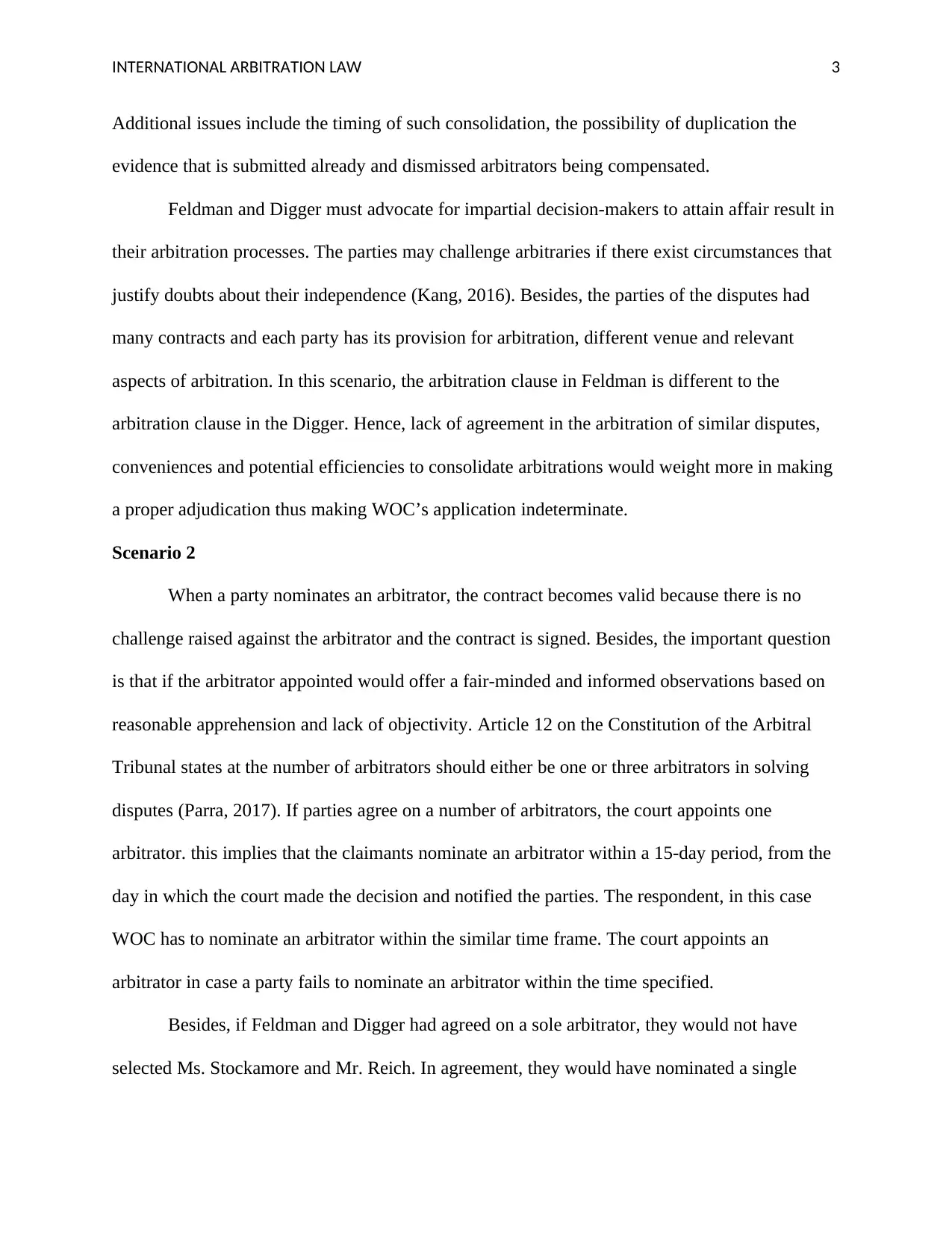
International Arbitration Law
Scenario 1
Consolidation of disputes is a procedural approach that allows for two or more claims to
be combined in one procedure that concerns the related disputes and parties. In this scenario, all
the parties involved must first express their consent to consolidate arbitrations according to the
case in Stolt-Nielsen S.A V. AnimalFeeds International Corp, U.S. (2010) (Stolt-Nielsen SA v.
AnimalFeeds International, 2010). Besides, when looking into the arbitration contract, it did not
grant the authority for the concerned panel to consolidate the arbitrations. According to Ohio
Law (R.C.2712.52), there must be a proof of undisputed consent to consolidate arbitrations as
well as the petition that the court fills to have separate arbitration claims (CHAMPION
CHRYSLER v. DIMENSION SERVICE, 2010). Hence, the court handles the consolidation
question.
Moreover, Feldman’s and Digger can present their arguments concerning WOC’s
application to consolidate the arbitrations by focusing on the lack of efficiency that the process
may subject them to. For instance, application of associated costs and arbitration fees which
might inconvenience them, non-included in the appetent of the arbitral tribunal, lack of their
consent and potential infringements of their rights in some way. An individual disputant, in this
case, Feldman or Digger, would acquire a more efficient arbitration if handle as a single case
(Haller & Keilmann, 2018). Unlike a consolidation arbitration that would involve indirect claims
in which its determination would take longer and might be more expensive. A bilateral dispute
resolution would be less expensive because it involves one respondent and one claimant.
Document Page
INTERNATIONAL ARBITRATION LAW 3
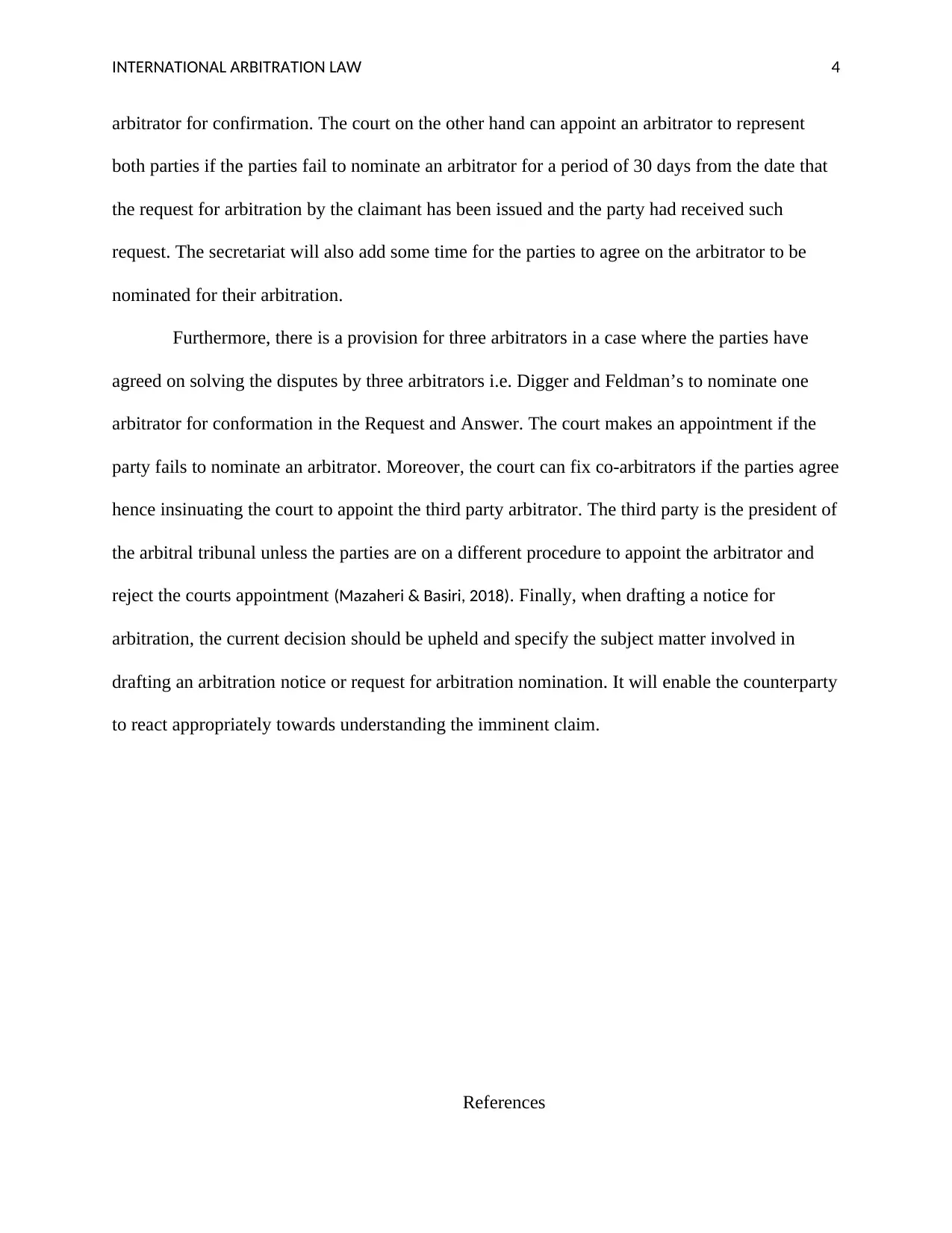
Additional issues include the timing of such consolidation, the possibility of duplication the
evidence that is submitted already and dismissed arbitrators being compensated.
Feldman and Digger must advocate for impartial decision-makers to attain affair result in
their arbitration processes. The parties may challenge arbitraries if there exist circumstances that
justify doubts about their independence (Kang, 2016). Besides, the parties of the disputes had
many contracts and each party has its provision for arbitration, different venue and relevant
aspects of arbitration. In this scenario, the arbitration clause in Feldman is different to the
arbitration clause in the Digger. Hence, lack of agreement in the arbitration of similar disputes,
conveniences and potential efficiencies to consolidate arbitrations would weight more in making
a proper adjudication thus making WOC’s application indeterminate.
Scenario 2
When a party nominates an arbitrator, the contract becomes valid because there is no
challenge raised against the arbitrator and the contract is signed. Besides, the important question
is that if the arbitrator appointed would offer a fair-minded and informed observations based on
reasonable apprehension and lack of objectivity. Article 12 on the Constitution of the Arbitral
Tribunal states at the number of arbitrators should either be one or three arbitrators in solving
disputes (Parra, 2017). If parties agree on a number of arbitrators, the court appoints one
arbitrator. this implies that the claimants nominate an arbitrator within a 15-day period, from the
day in which the court made the decision and notified the parties. The respondent, in this case
WOC has to nominate an arbitrator within the similar time frame. The court appoints an
arbitrator in case a party fails to nominate an arbitrator within the time specified.
Besides, if Feldman and Digger had agreed on a sole arbitrator, they would not have
selected Ms. Stockamore and Mr. Reich. In agreement, they would have nominated a single
Document Page
INTERNATIONAL ARBITRATION LAW 4
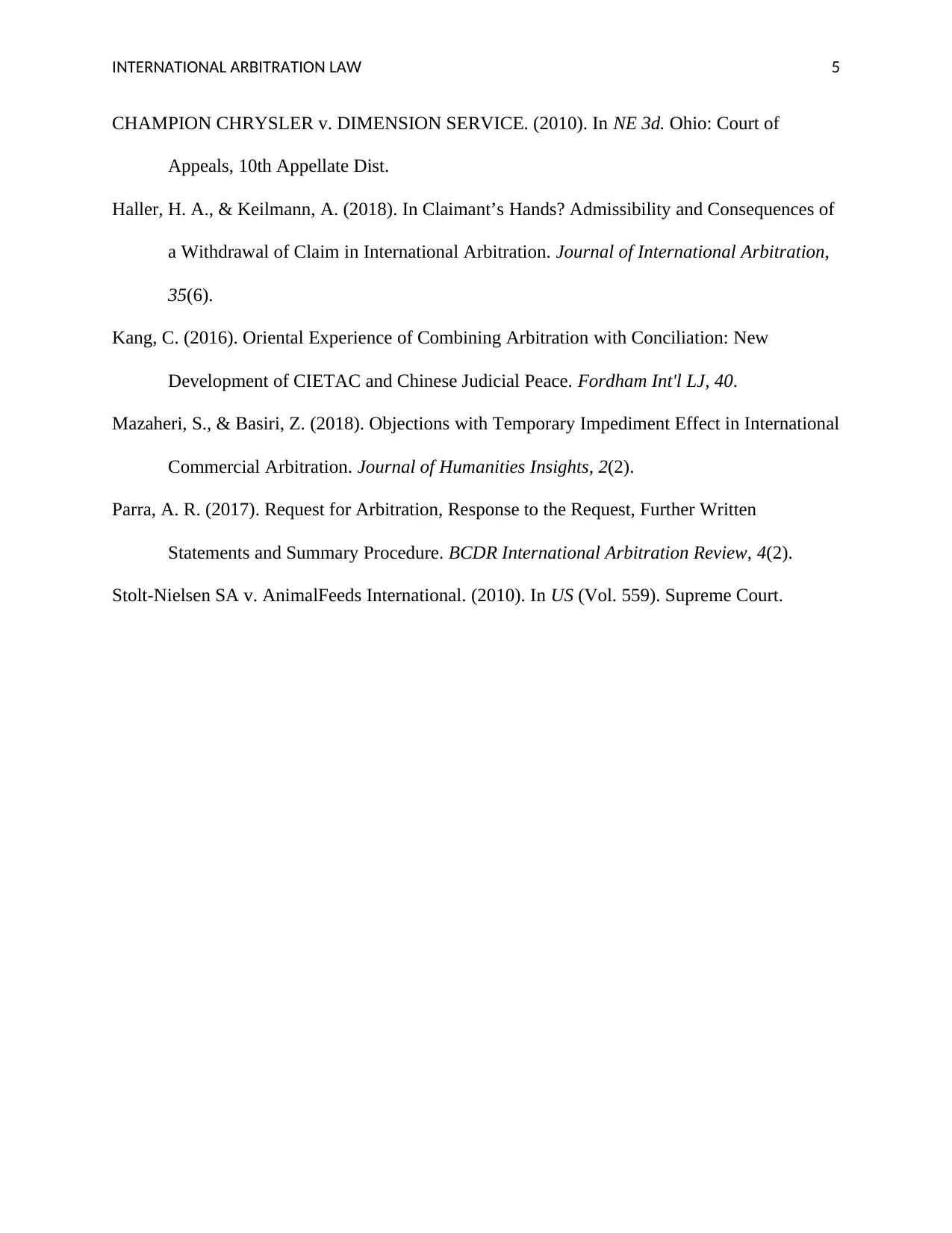
arbitrator for confirmation. The court on the other hand can appoint an arbitrator to represent
both parties if the parties fail to nominate an arbitrator for a period of 30 days from the date that
the request for arbitration by the claimant has been issued and the party had received such
request. The secretariat will also add some time for the parties to agree on the arbitrator to be
nominated for their arbitration.
Furthermore, there is a provision for three arbitrators in a case where the parties have
agreed on solving the disputes by three arbitrators i.e. Digger and Feldman’s to nominate one
arbitrator for conformation in the Request and Answer. The court makes an appointment if the
party fails to nominate an arbitrator. Moreover, the court can fix co-arbitrators if the parties agree
hence insinuating the court to appoint the third party arbitrator. The third party is the president of
the arbitral tribunal unless the parties are on a different procedure to appoint the arbitrator and
reject the courts appointment (Mazaheri & Basiri, 2018). Finally, when drafting a notice for
arbitration, the current decision should be upheld and specify the subject matter involved in
drafting an arbitration notice or request for arbitration nomination. It will enable the counterparty
to react appropriately towards understanding the imminent claim.
References
tabler-icon-diamond-filled.svg

Paraphrase This Document

Need a fresh take? Get an instant paraphrase of this document with our AI Paraphraser
Document Page
INTERNATIONAL ARBITRATION LAW 5
CHAMPION CHRYSLER v. DIMENSION SERVICE. (2010). In NE 3d. Ohio: Court of
Appeals, 10th Appellate Dist.
Haller, H. A., & Keilmann, A. (2018). In Claimant’s Hands? Admissibility and Consequences of
a Withdrawal of Claim in International Arbitration. Journal of International Arbitration,
35(6).
Kang, C. (2016). Oriental Experience of Combining Arbitration with Conciliation: New
Development of CIETAC and Chinese Judicial Peace. Fordham Int'l LJ, 40.
Mazaheri, S., & Basiri, Z. (2018). Objections with Temporary Impediment Effect in International
Commercial Arbitration. Journal of Humanities Insights, 2(2).
Parra, A. R. (2017). Request for Arbitration, Response to the Request, Further Written
Statements and Summary Procedure. BCDR International Arbitration Review, 4(2).
Stolt-Nielsen SA v. AnimalFeeds International. (2010). In US (Vol. 559). Supreme Court.
chevron_up_icon
1 out of 5
circle_padding
hide_on_mobile
zoom_out_icon
[object Object]