International Business: Essays on Culture, Trade Agreements, and FDI
VerifiedAdded on 2023/01/18
|19
|4520
|65
Essay
AI Summary
This assignment comprises three essays that delve into key aspects of international business. The first essay examines the impact of business culture, contrasting individualistic and collectivistic characteristics and offering insights for New Zealand business managers interacting with Chinese counterparts. The second essay focuses on Free Trade Agreements (FTAs), assessing the advantages and disadvantages for New Zealand in its FTA with China, and suggesting necessary improvements. The third essay analyzes Foreign Direct Investment (FDI), exploring the global money and capital market, evaluating New Zealand's FDI policy, and proposing required changes. The assignment incorporates figures and references to support the analysis, providing a comprehensive overview of international business practices and challenges.

International Business
1
1

Paraphrase This Document
Need a fresh take? Get an instant paraphrase of this document with our AI Paraphraser
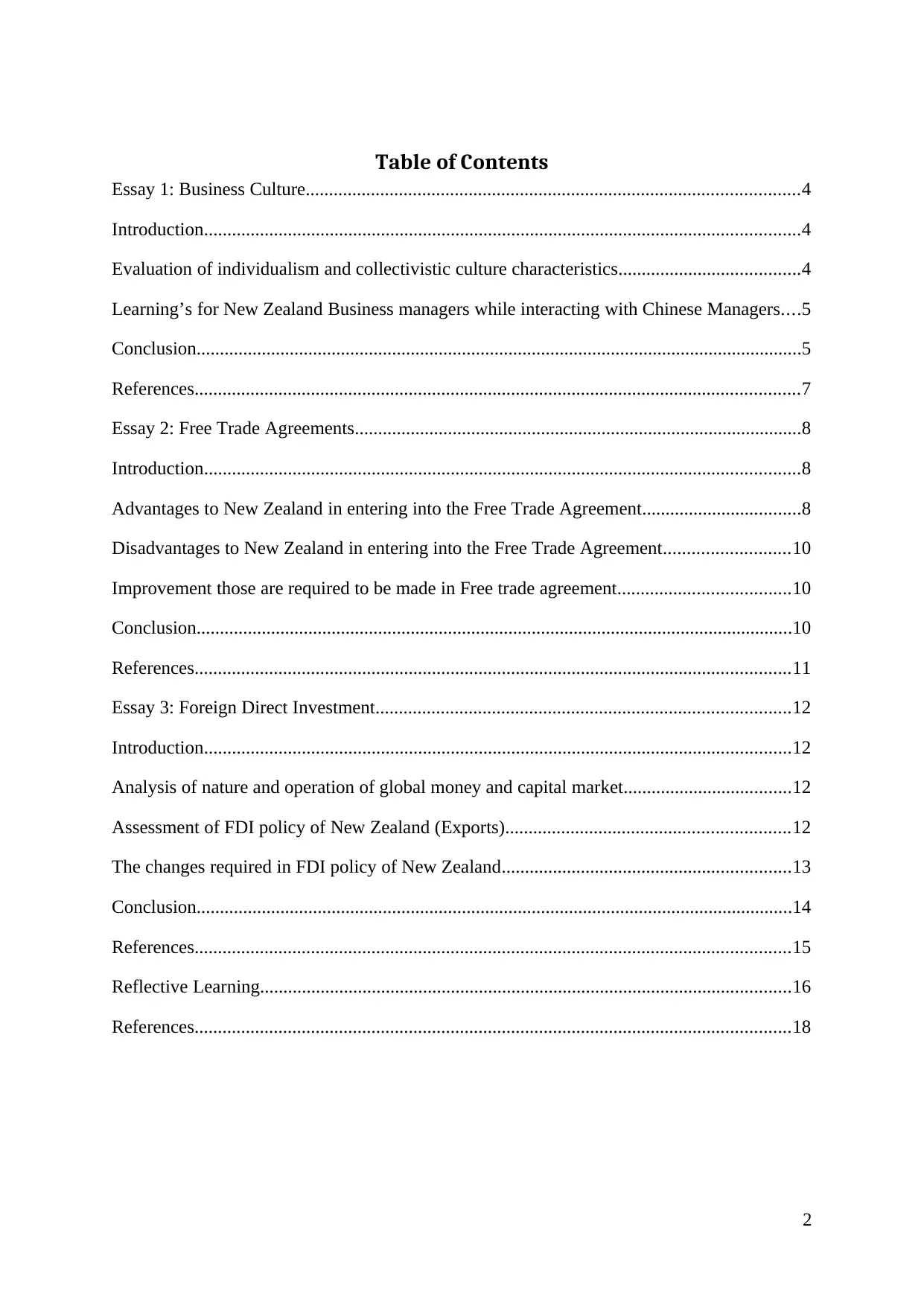
Table of Contents
Essay 1: Business Culture..........................................................................................................4
Introduction................................................................................................................................4
Evaluation of individualism and collectivistic culture characteristics.......................................4
Learning’s for New Zealand Business managers while interacting with Chinese Managers....5
Conclusion..................................................................................................................................5
References..................................................................................................................................7
Essay 2: Free Trade Agreements................................................................................................8
Introduction................................................................................................................................8
Advantages to New Zealand in entering into the Free Trade Agreement..................................8
Disadvantages to New Zealand in entering into the Free Trade Agreement...........................10
Improvement those are required to be made in Free trade agreement.....................................10
Conclusion................................................................................................................................10
References................................................................................................................................11
Essay 3: Foreign Direct Investment.........................................................................................12
Introduction..............................................................................................................................12
Analysis of nature and operation of global money and capital market....................................12
Assessment of FDI policy of New Zealand (Exports).............................................................12
The changes required in FDI policy of New Zealand..............................................................13
Conclusion................................................................................................................................14
References................................................................................................................................15
Reflective Learning..................................................................................................................16
References................................................................................................................................18
2
Essay 1: Business Culture..........................................................................................................4
Introduction................................................................................................................................4
Evaluation of individualism and collectivistic culture characteristics.......................................4
Learning’s for New Zealand Business managers while interacting with Chinese Managers....5
Conclusion..................................................................................................................................5
References..................................................................................................................................7
Essay 2: Free Trade Agreements................................................................................................8
Introduction................................................................................................................................8
Advantages to New Zealand in entering into the Free Trade Agreement..................................8
Disadvantages to New Zealand in entering into the Free Trade Agreement...........................10
Improvement those are required to be made in Free trade agreement.....................................10
Conclusion................................................................................................................................10
References................................................................................................................................11
Essay 3: Foreign Direct Investment.........................................................................................12
Introduction..............................................................................................................................12
Analysis of nature and operation of global money and capital market....................................12
Assessment of FDI policy of New Zealand (Exports).............................................................12
The changes required in FDI policy of New Zealand..............................................................13
Conclusion................................................................................................................................14
References................................................................................................................................15
Reflective Learning..................................................................................................................16
References................................................................................................................................18
2

Table of Figures
Figure 1: Graph representing reducing duties on New Zealand Exports to China under FTA..9
Figure 2: Analysis of trend of New Zealand's Foreign Direct Investment..............................13
3
Figure 1: Graph representing reducing duties on New Zealand Exports to China under FTA..9
Figure 2: Analysis of trend of New Zealand's Foreign Direct Investment..............................13
3
⊘ This is a preview!⊘
Do you want full access?
Subscribe today to unlock all pages.

Trusted by 1+ million students worldwide
Essay 1: Business Culture
Introduction
Business culture can be referred as key variant which has significan impact on each business
operaion. Consequently, trading with worldwide complexities as well as cultural sensitivity
that is concerned while conducting business in the popular countries has been growing in
significant manner. The fact that culture varies across the nation cannot be changed. Culture
comprises knowledge about techniques, food and dress culture, state of mind, principles,
language, symbols, socio-political and financial performance, native technique of making
decisions and implementing power, technique of manufacture as well as economic
connections etc. Thus, it is appropriate to state that it covers all the aspects of life.
Evaluation of individualism and collectivistic culture characteristics
Individualistic set next to its opposite communism that describes the level to which
individuals are tending toward outstanding in groups. The specified culture assists in
developing the contractual relations that rotate around the basics of exchange. Such kind of
cultures are connected with the computation of profit and loss proceeding towards meeting in
behaviour (Armstrong, and Li, 2017).
The people relating to individualistic cultture are connected with the different group that
barely have an impact on their lives. In specified culture individuals emphasizes on the
horizontal connections for example: connection among the spouse rather than the vertical
connections like connection between children and parent. The ideas on which they believe are
unique (Arpaci, 2019)
On the other hand in Collectivistic culture individual or organization behaves according to
the social norms that are recognised for upholding of social agreement between the groups
members. The organizations allow wider communal with observance to inference of their
performance. Further, contribution of resources and willingness to renounce individual
interest maintains in mind the communal interest (Kim, 2017). Further decision is made
considering the impact of same on some groups like friends and family (Kiani, Laroche, and
Paulin, 2016).
4
Introduction
Business culture can be referred as key variant which has significan impact on each business
operaion. Consequently, trading with worldwide complexities as well as cultural sensitivity
that is concerned while conducting business in the popular countries has been growing in
significant manner. The fact that culture varies across the nation cannot be changed. Culture
comprises knowledge about techniques, food and dress culture, state of mind, principles,
language, symbols, socio-political and financial performance, native technique of making
decisions and implementing power, technique of manufacture as well as economic
connections etc. Thus, it is appropriate to state that it covers all the aspects of life.
Evaluation of individualism and collectivistic culture characteristics
Individualistic set next to its opposite communism that describes the level to which
individuals are tending toward outstanding in groups. The specified culture assists in
developing the contractual relations that rotate around the basics of exchange. Such kind of
cultures are connected with the computation of profit and loss proceeding towards meeting in
behaviour (Armstrong, and Li, 2017).
The people relating to individualistic cultture are connected with the different group that
barely have an impact on their lives. In specified culture individuals emphasizes on the
horizontal connections for example: connection among the spouse rather than the vertical
connections like connection between children and parent. The ideas on which they believe are
unique (Arpaci, 2019)
On the other hand in Collectivistic culture individual or organization behaves according to
the social norms that are recognised for upholding of social agreement between the groups
members. The organizations allow wider communal with observance to inference of their
performance. Further, contribution of resources and willingness to renounce individual
interest maintains in mind the communal interest (Kim, 2017). Further decision is made
considering the impact of same on some groups like friends and family (Kiani, Laroche, and
Paulin, 2016).
4
Paraphrase This Document
Need a fresh take? Get an instant paraphrase of this document with our AI Paraphraser
Learning’s for New Zealand Business managers while interacting with
Chinese Managers
The traditional Chinese culture depends upon the varied and challenging viewpoints that rely
on Taoism, Legalism, Confucianism and Buddhism and various less popular civilizations.
Though Confucianism has a great impact on the Chinese cultural values. However an
important belief with such value system is it’s majorly concentrate on social order in which
all the person might be aware of his/her position in the civilization. Approaches of Chinese
tradition work more significantly than leisure as it provide emphasis on family’s happiness
in-stead of opposing with it. One more significant Chinese cultural value shimmering the
Confucianism viewpoint is the principal of “guanxi” which means “good connection” within
group or organization (Luo, Shi, and Venkatesh, 2018).
Thus, executives of New Zealand organization are required to be aware that their decision of
firing individuals will be difficult as the employment agreements are quite long. Legal system
of cChina should also be considered by the mangers because it is weak and not consistent,
thus it might create complexities for business operation. Legal resources are dominated by the
personal connections and mutual trust (Song, Moon, Chen, and Houston, 2018).
If strong relationship and trust is developed within the employees than Managers will be
effectual in executing their decisions. It can only happen when associates are allowed to take
part in the process of decision making. Thus, it is necessary for New Zealand manager to
develop internal control as well as positive environment in the organization in order to create
a strong bond between employees and management. Further, it is necessary that due to
change in cultural values throughout the participatory managerial process executives should
be careful and not take an obvious “yes” to be the definite answer from a worker (Thomas,
and Peterson, 2017). Another reason behind same is that the specified practice will increase
troubles, make things complicated (Triandis, 2018).
Conclusion
It can be concluded from above analysis that management decisions are highly affected by
culture. Further, decisions that are taken are based on the nation’s traditional culture
generates combined pattern (from perspective of organization as well as managemetn) for it
are more sustainable as well as acceptable. On the other hand culture based value systems
highly influence the perceptions of every decision maker or understanding of the conditions
5
Chinese Managers
The traditional Chinese culture depends upon the varied and challenging viewpoints that rely
on Taoism, Legalism, Confucianism and Buddhism and various less popular civilizations.
Though Confucianism has a great impact on the Chinese cultural values. However an
important belief with such value system is it’s majorly concentrate on social order in which
all the person might be aware of his/her position in the civilization. Approaches of Chinese
tradition work more significantly than leisure as it provide emphasis on family’s happiness
in-stead of opposing with it. One more significant Chinese cultural value shimmering the
Confucianism viewpoint is the principal of “guanxi” which means “good connection” within
group or organization (Luo, Shi, and Venkatesh, 2018).
Thus, executives of New Zealand organization are required to be aware that their decision of
firing individuals will be difficult as the employment agreements are quite long. Legal system
of cChina should also be considered by the mangers because it is weak and not consistent,
thus it might create complexities for business operation. Legal resources are dominated by the
personal connections and mutual trust (Song, Moon, Chen, and Houston, 2018).
If strong relationship and trust is developed within the employees than Managers will be
effectual in executing their decisions. It can only happen when associates are allowed to take
part in the process of decision making. Thus, it is necessary for New Zealand manager to
develop internal control as well as positive environment in the organization in order to create
a strong bond between employees and management. Further, it is necessary that due to
change in cultural values throughout the participatory managerial process executives should
be careful and not take an obvious “yes” to be the definite answer from a worker (Thomas,
and Peterson, 2017). Another reason behind same is that the specified practice will increase
troubles, make things complicated (Triandis, 2018).
Conclusion
It can be concluded from above analysis that management decisions are highly affected by
culture. Further, decisions that are taken are based on the nation’s traditional culture
generates combined pattern (from perspective of organization as well as managemetn) for it
are more sustainable as well as acceptable. On the other hand culture based value systems
highly influence the perceptions of every decision maker or understanding of the conditions
5

or situations which is to be dealt by management. Consequently it can be said that it is very
important for the worldwide executives to understand the power of culture on decision-
making styles and procedures in order to sustain in new environment for longer period.
6
important for the worldwide executives to understand the power of culture on decision-
making styles and procedures in order to sustain in new environment for longer period.
6
⊘ This is a preview!⊘
Do you want full access?
Subscribe today to unlock all pages.
Trusted by 1+ million students worldwide
References
Armstrong, S. J., & Li, Y. (2017). A Study of Anglo Expatriate Managers’ Learning,
Knowledge Acquisition, and Adjustment in Multinational Companies in China. Academy
of Management Learning & Education, 16(1), 1-22.
Arpaci, I. (2019). Culture and nomophobia: The role of vertical versus horizontal
collectivism in predicting nomophobia. Information Development, 35(1), 96-106.
Kiani, I., Laroche, M., & Paulin, M. (2016). Development of market Mavenism traits:
Antecedents and moderating effects of culture, gender, and personal beliefs. Journal of
Business Research, 69(3), 1120-1129.
Kim, M. S. (2017). Culture‐Based Conversational Constraints Theory. The International
Encyclopedia of Intercultural Communication, 1(1). 1-10.
Luo, W., Shi, Y., & Venkatesh, V. G. (2018). Exploring the factors of achieving supply chain
excellence: a New Zealand perspective. Production Planning & Control, 29(8), 655-667.
Song, R., Moon, S., Chen, H. A., & Houston, M. B. (2018). When marketing strategy meets
culture: The role of culture in product evaluations. Journal of the Academy of Marketing
Science, 46(3), 384-402.
Thomas, D. C., & Peterson, M. F. (2017). Cross-cultural management: Essential concepts.
Sage Publications.
Triandis, H. C. (2018). Individualism and collectivism. Routledge.
Wang, D., Fan, D., Freeman, S., & Zhu, C. J. (2017). Exploring cross-cultural skills for
expatriate managers from Chinese multinationals: Congruence and contextualization. Asia
Pacific Journal of Management, 34(1), 123-146.
7
Armstrong, S. J., & Li, Y. (2017). A Study of Anglo Expatriate Managers’ Learning,
Knowledge Acquisition, and Adjustment in Multinational Companies in China. Academy
of Management Learning & Education, 16(1), 1-22.
Arpaci, I. (2019). Culture and nomophobia: The role of vertical versus horizontal
collectivism in predicting nomophobia. Information Development, 35(1), 96-106.
Kiani, I., Laroche, M., & Paulin, M. (2016). Development of market Mavenism traits:
Antecedents and moderating effects of culture, gender, and personal beliefs. Journal of
Business Research, 69(3), 1120-1129.
Kim, M. S. (2017). Culture‐Based Conversational Constraints Theory. The International
Encyclopedia of Intercultural Communication, 1(1). 1-10.
Luo, W., Shi, Y., & Venkatesh, V. G. (2018). Exploring the factors of achieving supply chain
excellence: a New Zealand perspective. Production Planning & Control, 29(8), 655-667.
Song, R., Moon, S., Chen, H. A., & Houston, M. B. (2018). When marketing strategy meets
culture: The role of culture in product evaluations. Journal of the Academy of Marketing
Science, 46(3), 384-402.
Thomas, D. C., & Peterson, M. F. (2017). Cross-cultural management: Essential concepts.
Sage Publications.
Triandis, H. C. (2018). Individualism and collectivism. Routledge.
Wang, D., Fan, D., Freeman, S., & Zhu, C. J. (2017). Exploring cross-cultural skills for
expatriate managers from Chinese multinationals: Congruence and contextualization. Asia
Pacific Journal of Management, 34(1), 123-146.
7
Paraphrase This Document
Need a fresh take? Get an instant paraphrase of this document with our AI Paraphraser
Essay 2: Free Trade Agreements
Introduction
The framework of FTA (Free Trade Agreement) provides solution relating to trade and
investment issues which might arise in future. In the year 2005, in Beijing, China and New
Zealand signed a Free trade Agreement. The fact cannot be denied that support of the treaties
have provided widespread inerest of policies to New Zealand and provided economic
integration within Asia- Pacific areas and other multilateral agreement. Present study
emphasizes on assessment of benefits and drawbacks of Free Trade Agreement held between
China and New Zealand. Further, emphasis has been also made on the required changes in
agreement in order to assess the manner in which economy could be positively affected at
global level.
Benefits to New Zealand while the Free Trade Agreement came into effect
A significant benefit will be attained by New Zealand relating to tariffs as approximately 96
percent of current exports are to China and due to s FTA, there will be an total savings on an
yealy basis i.e. NZ$115.5 million on the basis of current trade figures. China is counted as
fourth largest individual state destination for exports. Thus after implementation of provisions
of FTA, the duty expenses relating to exporting goods was averaged NZ$118.5 million yearly
(Bolle, 2016). But through eliminating the tariff benefits are provided to the exporters.
Moreover the direct elimination of tariffs which was over NZ$200 million of current exports
comprising different types of scrap metal, fish meal, fibreboard, iron slag and cooking coal
will assist economy in attaining higher growth
8
Introduction
The framework of FTA (Free Trade Agreement) provides solution relating to trade and
investment issues which might arise in future. In the year 2005, in Beijing, China and New
Zealand signed a Free trade Agreement. The fact cannot be denied that support of the treaties
have provided widespread inerest of policies to New Zealand and provided economic
integration within Asia- Pacific areas and other multilateral agreement. Present study
emphasizes on assessment of benefits and drawbacks of Free Trade Agreement held between
China and New Zealand. Further, emphasis has been also made on the required changes in
agreement in order to assess the manner in which economy could be positively affected at
global level.
Benefits to New Zealand while the Free Trade Agreement came into effect
A significant benefit will be attained by New Zealand relating to tariffs as approximately 96
percent of current exports are to China and due to s FTA, there will be an total savings on an
yealy basis i.e. NZ$115.5 million on the basis of current trade figures. China is counted as
fourth largest individual state destination for exports. Thus after implementation of provisions
of FTA, the duty expenses relating to exporting goods was averaged NZ$118.5 million yearly
(Bolle, 2016). But through eliminating the tariff benefits are provided to the exporters.
Moreover the direct elimination of tariffs which was over NZ$200 million of current exports
comprising different types of scrap metal, fish meal, fibreboard, iron slag and cooking coal
will assist economy in attaining higher growth
8
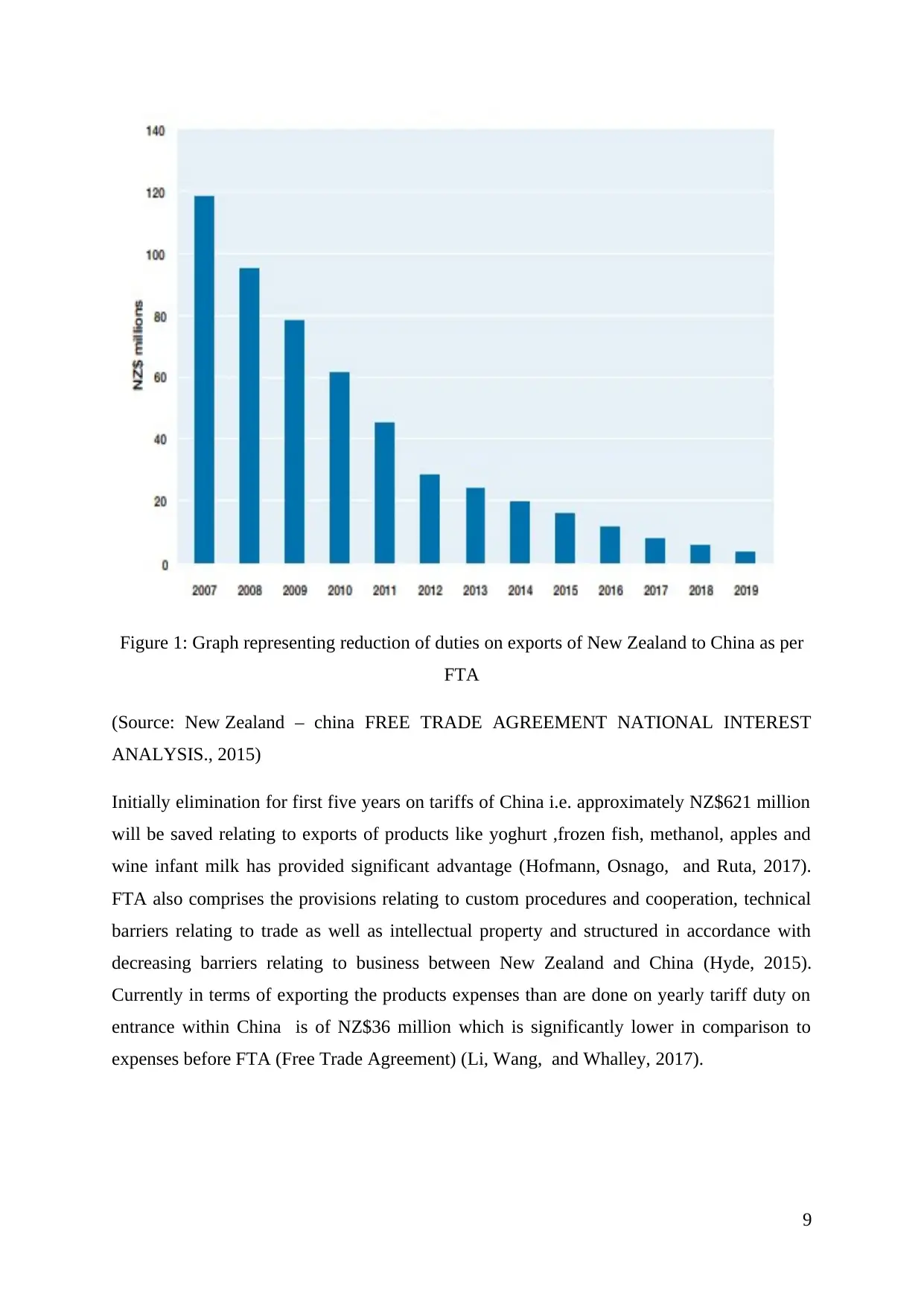
Figure 1: Graph representing reduction of duties on exports of New Zealand to China as per
FTA
(Source: New Zealand – china FREE TRADE AGREEMENT NATIONAL INTEREST
ANALYSIS., 2015)
Initially elimination for first five years on tariffs of China i.e. approximately NZ$621 million
will be saved relating to exports of products like yoghurt ,frozen fish, methanol, apples and
wine infant milk has provided significant advantage (Hofmann, Osnago, and Ruta, 2017).
FTA also comprises the provisions relating to custom procedures and cooperation, technical
barriers relating to trade as well as intellectual property and structured in accordance with
decreasing barriers relating to business between New Zealand and China (Hyde, 2015).
Currently in terms of exporting the products expenses than are done on yearly tariff duty on
entrance within China is of NZ$36 million which is significantly lower in comparison to
expenses before FTA (Free Trade Agreement) (Li, Wang, and Whalley, 2017).
9
FTA
(Source: New Zealand – china FREE TRADE AGREEMENT NATIONAL INTEREST
ANALYSIS., 2015)
Initially elimination for first five years on tariffs of China i.e. approximately NZ$621 million
will be saved relating to exports of products like yoghurt ,frozen fish, methanol, apples and
wine infant milk has provided significant advantage (Hofmann, Osnago, and Ruta, 2017).
FTA also comprises the provisions relating to custom procedures and cooperation, technical
barriers relating to trade as well as intellectual property and structured in accordance with
decreasing barriers relating to business between New Zealand and China (Hyde, 2015).
Currently in terms of exporting the products expenses than are done on yearly tariff duty on
entrance within China is of NZ$36 million which is significantly lower in comparison to
expenses before FTA (Free Trade Agreement) (Li, Wang, and Whalley, 2017).
9
⊘ This is a preview!⊘
Do you want full access?
Subscribe today to unlock all pages.
Trusted by 1+ million students worldwide
Drawbacks of Free Trade Agreement to New Zealand
Most determined results are expected from New Zealand exports in the areas like: dairy
products which are considered sensitive by China. As, the tariff liberalization provided by
FTA will not be applied on products which comprise paper and wood products thus tariffs
will be payable in same manner as prior to FTA. Thus, the disadvantage is that no saving in
tariffs will be attained in above specified products. The sensible results of mid term
evaluation and the individual preserved mechanism is as well predictable to be imperfect
(Swinbank, 2017).
Even the existence of bilateral safeguards mechanism would lead to application of additional
duties on New Zealand in case loss has been suffered by Chinese industry. Though, the
impact of this mechanism is limited due to small-scale of New Zealand Export in comparison
to the production of China. The extraordinary defend is a provisional mechanism, that is
obtainable for China throughout the time period when there was eradciation of tariffs (Van
Hoa and Harvie, 2016 ).
Improvement those are required to be made in Free trade agreement
Minor legislative and regulatory revision is required for the alignment of the New Zealand’s
local legal rules along with requirements and right developed by FTA. The sepecifed revision
is required for permitting New Zealand to modify the terms of FTA in order to attain higher
rate of growth by economy. Further, revision in Fair Trading Act 1986 is also required in
order to extend application relating to misleading and deceptive conducts regarding the
external New Zealand’s goods and services when it it is required to fulfill the obligations as
per global agreement. These improvements will eventually affect trade liberalization on
economic growth which can be specified as static effects.
Conclusion
It can be concluded from above study that provisions relating to Free Trade Agreement will
significantly affect areas such as trade and investment as well as consumer protection. Further
negative impact has been assessed on false and deceptive trade which eventually leads to
provide reduction in transaction cost of merchandise trade which comprises harmonization
and reorganization of correspondence of other party’s technical regulations.
10
Most determined results are expected from New Zealand exports in the areas like: dairy
products which are considered sensitive by China. As, the tariff liberalization provided by
FTA will not be applied on products which comprise paper and wood products thus tariffs
will be payable in same manner as prior to FTA. Thus, the disadvantage is that no saving in
tariffs will be attained in above specified products. The sensible results of mid term
evaluation and the individual preserved mechanism is as well predictable to be imperfect
(Swinbank, 2017).
Even the existence of bilateral safeguards mechanism would lead to application of additional
duties on New Zealand in case loss has been suffered by Chinese industry. Though, the
impact of this mechanism is limited due to small-scale of New Zealand Export in comparison
to the production of China. The extraordinary defend is a provisional mechanism, that is
obtainable for China throughout the time period when there was eradciation of tariffs (Van
Hoa and Harvie, 2016 ).
Improvement those are required to be made in Free trade agreement
Minor legislative and regulatory revision is required for the alignment of the New Zealand’s
local legal rules along with requirements and right developed by FTA. The sepecifed revision
is required for permitting New Zealand to modify the terms of FTA in order to attain higher
rate of growth by economy. Further, revision in Fair Trading Act 1986 is also required in
order to extend application relating to misleading and deceptive conducts regarding the
external New Zealand’s goods and services when it it is required to fulfill the obligations as
per global agreement. These improvements will eventually affect trade liberalization on
economic growth which can be specified as static effects.
Conclusion
It can be concluded from above study that provisions relating to Free Trade Agreement will
significantly affect areas such as trade and investment as well as consumer protection. Further
negative impact has been assessed on false and deceptive trade which eventually leads to
provide reduction in transaction cost of merchandise trade which comprises harmonization
and reorganization of correspondence of other party’s technical regulations.
10
Paraphrase This Document
Need a fresh take? Get an instant paraphrase of this document with our AI Paraphraser
References
Bolle, M. J. (2016). Overview of labor enforcement issues in free trade agreements.
Routledge.
Hofmann, C., Osnago, A., & Ruta, M. (2017). Horizontal depth: a new database on the
content of preferential trade agreements. The World Bank.
Hyde, M. (2015). Key agricultural outcomes of recent free trade agreements. Agricultural
Commodities, 5(1), 23.
Li, C., Wang, J., & Whalley, J. (2017). China’s regional and bilateral trade agreements.
In THE ECONOMIES OF CHINA AND INDIA Cooperation and Conflict: Volume 1:
China and India—The International Context and Economic Growth, Manufacturing
Performance and Rural Development (pp. 175-194).
New Zealand – china FREE TRADE AGREEMENT NATIONAL INTEREST ANALYSIS.
(2015). Retreived through <https://www.mfat.govt.nz/assets/FTAs-agreements-in-
force/China-FTA/National-interest-analysis.pdf>
Swinbank, A. (2017). World trade rules and the policy options for British agriculture post-
Brexit. Briefing paper, 7(1), 12.
Van Hoa, T., & Harvie, C. (Eds.). (2016). New Asian regionalism: responses to globalisation
and crises. Springer.
11
Bolle, M. J. (2016). Overview of labor enforcement issues in free trade agreements.
Routledge.
Hofmann, C., Osnago, A., & Ruta, M. (2017). Horizontal depth: a new database on the
content of preferential trade agreements. The World Bank.
Hyde, M. (2015). Key agricultural outcomes of recent free trade agreements. Agricultural
Commodities, 5(1), 23.
Li, C., Wang, J., & Whalley, J. (2017). China’s regional and bilateral trade agreements.
In THE ECONOMIES OF CHINA AND INDIA Cooperation and Conflict: Volume 1:
China and India—The International Context and Economic Growth, Manufacturing
Performance and Rural Development (pp. 175-194).
New Zealand – china FREE TRADE AGREEMENT NATIONAL INTEREST ANALYSIS.
(2015). Retreived through <https://www.mfat.govt.nz/assets/FTAs-agreements-in-
force/China-FTA/National-interest-analysis.pdf>
Swinbank, A. (2017). World trade rules and the policy options for British agriculture post-
Brexit. Briefing paper, 7(1), 12.
Van Hoa, T., & Harvie, C. (Eds.). (2016). New Asian regionalism: responses to globalisation
and crises. Springer.
11
Essay 3: Foreign Direct Investment
Introduction
Capital market is the market in which selling and purchasing of equity instruments and long
terms debts is facilitated. Investors those are looking to lift up long-term capital balance the
intermediation activities that are complemented by different financial institutions as well as
banks. New Zealand Foreign Direct Investment has received FDI inflows of USD 3.57 billion
in comparison to the level which was attained in year 2016i.e. equal to increase of 22.7 % .
The main reason behind same is New Zealand’s FDI stock relation to GDP which is
practically double in comparison to other countries such as Australia and Canada. As the
economy of New Zealand comprises open and business friendly economy, adequate
protection of property rights, political stability etc. Present essay emphasizes on Foreign
Direct Investment policy of New Zealand along with examination of capital market as well as
international money in terms fo their operations and nature (Barker, 2017).
Analysis of capital market as well as international money in terms fo their
operations and nature
Major domestic retail investors are contributing straightly towards the stock market of New
Zealand and it has been accessed that they are increasing over time. It assists in improving
the worldwide interest and market liquidity. In case where this tendency is continued than
lots of firms will be encourage to openly record as an option to private equity as well as bank.
Growth of domestic equity market can also be supported by the development of Kiwi Saver
funds (De Mooij, 2018).
Under the financial markets conduct, FMA Act 2013 has issued its first equity crowd funding
licenses in July. Crowd funding is an innovative technique for raising the capital by the small
firms. In the early stage of growth and investors service providers play a role of an
intermediary within the company. By the means of crowd funding securities are issued by the
firms moreover it needs less disclosures in compare to the companies those are listed on the
registered exchange, NXZ (Enderwick, 2017).
12
Introduction
Capital market is the market in which selling and purchasing of equity instruments and long
terms debts is facilitated. Investors those are looking to lift up long-term capital balance the
intermediation activities that are complemented by different financial institutions as well as
banks. New Zealand Foreign Direct Investment has received FDI inflows of USD 3.57 billion
in comparison to the level which was attained in year 2016i.e. equal to increase of 22.7 % .
The main reason behind same is New Zealand’s FDI stock relation to GDP which is
practically double in comparison to other countries such as Australia and Canada. As the
economy of New Zealand comprises open and business friendly economy, adequate
protection of property rights, political stability etc. Present essay emphasizes on Foreign
Direct Investment policy of New Zealand along with examination of capital market as well as
international money in terms fo their operations and nature (Barker, 2017).
Analysis of capital market as well as international money in terms fo their
operations and nature
Major domestic retail investors are contributing straightly towards the stock market of New
Zealand and it has been accessed that they are increasing over time. It assists in improving
the worldwide interest and market liquidity. In case where this tendency is continued than
lots of firms will be encourage to openly record as an option to private equity as well as bank.
Growth of domestic equity market can also be supported by the development of Kiwi Saver
funds (De Mooij, 2018).
Under the financial markets conduct, FMA Act 2013 has issued its first equity crowd funding
licenses in July. Crowd funding is an innovative technique for raising the capital by the small
firms. In the early stage of growth and investors service providers play a role of an
intermediary within the company. By the means of crowd funding securities are issued by the
firms moreover it needs less disclosures in compare to the companies those are listed on the
registered exchange, NXZ (Enderwick, 2017).
12
⊘ This is a preview!⊘
Do you want full access?
Subscribe today to unlock all pages.
Trusted by 1+ million students worldwide

1 out of 19


Related Documents


Your All-in-One AI-Powered Toolkit for Academic Success.
+13062052269
info@desklib.com
Available 24*7 on WhatsApp / Email
![[object Object]](/_next/static/media/star-bottom.7253800d.svg)
Unlock your academic potential
Copyright © 2020–2026 A2Z Services. All Rights Reserved. Developed and managed by ZUCOL.