International Business and Globalization: Coca-Cola Case Study

Verified

Added on  2022/08/21

|7
|1183
|9
Report
AI Summary
This report delves into the multifaceted influence of globalization on international business, using the Coca-Cola Company as a prime example. It examines the company's strategic importance in global trade, highlighting how globalization has provided competitive advantages like increased market reach and technological advancements, while also presenting challenges such as intense competition and the need for continuous innovation. The report details the role of data analytics, including Big Data and Artificial Intelligence, in managing financial data, understanding consumer preferences, and optimizing product development. Furthermore, it analyzes Coca-Cola's adoption of the Product Life Cycle theory and its export and 'One Brand' strategies for global expansion and market dominance. The analysis provides insights into the company's operations in over 200 countries and its efforts to sustain a competitive edge in a dynamic global environment. The report concludes with a summary of Coca-Cola's global strategies and provides a perspective on the future of international business in the face of globalization.
Document Page
Running head: GLOBALIZATION AND INTERNATIONAL BUSINESS
GLOBALIZATION AND INTERNATIONAL BUSINESS
Name of the Student
Name of the University
Author Note
tabler-icon-diamond-filled.svg

Paraphrase This Document

Need a fresh take? Get an instant paraphrase of this document with our AI Paraphraser
Document Page
1GLOBALIZATION AND INTERNATIONAL BUSINESS
Table of Contents
Introduction................................................................................................................................2
Discussion..................................................................................................................................2
Significance and impact of globalization and global trade:...................................................2
Role of analytics tool and strategies in globalization:...........................................................3
Theory and strategies adopted by The Coca-Cola Company:................................................4
Conclusion..................................................................................................................................5
Document Page
2GLOBALIZATION AND INTERNATIONAL BUSINESS
Introduction
The amalgamation of various potential markets through the aspect of the global economy
and proceeding towards increased interconnectedness of the national economies is known as
globalization. International businesses depict the application of business models in various
markets (Eriksen 2018). Globalization demonstrates a broader reach and universal aspect in
the global marketplace (Steger 2017). The purpose of the paper is to discuss the influence and
significance of globalization on business. The report will determine the role of analytical
tools, strategies and core theory on the international operations for the chosen organization.
The chosen organization for this report is the Coca-Cola Company.
Discussion
Significance and impact of globalization and global trade:
The Coca-Cola Company is a multinational organization, which has established itself
by growing its product range and expanding its operation in all across the globe. The strategic
importance and impact of globalization or maintaining global trade for the Coca-Cola
Company are:
The company has gained the competitive advantage of a global reach or easy
availability amongst several competitors (Coca-cola.com. 2020).
Maintenance of global trade and globalization contributed to the development of
networking, technological implications, and transportation.
Globalization has influenced communication networking by increasing the customer
base all across the globe (Coca-cola.com. 2020).
The Coca-Cola Company is operating in more than 200 countries by serving millions
of customers (Coca-colacompany.com 2020).
Document Page
3GLOBALIZATION AND INTERNATIONAL BUSINESS
Although, The Coca-Cola Company has been benefited through the implication of
globalization strategies it has also brought various challenges such as the price war
and heavy competition rate from local as well as international players.
Global Trade practices have led pressure on the product design and marketing team of
the Coca-Cola Company as it demands constant changes and innovation in the
offerings of the products (Coca-colacompany.com 2020).
Globalization satisfies one of the core values of the company, engaging the most
crucial stakeholders for effective operations management, employees as the expansion
of the niche or reach allows the company to gain increased values of profitability,
thereby indirectly influencing the employee wages.
Globalization also affects the organization negatively by presenting the challenge of
integrating various cultures in a single workplace.
Role of analytics tool and strategies in globalization:
The Cola-Cola Company utilizes the implication of a high-performing data analytics
platform for preparing, merging and assessing the data through multiple sources. The Coca-
Cola Company is majorly reliant on data analytics for managing financial data, delivery
orders and auditing efficiency (Coca-cola.com. 2020).
Big Data and Artificial Intelligence- The Coca-Cola Company was one of the few globally
operating and established companies outside the IT industry, which integrated the implication
of Big Data system for managing the heaps of data generated from serving the offerings in
more than 200 countries. Artificial Intelligence helps in the functionality of product
development, which allows the accumulation and assessment of each and every insight for
understanding customer preferences, shifting trends and changes in the market. The
application of AI technology will also be implied in the vending machines, which will stock
products depending on the weather and preference of the population in a specific location. AI
tabler-icon-diamond-filled.svg

Paraphrase This Document

Need a fresh take? Get an instant paraphrase of this document with our AI Paraphraser
Document Page
4GLOBALIZATION AND INTERNATIONAL BUSINESS
is being applied to develop authentic orange juice by assessing weather data, information of
crop yields, acidity, sweetness and satellite images for ensuring optimum production of
orange juice.
Social Data Mining- This is another tool used by The Coca-Cola Company to manage the
social media followers’ activities and data in order to create a brand image online and to build
products based on the trending ideas and tastes (Crane, Kawashima and Kawasaki 2016).
Theory and strategies adopted by The Coca-Cola Company:
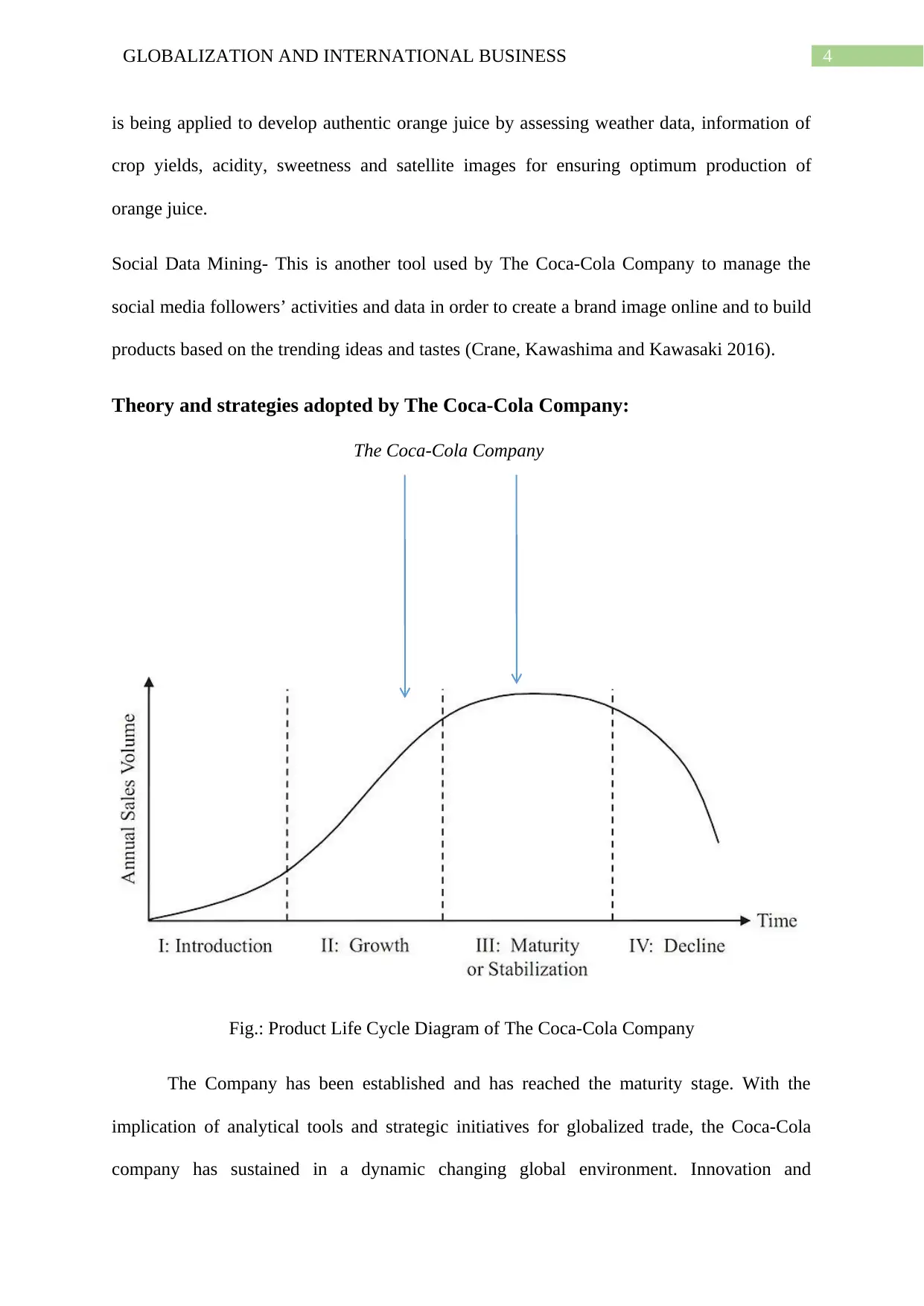
The Coca-Cola Company
Fig.: Product Life Cycle Diagram of The Coca-Cola Company
The Company has been established and has reached the maturity stage. With the
implication of analytical tools and strategic initiatives for globalized trade, the Coca-Cola
company has sustained in a dynamic changing global environment. Innovation and
Document Page
5GLOBALIZATION AND INTERNATIONAL BUSINESS
diversification is the key to maintaining its position in the leadership position. Moreover,
through a new product development strategy, the company is also maintaining its position in
an upward growth curve.
The Cola-Cola Company has adopted the Product Life-Cycle Theory. The product
life-cycle theory can explain the complete global trade production of Coca-Cola. Initially, the
company was producing products only for local and national demand. With the growing
demand in the country and internationally in association with the second, growth stage, which
represents the adoption of the product in wider markets, the U.S. based company Coca-Cola
started exporting products. With the company proceeding towards the maturity stage, the
company started experiencing reasons for establishing operations in other international
regions for responding to the increasing demand.
The Coca-Cola Company has adopted the export strategy. The rationale behind
adopting this strategy can be the expansion of profits and sales, accomplishing the economies
of scale in minimizing the cost of production and diversifying the sales offerings with respect
to sales locations. Coca-Cola adopted a direct selling medium by setting up bottling plants
(Stiglitz 2017).
Another strategy is ‘One Brand’ strategy for responding to the increasing demand of
the trademark brand. The company launched various beverage drinks, even healthy options
under the family for better coverage and need attainment.
Conclusion
Therefore, it can be concluded that Coca-Cola has expanded its operations globally
for gaining competitive advantage, maximizing profit and responding to the increasing
demand in foreign countries. The company has adopted the Product Life Cycle theory
accompanied by 'one brand' and export strategy.
Document Page
6GLOBALIZATION AND INTERNATIONAL BUSINESS
References:
Coca-cola.com. 2020. Home. [online] Available at: https://www.coca-cola.com/
Coca-colacompany.com 2020. Who We Are | The Coca-Cola Company. [online] Available at:
https://www.coca-colacompany.com/careers/who-we-are
Crane, D., Kawashima, N. and Kawasaki, K.I. eds., 2016. Global culture: Media, arts, policy,
and globalization. Routledge.
Eriksen, T.H., 2018. Globalization. In Handbook of Political Anthropology. Edward Elgar
Publishing.
Steger, M.B., 2017. Globalization: A very short introduction (Vol. 86). Oxford University
Press. The overselling of globalization. Business Economics, 52(3), pp.129-137.
chevron_up_icon
1 out of 7
circle_padding
hide_on_mobile
zoom_out_icon
[object Object]